




Abstract
When attending and participating in Higher Education, students face a multitude of personal, social, and work-related challenges, which may increase the risk of developing psychopathological symptomatology. To date, there is no instrument that grasps the non-technical skills that may help prepare students to respond to these challenges. This paper presents the development and psychometric properties of the Soft Skills Inventory (SSI). The inventory was developed based on theoretical and empirical findings on the skills associated with academic and professional success, and on students’ perception. The SSI was tested with 2030 Portuguese students (of which 77.1% were female) using a two-stage approach: item calibration and model generation (n = 1033), followed by model validation (n = 997). Item calibration analyses led to retaining 49 items that were organized into six-factors: self-determination, resilience, empathy, assertiveness, social support, and teamwork. This measurement model was further validated and proved to be an invariant, and thus credible, tool to compare male and female students on those relevant skills. All measures attained good internal consistency, with alphas ranging from .76 to .88. Female students scored significantly higher than males on self-determination, empathy, social support and teamwork. On the other hand, male students scored significantly higher on resilience. No significant differences were found between men and women for assertiveness. Psychometric analysis showed that the SSI is a reliable and valid instrument to evaluate students intra and interpersonal skills. The SSI may help identify gaps in soft skills and guide targeted interventions to support a more positive student experience in Higher Education.
Introduction
The definition of skills, and soft skills in particular, has been in continuous debate in education, psychology, and the broader social sciences. Nonetheless, the literature has found some consensus in defining skills as a set of technical, methodological, and practical knowledge that is dynamically activated and manifested in performance (Devedzic et al., 2018). Skills may be defined as the enaction of a set of knowledge and attitudes in a specific situation towards attaining specific outcomes (Ginns & Barrie, 2009; Jardim & Pereira, 2006).
In 2012, UNESCO (United Nations Educational, Scientific and Cultural Organization) published an important typology of skills comprising the following categories: foundational skills, transferable skills, and technical and vocational skills. Foundational skills are those basic skills required for the learning of any other skill (e.g., reading and writing). Transferable skills, which are generally acquired outside the school context, are useful for a successful performance in more widespread situations. Technical and vocational skills refer to technical knowledge that is specific to an activity or profession and are mainly acquired through formal education (UNESCO, 2012). While technical skills are particularly applicable to specific and predetermined contexts, both foundation and transferable skills are harder to define and assess and are applicable to a wider range of contexts (Direito et al., 2014).
The concept of transferable skills is intertwined with that of soft skills, which are defined as “personality traits, goals, motivations, and preferences that are valued in the labor market, in school, and in many other domains” (Heckman & Kautz, 2012, p. 451). Soft skills enable individuals to manage their own personal attributes, improve performance and sustain interpersonal relationships with others (Ginns & Barrie, 2009; Jardim & Pereira, 2006). These skills can promote more efficient ways of working and set individuals apart from others who may have similar technical skills and professional experience (Perreault, 2004).
Today, more than ever, employers have been looking for professionals who have the right set of skills (Washer, 2007). Considering that men are still highly more prevalent than women in professions that are associated with higher performance and achievement (Hansen et al., 2010), it could be speculated that men are more likely to present with ideal combinations of hard and soft skills. In fact, several studies found that men self-reported an overall higher level of softs skills, when compared to women (Alpay & Walsh, 2008; Whittle & Eaton, 2001). However, women seem to consider these skills as more important (Direito et al., 2018; Nabi & Bagley, 1998), and tend to work harder to acquire them (De Juan-Vigaray et al., 2012), in comparison to men. Other studies have found that men and women endorse different dimensions of self-efficacy leadership (Javidan et al., 2016), and that women score higher on specific personal skills such as team working, time management, planning/ organizing, and prioritizing skills (Nabi & Bagley, 1998). Despite possible gender differences, a balanced number of male and female collaborators is essential for collective intelligence and better professional group performance (Woolley et al., 2010).
Soft skills play an important role in young adults’ personal, social, and professional development, and may come to be determinant in their future employability and professional performance (Fallows & Steven, 2000; Washer, 2007). However, there is a notorious lack of psychometric instruments designed to assess soft skills in educational settings, though some examples should be described. Alpay and Walsh (2008) developed a skills perception inventory to evaluate the efficacy of a soft skills training initiative. The inventory was composed by 33 items that were grouped into four scales addressing specific training contents: group work, communication, project planning, and management of personal awareness. Only exploratory factor analysis on each of the scales and Cronbach alpha values were used to test the psychometric properties of this instrument. Chamorro-Premuzic et al. (2010) designed a self-report inventory to assess perceptions of the importance and the development of 15 soft skills. The authors then tested the relationship between these soft skills with academic and occupational success and explored their association with individual factors (such as personality traits and cognitive ability). However, the authors did not present a comprehensive psychometric analysis of the inventory.
Alternatively, contemporary society still places great value on standardized achievement tests to sift and sort people, to evaluate schools, and to assess the performance of nations. Despite their widespread use in educational contexts, such tests do not measure soft skills adequately. Because soft skills refer to personal processes, which are not always observable unless manifested in behaviors, it is appropriate to assess them through self-report questionnaires. This assessment method allows for a subjective and personal standing on these skills, as long as the items that compose the questionnaire are developed appropriately, and its psychometric properties are thoroughly investigated.
This paper presents the developmental process and psychometric analyses of a self-report questionnaire designed to evaluate soft skills in young adults – the Soft Skills Inventory (SSI). The development process included several stages aimed at establishing face validity, understandability, and usability of the items within the targeted population. The psychometric analyses included selecting and calibrating items, exploring the internal structure of the instrument, and then investigating the internal consistency and measurement invariance across gender of the resulting measurement model. These analyses were carried out to demonstrate the usefulness of the instrument for assessing gender-based skill profiles and allow gathering evidence on the construct validity of the instrument. If the gender differences found in this study are in line with what has been previously found in the literature, then it is more likely that SSI is, in fact, addressing its proposed construct. As a way of further providing preliminary evidence on the construct validity of the instrument in relation to other variables, SSI scores were associated with the subjective perceptions of one’s own academic success, as well as personal, social, and professional skills.
Method
Participants
Two thousand and thirty students, from several Portuguese Higher Education institutions, participated in the study. Most students were based in higher education institutions located in Northern and Central Portugal (51.5% and 40.5%, respectively), and just a few were studying in institutions in Southern Portugal and Islands (4.8% and 3.2%, respectively). Of all the students, 59.8% were enrolled in social science majors (arts, humanities, commerce and law), 33.1% in education, health and tertiary services, and 7.1% in exact sciences (i.e., mathematics, computer science, engineering, transformation industry, building and agriculture).
Participants were aged between 18 and 26 years old (M = 21.11, SD = 2.0), and the majority were female (77.1%). 1 According to our data analysis strategy (please see data analyses subsection), participants were randomly divided into a calibration sample (n = 1033) and a validation sample (n= 997). The sociodemographic characteristics of the total sample (N=2030), calibration sample, and validation sample are shown in Table 1. These two samples, calibration and validation, were homogenous in relation to distribution by gender (χ2(1) = 0.03, p < .86), by student status (χ2(1) = 0.02, p < .88), by teaching institution (χ2(1) = 1.31, p < .25), and by level of education (χ2(1) = 0.02, p = .89). Participants in these two samples also had similar mean ages (t(2028) = 1.48, p = .14).
Sociodemographic characteristics of total sample, calibration sample, and validation sample.

Note: Age values are presented as M (SD); student status, teaching institution and level of education are presented as n (%).
Instruments
Subjective Perception Form
Before completing the Soft Skills Inventory (SSI), students were asked to rate their subjective perception on their academic success, as well as the development of their personal, social, and professional skills during the last academic year. These perceptions were rated using an ordinal scale ranging from 1 (weak) to 5 (excellent).
Soft Skills Inventory
A preliminary study was conducted intending to ascertain if first year Higher Education students perceived personal, social, and professional skills as being relevant to cope better with transitioning from secondary school into Higher Education. They stated the high importance of these skills and stressed that Higher Education institutions should be more invested not only in promoting technical knowledge but also in training personally and socially apt professionals. In particular, students’ answers highlighted skills associated with: self-determination, self-regulation and self-confidence; engaging in productive, cooperative and friendly relationships with others; autonomy, initiative, responsibility, and persistence; willingness to be exposed to and cope with new and diversified experiences. Students described these skills as being the most important ones to be developed and strengthened in their educational majors. These skills were in line with what has been posited in the literature as personal and social transversal aptitudes associated with success in Higher Education (e.g., Bennett et al., 1999), and were included in the first set of items developed to compose the SSI.
An initial set of 180 items were developed, based on the literature review on the constructs we intended to evaluate, taking into account the distinct dimensions that the literature associated with the intended constructs, as well as their specific behavioral markers and, finally, the characteristics of the targeted population (i.e., Higher Education students). These 180 items were then subjected to content analyses by a panel of seven Higher Education experts who were asked to rate each item in relation to three criteria: 1) the item objectively and clearly stated the intended constructs and was easily understood; 2) the item was exclusive to only one behavioral unit; and 3) the item was relevant to the targeted population. Items were kept if at least 90% agreement between judges was achieved for all three criteria (i.e., judges agreed that the item was objectively and clearly stated, that it referred to only one behavioral unit, and that it was relevant and credible). As a result of this expert analysis, 80 items were excluded.
In the next step in the development of the inventory, a 100-item version of the instrument was tested following a thinking aloud method with a convenience sample of twenty-two 3rd year students (of which 17 were women). Students were instructed to read the instructions to rate each item using a 5-point Likert agreement scale (where 1 = never, and 5 = always), individual items, and to comment on any perceived inconsistencies, doubts or misunderstandings (Boren & Ramey, 2000). Concordantly, students were told that the goal of their participation was to evaluate the instrument concerning its pertinence and understandability, more so than to provide answers to the items. A specific grid was created by the researchers for registering the main verbal and non-verbal behaviors expressed by students while testing the instrument. Verbal behaviors included feedback about the instructions and items, but also other spontaneous comments and interest on the instrument. Non-verbal behaviors included facial expressions of curiosity, doubt, agreement, boredom, and discomfort. This testing took approximately 20 minutes. As a result of this preliminary analysis, the following changes were made to the instrument: 1) the numbers associated to the rating scale (1 to 5) were showed along each individual item; and 2) generic expressions such as I am were changed to I consider myself, in order to reflect a more subjective and personal standing on each item. Notwithstanding these comments, the majority of the participants considered the instrument to be clear, easily understood, pertinent, and adequate to the constructs it intended to grasp. Also, most participants demonstrated a facial expression of interest and curiosity while analyzing the instrument.
The final version of the Social Skills Inventory (SSI) was composed by 100 items, and included intra and interpersonal skills, as well as professional skills. The introduction section of the SSI presented the overall aim of the instrument (i.e., to identify intrapersonal, interpersonal, and professional skills of Higher Education students), and asked respondents to respond to all items with honesty. Following this, an instruction section described how to complete the SSI by rating each of the 100 items using a five-point Likert type scale ranging from 1 (never) to 5 (always). This version of the instrument was explored with further psychometric analyses, to find its more parsimonious and psychometrically adequate form (see Data Analyses and Results section).
Procedure
Sampling procedures
Key contacts in several Portuguese Higher Education institutions were invited to participate in a study about academic success and were asked to authorize and mediate students’ recruitment and participation in the study. Participant institutions selected classes across all five academic years (i.e., 1st to 3rd years refer to undergraduate degrees and 4th to 5th years correspond to Master’s degrees) and contacted their lead lecturers to make class time available for students to participate in the research. Prior to data collections, participants signed a consent form explaining the goals and procedures of the study and assuring the confidentiality and anonymity of their responses. This information was also repeated verbally. Participation in the study was totally voluntary, and students who wished to participate completed the research protocol during class time. The only criterium for inclusion in the study was being a Higher Education student; no exclusion criteria were defined, and no incentives were given to participants. Participation was based solely on motivation to participate.
A total of 4000 research protocols were delivered to the participating institutions. The research protocol included a set of socio-demographic questions, the Subjective Perception Form, and the SSI. The socio-demographic section asked for the following information: gender, age, student status (full time or working student), type of institution (private or public), and academic year. A total of 2640 protocols were returned, of which 610 were excluded due to missing values (i.e., a listwise deletion approach was used for handling missing values) and presenting automatic or random answering patterns (e.g., rating all items with the same value across the SSI). A final sample of 2030 protocols were considered valid and used for data analyses on the psychometric characteristics of the instrument.
Data analyses
A two-step data analyses strategy was employed, in which items were first calibrated and associated to a specific measurement model in the calibration sample and then further validated to the validation sample and investigated for internal consistency, gender-based invariance, latent mean comparisons and correlation with external variables.
For calibration purposes using the calibration sample (n = 1033), items were evaluated by applying criteria derived from Classical Test Theory. Firstly, items were excluded if they: 1) presented negative or lower than .30 corrected item-total correlation values (i.e., correlation of an item with the total scale 2 excluding the item itself), or 2) presented negative or lower than .20 inter-item correlation values (Ferketich, 1991). Secondly, after excluding items according to these two criteria, the dimensionality of the instrument was investigated, via exploratory factor analysis (EFA) using an oblimin rotation. Parallel analyses (PA) were used to determine the number of factors to be retained following EFA (Glorfeld, 1995), so long as that factorial solution also achieved acceptable values of fit indices (i.e., Standardized Root Mean Square Residual (SRMR) value lower than .09 combined with either a Comparative Fit Index (CFI) value higher than .95 or with a Root Mean Square Error of Approximation (RMSEA) value lower than .06; Hu & Bentler, 1999). We were not expecting to find a unidimensional solution, due to the diversity of competencies that have been associated with a more generalized concept of soft skills (Chamorro-Premuzic et al., 2010). Items were kept for further analyses if they had a loading value higher than .32 for only one factor (Fabrigar et al., 1999).
Considering the characteristics of our data, we then further analyzed the items based on criteria derived from Item Response Theory (IRT) using the Graded Response Model. Specifically, we considered guidelines provided by Toland (2014) and kept items if they were non-redundant, denoted and provided sufficient information about the latent construct, and represented it appropriately along its entire variance. Redundant items were identified based on multiple item information function (i.e., curves for all items associated with a given measure); items presenting with overlapping lines were considered redundant and up for exclusion based on content analyses. Information provided about the latent construct was assessed via slope values (i.e., items were kept if they had slope standardized values higher then .50). Representation of the latent construct by each individual item was assessed by observing individual item information curves (i.e., items were kept if they spread along the continuum of the latent construct) and if thresholds for each response category within that item were sequential when applied to sequential response options. Total information curves were then observed to ascertain if measures composed by the retained items represented the latent construct in its entirety; if so, no further item revision was deemed necessary. Because the use of multidimensional methods for IRT is still controversial, items were removed from each analysis (but not from the instrument) so that each factor was considered unidimensional and then subjected to IRT analyses (Edwards, 2009).
Following the calibration analyses, we used the validation sample (n = 997) to further validate the measurement model of the SSI via confirmatory factor analyses (CFA). Two models were tested: a first-order correlated factors model, and a higher overall second order factor in addition to first-order factors. The fit of these models was judged based on Hu and Bentler’s (1999) guidelines described above. The internal consistency values of each of the factors included in the best fitting model were assessed using the Cronbach Alpha.
The validation sample was also used for gender invariance testing via a multi-group CFA approach. A forward approach was used for measurement/ factorial invariance analyses, testing for configural (i.e., the measurement model being similarly suitable for men and women considered separately and simultaneously), then metric (i.e., the loading values being similar between men and women), and then scalar invariance (i.e., the loading and intercept values being similar between men and women). Invariance is established when each additional constraint on the model does not significantly worsen its fit statistics (Dimitrov, 2010; van de Schoot et al., 2012). Each level of invariance was judge based on the guidelines provided by Chen (2007), who recommends that metric invariance be determined if the delta CFI ≤−.01, combined with delta RMSEA ≤.015 or with a delta SRMR ≤.03; and that scalar invariance be determined if delta CFI ≤−.01, combined with delta RMSEA ≤.015 or with delta SRMR delta ≤.01. For these multi-group analyses, a unit loading constraint on the first item of each factor was used for scaling purposes (Kline, 2011). Following this multi-group analyses, we conducted latent mean comparison between men and women, based on the guidelines by Dimitrov (2006).
EFA, IRT, CFA, multi-group analyses and latent mean comparisons were analyzed using the Mplus 7.34 (Muthén & Múthen,1998–2015); all the other analyses were computed using IBM SPSS Statistics 21.
Results
Preliminary analysis indicated that the data taken from the 100 items was not multivariate normal (calibration sample: χ2 for skewness = 235812.6, p < .001; z for kurtosis = 114.1461, p < .001; validation sample: χ2 for skewness = 243893.6, p < .001; z for kurtosis = 124.89, p < .001) (Korkmaz et al., 2014). Therefore, the Maximum Likelihood Robust estimator was used when conducting all EFA, CFA, and multi-group analyses, according to previous evidence that it performs well with non-normal ordinal data (Li, 2016). IRT analyses considered the Graded Response Model, which is also reasonably robust to non-normality (Edwards, 2009).
Calibration analyses
Inter-item and item-total correlation analyses
A total number of eighteen items were excluded. Seven items were excluded 3 due to presenting negative inter-item correlation values with most of the remaining items and/or with the corrected total scale. All these seven items referred to an appreciation of need to possess or enact a certain skill, thus not representing the presence/absence of the skill but rather a self-assessment on its presence/absence (e.g., item 40 I feel I need to be more empathic towards others). The remaining eleven items were excluded due to presenting inter-item correlation values lower than .20 with most of the remaining items and/or corrected item-total correlation values lower than .30. For example, item 65 (I like to paint and draw) may refer to a specific instrumental/functional skill, rather than to the realm of personal and social skills the SSI intended to address. Another example, item 78 (I prefer group to individual evaluation) is more related to a person’s preference rather than his/her actual skills. Following these preliminary analyses, a total of 82 items were subsequently subjected to exploratory factor analyses.
Exploratory factor analyses
A total of four rounds of exploratory factor analyses were conducted. 4 In all cases, solutions containing 1 to 10 factors were requested. PA always suggested a six-factor solution, which always achieved acceptable adjustment based on the RMSEA and SRMR values (i.e., CFI values were always lower than .90). A total of 26 items were excluded, 25 due to presenting loading values lower than .32 for all factors and 1 for presenting cross-loading (i.e., loading values higher than .32 for two factors). The content of the items may justify why they had low loadings within a measure intended to evaluate intra and interpersonal skills. For example, item 2 (I am aware of my intellectual abilities) refers to the recognition of the skill (either good or bad) rather than to a quantification of that skill. Also, item 82 (I like to invite friends for joint activities) refers to a personal preference rather than a skill (i.e., one may like to invite friends but lack the skill to do it successfully). Item 21 (I feel accomplished as a person), cross-loaded into the first (λ = .36) and second factor (λ = .42). This item may refer to a general sense of accomplishment that, consequentially, does not apply to one specific category of skills.
The forth EFA, using 57 items and considering the 6-factor solution as suggested by PA, resulted in a statistically acceptable solution (RMSEA = .042, 95% confidence interval for RMSEA = .040; .042; CFI = .888, SRMR = .030); all items loaded higher than .32 into one single factor. Additionally, this solution allowed grouping the items into theoretically meaningful factors. The following factors were extracted: self-determination (ʎ between .34 and .61), resilience (ʎ between .36 and .72), empathy (ʎ between .36 and .69), assertiveness (ʎ between .46 and .80), social support (ʎ between .41 and .86), and teamwork (ʎ between .35 and .70). A more thorough description of the content of each factor is presented in the discussion. Table 2 provides a detailed account on the loading values for all items onto all six-factors.
Loading values taken from exploratory and confirmatory factor analyses.

Note: Item numbers shown in parenthesis and superscript represent the final numbering of the item. Short and paraphrased versions of the items are presented. Exploratory factor analysis was conducted on the calibration sample (n = 1033) and 55 items. Confirmatory factor analyses were conducted on the validation sample (n = 997) and 49 items.
Discrimination and representation of the latent construct
Table 3 presents the slopes and thresholds values for each item within each measure considered as unidimensional (see Data Analyses section); Figure 1 presents one representative Item Information Function and the Test Information Function for each measure. Eight items were excluded from the instrument (four within the self-determination measure, one within the resilience measure, two within the empathy measure, and one within the teamwork measure) as they presented standardized slope values lower than .50. The remaining items showed evidence of functional form within their respective measure: they did not overlap with each other and had sequential threshold values (see Table 3). All items and measures seem to be assessing the construct in its entirety, particularly for lower and medium levels of the latent trait, given the steep decrease of the line at higher levels of the latent trait (i.e., to the right; Figure 1). The social support and teamwork measures presented the most limited coverage of higher levels of the latent trait.
Slope and threshold values items within each individual measure.
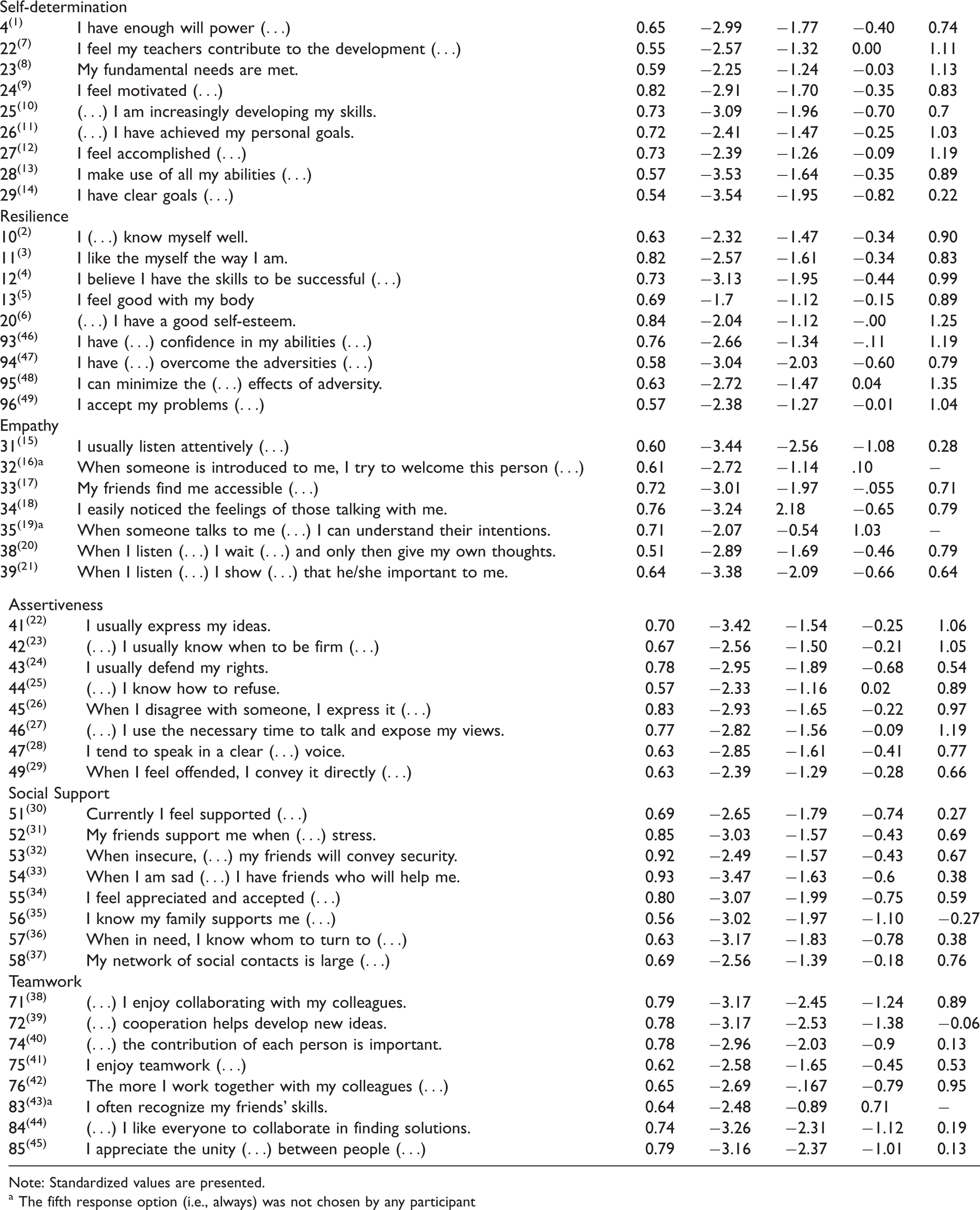
Note: Standardized values are presented.
a The fifth response option (i.e., always) was not chosen by any participant

Representative item information curve and total information curve for each measure.
Validation analyses
Confirmatory and multi-group factor analysis
We tested two competing models using the validation sample (n = 997): a six-factor 49-item solution and six-factor 49-item solution plus one total higher order factor. Though both models achieved appropriate fit indices (Table 4), the six-factor 49-item solution was a significant improvement in relation to the higher-order model (Δχ2(9) = 249.95, p < .001). Correlation values between all six factors were statistically significant and of low to moderate magnitude, supporting discriminant validity between factors. Likewise, item correlation values with their own belonging measure were always of moderate to high magnitude, whereas item correlation values with other non-belonging measures were always of low to moderate magnitude, indicating convergent and discriminant validity, respectively (Table 5). Loading values were significant for all items (Table 2) and internal consistency values were good for all factors, ranging from .76 to .88 (Table 5).
Confirmatory and multi-group confirmatory factor analyses results.
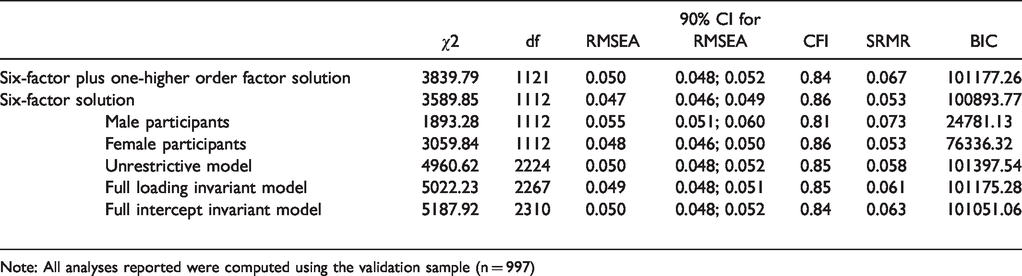
Note: All analyses reported were computed using the validation sample (n = 997)
Internal consistency and correlation analyses, and latent mean and descriptive values.
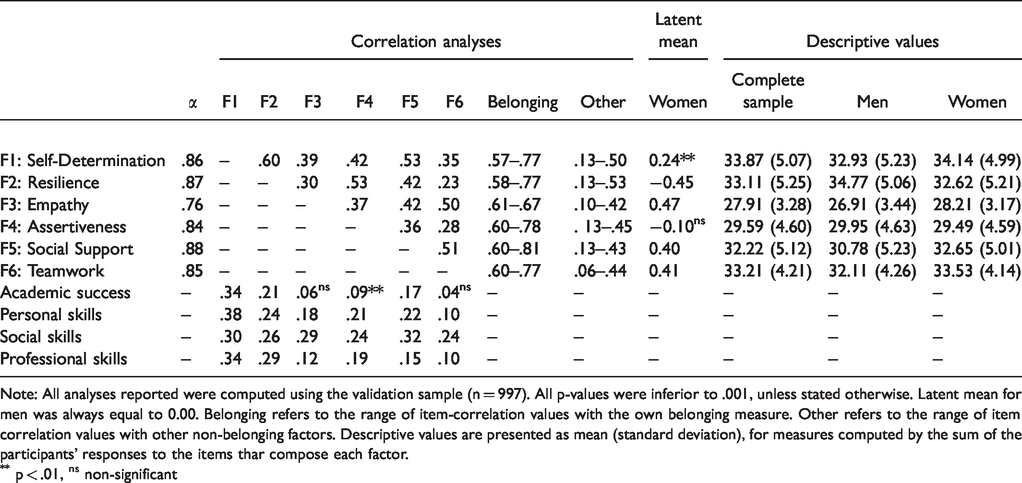
Note: All analyses reported were computed using the validation sample (n = 997). All p-values were inferior to .001, unless stated otherwise. Latent mean for men was always equal to 0.00. Belonging refers to the range of item-correlation values with the own belonging measure. Other refers to the range of item correlation values with other non-belonging factors. Descriptive values are presented as mean (standard deviation), for measures computed by the sum of the participants’ responses to the items thar compose each factor.
** p < .01, ns non-significant
The six-factor model was carried on for multi-group confirmatory factor analyses for assessing gender-based measurement invariance. Evidence was found supporting configural, full metric (ΔCFI = −.001, ΔRMSEA = −.001, ΔSRMR = .003) and full scalar (ΔCFI = −.006, ΔRMSEA = .001, ΔSRMR = .002) invariance by gender (Table 4). 5 Loading values were always significant when considering men and women separately (Table 2).
Descriptive analyses
After having achieved full metric and scalar invariance, latent mean comparisons were computed between men and women. Results show that women scored significantly higher than men on self-determination, empathy, social support and teamwork; instead men scored significantly higher on resilience. No significant differences were found between men and women on assertiveness. These findings are in line with the descriptive values for each factor by gender, as presented in Table 5.
Correlation with subjective perceptions
All factors achieved significant, positive and low to moderate correlation values with perceptions of personal skills, social skills and professional skills. With the exception of empathy and teamwork, all factors presented significant positive correlations with perceptions of academic success. The highest correlation values were found between self-determination and perceptions of academic success, personal skills and professional skills (ranging from .34 to .38); between social support and perceptions of social skills (.32); and between self-determination and perceptions of social skills (.30) (Table 5).
Discussion
This work set out to explore the measurement model of a self-report instrument developed to assess intra and interpersonal skills, as well as professional skills that may be associated with academic success of Higher Education students. The 49 items that compose the SSI were organized into six theoretically meaningful and internally consistent measures: self-determination, resilience, empathy, assertiveness, social support, and teamwork.
Self-determination is the ability to operationalize ones’ personal tendency for autonomous and proactive (e.g., item 24) expansion, development, and realization of personal (e.g., item 26), social and professional potentialities and goals (Gagné & Deci, 2005). Resilience refers to the ability to activate knowledge, attitudes and skills in order to overcome the negative effects of adversity and stress (Rutter, 1993; e.g., item 95). Empathy is a multidimensional construct which includes both cognitive (knowing what another person feels) and affective components (feeling what another person feels) (Braun et al., 2015; Levenson & Ruef, 1992; e.g., item 34). Looking into the items that compose the assertiveness measure, they portray both non-verbal components of assertiveness (Alberti & Emmons, 2008; e.g., item 47) as well as specific behaviors associated with the negative assertive dimension in particular (Arrindell et al., 1988), namely the expression of negative feelings (such as disagreement or dislike – item 45), the refuse of requests that are considered unreasonable (e.g., item 44), or the standing up for personal rights (e.g., item 43). Although social support has been described as one’s ability to gather and provide support, when needed, and within social networks (Pereira, 2005), the SSI seems to specifically address social support received by other (and not given to others) – friends in particular (e.g. item 52) but also family members (e.g., item 56). Teamwork is defined as the joint activity of people looking for the achievement of a common goal (e.g. item 84), by which the strength and knowledge of each person is combined through cognitive, affective, and behavioral investment in the group (Comoglio & Cardoso, 1996; Pereira, 2005; e.g., item 74).
Further evidence on the construct validity of the instrument may be taken from its constructs being closely linked to the transferable skills proposed by the European Skills, Competences, Qualifications and Occupations (European Commission, 2017). Namely: 1) Self-determination may be reflected in managing the self and the learning process, and can be included in the ‘thinking skills and competences’ group; 2) Resilience may concern the handling of challenges, which is part of the ‘attitudes and values at work’ group; 3) Empathy is the capacity to understand various verbal and non-verbal communication of sentiment and feeling, which belong to the ‘language and communication’ group; 4) Assertiveness may be part of the use of culturally appropriate gestures and language, accepting and giving constructive criticism, argue cases, seek consensus and compromise, and propose options, which are part of the ‘social skills and competences’ group; 5) Social support may concern the fostering of social networks, sharing opinions and resources, and collaborate in tasks, also part of the ‘social skills and competences’ group; and 6) Team work consists of working with others, especially as part of a team, of negotiating, and of displaying intercultural competence, again part of the ‘social skills and competences’. Some of these constructs also relate to those addressed by previous tentative instruments in the area (Alpay & Walsh, 2008; Chamorro et al., 2010), namely self-determination and teamwork. The fact that all these dimensions presented low to moderate inter-correlations supports the argument that they are relevant aspects – although not overlapping – of the global construct this instrument was designed to address (i.e., soft skills), and contribute to a more nuanced understanding of students’ skills. These six dimensions correlated with subjective perceptions of academic success, as well as personal, social, and professional skills.
Moreover, this measurement model proved to be an invariant and thus credible tool to compare men and women on these relevant skills. Significant gender differences were found in all measures except assertiveness. The finding that adult men and women report similar levels of assertive behavior is not uncommon (Arrindell et al., 2001; Bridges et al., 1991). In turn, women reported significantly higher scores in the self-determination, empathy, social support and teamwork measures. This is in line with previous findings indicating that women, compared to men, tend to invest more in processes of self-determination, particularly in order to achieve social/ familiar well-being (Antonova & Ivanova, 2016). Likewise, women are more likely to resort to social support when facing stressful situations, particularly emotional support (Day & Livingstone, 2003). Women have also been found to give more importance to prosocial attitudes in organizational contexts (León et al., 2011) and to self-report higher values of teamwork skills compared to men (Nabi & Bagley, 1998). Finally, women have been found to consistently self-report higher levels of empathy than men, which may be due to diverse rearing practices and cultural roles attributed to men and women (Wuying et al., 2014). Alternatively, men reported significantly higher scores in resilience, concurring with previous findings (Lehmann et al., 2013; Matud, 2004).
Hence, because we found gender mean differences that align with what has been reported in the literature, we may infer evidence on the construct validity of the SSI. Further works should consider validity evidence in relation to other external constructs, and possibly predictive validity. A relevant validity criterion that should be considered in future research is how well does the SSI predict meaningful outcomes, such as educational attainment and labor market success (Heckman & Kautz, 2012).
Limitations to the current work should be noticed. First of all, we set out to investigate a construct that is, in itself, extremely broad and controversial. In this sense, our proposed framework of soft skills (particularly intra and interpersonal skills) does not intend to be exhaustive. In addition, the data analyzed in this work used a sample of Portuguese students - whether or not current findings are specific to this cultural group remains to be explored. For example, findings with Portuguese adolescent samples concerning assertiveness have not entirely been in line with findings with north American samples, pointing to some cultural specificities that require further consideration (Vagos et al., 2014). Our findings on the item’s representativeness (i.e., they particularly represent low and medium levels of the skills), suggest that it may be important to explore the rephrasing of the top option of the Likert scale (for example, replacing ‘always’ with ‘most of the times’), or to add other items that may be representative of higher levels of each specific construct. Finally, the applicability and usefulness of the instrument for populations other than Higher Education students (namely early career and mature professionals) should be investigated. For example, the set of soft skills assessed by the SSI were similar to those required for executive professionals (Robles, 2012), which reinforces their application in contexts where people are already employed or are planning for their career development.
To date, there is a lack of psychometric instruments designed to assess soft skills in educational settings. The current work addresses this gap and proposes a self-assessment instrument of soft skills – the Soft Skills Inventory (SSI). The skills included in the SSI – self-determination, resilience, empathy, assertiveness, social support, and teamwork – have been associated with the accomplishment of developmental tasks that are characteristic of young adulthood, and also with what is expected of well-rounded graduates and successful professionals. This instrument may be a useful tool, not only for research purposes, but also for the screening of skills that Higher Education institutions need to be aware of, when supporting students holistic learning and development.
Footnotes
Declaration of Conflicting Interests
The author(s) declared no potential conflicts of interest with respect to the research, authorship, and/or publication of this article.
Funding
The author(s) received no financial support for the research, authorship, and/or publication of this article.
