



Abstract
Drawing upon previous theorizing and empirical research efforts supporting the importance of role breadth self-efficacy (RBSE) as a key motivational antecedent of proactive forms of behaviour at work, including individual innovation, this paper reports the process of building and validating a Portuguese version of Parker’s RBSE scale. Data from two studies with independent samples of employees (N = 103, N = 148) pertaining to an information technology company, showed that this version (RBSE-P) has, as expected, a unidimensional structure with a high level of factor structure similarity in both samples, as well as appropriate levels of internal consistency. Furthermore, evidence from the second sample (N = 148) revealed that, in line with preliminary research, this construct shows validity to predict the distinctive proactive behaviour of individual innovation, evaluated by the employee’s corresponding direct supervisors. These results support the use of this scale for assessing RBSE in Portuguese-speaking work settings and the meaningful role of this construct for predicting this criterion, which is acknowledged as an important driver of organizational success and competitiveness.
Introduction
Employee proactive behaviours are considered a catalyst for positive change at work and play an important role in organizations’ capacity to perform effectively in the present dynamic business environment (Grant et al., 2009; Ouyang et al., 2019). Proactive behaviours are self-initiated and future-oriented actions aiming to enact change and improve the situation or oneself. They tend to contribute to anticipating problems and identifying opportunities for improving work processes and methods, prompting increased levels of organizational effectiveness and innovation (Parker et al., 2006, 2010). Multiple and distinctive forms of proactive behaviours co-exist at work, including taking charge, voice, individual innovation and problem prevention. However, all are posited to pertain to a higher-order category of employee proactivity, given their commonalities in taking control and persist to bring about change within the organization (Parker & Collins, 2010).
Due to the mutual benefits of proactive behaviours for both employees and the organization, such as career success and enhanced organizational performance, a great deal of research has been devoted to uncovering its main individual and contextual determinants in order to identify effective ways to promote and sustain its occurrence in the workplace (Bindl & Parker, 2011; Parker et al., 2006; Sonnentag & Spychala, 2012). In the frame of their individual level antecedents, increasing emphasis has been placed upon the construct of role breadth self-efficacy (RBSE), as a key motivational determinant of proactive behaviour (Griffin et al., 2007; Ouyang et al., 2019; Wu & Parker, 2017). This self-efficacy construct, focused on employees’ job breadth, concerns the extent to which individuals view themselves as capable of carrying out a broader role, encompassing a range of proactive, interpersonal and integrative tasks, beyond prescribed technical job activities (Parker, 1998; Parker et al., 2006). Such expanded roles have become more prevalent within modern organizations, due to more frequent and ongoing change and demands for improvement, requiring of employees the ability to deal confidently with unpredictable situations for which responses cannot be entirely prespecified.
Consistently, previous empirical research has supported RBSE validity to predict both overall proactive behaviour criteria (e.g., Griffin et al., 2007; Ouyang et al., 2019; Wu & Parker, 2017), as well as specific forms of individual proactivity, like taking charge (Li et al., 2015; Parker & Collins, 2010; Sonnentag & Spychala, 2012) and proactive problem solving (Parker et al., 2006). Nonetheless, substantially less attention has been paid to examining the impact of employees’ RBSE on such more specific and distinctive proactive behavioural foci at work, particularly towards individual innovation. Additionally, irrespective of the merits of previous empirical efforts devoted to uncovering the links between RBSE and innovation, few studies have adopted an expanded approach to capture the key elements of the behavioural multistage process underlying this criterion (Chen et al., 2013 constitutes an exception). Still, as acknowledged by previous research developments linked with the delimitation of this criterion’s conceptual space (i.e., Janssen, 2001; Kanter, 1988; Potočnik & Anderson, 2016), effective innovation requires the generation of novel and useful ideas targeted to improve organization’s products and practices (i.e, creativity), however, it is equally dependent upon subsequent successful championing and implementation of such ideas in the workplace.
Therefore, the current study aims to contribute to the research about the role of RBSE in driving individual innovation at work by building a Portuguese version of Parker’s (1998) RBSE unidimensional scale and examining its criterion-related validity towards individual innovation when such an expanded conceptualization of this criterion, encompassing the behaviours of idea generation, promotion, and realization, is adopted. In addition to the acknowledged benefits of innovation for organizations, we focus upon this criterion in view of the encouraging, yet fragmented, evidence supporting the prospects of RBSE to promote innovative behaviours at work, such as idea suggestion (Axtell et al., 2000; Hao et al., 2018) and idea implementation (Parker et al., 2006).
As Ng and Lucianetti (2016) have emphasized by quoting Bandura’s (1995) considerations regarding social changes, innovative endeavours often require a “resilient sense of efficacy” because “innovations demand heavy investment of effort over a long period with uncertain results” (p. 13). Still, this implied agentic nature of innovative behaviour has been broadly overlooked in related research. Moreover, despite of recognizing the relevance of creative self-efficacy to prompt idea generation, as shown by extant meta-analytic research and latter literature reviews (e.g., Hammond et al., 2011; Potočnik et al., 2015), these authors encouraged researchers to draw attention to other self-efficacy constructs that may capture employees’ beliefs about their confidence to contribute to subsequent idea promotion and implementation, as well. Hence, drawing upon social-cognitive theory assumptions that self-efficacy beliefs prompt behavioural intensity, particularly when there is an alignment in the scope of such beliefs and targeted behavioural domain (Bandura, 2012), we propose that RBSE constitutes a meaningful self-efficacy predictor of individual innovation. RBSE captures employees’ confidence in performing expanded roles, involving proactive, interpersonal and integrative demands. It is thus arguably more aligned in terms of its bandwidth to such a global individual innovation criterion, than narrower self-efficacy appraisals such as creative self-efficacy, which focus on a portion of specific behaviours implied in the innovation process, i.e., idea generation.
Considering that measurement validation involves an ongoing process, since construct validity of a given measure is frequently context- and population-dependent (Flake et al., 2017; Van Bavel et al., 2016), this paper addresses these questions in the context of a high-complexity job and reports evidence from two studies focused on the construct validation of the Portuguese version of Parker’s (1998) RBSE scale, using two independent samples of software engineers, from an information technology company. Despite extant research supporting the psychometric soundness of Parker’s (1998) RBSE scale, the available evidence is relatively uninformative as concerns the adequacy of this instrument to assess RBSE at specific levels of job complexity since the samples in most previous studies are composed by an array of jobs which are not equivalent in terms of job complexity, e.g., production workers, managers, marketing, sales and clerical personnel (e.g., Ouyang et al., 2019; Parker, 1998; Parker et al., 2006; Wu & Parker, 2017). As such, further research is needed to conclude whether this instrument displays appropriate psychometric properties in the evaluation of role-breadth self-efficacy at specific levels of job complexity. By addressing these aspects in the context of a single, specific, high-complexity job, i.e. software engineering, this paper intends to contribute to this research question, as well.
Job complexity captures the degree to which a job entails autonomy, complex and non-repetitive tasks, as well as decision-making demands (Campbell, 1988; Roos & Treiman, 1980). Highly complex jobs tend to grant more autonomy, flexibility and latitude for decisions to their incumbents in their work. This increases their levels of discretion to undertake more proactive, interpersonal and integrative endeavours, which tend to act as a source of enactive mastery and personal control, stimulating the development of self-efficacy (Axtell & Parker, 2003; Bandura, 1986; Parker et al., 2006). As underlined by Parker et al. (2006), “autonomy provides a source of enactive mastery experience because it gives employees the opportunity to acquire new skills and master new responsibilities” (p. 639), which enhances RBSE, but also more flexible role orientations and openness to change. As such, by focusing upon a high-complexity job, this study is carried out in a typically high-autonomy job context, thereby particularly conducive to the development of RBSE and where employees have discretion to behave proactively, particularly in terms of innovation.
Furthermore, most previous studies with this scale were performed in countries such as the United Kingdom and China (e.g., Chen et al., 2013; Ouyang et al., 2019; Parker, 1998; Parker et al., 2006), therefore sampling a restricted range of cultural settings. This study relies on a sample pertaining to Portuguese culture, which has the distinctive characteristic of a high level of preference for avoiding uncertainty which may generate stronger levels of resistance to innovation (Hofstede, 2001; Hofstede-insights, 2017). Thus, it also contributes to widening the scope of related research regarding the psychometric adequacy of Parker’s (1998) RBSE scale across multiple cultural contexts.
In summary, the intention of this study is to contribute to the research questions presented by building and validating a Portuguese version of Parker’s (1998) RBSE scale. Two independent studies are employed to provide specific evidence concerning its suitability to assess this construct in a high-complexity job context and its validity to predict the criterion of individual innovation in a Portuguese-speaking work setting and within its respective culture. Specifically, after the preliminary assessment of the scale content validity, the first study was focused upon the examination of its psychometric characteristics, namely factor structure and internal consistency. The second study was developed using an independent sample to cross-validate RBSE-P scale psychometric properties and gather further evidence regarding its criteria-related validity to predict individual innovative work behaviour. Following the recommendations of Potočnik et al. (2015), this criterion was operationalized through supervisor ratings to avoid reliance upon self-reports of innovative behaviour that characterize some previous research. Specific evidence shows that these self-evaluations tend to be affected from motivated distortions and lack validity, due to the high value that is placed upon individual innovation by most organizations (see Potočnik & Anderson, 2012).
Validity of RBSE to predict innovative work behaviour
In recent decades, innovative behaviour has emerged as a critical criterion for modern organizations due to its contribution to continuous improvement of organization products, services and practices (Anderson et al., 2014; Potočnik et al., 2015). Conceptualized as a core and distinctive proactive behaviour (see Parker & Collins, 2010), innovative behaviour is defined as a set of intentional behaviours implied in the generation, promotion and implementation of ideas which are either novel or useful for the organization to develop and optimize its products, work processes and methods (Janssen, 2001; Potočnik & Anderson, 2016).
Like other proactive behavioural foci, innovative actions often imply challenging the status quo and raising controversial issues in the workplace, as well as dealing with potential scepticism, resistance, and risk of failure (Hsu & Chen, 2017; Ouyang et al., 2019; Parker et al., 2006). As the unpredictability and risks inherent to innovation endeavours are recognized, along with the acknowledgement of its deliberate kind, i.e. agentic nature, self-efficacy beliefs have been proposed as playing an important role in enhancing employees’ willingness to undertake innovative behaviours and enact positive change at work (Ng & Lucianetti, 2016; Parker, 2000; Sonnentag & Spychala, 2012). A fruitful application of theoretical developments in self-efficacy to the explanation of proactive behaviours at work was developed by Parker (1998) through the construct of RBSE. It was modelled as a key cognitive-motivational state which directly impacts on employee proactive behavioural forms (Ouyang et al., 2019; Parker & Collins, 2010; Parker et al., 2006), including individual innovation (Chen et al., 2013).
As theorized by Parker et al.’s (2010) model of proactive motivation, the extent to which employees exhibit proactive behaviours is dependent upon the enactment of a high level of “can do”, “reason to” and “energized to” motivations. Whereas “reason to” motivation builds upon intrinsic, integrated and identified motivation; “energized to” motivation arises from activated positive affect states that prompt proactive goal regulation; while “can do” motivation primarily draws upon self-efficacy perceptions, particularly RBSE, along with control appraisals, attributions and perceived costs. Indeed, RBSE constitutes one of the most consistently identified “can do” motivational antecedents of proactive behaviour in previous literature (Ouyang et al., 2019; Wu & Parker, 2017), since it captures employees’ confidence in accomplishing a range of proactive, interpersonal, and integrative requirements that go beyond prescribed technical duties (Parker, 1998; Parker et al., 2006). By expressing the level of employees’ perceived ability to deal with such a range of proactive demands, RBSE is posited as enhancing one’s perceptions of job control and likelihood of success of their own initiatives, including those targeted at bringing about change and improvement in the organization (Morrison & Phelps, 1999; Parker & Collins, 2010; Parker et al., 2010). Such favourable cognitive assessments are then crucial in strengthening employees’ readiness to take risks and confidently undertake proactive actions, such those typically implied in individual innovation (Chen et al., 2013; Li et al., 2015). These propositions are also consistent with expectancy theory assumptions (Vroom, 1964), according to which individuals tend to become more motivated and exert a higher level of effort when they perceive more favourable prospects of successfully accomplishing their goals and expectations. Therefore, improved RBSE is purported to allow employees to capitalize upon a stronger “can do” motivation to engage in proactive and innovative behaviours. In addition to prompting the production of new ideas and suggestions, stronger RBSE, through its implied increased confidence in one’s capacity to successfully undertake interpersonal communication initiatives (Parker, 1998; Parker et al., 2006), is also posited as enhancing employees’ efforts to persuade others to adhere and support their suggestions (Petty et al., 2002), as well as to collaborate in implementing them (Ng & Lucianetti, 2016). Taking all these aspects into consideration, we posit that employees with higher RBSE will be more likely to take the initiative and participate in generating ideas, looking for interpersonal and organizational support, and implementing these new ideas at work. As noted above, empirical research with innovative behaviours, albeit limited, points toward this direction and suggests that RBSE constitutes an important driver of innovative behaviours at work, including idea suggestion (Axtell et al., 2000; Hao et al., 2018) and idea implementation (Parker et al., 2006).
Yet, besides RBSE, which captures one’s confidence in exhibiting an expanded span of proactive actions beyond job technical requirements, previous research on innovation at work has also focused upon three rather more specific self-efficacy constructs, including creative self-efficacy, persuasion self-efficacy and change self-efficacy (see Ng & Lucianetti, 2016; Tierney & Farmer, 2002). These three self-efficacy beliefs have been modelled as proximal precursors of the main types of innovative behaviours, respectively idea generation, promotion, and implementation. While creative self-efficacy refers to employees’ perceptions regarding their own ability to produce novel ideas and persist in face of setbacks inherent to the idea generation process (Gist & Mitchell, 1992; Tierney & Farmer, 2002), persuasion self-efficacy captures employees’ confidence in their own ability to present new ideas to others and secure their support. Lastly, change self-efficacy refers to employees’ perceived ability to manage uncertainty, change demands and contingencies inherent to the implementation of new ideas and potential solutions in the workplace (Janssen, 2004; Vardaman et al., 2012; Wanberg & Banas, 2000).
Previous research has also shown that such narrower self-efficacy beliefs, targeting domain-specific innovative individual capacity, constitute valid predictors of innovative behaviours. One of these more specific self-efficacy constructs that has drawn a great deal of attention in the literature is creativity self-efficacy. Meta-analytic and primary longitudinal research evidence (i.e., Hammond et al., 2011; Tierney & Farmer, 2011) has supported its meaningful role in promoting employees’ generation of new ideas, i.e. creativity. Further preliminary efforts focused upon the links between the other focal self-efficacy constructs and individual innovative actions, namely between persuasion self-efficacy and idea promotion, as well as between change self-efficacy and idea realization, have likewise provided convergent evidence supporting the merits of these constructs in predicting the unitary behavioural blocks of the multistage process underlying innovation at work (Ng & Lucianetti, 2016).
Nonetheless, we relied upon RBSE in the current study, instead of these more specific self-efficacy beliefs, due its broader breadth and, therefore, stronger alignment with the adopted criterion of overall individual innovation. The intention is to capture the employee’s global contribution, within their respective work role, in suggesting, championing and implementing new and useful ideas at the organization. As asserted by social-cognitive theory (Bandura, 1995, 2012), self-efficacy beliefs (i.e., one’s belief in own capacity to organize and execute the courses of action needed to manage prospective situations) determine behavioural intensity and persistence, especially when such beliefs are in accordance with the type of behaviour that is required. Moreover, as previously highlighted, contrary to extant evidence supporting the links between specific self-efficacy constructs and unitary innovative behaviours (Hammond et al., 2011; Hao et al., 2018; Ng & Lucianetti, 2016), very few attempts have been undertaken to scrutiny whether RBSE could play an instrumental role when a broader and relevant criterion of individual innovation is adopted (Chen et al., 2013). Therefore, considering all the above-mentioned aspects, we anticipate that RBSE will show criterion-related validity for the prediction of individual innovation.
The role breadth self-efficacy scale
The construct of RBSE was originally introduced in the literature by Parker (1998) and refers, as mentioned, to the extent to which employees feel confident that they are able to use initiative and effectively perform a broader and more proactive role, extended beyond formal technical duties. Such expanded roles have become more common in modern organizations, where job demands have become increasingly proactive, interpersonal, and integrative in nature. In her seminal study, Parker (1998) built this original 10-item scale in English to access the proposed construct of RBSE. This instrument reflects a set of 10 distinct tasks, which were selected over an initial pool of 20 typical proactive tasks, identified through focal interviews with employees from different jobs involved in change-related activities in a glass manufacturing company. The author’s final selection of 10 tasks to be reflected in the items of the scale aimed to sample a set of activities which would reflect a common core of proactive, integrative and interpersonal competencies that could also be applicable across jobs and hierarchical levels in the company. Respondents were instructed to rate how confident they would feel in carrying out each of these tasks, using a 5-point response Likert scale, ranging from 1 = not at all confident and 5 = very confident.
Empirical evidence provided by the author supported that these items access a unidimensional and reliable RBSE construct, distinct from other relevant psychological constructs, like proactive personality and self-esteem. Results also show that this scale effectively discriminates between occupational groups, as well as the fact that RBSE can be effectively predicted by work design-related variables, such as job enrichment, job enlargement, and membership of improvement groups. Furthermore, collected longitudinal data have shown that higher levels of job enrichment and increased quality of communication predicted a greater development of RBSE (Parker, 1998). Since its inception, this scale has been increasingly used in proactive behaviour-related literature, given that RBSE is conceptualized, as emphasized above, as a key “can do” motivation pathway for proactivity (Parker et al., 2010). It has been modelled as a proximal antecedent of proactive behaviours (Parker et al., 2006; Wu & Parker, 2017), including individual innovation (Chen et al., 2013). In light of the growing attention devoted to RBSE in the literature about proactivity at work, the intention of the current study is to develop a Portuguese version of this scale (RBSE-P) and gather evidence concerning its construct validation, using two independent samples of job incumbents belonging to a high-complexity job of software engineering.
Method
Validation process
In order to validate the RBSE scale, recommended practices of Standards of Educational and Psychological Testing (American Educational Research Association et al., 2014) were followed. Since the Portuguese version of this scale has not previously been studied in the current population, the validation process started with its content validity assessment (i.e., substantive phase), via consultation with subject matter experts and members of the population (Vogt et al., 2004). An examination of its psychometric characteristics (i.e., structural phase) in terms of its factor structure and reliability followed, using data collected in both study 1 and study 2. Finally, evidence concerning convergent and discriminant validity, as well as the criterion-related validity of this measure was gathered (i.e., external phase) from data collected in study 2, to examine whether RBSE, as assessed by this measure, corresponds to a reflective and discrete construct that can be used to predict incumbents’ global innovation, assessed through employee’s immediate supervisors.
Content validity
In order to assess the content validity of RBSE-P, correspondent item relevance, ease of understanding, clarity of the instructions and rating scale, as well as its appropriateness for the specific context of an information technology organization, were evaluated in the first phase. This was achieved by consulting the company’s CEO, the human resources manager and two senior software engineers as subject matter experts and members of the population under examination (Haynes et al., 1995; Vogt et al., 2004). According to their review and feedback concerning Parker’s (1998) RBSE scale in English, while instructions and rating scale were considered clear, only five of the ten original items were regarded as appropriate to capture the sort of proactive, interpersonal, and integrative tasks that could be undertaken via employees’ self-initiative, across software engineering jobs within the organizational setting under study. They included “Designing new procedures for your work area”, “Making suggestions to management about ways to improve the working of your section”, “Representing your work area in meetings with senior management”, “Helping to set targets/goals in your work area” and “Visiting people from other departments to suggest doing things differently”. Interestingly, these five items were also among those with highest factor loadings (> .80) in Parker’s (1998) original validation study, with the exception of the last item, which has a comparatively lower, yet very acceptable loading of .68.
With regard to the other five items presented in the original 10-item RBSE scale, they were excluded from the RBSE-P, as the company subject matter experts indicated that they refer to tasks that were not applicable to the jobs under examination (i.e., “Contributing to discussions about the company’s strategy”). As specified above, the same rationale was applied by Parker (1998) to select the 10 tasks that were reflected in the correspondent final scale items, from an initial pool of 20 different tasks, involving proactive, interpersonal and integrative competencies. As stated by the author, “The set of tasks was not intended to be exhaustive; the aim was to represent important exemplar elements of an expanded role that apply across jobs and hierarchical levels” (p. 839).
In the second phase, two doctorate researchers in organizational psychology and management studies were consulted as related-research subject matter experts to assess whether the five items selected for the Portuguese version represent the definition of the RBSE construct and adequately capture its core content. Given their positive feedback, these five items, originally in English, were translated into Portuguese, following translation-back translation procedures (Brislin, 1986), and later included in the surveys used in both study 1 and 2.
Study 1
Participants and procedure
Using a cross-sectional design, data were collected at the headquarters of a multinational information technology firm located in Portugal, which specializes in delivering customized software solutions for worldwide clients. With the permission of the firm’s executive board, 150 Portuguese incumbents were invited to complete an online survey in their native language, voluntarily and during regular working hours. In the first section of the survey, the main goals of the study were briefly explained, and participants’ informed consent was requested, emphasizing the confidentiality of their answers and their use for research purposes only. The second section included sociodemographic background and work-related variables, as well as the Portuguese version of the RBSE scale developed for this study.
In total, 103 usable surveys were received, representing a 69% response rate. Respondents were 32.03 years old on average (range = 21 to 55, SD = 5.71), mostly male (90.3%), with an average organizational tenure of 4.12 years (SD = 2.57). They belong to different job areas pertaining to the company’s software engineering department (junior engineers = 19%, software product assistants = 5%, project engineers = 36%, senior engineers = 18%, senior project managers = 14%) followed by engineering support staff (8%). Of all participants, 67% occupy non-management roles, whereas the remaining 33% hold management or coordinating duties in the scope of their jobs.
Measures
Role breadth self-efficacy was measured, as described above, with the five-item RBSE-P, developed from Parker’s (1998) original scale. Likewise, some previous studies have implemented five-item short-scales to measure this construct, specifically by selecting Parker’s (1998) highest loadings items (Cabrera et al., 2006; Wu & Parker, 2017). In line with the original scale instructions, incumbents were asked to report how confident would they feel carrying out a set of a set of proactive, interpersonal and integrative tasks. Sample items included “Designing new procedures for your work area” and “Making suggestions to management about ways to improve the working of your section”. Responses were obtained using a 5-point Likert scale where 1 = not at all confident and 5 = very confident.
Background and job-related variables. Incumbents were asked to provide information regarding their gender, age and previous job experience. In accordance with previous research on RBSE, participants were also instructed to report their organizational tenure, as well as their job level, i.e. whether they perform management duties in the scope of their jobs (Wu & Parker, 2017). Organizational tenure is regarded as a proxy of individuals’ knowledge about the job and the organization, which could play a role in the extent to which they feel more confident to bring about proactive action and change. In the case of job level, it is purported that incumbents with management or coordinating roles tend to feel more responsible for promoting change, which is likely to positively impact the development of their RBSE (Ng & Lucianetti, 2016; Parker, 1998; Wu & Parker, 2017). According to their answers, approximately 33% of the respondents have management or coordinating roles, while the others occupy non-management roles. Complete data were obtained for all variables, with the exception of job experience, for which answers were missing from nine participants.
Results and discussion
Factorial structure and reliability
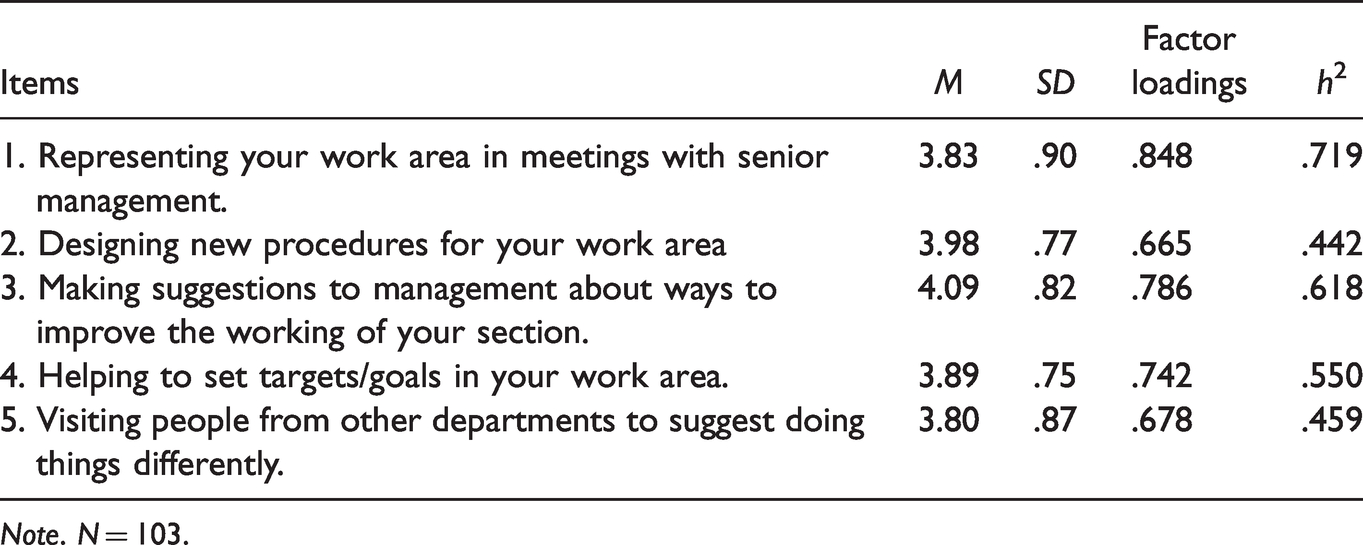
Given the relatively small sample size (N = 103), the RBSE-P factor structure was examined through exploratory factor analysis, using principal axis factoring as the extraction method. The item ratio was approximately 1:21, the average communality was .56 and substantial loadings were obtained (as depicted in Table 1), and thus sample size was considered adequate to carry out the analysis (Pituch & Stevens, 2016). Likewise, the KMO value of .81 and the statistical significance of Bartlett’s test (χ2 = 233.31, df = 10, p < .001) supported this indication. As expected, a single factor solution emerged, accounting for 64.31% of the variance, with respective loadings ranging from .67 to .85, as summarized in Table 1. In line with prior research with Parker’s (1998) original 10-item RBSE scale, as well as with the five-item short forms used in previous studies (e.g., Cabrera et al., 2006; Wu & Parker, 2017), these results support the unidimensional structure of the latent RBSE construct, as assessed by this measure in the present sample.
RBSE 5-item statistics and loadings from exploratory factor analysis, using principal axis factoring.
Note. N = 103.
With respect to scale reliability estimation, the Cronbach’s alpha obtained of α = .86 supported the adequate level of internal consistency. This coefficient is also within the respective range of alpha values that have been reported in previous studies with five-item RBSE scale forms (i.e., Cabrera et al., 2006, α = .76; Wu & Parker, 2017, α = .87). All items showed appropriate item-total scale correlations (ranging from .61 to .77) and that the exclusion of any item will not improve scale reliability. Considering the reported evidence supporting that this RBSE scale, as expected, has a unidimensional factor structure and reaches an appropriate level of intra-rater reliability, the scores of respective five items were averaged to represent the employee’s RBSE total score.
Table 2 depicts the descriptive statistics and inter-correlations between RBSE and incumbents’ sociodemographic and work-related variables assessed in this sample (N = 103). As shown, RBSE displays a positive significant association with employee age, a finding that has been also reported in some prior empirical studies (i.e., Parker, 1998, 2000). Similarly, RBSE established a positive link with incumbents’ years of job experience and job level, indicating that employees with higher levels of job experience, such as those with management or coordinating roles, tend to report stronger levels of RBSE.
Means, standard deviations and intercorrelations.

Note. N = 103.
aMale = 1, Female = 2. RBSE = Role breadth self-efficacy.
bCorrelations between job experience and the other variables under study are based in a subsample of N = 94. cNon-managers = 0, Managers = 1. *p < .05. **p < .01. ***p < .001.
Likewise, RBSE was positively associated with employees’ organizational tenure, albeit only a marginally significant relationship (p < .10) was found in this sample. These correlates are consistent with previous findings according to which there is a reciprocal relationship between self-efficacy and job/organizational-related experiences (Bandura, 1986; Parker, 1998). Still, as further research has shown, to enhance RBSE, such experiences must enact individual mastery, via repeated performance and accomplishment of proactive demands (Axtell & Parker, 2003; Parker, 1998). Work design plays an important role in promoting this sort of experiences. Indeed, as suggested by extant evidence, simply enlarging the breadth of job tasks without increasing employee’s job control, responsibility and decision-making influence, is unlikely to develop employee’s RBSE, hindering its potential to enhance proactivity (Axtell et al., 2006; Axtell & Parker, 2003; Parker et al., 2006; Sonnentag & Spychala, 2012; Wu & Parker, 2017). The significant correlation between RBSE and job-level is consistent with these aspects, given that management roles, which tend to have provide greater influence, autonomy and decision latitude, are associated with higher levels of RBSE.
Study 2
Participants and procedure
This second study was conducted with an independent sample of Portuguese software engineers from the same multinational information technology firm. A predictive design was followed, with two separate waves of data collection targeting two independent data sources (i.e., incumbents and respective supervisors) to avoid common source bias. During the first phase, the other 205 engineers available from the software engineering department were invited to complete an online survey, during working hours, including socio-demographic questions, the Portuguese five-item RBSE scale and work-related variables. The main research goals were briefly mentioned in the first section of the survey and participants’ informed consent was requested, under the assertion that answers would be kept confidential and used exclusively for research. The second phase of data collection took place six months later and occurred concomitantly with the company performance appraisal system, to collect individual innovation ratings of participants from their respective direct supervisors.
In total, valid data from 148 incumbent-direct supervisor pairs was obtained, corresponding to a 72% response rate. Sample participants were 30.89 years old on average (range = 22 to 46, SD = 4.78), predominantly male (93.2%), with an average organizational tenure of 3.54 years (SD = 2.16). Regarding software engineering jobs in the sample, 30% of the participants occupied the position of junior software engineer, 39% of software project engineer and 31% were senior engineers. Among the main duties, participant roles included software coding, testing, quality control and project management.
Measures
Role breadth self-efficacy was assessed through the same measure as used in study 1, i.e. five-item RBSE-P, the Portuguese version of Parker’s (1998) RBSE scale. Similarly, incumbents were instructed to report the extent to which they would feel confident carrying out a range of proactive and integrative tasks reflected in the five items, using the same 5-point Likert response scale, ranging from 1 = not at all confident to 5 = very confident.
The individual innovation of each participant was rated by direct supervisors, using Janssen’s (2001) 9-item scale of innovative work behaviour, which includes the assessment of individual’s behaviours implied in the creation, promotion, and implementation of ideas at work. Example items included “Searching out new working methods, techniques or instruments”, “Making important organizational members enthusiastic for innovative ideas” and “Transforming innovative ideas into useful applications”. Immediate supervisors were asked to rate the frequency with which each incumbent exhibited these behaviours throughout the last six months, using a 5-point Likert scale anchored at 1 = Never and 5 = Always. Despite including items to evaluate idea generation, promotion and implementation, previous evidence suggests that this measure represents an additive scale of interrelated innovative behavioural forms, capturing a unidimensional construct of individual innovation (Ng & Lucianetti, 2016; Wang et al., 2015; Woods et al., 2018). Thus, supervisors’ ratings on the nine items in the scale were averaged to form a single individual innovation score. Cronbach’s alpha for the total scale was .92.
Control variables. Information concerning incumbents’ gender, age and organizational tenure were also collected. The control of these variables when studying the criterion-related validity of RBSE is recommended, especially for organizational tenure, due to its potential non-trivial impact upon innovative behaviours (Woods et al., 2018). As previously mentioned, tenure is regarded as a proxy of individuals’ knowledge about the job and the organization, which could play a role in the extent to which they tend to innovate.
Results and discussion
Factorial structure and reliability
As indicated, one of the main purposes of study 2 was to cross-validate the psychometric characteristics of the five-item RBSE scale under study, specifically by testing its factor structure in this second sample. A confirmatory approach was adopted and its reliability estimated. Furthermore, additional evidence was gathered regarding convergent and discriminant validity, as well as criteria-related validity. Hence, confirmatory factor analysis with maximum likelihood estimation was used to test the hypothesis that, when assessed via this measure, RBSE captures a unidimensional construct with adequate convergent validity, as well as discriminant validity regarding individual innovation construct. Goodness-of-fit between the hypothesized measurement model (comprising both RBSE and innovative work behaviour scales) and sample data was evaluated in terms of absolute fit, incremental fit and parsimonious fit (Brown, 2015). A non-significant chi-square (χ2) is indicative of good fit, nonetheless, due to its sensitivity to sample size, additional fit indexes were adopted to assess the fit of the proposed factor structure (Brown, 2015). Specifically, the χ2/df ratio, the comparative fit index (CFI), the Tucker-Lewis index (TLI), the standardized root mean square of approximation (RMSEA) and the standardized root mean square of residuals (SRMR), were used. Correspondent adopted cut-offs were χ2/df < 2, CFI and TLI > .90, preferably higher than .95, to support adequate model fit, while SRMR and RMSEA < .08 or < .60 are indicative of acceptable or good model fit, respectively (Brown, 2015; Hu & Bentler, 1999).
The respective results indicated that the hypothesized measurement model displays a good level of fit to the data (χ2 [76, N = 148] = 115.05, p = .003, χ2/df = 1.514, CFI = .965, TLI = .958, RMSEA = .059, p = .238, SRMR = .048). Moreover, all items load appropriately and significantly on the respective factor, as depicted by Figure 1.
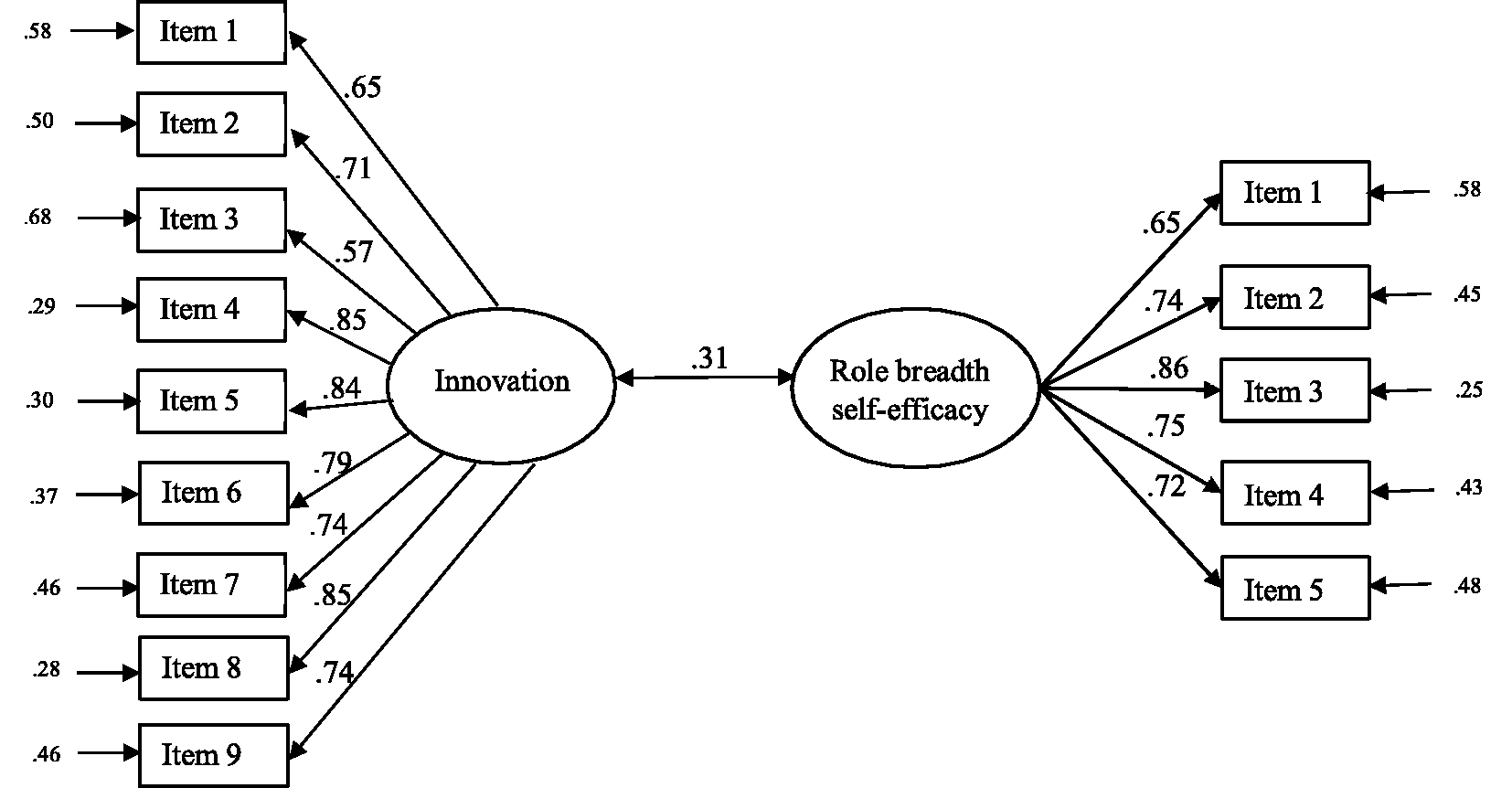
Confirmatory factor analysis for the measurement model, with standardized item loading estimates and measurement errors.
Following Fornell and Larcker (1981), the results showed convergent validity, as the composite reliability of each scale is greater than .70 (.86 for RBSE and .92 for innovative work behaviour), and the average variance extracted is greater than .50 in both scales (.56 for RBSE and .57 for innovative work behaviour). The results also showed discriminant validity, since the correlation between constructs is .31, and the average variance extracted of both scales is greater than the squared correlation between constructs (.09). Thus, in line with the evidence collected in study 1, the results from this second sample also support the unidimensional structure of the RBSE construct, as captured by this short scale (RBSE-P). As such, in order to gather further evidence regarding the similarity of the factor structures obtained in these two independent samples, Tucker’s (1951) congruence coefficient was calculated, using Lovik et al.’s (2020) formula. Following Lorenzo-Seva and ten Berge’s (2006) cut-off criteria, the obtained coefficient of φ = .991 indicates a good level of similarity in the factor structures, supporting the replicability of the single factor structure of RBSE construct in the employee population under study.
With regard to the scale reliability results, in keeping with study 1, the obtained Cronbach’s alpha estimate in this second sample was also .86, reiterating the adequate RBSE-P level of intra-rater reliability. Similarly, results indicated an acceptable pattern of item-total scale correlations (from .59 to .78) and that eventual item exclusion will not increase scale reliability.
Criteria-related validity
Table 3 presents the descriptive statistics and intercorrelations between the variables under consideration. As anticipated, RBSE emerged positively correlated with individual innovation in the current sample. Organizational tenure also established a positive and significant link with this criterion, which converges with previous research findings. This gives credit to the proposition that increased tenure may benefit innovative behaviour, as it allows a more accurate and extended contextual knowledge regarding internal processes and systems, which are important for the alignment of innovative endeavours with the workings of the organization (Ng & Feldman, 2013; Woods et al., 2018). In addition, employee age was significantly associated with RBSE, as it was also obtained in the sample of the study 1.
Means, standard deviations and intercorrelations.

Note. N = 148.
aMale = 1, Female = 2. RBSE = Role breadth self-efficacy.
*p < .05. **p < .01. ***p < .001.
Considering that individual innovation was rated by incumbents’ immediate supervisors and given that some supervisors assessed more than one incumbent (each supervisor rated 1.97 subordinates on average), the current data structure is partially nested. As such, hierarchically linear modelling (HLM) was employed (computed on R, multilevel package) to examine the validity of RBSE to predict individual innovation, accounting for potential nonindependence of supervisor ratings. The intraclass coefficient (ICC(1) = 0.31) revealed that supervisors account for about 31% of the variability in individuals’ global innovation ratings, which supports the use of multilevel modelling. The examination of the intercept variability by estimating an unconditional means model (or null model) also strengthened the use of multilevel analyses. The -2 log likelihood (-2LL) value (332.15) of the model with a random intercept is smaller than the -2LL value (341.66) of a model without a random intercept, and the difference is statistically significant (9.51, p = .002). Thus, a random intercept model was required to adequately account for the nested nature of our data concerning innovation ratings (Bliese, 2016). Since age and organizational tenure were significantly correlated with this criterion, they were inserted as controls in the analyses.
As can be observed in the model 2 of the Table 4, RBSE displays a significant contribution for predicting individual innovation, when effects of employee age and tenure are also accounted for. Consistent with our expectations, these results support the criterion-related validity of the RBSE scale in relation to this important criterion for modern organizations (Anderson et al., 2014; Potočnik et al., 2015).
HLM results for individual innovation.

Note. Individual-level sample size = 148 (nested in 75 supervisors). Unstandardized coefficients are reported with standard errors in parenthesis. ***significant at the .001 value; **significant at the .01 level;*significant at the .05 level. τ00 = between-group or intercept variance; σ2 = within-group or residual variance.
General discussion
Building upon the key role of breadth self-efficacy in prompting employee proactivity at work, this paper intended to develop a Portuguese version of Parker’s (1998) RBSE scale and proceed to its construct validation using two independent samples of employees in an information technology firm, based in Portugal. Furthermore, it also aimed to include the assessment of the criterion-related validity of this measure for predicting individual innovation in such a high-complexity job, using evidence from two samples composed by incumbents from software engineering jobs in this firm.
By pursuing these goals, the current paper has made some contributions to RBSE assessment research and related literature concerning this construct’s relevance to the prediction of individual innovation as a key and distinctive form of employee proactive behaviour (Parker & Collins, 2010).
With regard to its implications for RBSE measurement-related research, the evidence obtained supports the psychometric soundness of this five-item Portuguese version (RBSE-P), therefore indicating its appropriateness to assess this work role-focused self-efficacy construct in the Portuguese-speaking population, specifically for information technology professionals. Firstly, the empirical evidence gathered suggests that it holds adequate content validity, given the favourable assessment by the subject matter experts of its content pertinence, considering the scope of the software engineering jobs studied, as well as its reasonable coverage of the RBSE construct. Secondly, data support this scale’s adequate psychometric properties in terms of factor structure, convergent and discriminant validity, and intra-rater reliability. Specifically, results showed that RBSE-P has a single and equivalent factor structure in both samples under examination. By replicating the single factor structure found with the original 10-item version, as well as with other abbreviated versions used in previous research (i.e., Cabrera et al., 2006; Hao et al., 2018; Parker et al., 2006; Wu & Parker, 2017), the empirical evidence collected suggests that this Portuguese version also captures this self-efficacy belief, in the frame of this high-complexity job and the Portuguese cultural setting, supporting its construct validity. Hence, these results corroborate the RBSE theoretical propositions according to which this construct is posited to represent a unidimensional individual belief about own’s perceived capability to effectively engage in and perform self-directed, interpersonal, and integrative tasks, that go beyond technical requirements (Parker, 1998; Parker et al., 2006). Finally, results also indicated that the RBSE-P has acceptable levels of internal consistency, which are within the range of Cronbach’s alpha values reported in extant research (Den Hartog & Belschak, 2012; Ouyang et al., 2019; Wu & Parker, 2017).
In addition to these contributions for RBSE assessment in the Portuguese-speaking work context, the findings obtained regarding the validity of this construct for predicting individual innovation also allow some theoretical and applied contributions to be drawn for the literature. As previously emphasized, by examining the link between RBSE and individual innovation, it has addressed previous calls for more empirical research focused on improving the understanding of whether employees’ sense of agency and particularly their underlying self-efficacy beliefs (Bandura, 2001, 2012) can make a difference in the extent to which they get involved in innovation efforts (Ng & Lucianetti, 2016). Prior research has shown that such an appropriation of social-cognitive theory, particularly through Parker’s (1998) construct of RBSE, holds promising prospects for the prediction of individual proactivity and some of its foci, like taking charge and personal initiative (Ouyang et al., 2019; Sonnentag & Spychala, 2012). Still, as stressed above, research concerning innovation remains underdeveloped, with very few studies existing which examine the relevance of RBSE in predicting this criterion. This is especially the case when an inclusive operationalization capturing its entire behavioural space is taken and respective observer ratings of employee innovative behaviours are used (Chen et al., 2013 is one of the few examples).
By showing that RBSE constitutes a valid and meaningful predictor of individual innovation within the scope of a high-complexity job, i.e. software engineering, our findings support the inclusion of this self-efficacy belief, theorized as primary cognitive-motivational “can do” antecedent of proactive behaviour (Parker et al., 2006, 2010), in theoretical and predictive modelling efforts involving the individual antecedents of innovation at work. Specifically, they are consistent with the social-cognitive theory premises applied to innovation. These assert that, as individual innovation demands substantial effort in the face of technical risks and involves a certain level of unpredictability regarding the achievement of expected positive results, employees need to feel confident by possessing a strong level of job control and perceiving that their efforts to innovate are likely to be successful (Ng & Lucianetti, 2016; Parker et al., 2006). Furthermore, by depicting a link between RBSE and global innovation with an approximately moderate magnitude, our results indicate that employees’ level of perceived confidence in performing a complex job with an expanded breadth, involving proactive, interpersonal and integrative demands, seems to constitute an important driver of innovative behaviours in the workplace. It therefore complements extant research which has evidenced such beneficial effects of RBSE towards other proactivity constructs and sampling jobs which are not equivalent in terms of job complexity (Ouyang et al., 2019; Parker et al., 2006; Sonnentag & Spychala, 2012; Wu & Parker, 2017). Moreover, by evidencing the criteria-related validity of RBSE for predicting innovation in a Portuguese sample, our findings support the merits of this construct in enhancing individual innovation, even when the cultural context encompasses a high level of preference for avoiding uncertainty, which tends to elicit higher levels of resistance to change (Hofstede, 2001; Hofstede-insights, 2017).
Such contributions also draw some intertwined applied implications concerning the promotion of innovative behaviours in the workplace. Taking into account that RBSE stands as a proximal and, arguably key, state-like antecedent of innovative behaviours, organizations should take action to strengthen this cognitive belief in their workforce by enacting relevant employee mastery experiences, particularly through work design strategies and promotion of positive change initiatives. As evidenced by prior research, RBSE can be improved by designing enriched jobs, which grant higher levels of job control, responsibility, and decision latitude to its incumbents, as well as by involving employees in improvement initiatives, enhancing communication quality and training breadth (Axtell et al., 2006; Axtell & Parker, 2003; Parker, 1998).
Despite its contributions, the research presented in this paper has some limitations. It focuses exclusively on the effects of RBSE on global individual innovation, due to its similarity in terms of breadth, i.e., a broad sense of self-efficacy in performing a range of proactive and integrative demands, to a broad innovation criterion, encompassing an extended behavioural range. Our findings are thus uninformative about the extent to which such effects will still occur when other well-established and more specific self-efficacy predictors, such as creative self-efficacy, persuasion self-efficacy and change self-efficacy, are also accounted for (Hammond et al., 2011; Potočnik et al., 2015). In fact, despite social-cognitive theory propositions asserting that stronger behavioural persistence and effort will occur when self-efficacy beliefs correspond to the involved behavioural domain (Bandura, 2012), this matching principle remains empirically untested for individual innovation. Our results, along with the respective findings of Chen et al. (2013), suggest that RBSE, as a broader self-efficacy construct, positively impacts on overall individual innovation. Other preliminary research efforts have also shown that domain-specific self-efficacy constructs, i.e., creative, persuasion and change self-efficacy tenets, are valid precursors of respective unitary behaviours of idea suggestion, dissemination and implementation at work (Ng & Lucianetti, 2016). Still, examination of the joint effects of these broad and narrow self-efficacy beliefs upon innovative global and unitary behavioural criteria remains unaddressed. Yet, such examination is crucial in diagnosing if these self-efficacy beliefs should be aligned to individual innovation criteria (overall innovation vs. specific innovative behaviours) in terms of respective focus and breadth, to maximize prediction. It also remains to be concluded whether they may build together in influencing individual innovation efforts, therefore constituting an interesting question for future research.
Another limitation of the current study stems from sampling jobs pertaining to software engineering, which prevents the generalization of reported findings to other industries and different types of jobs, namely in terms of job complexity, and calls for future research across industries and contrasting low-, medium- and high-complexity jobs, before more definitive conclusions can be taken. Furthermore, the strong prevalence of male employees, due the current typical higher proportion of this gender in such engineering positions, also precludes the further examination of possible gender differences in RBSE and the implications for the RBSE-P’s psychometric characteristics, calling for its replication with more gender-balanced samples.
In conclusion, our findings support the psychometric adequacy of the Portuguese five-item version of Parker’s (1998) RBSE scale, as well as its usefulness to predict innovative behaviour at work in the frame of a high-complexity job, giving credit to extant research that acknowledges this construct as a key antecedent of employee proactivity and its core behavioural foci at work.
Supplemental Material
sj-pdf-1-prx-10.1177_00332941211037609 - Supplemental material for Portuguese Version of Parker’s (1998) Role Breadth Self-Efficacy Scale: Examining Its Factor Structure, Reliability and Validity to Predict Innovative Work Behaviour
Supplemental material, sj-pdf-1-prx-10.1177_00332941211037609 for Portuguese Version of Parker’s (1998) Role Breadth Self-Efficacy Scale: Examining Its Factor Structure, Reliability and Validity to Predict Innovative Work Behaviour by Nuno Rodrigues and Teresa Rebelo in Psychological Reports
Supplemental Material
sj-pdf-2-prx-10.1177_00332941211037609 - Supplemental material for Portuguese Version of Parker’s (1998) Role Breadth Self-Efficacy Scale: Examining Its Factor Structure, Reliability and Validity to Predict Innovative Work Behaviour
Supplemental material, sj-pdf-2-prx-10.1177_00332941211037609 for Portuguese Version of Parker’s (1998) Role Breadth Self-Efficacy Scale: Examining Its Factor Structure, Reliability and Validity to Predict Innovative Work Behaviour by Nuno Rodrigues and Teresa Rebelo in Psychological Reports
Supplemental Material
sj-pdf-3-prx-10.1177_00332941211037609 - Supplemental material for Portuguese Version of Parker’s (1998) Role Breadth Self-Efficacy Scale: Examining Its Factor Structure, Reliability and Validity to Predict Innovative Work Behaviour
Supplemental material, sj-pdf-3-prx-10.1177_00332941211037609 for Portuguese Version of Parker’s (1998) Role Breadth Self-Efficacy Scale: Examining Its Factor Structure, Reliability and Validity to Predict Innovative Work Behaviour by Nuno Rodrigues and Teresa Rebelo in Psychological Reports
Supplemental Material
sj-pdf-4-prx-10.1177_00332941211037609 - Supplemental material for Portuguese Version of Parker’s (1998) Role Breadth Self-Efficacy Scale: Examining Its Factor Structure, Reliability and Validity to Predict Innovative Work Behaviour
Supplemental material, sj-pdf-4-prx-10.1177_00332941211037609 for Portuguese Version of Parker’s (1998) Role Breadth Self-Efficacy Scale: Examining Its Factor Structure, Reliability and Validity to Predict Innovative Work Behaviour by Nuno Rodrigues and Teresa Rebelo in Psychological Reports
Supplemental Material
sj-pdf-5-prx-10.1177_00332941211037609 - Supplemental material for Portuguese Version of Parker’s (1998) Role Breadth Self-Efficacy Scale: Examining Its Factor Structure, Reliability and Validity to Predict Innovative Work Behaviour
Supplemental material, sj-pdf-5-prx-10.1177_00332941211037609 for Portuguese Version of Parker’s (1998) Role Breadth Self-Efficacy Scale: Examining Its Factor Structure, Reliability and Validity to Predict Innovative Work Behaviour by Nuno Rodrigues and Teresa Rebelo in Psychological Reports
Footnotes
Declaration of Conflicting Interests
The author(s) declared no potential conflicts of interest with respect to the research, authorship, and/or publication of this article.
Funding
The author(s) disclosed receipt of the following financial support for the research, authorship, and/or publication of this article: This work was supported supported by a PhD Grant (SFRH/47004) to the first author from the Portuguese Foundation for Science and Technology (FCT) and partially supported by national funds through FCT – Fundação para a Ciência e a Tecnologia, I.P., Project UIDB/05037/2020.

Author Biographies
References
Supplementary Material
Please find the following supplemental material available below.
For Open Access articles published under a Creative Commons License, all supplemental material carries the same license as the article it is associated with.
For non-Open Access articles published, all supplemental material carries a non-exclusive license, and permission requests for re-use of supplemental material or any part of supplemental material shall be sent directly to the copyright owner as specified in the copyright notice associated with the article.
