




Abstract
Keywords
Introduction
Since December 2019, the coronavirus disease (COVID-19) has attracted worldwide attention for its rapid and exponential diffusion (Forte et al., 2020). In order to stop the spread of the COVID-19, Chinese authorities took lockdown actions on cities in an unprecedented effort on January 23, 2020 (Wang et al., 2020). Many other countries adopted similar measures, such as requesting people who were possibly infected to isolate themselves at home or in a dedicated quarantine facility, as well as limiting social interactions to reduce transmission (Brooks et al., 2020; Di Renzo et al., 2020; Fernández-Aranda et al., 2020; Mediouni et al., 2020).
The COVID-19 pandemic has profoundly disrupted daily life across the globe, with profound effects on mental health. Specifically, some studies showed a high prevalence of generalized anxiety, depression symptoms, psychological distress, stress, and posttraumatic stress disorder (PTSS) symptomatology in the general population during the COVID-19 pandemic (Bäuerle et al., 2020; Forte et al., 2020; Huang & Zhao, 2020; Liu et al., 2020; Wang et al., 2020).
Moreover, apart from the mental effect inherent in the COVID-19 epidemic itself, home confinement might also affect an individuals' habits and lifestyles (Ammar et al., 2020; Pišot et al., 2020; Robinson et al., 2021), especially eating behaviors (Di Renzo et al., 2020). Home confinement could be a catalyst for disordered eating behaviors (Brown et al., 2021). For instance, in a sample of 5738 French students, home confinement was associated with more binge eating and dietary restriction (Flaudias, 2020). During the COVID-19 lockdown, the sense of hunger and satiety changed for more than half of the population, in the manner of less/increased appetite and eating more than usual (Di Renzo et al., 2020; Kriaucioniene et al., 2020; Owen et al., 2021). Though plenty of new studies about eating problems came out recently, it still lacks research to shed light on the perceived severity of COVID-19 and its impact on eating behaviors. Notably, a finding suggested that the perceived severity of COVID-19 was generally related to behavioral problems (Li et al., 2020), such as eating problems. Therefore, we hypothesized that the higher perceived severity of the COVID-19 in daily life could predict more eating problems.
Another purpose of this study was to explore the mechanism between the perceived severity of COVID-19 and eating problems. Disordered eating is likely to be impacted by the pandemic through multiple pathways (Flaudias et al., 2020). Higher perceived severity of the COVID-19 epidemic might increase stress, NA, and PTSS, which may trigger or worsen eating problems. In the current study, Ecological Momentary Assessment (EMA) data were collected to explore the association between the perceived severity of COVID-19, stress, NA, PTSS, and eating problems.
Perceived severity of COVID-19, stress, and eating problems
The ongoing pandemic has resulted in an obvious rise in stress. Stress affects people's food choices and eating behaviors (Shen et al., 2020). According to the stress-eating-obesity model (Talbot et al., 2013), eating more is a maladaptive response to stressors. When feeling stressed, individuals may shift their preference to more palatable and energy-dense foods, which contain less healthy and more fat (O'Connor et al., 2008). Indeed, stressful life events were positively associated with extreme weight control behaviors and binge eating (Loth et al., 2008), identified as significant precursors of eating disorder onset, maintenance, and relapse (Degortes et al., 2014; Grilo et al., 2012). Moreover, stress was associated with a greater likelihood of binge eating and dietary restriction during the COVID-19 epidemic (Flaudias, 2020). A previous study showed that the perceived severity of COVID-19 was associated with less perceived controllability (Li et al., 2020), which may trigger a sense of stress (Lazarus, 2006). Thus, it is reasonable to deduce that the higher perceived severity of COVID-19 might lead to more stress. Considering the close relationship between the perceived severity of COVID-19, stress, and eating problems, we hypothesized that stress might mediate the relationship between the perceived severity of COVID-19 and eating problems.
Perceived severity of COVID-19, NA, and eating problems
Preliminary reports indicated that during epidemics, many adults experience NA (Castellini et al., 2020). According to the emotion regulation model (Leehr et al., 2015), negative emotion can trigger binge eating. Moreover, Rodgers et al. (2020) proposed a fear of contagion may increase restrictive eating patterns. Then, leading to the risk of disordered eating. Notably, substantial literature suggests that NAs, such as generalized uncertainty and anxiety caused by the pandemic related to overeating and restrained eating (Bongers et al., 2016; Canetti et al., 2002; Cooper et al., 2020; Ouwens et al., 2009). A study among 13829 Australians indicated that clinically significant depression and anxiety were associated with substantially increased reporting of being bothered by poor appetite or overeating during the COVID-19 epidemic (Owen et al., 2021). What's more, the perceived severity of COVID-19 was related to NA (Li et al., 2020). Therefore, we proposed that NA mediate the relationship between the perceived severity of COVID-19 and eating problems.
Perceived severity of COVID-19, PTSS, and eating problems
The COVID-19 pandemic could be considered a traumatic event (Forte et al., 2020), resulting in increased PTSS (Liu et al., 2020; Touyz et al., 2020). Perceived severity of disasters mediated the relation between trauma experiences and PTSD (Quan et al., 2017). Thus, the higher perceived severity of the COVID-19 pandemic could predict higher PTSS (Touyz et al., 2020). During the COVID-19, PTSS may also be associated with individuals' eating behaviors. Overconsumption of food may be a common coping strategy for those experiencing significant psychological distress (Brewerton, 2011), such as the current COVID-19 epidemic. Therefore, it is theorized that disordered eating, particularly bingeing and purging, may help cope with PTSD symptoms. These behaviors may serve to blunt or avoid reminders of the trauma (Brewerton, 2007). Furthermore, studies have shown that PTSD symptoms can increase eating disorder symptoms (Karr et al., 2013; Thornley et al., 2016). Mason et al. (2017) also found that PTSD symptoms predicted problematic eating behaviors longitudinally. Therefore, PTSS may mediate the relationship between the perceived severity of COVID-19 and eating problems.
The Public's subjective severity of COVID-19 changes with environmental conditions such as the number of confirmed cases and exposure to COVID-19-related media coverage. However, previous studies of COVID-19 and eating problems have primarily used cross-sectional retrospective questionnaires (e.g., Ahmed, 2020; Bäuerle et al., 2020; Huang & Zhao, 2020; Poelman et al., 2021; Robinson et al., 2021), which did not capture the dynamic variable accurately. Accordingly, this study explores the dynamic associations between the perceived severity of COVID-19, stress, NA, PTSS, and eating problems using EMA. EMA is mainly adopted to assess dynamic psychological processes and variables that change over time (Trull & Ebner-Priemer, 2014). Importantly, by collecting real-world data in the natural environment, EMA maximizes the ecological validity and generalizability of the assessments (Engel et al., 2016) and minimizes retrospective and heuristic biases of retrospective survey methods (Stone & Shiffman, 1994). Indeed, EMAs have already been adopted in numerous studies of psychological reactions (Ding et al., 2019; Wang et al., 2017) and eating behaviors (Berg et al., 2017; Engel et al., 2016). Therefore, it is feasible to explore the relationships between the perceived severity of COVID-19, stress, NA, posttraumatic stress symptoms, and eating problems in daily life via EMA.
To date, minimal research has explored the effect of the perceived severity of the COVID-19 pandemic on eating problems and the potential mechanism. To the best of our knowledge, few studies have explored the relationships between the perceived severity of COVID-19, stress, NA, PTSS, and eating problems with the statistical framework of mediation and the dynamic association. Thus, the present study attempted to overcome this limitation, adopting an EMA design to test whether stress, NA, and PTSS would mediate the relationship between the perceived severity of COVID-19 and eating problems in daily life during the COVID-19 pandemic. We hypothesized that at the personal level (a) perceived severity of COVID-19 would predict more subsequent eating problems, (b) state stress, NA, and PTSS would be associate with eating problems in daily life, and (c) state stress, NA, and PTSS would mediate the relationship between perceived severity of COVID-19 and subsequent eating problems. Moreover, at the interpersonal level (d) trait-like perceived severity of COVID-19 would predict more overall eating problems, (e) trait-like stress, NA, and PTSS would be associated with overall eating problems and (f) trait-like stress, NA, and PTSS would mediate the relationship between perceived severity of COVID-19 and overall eating problems.
Methods
Participants
The present study recruited college students in mainland China during the COVID-19 outbreak, and all of the participants were at home for a period of seven successive days. The sample included 108 participants, of whom 82 (75.93%) were female. The average age of the sample was 22.09 years (SD = 2.65). The inclusion criteria were: (1) ≥18 years of age and (2) have a smartphone to receive the questionnaire link. Exclusionary criteria were: (1) inability to read Chinese, (2) current/past neurological diseases or mental disorders, (3) severe cognitive impairment, and (4) currently pregnant or breastfeeding.
Procedures
This study was approved by the research ethics committee of the university. Participants were recruited via WeChat. The EMA time frame covered the outbreak phase of the COVID-19 epidemic in China, and the data were collected from February 1, 2020, until February 7, 2020 (consecutive seven days). Participants were informed of the goals and procedures of the study. Over the following seven consecutive days, participants were invited to complete a short questionnaire including measures of perceived severity of COVID-19, stress, NA, PTSS, and eating problems in daily life three times a day (at 10:00 am, 4:00 pm, and 10:00 pm). All procedures were completed online, and the questionnaire was accessed via a web link sent to the participants' mobile phones via WeChat (a Chinese messaging platform) at scheduled time points each day. All participants were asked to complete the questionnaires within 30 minutes after receiving the link. Participants received 40 RMB after completing the EMA.
Measures
Perceived severity of COVID-19
One item (i.e., Now, You think the severity of the pandemic is ____) rated on a 7-point scale from 1 (not serious at all) to 7 (extremely serious) was used to assess participants' perceived severity of COVID-19 at each time point. The Intra-class Coefficient (ICC) of the perceived severity of COVID-19 was 0.669 (Cohen, 1988).
Stress
Two items were used to assess stress (i.e., “Right now, how nervous and stress do you feel?” and “Right now, you feel out of control important things in your life”). These items were adapted from the Perceived Stress Scale (PSS; Cohen et al., 1983) and drawn from the past EMA of stress (Mayhugh et al., 2018). The items were rated on a 7-point scale (1 = not at all) to (7 = very much). The sum of the two items was calculated as the total stress score, where higher scores denote more stress. The ICC of stress was 0.692.
Negative affect (NA)
Participants rated their current levels of several emotions on a 7-point scale from 1 (not serious at all) to 7 (extremely serious) using items in the form of “Right now, how ____ do you feel?”, with five items (“anxious,” “depress,” “angry,” “worry,” “sad”) combined into a measure of NA. These items were largely drawn from the past EMA of NA (Miller et al., 2009; Reichenberger et al., 2018; Spears et al., 2019). The five items' sum was calculated as the total NA score, where higher scores denote higher NA. The ICC of NA was 0.648.
Posttraumatic stress symptoms
The momentary assessments of PTSS were derived from the PTSD Checklist-Civilian Version (PCL-C; Ruggiero et al., 2003). We compiled four items (e.g., “Right now, you try to avoid memories, thoughts, or feelings related to the COVRD-19 epidemic.”) to representatives of the level of PTSS. The items were rated on a 7-point scale (1 = not at all) to (7 = very much). The sum of the four items was calculated as the total PTSS score, where higher scores denote severe PTSS. The ICC of PTSS was 0.776.
Eating problems in daily life
Four items were adopted to assess eating problems in daily life (e.g., “Since the last survey, you deliberately limit the amount of food you eat to change your body shape or weight”). Participants rated their eating problems' intensity since the last survey on a 7-point scale (1 = not at all) to (7 = very much). Three items were adapted from Mond et al.'s (2004) Eating Disorder Examination Questionnaire (EDE-Q), and an overeating dimension item (i.e., “Since the last survey, you overeat to the point where you can't control yourself”) was selected from Eating Attitudes Test (EAT-26; Garner et al., 1982). The sum of the four items was calculated as the total eating problems in daily life score, where higher scores denote severe eating problems. The ICC of eating problems in daily life was 0.867.
Data analysis
Descriptive data analysis and mediational model were conducted using SPSS 20.0 and Mplus 8.0. An indirect effect is considered statistically significant when the 95% bootstrap confidence interval does not include zero (Hayes & Scharkow, 2013). The current study analysis examines the relationship between personal level variables and the relationships between interpersonal level variables (the mean of personal level variables for each individual). Perceived severity of COVID-19, stress, NA, and PTSS were group-mean centered at personal level (centered at each person's mean to ensure that it featured within-person fluctuations instead of between-person differences) and grand-mean centered at interpersonal level. The current research first tested the relationship between the perceived severity of COVID-19 (t) and subsequent eating problems at the next time point of assessment (t + 1). Then, the current research examined the relationship between the perceived severity of COVID-19 (t) and subsequent stress/NA/PTSS (t + 1) as well as the relationship between stress/NA/PTSS (t + 1) and eating problems (t + 1). Finally, the present study examined the mediating of stress/NA/PTSS (t + 1). The dynamic relationships found between state perceived severity of COVID-19 (t), stress/NA/PTSS (t + 1), and eating problems (t + 1) in daily life were investigated, respectively.
At the interpersonal level, variables are averaged from the personal level data. In this paper, we considered the averaged data as trait-like data, a common transformation in EMA research (Stevenson et al., 2019). Therefore, in the current study, the trait-like relationships between perceived severity of COVID-19, stress/NA/PTSS, and eating problems were also investigated.
Results
Descriptive analysis
Each of the 108 participants received 21 message reminders. In the current study, each participant completed 19.19 assessments on average and provided 2073 valid responses (91.40%), representing a reasonable response rate for studies using an EMA approach.
Personal level
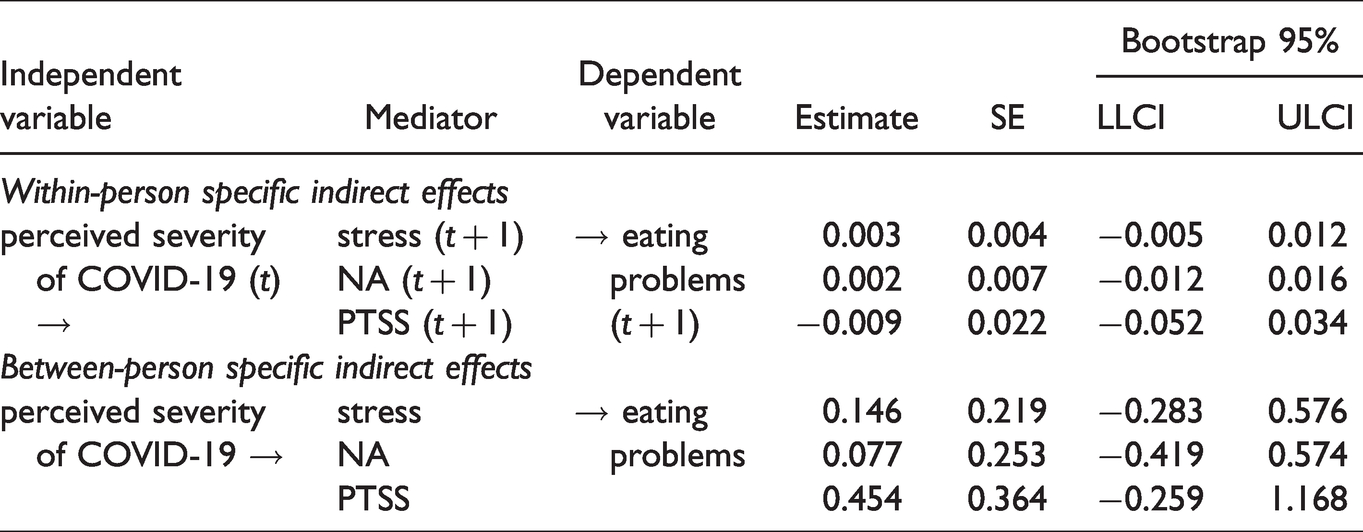
At the daily level, perceived severity of COVID-19 (B = −0.339, 95% CI [−0.580, −0.098]) predicted less subsequent eating problems. Both state NA (B = 0.035, 95% CI [0.006, 0.064]) and PTSS (B = 0.155, 95% CI [0.090, 0.220]) were positively associated with eating problems in daily life, whereas state stress (B = 0.051, 95% CI [−0.007, 0.109]) was not significantly associated with eating problems at personal level. However, perceived severity of COVID-19 did not predict subsequent state stress (B = 0.055, 95% CI [−0.075, 0.185]), NA (B = 0.071, 95% CI [−0.449, 0.592]) or PTSS (B = −0.080, 95% CI [−0.452, 0.292]), thus the mediating roles of stress/NA/PTSS in the relation between perceived severity of COVID-19 and eating problems were not significant between state perceived severity of COVID-19 and eating problems in daily life. Specific mediating effect results are shown in Table 1.
The mediating effects of stress/NA/PTSS on the relations between perceived severity of COVID-19 and eating problems at the personal level and interpersonal level.
Interpersonal level
At the interpersonal level, trait-like perceived severity of COVID-19 was associated with more overall eating problems (B = 1.517, 95% CI [0.142, 2.892]). Trait-like stress (B = 0.645, 95% CI [0.306, 0.985]), NA (B = 0.304, 95% CI [0.070, 0.483]) and PTSS (B = 0.522, 95% CI [0.353, 0.691]) were positively associated with overall eating problems at interpersonal level. However, perceived severity of COVID-19 was not associated with stress (B = 0.235, 95% CI [-0.437, 0.908]), NA (B = 0.261, 95% CI [-1.395, 1.916]) or PTSS (B = 0.895, 95% CI [-0.428, 2.218]), thus the mediating roles of stress/NA/PTSS in the relation between perceived severity of COVID-19 and eating problems were not significant between trait-like perceived severity of COVID-19 and overall eating problems at interpersonal level. Specific mediating effect results are shown in Table 1.
Discussion
The current study used an EMA to examine the impact of the COVID-19 pandemic on eating problems and the mechanism of what might contribute to eating problems during the COVID-19 pandemic. This study showed that the relationships between the perceived severity of COVID-19, stress, NA, PTSS, and eating problems differed when examined at the personal level versus the interpersonal level.
Contrary to hypotheses at the personal level, individuals who perceived higher severity of COVID-19 showed fewer subsequent eating problems in daily life. State stress, NA, or PTSS, failed to mediate the relationship between the perceived severity of COVID-19 and subsequent eating problems because the perceived severity of COVID-19 did not predict the state stress, NA, or PTSS at the next measure time point. One potential explanation may be that to raise health awareness, and intensive press coverage was used to arouse widespread fear during the COVID-19 outbreak (Tannenbaum et al., 2015). Indeed, fear appeal campaigns may generate maladaptive fear control actions such as defensive avoidance (Witte & Allen, 2000). Berman et al. (2010) suggested that avoidance reduces anxiety in the short term but maintains anxiety in the long term, creating a reinforcing cycle of anxiety-avoidance. Similar to the cycle of anxiety-avoidance, when the public-facing the COVID-19 epidemic, inappropriate coping strategies such as avoidance may not cause more eating problems in the short term. Additionally, Brose et al. (2021) found that individuals who felt more capable of dealing with the COVID-19 pandemic also felt more able to cope with new challenges in daily life, which may have led to lower NA turn. This may be the reason why the state perceived severity of COVID-19 did not predict the state stress/NA/PTSS in daily life. Moreover, it should be noted that all of our participants were college students. During the pandemic, the role of university support was positively associated with students' optimistic attitudes towards COVID-19 (Kleiman et al., 2020). Future research should examine more cognitive appraisal factors such as perceived support and control expectancy to explore the COVID-19 effect on mental health. Another possible reason may be that for EMA, choosing the most appropriate sampling frequency is a significant challenge, and it can substantially influence the obtained results (Bolger & Laurenceau, 2013). This study measured state variables three times a day, which might have caused us to miss fluctuations, limiting our ability to accurately capture dynamics is related to state variables. A more intensive sampling frequency should be recommended in the future study.
The results at the personal level partially supported our hypotheses. The present study found that state NA and PTSS were positively associated with eating problems in daily life. Specifically, higher state NA and PTSS at one moment were associated with more restrained eating or overeating at the same measurement time during the COVID-19 epidemic.
Regarding the interpersonal level, concordant with our hypothesis, the perceived severity of COVID-19 was significantly associated with overall eating problems. Specifically, individuals with higher overall perceived severity of COVID-19 reported more eating problems. We found that trait-like stress, NA, and PTSS were positively associated with overall eating problems at the interpersonal level, which was consistent with previous research (Berg et al., 2017; Mitchell & Wolf, 2016; Torres & Nowson, 2007). The present research findings could further support the stress-eating-obesity model (Talbot et al., 2013) and emotion regulation model (Leehr et al., 2015).
However, trait-like stress, NA, or PTSS, did not mediate the relationship between trait-like perceived severity of COVID-19 and overall eating problems. This article presented that the perceived severity of COVID-19 was not significantly related to trait-like stress, NA, or PTSS at the interpersonal level, which is inconsistent with previous research (Li et al., 2020; Quan et al., 2017). The discrepancies observed between the literature and our findings on the trait-like association might have the following reasons. First, it might be that a decrease in mental health symptoms occurred after some initial COVID-19 outbreak increase (Brose et al., 2021). For example, Buecker et al. (2020) used a daily diary study to assess daily loneliness and found that loneliness slightly increased during the first two weeks since implementing the pandemic-related measures and slightly decreased thereafter. Notably, Chinese authorities imposed lockdown measures on January 23, 2020 (Wang et al., 2020). We conducted the assessment (February 1, 2020) when the anti-COVID-19 measures were already implemented for one week. Therefore, psychological reactions such as stress, NA, and PTSS followed the curve trajectory of declining after the initial increase. Thus, stress/NA/PTSS might have decreased after one-week lockdown measures. Accordingly, the overall perceived severity of COVID-19 did not significantly predict the trait-like stress/NA/PTSS at the interpersonal level. Second, it could be due to our measurement of trait-like perceived severity of COVID-19, stress, NA, and PTSS as an average of the participant responses across the EMA monitoring period. Compared to assessing how the participant generally felt, the ambulatory method was more likely to obtain a different result (Stevenson et al., 2019). Third, the measurement of the perceived severity of COVID-19 only contains a single item. Indeed, assessing individuals' mental health using a single-item scale for providing general health indicators is commonly used in epidemiological studies to reduce respondents' burden (Yıldırım & Güler, 2020). Future studies should assess this variable by using multiple-item scales such as perceived controllability and knowledge of the epidemic to present more solid evidence regarding the predictive validity of psychological outcomes.
Implication
This study has several theoretical and practical implications. Theoretically, the findings deepen our understanding of the critical role of the perceived severity of COVID-19 and several mental health problems (stress, NA, and PTSS) in eating problems during the outbreak of COVID-19. Practically, alleviating the public's state and overall perceived severity of COVID-19, stress, NA, and PTSS might be a promising way to reduce eating problems after the outbreak. Furthermore, individuals with eating problems should be considered at risk of developing eating disorders (Franko & Omori, 1999; Talbot et al., 2013). Therefore, some measures should be adopted to prevent eating problems, such as encouraging individuals to the psychological hotline services to improve mental health and reduce problematic eating behaviors in daily life.
Limitation
First, this study has a relatively small sample, and women were over-represented. Second, all of the participants were healthy college students who were in home confinement. It is unknown whether the results can be generalized to other samples, especially clinical eating disorder samples. Third, the current study lacks a specific measure for emotion dysregulation, and further studies should be added to measure emotion dysregulation. Forth, participants only reported their subjective eating problems without offering any objective eating behavior information. Further studies are encouraged to gather additional information such as calorie intake, which may reflect individuals' eating problems from subjective and objective perspectives.
Conclusion
Perhaps the most interesting finding of the current study was the difference in perceived severity of COVID-19's association with eating problems between the personal level and interpersonal level. We found that the overall perceived severity of COVID-19 could cause serious eating problems at the interpersonal level. However, the perceived severity of COVID-19 predicted fewer subsequent eating problems in daily life at the personal level. While these results should be interpreted as preliminary, findings highlight the importance of considering the interplay between personal level and interpersonal level factors when addressing the COVID-19 epidemic. Remarkably, it should be noted that the positive impact of state perceived severity of COVID-19 only appeared for a moment, and the cumulative effect of perceived severity of COVID-19 could be deleterious in the long term. Also, our findings suggested that EMA could consider subtle differences between within-person and between-person.
Footnotes
Declaration of Conflicting Interests
The author(s) declared no potential conflicts of interest with respect to the research, authorship, and/or publication of this article.
Funding
The author(s) disclosed receipt of the following financial support for the research, authorship, and/or publication of this article: This work was supported by the National Natural Science Foundation of China Youth Program (grant numbers 31800929) and the Fundamental Research Funds for the Central Universities (grant numbers 2020NTSS42). This funding supported for the conduct of the research (i.e., study design; collect data, analysis, and interpretation of data).
