



Abstract
Research has shown a relationship between attachment style and psychosocial adjustment in adolescents. Whereas secure attachment is related to fewer internalizing and externalizing symptoms, the opposite is the case for the various insecure attachment styles. The aim of the two studies reported in this paper was to adapt and validate the CaMir-R (a self-report measure of attachment that has shown adequate psychometric properties) for use among Basque adolescents, and to analyse the relationship between attachment and internalizing and externalizing symptoms. In Study 1, the instrument was adapted using the back translation method and applied to a sample of 203 adolescents and young adults. Confirmatory factor analysis supported the theoretical dimensions of the scale, and its psychometric properties were found to be adequate. In Study 2 we obtained additional validity evidence by applying, in a sample of 786 adolescents and young adults, the attachment representations section of the CaMir-R alongside other measures of attachment and clinical symptoms. The results once again supported the dimensional structure of the instrument, and evidence of convergent validity was obtained based on correlations between CaMir-R scores and scores on the Inventory of Parent and Peer Attachment (IPPA). In addition, scores on the five dimensions of attachment representations (Security, Family concerns, Parental interference, Self-sufficiency and resentment of parents and Childhood trauma) were correlated with scores on other measures of internalizing and externalizing symptoms. Based on these results, we conclude that the Basque version of the CaMir-R is a valid instrument for assessing the quality of attachment representations among adolescents, and also that internalizing and externalizing problems are related to attachment style. We discuss the importance of attachment in relation to behaviour problems and clinical symptoms.
Introduction
John Bowlby (1969/1982, 1973, 1980) argued that children are biologically hard-wired to seek close contact with their main caregivers, especially in situations where they need comfort and protection. This adaptive system encourages the development of an emotional bond between child and caregiver, which Bowlby referred to as attachment. Numerous studies in the field of attachment have been informed by Bowlby’s theory.
The attachments that children develop are shaped by their experiences when interacting with caregivers, and these experiences become part of their cognitive and emotional schema. Accordingly, the quality of these early relationships will influence how a child sees the world and, to a certain extent, will determine the nature of his or her future interpersonal relationships (López, 2006; Mikulincer & Shaver, 2016; Thompson, 2008). However, although early experience plays a key role in relation to later life, Bowlby (1988) argued that these representations are not immutable, but rather should be seen as working models that can be revised through new interactions with significant others.
Based on Bowlby’s work and the results obtained with the experimental procedure known as the strange situation (Ainsworth & Bell, 1970), Ainsworth et al. (1978) described three attachment styles in children: secure, insecure ambivalent and insecure avoidant. This classification was subsequently validated in a sample of adults by Main et al. (1985), who added a fourth category: disorganized attachment. The model of attachment proposed by Bartholomew and colleagues (Bartholomew, 1990; Bartholomew & Horowitz, 1991) comprises two dimensions that are closely related to the aforementioned cognitive and emotional schema: the model of self (conceptualized in terms of anxiety) and the model of other (conceptualized in terms of the avoidance of intimacy). We could say that the proposal of Bartholomew and Horowitz (1991) combines categorical and dimensional models, providing a definition of categories that represent the combination of high and low levels of anxiety and avoidance, that is, of the two dimensions previously mentioned. Thus, scores on these dimensions produce four possible attachment styles. People who score low in both dimensions would be classified as securely attached and would have a positive view of themselves and others thanks to the constant care and attention they received during their childhood. People who score high in anxiety and low in avoidance would be classified as worried people, and would have a negative view of themselves, but a positive view of others because they received care in their childhood, but in an inconsistent way. Third, people who score low in anxiety and high in avoidance, classified as dismissive, would have, contrary to the previous ones, a positive vision of themselves, where they see themselves as resilient and that they do not need others, but a negative view of others due to the lack of care and attention received in childhood. Finally, people who score high in both dimensions, classified as fearful, would have a negative view of both themselves and others. These people, like people with worried styles, seek social contact, but in this case, they are inhibited by the fear of rejection, which leads to a style of approach and avoidance behaviour in interpersonal interactions in adult life.
Attachment and Adolescent Mental Health
Mental health disorders are very common in adolescence. Following universally accepted standard criteria for the classification of mental disorders in childhood and adults in DSM-5 (APA, 2013) and ICD-10 (WHO, 1990), both emotional and behavioural problems (EBP) can also be classified as either internalizing (emotional disorders such as depression, anxiety and obsession-compulsion) or externalizing (disruptive behaviours such as ADHD-Attention-Deficit Hyperactivity disorder, ODD-Oppositional Defiant Disorder and CD-Conduct Disorder) problems (Ogundele, 2018). The causes of adolescence EBPs are unknown, but several studies have identified adverse family factors that increase the risk of developing any of these problems, for example: maternal psychopathology (Bagner et al., 2012; Plant et al., 2013), poor child–parent relationship (Smeekens et al., 2007) or adverse family life (Brody et al., 2002). In fact, psychological adjustment in adolescence is related to attachment, and it is based on specific representations of their interactions with past and present attachment figures (Allen & Tan, 2016).
Although attachment theory was originally focused on childhood, the study of attachment relationships at later developmental stages has revealed that they continue to play an important role in individual wellbeing (Ainsworth, 1985; Lacasa & Muela, 2014). For example, various studies have examined the association between attachment styles and the psychosocial adjustment of adolescents, showing that insecure attachment is correlated with more psychological symptoms, whereas secure attachment is related to better adjustment (Keskin & Çam, 2010; Muris et al., 2001; Scott-Brown & Wright, 2001; Seiffge-Krenke, 2006). Accordingly, insecure attachment styles have been considered risk factors for mental health problems in children and adolescents (Groh et al., 2017). More specifically, an insecure attachment style in adolescence has been linked to more internalizing (Madigan et al., 2016; Muris et al., 2003; Tambelli et al., 2012) and externalizing behaviours (Allen et al., 2007; Madigan et al., 2016; Muris et al., 2003; Tambelli et al., 2012). The meta-analysis by Madigan et al. (2016) found that within the internalizing spectrum, the magnitude of the correlation between attachment and depression was greater than that observed for anxiety or broadband internalizing behaviour. Other authors have likewise reported a relationship between insecure attachment and depression in adolescence (Allen et al., 2007; Lee & Hankin, 2009).
Among the different types of insecure attachment, various studies have found that adolescents with an insecure ambivalent style tend to show more internalizing symptoms (Allen et al., 1998; Bakermans-Kranenburg & van IJzendoorn, 2009; Lacasa et al., 2015; Scott-Brown & Wright, 2003), whereas preoccupied attachment representations have been related to greater anxiety (Dagan et al., 2020). As regards externalizing problems, these have been linked to an insecure avoidant style (Bakermans-Kranenburg & van IJzendoorn, 2009; Reimer et al., 1996). In addition, disorganized attachment appears to be more closely related to externalizing than internalizing symptoms (Groh et al., 2012).
Taken together, these findings lead us to anticipate that adolescents with insecure attachment styles (preoccupied, avoidant, and disorganized teens), compared to those with secure attachment, will present greater emotional and behavioural problems. In a more detailed way: (1) A preoccupied attachment style will correlate mainly with internalizing problems as anxiety or social anxiety; (2) An avoidant attachment style will correlate principally with externalizing problems that concern the school environment (attention, hyperactivity, impulsivity or anger control problems); and (3) A disorganized attachment style will correlate mainly with externalizing problems that affect relationships with their peers and family (defiant or antisocial behaviours).
Assessment of Attachment
With respect to the assessment of attachment, both clinician and self-report measures are available. Among the former, the most widely used instrument in adolescents and adults is the Adult Attachment Interview (AAI; George et al., 1985), with subsequent versions being developed to study attachment in preteens and adolescents: the Child Attachment Interview (CAI; Shmueli-Goetz et al., 2008) and the Attachment Interview for Childhood and Adolescence (AICA; Ammaniti et al., 2000), respectively. Notable among self-report instruments are the Adolescent Attachment Questionnaire (AAQ; West et al., 1998), the Attachment Style Questionnaire (ASQ; Feeney et al., 1994), the Experiences in Close Relationships scale (ECR; Brennan et al., 1998), the Parental Bonding Instrument (PBI; Parker et al., 1979) and the Inventory of Parent and Peer Attachment (IPPA; Armsden & Greenberg, 1987). Importantly, however, very few instruments have been adapted for use in the Spanish or, more specifically, the Basque population, and this is especially evident when it comes to measures designed for adolescents.
One of the few instruments that has been adapted for use with Spanish adolescents is the CaMir (Cartes-Modèles Individuels de Relations; Pierrehumbert et al., 1996; Spanish adaptation by Lacasa, 2008), originally created in French and that has also been adapted to English and Italian. It is a self-report instrument based on Bowlby’s attachment theory that measures attachment styles or prototypes (secure, avoidant and preoccupied), attachment cognitions regarding specific aspects of attachment (e.g. parental attitudes, experiences and personal reactions in determined circumstances) and conceptions of family functioning. It can be used both as a traditional self-report questionnaire (5-point Likert-type response format), and as a Q-Sort instrument. In both versions, items are written on a card, and respondents are asked to put the cards in five piles, ordered from the less pertinent (‘not at all true for me’) to the more pertinent (‘very true for me’). In the Q-Sort version, items are to be placed according to a forced distribution, resembling a normal distribution, while in the Likert format, the distribution is free. In both versions, the administration is somewhat complex as it comprises 72 items that are applied in two different stages. The CaMir is therefore a lengthy questionnaire that requires about an hour to complete, and it must be administered by a qualified professional. In light of this, a shortened Spanish version of the instrument (the CaMir-R- Cartes-Modèles Individuels de Relations-Reduced) has been developed (Balluerka et al., 2011) with the aim of allowing a quicker and more straightforward assessment of attachment representations and family structure in adolescent population. The CaMir-R comprises 32 items that were selected, among the 72 items of the original version, based on their contribution to the corresponding factors. The items of the CaMir-R are rated using a 5-point Likert-type response format, and it takes around 20 minutes to complete, thus making it much easier to apply than the original instrument (all the adaptations of the CaMiR are accessible on the web: ttps://sites.google.com/view/blaise-pierrehumbert/).
In terms of its internal structure, the CaMir-R consists of seven dimensions, five of which refer to attachment representations: Security: Availability of and support from attachment figures (SE); Family concerns (FC); Parental interference (PI); Self-sufficiency and resentment of parents (SR) and Childhood trauma (CT). The other two dimensions concern representations of family structure: Value of parental authority (VA) and Permissive parenting (PP). The dimensions referring to attachment representations are associated with secure attachment (SE), preoccupied attachment (FC and PI), avoidant attachment (SR) and disorganized attachment (CT).
Reliable assessment requires the availability of instruments that have been adapted to the mother tongue of the target population. This is a big concern in bilingual regions like ours where 20.5% of the population have Basque as their first language, percentage that rises to 25.0% in 16–24 age group (Basque Government, 2019). And even though, there is a huge scarcity of assessment instruments adapted to that language. Furthermore, the relationship between attachment representations and clinical symptoms can only be examined if these constructs are properly measured. With this in mind, the present paper reports two studies conducted with the following two objectives: (1) To adapt the CaMir-R for use with adolescents whose first language is Basque, and to provide validity evidence based on its internal structure, the ultimate objective being to provide both clinicians and researchers with access to a new tool; and (2) To examine the possible relationships between attachment representations and both internalizing and externalizing symptoms in adolescence.
Objective
The aim of Study 1 was to develop a Basque version of the CaMir-R and to examine its psychometric properties in terms of internal structure and consistency.
Method
Participants
A convenience sample of 203 students was recruited from four schools or colleges in the Basque Country. They ranged in age from 12 to 21 years (M = 14.43; SD = 2.03), 85% of them being between 12 and 16, and 57.6% were female. The majority were enrolled in compulsory secondary education (82.8% of the sample), with the remainder being either university (10.8%) or baccalaureate students (6.4%).
Instruments
The short Spanish version of the CaMir (CaMir-R; Balluerka et al., 2011) measures attachment representations and family structure through 32 items grouped into seven dimensions. Items are answered using a 5-point Likert-type scale (1 = Totally disagree, 5 = Totally agree). In this study, we applied the Basque version that was in the process of being adapted, which contains the same number of items and uses the same response format as the CaMir-R. This instrument was complemented with a short questionnaire designed to gather sociodemographic information, plus two questions exploring possible difficulties in understanding the items proposed in the Basque adaptation.
Procedure
The CaMir-R was adapted for use in the Basque language (hereinafter, the CaMir-R-B) using the back translation method (Balluerka et al., 2007; Hambleton, 1996). Two psychologists with expert knowledge of the construct of interest produced independent translations of the CaMir-R and then met to agree on a preliminary Basque version, which was then back translated into Spanish by two different psychologists, also experts in the field and again working independently. Once agreement had been reached on the back translated version, all four translators met to compare it with the original and to identify any problems of equivalence of meaning. The wording of items in Basque was revised and modified, if necessary, to ensure suitability for the target population. All four psychologists were bilingual Spanish/Basque speakers and were familiar with the construct to be assessed (two of them were the authors of the CaMir-R). They also had knowledge of the process of adapting assessment instruments. The data were collected throughout 2017.
The instruments were administered collectively in the students' usual classroom during their normal timetable by a psychologist with research experience, and it took a maximum of 30 minutes to complete them. Informed consent was obtained from all students prior to any data collection, and in the case of those under the age of 18 this was complemented with parental consent. The heads of each school or college signed permission for the study to be conducted on their premises, and approval was obtained from the Ethics Committee for Research Involving Humans of the University of the Basque Country.
Data Analysis
We began by conducting an item analysis to determine the proportion of missing responses and the mean score and SD for each item. Internal consistency was assessed by calculating Cronbach’s alpha coefficient for each dimension, as well as correlated item-total correlations. Confirmatory factor analysis (CFA) was performed to examine whether the factor structure of the Basque version was consistent with that of the original instrument. To this end, we analysed three models. The first was a seven-factor model that included all the dimensions of the CaMir-R-B, covering both the attachment representations and representations of family structure sections. The purpose of models 2 and 3 was to confirm the structure of each section separately, that is, a five-factor model referring to attachment representations and a two-factor model for representations of family structure. The estimation method used was weighted least squares (WLSMV). Goodness-of-fit was assessed by means of the comparative fit index (CFI), the Tucker–Lewis index (TLI) and the root mean square error of approximation (RMSEA). In the case of the CFI and TLI, values above .90 and .95 indicate acceptable and excellent fit, respectively. For the RMSEA, values below .08 indicate acceptable fit, and those below .06 a good fit (Hu & Bentler, 1999). We used Mplus for the CFA, and SPSS for all other analyses. In order to handle missing data, pairwise deletion was used.
Results
Means, Standard Deviations, Corrected Item-Total Correlations and Percentage Of Unanswered Items.
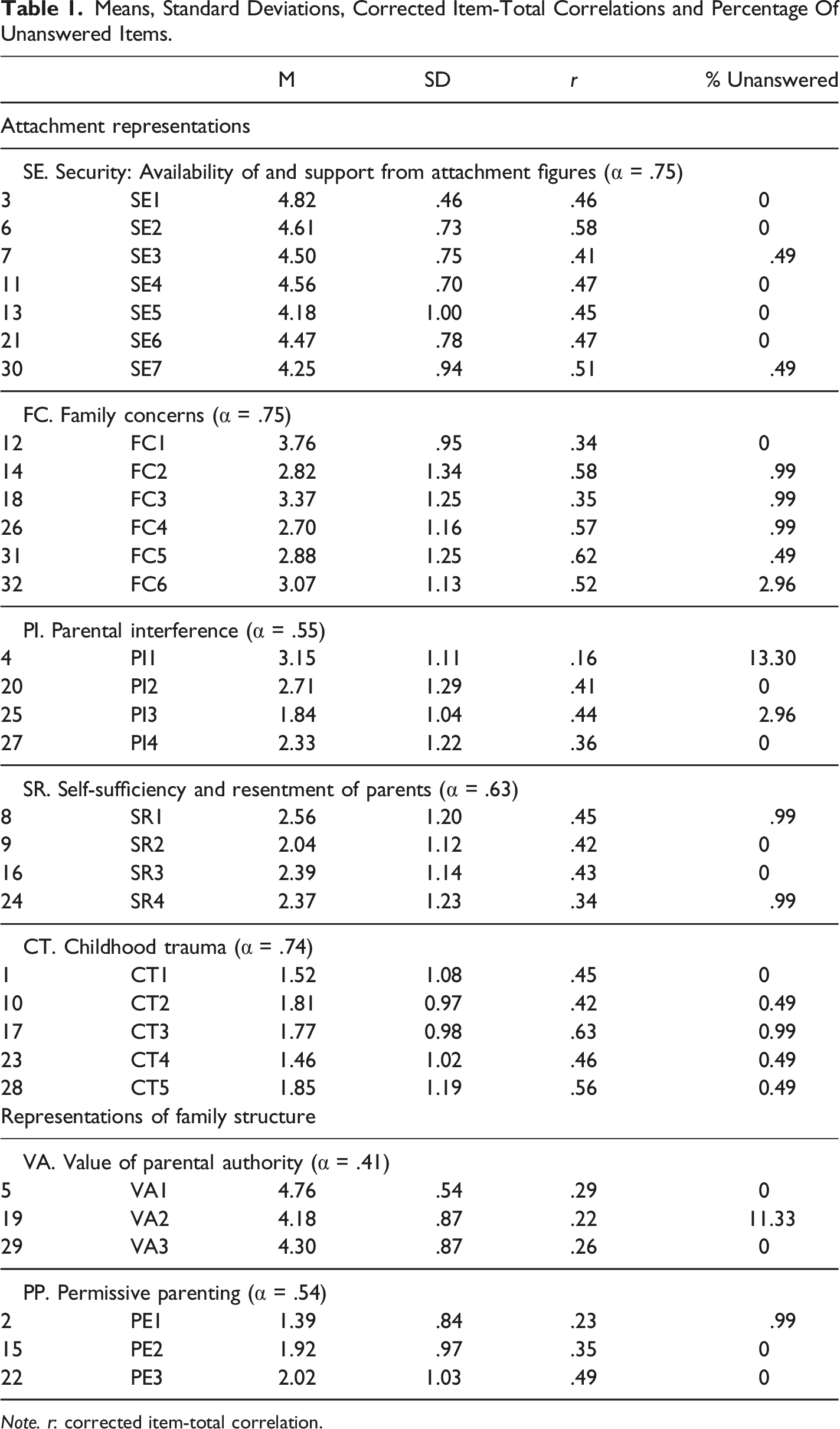
Note. r: corrected item-total correlation.
Results of the Confirmatory Factor Analyses (N = 203).
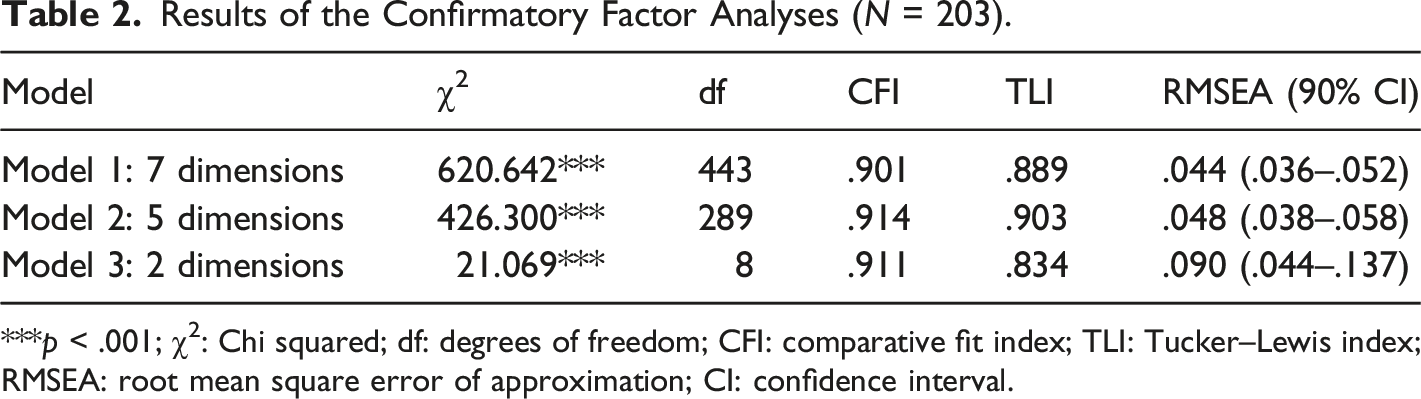
***p < .001; χ2: Chi squared; df: degrees of freedom; CFI: comparative fit index; TLI: Tucker–Lewis index; RMSEA: root mean square error of approximation; CI: confidence interval.
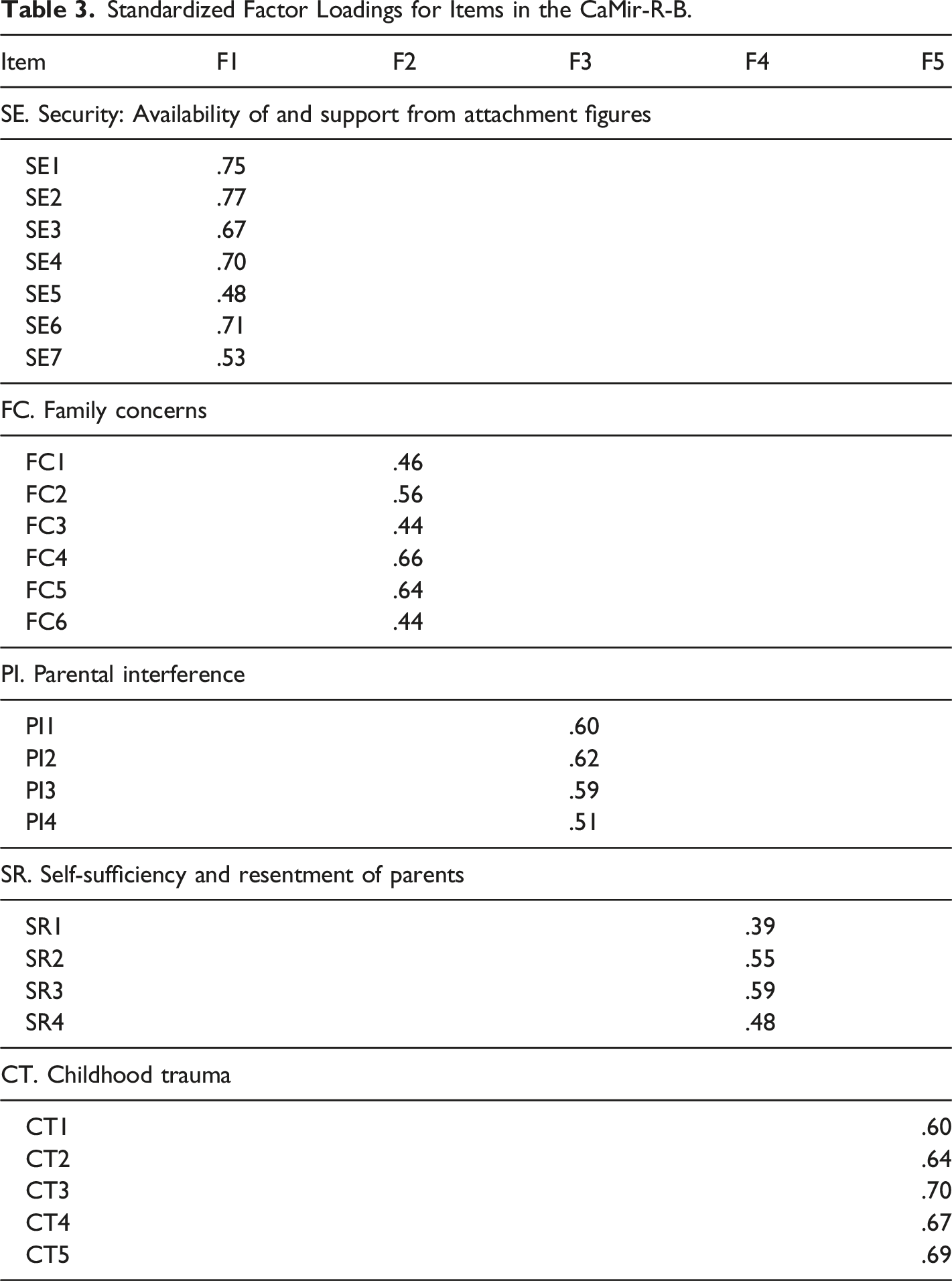
In the two models (1 and 2) that showed adequate fit, almost all the items had statistically significant factor loadings above .40, the exceptions being item PI4, with factor loadings between .30 and .40, and item PI1, with non-significant factor loadings close to zero in both models. In addition, all the correlations between dimensions (ranging from .10 to .75 in Model 1 and from .10 to .68 in Model 2) were below the suggested threshold of .90 (Kline, 2005). Supplemental Tables 1 and 2 show the standardized factor loadings for these two models.
Conclusions
The results of the CFA in this first study support the theoretical dimensions of the CaMiR-R-B, confirming the five-factor structure in the section of the instrument corresponding to attachment representations and the two-factor structure for representations of family structure. In addition, the acceptable fit indices obtained when testing Model 2 indicate that the attachment representations section (comprising five dimensions) may be applied independently. The indices of internal consistency and item homogeneity were also found to be adequate, with the exception of item 4 (PI1). Because of the low values it yielded, we decided to reformulate this item so as to make it more consistent with its corresponding dimension. We made the decision to rephrase the item instead of deleting it because eliminating items would probably affect the reliability and the validity of the test. It should also be noted that the indices of internal consistency were lowest for the two dimensions corresponding to representations of family structure, but values in all cases were similar to those obtained when developing the short Spanish version of the CaMir (Balluerka et al., 2011). Supplemental Table 3 shows the items included in the definitive version of the CaMiR-R-B.
Objectives and Hypotheses
A first objective of this study was to provide additional evidence of internal consistency, temporal stability and structure for the attachment representations section of the CaMir-R-B developed in Study 1. In addition, we sought to obtain evidence of convergent validity based on correlations between CaMir-R-B scores and scores on the Basque version of the Inventory of Parent and Peer Attachment (IPPA). In relation to this objective, we hypothesized positive correlations of the Security dimension of CaMir-R-B and negative relationships of the rest of the dimensions of CaMir-R-B with the IPPA.
The second objective of this study was to examine possible relationships between attachment representations and internalizing and externalizing symptoms. In relation to this objective, we expected negative correlations of the Security dimension of Camir-R-B and positive correlations of the other dimensions of Camir-R-B with internalizing and externalizing symptoms. More concretely, we expected that FC and PI (dimensions related to preoccupied attachment style) would be positively correlated with internalizing symptoms such as anxiety and social anxiety; whereas SR (the dimension related to avoidant attachment style) would be positively related to externalizing symptoms like attention, hyperactivity, impulsivity or anger control problems and CT (the dimension related to disorganized attachment style) would be positively related to externalizing symptoms like defiant and antisocial behaviour.
Method
Participants
The initial sample for this study comprised 786 individuals, of whom 22 were eliminated from the analysis due to anomalous response patterns. The final sample therefore comprised 766 students recruited from nine schools or colleges in the Basque Country. They ranged in age from 11 to 20 years (M = 14.75, SD = 1.73), more than 95% being between 12 and 17, and were evenly split in terms of gender (50.9% female). As regards their educational level, 62.7% were enrolled in compulsory secondary education (16.3% in year 1, 18.4% year 2, 15.3% year 3 and 12.7% year four) and the remainder in a baccalaureate programme (20.1% year 1 and 17.2% year two).
Instruments
We used the Basque version of the Inventory of Parent and Peer Attachment (IPPA) to assess attachment in order to obtain evidence of convergent validity, the Basque version of the Clinical and Educational Questionnaire: Anxiety and Depression (an instrument developed originally in Spanish and known as the CECAD) to assess internalizing symptoms, and the Assessment System for Children and Adolescents (an instrument developed originally in Spanish and known as the SENA) to assess both, internalizing and externalizing symptoms. Therefore, the questionnaire battery consisted of the attachment representations section of the CaMir-R-B, the Basque version of the IPPA, the Basque version of the Clinical and Educational Questionnaire: Anxiety and Depression (CECAD), and a sociodemographic questionnaire. A sub-sample of participants (n = 288) also completed the internalizing and externalizing problems subscales of the Assessment System for Children and Adolescents (SENA).
CaMir-R-B. For this study we used the 26 items that comprise the attachment representations section and which are distributed across five dimensions: SE – Security: Availability of and support from attachment figures; FC – Family concerns; PI – Parental interference; SR – Self-sufficiency and resentment of parents and CT – Childhood trauma. The response format for items was a 5-point Likert-type scale (1 = Totally disagree, 5 = Totally agree).
Basque version of the Inventory of Parent and Peer Attachment (Alonso-Arbiol et al., 2014). The IPPA assesses a young person’s attachment to both parents through a single factor that provides an overall measure of the security of attachments. In this study, we used the IPPA-Mother and IPPA-Father scales, each comprising 17 items that are responded to using a 5-point Likert-type scale (1 = Almost never or never true, 5 = Almost always or always true). Internal consistency of these scales in the present sample was high (Cronbach’s alpha of .90 and .92 for the IPPA-Mother and IPPA-Father scales, respectively).
Basque version of the Clinical and Educational Questionnaire: Anxiety and Depression (CECAD; Gorostiaga et al., 2018). The CECAD is designed to assess the two most common emotional disorders: depression and anxiety. Its two scales include a total of 50 items, each rated on a 5-point Likert-type scale (1 = Totally disagree, 5 = Totally agree). Internal consistency in the present study was adequate (Cronbach’s alpha of .86 and .93 for anxiety and depression, respectively).
Assessment System for Children and Adolescents (SENA; Fernández-Pinto et al., 2015). The SENA is a screening tool designed to detect a wide spectrum of emotional and behavioural problems in children aged 3–18. Here we used the self-report version that has been developed for respondents aged 12–18 years. The questionnaire scales are organized into three blocks corresponding to problems, vulnerabilities and personal resources. In the present study, we used only the problem scales, which assess both internalizing problems (depression, anxiety, social anxiety, somatic complaints, post-traumatic symptoms and obsession/compulsion) and externalizing problems (attention problems, hyperactivity/impulsivity, anger control problems, aggressivity, defiant behaviour and antisocial behaviour). Items are responded to using a 5-point Likert-type scale (1 = Almost never or never, 5 = Almost always or always). Internal consistency of these two dimensions in the present study was adequate (Cronbach’s alpha of .67 and .90, respectively).
Procedure
As in Study 1, the instruments were administered collectively in a classroom setting, subsequent to obtaining informed consent. The time needed to complete the whole battery was 1 hour for the participants who did not have to answer to the SENA, and 2 hours, divided into two sessions of 1 hour, for the sub-sample who also had to answer the SENA (which was answered in the second session). The instruments were applied in the following order: Sociodemographic questionnaire, attachment representations section of the CaMir-R-B, the IPPA-M, the IPPA-F, the CECAD and the problem scales of the SENA for the sub-sample of 288 participants. The data were collected throughout 2018. This second study was also approved by the Research Ethics Committee for Research Involving Humans of the University of the Basque Country.
Data Analysis
Internal consistency of the CaMir-R-B was assessed by calculating Cronbach’s alpha coefficient for each of the five dimensions. In order to analyse the temporal stability of the instrument, a sub-sample of 185 students completed it on two occasions separated by a 3-week interval. Dimensionality and the fit of the five-factor structure was examined by means of CFA with the weighted least squares estimation method (WLSMV). Evidence of convergent validity was obtained by calculating Spearman rho correlations between scores on each dimension of the CaMir-R-B and scores on the IPPA-M and IPPA-F scales. Finally, in order to examine the relationship between attachment representations and internalizing and externalizing symptoms, we calculated Spearman correlations between scores on each dimension of the CaMir-R-B and scores for anxiety and depression on the CECAD and scores for internalizing and externalizing problems on the SENA. We used Mplus for the CFA, and SPSS for all other analyses. In order to handle missing data, pairwise deletion was used.
Results
With the exception of the Self-sufficiency and resentment of parents dimension, comprising four items and with a Cronbach’s alpha of .51, values of internal consistency were above .60 on all dimensions, which is considered acceptable on scales with fewer than eight items (Balluerka et al., 2011). As regards temporal stability, correlations ranged between .59 and .77.
Standardized Factor Loadings for Items in the CaMir-R-B.
Spearman Correlations Between Scores on the Five Dimensions of the CaMir-R-B and Scores on the IPPA.
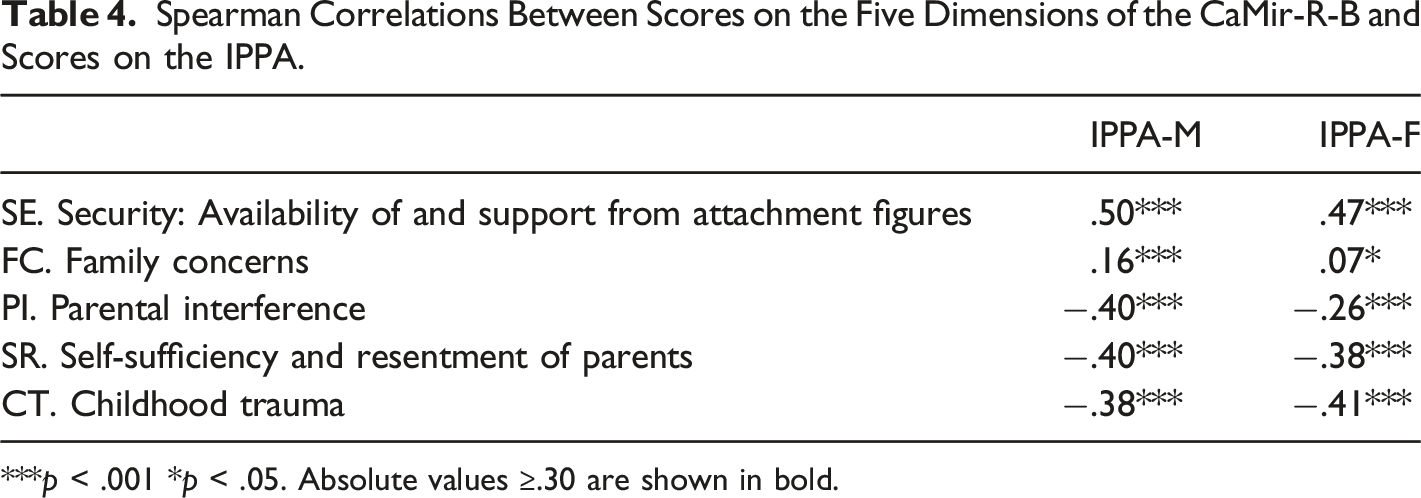
***p < .001 *p < .05. Absolute values ≥.30 are shown in bold.
Spearman Correlations Between Scores on the Five Dimensions of the CaMir-R-B and Scores on the Depression and Anxiety Subscales of the CECAD.
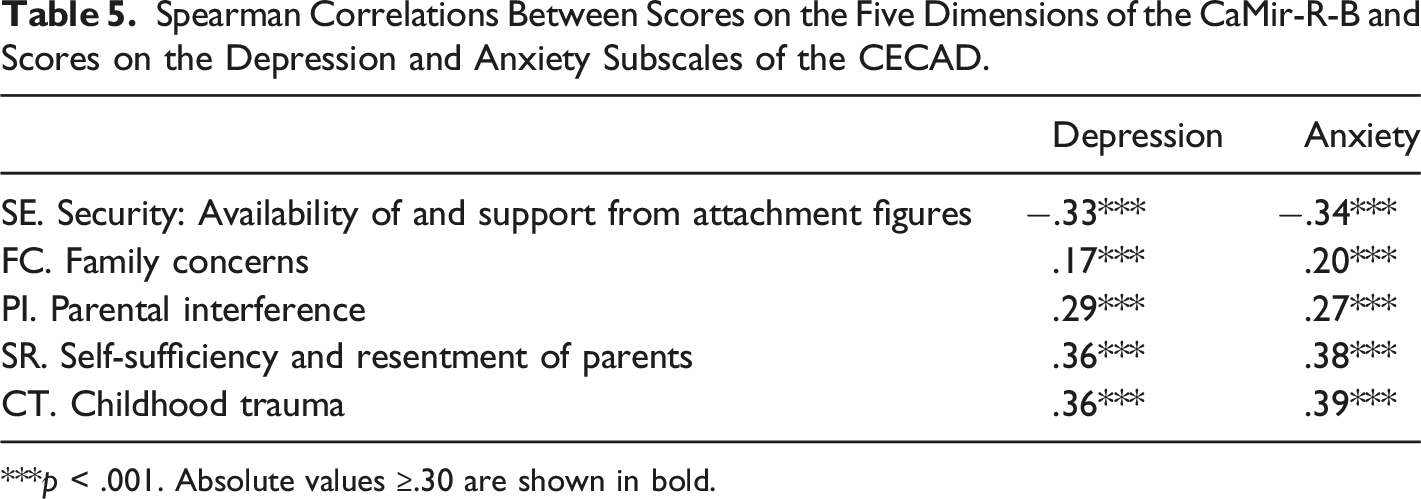
***p < .001. Absolute values ≥.30 are shown in bold.
Spearman Correlations Between Scores on the Five Dimensions of the CaMir-R-B and Scores on the Internalizing Problems Scales of the SENA.
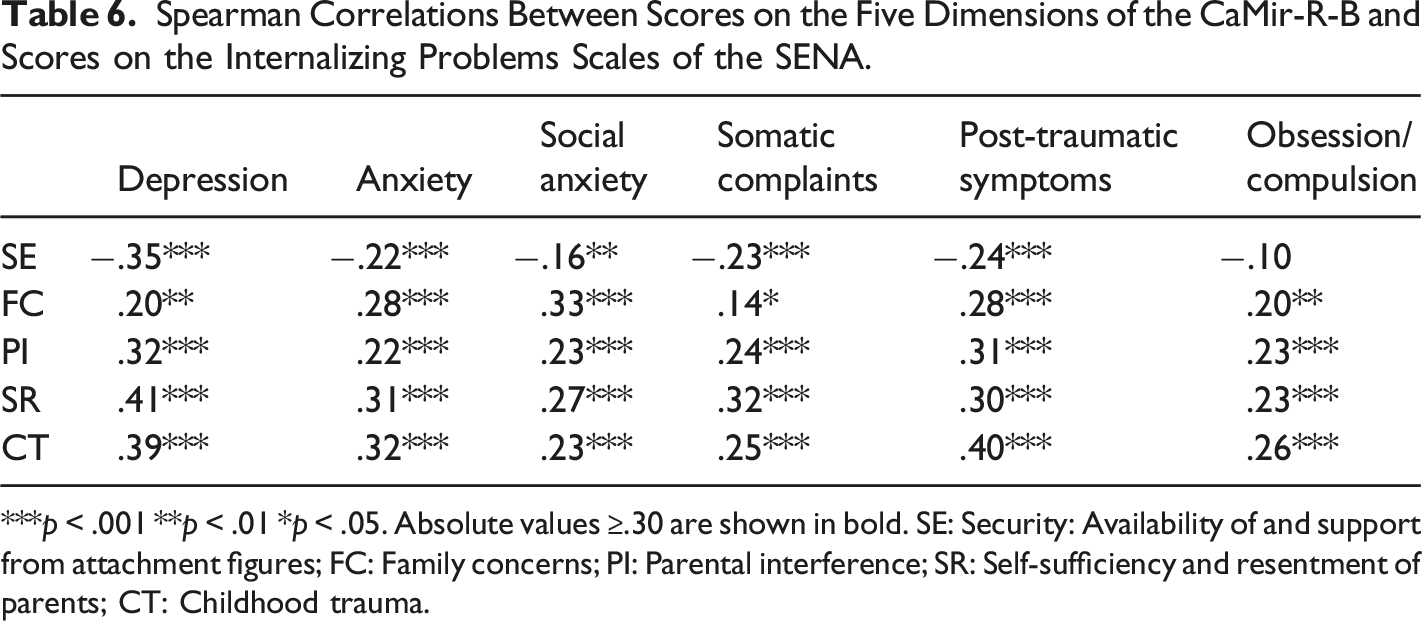
***p < .001 **p < .01 *p < .05. Absolute values ≥.30 are shown in bold. SE: Security: Availability of and support from attachment figures; FC: Family concerns; PI: Parental interference; SR: Self-sufficiency and resentment of parents; CT: Childhood trauma.
Spearman correlations Between Scores on the Five Dimensions of the CaMir-R-B and Scores on the Externalizing Problems Scales of the SENA.
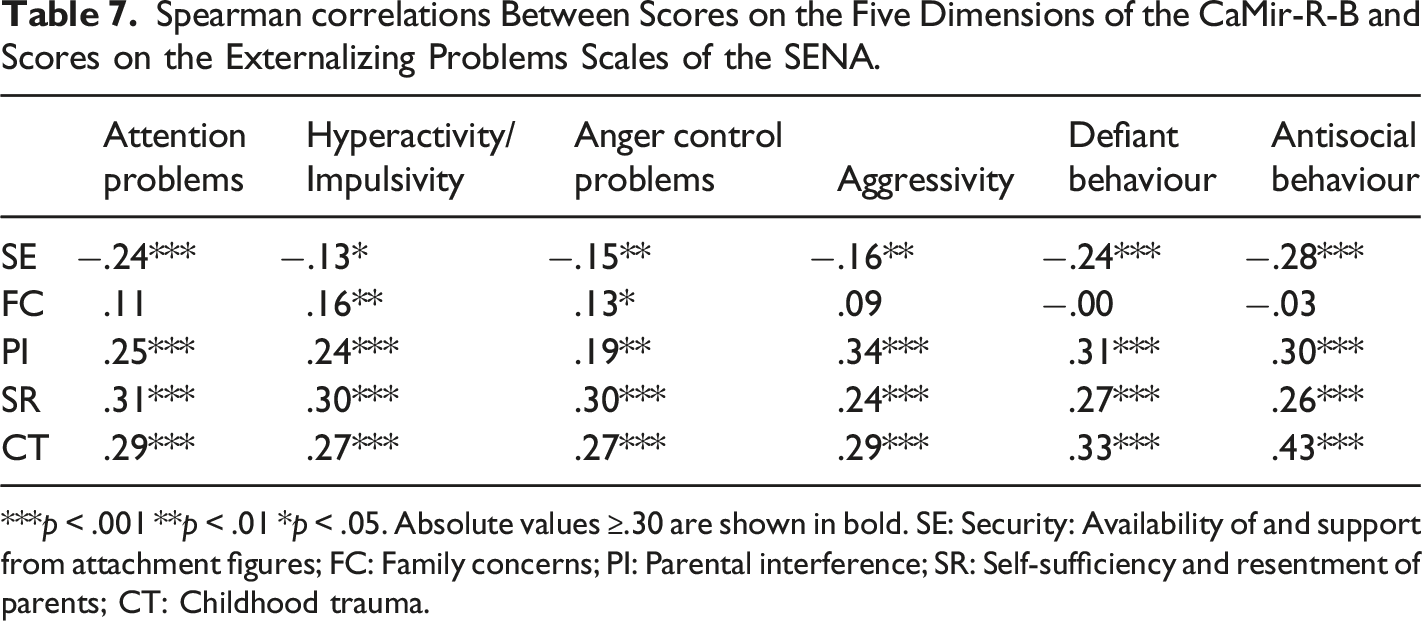
***p < .001 **p < .01 *p < .05. Absolute values ≥.30 are shown in bold. SE: Security: Availability of and support from attachment figures; FC: Family concerns; PI: Parental interference; SR: Self-sufficiency and resentment of parents; CT: Childhood trauma.
Conclusions
One of the aims of this second study was to obtain additional validity evidence for the attachment representations section of the CaMir-R-B developed in Study 1. The analysis of its dimensional structure, internal consistency and item homogeneity in a new sample yielded adequate results in each case, and we also confirmed the temporal stability of the five dimensions that comprise this section of the instrument. In addition, evidence of convergent validity was provided by the high positive correlations between scores on the secure attachment dimension of the CaMir-R-B and scores on both of the IPPA scales, and by the moderate negative correlations between the other CaMir-R-B dimensions and the IPPA, confirming the hypothesis raised.
The second objective of this study was to examine the relationship between attachment representations and internalizing and externalizing symptoms. Confirming the hypotheses in this respect, the analysis showed that scores on anxiety and depression were negatively related to scores on the secure attachment dimension and positively related to scores on the other dimensions, with the correlations obtained being similar to those reported by other authors (Allen et al., 2007; Lee & Hankin, 2009; Muris et al., 2003). More generally, and also consistent with the literature, we observed that secure attachment representations were negatively related to a broad spectrum of internalizing and externalizing problems (Allen et al., 2007; Balluerka et al., 2011; Lee & Hankin, 2009; Muris et al., 2003). As regards the other dimensions, scores on Family concerns were positively related to social anxiety, as reported by Balluerka et al. (2011). We also found that scores on Self-sufficiency, characteristic of an avoidant attachment style, were positively related to scores on both internalizing (depression, anxiety, somatic complaints and post-traumatic symptoms) and externalizing (attention problems, hyperactivity/impulsivity and difficulties controlling anger) problems, which again is consistent with previous studies (Bakermans-Kranenburg & van IJzendoorn, 2009; Reimer et al., 1996). Finally, high scores on Childhood trauma, indicative of a disorganized attachment style, were positively related to various internalizing and externalizing problems. The strong relationships we observed between scores on childhood trauma and scores on both defiant and antisocial behaviour support previous findings of an association between disorganized attachment and externalizing problems (Groh et al., 2012).
General Discussion
The primary objective of the two studies reported here was to develop a Basque version of the CaMir-R and to provide validity evidence based on its internal structure. To this end, we administered two questionnaire batteries, both including the newly adapted Basque version of the instrument (the CaMir-R-B), to two samples of adolescents in the Basque Country. The results supported the validity and reliability of the new instrument, and especially of the five dimensions comprising its attachment representations section. Overall, we conclude that the CaMir-R-B is a quick and simple tool for assessing both attachment representations and family structure in Basque adolescents, a population for which validated instruments of this kind are lacking.
Regarding our second objective of examining the relationship between adolescents' attachment representations and both internalizing and externalizing problems, the results of Study 2 indicate the presence of a strong association, as reported previously in the adult population (Pianta et al., 2006; Soares & Dias, 2007). Although it is not possible to infer a causal relationship between attachment style and the emotional and behavioural problems considered, the observed association does highlight the importance of intervention programmes aimed at improving family relationships. As social beings, our interpersonal relationships, especially those with significant others, play an important role in shaping our social and emotional adjustment.
The present research does have certain limitations. Although the sample was fairly large, it did not include a clinical population and the data were obtained through self-report measures. That said, although the validity of self-reports can be undermined by a tendency for people to respond based on their particular mood state at the time of answering, or even to underestimate their own health status, this is usually more of an issue with younger children. Additionally, the fact of including participants of a wide age range, although on the one hand provides external validity, on the other hand, it also implies the possibility that people of different ages could interpret certain items in which childhood memories are referred to differently. Finally, it should also be noted that the data were collected before the COVID-19 pandemic. Although it is true that the world has changed as a result of said pandemic, we understand that the data obtained and analysed in these studies continue to be generalizable to the post-pandemic situation. Future studies should nevertheless aim to obtain further validity evidence for the instrument developed here by obtaining parental reports of children’s attachment style and/or by using observational techniques, thus enabling comparison of the correlations obtained with those derived from self-reports. It would also be useful to apply the CaMir-R-B to clinical populations or to young people in family or residential foster care, as the literature suggests that insecure attachments are more likely in these situations. Confirmation in these contexts of a strong relationship between insecure attachment styles and measures of psychopathology would provide evidence of criterion validity. Notwithstanding these limitations, the CaMir-R-B is a short and easy-to-apply tool for assessing both attachment representations and family structure, and its psychometric properties have been shown to be adequate. We therefore consider that the present research makes a useful contribution to the field of attachment, providing both a new assessment instrument and further support for the relationship between attachment style and internalizing and externalizing problems in adolescents.
Practical Implications
Adolescence is a period in which people suffer negative mood states of great intensity, experiencing, in turn, difficulty in regulating emotions (Schweizer et al., 2020). Therefore, adolescents constitute a vulnerable group as regards mental health. The pandemic caused by the coronavirus has reaffirmed this reality. In fact, some studies aimed at analysing the psychological consequences of the pandemic and the confinement associated with it, have shown that adolescents are one of the groups that have suffered the greatest psychosocial impact, showing worrying levels of anxiety and depression (Gómez-Gómez et al., 2020).
However, there are studies that point out that the measures adopted to confront the pandemic have also been able to activate protective factors. In an international study recently published by Pirkis et al., 2021, carried out in 21 countries, the authors concluded that although levels of anxiety, depression and thoughts of suicide increased in the first months of the pandemic, protective factors also emerged, such as the collective feeling of community, support for vulnerable people through new technologies, or the permanence of long periods of time accompanied at home and that these factors reduced stress and the feeling of isolation and emptiness. These results corroborate the importance of family and social ties for mental health, especially in adolescence.
In this context, the present study provides an instrument that makes it possible to rigorously evaluate both attachment representations and family structure associated with internalizing and externalizing symptoms in adolescence. With this, it would be possible to detect those adolescents who are especially vulnerable to adverse psychological effects derived from stressful events, which acquires special relevance in a pandemic and post-pandemic context. As we have pointed out above, some studies focussing on the psychological effects of the pandemic have corroborated the importance of social support to face the emotional and behavioural problems that may arise in adolescents in difficult situations. Therefore, it is necessary to design interventions aimed at strengthening interpersonal relationships, especially with significant others, from an early age. In addition to the instrument to assess attachment representations and family structure, our study provides evidence that justifies the need for such interventions.
Supplemental Material
sj-pdf-1-prx-10.1177_00332941211057147 – Supplemental Material for Assessment of Attachment Representations in Basque Adolescents and their Relationship with Internalizing and Externalizing Problems
Supplemental Material, sj-pdf-1-prx-10.1177_00332941211057147 for Assessment of Attachment Representations in Basque Adolescents and their Relationship with Internalizing and Externalizing Problems by Jone Aliri, Nekane Balluerka, Arantxa Gorostiaga and Goretti Soroa in Psychological Reports
Footnotes
Declaration of Conflicting Interests
The author(s) declared no potential conflicts of interest with respect to the research, authorship, and/or publication of this article.
Funding
The author(s) disclosed receipt of the following financial support for the research, authorship, and/or publication of this article: This research was funded by a grant from the Basque Government (IT892-16).

Supplemental Material
Supplemental material for this article is available online.
Author Biographies
References
Supplementary Material
Please find the following supplemental material available below.
For Open Access articles published under a Creative Commons License, all supplemental material carries the same license as the article it is associated with.
For non-Open Access articles published, all supplemental material carries a non-exclusive license, and permission requests for re-use of supplemental material or any part of supplemental material shall be sent directly to the copyright owner as specified in the copyright notice associated with the article.
