



Abstract
In recent years, the study of perfectionistic automatic thoughts (PAT) has increased given its maladaptive nature since it is link to numerous psychological disorders. From our knowledge, no previous research has addressed the relationship between PAT and the four components of aggressive behavior (anger, hostility, verbal aggression, and physical aggression). This study had a double goal. The first aim was to identify distinct profiles of PAT in a sample of 3060 Ecuadorian undergraduates (Mage = 22.7, SD = 2.46). The second aim of this study was to determine whether or not statistically significant differences exist between these profiles, based on the four components of aggressive behavior. The Perfectionism Cognitions Inventory (PCI) and the Aggression Questionnaire (AQ) were used. Five profiles with different intensities in the dimensions of perfectionistic automatic thoughts were identified by Latent Class Analysis ((1) No-Perfectionistic Automatic Thoughts, (2) Low Perfectionistic Automatic Thoughts, (3) High Perfectionistic Demands, (4) Moderate Perfectionistic Automatic Thoughts, and (5) High Perfectionistic Automatic Thoughts). The moderate and high perfectionistic automatic thoughts profiles obtained the highest mean scores for all components of aggressive behavior (i.e., the four factors that make up AQ: Physical Aggression, Verbal Aggression, Anger, and Hostility), while the No-perfectionistic automatic thoughts and Low perfectionistic automatic thoughts profiles had the lowest mean scores. These results provide new knowledge about the prevalence of PAT in the context of Ecuador. Also, they suggest further research on the topic given the positive relationship of PAT and aggressive behavior.
Keywords
Introduction
Perfectionism, a multi-dimensional personality trait resulting from the self-imposition of high standards and excessive personal sacrifice and with the objective of achieving high performance (Smith et al., 2018), is an increasingly popular construct for study by scientific researchers, given its high prevalence and close relationship with numerous psychopathological variables (Flett & Hewitt, 2020a). In fact, in a recent publication referring to current times, Flett & Hewitt (2020b) warned of the high presence of perfectionism in the general population. They referred to the so-called “perfectionism pandemic,” suggesting the need to reflect on the psychological distress that may be experienced by these individuals and that may be on the rise, given the stress and anguish caused by situations outside of their control, such as the COVID19 crisis or other life situations, due to our ever-changing world, even when we are not in the midst of a global pandemic.
Therefore, studies on perfectionism should be continued, since previous works have warned of its negative influence on affected individuals (Babapour et al., 2015; Flett & Hewitt, 2014). This appears to be caused by its cognitive, emotional, and behavioral foundations (Newman et al., 2019) and due to the association of multiple and diverse psychopathological constructs in both adults (Buzzichelli et al., 2018; Gautreau et al., 2015; Mahmoodi-Shahrebabaki, 2017) and children/youth (Inglés et al., 2016; Vicent, Inglés, & García-Fernández, 2019; Vicent, Inglés, Gonzálvez, et al., 2019).
Specifically, Flett et al. (1998) studied rumination based on perfectionist thought or beliefs about imperfection, which they referred to as Perfectionistic Automatic Thought (PAT). These PAT are defined as frequent cognitive biases regarding divergences perceived by the subject between his/her goals and reality (Flett et al., 2011). That is, thoughts that appear automatically and that result from discrepancies between the “real” self and the “ideal” self (Hewitt & Genest, 1990).
Studies published to date suggest the maladaptive nature of PAT. They highlight rumination as a type of perfectionist thought (Macedo et al., 2017) causing great psychological anguish (Flett et al., 1998, 2011; Lyubomirsky et al., 2015). PAT have been the subject of interest over recent decades, given their positive association with anger, anxiety (Donachie et al., 2018, 2019), social anxiety (Esteve Faubel et al., 2020), depression (Besser et al., 2019; Casale et al., 2019; Flett et al., 2011; Flett, Galfi-Pechenkov, et al., 2012), response to stress (Flett, Nepon, Hewitt, et al., 2016), catastrophizing (Macedo et al., 2017), vulnerability to physical illnesses (Flett, Nepon, Hewitt, et al., 2016) and even difficulty in performing a task (Desnoyers & Arpin-Cribbie, 2015) and procrastination (Flett et al., 2019) due to the sense of inability and the fear of failure (Flett, Stainton, et al., 2012).
Additional studies on PAT are necessary for a variety of reasons. First, a close relationship exists between PAT and many maladaptive variables. Next, according to diverse studies analyzing PAT profiles in the general population (Aparicio-Flores et al., 2020; Esteve-Faubel et al., 2020), profiles with high and moderate PATs make up over 40% of the analyzed sample. Finally, although PAT have generally been conceptualized as a unitary construct (Appleton et al., 2011; Flett et al., 1998; Flett et al., 2007; Flett, Hewitt, et al., 2012), many studies have placed doubt on this supposed unidimensionality, warning of the potential existence of three PAT dimensions: perfectionistic demands (thoughts and demands for self-improvement), perfectionistic strivings (reflections based on the excessive imposition to achieve a goal), and perfectionistic concerns (discomfort and unrest due to constant ruminations about imperfection) (Aparicio-Flores, Vicent et al., 2020; Esteve-Faubel et al., 2020; Stoeber et al., 2014). Thus, the analysis of the distinct PAT dimensions, the way in which they interact with one another and their implications in terms of adjustment and disruption would mean an improvement in the understanding of the construct and its underlying thoughts, as well as in the determination of strategies of prevention and reduction of PAT.
Perfectionistic Automatic Thoughts and Aggressive Behavior
Aggressiveness is considered to be a personality trait presenting danger to both the individual and others since it is related to disruptive, criminal, and anti-social behavior (García-Fernández et al., 2015). Buss & Perry (1992) conceptualized aggressive behavior as a construct including three components: (a) cognitive, including Hostility (i.e., feeling of discomfort, devaluation of others and the perception of others as conflictive and opposing sources); (b) emotional or affective, represented by Anger (i.e., physiological activation manifested as an intense emotional state of irritation); and (c) motor or instrumental, represented by Verbal Aggression (i.e., taunting, threats, and insults) and Physical Aggression (i.e., physical abuse, pushing, hits or strikes against a subject) (García-Fernández et al., 2015; López-Del Pino et al., 2009).
Aggressive behavior is a maladaptive trait since it negatively relates to self-esteem (Teng et al., 2015) and humility (Summerell et al., 2020) and is positively related to negative affect (Zhu et al., 2019). This behavior is also associated with high levels of sensitivity to rejection and low levels of self-compassion (Sommerfeld & Shechory-Bitton, 2020), a high level of interpersonal anguish and problems with vengeance towards others (Laverdière et al., 2019). Aggression is also influential in psychosomatic terms, including skin conductance response, sweating, and respiratory sinus arrhythmia (Godfrey & Babcok, 2020).
As for the association between PAT and aggressive behavior, some studies have analyzed the link between the emotional components of aggressive behavior (i.e., anger) and PAT. Thus, Ferrari (1995), using a sample of US university students, found significant negative correlations between PAT and external anger, which is externalized anger that is directed to others. However, the author observed a significant positive relationship between PAT and internal anger, the anger that an individual does not display externally. This is the rage that remains within the individual and that may cause increased anguish and psychological stress. Similarly, Donachie et al. (2018), using a sample of British footballers, found that PAT were positive predictors of emotions such as rage, anxiety or despondency. And in 2019, Donachie et al. (2019) further revealed that British footballers displayed higher levels of anger and anxiety as their PAT increased.
Although researchers have yet to consider how PAT may relate to the cognitive and motor components of aggressive behavior, some studies have offered data on how perfectionism, a multidimensional and an intra- and interpersonal personality trait, is associated with hostility and physical and verbal aggression. For example, it has been observed in Spanish students aged 8–12, that high levels of perfectionism (either self-oriented or socially prescribed perfectionism) are related to high levels of anger, hostility, and physical and verbal aggression (García-Fernández et al., 2017; Vicent et al., 2018; Vicent, Inglés, Gonzálvez, et al., 2019). Similarly, in adults, it has been found that the perfectionist dimensions considered as maladaptative are related to aggressive behavior (Barnett & Johnson, 2016; Flett, Galfi-Pechenkov, et al., 2012; Stoeber et al., 2017), and that failure by subjects with maladaptive perfectionism, increases the risk of self-injury (Chester et al., 2014).
This study
As previously mentioned, many studies have observed a positive and significant association between anger and PAT (Donachie et al., 2018, 2019; Ferrari, 1995). But currently, no studies have reported on the link between PAT and the cognitive and motor components of aggressive behavior, and to a lesser extent on the link between aggressive behavior and PAT profiles characterized by different levels on PAT dimensions. Therefore, this work aims to examine the relationship between PAT and aggressive behavior, considering all of their components using an individual-focused approach. This general objective is based on the following more specific objectives: (a) to identify distinct profiles of PAT and (b) to analyze whether or not statistically significant differences exist between the distinct PAT profiles, based on mean scores in anger, hostility, and physical and verbal aggression.
Method
Participants
A total of 3060 undergraduate students from the Universidad Central de Ecuador in Quito were recruited for the study. A proportional, random sample was used to form groups in each of the departments. Participants ranged between 18 and 54 years of age (M age = 22.7, SD = 2.46), 1309 (42.8%) were male and 1751 (57.2%) were female. As for distribution in terms of the class year, 240 (7.8%) were in their first semester of studies, 283 (9.2%) in the second, 552 (18%) the third, 551 (18%) the fourth, 549 (17.9%) the fifth, 307 (10%) the sixth, 243 (7.9%) the seventh, 153 (5%) the eighth, 104 (3.4%) the ninth, 28 (0.9%) the tenth, 21 (0.7%) were university graduates, and 29 (0.9%) failed to provide this information. The sex x semester distribution was homogenous (χ2 = 17.68, p = .09).
Instruments
Perfectionism Cognitions Inventory (PCI; Flett et al., 1998; Aparicio-Flores, Vicent, Sanmartín, et al., 2020). The PCI, designed by Flett et al. (1998), is a Likert-like scale having five response options (1 = not at all; 5 = all of the time), which measures the frequency with which individuals experience PAT. The version that was translated into Spanish and validated for the Ecuadorian sample (Aparicio-Flores, Vicent, Sanmartín, et al., 2020) consists of 17 items that are structured in 3 dimensions: perfectionistic demands, with 4 items (e.g., Should be doing more); perfectionistic strivings, with 7 items (e.g., I can always do better, even if it is almost perfect); and perfectionistic concerns, with 6 items (e.g., Why can’t things be perfect?). The levels of reliability for the Ecuadorian version were acceptable, both for the scale total (α =.94), and for its three dimensions (α = between .86 and .91).
Aggression Questionnaire (AQ; Buss & Perry, 1992). The AQ is a self-reporting measure that is used to evaluate distinct dimensions of aggressive behavior. In this work, the Spanish version validated by Andreu et al. (2002) was used. This version includes 29 items referring to aggressive thoughts, behaviors, and beliefs, assessed using a Likert-like scale with five response options (1 = Extremely uncharacteristic of me; 5 = Extremely characteristic of me). A four-dimension factorial structure was observed, organized by physical aggression, consisting of 9 items (e.g., Once in a while, I can’t control the urge to strike another person); verbal aggression, with 5 items (e.g., I can’t help getting into arguments when people disagree with me); anger, consisting of 7 items (e.g., When frustrated, I let my irritation show); and hostility, made up of 8 items (e.g., I wonder why sometimes I feel so bitter about things).
In this study, appropriate reliability was observed for all of the dimensions: physical aggression (α = .92), verbal Aggression (α = .80), anger (α = .88), and hostility (α = .91).
Procedure
A meeting was held with the decanal team of each department and/or degree directors, in order to explain the objectives of the study and to request permission and collaboration for the same. Once collaboration was agreed to, students were contacted, informing them of the study objectives and that their responses would be anonymous, clarifying any doubts and inviting them to participate.
Questionnaires were responded to using the Google Forms platform, which required that all questions be answered, to prevent loss of data. Each student used their own computer or cell phone independently. The average application time was 35 minutes. Once the questionnaires were completed, each student sent their responses to the database. Questionnaires were completed during the class time for each of the degree areas.
Data Analysis
First, the descriptive statistics and Pearson correlation coefficient were analyzed to observe the relationship between the PAT dimensions and the components of aggressive behavior. According to Cohen (1988), the effect sizes of the correlations that were considered small had values ranging between .10 and .29, moderate were between .30 and .49 and large, for values equal to or greater than .50.
The profiles of the distinct PAT intensities were identified using latent profile analysis, based on a model that adjusts the data, classifying each case (subject) to the profile that best adjusts, based on the responses to a set of variables. Therefore, it is based on the similarities and differences of the responses of each individual and is distributed by the scores of each subject on the dependent variables, resulting in the profiles based on the estimate of the mean, the variance, and the covariance of each latent class (Tein et al., 2013). To define the number of classes that best adjust to the data, statistical analyses and goodness of fit models were used. Wang & Wang (2012) recommend selecting the solution of classes with: (a) the lowest values in the Akaike information criterion (AIC) and from the Bayesian information criterion (BIC); (b) significance values complying with < .05 linked to the Vuong–Lo–Mendell–Rubin probability (LRT) and to the Bootstrap likelihood ratio test (BLRT).
Having selected the model of classes, a multivariate analysis of variance (MANOVA) was performed in order to analyze the potential inter-class differences in the mean scores on anger, hostility, physical and verbal aggression. In order to compare PAT and aggression in the distinct profiles, an analysis of variance (ANOVA) was performed and the Bonferroni test was used for multiple post-hoc comparisons. The size of these differences was determined using Cohen’s d (1988) which may be interpreted as follows: small sizes for values ranging between d = .20 and .49, moderate sizes for values ranging between d = .50 and .79, and large size for values equal to or greater than d = .80.
The statistical analyses performed used the Mplus 8.4 and SPSS 21.0 programs.
Results
Descriptive Results
Correlations between PAT and aggression.
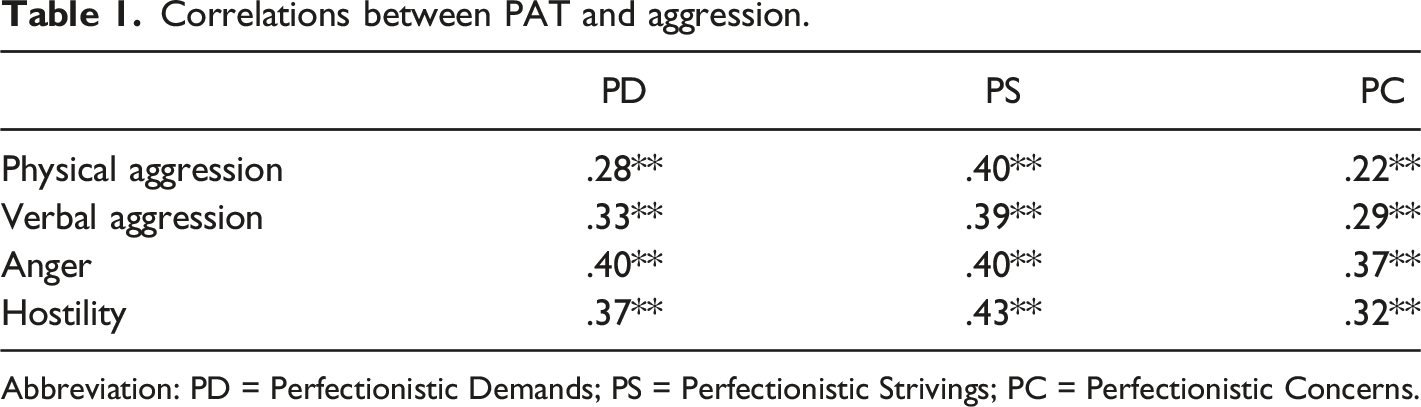
Abbreviation: PD = Perfectionistic Demands; PS = Perfectionistic Strivings; PC = Perfectionistic Concerns.
Analysis of Latent Profiles of Perfectionistic Automatic Thoughts
Fit data of all analyzed PAT models.

Abbreviation: AIC = Akaike Information Criterion; BIC = Bayesian Information Criterion; BIC-adjusted = Bayesian Information Criterion-adjusted; LRT = Vuong–Lo–Mendell–Rubin likelihood-ratio test, LRT-adjusted = Vuong–Lo–Mendell–Rubin likelihood ratio-test-adjusted; BLRT = Bootstrap likelihood ratio test.
It can be observed that the AIC and BIC values decreased in the models with each increase in class. That is, model 3 had lower values than model 2 and so on, for the models, successively. Values were <.001 for the BLRT in all models. However, the restriction criterion was the LRT, taking into account that only models 2 to 5 had significant values (p = <.05) and values <.001 for the LRT-adjusted. Of these models, the 5-profile model was selected, since it had the highest levels of entropy with a classificatory capacity for the entire sample that had a precision of almost 87%.
Frequency of undergraduates in the profiles.
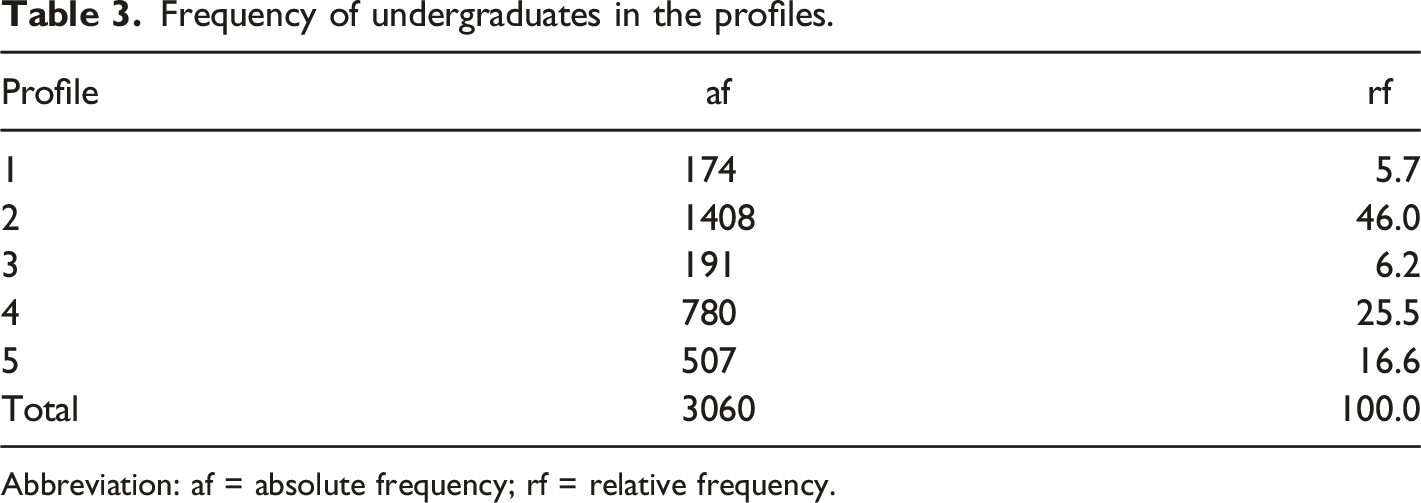
Abbreviation: af = absolute frequency; rf = relative frequency.
Profile 1 is interpreted as the profile with the lowest PAT in all dimensions; therefore, it is referred to as No-PAT. In profile 2, moderate scores are observed in all dimensions; therefore, it is referred to as Moderate PAT. Regarding profile 3, it is characterized by high perfectionistic demands and low perfectionistic concerns; therefore, it is referred to as High Perfectionistic Demands. Similarly, profile 4 has a group with low PAT; therefore, it is referred to as Low PAT. Finally, for the fifth profile, the results reveal high scores on the three factors of PAT. Therefore, it has been referred to as High PAT (see Figure 1). PAT clusters.
Differences Between Profiles
Means, standard deviations, and post-hoc contrasts between the scores obtained by the PAT profiles in aggressive behavior.
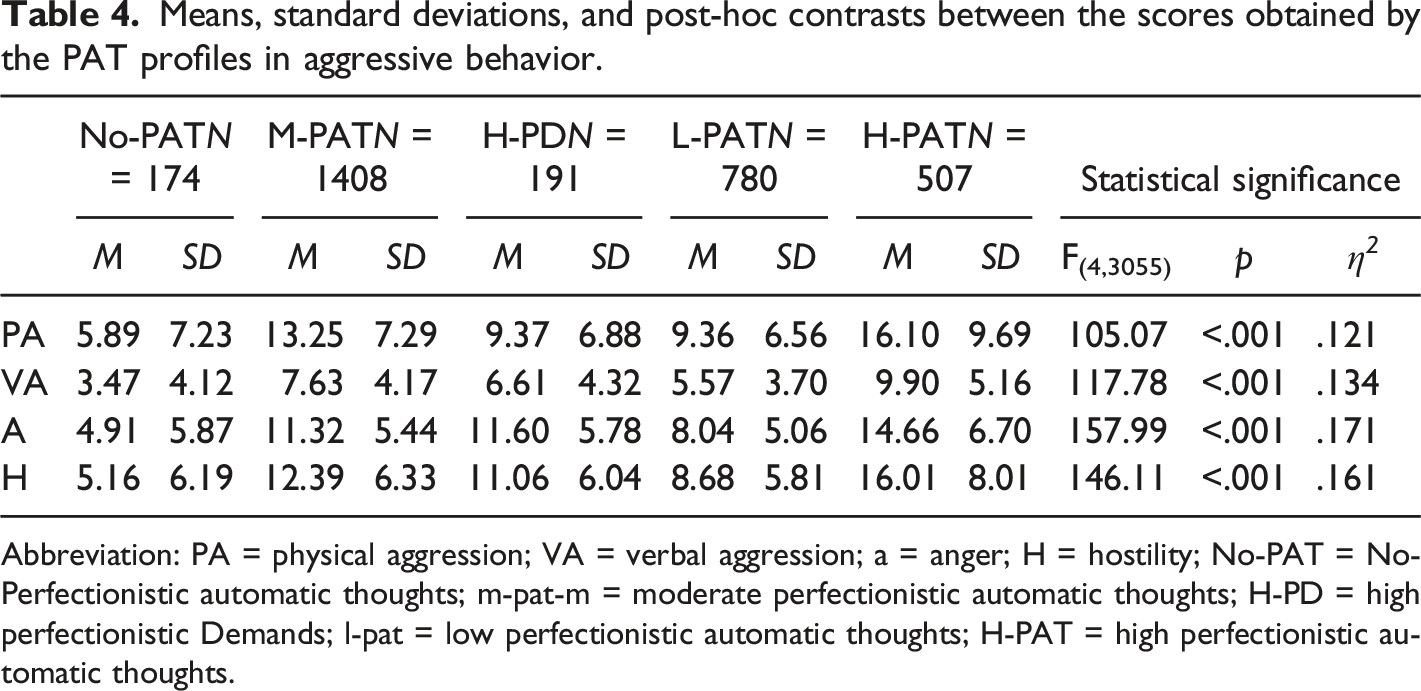
Abbreviation: PA = physical aggression; VA = verbal aggression; a = anger; H = hostility; No-PAT = No-Perfectionistic automatic thoughts; m-pat-m = moderate perfectionistic automatic thoughts; H-PD = high perfectionistic Demands; l-pat = low perfectionistic automatic thoughts; H-PAT = high perfectionistic automatic thoughts.
Cohen’s d indices for post-hoc contrasts between the mean scores of the five PAT profiles in aggressive behavior.
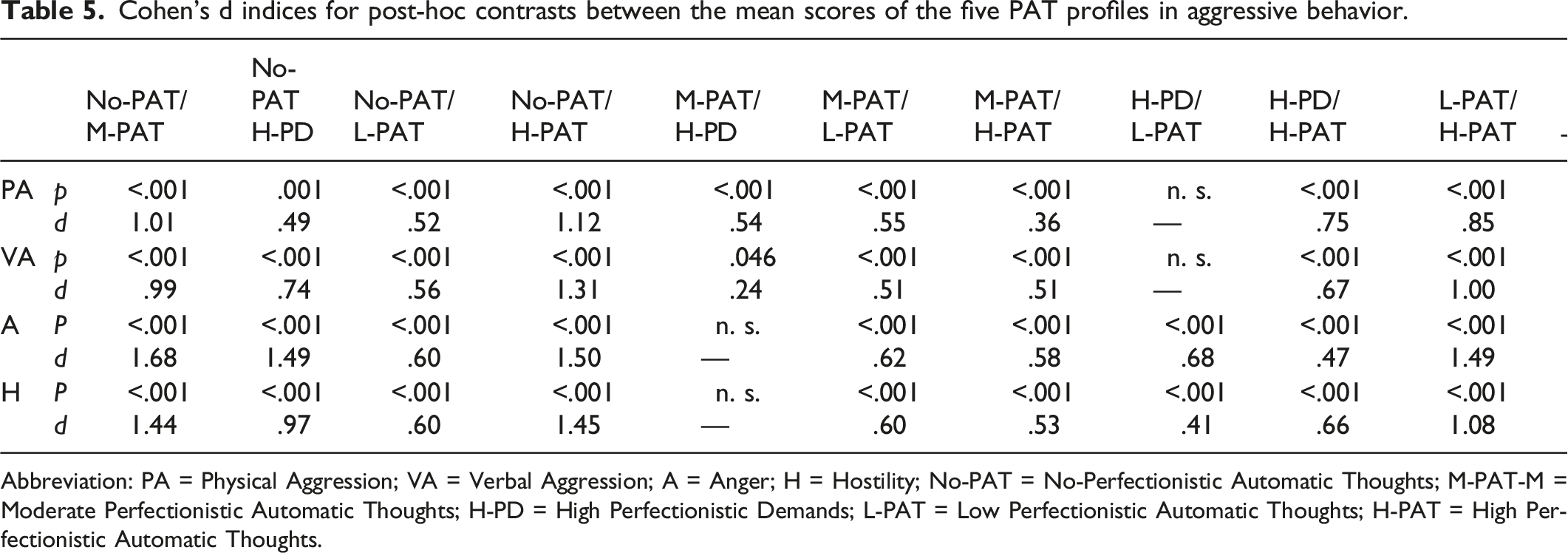
Abbreviation: PA = Physical Aggression; VA = Verbal Aggression; A = Anger; H = Hostility; No-PAT = No-Perfectionistic Automatic Thoughts; M-PAT-M = Moderate Perfectionistic Automatic Thoughts; H-PD = High Perfectionistic Demands; L-PAT = Low Perfectionistic Automatic Thoughts; H-PAT = High Perfectionistic Automatic Thoughts.
Regarding physical aggression, the largest difference was found between the No-PAT and High PAT profiles (p ≤.001, d = 1.12), and the lowest was found between Moderate PAT and High PAT (p ≤.001, d =.36). As for verbal aggression, the largest statistically significant difference was found between the Low PAT and High PAT groups (p ≤.001, d = 1.31). Similarly, in the Anger dimension, the results find large statistically significant differences between various groups, highlighting the differences between No-PAT and Moderate PAT (p ≤.001, d = 1.68). Finally, for the Hostility factor, the profiles with the largest differences were found in No-PAT and Moderate PAT (p ≤.001, d = 1.44), and No-PAT and High PAT (p ≤.001, d = 1.45).
Discussion
This study has a dual objective. The first is to observe the existence of student profiles having different PAT intensities. The second is to analyze the relationship between PAT and aggressive behavior and to determine whether or not significant differences exist between aggressive behavior and the distinct PAT profiles, according to the intensity of these ruminations in Ecuadorian university students.
First, the results from the study reveal the existence of five university student profiles that reflect distinct levels of PAT: No-PAT, Low PAT, Moderate PAT, High PAT, and High Perfectionistic Demands. It should be noted that this five-profile model does not coincide with previous studies that have assessed the intensity of PAT profiles, given that prior studies have identified three PAT profiles (low, moderate, and high PAT) with Spanish samples (Aparicio-Flores, Vicent, & García-Fernández, 2020; Aparicio-Flores et al., 2021; Esteve Faubel et al., 2020). However, this study continues to find low and high profiles, as well as moderate ones, but also includes 5.7% that do not reveal PAT and another 6.2% that are characterized by high perfectionistic demands but low perfectionistic concerns. In this regard, for the High Perfectionistic Demands profile, it is important to consider that there are similarities with previous studies that have assessed the distinct PAT profiles (Aparicio-Flores, Vicent, & García-Fernández, 2020; Esteve Faubel et al., 2020). In these studies, it was observed that, for the moderate PAT intensity profile, subjects that are classified in this group also have more perfectionistic demands and fewer perfectionistic concerns (Aparicio-Flores, Vicent, & García-Fernández, 2020; Esteve-Faubel et al., 2020). Prior studies suggest that this may be because some individuals, despite demanding personal excellence, do not focus on excessive sacrifice in order to achieve it. Furthermore, these individuals may not experience discomfort and an excessive concern when there is a divergence between performance and the marked standards (Aparicio-Flores, Vicent, & García-Fernández, 2020; Esteve Faubel et al., 2020).
It should be noted that the three groups with the highest percentage of subjects with PAT in the Ecuadorian population of this study included the High PAT (16.6%), Moderate PAT (46.0%), and High Perfectionistic Demands (25.5%) groups. That is, 86.7% are found in the three PAT profiles with the highest intensity, an aspect that suggests the need for further study in this area, taking into account the relationships between the construct with maladaptive variables (Besser et al., 2019; Casale et al., 2019; Donachie et al., 2018, 2019; Flett et al., 2019; Macedo et al., 2017). However, despite these high and moderate PAT percentages, it should be noted that many university students have low PAT levels (25.5%). These findings coincide in part with previous studies that have suggested a greater percentage of high PAT in Spanish university students, with percentages approaching 40%, for both high and moderate PAT (Aparicio-Flores, Vicent, & García-Fernández, 2020; Esteve Faubel et al., 2020). These differences may be due to the study methods used. Clusters suggested by Aparicio-Flores, Vicent, and García-Fernández (2020) and Esteve Faubel et al. (2020) were created using a non-hierarchical cluster analysis (Hair et al., 1998). However, in this study, the profiles of diverse PAT intensity were identified through latent profile analysis. According to Nylund et al., (2007), profiles from the BIC are more sensitive for specifying smaller sample sizes, regardless of the model and therefore, it is more precise in its results, even higher than other statistical analyses.
Regarding the relationship between PAT and the four components of aggressive behavior (physical aggression, verbal aggression, anger, and hostility), all the correlations between the three factors of PAT and the four components of aggressive behavior were positive and significant. These correlations were of a moderate magnitude for the relationship between the three factors of PAT (perfectionistic strivings, perfectionistic demands, and perfectionistic concerns) and anger and hostility. In terms of inter-profile differences, the profiles with moderate and high PAT scored higher on all the aggressive behavior factors as compared to the No-PAT or Low PAT groups. It means that individuals belonging to profiles with high and moderate PAT are much angrier, more hostile, and verbally and physically aggressive as compared to less “ruminating” subjects. Moreover, the moderate and high effect sizes associated to many of comparisons between the PAT profiles suggest that differences on aggressive behavior are relevant, both from a theoretical and practical perspective.
As far as anger is concerned, results of this study coincide with previous literature which found a positive relationship between perfectionism traits and PAT with anger (Donachie et al., 2018, 2019; Ferrari, 1995). According to Stoeber et al. (2017), regarding perfectionism traits, both socially prescribed perfectionism and perfectionism oriented to others reveal patterns of social disconnection and interpersonal hostility, although this is not the case of self-oriented perfectionism. This once again suggests that aggressive behavior may arise in these subjects due to their distrust of others. It is also necessary to consider that individuals having a greater emotional intelligence tend to demonstrate less aggressive behavior (Petrides et al., 2006) and vice versa (Inglés et al., 2014). Also, it should be noted that the concern for errors may lead to a negative association with emotional intelligence (Gong et al., 2017). Thus, it should be noted that emotional intelligence is understood as the ability to perceive, understand, and repair an individual’s emotional state (Mayer et al., 2016). Salguero, García-Sancho, et al. (2019) discussed the self-regulating model of executive function, which explains the deregulation of negative emotions based on ruminating thoughts and musings. These thoughts are based on beliefs about one’s own executive functions and coping strategies. That is, they are metacognitive beliefs. These metacognitive beliefs, when maladaptive, may cause psychopathological disorders (Sun et al., 2017) and they are related, among other variables, to ongoing concerns and excessive ruminating patterns (Salguero, Ramos-Cejeda et al., 2019). PATs are considered to be ruminations regarding the level of the subject’s perfection or imperfection, leading to this emotional deregulation. And this deregulation of the emotions may lead to angry thoughts, increasing levels of anger and aggression (Salguero, García-Sancho, et al., 2019).
Due to the absence of previous studies that have analyzed the relationship between PAT and the motor (i.e., physical and verbal aggression) and cognitive (i.e., hostility) components of aggressive behavior, results about these aggressive components will be discussed in light with the conclusions obtained by studies which examined the relationship between perfectionism traits and aggressive behavior. First, regarding the cognitive component of aggressive behavior, our results coincide with previous research which found a positive relationship between perfectionist traits and hostility in young students (García-Fernández et al., 2017; Vicent, Inglés, Gonzálvez, et al., 2019). Secondly, in respect of the association between PAT and physical aggression, it should be noted that perfectionist traits such as perfectionism oriented to others and socially prescribed perfectionism are positively and significantly linked to aggressive patterns such as physical aggression, including anger and hostility, caused by states of frustration (Stoeber et al., 2017). Finally, regarding verbal aggression and its link with PAT, the study of Barnett & Johnson (2016) on communication styles and perfectionism as a trait is also revealing. Here, the authors, despite not evaluating PAT, found that maladaptive perfectionism had a positive effect on verbal aggression, and an indirect negative effect on social support through verbal aggression. In this sense and considering the link between PATs with social anxiety (Esteve Faubel et al., 2020) and interpersonal difficulties (Fernández-Sogorb et al., 2021), it is important to put attention on social disconnection. Perfectionists tend to perceive themselves as individuals that are not accepted, leading to potentially depressing consequences for them and generating a social disconnection (Stoeber et al., 2017). This disconnection may negatively influence the interpretation of social information, resulting in high levels of concern for external criticism and even perceiving others as being overly demanding and intolerant (Barnett & Johnson, 2016); ultimately these socially stressful triggers could lead to verbal aggression.
On the other hand, it is worth mentioning that, according to the correlational analysis, perfectionistic strivings was the PAT dimension most closely linked with all the aggressive behavior dimensions. Instead of the lack of studies that have measured the perfectionistic strivings factor of PAT with aggressive behavior, previous research suggests that perfectionist rumination based on continuous self-sacrifice and comparisons with others (e.g., My work has to be better) may cause increased neurotic and comparative rumination thoughts. This incessant rumination may provoke aggressive behavior with others when divergences between the “real” self and the “ideal self” intensify; and, at the same time, when observing a real and achieved goal accomplished by others. It should be noted that hypersensitivity is associated with aggression (Hibbard & Buhrmester, 2010; Patock-Peckham et al., 2020) and PAT result from ideas that acclaim this excellent result in the individual. Hence, it may justify the positive association between the perfectionist strivings component of PAT and aggressive behavior.
Focusing on perfectionistic demands, it should be stressed that large statistically significant differences also exist between the No-PAT and High Perfectionistic Demands groups, based on verbal aggression, anger, and hostility, with the High Perfectionistic Demands group having the highest scores. As previously mentioned, it should be noted that perfectionistic demands play a different role, as compared to perfectionistic strivings and perfectionistic concerns (Aparicio-Flores, Vicent, & García-Fernández, 2020; Esteve-Faubel et al., 2020), possibly because some individuals demand self-development but are not overly concerned with this and do not take excessive measures to ensure the same. However, between the No-PAT group, having a minimal PAT level, and the group with high perfectionistic demands, higher scores on verbal aggression, anger, and hostility were found for the latter group (Barnett & Johnson, 2016; Donachie et al., 2019; Flett, Galfi-Pechenkov, et al., 2012; Stoeber et al., 2017). However, in this case, in addition to experiencing this social disconnection or distrust of others, issues that should be specifically tested with this PAT factor, this may be due to the hyper-competitiveness of perfectionists. In this regard, Sherry et al. (2016) noted that subjects with self-oriented perfectionism are hyper-competitive, making them more hostile towards others. These are subjects that are mainly focused on achieving their goals and who tend to ignore interpersonal relationships, causing a social disconnection (Hewitt et al., 2017). Thus, we should recall that PAT are ruminations about one’s perfection or imperfection. The perfectionistic demands factor of PAT lead to persistent thoughts such as “I need to do it better” or “I have to keep working on my goals.” Therefore, these repeated thoughts and the observing of a goal or effort that is achieved by others, or frustration with one’s own efforts, may cause irritability, hostility, and verbal aggression. Thus, future studies should attempt to find a link between hyper-competitiveness and the different PAT factors. Studies such as that of Hibbard and Buhrmester (2010) and Patock-Peckham et al. (2020) warn that hyper-competitiveness is linked to aggressive behavior.
There are diverse limitations to this study that must be considered. On the one hand, and despite the extensive sample size, the results of this work may not be generalized to the entire Ecuadorian population. Thus, it would be useful for future studies to verify whether or not these findings may be replicated in other age groups. Moreover, studies should be designed in other countries to examine the relationship between PAT variables and aggressive behavior and to determine distinct PAT profiles. And finally, it may be useful to process the data using a longitudinal study that permits corroboration as to whether or not the PAT trajectory over the long term continues to exist for each profile with the same intensity, and if other PAT profiles present the same levels of aggression over time, or if there are any significant variations.
Despite these limitations, we should note that this is a novel work that extends scientific knowledge in the field of Psychology, being the first study to examine PAT profiles in the Ecuadorian population. It is also the first work to note the differences and relationships between these profiles based on aggressive behavior (physical aggression, verbal aggression, anger, and hostility). This is important, given the disruptive nature of aggressive behavior in all of its dimensions (Godfrey & Babcok, 2020; Laverdière et al., 2019; Sommerfeld & Shechory-Bitton, 2020; Summerell et al., 2020; Zhu et al., 2019) as well as of PAT (Besser et al., 2019; Casale et al., 2019; Donachie et al., 2019; Flett et al., 2019). Therefore, in order to prevent these disruptive rumination thoughts and behaviors, further studies should be carried out on the Ecuadorian population.
Footnotes
Declaration of Conflicting Interests
The authors declared no potential conflicts of interest with respect to the research, authorship, and/or publication of this article.
Funding
The authors received no financial support for the research, authorship, and/or publication of this article.
