



Abstract
People with drug addiction are more likely to suffer from sleep disorders than non-addicts. The roles that childhood adversity experiences and resilience play in the development of sleep disorders will be explored in this study. A total of 459 participants with drug addiction and 400 non-addicts were investigated with the Adverse Childhood Experiences (ACEs) Scale, Pittsburgh Sleep Quality Index (PSQI), and Connor–Davidson Resilience Scale from April 2019 to December 2020. Our results suggested that participants with drug addiction had worse sleep quality compared to non-addicts. Resilience acted as a mediator and significantly affected the relationship between ACEs and sleep quality. For all participants who experienced ACEs, individuals with high resilience reported lower PSQI score, the regulatory effect of medium and high resilience on sleep quality was better than that of low resilience. Moreover, comparing to the non-addicts who experienced mild ACEs, high resilience showed a good buffer effect on the sleep quality for people with drug addiction. And high resilience played a stronger regulatory role in females as compared to males. The results help to broaden the relevant research in the field of sleep and we should pay attention to the role of resilience in regulating sleep quality.
Introduction
Adverse childhood experiences (ACEs) are often defined as stressful and/or traumatic experiences in childhood (Dube et al., 2001). There is a close relationship between early adverse experiences and subsequent drug use and abuse (illicit drugs, alcohol, and nicotine) (Anda et al., 2006). Childhood adversity has been shown to be the main risk factor of drug addiction and other mental disorders (Elton et al., 2014). People with ACEs score greater than or equal to five are seven to 10 times more likely to report illicit drug use problems and illicit drug addiction than those who have not experienced ACEs (Dube et al., 2003). This suggests that ACEs seem to increase the possibility of drug abuse.
There has been increasing evidence that ACEs are related to poor sleep quality in adulthood. Major stressors in childhood (especially those related to ACEs) may affect sleep in childhood and develop bad sleeping habits, which may go beyond childhood and lead to sleep problems in adulthood (Greenfield et al., 2011; Sullivan et al., 2019). Bader et al. (2007) has shown that stressful negative life experiences, such as emotional, physical, and sexual abuse in childhood, may be related to the sleep of patients with primary insomnia. In particular, long-term and serious adverse experiences in childhood are associated with the degree of sleep disorders in adulthood. A number of studies have identified the association between ACEs and sleep disorders in adulthood and the intensity of the association increases with the number and severity of adverse experiences (Chapman et al. 2011, 2013; Kajeepeta et al., 2015; Koskenvuo et al., 2010; Sheehan et al., 2020).
A study has shown that the prevalence of sleep disorders in people with drug addiction was much higher than that was found in non-addicts (Tang et al., 2015). In terms of gender differences in sleep quality, most studies have found that females’ sleep quality seems to be worse than males’. For example, a study from China found that the prevalence of poor sleep quality in females was significantly higher than males (Wang et al., 2019). A study of teenagers also found that girls’ sleep quality and hygiene was worse (Galland et al., 2017). Another study found a moderate to strong correlation between drug use and decreased sleep quality in women (Ly & Gehricke, 2013).
Good sleep is of great importance for people’s physical and mental health. It is very meaningful to identify the impact of ACEs on sleep quality. Despite growing academic/public interest in ACEs and quality of sleep, there has been limited research on the population and gender differences in their prevalence, especially for people with drug addiction. At the same time, it is also worth exploring whether resilience can act as a way to regulate stress and improve sleep quality. Therefore, the purpose of this study includes three parts: (1) Whether the effects of ACEs on sleep quality in people with drug addiction and non-addicts were present; (2) Whether resilience played a mediating and regulating role; and (3) Whether the regulating role of resilience differed between different groups (people with drug addiction vs non-addicts) and genders.
Methods
Participants
A total of 859 participants were investigated in this study. According to the needs of the study, they were divided into two groups, people with drug addiction and non-addicts. 459 participants with drug addiction (252 males and 207 females) were recruited from two drug rehabilitation centers of Sichuan Province, China. These participants with drug addiction (about 70% of the participants were methamphetamine addicts, and the rest were heroin, Magu, and k powder addicts) received detoxification at the drug rehabilitation center for more than 1 year and completed physical detoxification. Inclusion criteria for participants with drug addiction were as follows: (a) Meeting the DSM-V diagnostic criteria for psychoactive substance abuse or dependence; (b) Age 18–50 years old; (c) No serious mental illness, had left the physiological detoxification period, and the urine test was negative; and (d) Education level of elementary school or above.
400 participants (134 males and 266 females) in the non-addict group were recruited from some universities and working people in Sichuan Province, China. Inclusion criteria for non-addict group were as follows: (a) Age 18–50 years old; (b) No serious mental illness; and (c) Education background of elementary school or above. All participants signed informed consent before participation.
Measures
Adverse Childhood Experiences Scale
The ACE scale consists of 28 items divided into three categories and 10 subscales, including childhood abuse (emotional, physical, and sexual), neglect (emotional and physical), and growing family dysfunction (substance abuse, mental illness, domestic violence, criminal household member, and parental marital discord). The ACEs score (10 ACEs subscales) were used to evaluate the cumulative effect of multiple ACEs. One ACE was recorded for each subscale that met the conditions of exposure to ACEs otherwise with no ACE being recorded (Su et al., 2015). Moreover, we divided the ACEs score (total score vary from 0 to 10) into four categories: no exposure: 0 ACEs, mild: 1–2 ACEs, moderate: 3–4 ACEs, and severe: ≥5 ACEs, which showed the higher the ACEs score, the more serious the ACEs exposure. In this study, the Cronbach’s alpha value of the ACEs scale was 0.69 in people with drug addiction and 0.671 in non-addicts.
Pittsburgh Sleep Quality Index
The Pittsburgh sleep quality index (PSQI) is a self-rated questionnaire that evaluates sleep quality and sleep disorders at a one-month interval. Ten items produce seven-dimensional scores: subjective sleep quality, sleep latency, sleep duration, habitual sleep efficiency, sleep disorders, sleep drug use, and daytime dysfunction. The scale rates participants over the past month with a total score of the PSQI varying from 0 to 21, and the higher the total score is, the worse the sleep quality is. The original validation study of PSQI showed that the critical score >5 could be used to distinguish individuals with good and poor sleep (Buysse et al., 1989). In this study, the Cronbach’s alpha value of PSQI was 0.726 in people with drug addiction and 0.641 in non-addicts.
Connor–Davidson Resilience Scale
The Connor–Davidson Resilience Scale (CD-RISC) includes 25 items, which are scored by Richter’s 5-point scales(1 to five points) and divided by the five-factor scoring method proposed by Connor and Davidson (Connor & Davidson, 2003). The five-factor scoring methods are as follows: F1 (the concept of personal ability, high standard, and tenacity), F2 (believe in instinct, tolerate negative effects and resist the stress), F3 (actively accept change and security relations), F4 (control), and F5 (religious influence). Higher scores indicate better resilience, with a total score varying from 5 to 105. In this study, the Cronbach’s alpha value of CD-RISC was 0.804 in people with drug addiction and 0.855 in non-addicts.
Procedures
All data collection was completed in two stages due to the outbreak of the pandemic at the end of 2019. We completed the most of data collection from April 2019 to December 2019. The second phase of data collection started in April 2020 and ends in December 2020. We used field tests to collect data. Two psychology teachers supervised participants to complete questionnaires and gave guidance if necessary. Finally, after the participants completed all tests, we took back questionnaires on site and distributed souvenirs and gifts to all participants.
Statistical analysis
All analyses were done using SPSS 23.0. Sociodemographic variables were characterized with descriptive statistics (t-tests for continuous traits). The χ2-tests for categorical traits were used to examine the differences in ACEs score among people with drug addiction and non-addicts. A linear regression model with each individual ACEs as the independent variable and sleep quality as the dependent variable was used to evaluate the correlation between ACEs and sleep quality. In order to better control the impact of gender, age, and BMI on the regression model, this study included gender, age, and BMI as covariates in the model. For further analysis of the role of resilience between ACEs and sleep quality, we established an intermediary model with ACEs as the predictive variable and PSQI as the resultant variable. In addition, the use of line chart was to show the regulatory effect of different levels of resilience on people (by group and gender) experiencing different degrees of ACEs more clearly. Statistical significance required a two-sided p-value of ≤0.05.
Results
Sample description
Characteristics of the Studied Population (n = 859).

Note. Pgender: “gender” refers to that all participants were grouped by gender; Pgroup: “group” refers to that all participants were grouped by whether addicts or not.
Common Method Bias Test
The data of this study were investigated by self-report, so we conducted principal component factor analysis on all items of the original questionnaire by Harman single factor test. The results showed that the variance of the maximum factor interpretation was 13.71% (<40%),which indicated that there was no common method bias in the questionnaire used in this study (Jiang, Yang et al., 2021; Podsakoff et al., 2003).
ACEs Score of All Participants
Comparison of Adverse Childhood Experiences Score Between People With Drug Addiction and Non-Addicts.

Effects of ACEs on Sleep Quality of People With Drug Addiction
Individual effects of Adverse Childhood Experiences on Sleep Quality of People With Drug Addiction and Non-Addicts.

Note. SE: standard error; Each variable of ACEs was controlled for gender, age, and BMI.
The Role of Resilience
The Mediating Role of Resilience
In order to predict whether there was a mediating effect between ACEs and sleep quality, a structural equation model was constructed, as shown in Figure 1. For people with drug addiction, resilience displayed a mediating effect between substance abuse and sleep quality (indirect effect β = 0.076, p < 0.001, direct effect β = 0.744, p = 0.003, total effect β = 0.820, p = 0.001), which accounted for 9.28% of the total effect and indicated that resilience weakened the negative impact of substance abuse on sleep quality. For non-addicts, resilience had a mediating effect between emotional neglect and sleep quality (indirect effect β = 0.027, p < 0.001, direct effect β = 0.147, p < 0.001, total effect β = 0.174, p < 0.001), which accounted for 15.44% of the total effect. Resilience lessened the negative impact of emotional neglect on sleep quality. In addition, other dimensions of ACEs were used to construct the mediation model, in which the mediation effect was not significant. The structural equation model of the relationship between Adverse childhood experiences and sleep quality. Note. a represents substance abuse of people with drug addiction; b represents emotional neglect of non-addicts.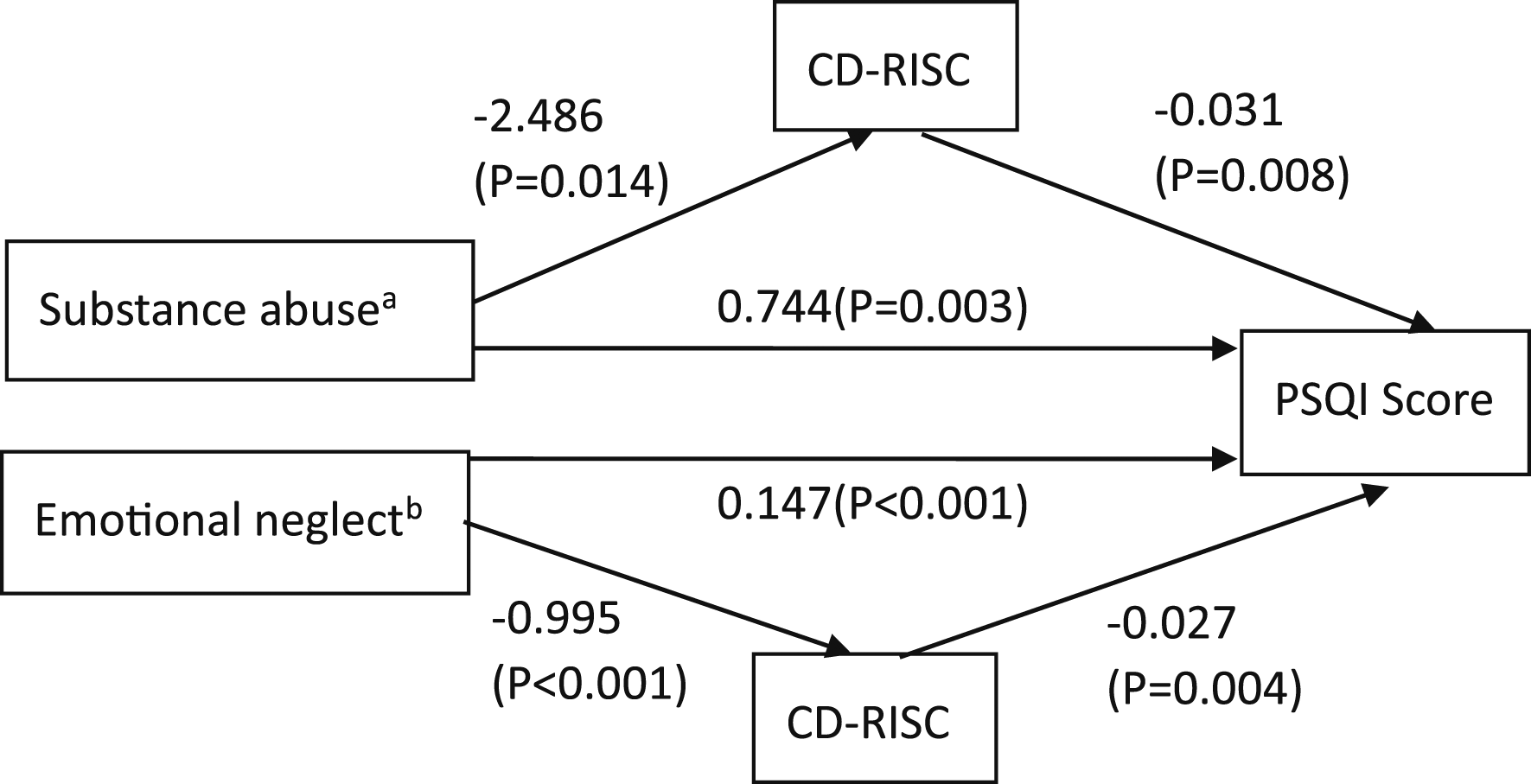
The Regulating Role of Resilience
In order to assess the regulating role of resilience in the relationship between ACEs exposure and sleep quality, resilience was divided into three levels by applying the percentile method to the CD-RISC score (high resilience: score >75th percentile; moderate resilience: score >25th percentile and ≦75th percentile; low resilience: score ≦25 percentile). We also divided the ACEs score into four categories (no exposure: 0 ACEs, mild: 1–2 ACEs, moderate: 3–4 ACEs, and severe: ≥5 ACEs). Figure 2 showed mean PSQI score according to ACEs score by resilience score based on group and gender (people with drug addiction vs. non-addicts; male vs female). For all participants who experienced ACEs, individuals with high resilience reported lower PSQI score, the regulatory effect of medium and high resilience on sleep quality was better than that of low resilience. Sleep quality according to Adverse childhood experiences score by resilience score (total score ≤25th percentile, > 25th and <75th percentile, and ≥75th percentile) based on group and gender.
Discussion
Females’ Sleep Quality was Better Than Males in People With Drug Addiction, Which was Different From Non-Addicts
According to our results, the sleep quality of female participants in non-addicts was worse than that of males, which was consistent with the results of most studies (Galland et al., 2017; Wang et al., 2019). However, the results showed that the sleep quality of females was better than that of males in people with drug addiction. The results may be caused by the randomness of the survey sample; On the other hand, it may be related to the unhealthy lifestyle of males with drug addiction. Moreover, compared with males, females with drug addiction had higher detoxification enthusiasm among our participants, they were more willing to follow the advices of doctors, which may be an important reason why their sleep quality was better than males with drug addiction.
ACEs Affected the Sleep Quality of People With Drug Addiction and Non-Addicts
The results showed that ACEs significantly affected the sleep quality of people with drug addiction and non-addicts. Adults who have experienced ACEs tend to have worse sleep quality (Jung & Oh, 2020). Abuse in childhood may lead to a series of long-term sleep changes and produce sleep disorders, which emerge in the early stages of life and extend into adulthood (Lewin et al., 2019). Our findings were in line with previous evidence supporting the association between ACEs and sleep quality and extended the understanding of the association with people with drug addiction. It was worth noting that ACEs had more influence on sleep in non-addicts, which may be the reason why some young people chose to take drugs to reduce the impact of ACEs. In other words, people with severe ACEs could not address the negative outcomes of ACEs for a long time, which continued into adulthood (Felitti et al., 1998). Therefore, some people chose the wrong way to escape and avoid the stress, trauma, or other negative effects caused by ACEs and finally chose to take drugs (Baker et al., 2004). Our research is helpful to understand the sleep problems of adults, including people with drug addiction. We must pay more attention to childhood adversity and create a good growth environment for children’s healthy growth, which is what every parent should do.
Resilience had a Mediating Role in the Relationship Between ACEs and Sleep Quality
The results revealed that resilience played an important role in reducing the negative impact of ACEs on the sleep quality. This was consistent with previous studies reporting that resilience helped improve sleep quality (Cicchetti, 2010; Chang et al., 2019; Li et al., 2016). However, for different groups, the predictive variables in our mediation model were different. For the people with drug addition, the predictive variable was substance abuse, but for the non-addicts, it was emotional neglect. The results suggested that there was substance abuse problem in the childhood of people with drug addiction, while the emotional neglect that non-addicts experienced in childhood had become a factor affecting the sleep quality in adulthood. In addition, resilience as a protective factor mediated the effect of ACEs on sleep effectively.
High Resilience Buffered the Effect of ACEs on Sleep Quality for Both Groups
Under the same level of resilience, ACEs score were positively correlated with PSQI in all the participants, suggesting more ACEs may lead to worse sleep quality. This was in line with many studies (Chapman et al. 2011, 2013; Kajeepeta et al., 2015; Koskenvuo et al., 2010). Overall, high resilience played a better regulatory role compared to participants with low and medium resilience no matter what degree of ACEs they experienced. It was worth mentioning that the PSQI score of participants exposed to moderate and severe ACEs have shown an obvious downward trend under the high level of resilience from the four pictures as shown in Figure 2. This indicated that the high level of resilience could better adjust the sleep quality of participants exposed to moderate and severe ACEs. This is consistent with Cicchetti et al. (2010) showing that high resilience allows individuals to have better adaptability to avoid the occurrence of psychological diseases, such as sleep disorders.
Moreover, in the two groups (based on whether addicts or not) of participants who experienced mild ACEs, high resilience showed a good buffer effect on the sleep quality for people with drug addition, compared to non-addicts. It showed that the regulating effect of high resilience in people with drug addiction was stronger than those in non-addicts. On the other hand, for the females with high resilience, no matter what exposure level of ACEs they experienced, their PSQI score was lower than that of males, suggesting that high resilience had a stronger regulatory effect on females. It also showed that the sleep quality of male participants who experienced similar ACEs was worse than that of females. We should formulate resilience training methods for patients with sleep disorders, which can reduce the occurrence of sleep disorders and effectively improve sleep quality.
There are several limitations to consider when interpreting the results of this study. First of all, the pandemic led to a certain deviation in the sampling of our study. There was a big difference between the average age of people with drug addiction group and that of non-addicts group. This greatly reduced the comparability between the two groups because of the low incidence of sleep disorders in young people. However, we can still see the effects of ACEs on the subjects in both groups, whether young or middle-aged. Second, the poor sleep quality of people with drug addiction may be caused by many factors, ACEs was only one of them, and we could not completely rule out the withdrawal reaction caused by drugs, although the participants in the people with drug addiction group had been detoxified for more than 1 year. Third, the potential for recall bias, subjectivity and prejudice were inevitable when recalling the past childhood experiences. Under-reporting of the ACEs were likely to lead to inconsistencies (Della Femina, Yeager et al., 1990). Forth, it was difficult to fully explain the causal relationship between childhood adversity and sleep quality by a cross-sectional survey. In the future research, we will try our best to make up for these deficiencies.
Conclusion
This study investigated the effects of ACEs on sleep quality of people with drug addiction and non-addicts. It preliminarily explored the role of resilience in the relationship between ACEs and sleep quality, while comparing the regulatory role of resilience between different populations and genders. The results showed that ACEs had a significant impact on the sleep quality. As an intermediary factor, resilience could effectively regulate and improve sleep quality. Moreover, comparing to the non-addicts who experienced mild ACEs, high resilience showed a good buffer effect on the sleep quality for people with drug addiction. Meanwhile, high resilience played a stronger regulatory role in females as compared to males. The results of our study contribute to a better understanding of the relationship between childhood adversity and sleep quality in adulthood, guide further research for promising therapies to boost resilience, and potentially decrease sleep disorder.
Footnotes
Acknowledgments
We thank the continued participation and cooperation of all participants and their families. Then, we also wish to thank the tireless staff at the drug rehabilitation centers of Sichuan Province.
Author contributions
Declaration of Conflicting Interests
The author(s) declared no potential conflicts of interest with respect to the research, authorship, and/or publication of this article.
Funding
The author(s) disclosed receipt of the following financial support for the research, authorship, and/or publication of this article: This work was supported by the This research was supported by the National Social Science Fund of China (17XSH010).
Ethical Approval
All procedures performed in studies involving human participants were in accordance with the ethical standards of the institutional and/or national research committee and with the 1964 Helsinki declaration and its later amendments or comparable ethical standards.
