



Abstract
The current study aims to examine the relationship between Social Media Use Disorder (SMUD) and Orthorexia Nervosa (ON), and evaluate the indirect effect of loneliness in this association. This cross-sectional study was carried out between July and September 2021. A total of 363 university students were recruited through convenience sampling through several universities in Lebanon’s governorates. Data about information about the social media applications mostly used (Instagram, Facebook, Twitter, etc.), the number of times of entry to social media applications, the time spent on these applications, ON, loneliness and SMUD, were also collected. The Mplus v.7.2 software was used to estimate categorical confirmatory factor analyses (CFA) of the SMD and loneliness scales. The one-factorial model of the SMD scale fitted well according to χ2/df (69.71/27 = 2.58), TLI (.967), CFI (.956), and RMSEA values (.066; CI [.047–.085]; pclose = .079). The one-factorial model of the loneliness scale fitted well according to χ2/df (10.30/5 = 2.06) TLI (=0.97), CFI (=0.98), and RMSEA values (=0.054; CI [0.000–0.101]; pclose = 0.379). When entering the social media applications and time spent on these applications as independent variables in a first regression model, using Instagram (Beta = 2.73), using Tumblr (Beta = 3.22), spending 30–60 minutes per day on social media apps compared to less than 30 minutes (Beta = 2.33), higher physical activity index (Beta = 0.04) and loneliness (Beta = 0.67) were significantly associated with more ON. When entering the SMUD score as an independent variable in a second regression model, the results showed that higher SMUD (Beta = 0.50) was significantly associated with more ON. Also, loneliness played a partial indirect role in the association between SMUD and ON (by 16%). The current results can help mental health professionals better detect these potential psychological disorders and might help improve future treatment of issues related to ON and SMUD.
Keywords
Introduction
Disordered eating patterns are often assumed to be related to pursuit of thinness, but in the case of Orthorexia Nervosa (ON), it is ironically done in the pursuit of health. ON refers to an obsessive pattern of eating only foods that are perceived as healthy by the individual (Brytek-Matera et al., 2020; Cena et al., 2019). The subject firmly follows a consistent set of rules pertaining to the consumption of food (Dunn & Bratman, 2016). As a result, individuals expressing orthorexic behaviors suffer from significant distress and/or impairment in different aspects of their lives including social relationships and physical health, such as nutritional deficiencies (Dunn & Bratman, 2016). These consequences can extend to the individual’s social life (Cena et al., 2019); for example, a person exhibiting ON behaviors might avoid certain social settings or outings where perceived unhealthy food is involved and may perceive the lifestyle of others who consume perceived unhealthy foods as wrong. Also, ON is less likely to be validated by others as a legitimate psychological disorder, it is perceived as less distressing and does not evoke sympathy as opposed to other eating disorders such as Bulimia Nervosa, as it is considered by others as a lifestyle choice than a pathology (Simpson & Mazzeo, 2017).
The influence of Social media was confirmed to be an impacting factor on the development of ON (Cheshire et al., 2020). In this case, social media was a supportive factor by validating certain dietary beliefs and behaviors such as extreme healthy eating (Cheshire et al., 2020). ON was present among high addicts of social media, according to the Social Media Addiction Scale that was used, by 31.0% and 62.2% of social media addicts in general exhibited ON symptoms in a sample of doctors and nurses (Yilmazel, 2021). Another study showed that ON was significantly influenced by social media exposure among university students; consumption of social media content reinforced tendencies such as paying extreme attention to nutrition (Gabriel, 2021). Furthermore, disordered eating and healthy eating concerns were impacted by a variety of social influences, such as mainstream culture and family pressure, including media influence, which was significantly mentioned by various studies’ participants (Haddad et al., 2021; Saade et al., 2019; White et al., 2021; Zeidan et al., 2019). It was shown that Instagram was associated with higher ON (Turner & Lefevre, 2017). People who shared content that indicated ON were more likely to heavily use social media; specifically, Instagram was shown to heavily promote ON (Valente et al., 2021). Instagram is a relatively new social media platform that was created in 2010 where users can publish updates in the form of photos (Hu et al., 2014). Instagram emphasizes image and focus on pictures, which presents ideal appearance and dietary behaviors such as healthy eating and influences users to engage in these behaviors; this linked Instagram to higher ON (Valente et al., 2021). Health professionals believe that the propagation of pseudoscientific information on nutrition through social media has exacerbated the development of ON (Douma et al., 2021). Other social media platforms were associated with ON: watching YouTube videos, especially those on healthy eating, was associated with higher ON scores (Geise, 2021). YouTube is a social media platform where users can upload and watch videos, as well as subscribe to channels that post video content (Wattenhofer et al., 2012). Healthy eating vlogs, which are video blogs that show a user’s dietary journal, were found to influence watchers as they were seeking diet advice from those posting the vlogs and followed their dietary behaviors in order to achieve a specific goal (Geise, 2021).
In another investigation involving university students, results showed that loneliness predicted eating disorders (Richardson et al., 2017). Not only that, but higher loneliness predicted overall worse anxiety, stress and depression in the long-term, which highlights its importance in the context of overall mental health (Geise, 2021). It was previously suggested that loneliness increases the probability of developing or aggravating disordered eating patterns (Fox, 2020). Disordered eating behaviors were associated with negative social relationships and higher loneliness (Levine, 2012).
It is a common logic that eating in a healthy way and performing physical activity have positive contribution to health (Rudolph, 2018). Individuals that are physically active are more likely to attribute significant importance to food choices, as they are more likely than those who are less physically active to consume products that have less sugar, for example; which was found to be related to ON (Brodock et al., 2021). Another study showed that people who are physically active exhibited test scores that showed a positive relationship between physical activity addiction and ON (Rudolph, 2018). In a sample of university students, those specializing in sports science were more likely to exhibit ON and higher level of physical activity (Malmborg et al., 2017). Furthermore, previous research has showed that populations that practice physical activity such as athletes and fitness students are more likely to have ON (Bert et al., 2019). Additionally, findings show that individuals who frequently perform physical activity have a higher probability of having ON (Almeida et al., 2018).
Previously, social media usage and loneliness accurately predicted the presence of disordered eating patterns among university students (Wright & Pritchard, 2009). In this study, mass media in general predicted variables related to eating disorders, including dieting and food preoccupation (Wright & Pritchard, 2009), which is a core element of ON. Ideal bodies for both men and women are being presented in the media, subsequently influencing what and how much foods people consume (Wright & Pritchard, 2009). It is important to note that heavy social media use is associated with higher loneliness (Pittman & Reich, 2016). For university students, those who were addicted to social media showed higher loneliness levels (Baltaci, 2019). An experimental study found that decreasing social media use subsequently decreased loneliness among university students (Hunt et al., 2018). The presence of these two variables, social media use and loneliness, in relation to ON simultaneously raise the question that they may interact in a way that may affect the final outcome relating to this pathological eating pattern.
Previous studies in Lebanon evaluated the associations between SMUD and mental health issues (Awad et al., 2021; Barbar et al., 2021; Malaeb et al., 2021; Youssef et al., 2021) but not eating disorders. This association between ON and Social Media Use Disorder (SMUD), which is a pattern of problematic and addictive use of social media based on a study developing a Social Media Use Disorder scale, was interesting to investigate following the significant relationships previously found in the discussed studies above, given that ON and social media use were connected in multiple studies. A notable prevalence of ON behaviors (8.4%) was shown in a Lebanese sample, as well as a significant prevalence of individuals who met the criteria for SMUD (23.7%) in another Lebanese sample (Youssef et al., 2020). The latter study also found a relationship between SMUD and loneliness (Youssef et al., 2020). Currently, more than 4.6 billion people use social media (DataReportal, 2022), meaning that more than half the world’s population consumes social media content. The reach that social media has in addition to its connection to ON might mean that ON behaviors exhibited on social media platforms now have a wider audience now, which should be observed for novel findings. In addition, the rather intuitive relationship between physical activity and ON discussed in the introduction inspires further investigation in order to explore its association with other psychological variables involved. To the best of our knowledge, no previous study has attempted to evaluate the relationship between the current variables, specifically within the Lebanese population. The current study aims to examine the relationship between SMUD and ON, as well as physical activity, and evaluate the indirect effect of loneliness in this association.
Methods
Ethical Approval and Consent to Participate
The Psychiatric Hospital of the Cross Ethics and Research Committee approved this study protocol (HPC-007–2021). Submitting the form online was considered equivalent to obtaining a written informed consent.
Study Design and Participants
This cross-sectional study was carried out between July and September 2021. A total of 363 university students were recruited through convenience sampling through several universities in Lebanon’s governorates. Participants received the online link to the survey. Involved people were encouraged to visit a Web site that would guide them to the consent form, information form (purpose of the current study, anonymity, voluntariness of consent to research), and questionnaire. All participants responded willingly to the survey. There were no fees for participating in the study. All university students over the age of 18 were eligible to participate. Excluded were those who refused to complete the survey.
Minimal Sample Size Calculation
According to G-power (Faul et al., 2007), a minimum of 316 students was deemed necessary to have enough statistical power, based on a 5% risk of error, 80% power, f2 = 2.5% and 10 factors to be entered in the multivariable analysis.
Questionnaire and Variables
The Arabic self-administered questionnaire with closed-ended questions was anonymous; the questionnaire required approximately 20 min to be completed. The questionnaire consisted of different sections. The first part clarified socio-demographic characteristics: age, gender, marital status, educational level, and household crowding index. The latter, reflecting the socioeconomic status of the family, was calculated by dividing the number of persons in the house by the number of rooms in the house excluding the bathrooms and kitchen. The higher the household crowding index, the lower the socioeconomic status of the family (Melki et al., 2004). The physical activity index was calculated by multiplying the intensity by the frequency by the time of physical activity (Weary-Smith, 2007).
The second part of the questionnaire included information about the social media applications mostly used (Instagram, Facebook, Twitter, etc.), the number of times of entry to social media applications, the time spent on these applications and the following scales:
Teruel Orthorexia Scale (TOS) - Validated in Lebanon (Awad et al., 2021; Mhanna et al., 2021), this scale is composed of 17 items and yields two subscores, TOS orthorexia nervosa (TOS OrNe) (composed of 8 items) and TOS Healthy Orthorexia (TOS HeOr) (composed of 9 items) (Barrada & Roncero, 2018). Scores are computed by summing the answers of the corresponding items; higher scores indicate more orthorexia in both aspects (αOrNe = 0.909 and αHeOr = 0.884). In this study, the OrNe subscale was considered only.
Jong-Gierveld loneliness scale - Subjective loneliness was assessed by the modified version of the Jong-Gierveld Loneliness Scale, composed of 5 items (Wilson et al., 2007). One point was given for a yes answer and zero was given for a no answer. Higher scores would indicate more loneliness (α = 0.759).
Social Media Disorder Scale (SMD) - The short form of the SMD was used in this study. It is composed of 9 items, with higher scores reflecting more problematic social media use (Van den Eijnden et al., 2016). An example of the items is: “During the past year, have you tried to spend less time on social media, but failed?” The Arabic version of this scale has been previously used (Barbar et al., 2021; Dagher et al., 2021; Malaeb et al., 2021; Youssef et al., 2021) (α = 0.785).
Statistical Analysis
The Mplus (v. 7.2. Muthén & Muthén, 2012) was used to estimate categorical confirmatory factor analyses (CFA) of the SMD and loneliness scales. CFAs were conducted to make sure that the one-factor model for both scales can be used in our study for the calculation of the total scores. Given they comprise only two response-options, we used tetrachoric correlation matrix as an input and applied weighted least squares with means and variances adjusted estimation method. Multiple indices of goodness-of-fit were described: the Relative Chi-square (χ2/df) (cut-off values: <2–5), the Root Mean Square Error of Approximation (RMSEA) (close and acceptable fit are considered for values <0.05 and <0.11 respectively), and the Comparative Fit Index (CFI) (acceptable values are ≥0.90) (Marsh et al., 2004).
SPSS software version 23 was used to conduct data analysis. We had no missing data since all questions were required in the Google form. Cronbach’s alpha values were recorded for reliability analysis of all scales and subscales. The TOS ON score was normally distributed, with its skewness and kurtosis varying between −1 and +1 (Hair et al., 2021). The Student t and ANOVA tests were used to compare two and three or more means respectively, whereas the Pearson correlation test was used to compare two continuous variables. A forward linear regression was conducted to check for correlates associated with ON.
The PROCESS SPSS Macro version 3.4, model four (Hayes, 2017) was used to calculate three pathways. Pathway A determined the regression coefficient for the effect of SMUD on loneliness; Pathway B examined the association between loneliness and ON, and Pathway C′ estimated the direct effect of SMUD on ON. An indirect effect was deemed significant if the bootstrapped 95% confidence intervals of the indirect pathway AB did not pass by zero. Variables that showed a p < 0.25 in the bivariate analysis were entered in the multivariable and mediation models. Significance was set at a p < 0.05.
Results
Sociodemographic and Other Characteristics of the Participants
Sociodemographic and Other Characteristics of the Participants (N = 363).

Note: The yes/no options indicate if the participant has an account on that specific application.
Confirmatory Factor Analyses
The one-factorial model of the SMD scale fitted well according to χ2/df (69.71/27 = 2.58), TLI (.967), CFI (.956), and RMSEA values (.066; CI [.047–.085]; pclose = .079).
The one-factorial model of the loneliness scale fitted well according to χ2/df (10.30/5 = 2.06) TLI (=0.97), CFI (=0.98), and RMSEA values (=0.054; CI [0.000–0.101]; pclose = 0.379).
Bivariate Analysis
Bivariate Analysis of the Categorical Variables Associated with the Orthorexia Scores.

Note: Numbers in bold indicate significant p-values.
Bivariate Analysis of the Continuous Variables Associated with the Orthorexia Score.

Note: n = Sample size; M = Mean; SD = Standard Deviation; r = Pearson correlation coefficient.
**p < 0.01; ***p < 0.001.
Multivariable Analysis
A first linear regression taking the TOS ON as the dependent variable showed that using Instagram (Beta = 2.73), using Tumblr (Beta = 3.22), spending 30–60 minutes per day on social media apps compared to less than 30 minutes (Beta = 2.33), higher physical activity index (Beta = 0.04) and loneliness (Beta = 0.67) were significantly associated with more ON (Table 1, Model 1).
Multivariable Analyses (N = 363).

Note: *Reference group; Beta = unstandardized beta; SE = Standard Error; β = standardized beta; CI = Confidence interval; LL = Lower Limit; UL = Upper Limit; p = p-value; numbers in bold indicate significant p-values.
Mediation Analysis
Mediation Analyses Results, Taking SMUD as an Independent Variable, Loneliness as a Mediator and TOS ON as a Dependent Variable.

*indicates significant mediation.
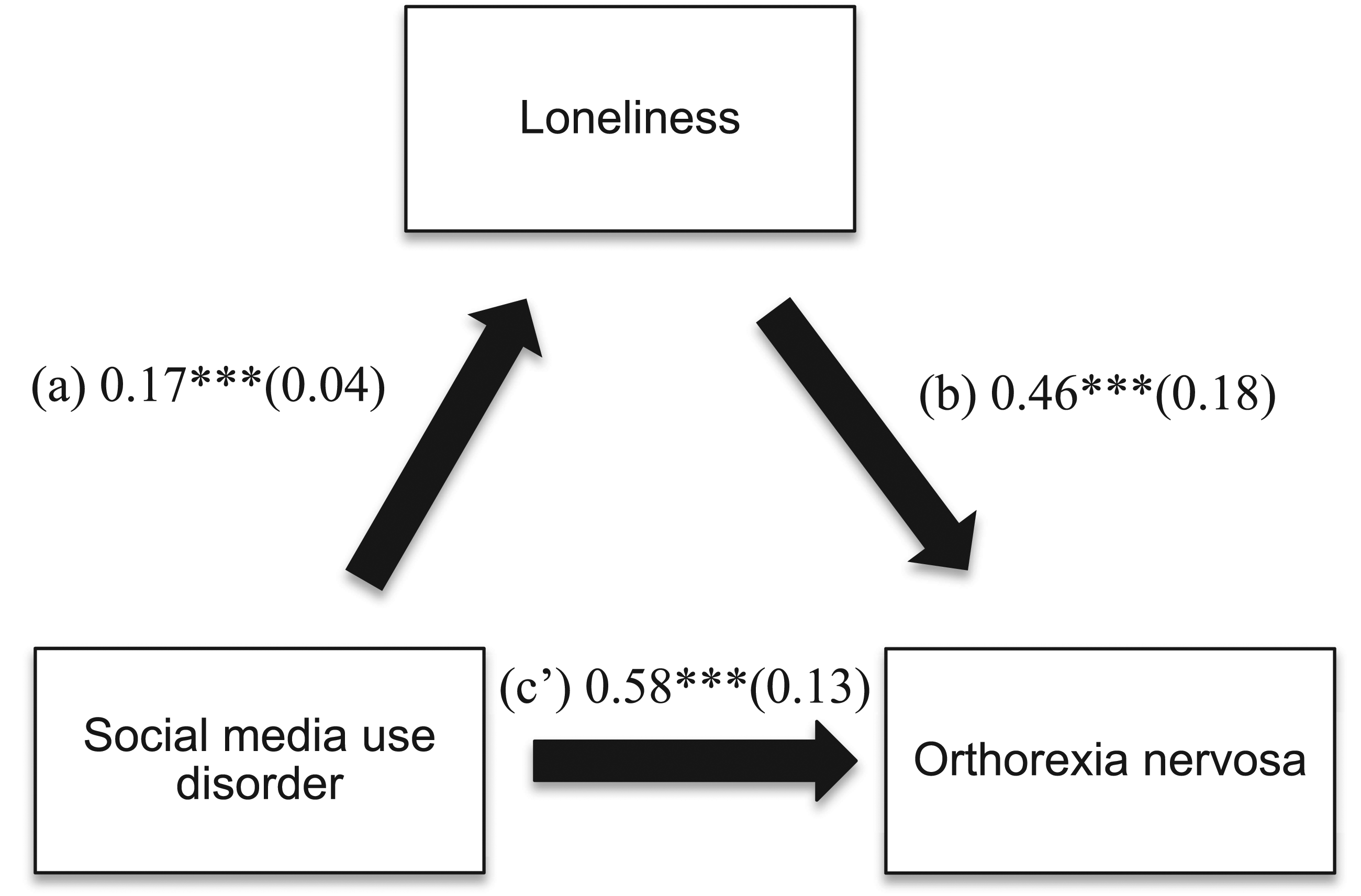
(a) Relation between SMUD and loneliness (R2 = 5.59%); (b) Relation between loneliness and ON (R2 = 8.74%); (c’) Direct effect between SMUD and ON (R2 = 7.06%). Numbers are displayed as regression coefficients (standard error). ***p < 0.001.
Discussion
Current findings show that higher SMUD was significantly associated with more ON, an association that was mediated by loneliness. Also, using Instagram, Tumblr, spending 30–60 minutes per day on social media applications compared to less than 30 minutes, higher physical activity index and loneliness were significantly associated with more ON.
ON and Social Media Applications
In this study, higher ON was associated with using Instagram and Tumblr and spending 30–60 minutes per day on social media applications. Using Instagram to browse health-related content and comparing self to others increased the risk of developing ON among Australian women (Norton, 2018). Another study showed that having a dependent relationship with Facebook, Instagram, Twitter and Pinterest, as well as spending more time on these social media platforms than the average of the population were associated with more symptoms of disordered eating (Santarossa & Woodruff, 2017). Also, ON is associated with causing and aggravating existing distress including loneliness (Segura-Garcia et al., 2015). Individuals exhibiting ON symptoms have the tendency to isolate themselves from social situations that expose them to perceived unhealthy eating behaviors (Alvarenga et al., 2012; Sfeir et al., 2021). Previously, it was found that Tumblr contained a community of people that promoted eating disorders; through as study, important markers to identify eating disorders were found (De Choudhury, 2015). These harmful messages were not exclusive to Tumblr but were also found on Instagram, Twitter and Facebook among other social media platforms, where some users were encouraging others to engage in pathological eating behaviors (Custers, 2015).
Social media has played an important role in spreading conversation about eating disorders, with ON being one (Valente et al., 2021). Additionally, a study found that a large number of people from the Instagram community was convinced that using social media contributes to the emergence of ON (Valente et al., 2021). Overall, social media has a significant influence on mental health, including eating disorders (Marks et al., 2020). Therefore, it can be hypothesized that being addicted to social media continuously exposes individuals to what is perceived as healthy diets and healthy bodies (Rodgers et al., 2019), subsequently increasing the probability of developing ON.
In this study, loneliness was significantly associated with more ON, which is consistent with the social implications of this disordered eating pattern; feeling incapable of convincing others of their eating patterns, or being understood, as well as the avoidance of social situations that do not promote their dietary beliefs (Conrad, 2019).
Mediation of Loneliness Between ON and Social Media Use
Results of the current study show that loneliness is a mediating variable between SMUD and ON. These findings can be explained by a couple different hypotheses. First, loneliness is a significant motivator of increased social media use, which can lead to addiction to social media. In a sample of university students in the U.S, it was found that browsing Instagram was related to lower loneliness (Yang, 2016). Similarly, university students in the United Kingdom that had more social interaction on social media experienced lower levels of loneliness (Thomas et al., 2020). Among Lebanese adults, women who met criteria for SMUD were more likely to exhibit high levels of loneliness (Youssef et al., 2020). Having said that, excessive use of social media increases exposure to dietary content associated with health, which can influence the onset of ON (Turner & Lefevre, 2017).
Second, ON can lead to social isolation, which increases feelings of loneliness (Brytek-Matera, Onieva-Zafra, et al., 2020). Exposure to information about health and diet, such as through social media, has been linked to an increase in dietary restrictions associated with ON and social isolation (DeBois & Chatfield, 2021). This can lead to an increased usage of social media that might eventually lead to SMUD. A study showed that loneliness was a strong predictor for addiction to the Internet among a sample of university students (Osman & Cirak, 2019). Research has shown that individuals experiencing loneliness are more likely to have a problematic use of social media and use it more frequently (O’Day & Heimberg, 2021).
ON and Physical Activity
Current results show that higher ON was associated with higher physical activity index. A high prevalence of ON and higher physical activity were found in university students specializing in sports science (Malmborg et al., 2017). In a German sample, a positive relationship was found between addiction to physical exercise and ON (Rudolph, 2018). In another study, results showed that skipping physical activity generated guilt and was associated with ON (Kiss-Leizer et al., 2019). In our study, higher ON was related to higher physical exercise, which is consistent with previous results. The connection between ON and higher physical activity can be clarified by the results of a past study: symptoms of ON were connected with addiction to physical exercise (Oberle et al., 2018). It can be assumed that ON and higher physical activity are perceived as attempts to optimize health.
Clinical Implications
The results found in this study guide future practices related to the screening and diagnosis of ON, SMUD and associated psychological variables. Assessing the factors included in this study, such as loneliness and physical activity, to identify possible ON and/or SMUD, can aid determine potential mental health problems. It can also help identify these potential psychological pathologies through loneliness and/or excessive physical exercise. Furthermore, physical activity can be transformed in an adaptive way to aid psychological problems through behavioral therapy, especially for those with ON symptomatology who already engage in exercise. Overall, the study aids in determining the profile of an individual who might suffer from psychological issues discussed at hand.
Limitations
There are some limitations to this study that must be mentioned. First, the results of the study cannot be extended to the rest of the Lebanese population as the sample is not representative, but consists of only university students and was gathered through a convenience sampling method. Second, this study is correlational and therefore, causation cannot be inferred from the current results but can only be done through assumptions and hypotheses. Third, the literature on ON remains relatively limited and no previous studies have examined the same variables in other samples or populations. This makes the results more challenging to interpret, as there is a lack of studies for it to be compared to or contrasted with. In addition, information bias might occur due to the use of self-report measures to assess the variables evaluated. Finally, it is important to mention the possibility of residual confounding bias because other variables that might affect ON were not considered in this study.
Conclusion
ON and SMUD are potential disorders that require support by conducting further studies, given that they are not included in the DSM yet. This study provides additional arguments on its significance in the clinical and social settings. The current results showed that SMUD is associated with ON and that this association is mediated by loneliness. These relationships might help mental health professionals better detect these potential psychological disorders and might help improve future treatment of issues related to ON and SMUD. Furthermore, this study can be replicated within other samples and populations in order to detect differences among cultures. Future studies should also focus on other variables (e.g. body image, depression), which may interact in the association between SMUD and eating disorders.
Future Perspectives
ON is yet to be included as an official disorder is the DSM-5, despite the growing body of research discussing it as well as its associated psychological variables. This study is an addition to the literature discussed the potential psychological disorder and can be used as further proof that ON is a considerable pathology affecting other aspects of the human psychology.
Footnotes
Acknowledgments
We would like to thank all participants who helped us during this project.
Authors’ Contributions
RR, SO and SH designed the study; EA drafted the manuscript; SH and RR carried out the analysis and interpreted the results; SG was responsible for the data collection; all authors reviewed the final manuscript and gave their consent.
Declaration of Conflicting Interests
The author(s) declared no potential conflicts of interest with respect to the research, authorship, and/or publication of this article.
Funding
The author(s) received no financial support for the research, authorship, and/or publication of this article.
Ethical Approval and Consent to Participate
The Psychiatric Hospital of the Cross Ethics and Research Committee approved this study protocol (HPC-007–2021). Submitting the form online was considered equivalent to obtaining a written informed consent.
