



Abstract
The purpose of this study was to explore variables related to school belonging from a holistic perspective, including a large number of variables in one model, different to the traditional analytical method. Using 2015 data from the Program for International Student Assessment (PISA), we sought to identify variables related to school belonging by searching for hundreds of predictors in one model using the group Mnet machine learning technique. The study repeated 100 rounds of model building after random data splitting. After exploring 504 variables (384 student and 99 parent), 32 variables were finally selected after selection counts. Variables predicting a sense of school belonging were categorized as individual/parent variables (e.g. motivation to achieve, tendency to cooperative learning, parental support) and school-related variables (e.g. school satisfaction, peer/teacher relationship, learning/physical activities). The significance and implications of the study as well as future research topics were discussed.
Keywords
Introduction
School is an important context in which adolescents can form a bond with teachers and peers. A sense of belonging to school reflects a broader need to belong, which engenders a healthy and protective relationship within the school community (Goodenow & Grady, 1993). Moreover, students’ positive experiences can be increased, and negative experiences buffered. It also helps to facilitate psychological well-being; therefore, a lack of belonging can inhibit students’ mental health, which can result in stress, anxiety, depression, and loss of meaning in life (Hagerty et al., 1992; Millings et al., 2012).
Student’s sense of belonging to school has been studied as an important factor that influences academic and psychological success (Booker, 2007), as students can feel accepted and respected by other students and feel connected to the school community (Chow, 2007; Prieto-Flores et al., 2011). Furthermore, students with a high sense of belonging have intrinsic motivation and attain greater achievement (Barile et al., 2012). Some studies also report that sense of belonging has a positive influence on learning motivation, class participation, career maturity, and school satisfaction (Becker & Luthar, 2002; Furrer & Skinner, 2003).
Studies on variables that influence school belonging account for individual and family factors such as individual psychological needs, family environment, and parents’ learning interventions, while studies that examine school factors focus on social relations such as school life, friends, and teachers. It has been shown that meeting of the basic psychological needs enhances psychological happiness and a sense of belonging in relation to individual and family factors (Hahn & Oishi, 2006), while parents’ involvement in learning leads to improved confidence in learning and academic achievement through their child’s sense of belonging to school (Kuperminc et al., 2008).
In one study related to school factors, a cooperative school environment was found to induce a sense of belonging among members (Reichmann & Grasha, 1974), and a positive relationship between perception of cooperative learning and school belonging was reported (Strahm, 2007). Thus, forming a positive bond with peers is necessary to increase school life satisfaction and school belonging (Demanet & Van Houtte, 2012). Teachers’ autonomy support was also found to be important as it positively relates to school belonging (Froiland et al., 2016).
Until now, studies have revealed the need to explore more diverse and comprehensive variables that affect the sense of belonging to school. Most studies on school belonging to date have relied on finding statistical significance through the relationship between variables derived from theory and previous studies. However, studies employing conventional statistical techniques may have varying results in statistical significance according to variable combinations and variable input orders, and such statistical methods may have problems such as non-convergence, overfitting, and multicollinearity (Yoo, 2018).
Therefore, to overcome these problems and to explore predictors related to school belonging in this study, a machine learning technique was applied to the Program for International Student Assessment
Theoretical Background
The Concept and Importance of School Belonging
Humans have a fundamental instinct to form psychological bonds in their group; that is, a desire to belong as a member of the community they value. A sense of belonging is important for survival and psychological well-being, and any lack of belonging results in harm to individual mental health, including stress, anxiety, depression, and loss of meaning in life (Baumeister & Leary, 1995). The school is a place where students’ social, emotional, and cognitive development occurs, and the sense of belonging that students feel toward school can act as an important variable of academic achievement as a result of studying together within the community of a school or class (Bandura, 1988; Faircloth & Hamm, 2005; Goodenow, 1992).
School belonging is defined as the way students respect and value their school and the people within it through social and emotional bonds (Goodnow, 1992), and this concept has been studied as an important factor that explains students’ academic and psychological status (Booker, 2004) and as a powerful variable for predicting academic achievement (Sirin & Rogers-Sirin, 2004). As many studies have reported a positive correlation between school belonging and academic achievement (Eccles, 2009; Pittman & Richmond, 2007), school belonging is considered likely to increase the probability of successfully completing school (Hallinan, 2008). Students who feel socially connected within their school tend to have higher motivation to learn and in turn, to perform better (Abdollahi & Noltemeyer, 2018; Freeman et al., 2007). Moreover, school belonging has been found to be related to life satisfaction (Chow, 2007; Datu & Valdez, 2019; Lin, 2016).
Variables Related to a Sense of School Belonging
Individual and parent variables
The family environment can affect attachment and interpersonal relationships that help form a sense of belonging. In particular, family status, environment, and socioeconomic status (SES) have significant influence on motivation and achievement (Sirin, 2005). A dynamic and positive home environment including parent-child interactions are also important. Parental involvement in learning refers to the behaviors carried out by parents that enhance their child’s academic achievement through interaction. Specifically, this refers to positive support for learning, parental participation, learning environment creation, and expected behavior for learning outcomes (Hill & Tyson, 2009). Kuperminc et al. (2008) investigated the relationship between middle and high school students’ parental learning intervention and their children’s academic achievement and found that students’ school belonging was mediated by parental intervention and increased students’ confidence and achievement.
Teacher, peer, and school climate variables
Satisfying the desire for a sense of belonging is closely related to the level of psychological and/or social development and adolescent adjustment. The theory of self-determination emphasizes satisfaction of three basic psychological needs: autonomy, competence, and relationship. Satisfaction with basic psychological needs plays an important role in promoting psychological well-being and belonging (Hahn & Oishi, 2006; Reis et al., 2000). Of these needs, relatedness—the levels of social connectedness (Ryan & Deci, 2000)—appears to be important for school belonging, and satisfying relatedness can affect intrinsic motivation and well-being. An environment that supports students’ relatedness can help them to internalize external values as well as improve competence and relationships. Teachers can help meet the basic psychological needs of adolescents and promote adjustment by facilitating a supportive classroom environment and providing students with autonomy support, structure, and engagement (Kiefer et al., 2015). Teacher support and care were pointed out as important factors explaining a sense of belonging (Libbey, 2004).
Adolescence is a critical life stage, when the focus of social interaction shifts from self-oriented behavior to other- and social- oriented cognitive behavior (Eisenberg & Fabes, 2006). Adolescents are more strongly motivated to be accepted by peer groups (rather than children and adults) and are more sensitive to being rejected by peers (Newcomb et al., 1993). Therefore, the number of peers included in interpersonal relationships increases in this developmental stage than in childhood. As the time spent at school increases, the importance of peer relations is emphasized over parent relationships. Therefore, it is important for peer relationships in adolescence to remain positive both in and out of school. If a positive relationship with peers is not maintained, the student may feel alienated and lonely when intimacy between peers is most needed. Thus, peer attachment has been studied in relation to school bonding (Juvonen, 2006; Oldfield et al., 2016).
Whitlock (2006) revealed that school bonding involves experiencing intimate relationships in school, a sense of belonging, and satisfaction with school. Armsden and Greenberg (1987) mentioned that adolescents with high peer attachment have a high school attendance rate and a positive perception of school. Therefore, peer attachment forms a sense of belonging to school and increases life satisfaction (Demanet & Van Houtte, 2012; Pittman & Richmond, 2007). In other words, peer attachment can be a powerful driving force for positive relationships among school members (McLaughlin & Clarke, 2010).
Penalized Regression in Social Science Large-Scale Data Analysis
Penalized regression (regularization) is an approach that yields prediction models and has been popular in various fields of study, including bioinformatics (e.g., Antonacci et al., 2020; Lécuyer et al., 2020; Liu et al., 2018; Zeng et al., 2021), economics (Yang et al., 2022; Zhang et al., 2019), and engineering (e.g., Abdella & Shaaban, 2021; Nabian & Meidani, 2020). Recently, social science studies utilizing large-scale data analysis have started to utilize this approach. For instance, elastic net (Yoo, 2018), glmmLasso (Kim & Yoo, 2020; Koo & Yoo, 2021), and group Mnet (Yoo & Rho, 2020) have been employed to predict students’ mathematics achievement, computer and information literacy, and teacher cooperation, as well as teacher job satisfaction, using Trends in International Mathematics and Science Study (TIMSS), International Computer Information Literacy Study (ICILS), and Teaching and Learning International Survey (TALIS) data. However, no studies have yet applied penalized regression for predictor selection of students’ belonging to school using social science large-scale data.
In the context of this type of analysis, penalized regression has the following advantages (Yoo & Rho, 2022, pp. 1–2). First, penalized regression is a linear method with strength in interpretation compared to nonlinear models, such as random forest or deep learning. Although nonlinear models are considered to show higher prediction than linear models, recent studies that analyze social science large-scale data (Yoo & Rho, 2022) or learning analytics data (Beemer et al., 2018; Yoo et al., 2022) have reported that nonlinear methods such as random forest did not outperform penalized regression in terms of prediction. Second, penalized regression relies on the sparsity assumption (Hastie et al., 2015). The sparsity assumption that the true model comprises a subset of predictors among a very large set of predictor candidates is more likely to be satisfied analyzing data obtained in large-scale studies. Third, by exploring many variables of the large-scale survey data, new important predictors or relationships can be identified (Shmueli, 2010), which may not be viable with traditional methods such as hierarchical linear modeling and structural equation modeling.
Methods
Data
A total of 5581 Korean students (2912 males and 2669 females) participated in PISA 2015, most of whom were 10th graders. In this study, we commenced with 927 student and parent variables (after merging the four questionnaires: student background, ICT familiarity, educational career, and parent), from which 423 variables were removed as follows. First, variables that were irrelevant to analysis were removed, including identification (e.g., CNTSTUID), weighting (e.g., W_FSTURWT), and administration (e.g., ADMINMODE). With regard to the plausible values (PVs), the first PV of each subject was retained, and the other PVs were deleted. This resulted in the removal of a total of 234 variables. Second, variables of 30% or higher missingness (68 variables) were deleted, as these can lead to problems in the subsequent imputation phase. Third, variables of near-zero variance (65 variables) were removed from analysis, as such variables contribute little overall to modeling. Lastly, derived variables such as ANXTEST and MOTIVA (56 variables) were removed and instead, individual items were included in the analysis to investigate their relationship to the response variable, resulting is a final total of 504 variables to be used in the study.
Responses from categorical questions were dummy-coded. Of note, by utilizing group Mnet, a set of dummy-coded variables from a multiple-category variable was treated as a group. In other words, a group of dummy-coded variables is either selected or unselected as if one set. Likert-scaled variables were analyzed as continuous. A total of six items measured students’ sense of belonging to school on a 4-point Likert scale (ST034; Cronbach’s alpha = .80; mean = 3.16; standard deviation = 0.48). The PISA 2015 data and questionnaires are available at https://www.oecd.org/pisa/data/2015database/.
Group Mnet
Group Mnet is categorized as penalized regression among machine learning techniques. This method imposes penalties to the objective function and shrinks some of the coefficient estimates of less important predictors. The least absolute selection and shrinkage operator (LASSO), developed by Tibshirani (1996), has been popular as the first penalized regression methods for variable selection. However, estimates of LASSO are known to be inconsistent in terms of variable selection by utilizing a convex penalty (Fan & Li, 2001; Leng et al., 2006; Meinshausen & Bühlmann, 2006; Zou, 2006). Minimax concave penalty (MCP) solves this problem of LASSO by employing a nonconvex or a concave penalty (Zhang, 2010). When a ridge term is added to the MCP penalty function, MCP turns to Mnet, handling possible multicollinearity problems and yielding nearly consistent estimates (Huang et al., 2016).
In particular, group Mnet has the aforementioned advantage of dealing with categorical predictors in variable selection. Group Mnet (hereafter Mnet) is explained in equations (Yoo et al., 2022; Yoo & Rho, 2022). Consider a linear regression model with

The objective function of Mnet is equation (2), which consists of the loss function of least squares, the MCP penalty, and the ridge penalty terms. The penalty parameter


K-Nearest Neighbors Imputation
After data cleaning, 384 student and 99 parent variables (504 total) served as explanatory variables, of which only 21 predictors (8.51%) were completely observed, while the remaining 483 (95.83%) variables had missing rates ranging between 0.44% and 26.41%. Listwise deletion retained approximately 8.13% of the observations (454 out of 5581 observations), and we therefore employed k-Nearest Neighbors (k-NN) imputation. A simulation study on social science large-scale data recommends k-NN as a suitable method to employ (Yoo & Rho, 2022). In the same study, k-NN outperformed expectation-maximization (EM) in terms of prediction measures and variable selection.
In k-NN, the k closest observations to a missing data point are identified by calculating distance in the multidimensional space (Troyanskaya et al., 2001), and the average of the k closest observations replaces the missing data point. Therefore, the distance measure and the number of k are of importance in k-NN. Following Beretta and Santaniello (2016), the number of complete observations was obtained as 1,638, and 40 (the square root of 1638) served as the value of k. With regard to the distance measure, Gower distance was employed to handle the mixed-format data of PISA (Gower, 1971).
Selection Counts and Prediction Error
Variables of estimates with nonzero coefficients after Mnet cannot be interpreted as statistically significant. While statistical significance testing is conducted on unbiased estimates, penalized regression including Mnet produces biased estimates. Special techniques such as post-selection inference (Lee et al., 2016) are required to examine statistical significance, but currently are available with LASSO. Thus, to identify important predictors, we employed selection counts of variables after multiple iterations of random data splitting and model fitting (Yoo et al., 2022; Yoo & Rho, 2020, 2022). Variables selected more frequently are of greater importance. The selection (or non-selection) of each variable was counted, which served as a selection count.
The steps for obtaining root mean squared error (RMSE) and selection counts were as follows (Yoo et al., 2022; Yoo & Koo, 2021). First, the entire cleaned data was divided with a ratio of 7:3 for the training and test data, respectively. Second, a 10-fold cross validation (CV) was implemented on the training data and the penalty value of the smallest error was identified. Third, the penalty value from Step 2 was applied to the test data and the RMSE of the test data (prediction error) was calculated. After the three steps were iterated 100 times with random seeds, the number of selections was counted for each variable. The programs were written in R, including grpreg (Breheny et al., 2021) for group Mnet.
To summarize, the methodological significance of this study was mainly determined in four reasons: a) to overcome the inconsistency of penalized regression methods using convex penalties; b) to handle possible multicollinearity problems; c) to consider multi-category predictors in modeling; and d) to obtain selection counts of predictors to account for the randomness of data segmentation.
Results
Descriptive Statistics of Test Data RMSE.

Note: Q1 = the first quartile; Q3 = the third quartile.
Descriptive Statistics of Variable Selection in One Run of Mnet.

Note: Q1 = the first quartile; Q3 = the third quartile.
Selection Counts after 100 Iterations.

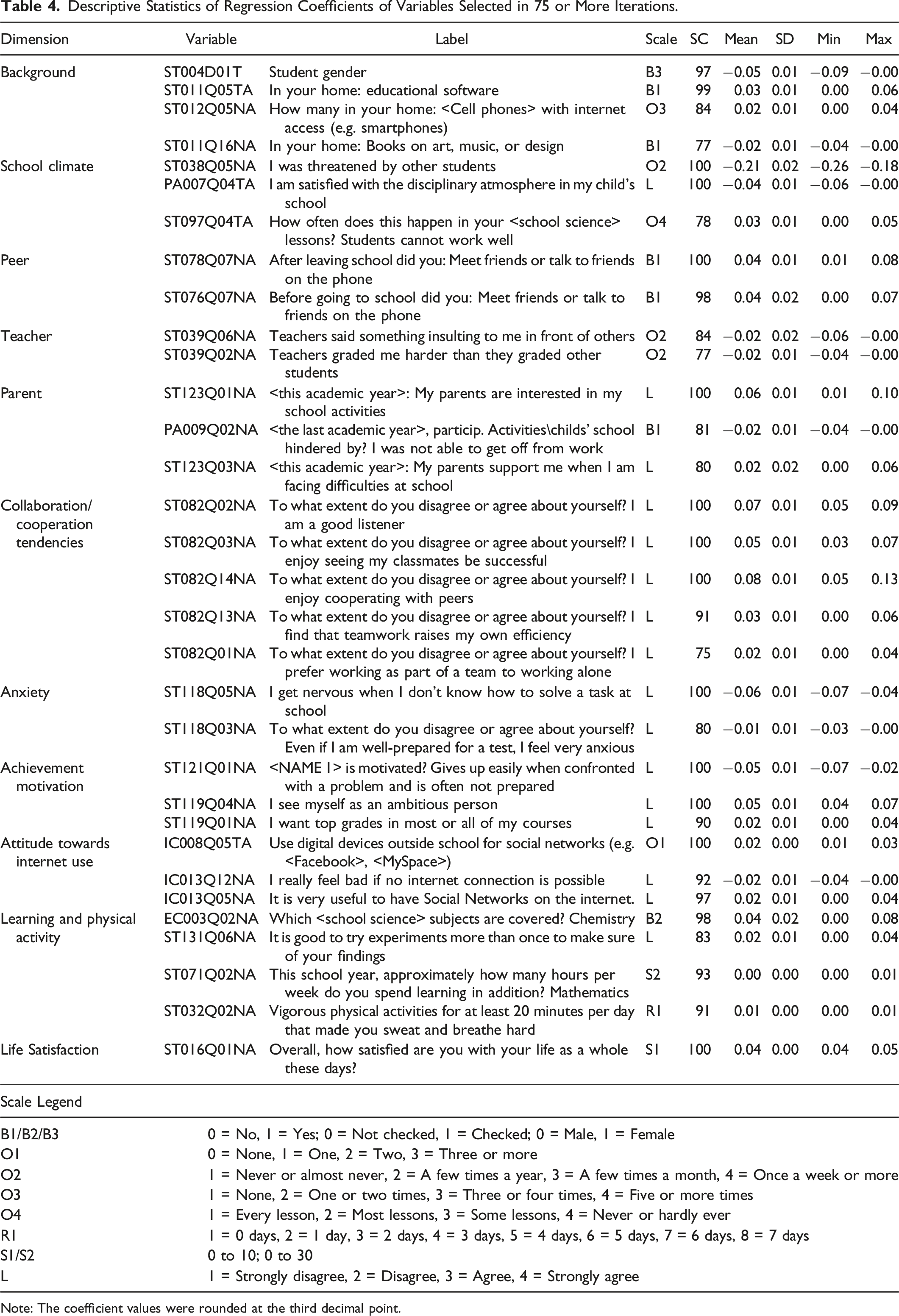
Descriptive Statistics of Regression Coefficients of Variables Selected in 75 or More Iterations.
Note: The coefficient values were rounded at the third decimal point.
Table 4 reports the regression coefficients of the 32 predictors selected from 75 or more iterations. As shown, important variables spanned across dimensions such as background, school climate, interpersonal relationships, parental involvement, collaboration/cooperation tendencies, motivation/anxiety, attitude toward internet use, and learning/physical activities. Among the background variables, female students felt a greater sense of school belonging, while SES (ICT environment, ST011Q05TA, ST012Q05NA) was positively associated with sense of school belonging. Interestingly, the number of books on art, music, or design was negatively associated with sense of school belonging (ST011Q16NA).
Regarding to school climate, students who were threatened by other students reported less sense of belonging to school (ST038Q05NA), as expected. When students perceived their class as more academically focused (ST097Q04TA), they felt more sense of school belonging. When parents were satisfied with the disciplinary atmosphere of their child’s school, the students felt less sense of belonging (PA007Q04TA).
Two variables of peer relationship (ST078Q07NA, ST076Q07NA) and two variables of teacher relationship (ST039Q06NA, ST039Q02NA) demonstrated that students who perceive positive peer/teacher relationship reported a greater sense of school belonging. Parental support (ST123Q01NA, ST123Q03NA) and involvement in school (PA009Q02NA) were also positively associated with students’ sense of belonging.
Relatively more variables regarding collaboration/cooperation tendencies were related to sense of school belonging (ST082Q01NA, ST082Q02NA, ST082Q03NA, ST082Q13NA, ST082Q14NA); the more students preferred cooperation and teamwork in the classroom or having a positive attitude toward cooperative learning, the greater their sense of belonging to school. Students who had a higher level of motivation to achieve were likely to report greater sense of school belonging (ST119Q01NA, ST119Q04NA, ST121Q01NA). Conversely, students who felt anxious about learning tended to have a lower sense of school belonging (ST118Q03NA, ST118Q05NA).
Students’ positive attitude toward the use of social networks on the Internet (ICT008Q05TA, ICT013Q05NA) was positively associated with sense of school belonging. Correspondingly, when student feel bad about having no internet connection, their sense of school belonging is reduced (IC013Q12NA). Learning activities in chemistry (EC003Q02NA) and mathematics (ST071Q02NA) and preference for experiments (ST131Q06NA) were positively related to a sense of belonging. Further, students who spent more time engaged in physical activities (ST032Q02NA) were more likely to feel a sense of school belonging. Finally, students’ satisfaction with life was positively associated with a heightened sense of belonging to school (ST016Q01NA).
Discussion
We conducted this study to explore new variables and build a model with high predictive power using group Mnet, one of the machine learning techniques, to find a more comprehensive list of variables related to school belonging. By optimally utilizing hundreds of variables, we can search beyond the existing literature in relation to school belonging. Of note, when interpreting machine learning results, direct comparison with existing literature based on conventional methods may not be appropriate. Machine learning focuses on the prediction of new data, whereas traditional analysis methods focus on explaining the current data (Shmueli, 2010). Likewise, the variables identified as important via group Mnet may not be statistically significant as they are variables that contribute to prediction. Because there are few studies that have explored variables related to school belonging using this line of advanced techniques, we focused on variables that are newly explored in the results and variables that were different from those of previous studies and suggest subsequent research topics.
Individual, Parental, and Interpersonal Factors Predicting a Sense of School Belonging
First, students’ motivation and achievement are related to sense of school belonging. In terms of the relationship between school belonging and motivation, it is known that the greater the sense of school belonging, the greater the academic achievement (Adelabu, 2007; Niehaus et al., 2012). The present study demonstrated that students’ higher learning motivation is positively associated with sense of school belonging, while students’ anxiety about learning is negatively associated with the outcome. It is noted that high-achieving students are likely to be motivated to learn and feel competent about their learning. In a longitudinal study on high school students in the United States, a sense of belonging was found to be significant for predicting the next year’s academic achievement when controlling for academic achievement in the previous year (Neel & Fuligni, 2013). This means that a high sense of belonging to school is related to students’ increased motivation to learn. Performance in school and the extent to which students feel satisfaction are connected to each other (Gilman & Huebner, 2006). Students who obtain high achievement may do so partly because they are happy, and higher achievement may make them happier (Quinn & Duckworth, 2007). In this study, life satisfaction was found to be a positive predictor of a sense of school belonging. Prior studies also have shown that depression, social rejection, or negative affect are negatively correlated with school belonging (Shochet et al., 2011) and overall satisfaction in life can predict students’ sense of belonging.
Another individual factor relating to school belonging is students’ preference for cooperation and tendency to engage in teamwork. Research related to cooperation and school belonging showed that the stronger the sense of school belonging, the more active the participation in classroom learning, including assignment completion, test preparation, and school attendance (Goodenow & Grady, 1993). In addition, Goodenow (1992) reported a relationship between school belonging and social interaction in the classroom environment as well as support from others. Qualitative research supports this result, emphasizing the importance of teamwork to individuals (Cleary et al., 2011; Strahm, 2007).
Second, parents’ emotional support and the degree to which parents are interested in their children’s school activities are positively related to children’s sense of school belonging. Previous studies have reported that parental variables are significantly related to school life satisfaction (Shin et al., 2011). It was found that parental support and interest in children’s school-related activities had a positive effect on student sense of belonging. Related studies suggest school belonging acts as a mediator between parents’ involvement in learning and academic achievement (Kuperminc et al., 2008). In addition, parents’ involvement in learning affects individual psychological variables such as learning motivation, self-concept, and school belonging (Gonzalez-Pienda et al., 2002; Seol & Jung, 2013).
Third, the sense of belonging reduced when students perceived their teacher treated them unfairly (e.g. “Teachers graded me harder than they graded other students”). Allen et al. (2018) found that discipline procedures and fairness were related to the environmental factors of school belonging. The current finding also suggests that if the relationship between students and teachers is not positively formed, students barely feel connected with their school. Thus, teachers’ efforts to build positive relationships with students by providing them with social and emotional support are critical to satisfying the students’ need for relatedness, engagement, and belonging (Juvonen, 2006).
Fourth, peer variables predicting school belonging included interpersonal relationships. Positive peer relationships can promote individual belonging by helping each student feel connected (St-Amand et al., 2017). The feeling of belonging has a positive effect on feelings such as joy, passion, happiness, interest, and confidence when participating in learning activities. Without a sense of belonging, emotions such as anxiety and boredom prevail (Furrer & Skinner, 2003; Weiss & Smith, 2002). In the present study, using digital devices to communicate with friends and maintain social relationships outside of school predicted students’ sense of belonging to school. According to Cingel and Krcmar (2014), the use of social network services (SNS) during adolescence influences students’ peer relationships by acting as a “super-peer.” (p. 156) This enables teenagers to understand social and behavioral norms. Previous studies investigating the characteristics of mobile phone use among Korean middle school students also found that 68.6% of students use mobile phones to communicate with their peers and maintain interpersonal relationships (Kim, 2016). As such, the use of outside-school digital devices can help increase adolescents’ peer attachment and positive relationship between friends, which leads to an increase in school affiliation (Lin, 2016). The result of the positive correlation between students’ positive attitude toward social networks on the Internet and their sense of belonging supports the prior research.
The Importance of School Climate
The school climate reflects “norms, goals, values, interpersonal relationships, teaching and learning practices, and organizational structures” (Cohen et al., 2009, p. 182). In the present study, students who were threatened by other students reported less of a sense of belonging to school. A safe school environment has been reported to have a positive effect on adolescents’ school adaptation and school satisfaction (Coelho & Dell’Aglio, 2019; Reddy et al., 2003). Cunningham (2007) reported that feelings of safety at school were increased when students perceived that there were ‘healthy norms’ concerning bullying (e.g. teachers and staff intervene effectively when bullying occurs). School belonging can be lowered when students cannot feel safe, as in the case of victimization (Holt & Espelage, 2003).
To improve the quality of school belonging, it is necessary to meet basic psychological needs by creating a school environment in which students can feel a sense of relatedness (Deci & Ryan, 2000). Students with a high sense of belonging to school can interact more closely with their peers and teachers by feeling that they are accepted and supported by members of the school community. School community can provide opportunities for students to experience and develop social cohesion.
Previous research on environmental factors of sense of belonging mostly focused on school size, location, safety policies, and availability of places to socialize (Chan, 2008; Cunningham, 2007; Waters et al., 2010). This study further identified that academic climate of school can be a contributor to promote school belonging. Students who perceived their climate as more academically focused were more likely to feel a sense of belonging. Allen et al. (2018) also pointed out that when schools focus on academic performance, students may benefit from both higher achievement and a greater sense of school belonging.
It is interesting to note that the more parents were satisfied with the school’s disciplinary climate, the less students felt sense of belonging. Parent’s satisfaction with the school’s disciplinary atmosphere does not necessarily appear linked to their children’s satisfaction on the school climate. Rather, students who attend schools with strict disciplines may perceive that the atmosphere has become rigid, and as a result, students’ sense of belonging to the school may decrease. In-depth investigation is warranted in future research on the types and degrees of school disciplines with which parents are satisfied.
New Implications for School Belonging Research
By applying group Mnet, one of the most recent machine learning techniques, hundreds of variables were explored in one statistical model. As a result, important predictors of school belonging were identified, of which several were newly identified and unexplored in previous research. For example, first, in terms of home environment, we found that the number of books on art, music, and design is negatively associated with a sense of school belonging. While there is no previous study on the direct relationship between these variables, Guilford (1973) suggested that independence, flexibility, and autonomy are the characteristics of people who are creative. Thus, parents with this type of home environment are more likely to engage in related jobs. In other words, influenced by the artistic and musical characteristics of parents, students will also value individual autonomy and form an independent disposition, negatively associated with the connectedness or relatedness to other students and school in general. Moreover, it is also suggested that students who grow up in this type of home environment tend to have an interest in art and music compared to other students. Because most of the students in this study were sampled from general high school, the learning environment was less focused on artistic and musical interests. Therefore, it is highly likely that they would be focused more on studying subjects related to college entrance exams. Students with an interest in art and music may have low school life satisfaction, which in turn has a negative effect on school belonging (Shin et al., 2011).
It is noted that, while previous studies only consider the relationship between in- and out-of-school activities and school belonging (Faircloth & Hamm, 2005; Ma, 2003), we expanded the result that learning activities of either academic (chemistry and mathematics) or non-academic (time spent in physical education) activities and preference for experiments in science positively predict a sense of school belonging. Because this study only considers the PISA 2015 data (with a focus on science), we specifically investigated variables related to science-related educational practices. The present results reveal that chemistry (that may involve relatively higher level of experimentation in class) is positively associated with school belonging. Experiments and/or simulation activities in chemistry class include various forms of student- and teacher-student interactions and collaborations. Therefore, it can be suggested that those learning activities can ultimately promote student’s sense of school belonging.
Limitations and Suggestions for Future Study
This study expands research on school belonging through the exploratory derivation of school belonging predictors by applying the group Mnet machine learning technique to provide an empirical basis for variable exploration in future studies. Existing studies related to school belonging model the relationship with school belonging using limited variables based on previous theories because of the constraints of analysis techniques. However, this study attempted to identify new variables related to school belonging. Subsequent studies are expected to provide richer implications for school belonging by using machine learning techniques to find major variables of school belonging using domestic and international panel data, including large-scale assessments such as PISA.
Of note, while this study focused on student and parent variables, the inclusion of school and teacher variables in modeling can shed additional light on school belonging research. Penalized regression methods such as glmmLasso (Groll & Tutz, 2014) can be particularly suitable for modeling nested data and have recently received attention in social science large-scale data studies (e.g., Kim & Yoo, 2020; Koo & Yoo, 2021; Yoo & Koo, 2021). Nonetheless, penalized regression for multilevel data are currently available with LASSO, and its extension to nonconvex methods (e.g., Mnet) is thus far undeveloped (Yoo & Rho, 2022).
Sense of belonging can also be derived from the efforts of individual students, stimulation from the home and school environment, and interaction with school members. Because school belonging comprises an individual’s subjective feeling about the school, it is necessary for the school to provide a learning environment that induces students to promote their own sense of purpose (Coates, 2006). Therefore, it is necessary to develop programs that can provide opportunities for students to develop social cohesion through various out-of-school experiences and exchanges at school. In addition, it is important for schools to continuously provide services such as parental education programs for appropriate emotional support to students at home. Such information was found to be useful at parent-teacher conferences and school participatory activities for parents.
To help students who have a low sense of belonging and maladjustment to school, both professional interventions by student counselors and informal meetings or activities for peers and teachers need to be expanded. Similarly, student councils or clubs/out-of-school activities can strengthen peer interaction between students. If such a school system is formed and the quality of interaction between school members increases, students will be united as members of the school and connected to each other to enhance their sense of school belonging.
Footnotes
Declaration of Conflicting Interests
The author(s) declared no potential conflicts of interest with respect to the research, authorship, and/or publication of this article.
Funding
The author(s) received no financial support for the research, authorship, and/or publication of this article.
