




Abstract
Taking into account beliefs and culture is essential in behaviour analysis in various areas of life and work. However, knowledge about the links between these beliefs is sparse and imprecise. This article analyses the links between fatalistic, cultural and socio-instrumental control beliefs, by a questionnaire on a sample of 515 Cameroonian partcipants including male (N = 290) and female (N = 225), workers from the public (N = 208), formal private (N = 265) and informal (N = 40) sectors. The questionnaire consisted of the fatalism scale designed by Kouabenan (1998), the Cameroonian cultural beliefs scale by Ngueutsa et al. (2021), and the socio-instrumental control beliefs scale derived from Spector (2004). Regression analyses showed that cultural beliefs partially mediated the link between fatalistic and socio-instrumental control beliefs. The results call into question the conceptualization of fatalistic beliefs, often seen as inducers of passivity. They suggest that cultural beliefs and practices may activate a ‘non-inhibiting’ form of fatalism that would justify the use of cultural entities to exercise indirect control over events. The concept of active fatalism is discussed.
Introduction
It is increasingly recognized that beliefs intervene in various areas of an individual’s life (Cohn et al., 2015; Kouabenan, 2009). The functional relationship between the author and the object of belief - which is control - is one of the conceptual approaches to investigating beliefs in some studies in psychology (Cheng et al., 2013). These studies are based on the idea that most human behaviours aim to acquire or maintain control over events in all areas of life (Heckhausen & Schulz, 1995). Sitting at opposite ends of a hypothetical continuum defining the control we can have over events, we note two contrasting conceptions of beliefs in the literature. At one end, we have a conception characterised by a total lack of control that individuals believe they have over events, constituted by fatalistic beliefs (Esparza et al., 2015; Kouabenan, 1998; McIlroy et al., 2020; Ngueutsa & Kouabenan, 2017). At the other end is a conception which is characterised by a high level of control that individuals believe they have over events, reflecting what are commonly called ‘control beliefs’ (Cheng et al., 2013; Heckhausen & Schulz, 1995). Between the two opposite ends, socio-instrumental control beliefs (Spector et al., 2004) refer to control that individuals believe they have over events through social entities. These forms of control beliefs are conceptualized on the basis of Rotter’s locus of control (LOC) (1966) and subsequent developments.
Similarly, the place of cultural norms and practices is increasingly highlighted in how control beliefs are expressed (Testé, 2017). Spector et al. (2004) and Cheng et al. (2013) noted that individuals from so-called individualist societies (Western) tend to believe in the importance of a control that is more internal than external than persons from so-called collectivist societies (southern hemisphere countries). Accordingly, control and/or fatalistic beliefs may be moderated by beliefs rooted in cultural practices (Ngueutsa et al., 2021; Reynolds et al., 2006). We are concerned about the widespread western and monolithic individual-centred conception of control, in which “control beliefs are classified into either external or internal, based on whether the person believes in direct personal control or sees control to lie elsewhere such as in powerful others” (Spector et al., 2004, p. 41). This conception of control does not reflect other means of control viewed and experienced by people in so-called collectivist cultures where group harmony, interpersonal relationships and powerfull others are of paramount importance and could be central in the conception of control. Therefore, control could go beyond the traditional and dualist internal/external conception and reflect a continuum lying from a total lack of control by oneself or powerfull others to a total control by oneself or powerfull others. This conception of mediated control through others, i.e., socioinstrumental control, suggested by Spector et al. (2004) is unknown in the literature and deserves special attention. This article analyses the link between fatalistic beliefs, cultural beliefs and socio-instrumental control beliefs in the African cultural context, where cultural practices constitute significant markers of social norms.
From LOC to Socio-Instrumental Control Beliefs
The western forms and conceptualizations of control beliefs vary in psychology literature in general, and in organizational behaviour theories in particular (Terry & Jimmieson, 1999). In social cognitive theory and in the sequential model of self-protection behaviour, they are conceptualized in terms of self-efficacy (Bandura, 1977, 1997; Dejoy, 1996; Strecher et al., 1986). In the theory of planned behaviour, they are conceptualized as perceived behavioural control (Ajzen, 1985), while in the protection motivation theory (Rogers, 1983), they are conceptualized as the perceived capacity to cope with risk. The applications of psychological models explaining adapted behaviours (Bergvik et al., 2012; Brockner et al., 2004; Spector, 1986) show that control beliefs are robusts predictors of health and safety behaviours.
Conceptualizations of control beliefs are based on Rotter’s LOC (1966) which places individuals at the centre of control over the events they are confronted with. Rotter was the first to consider using beliefs in controlling events by oneself (internal control) or by others (external control) as a relevant adjustment variable when analysing and understanding behaviours. In their work on the LOC, Levenson (1972) and Paquet et al. (2009, 2014) emphasized the role of “the significant other” which Rotter (1966) designated “the powerful other”, in the control of the rewards for the individual in different situations. This conception of the external LOC suggests that individuals who believe in external control might also perceive themselves as having indirect control over what happens to them, by influencing “the significant other” to their (i.e., the individuals’) benefit (Paquet et al., 2009, 2014). However, a literature review by Spector et al. (2004) noted that almost all studies in psychology highlight a strong external perceived control in so-called collectivist societies and tend to treat it too hastily as passivity or fatalism. The authors criticized these works and suggested that all individuals exercise control over events, but that the measures of perceived control developed in the Western context, are not applicable in Southern hemisphere societies. The same authors conceptualized the notion of socio-instrumental control beliefs, which consists in using social means and entities (relationships, networks, important people, loved ones, etc.) to influence the environment in order to adapt it to oneself. In their pioneering study on a sample population of Asians and Americans, they observed high scores for socio-instrumental control beliefs in the sample, with Asian participant scores being slightly higher than those of their American counterparts. The authors concluded that all societies (individualist and collectivist) have socio-instrumental control beliefs, which are rooted to different degrees. This conclusion was corroborated by the recent design and measurement of the four-dimensional LOC in the context of the workplace in France (Paquet et al., 2014), which showed indirect control in the LOC, through colleagues and supervisors. These pioneering works suggested that the dualistic (internal/external) conception of control should be nuanced in favor of a conception of control on a continuum whose ends would be absolute control versus a total absence of control.
Spector’s work suggests that the cultural context stimulates socio-instrumental control beliefs. This means that the practices and values of a cultural context, could determine the type of control that members believe they have over events. Cultural practices involve beliefs and values of a cultural community. In the current context of globalization, where multicultural populations face the same problems in various domains (work, games, leisure, power, politics, religion, etc.), it would be interesting to understand the emergence of forms of control beliefs in general, and in particular socio-instrumental control beliefs, as a function of the cultural context of belonging. The African context offers various cultural practices which foster specific beliefs that could give social authorities power over the future of community members. In this context, it would be useful to understand how adhering to cultural beliefs and values could lead individuals to believe in the influence of their social environment as an effective means of obtaining what they desire.
Cultural Beliefs: The Case of Cameroon
Cultural beliefs are beliefs shared by members of a group who have similar life experiences. These beliefs structure the construction and consolidation of cultural values and social practices. Schwartz (1999) defines values as explicitly or implicitly shared abstract ideas about what is good, just and desirable in a society. Cultural values are the fundamental basis for norms that tell group members what to do in various situations. For example, the African cultural belief that “disrespecting the elderly brings a curse on you” unites members of the social group around the values of hierarchy and social roles. Studies on the American Indians of Alaska in the USA (Reynolds et al., 2006) and on the African Bantu and Sudano-Sahelian peoples in Cameroon (Ngueutsa et al., 2021) have made it possible to conceptualize and measure cultural beliefs and values rooted in traditional cultural practices.
Ngueutsa et al. (2021) highlight three forms of cultural beliefs in Cameroon: cultural beliefs related to the protection and celebration of life, cultural beliefs related to group identification and belonging, and cultural beliefs related to manifestations of joy. The former are rooted in practices, some of which consist in resorting to various deities, ancestors, various rituals, perceived by the community to be entities that act for the well-being of the community members. Consequently, well-being and joyful events are celebrated with these entities, which are perceived as regulators of social balance. Similarly, beliefs related to group identification and belonging are the basis of cultural practices that promote the local language, participation in family gatherings and community-based associations. These practices establish the ties that the individual has with the cultural group.
In this cultural context, individuals are perceived as members of the community through their adherence to these practices and could risk symbolic exclusion (source of psychological distress or insecurity) if they deviate from them. We note that the family, community-based associations, deities, ancestors and celebrants of customary rituals, all constitute entities supposed to protect individuals, all the while exerting psychological pressure on the latter to push them to conform to cultural practices. It is therefore possible that in such a cultural context, individuals believe that whatever happens to them - whether good or bad - could depend on these entities; this could a priori be viewed as fatalism by westerners. However, individuals actively influence these entities through various means offered to them by cultural practices. It would therefore appear relevant to analyse the possible link between socio-instrumental control beliefs and fatalistic beliefs.
Fatalistic Beliefs
Widely studied in psychology, fatalistic beliefs (as total absence of control) are found in all societies around the world (Maercker et al., 2019) and constitute the typical example of beliefs in uncontrollable elements (fatality, destiny, fate, superstition). Fatalistic beliefs refer to propositions (or adherence to such propositions) that affirm the inevitability or supposed determinism of events, especially unfortunate ones (Ngueutsa & Kouabenan, 2017). Fatalism is also the propensity of individuals or groups to believe that their fates are determined by some invisible power or that their fate is inevitably determined by external forces rather than by their will (Maercker et al., 2019). Several studies reveal significant negative links between fatalistic beliefs and road safety behaviours in several countries around the world, notably in Cameroon (Ngueutsa & Kouabenan, 2017), Ivory Coast (Kouabenan, 1998), South Africa (Peltzer & Renner, 2003), Israel (Omari & Baron-Epel, 2013), Pakistan (Kayani et al., 2012), Bangladesh, China, Great Britain, Kenya, Thailand, and Vietnam (McIlroy et al., 2020). Moreover, fatalistic beliefs are, in general, associated with low engagement in health behaviours (Cohn et al., 2015), especially protective behaviours against sexually transmitted diseases (Kalichman et al., 1997). Finally, fatalistic beliefs are associated with low commitment to protective behaviours against earthquakes (Türküm, 2006), poor involvement of managers in safety management (Kouabenan et al., 2015), and little engagement of fast food restaurant employees in hygienic and safety behaviours (Kouabenan & Ngueutsa, 2016). Acordingly, as we can see, the literature highlights that fatalistic beliefs are associated with several types of unsuitable behaviours in various fields.
In their review of the literature on the different conceptualizations and measures of fatalism, Esparza et al. (2015) distinguish five dimensions of fatalism, including general fatalism, feelings of helplessness, externality, luck and divine control. Their work highlights the importance of clarifying the various forms of fatalism observed in the literature in terms of their function in different cultural contexts, with a view to gaining a better understanding of their relationship to other forms of belief. In a cross-cultural study using the multidimensional scale, which Esparza and colleagues developed in their review, McIlroy et al. (2020) noted that divine control is positively associated with a positive attitude to road safety in Thailand and Vietnam, while the opposite was true in Bangladesh. Prior to that work, Yildirim (2007) in Turkey and Nabipour et al. (2015) in Iran had already noted that beliefs in divine control are associated with a positive attitude towards protective measures and road safety behaviours. The findings of these three studies contradict those in Esparza et al.’s review, as the latter found that divine control is considered a dimension of fatalism, known for its negative impact on safe behaviours. According to McIlroy et al. (2020), these contradictory results may depend on how fatalism was conceptualized and measured in the different studies reviewed by Esparza and colleagues.
We believe that they may also depend on the conception that individuals have of fatalism in different cultural contexts. Indeed, the definitions of fatalism agree that the fatalistic individual tends to believe in the determinism of events by invisible external forces. Believing that what happens is determined by destiny or fate and holding on to that belief may convey fatalism. However, we can no longer still speak of fatalism when individuals act to influence these invisible external forces and ‘ward off’ fate for their own benefit, something done in many contexts dominated by religiosity or by traditional cultural practices. Indeed, in an intercultural study, Maercker et al. (2019) note more fatalism in a German sample than in an African/South American sample.
That finding suggests once again the need to question the long-held idea in the literature that there is more fatalism in Southern than Northern hemisphere societies. Maercker and colleagues suggest that there are varying degrees of fatalism in all cultural contexts. This is in line with Ruiu (2013) who notes that cultural contexts with a prevalence of beliefs in deities favour fatalistic tendencies. This would suggest that fatalism is universal, has various meanings, and is expressed to varying degrees according to cultural contexts, periods, and circumstances. It would therefore be interesting to analyse the link between fatalistic beliefs and cultural beliefs. We agree with Cheng et al. (2013), who consider that the mediating role of culture on control beliefs deserves special attention
Clarifying the link between fatalistic beliefs and cultural beliefs is a necessity in Africa where cultural practices are seen by some authors as a handicap for the market economy in the current context of globalization and the internationalization of work (Hyden, 1983; Illife, 1983). Specifically, Munene et al. (2000) reported studies (Hyden, 1983; Illife, 1983) which considered that adherence to traditional African cultural practices and values in the area of work organization is counterproductive for the accumulation of savings necessary for the development of a market economy. We can therefore ask ourselves whether African cultural practices foster a form of fatalism. If so, is it an inhibiting form of fatalism or active (i.e., non-inhibiting) fatalism which would be more inclined to foster a tendency to influence external forces in whose hands the fate of the individual is supposed to lie?
Belief in divinities exists in all African cultures and fatalism is expressed, among other things, by attributing the destiny and fate of the individual to these divinities. However, cultural practices believed to influence divinities and ward off fate take various forms in different cultures. Examples include sacrifices to the gods or to ancestors, prayers, gris-gris in the African context, and protective medals such as the Saint Christopher cross in Western societies. Through these cultural practices, individuals believe that they are exerting an influence on external forces supposed to have power over their destiny and consequently, that they have an indirect influence on this destiny. This is active fatalism, which we define as an individual’s belief in the possibility and his/her capacity to influence external and invisible forces considered custodians of his/her destiny, so that this destiny is favourable to him/her.
Active fatalism can take spiritual or social forms. The spiritual forms consist in influencing spiritual entities (gods, ancestors, etc.) supposed to have power over the destiny and the fate of the livings, by enacting rituals so that these entities promote a positive destiny and protect the living. Social forms of active fatalism include influencing powerful groups - which are supposed to rule the world and control the fate of people - through social actions (denouncements, demonstrations, opposition to public authorities, etc.), in the hope of taking back control of own destiny. Social forms of active fatalism may be equated to conspiracy beliefs (Brotherton et al., 2013) that are more expressive in contexts where individuals feel that their control over events is threatened (van Prooijen & Acker, 2015).
Study Objectives and Hypotheses
The analysis of the literature we presented in the previous paragraphs shows that socio-instrumental control beliefs can, rightly or wrongly, be considered as fatalism. By exerting an influence on factors external to him/herself, the individual hopes to transform events in his/her favour (socio-instrumental control). Referring to Spector et al. (2004) and Paquet et al. (2014), whose work suggests control on a continuum from no control at all to absolute control, we believe that there would not be a watertight boundary between fatalistic beliefs (as currently conceived in the literature) and socioinstrumental control beliefs. Thus, the current conception of fatalistic beliefs would include socioinstrumental control beliefs. Therefore, we hypothesize that fatalistic beliefs would be positively associated with socio-instrumental control beliefs (Hypothesis 1). In other words, in the Cameroonian context, fatalistic individuals will tend to believe that they can have an indirect influence on external factors supposed to be out of their control (destiny, fate, God, ancestors, etc.), with a view to transforming future events in their favour.
Moreover, in the Cameroonian cultural context, individuals are subject to social entities which are supposed to protect them yet which simultaneously exert psychological pressure on them, pushing them to conform to cultural practices. Accordingly, to obtain what they desire, individuals might be more tempted to exert an influence on these entities through friendly ties with entities such as the family, membership in community-based associations, participation in rituals to divinities and ancestors, etc. This is an indirect control of events, comparable to socio-instrumental control. Following this logic, we hypothesize that strong adherence to cultural beliefs would be associated with strong adherence to socio-instrumental control beliefs (Hypothesis 2).
In addition, the work of Maercker et al. (2019) shows that fatalism exists to different degrees in all cultural contexts. According to the studies listed by McIlroy et al. (2020), fatalism in these different contexts would not appear to have the same impact on behaviour. Therefore, there would certainly be a link between cultural beliefs and fatalistic beliefs. In other words, the cultural practices in which cultural beliefs and values are rooted could be places for the expression of what can be currently considered fatalism. Cultural practices could then include a certain “fatalism” that is non-inhibiting, in other words, an active fatalism. We can therefore suppose that in the Cameroonian cultural context, individuals who have strong fatalistic beliefs will express strong adherence to cultural beliefs (Hypothesis 3). Finally, we believe that the cultural context is an indispensable adjusting variable for the expression of fatalistic beliefs and socio-instrumental control beliefs. Considering the cultural context through cultural beliefs highlights the conception of control on a continuum, which goes beyond the current dualistic (internal/external) conception, so that the levels of control would be interrelated. Accordingly, we postulate that cultural beliefs mediate the link between fatalistic beliefs and socio-instrumental control beliefs according to the model presented in Figure 1. Model of the moderating effect of the link between fatalistic beliefs and socio-instrumental control beliefs by cultural beliefs.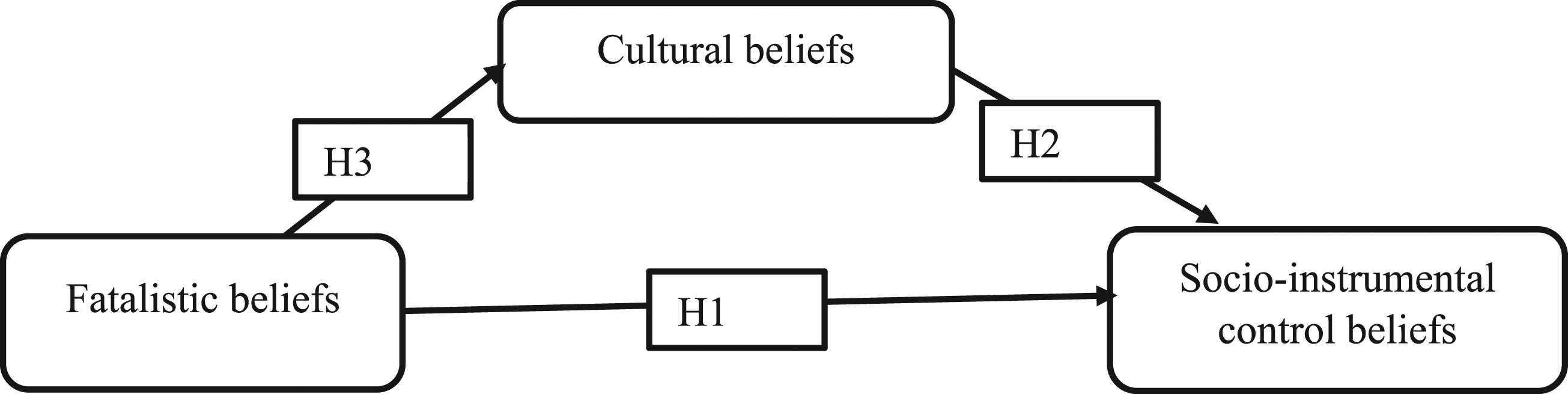
Methodology
Study Population
We conducted a study on a sample of 515 Cameroonian workers from the public (N = 208), formal private (N = 265) and informal (N = 40) sectors. There were 290 male and 225 female participants and the average age was 36 years. Two hundred and thirty-eight participants had a higher education level, with 71 and 10 having secondary and primary education levels, respectively; 196 did not answer the question on education level. All the participants were recruited from the four major cultural groups of Cameroon, specifically, Bantus of the grass-fields (N = 218), Bantus of the forest (N = 172), Bantus of the coastal plains (N = 98) and Soudano-Sahelians (N = 25). With regard to their religion affiliations, 407 were Christians, 43 were Muslims, and 62 were members of non-codified traditional religions. Most of the participants lived in cities (N = 434), with a small number living in villages (N = 34) and in a Western country (N = 16).
Data Collection Indtruments
Data were collected using a questionnaire that included a cultural beliefs scale, a fatalistic beliefs scale, a socio-instrumental control beliefs scale, and questions on sociodemographic variables.
Cultural beliefs were measured using the scale previously developed by Ngueutsa et al. (2021) that was specifically designed for and validated on a Cameroonian population. The scale is two-dimensional and measures beliefs and values rooted in Cameroonian cultural practices. The first dimension, comprising 16 items, measures the importance given to cultural beliefs and values. Participants were invited to express the importance they attached to each of the cultural beliefs and values using a 4-point Likert-type scale, ranging from 1 (not at all important) to 4 (very important). The second dimension, comprising 14 items, measures the practice of activities expressing cultural beliefs and values. Participants were asked to express how often they practiced or would like to practice cultural activities if they had the possibility, on a 4-point Likert-type scale ranging from 1 (never) to 4 (very often).
Socio-instrumental control beliefs were measured using a scale specifically constructed for the purposes of this study. Spector et al. (2004) inspired four of the scale’s items. The scale comprises 10 items relating to statements that present entities external to oneself (hierarchical superiors, colleagues, God, family, ancestors) as entities through which the individual is supposed to pass to obtain what he/she wants. Example items are “It is important to cultivate relationships with superiors at work if you want to be effective” and “You can get your own way at work if you learn how to get along with other people”. Participants were invited to express their degree of agreement or disagreement with each of the statements by referring to their personal situation, on a 4-point Likert-type scale ranging from 1 (Strongly disagree) to 4 (Strongly agree).
Fatalistic beliefs were measured using the Fatalism Scale developed by Kouabenan (1998) in the field of road accidents, and successfully applied in studies in the same field in South Africa (Peltzer & Renner, 2003) and in Cameroon (Ngueutsa & Kouabenan, 2017). This scale comprises nine items proposing statements relating to the supposed determinism of road accidents by entities that are external to oneself. Examples of items include “If a black cat crosses the road in front of your car, you should redouble your attention” and “Accidents are due to fate, nothing can be done about it”. Participants were asked to rate their level of agreement or disagreement with each statement on a 4-point Likert-type scale ranging from 1 (Strongly disagree) to 4 (Strongly agree).
Data Collection Procedure
Data were collected by the researchers, assisted by students trained in administering questionnaires. Participants were recruited using the ‘snowball’ method from towns and villages in Cameroon as well as from the Cameroonian diaspora living in France. Participants were met at their workplace, in public places, or at home, whichever suited them best. They completed the study questionnaire in the presence of the investigator. Questionnaires took an average of 30 minutes to complete. Although no participant interrupted their participation in the study, some refused to answer certain questions relating to socio-demographic data. This explains the missing data for this dimension.
Results
The results are presented in two stages. First, we present the results of the analyses used to verify the quality of the measurements, in particular the reliability of the measurement scales, followed by descriptive statistics. Second, we verify our hypotheses.
Reliability of Measurement Scales and Descriptive Statistics
Reliability of Scales Measuring the Importance Given to Cultural Beliefs, the Practice of Cultural Activities, Fatalistic Beliefs, and Socio-Instrumental Control Beliefs.

We can see in Table 1 that the factor structure of the two-dimensional cultural beliefs and values scale is reproduced according to the original scale (Ngueutsa et al., 2021), with satisfactory reliability coefficients. The same is true for Kouabenan’s scale of fatalistic beliefs (1998). In terms of the socio-instrumental control beliefs scale, the PCA with varimax rotation without fixing the number of factors, revealed three factors. Two of the latter had very low reliability; accordingly, we decided to remove them and continue the analyses with the only factor with an acceptable reliability (see Table 1).
This factor had four items (two of which were taken from Spector et al. (2004)) as follows “To find your way at work, you have to learn to get along with and follow your colleagues.”, “The tribute I pay to my ancestors is decisive in my ability to face life’s difficulties and to be successful in my endeavours.”, “To be successful and be promoted at work, you must cultivate good relationships with your supervisors.”, and “You can’t achieve any success in life without having good relationships with powerful people.”
Range, Mean and Standard Deviation of Study Variables.
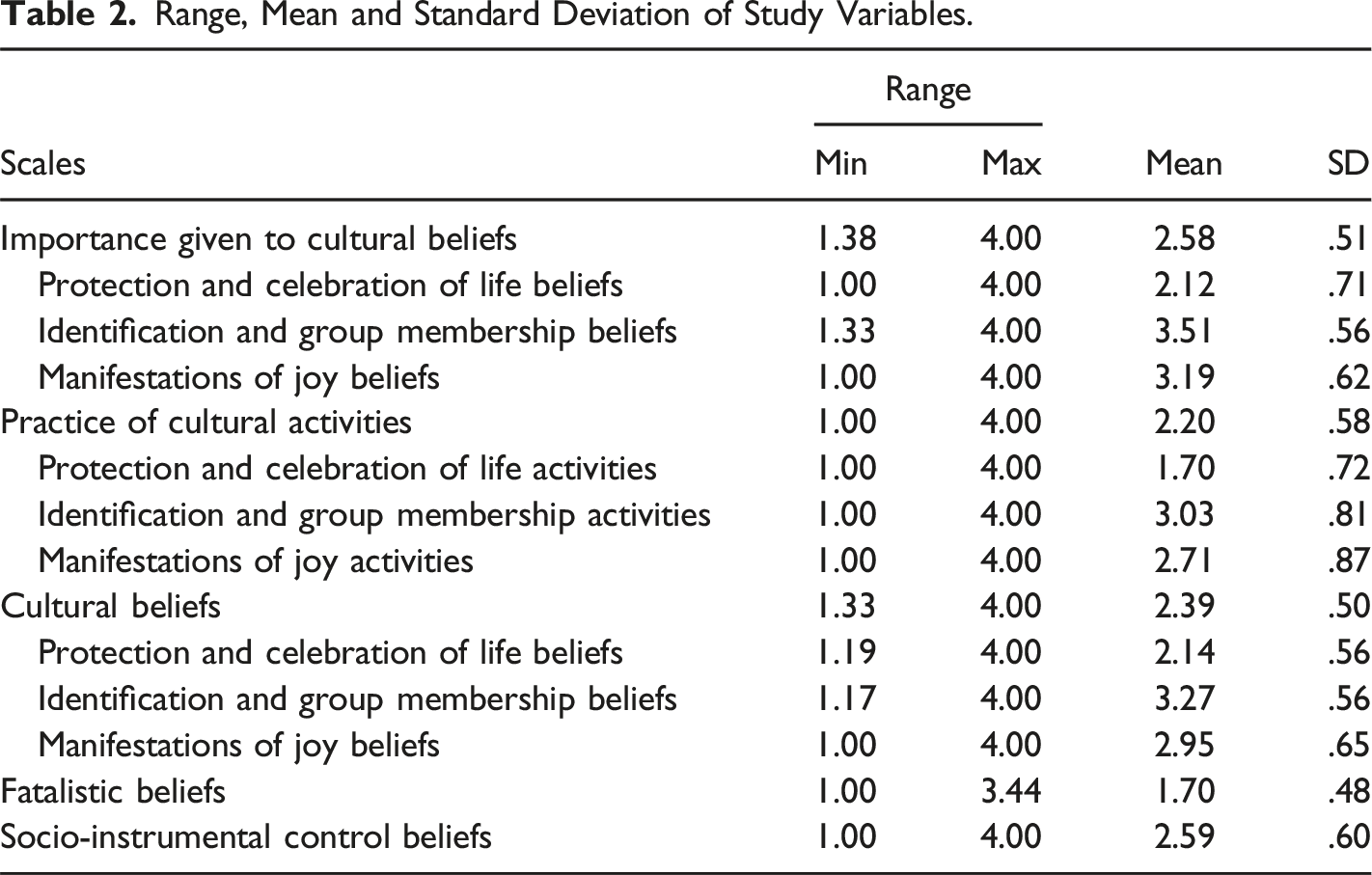
We can see in Table 2 that the study participants were less fatalistic (M = 1.70) and practiced less cultural activities intended to protect and celebrate life (M = 1.70). On the contrary, they attached great importance to activities relating to identification and belonging to a cultural group (M = 3.51) as well as to manifestations of joy (M = 3.19). Furthermore, they had strong beliefs relating to identification with a cultural group (M = 3.27), but moderate cultural beliefs relating to the protection and celebration of life (M = 2.14). Cultural beliefs as a whole (M = 2.39), as well as socio-instrumental control beliefs (M = 2.59) were also moderate.
Correlations between All Study Variables.

**p < .01.
Testing the Study’s Hypotheses
Results of Successive Regression Analyses Between Fatalistic and Cultural Beliefs as Predictors and Socio-Instrumental Control Beliefs as the Predicted Variable.

***p < .001; **p < .01; *p < .05.
In Table 4, fatalistic beliefs significantly and positively predicted socio-instrumental control beliefs, with an 11% proportion of variance (R 2 = .11). This result confirms Hypothesis 1. In other words, the more fatalistic the participant, the more he/she tended to have strong socio-instrumental control beliefs. We can also see that cultural beliefs as a whole positively and significantly predicted socio-instrumental control beliefs, with a large proportion of induced variation (R 2 = .14). Hypothesis 2 is therefore also confirmed. In other words, the more participants had strong cultural beliefs as a whole, the more he/she tended to have strong socio-instrumental control beliefs.
The specific dimensions of cultural beliefs were also positively and significantly associated with socio-instrumental control beliefs, with varying effect sizes. In particular, cultural beliefs specifically linked to the protection and celebration of life (R 2 = .14), as well as those specifically linked to group identification and belonging (R 2 = .04), explained a high proportions of variance in socio-instrumental control beliefs, while cultural beliefs specific to manifestations of joy explained only a small proportion (R 2 = .02). When we look at the two dimensions of cultural beliefs, namely the importance given to these beliefs and their practice, Table 3 shows similar results to those presented above.
In order to test Hypothesis 3, we performed another series of regression analyses on the data with ‘cultural beliefs’ and its three sub-dimensions as predicted variables and fatalistic beliefs as the predictor. Fatalistic beliefs significantly predicted strong cultural beliefs as a whole, b = .36, t (513) = 9.00, p < .001, R 2 = .14, but also beliefs specific to protection and celebration of life, b = .34, t (513) = 9.66, p < .001, R 2 = .15, and identification with the cultural group, b = .11, t (513) = 2.83, p < .001, R 2 = .02. Accordingly, Hypothesis 3 is confirmed. Since the correlation between fatalistic beliefs and cultural beliefs related to manifestations of joy was not significant, we did not conduct a regression analysis between these two variables.
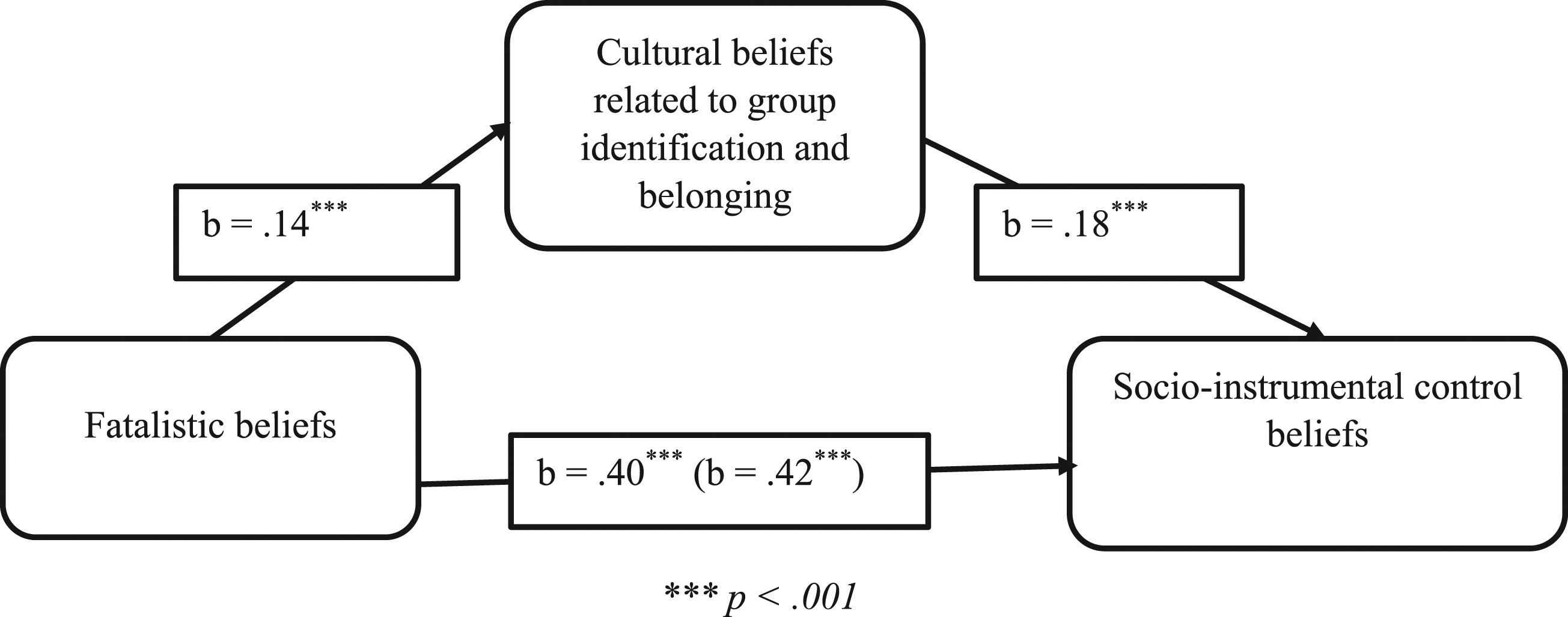
Finally, we conducted further regression analyses to verify the study’s mediation model, using Preacher and Hayes’ (2004) bootstrap approach. The results are shown in Figures 2 to 4. Partial mediation of the positive effect of fatalistic beliefs on socio-instrumental control beliefs by cultural beliefs as a whole. Partial mediation of the positive effect of fatalistic beliefs on socio-instrumental control beliefs through cultural beliefs relating to the protection and celebration of life. Partial mediation of the positive effect of fatalistic beliefs on socio-instrumental control beliefs by cultural beliefs related to group identification and belonging.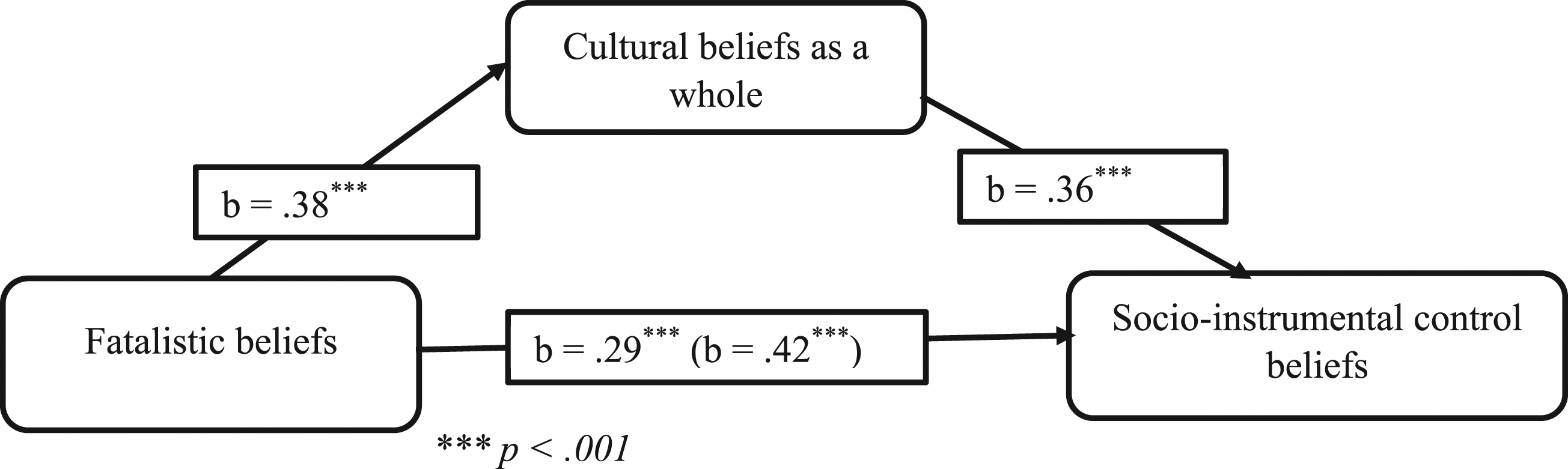

The results of the first analysis, summarized in Figure 2, show that fatalistic beliefs were positively associated with cultural beliefs as a whole (b = .38, t = 9.00, p < .001, 95% IC = [.2985; .4652]) and also with socio-instrumental control beliefs (b = .42, t = 8.07, p < .001, 95% IC = [.3191; .5243]). Cultural beliefs as a whole were positively associated with socio-instrumental control beliefs (b = .36, t = 6.82, p < .001, 95% IC = [.2529; .4576]). When controlling for cultural beliefs as a whole, the positive effect of fatalistic beliefs on socio-instrumental control beliefs decreased, but remained significant (b = .29, t = 5.31, p < .001, 95% IC = [.1802; .3918]). The CI associated with estimating this effect did not include zero, therefore cultural beliefs as a whole partially mediated the effect of fatalistic beliefs on socio-instrumental control beliefs.
The results of the second analysis, summarized in Figure 3, showed that fatalistic beliefs were positively associated with cultural beliefs about the protection and celebration of life (b = .46, t = 9.66, p < .001, 95% IC = [.3645; .5504]), and with socio-instrumental control beliefs (b = .42, t = 8.07, p < .001, 95% IC = [.3191; .5243]). Cultural beliefs relating to the protection and celebration of life were positively associated with socio-instrumental control beliefs (b = .31, t = 6.68, p < .001, 95% IC = [.2207; .4045]). When controlling for cultural beliefs relating to the protection and celebration of life, the effect of fatalistic beliefs on socio-instrumental control beliefs decreased, but remained significant (b = .28, t = 5.11, p < .001, 95% IC = [.1716; .3858]. Therefore, cultural beliefs about the protection and celebration of life partially mediated the effect of fatalistic beliefs on socio-instrumental control beliefs.
Figure 4 summarizes the results of the third mediation analysis. We can see that fatalistic beliefs were positively associated with cultural beliefs relating to identification and belonging to a cultural group (b = .14, t = 2.84, p < .01, 95% IC = [.0441; .2440]) and with socio-instrumental control beliefs (b = .42, t = 8.07, p < .001, 95% IC = [.3191; .5243]). Cultural beliefs relating to identification and belonging to a cultural group were also positively associated with socio-instrumental control beliefs (b = .18, t = 3.97, p < .001, 95% IC = [.0898; .2654]). When controlling for cultural beliefs relating to group identification and belonging, the effect of fatalistic beliefs on socio-instrumental control beliefs diminished, but remained significant (b = .40, t = 7.63, p < .001, 95% IC = [.2942; .4981]. Therefore, cultural beliefs about group identification and belonging partially mediated the effect of fatalistic beliefs on socio-instrumental control beliefs. To sum up, cultural beliefs as a whole as well as those specifically relating to the protection and celebration of life, and those relating to identification and belonging to a cultural group, partially mediated the effect of fatalistic beliefs on socio-instrumental control beliefs.
Discussion
The results of the present study showed that fatalistic beliefs were positively associated with cultural beliefs and socio-instrumental control beliefs. This confirms the work of Spector et al. (2004) which suggested that the lack of primary control over events in so-called collectivist societies does not mean an absence of total control over them. Indeed, in these societies, where the collective self is proeminent over the individual self, it is through the collective that adaptation and success in society are guaranteed. The collective therefore deprives individuals of the possibility to control alone events that are imposed on them. This may explain the tendency of individuals to rely on or resort to a third party (social and/or spiritual) and implement actions (e.g., paying tribute to one’s ancestors) to exert an indirect influence on the course of events in their favour. Even when individuals do not resort to a third party, some of these actions reflect their desire to influence the course of events (e.g., respect for elders, which leads to positive things happening to the individual). In this context, what is considered fatalistic beliefs do not promote an attitude of passivity in the face of events; on the contrary, they stimulate a proactive attitude. This proactive attitude is manifested through resorting to various actions (prayers, cultural rituals, participation in associations of one’s cultural group, etc.) directed towards social and/or spiritual entities in order to engage the latter in the action of intermediation for oneself, in the hope of maintaining indirect control over events.
The positive link between fatalistic beliefs and socio-instrumental control beliefs also supports the most recent conceptualizations of LOC, which consider the individual’s ability to exercise indirect control over events (Paquet et al., 2009, 2014; Rothbaum et al., 1982; Spector, 1982; Spector et al. al., 2004). This result shows that in the Cameroonian cultural context, individuals do not passively endure destiny and fate, two dimensions over which divinities are supposed to have power. Individuals act indirectly on these divinities through the collective, and through the cultural and ritual practices specific to their society. These cultural practices allow them to interact with the social and/or spiritual entities responsible for these same events, or believed to have control over them. In such a cultural context, what is considered fatalistic beliefs by westerners can be seen as a basis for legitimizing the powers attributed to social and spiritual entities, while justifying the cultural and religious practices intended for these entities.
The idea that fatalistic beliefs might be part of certain cultural practices is supported by the result showing a positive link between fatalistic beliefs and cultural beliefs. Indeed, the cultural beliefs, which constitute the normative base of African society in general, and Cameroonian society in particular, attribute power to “the significant other” which can be a group, an elder or a divinity. Adhering to these beliefs means accepting de facto that one cannot act directly on certain events without going through the mediation of one or more of these external entities. To be fatalistic would seem to mean accepting that you do not have primary control over events. However, individuals do not passively endure the course of events since they act by influencing these same external entities. It is therefore active (and not passive) fatalism that will justify their belief in indirect (i.e., socio-instrumental) control of events. The idea of active fatalism is a novel conceptualisation of fatalism, which, until now, has been considered as a belief in the inevitability of events (Esparza et al., 2015; Maercker et al., 2019; McIlroy et al., 2020; Ngueutsa & Kouabenan, 2017).
This concept of active fatalism can be defined as the belief in a supposed determinism of events by powerful entities (deities, powerful groups, etc.) certainly, but which is also likely to be influenced by indirect actions. Accordingly, active fatalism would be implemented only when individuals believe in entities that hold power over their fate, but also believe that they (the individuals) can exercise an indirect action over these entities in order to change the course of events in their favor. It is therefore possible that active fatalism does not manifest itself in people who do not believe in the existence of entities with powers over their destiny. In addition, active fatalism may manifest itself more in situations, which appear to be beyond the direct control of the individual. This is probably why we found a positive and significant link between fatalistic beliefs and cultural beliefs regarding the protection and celebration of life, as well as cultural beliefs regarding group identification and belonging. The idea that active fatalism may manifest itself in situations beyond the individual’s control is also supported by the fact that in the present study, we did not observe any significant link between fatalistic beliefs and cultural beliefs linked to the manifestations of joy. In fact, events related to manifestations of joy, such as the organization of a wedding or a party for a newborn, come largely under the control of the individual and not of social or spiritual entities.
We also found that cultural beliefs were positively associated with socio-instrumental control beliefs. This result corroborates the work of Heckhausen and Schulz (1995) for whom beliefs in general - and therefore cultural beliefs included - help the indivudal to develop a perceived control over his/her life events. Cultural beliefs constitute the normative foundations of any society. In so-called collectivist societies, they occupy a preponderant place in the definition of self. In these collectivist contexts, adherence to socio-cultural practices is a factor of identification with a social group. It is therefore through the acceptance of habits and customs that individuals identify with society, which in turn has the duty to protect them. In this context, society reduces individual responsibility for the occurrence of events, and therefore primary control over them. The individual therefore believes more in the power of the collective, a “significant other”, and supernatural forces to explain the occurrence of events. However, it is quite logical to assume that the individual also believes in the possibility of influencing these events through the same media (i.e., social settings, a significant other, and supernatural entities). This reflection echoes that of Spector et al. (2004) who believe it would be inappropriate to hastly treat the absence of primary control as passivity because one can exercise indirect control over events by influencing “the significant other” in one’s favour (Paquet et al., 2009, 2014).
This study sheds light on the relationship between fatalistic beliefs, cultural beliefs and socio-instrumental control beliefs in African context, on a Cameroonian sample. However, it has a number of limitations, which must be considered before any attempt to generalize the results. First, the study only included Cameroonians; had we included people for other countries, we would possibly have obtained different results. Second, this study suggests a new conceptualization of fatalism, in particular active fatalism. However, in order to validate this conceptualization, it needs to be tested further by consolidating our data with those from other cultural contexts. This new conceptualization could pave the way for further research on beliefs in general and fatalistic beliefs in particular, in order to better understand how they can affect behaviours in various areas of life.
Finally, the main contribution of this article to the literature is that we questioned the widespread individual-centered conception of the control people believe they have over events and suggested that it should be nuanced. The said monolithic conception noted by Spector et al. (2004) leads to misinterpretations of the control people have over events, and to a dualist internal versus external control, which does not reflect the entire reality of control. The dualist conception of control leads to errorniously view people with high external control as fatalists and those with high internal control as non-fatalists. This dualist conception has been the foundation of studies on fatalistic beliefs so far. These studies and the Esparza et al. (2015) scale wich considered externality, divine control, helplessness and luck as fatalistic beliefs, failed to consider the indirect control raised by Spector et al. (2004), which showed that what appears at first glance to be fatalism is often not. Hence our suggestion of active fatalism and of the conception of control on a continuum and not on a dualistic basis.
Footnotes
Declaration of Conflicting Interests
The author(s) declared no potential conflicts of interest with respect to the research, authorship, and/or publication of this article.
Funding
The author(s) received no financial support for the research, authorship, and/or publication of this article.
Ethical Statement
All work reported here complied with APA and French regulations ethical standards.
Informed Consent
Participants consented to freely participate to the research
Availability of Data and Material
The data are available upon request
