




Abstract
This study investigated the mediating role of difficulties in emotion regulation and reflective functioning in the association between childhood trauma and parental burnout. The participants included 402 mothers with children ranging in age from 1 to 6 years. Mothers completed the Parental Burnout Assessment (PBA) the parental reflective functioning questionnaire (PRFQ), the Difficulties in Emotion Regulation Scale (DERS), and the Childhood Trauma Questionnaire (CTQ). Data analysis was performed using SPSS 26, and Hayes Macro in SPSS was also used to analyze the effects of mediating variables. The results show that although childhood trauma and parental burnout do not have a direct and significant relationship, there is a significant indirect relationship through difficulties in emotional regulation and the two factors of parental reflective functioning, i.e., pre-mentalization, interest and curiosity about mental states. These findings contribute to the understanding of the importance of variables such as difficulties in emotion regulation and reflective functioning, which play a mediating role in the relationship between childhood trauma and parental burnout. This suggests that designing interventions and prevention to reduce parental burnout based on emotion regulation and reflective functioning may be beneficial.
Keywords
Introduction
Parenting is often a challenging experience that involves stress, which is normal, common, and sometimes necessary (Mikolajczak & Roskam, 2020). However, when the stress is severe and chronic and parents do not have the necessary resources to cope, they experience parental burnout (Mikolajczak & Roskam, 2018). Parental burnout, a state of physical and mental in parents, has four basic dimensions, namely exhaustion in the parental role (psychological exhaustion and struggle to preserve energy due to excessive involvement in children’s problems), contrast with one’s previous self (ambivalent feelings of shame if parents believe they are not as good as they were in the past), fed up with one’s parental role (loss of efficiency and performance, and no longer enjoying spending time with one’s children), and emotional distance from one’s children (low relationship or a connection without feeling) (Hubert & Aujoulat, 2018; Mikolajczak & Roskam, 2020). Considering the severe and wide-ranging consequences of parental burnout, including suicidal thoughts, addiction, and sleep problems for parents, conflicts, estrangement between partners, and increased neglectful and violent behaviors toward children, understanding the antecedents and etiology of burnout is extremely important (Mikolajczak, Raes, et al., 2018; Mousavi, 2020). Recent research suggests that several factors may place parents at higher risk for experiencing burnout (Roskam & Mikolajczak, 2020). According to the theory of balance between demand and resources (BR2), parental burnout can result when the demands of parenting chronically outweigh the resources available to parents for coping (Mikolajczak & Roskam, 2018). In other words, burnout occurs when stressors persist and surpass the level of protective factors, leading to a chronic state of stress in parents. Risk factors, such as parental perfectionism, low emotional intelligence, poor childrearing practices, numerous parental responsibilities, a lack of support from the co-parent, and a lack of external support (such as family support and nurseries), can increase parental stress and the risk of parental burnout (Sorkkila & Aunola, 2020). On the other hand, protective factors such as stress-relieving factors, including parental self-compassion, high emotional intelligence, good child-rearing practices, leisure time, positive co-parenting, and external support can reduce parental burnout (Mikolajczak, Brianda, et al., 2018). Identifying and preventing risk factors is key to reducing parental burnout according to the BR2 theory (Mikolajczak et al., 2019). The BR2 theory states that the level of burnout experienced by parents depends on the interaction between specific vulnerability factors and available resources. However, limited research has focused on risk factors related to parents themselves, which warrants further investigation.
In this research, the focus is on examining parental burnout specifically in mothers, as it is a prevalent phenomenon among them (Roskam & Mikolajczak, 2020). Studies have found that might mothers face higher levels of burnout due to the pressures of parenthood and the societal expectations placed upon them. Moreover, mothers often contend with challenges related to household responsibilities and children’s interference with work, which can exacerbate parental burnout. (Lin et al., 2023). Consequently, these factors suggest that mothers may be more vulnerable to parental burnout due to a combination of biological, social, and cultural influences.
This study investigates the relationship between traumatic childhood experiences, difficulties in emotion regulation, and reflective functioning with parental burnout, highlighting the significant role of these risk factors. By clarifying the factors that contribute to parental burnout, this study can provide crucial guidance for developing effective interventions to better support parents.
Childhood Trauma and Parental Burnout
Many risk factors make parenting difficult, among these important risk factors are parents’ traumas during their childhood (Kalmakis & Chandler, 2015). Childhood trauma, which may be chronic and vary in severity, is linked to negative health outcomes in adulthood, including psychological, behavioral, social, and physical problems (Rowell & Neal-Barnett, 2022). One consequence of experiencing early trauma in adulthood is the potential for difficulties in parenting. The intergenerational impact of childhood trauma on the parent-child relationship is complex and significant for parents who experienced neglect or abuse in their childhood (San Cristobal et al., 2017). The experience of childhood trauma can have a damaging impact on the psychological, cognitive, and behavioral functioning of parents who may not possess the necessary skills to effectively manage their emotions and negative thoughts (Cooke et al., 2019). This obstacle presents significant challenges for parents, potentially hindering their ability to effectively care and play a supportive role in sensitive and stressful situations (Sroufe et al., 1999). One of the common goals of parenting is to provide security and support for children’s cognitive, emotional, and social development into adulthood, but this is a difficult task for those who have experienced early abuse or family dysfunction (Lange et al., 2019). The impact of intergenerational trauma on the way people raise their children sometimes manifests itself as a lack of energy and resources to deal with the challenges of bringing up children and will include consequences such as stress from the role of parent (Steele et al., 2016). Despite this evidence, the intergenerational transmission of childhood trauma to parental burnout remains questionable and unclear.
The Mediating Role of Difficulties in Emotion Regulation
Emotion regulation is the process of employing both conscious and unconscious cognitive and behavioral techniques to manage the intensity, duration, and expression of emotions (Gratz et al., 2015). Difficulties in emotion regulation are defined as a lack of ability to cope with emotional situations or the use of maladaptive methods. Difficulty in emotion regulation has 6 dimensions, including Limited Emotion Regulation Strategies (difficulty in emotion regulation following distress), Non-Acceptance (tendency to secondary reactions to negative emotions and denial of distress) and Difficulty in Impulse Control (difficulty in controlling behavior when upset) and Difficulty in Engagement with Goals (difficulty in concentrating and completing tasks when faced with negative emotions) and Lack of Emotional Awareness (neglecting emotional reactions) and Lack of Emotional Clarity (lack of clarity about emotions experienced) (Gratz & Roemer, 2004). Childhood trauma increases difficulties in emotion regulation (Erol & Inozu, 2023). Several studies have demonstrated that the formation of the ability to regulate emotions takes place from childhood under the influence of primary and root factors, including childhood experiences, because the development of emotion regulation, the process of expressing, understanding, and communicating emotions, is shaped by primary parent-child relationships (Ehrensaft et al., 2015; McLafferty et al., 2020). Experiencing trauma such as sexual abuse, physical abuse, emotional abuse, physical neglect, and/or emotional neglect can hurt coping strategies and the ability to regulate emotions in different situations (Wang, 2022). This is because coping strategies and emotional regulation are learned through interactions between caregivers and children, and people who have experienced trauma early in life may use unhealthy strategies in the face of problems, such as avoidance, denial, wishful thinking, or emotional suppression. Or emotional suppression (Mares et al., 2023). The ability to regulate emotions is involved in all stages of human life and communication with different people and affects different human roles, including parenting, from childhood to adulthood (Deater-Deckard, 1998). Parents who have difficulty regulating their emotions perceive parental responsibilities as more stressful than parents who are better at regulating their emotions (Gau et al., 2010). Although parental burnout and its underlying mechanisms have much in common with stress, parents who can manage their emotions adaptively can reduce the negative effects of parental burnout and even control its transmission to their children (Yang et al., 2021). Therefore, the ability to regulate emotions, which begins to develop in childhood, represents the ability of parents to cope with parental burnout and, conversely, predicts the difficulty and lack of emotion regulation skills during the period of burnout (Vertsberger et al., 2022). Therefore, this study investigates this relationship.
The Mediating Role of Reflective Functioning
Reflective functioning in general refers to the disclosure of the individual’s capacity for mentalization, and parental reflective functioning as a specific concept refers to the capacity of parents to reflect on their own and their child’s inner mental states (Slade, 2005). Reflective parenting refers to the parent or caregiver’s capacity to imagine their child through the lens of internal mental states such as feelings, wishes, and desires (Luyten, Nijssens, et al., 2017). It also requires the caregiver’s ability to reflect on his or her internal mental states, to interact with the child, observe changes in mental states over time, and observe how the parent’s thoughts, feelings, and behaviors affect the child (Nijssens et al., 2021). Parental Reflective Functioning (PRF) comprises of three modes: pre-mentalizing, certainty about mental states, and interest and curiosity in mental states. These modes reflect parents’ ability to consider their child’s internal experiences and understand their behavior in light of underlying mental states. Pre-mentalizing refers to difficulties in understanding and reflecting on mental states, while certainty about mental states reflects a parent’s confidence in their understanding of their child’s thoughts and feelings. Interest and curiosity in mental states indicate a parent’s openness and engagement in understanding their child’s internal experiences (Luyten, Nijssens, et al., 2017). Early childhood experiences influence the formation of reflective functioning in parents because childhood adversity prevents the proper development of mentalizing skills (Håkansson et al., 2018). Parents who have experienced early experiences such as sexual, physical, and emotional abuse and neglect may have a lower capacity for reflective functioning (Rowell & Neal-Barnett, 2022). A person’s developmental history may be related to their psychological functioning and personality traits, particularly in the parenting role, it suggests that there is a link between childhood trauma and the ability to mentalize (Håkansson et al., 2018). Based on the research literature, it can be concluded that early experiences can influence parents’ attitudes and behaviors through reflective functioning (Nijssens et al., 2018). A Low capacity for mentalization is associated with higher levels of stress in people, while sufficient capacity for reflection is associated with increased tolerance of child distress and reduced parenting problems. Parents with weaker PRF may feel less competent and less effective, leading to higher levels of parental stress and feelings of inadequacy, which are signs of parental burnout (Stuhrmann et al., 2022). Therefore, examining the mediating role of reflective functioning may clarify the relationship between childhood trauma and burnout.
The Present Study
The purpose of the present study was to examine the relationship between childhood trauma and parental burnout, as well as the mediating role of difficulties in emotion regulation and parental reflective functioning. Parental burnout is of particular importance for two reasons: first, it emphasizes the importance of parental well-being and the risk of parental fatigue in the parenting process. Second, it highlights that parental burnout affects children themselves, leading to increased parental neglect and violence toward them (Roskam & Mikolajczak, 2020). Because of the importance of parental burnout, the role of deep factors and underlying variables may be more compelling to find the cause) Raudasoja et al., 2023 (. One of these deep factors is childhood trauma, and the path from childhood that causes problems in parenting is unclear. Therefore, this research clarified the path of intergenerational transmission of childhood trauma through the variables of difficulties in emotion regulation and reflective functioning on parental burnout, because the emotional variables that begin to form in childhood are the key elements of this path (Vertsberger et al., 2022). Therefore, the following hypotheses have been proposed: (1) Childhood trauma would positively and significantly predict parental burnout. (2) Difficulties in emotion regulation played a mediating role between childhood trauma and parental burnout. (3) Parental reflective functioning factors played a mediating role between childhood trauma and parental burnout. Figure 1 The proposed model PB = Parental burnout, PM = Pre-Mentalizing, CM = Certainty about Mental States, IC = Interest and Curiosity in Mental States, CT = Childhood Trauma, DER = Difficulties in Emotion Regulation.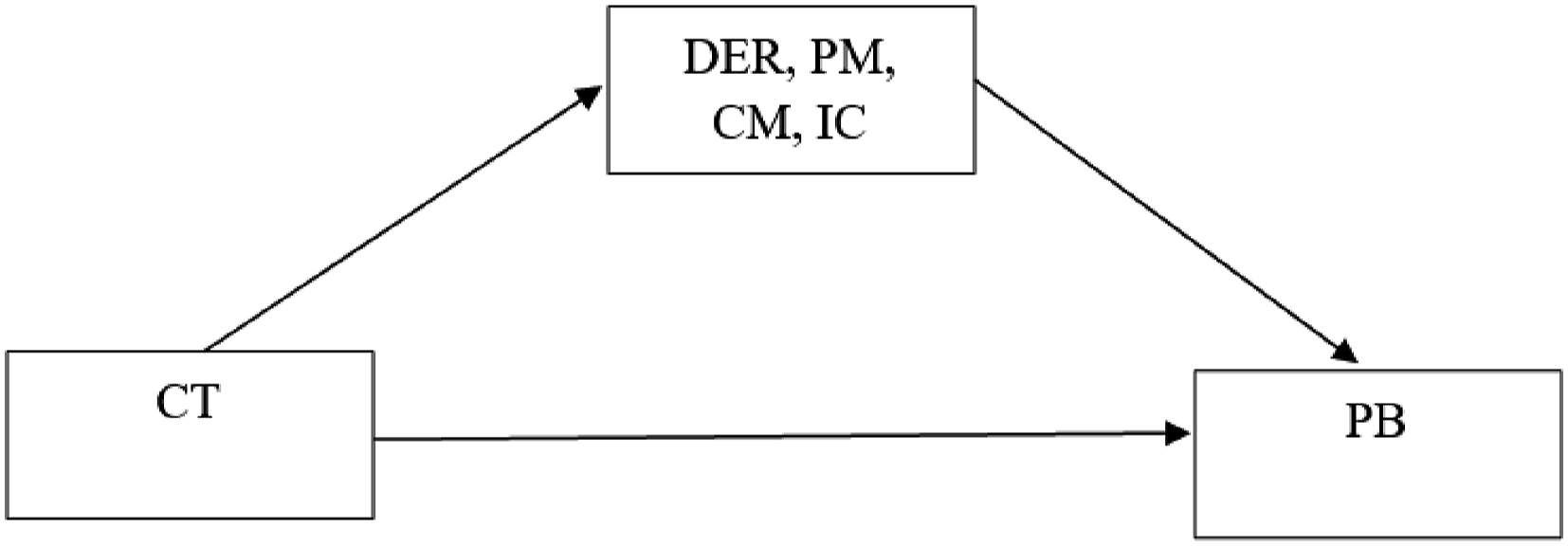
Materials and Methods
Participants
A study was conducted in which a group of Iranian mothers with at least one child older than 1 year participated by completing 423 questionnaires using available sampling methods. To estimate the sample size, we used G power software version 3.1.9.2, considering 5 predictor variables, significance level (α) 0.1, and effect size ƒ2 0.1, the sample size was estimated to be 395 samples. Note that more subjects were enrolled to avoid dropout. In this study, 423 surveys were completed by Iranian mothers. After checking the number of invalid surveys, 21 invalid surveys were excluded from the analysis, resulting in a final sample size of 402 surveys. The mothers’ ages ranged from 19 to 33 years (M = 26.28, SD = 5.29). 31.1% of mothers had only girls, 40.3% of mothers had only boys, and 28.6% percent of mothers had both girls and boys. The youngest child was 1 year old, and the oldest was 6 years old. 31.1% of mothers were working and 68.9% of mothers were not working.
Procedure
Data collection for the research project began in March 2023 and was approved by the university ethics committee. During the study, participants were provided with an informed consent form outlining that their data would be employed anonymously for scientific purposes. They were assured of their right to withdraw from the research at any time should they choose to do so, maintaining their privacy and autonomy throughout the process. To facilitate participation by the mothers, an online questionnaire was designed using a Google Form, which was distributed to targeted groups for mothers parenting via social networks like Telegram and Instagram, as well as relevant websites. By sharing the questionnaire link, the researchers ensured easy accessibility and response submission, ultimately enhancing the study’s methodology and convenience for the participants. By completing the questionnaire, participants were also able to enroll in free parenting classes taught by trained instructors.
Measures
The Parental Burnout Assessment (PBA)
The parental burnout assessment was developed by Roskam et al. (2018) and a Persian version of the assessment was used in the research conducted by Mousavi et al. (2020). It has 23 items that are scored on a 7-point Likert scale, ranging from never (0) to every day (6). It has 4 subscales: exhaustion in a parental role, contrast with the previous parental self, feelings of being fed up as a parent, and emotional distancing from one’s children. The range of these scores is from 0 to 138, and the closer the scores are to 0, the less parental burnout; the closer the scores are to 138, the greater the burnout. Cronbach’s alpha coefficient is .97 for the total score and .93, .93, .90, and .81 for the scores of the 4 subscales (Roskam et al., 2018). In this study, Cronbach’s alpha coefficient was .97.
Childhood Trauma Questionnaire (CTQ)
The Childhood Trauma Questionnaire was developed by Bernstein et al. (2003) And in this research, the Persian version was used (Ebrahimi et al., 2014). The questionnaire consists of 28 items that are scored on a 5-point Likert scale from never (1) to Always (5). It has 5 subscales: physical abuse, sexual abuse, emotional abuse, physical neglect, and emotional neglect. The range of scores for each of the subscales is 5–25 and for the total questionnaire is 25–125. Higher scores indicate more childhood maltreatment. Cronbach’s alpha coefficient is .89. For the total score and .86, .78, .77, .82, and .79 for the scores of the 5 subscales (Bernstein et al., 2003). In the present study, Cronbach’s alpha coefficient was .82.
Parental Reflective Functioning Questionnaire (PRFQ)
The parental reflective functioning questionnaire was developed by Luyten (2017) and was used in the Persian version (Mousawi & Bahrami Ehsan, 2020). The questionnaire consisted of 18 items that are scored on an 8-point Likert scale from strongly disagree (0) to strongly agree (7). It has 3 subscales clinically and theoretically: pre-mentalization state (PM) which shows denial or defense against mentalization, Certainty about Mental States (CMS) which shows excessive confidence in children’s mental states or uncertainty about are to the mental states of the child, and Interest and Curiosity in Mental States (IC) indicates curiosity about the child’s internal states. Cronbach’s alpha coefficient was .73, .73, and .72 respectively (Mousawi & Bahrami Ehsan, 2020). In this study, Cronbach’s alpha coefficient of pre-mentalization, certainty of mental state, and curiosity about mental state were .70, .69, and .73, respectively.
The Difficulties in Emotion Regulation Scale (DERS)
The Difficulties in Emotion Regulation Scale was developed by Gratz and Roemer (2004), and in this research, the Persian version was used (Besharat, 2019). This scale has 36 items and is scored on a 6-point Likert scale, ranging from never (0) to always (5). It has 6 subscales: nonacceptance of negative emotions, difficulties engaging in goal-directed behaviors, difficulties controlling impulsive behaviors, limited access to effective emotion regulation strategies, lack of emotional awareness, and lack of emotional clarity. Scores range from 36 to 180, with higher scores indicating greater emotional difficulty. Cronbach’s alpha coefficient is .91 for the total score and .88, .89, .90, .89, .86, and .90 for the scores of the 6 subscales (Besharat, 2019). In the present study, Cronbach’s alpha coefficient was .91.
Data Analysis
There were no missing data in this study. All participants were required to answer all questions completely before submitting their responses. Initially, descriptive statistics and a correlation matrix were calculated using SPSS version 26.0. Subsequently, the PROCESS macro for SPSS, particularly Model 4 (Parallel Multiple Mediator Model) from Hayes (2017), was utilized to investigate the possible mediating role of the variables under consideration. In this study, 5000 bootstrapped samples with a 95% confidence interval were used to examine the mediating roles of difficulties in emotion regulation and reflective functioning.
Results
Descriptive Statistics and Correlations
Mean, Standard Deviation, Correlation Coefficient Matrix, Skewness, and Kurtosis.

**p < .01. PB = Parental burnout, PM = Pre-Mentalizing, CM = Certainty about Mental States, IC = Interest and Curiosity in Mental States, CT = The Childhood Trauma, DER = Difficulties in Emotion Regulation.
Testing the Hypothesized Model
Standard Coefficients of Direct and Indirect Effects.
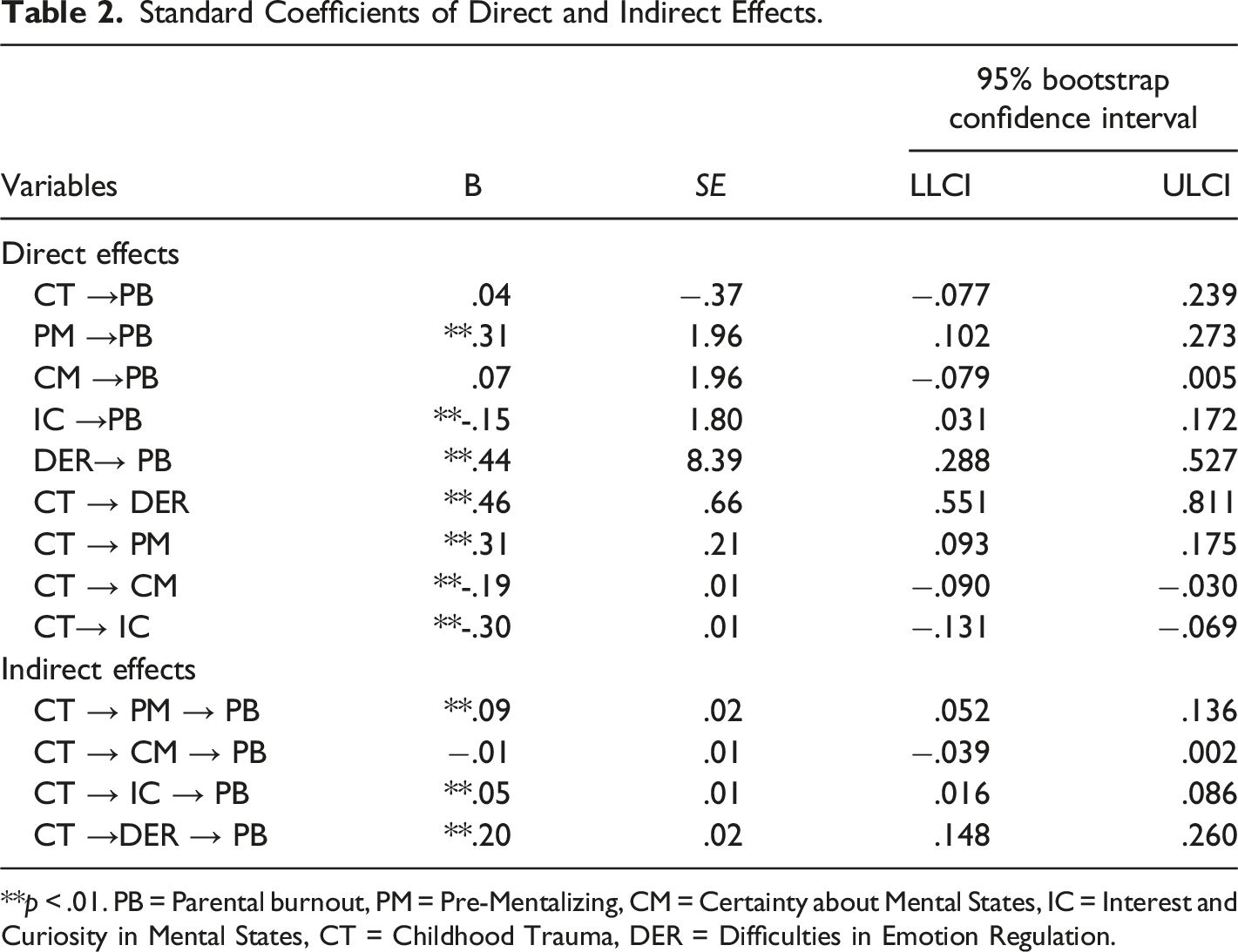
**p < .01. PB = Parental burnout, PM = Pre-Mentalizing, CM = Certainty about Mental States, IC = Interest and Curiosity in Mental States, CT = Childhood Trauma, DER = Difficulties in Emotion Regulation.
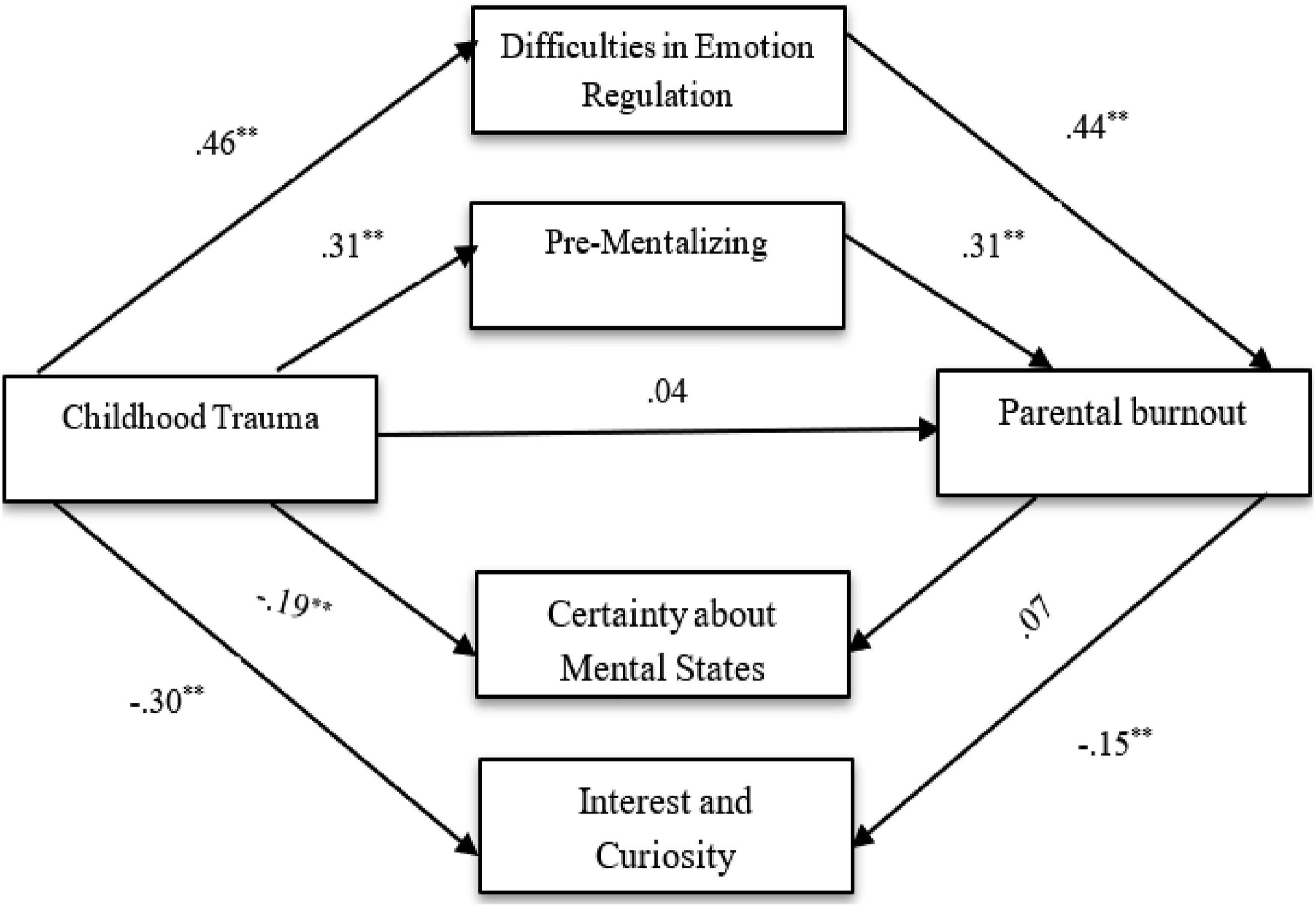
Analyzed model of the relationships among research variables. **p < .01.
The partial indirect effects revealed that childhood trauma is more related to difficulties in emotion regulation with parental burnout. As a result, Hypothesis 2 was supported, and Hypothesis 3 was partially supported. The results are shown in Figure 2.
Discussion
The purpose of this study was to examine the relationship between childhood trauma and parental burnout, considering the mediating role of difficulties in emotion regulation and reflective functioning. The results of this research indicated no significant direct relationship between childhood trauma and parental burnout. This argument can be persuasive because it implies that childhood trauma, along with its varying mediating factors and parent-related aspects, can lead to disorders like stress and parental burnout (Vertsberger et al., 2022). Many parents may have experienced trauma in their childhood, but some characteristics and factors can break this cycle of trauma transmission and not have a negative impact on them in the future (Burke et al., 2021). Parenting problems, including parental stress and burnout, have multifactorial antecedents, and childhood trauma is one of the triggers that depletes parents’ resources and reduces their capacity in various ways (Moe et al., 2018). Therefore, according to this case, it is important to study the basic mechanism of the effects of childhood trauma on various aspects of people throughout life. In this study, although trauma did not directly predict burnout, it affects parental burnout through indirect effects and other factors. In other words, childhood trauma can predict parental burnout in two ways. Difficulties in emotional regulation and reflective functioning (pre-mentalizing and interest and curiosity in mental States) are two indirect ways in which childhood trauma affects parental burnout. Various childhood traumas have a negative impact on emotion regulation, which involves the identification, expression, and management of emotions (Mares et al., 2023). They even have problems using the correct emotion regulation strategies, i.e., instead of using successful strategies such as cognitive reappraisal, they use incompatible strategies such as expressive suppression, disengagement, and rumination (Gau et al., 2010). The results of this research also revealed that not using proper emotion regulation skills leads to problems in parenting and causes people to become exhausted as parents (Yang et al., 2021). When they have trouble regulating their emotions, they attribute wrong and malicious intentions to their child’s mental states (e.g., my child is intentionally trying to hurt me) (Wang, 2022). In addition, when negative emotions are generated, the lack of adequate knowledge about the reason for generating these emotions, as well as limited access to effective emotion regulation strategies, leads to problems in parenting attitudes in the future. Such stressful conditions will lead to burnout. Consequently, childhood trauma, which carries negative implications for people’s emotional regulation, may, in the long run, impair parents’ ability to grasp and regulate their emotions, potentially leading to burnout. Another indirect pathway examined in this study is the mediating role of reflective functioning. According to our expectations, the results showed that childhood trauma has a negative effect on the formation of reflective functioning. Mentalization is a potential capacity that can be learned through social experiences during the first years of life by observing and interpreting the behaviors and expressions of others as they provide an opportunity to learn mental states through deep processing of the social environment (Slade, 2005). It can therefore be concluded that primary trauma interferes with the effective formation of reflective functioning. According to the results, PM and IC played a mediating role between childhood trauma and parental burnout in this study. IC is one of the dimensions of reflective functioning, based on which a low score in this subscale indicates that parents do not see their child as a person separate from themselves, and as a result, it is difficult to understand the child’s mental state (Rojas, 2021). Another factor is PM, which has a positive and significant relationship with traumatic experiences; it indicates severe disorders in parental reflective functioning. Its high level indicates that parents are unable to enter into the inner world of their child and attribute malicious and incompatible views to him. (Luyten, Nijssens, et al., 2017). Another factor of reflective functioning is Certainty about Mental States (CMS). Low levels of CMS in parents indicate excessive uncertainty and ambiguity about the inner psychological world of the child (Brady, 2022). Considering that the PRF is a multidimensional structure and each dimension shows different characteristics of mentalizing ability, the results of the present study based on the significance of the indirect effects of PM and IC dimensions clarify the importance of these dimensions. Therefore, regarding the non-significance of the indirect effect of CM, it should be pointed out that in different samples of mothers, different results may be obtained regarding the role of reflective functioning dimensions in parenting problems. As in the study (Nijssens et al., 2018), only the PM dimension played a mediating role in the relationship between parental attachment and parenting stress, while the other dimensions were not significant. The interpretation of the findings in this part of the study should be done with caution, and more research is needed in the future. However, it can be concluded that disturbances in these areas are associated with consequences such as parental insensitivity and lack of appropriate communication with children, which can lead to parental burnout (Stuhrmann et al., 2022).
According to the findings of the present research, impaired levels of reflective functioning resulting from early traumatic experiences can pose challenges for parents in accepting and coping with the role of parenting, potentially impacting their capacity and increasing the risk of burnout. Finally, this research demonstrated that difficulties in emotion regulation and reflective functioning mediate the intergenerational transmission of childhood trauma to parental burnout. In this manner, trauma complicates the development of both factors, thereby reducing the resources necessary for parenting.
Theoretical and Practical Implications
This study examined the predictors of parental burnout, including childhood trauma, through reflective functioning and difficulties in emotion regulation. Based on the theory of balance between resources and risks, higher risks lead to burnout. Research that has examined the underlying factors, or demands that cause burnout has found that factors such as low perceived social support, lack of leisure time, financial worries, and illness and child problems are effective (Lindström et al., 2011). Given the wide-ranging factors that influence burnout, the role of deeper factors such as personality factors, perfectionism, and underlying variables may be more compelling (Raudasoja et al., 2023). Few studies have examined the role of deep and underlying risk factors related to the parents themselves. The importance of this research lies in the variables and factors that play a fundamental role in parents’ attitudes toward parenting that have not been studied in this way to predict burnout. On the other hand, by further investigating these risk factors and resolving them based on the theory of balance between resources and risks, the burnout rate was reduced. One of the other applications of this research is that it is possible to take measures such as prevention, management, and treatment of burnout using research variables. The question of what happens between the intergenerational transmission of childhood trauma experiences and becoming a parent is the key to such interventions.
Limitations and Future Directions
This study has significantly expanded our understanding of parental burnout antecedents by exploring intergenerational trauma transmission through emotion regulation and reflective functioning challenges. However, it is crucial to acknowledge its limitations, such as the self-selected and predominantly convenience sampling approach, which may impact the study’s generalizability. The study exclusively involved mothers, and future investigations should consider examining fathers to compare results between parents. Additionally, the cross-sectional design of the study makes it difficult to establish causal relationships among the variables. To enhance the comprehension of these connections, it is advisable to adopt a longitudinal research design in future studies. Furthermore, although the model proposed by the authors received empirical support, it is essential to recognize the absence of crucial demographic and confounding variables, such as income, age, and the number of children in the household, as limitations of the article. Controlling for these factors would have provided a more comprehensive and accurate representation of the study’s findings. As a future suggestion, researchers should consider incorporating these variables into their investigations to enhance the validity and generalizability of their results.
Conclusions
The current study confirmed the underlying theory of burnout, BR2, and demonstrated the role of new factors in creating and maintaining parental burnout. By examining mediating variables such as difficulties in emotional regulation and reflective functioning, the cycle of transmission of trauma can be broken, and its negative effects on future roles, such as parenting, reduced. These findings emphasize the significance of a past-oriented approach to factors related to parents and guide future research. In addition, designing interventions to improve emotional regulation and reflective functioning can reduce the intergenerational transmission of trauma to parental burnout.
Footnotes
Acknowledgments
We are very grateful to all mothers who participated in this research.
Declaration of Conflicting Interests
The author(s) declared no potential conflicts of interest with respect to the research, authorship, and/or publication of this article.
Funding
The author(s) received no financial support for the research, authorship, and/or publication of this article.
Ethical Statement

Data Availability Statement
The data that support the findings of this study are available from the corresponding author, upon reasonable request.