




Abstract
Hiding effort has become prevalent among adolescents; however, whether this behavior benefits or harms their social impression remains unclear. The study explored whether hiding effort is an effective impression management strategy to obtain high popularity, likeability, interpersonal trust, and cooperation intention from peers. Using hypothetical scenarios, Study 1 (N = 243) found that hiding effort led to lower popularity, likeability, interpersonal trust, and cooperation intention among adolescents. Study 2 (N = 176) replicated the findings of Study 1 and found that the hiding-effort adolescents did not realize these negative consequences. Furthermore, Study 2 revealed that authenticity mediated the effect of hiding effort on popularity, likeability, interpersonal trust, and cooperation intention. The findings provided theoretical and practical implications for educators and adolescents. Educators should foster environments where effort and authenticity are rewarded. Adolescents should understand the cost of hiding efforts from peers.
Introduction
Effort is an appreciated and admirable attribute to achieve success. Students are educated to exert continuous effort to achieve academic and interpersonal success. However, studies showed that when students entered secondary school, they downplayed their academic effort to their peers (Heyder & Kessels, 2017; Zhao & Heyman, 2018; Zook & Russotti, 2012). Hiding effort becomes prevalent among adolescents. Previous literature focused on the motivation and psychological benefits of showing low effort, to look cool/smart or avoid being taken as nerds/teachers’ pets (Heyder & Kessels, 2017; Lsane et al., 1999; Saidah et al., 2019). Little research investigated hiding effort from the perspective of impression management in adolescence. Adolescence is a critical period of identity formation (Erikson, 1994). The impression management strategy to gain peers’ social approval could facilitate identity formation and may continue in adulthood (Branje, 2022). It is necessary to clarify the impression management consequences of hiding effort in adolescents.
Impression Management in Adolescence
Impression management refers to the process by which individuals attempt to control the impressions others form of them (Goffman, 1959; Leary & Kowalski, 1990). According to Dramaturgical Theory, social interactions are conceptualized as theatrical performances in which individuals manage their impressions to control how they are perceived by others (Goffman, 1959). One major social interaction in adolescence is peer interaction which peaks in early adolescence alongside susceptibility to peer influence (Laursen & Veenstra, 2021; Meehan et al., 2024; Veenstra & Laninga-Wijnen, 2023). During interactions with peers, adolescents often engage in impression management to present an admirable and acceptable public self, aiming to gain peer acceptance (Juvonen & Murdock, 1993; Leary & Kowalski, 1990). They could try out their different identities based on the feedback from their peers (Ragelienė, 2016). Impression management facilitates adolescents’ formation of identity.
To make a positive impression to gain peer acceptance, adolescents engaged in different ways of impression management, such as mimicking popular adolescents’ behaviors, or adjusting behaviors to align with those of the peer group to gain acceptance (McHale et al., 2022). Self-enhancement strategy was often used to gain peer acceptance by promoting one’s achievement and competency (Rudolph, 2021). In the middle school context, effort is crucial for success, but the way effort is presented may affect the impression made. Adolescents believed that success with low effort suggested greater competence and made a more positive impression than success with obvious effort (Meijs et al., 2010; Zook & Russotti, 2012). Hiding effort becomes prevalent in adolescence.
Hiding Effort as an Impression Management Strategy
Hiding effort was defined as the intentional concealment of time and energy invested in school tasks (Jackson & Nyström, 2014; Juvonen & Murdock, 1995; Zhao & Heyman, 2018). Adolescents intentionally hide efforts from their peers mainly for two reasons. First, adolescents believed that effort and ability were compensatory (Covington & Omelich, 1979; Kun, 1977). Second, hiding effort could protect their self-worth (Ryan et al., 2013). When they succeed, hiding effort makes them seem more capable like effortless achievers. When they fail, they can attribute the failure to low efforts rather than low abilities (Heyder & Kessels, 2017; Juvonen, 2000). Previous research focused on the motivation and benefits of hiding efforts from the perspective of actors who hid efforts (Heyder & Kessels, 2017; Jackson & Nyström, 2014; Juvonen & Murdock, 1995); however, whether the observers who witness the hiding behavior share the same perception with the actors remains unclear. Therefore, the current study investigated the consequences of hiding effort from the perspective of observers and made comparisons with the actors’ perceptions.
The Effect of Hiding Effort on Adolescents’ Popularity, Likeability, Interpersonal Trust, and Cooperation Intention
Popularity and likeability are two related but distinct dimensions of peer acceptance in adolescence (van den Berg et al., 2020). Popularity refers to a dimension of power, prestige, or visibility, which measures an individual acceptance within group consensus, while likeability is more a personal preference and acceptance than popularity (Cillessen & Marks, 2011). Adolescents believed that hiding their efforts would enhance their perceived competence, making them socially central, followed, and trusted by peers (Zhang et al., 2018; Zook & Russotti, 2012). However, only a limited number of adolescents could get ahead of their peers to obtain popularity (Bravo et al., 2022; Cillessen & Marks, 2011). Many other adolescents hid efforts to convey equality and comradeship to obtain peers’ interpersonal trust and likeability (de Vries et al., 2020; Juvonen, 2000). Adolescents believed that peers were more likely to cooperate with them if they looked competent and smart (Tackett et al., 2022). Therefore, from the perspective of actors, the current study predicted that they believed hiding efforts would be positive to their impression management.
However, from the perspective of observers, they may not share the same perception as actors. First, hiding effort violated the honesty principle in communication. People appreciate honesty and authenticity in disclosure (Vijayakumar et al., 2020). Comparing those who hid information from others, people would even prefer those who authentically disclose negative information (Gino et al., 2020; John et al., 2016). Evidence indicated that honest disclosure, even showing one’s imperfections, was more attractive to gaining social support than hiding information (Luo & Hancock, 2020). Second, adolescents may mistakenly perspective-take their peers’ judgment on effort. Receivers favored self-presenters who attributed their success to hard work rather than to natural talent (Steinmetz et al., 2017). The current study hypothesized that from the perspective of observers, hiding effort might decrease the hiding-effort adolescents’ popularity, likeability, interpersonal trust, and cooperation intention, while from the perspective of actors, they might not notice the negative consequences.
The Mediating Role of Authenticity
Authenticity refers to one’s outer behavior congruent with one’s feelings and sense of self (Alchin et al., 2023). Adolescents become increasingly concerned about showing their true selves (Bailey et al., 2020). They want to act as the real themselves inside and display their true feelings (Thomaes et al., 2017). The fact that adolescents actively wrestle to achieve a sense of authenticity suggests that it is a developmental task and a value toward which they aspire to form identities (Harter, 2002).
Authenticity signals trust, honesty, and openness in social interactions which are crucial to developing close relationships (Altman & Taylor, 1973; Kim et al., 2023). Disclosing one’s authentic self in peer interactions can help penetrate interpersonal boundaries and deepen relationships (Emmerich et al., 2019; Vijayakumar et al., 2020). Hiding information hindered reciprocal authentic self-disclosure (Yuan et al., 2024), which may cause misunderstandings or conflicts, resulting in less social support and cooperation intention (Alam et al., 2021). Compared to those who hide effort and show a fake self in front of peers, adolescents may personally like and admire those who authentically display efforts. Therefore, the current study predicted that authenticity might mediate the relationship between hiding effort and popularity, likeability, interpersonal trust, and cooperation intention among adolescents.
Overview of Research
The current research investigated the impression management consequences of hiding efforts among adolescents, focusing on popularity, likeability, interpersonal trust, and cooperation intention. A pilot study was conducted to find that over half of the participants had ever hidden their efforts from their peers. Details are provided in Appendix A. Study 1 investigated how adolescents evaluated the hiding-effort adolescents’ popularity, likeability, interpersonal trust, and cooperation from the perspective of observers. Based on Study 1, Study 2 added the perspective of actors to investigate whether the hiding-effort adolescents were aware of the negative consequences of hiding effort, using a 2 (Role: actor vs. observer) × 2 (Effort: hiding vs. not hiding) between-subjects design. Furthermore, to understand the underlined psychological mechanism, Study 2 explored the mediating effect of authenticity between hiding effort and popularity, likeability, interpersonal trust, and cooperation intention. The studies were preregistered at Open Science Framework and all the data and materials are available at: https://osf.io/m4sjt/.
Study 1: Observer Impression Perception of Hiding Effort
Study 1 examined the impression management consequences of hiding effort. The study hypothesized that hiding efforts would decrease adolescents’ popularity, likeability, interpersonal trust, and cooperation intention among their peers.
Method
Participants
A priori power analysis was conducted using G*Power software version 3.1 (Faul et al., 2009) to determine the sample size for a MANOVA F-test. The analysis aimed to detect a medium effect size (f = .25) with an alpha level of .05 and 80% power, considering two groups and four response variables. The result indicated that a total of 196 participants would be required.
Using a convenience sampling method, Study 1 recruited 320 participants from two middle schools in South China. Seventy-seven participants were excluded from the analysis, among whom sevety-six failed the comprehension checks and one failed the confirmation statement “I confirmed that I had provided the answers seriously” (1 = yes, 2 = no). An effective sample of 243 participants was included in the analysis, aged 12 to 16 (Mage = 14.14; SD = 0.86). Among them, 50.21% were male, 48.97% were female, and 0.82% did not provide gender information; 19.75% were in seventh grade, 43.21% in eighth grade, 36.22% in ninth grade, and 0.82% did not provide grade information.
Procedures and Materials
Study 1 was a between-subjects design, using Effort (hiding vs. not hiding) as the independent variable, popularity, likeability, interpersonal trust and cooperation intention as dependent variables. Participants were required to imagine that a hardworking classmate (called That Classmate) was joining a daily talk about tests and studies with other classmates. In the hiding condition, participants read, “That Classmate hid academic effort.” In the not-hiding condition, participants read, “That Classmate honestly told the academic effort invested in study to other classmates.” Before the experiment, all participants provided their parental informed consent and the whole research procedures were approved by the Ethics Committee of Institute of Psychology, Chinese Academy of Sciences. The procedure was as follows.
First, the experiment assistant informed the participants that they participated in the experiment voluntarily and could withdraw at any time. Their responses would be kept confidential. Second, participants were randomly assigned to read one of the two experimental conditions: hiding versus not hiding. Third, after reading the scenario, participants answered two comprehension-check questions: “Is That Classmate a hardworking student?” and “Did That Classmate hide academic effort from other classmates?” (1 = yes, 2 = no). Fourth, participants answered dependent variable questions and then filled in the demographic information, including age, gender, and grade. Fifth, after the participants finished the experiment, they were given stationery as a gift for their participation. All the materials were included in Appendix B.
Dependent Variables
All measures in the current study used a Likert-type response scale ranging from 1 (very unlikely) to 7 (very likely) unless otherwise noted.
Popularity
According to previous research (Heyder & Kessels, 2017), the current study used the same item to assess the adolescent’s popularity, “To what extent is That Classmate popular among your classmates (Being popular means to have influence and prestige over classmates)?” The higher score indicated higher popularity.
Likeability
According to previous research (Heyder & Kessels, 2017), two items were adapted to assess the adolescent’s likeability, “To what extent do you like That Classmate?” and “To what extent are you willing to make friends with That Classmate?”. The two items were averaged to form a composite measure of likeability, the correlation coefficient of the two items, rs (241) = .75, p < .01. The higher score indicated higher likeability.
Interpersonal Trust
One question assessed the adolescent’s interpersonal trust, “To what extent do you trust That Classmate?” The higher score indicated higher interpersonal trust.
Cooperation Intention
Following previous research (Roberts et al., 2021), one adapted question assessed the adolescent’s cooperation intention, “To what extent are you willing to team with That Classmate to study?” The higher score indicated higher cooperation intention.
Results
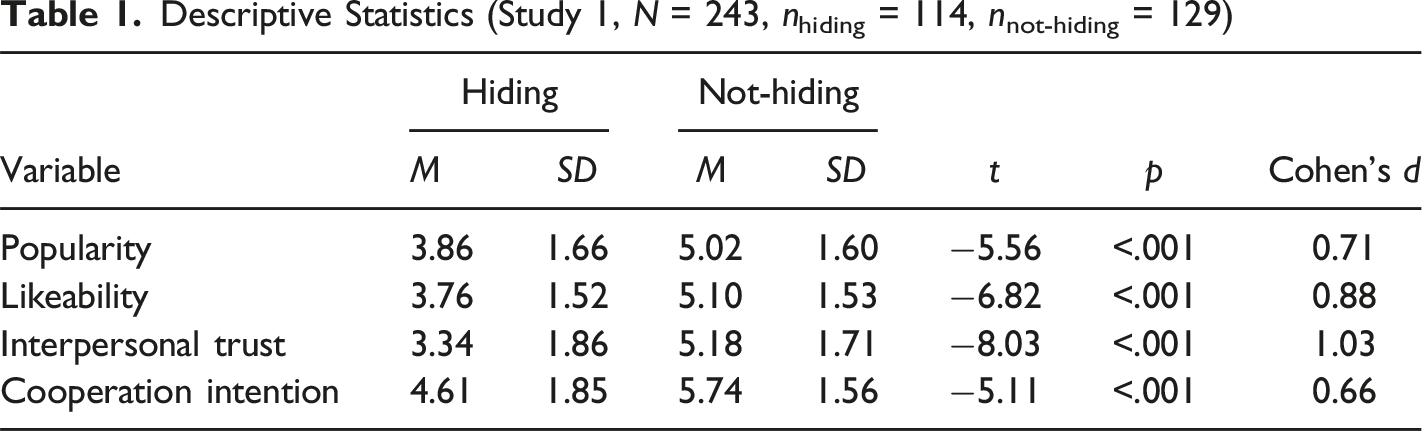
Descriptive Statistics (Study 1, N = 243, nhiding = 114, nnot-hiding = 129)
Popularity and Likeability
Participants in the not-hiding condition (M = 5.02, SD = 1.60) rated popularity significantly higher than in the hiding condition (M = 3.86, SD = 1.66), t (241) = −5.56, p < .001, Cohen’s d = 0.71. Participants in the not-hiding condition (M = 5.10, SD = 1.53) rated likability of adolescents significantly higher than in the hiding condition (M = 3.76, SD = 1.52), t (241) = −6.82, p < .001, Cohen’s d = 0.88. As predicted, not-hiding-effort adolescents were more popular and liked than hiding-effort adolescents among their peer classmates.
Interpersonal Trust
Participants in the not-hiding condition (M = 5.18, SD = 1.71) rated interpersonal trust of adolescents significantly higher than in the hiding condition (M = 3.34, SD = 1.86), t (241) = −8.03, p < .001, Cohen’s d = 1.03. As predicted, adolescents were more likely to trust not-hiding-effort peers than hiding-effort peers.
Cooperation Intention
Participants in the not-hiding condition (M = 5.74, SD = 1.56) rated cooperation intention towards adolescents significantly higher than in the hiding condition (M = 4.61, SD = 1.85), t (241) = −5.11, p < .001, Cohen’s d = 0.66. As predicted, adolescents were more likely to cooperate with not-hiding-effort peers than hiding-effort peers.
Study 2: Observer versus Actor Impression Perception of Hiding Effort
Adding the perspective of actors, Study 2 investigated whether adolescents who hid efforts were aware of the negative consequences by a 2 (Role: actor vs. observer) × 2 (Effort: hiding vs. not hiding) between-subjects design. Role and Effort were the dependent variables. Popularity, likeability, interpersonal trust, and cooperation intention were the dependent variables. The study hypothesized that hiding-effort adolescents might not realize the negative consequences of hiding effort. It was further hypothesized that authenticity might mediate the effect between hiding effort and popularity, likeability, interpersonal trust, and cooperation intention.
Method
Participants
A priori power analysis was conducted using G*Power software version 3.1 (Faul et al., 2009) to determine the sample size for a 2 × 2 between subjects MANOVA F-test. The analysis aimed to detect a medium effect size (f = .25) with an alpha level of .05 and 80% power, considering four groups and five response variables. The result indicated that a total of 135 participants would be required.
Using a convenience sampling method, Study 2 recruited 232 participants from two middle schools. Fifty-six participants were excluded from the analysis, among whom two participants withdrew from the experiment, fifty failed the comprehension check, two did not finish all the dependent variable questions, and two failed the confirmation statement “I confirmed that I had provided the answers seriously” (1 = yes, 2 = no). An effective sample of 176 participants was included in the analysis, aged from 12 to 16 (Mage = 14.16; SD = 0.90). Among them, 44.32% were female, 51.70% were male, and 3.98% did not provide gender information; 18.18% were in seventh grade, 16.48% in eighth grade, 59.66% in ninth grade, and 5.68% did not provide grade information.
Procedures and Materials
Compared to Study 1, Study 2 added two more scenarios: actor hiding versus actor not hiding. The procedures and the scenarios: observer hiding versus observer not hiding were the same as with Study 1.
In the actor scenario, participants were asked to imagine themselves as hardworking and diligent students. They were then asked to imagine themselves joining a daily discussion about tests and studies with their classmates. In the hiding condition, participants read, “I hid my academic effort from other classmates.” In the not-hiding condition, participants read, “I honestly told the academic effort invested in study to other classmates.” The observer scenario materials were the same as in Study 1.
After reading the actor scenario, participants answered one comprehension-check question, “Are you a hardworking student in the scenario?” (1 = yes, 2 = no). Participants who read the observer scenario answered: “Is That Classmate a hardworking student in the scenario?” (1 = yes, 2 = no).
Finally, participants answered manipulation check and dependent variable questions and filled in the demographic information as in Study 1. All the materials are included in Appendix C.
Dependent variables
Manipulation Check
As a manipulation check, Study 2 asked participants, “To what extent do you think you (That classmate) hid effort from others?” from 1 (not hid at all) to 7 (completely hid). The higher score indicated the greater extent of hiding.
Popularity
In the actor scenario, participants answered, “To what extent do you think you are popular among your classmates?” (Heyder & Kessels, 2017). In the observer scenario, the item was the same as in Study 1. The higher score indicated higher popularity.
Likeability
In the actor scenario, participants answered, “To what extent do you think your classmates like you?” and “To what extent do you think your classmates are willing to make friends with you?” (Heyder & Kessels, 2017). In the observer scenario, the items were the same as in Study 1. The correlation coefficient of the two items was rs (176) = .75, p < .01. The higher score indicated higher likeability.
Interpersonal Trust
In the actor scenario, participants answered, “To what extent do you think your classmates trust you?” In the observer scenario, the item was the same as in Study 1. The higher score indicated higher interpersonal trust.
Cooperation Intention
In the actor scenario, participants answered “To what extent do you think your classmates are willing to team with you to study?” (Roberts et al., 2021). In the observer scenario, the item was the same as in Study 1. The higher score indicated higher cooperation intention.
Authenticity
Southampton Authenticity Scale (SAS) was used to assess the adolescents’ authenticity (Kelley et al., 2022; Lenton et al., 2013), with minor changes made to the four items to fit the scenarios, such as “You (That Classmate) feel/s authentic” and “You (That Classmate) feel/s true to yourself (himself/herself).” The items were rated on a 7-point scale (1 = strongly disagree, 7 = strongly disagree), Cronbach α = .82. The higher score indicated higher authenticity.
Analytical method
Study 2 conducted an independent t test on all the dependent variables in each experiment condition and MANOVAs on all the dependent variables in SPSS 26.0 (Keselman et al., 1998). A mediation analysis was conducted using the PROCESS macro (Model 4) in SPSS 26.0 (Hayes, 2017). The analysis tested whether authenticity mediated the relationship between hiding effort and popularity, likeability, interpersonal trust, and cooperation intention. Bootstrap resampling with 5000 samples was employed to estimate the indirect effect, providing bias-corrected confidence intervals. An effect was considered statistically significant if the confidence intervals did not include zero.
Results
Descriptive Statistics (Study 2, N = 176, nactor hiding = 43, nactor not-Hiding = 40, nobserver hiding = 47, nobserver not-hiding = 46)

Manipulation Check
Participants rated the extent of hiding effort in the hiding condition (M = 5.30, SD = 1.89) significantly higher than in the not-hiding condition (M = 3.24, SD = 2.00), t (172) = 7.01, p < .001, Cohen’s d = 1.06. The result indicated that the manipulation of the hiding effort was effective.
Popularity and Likeability
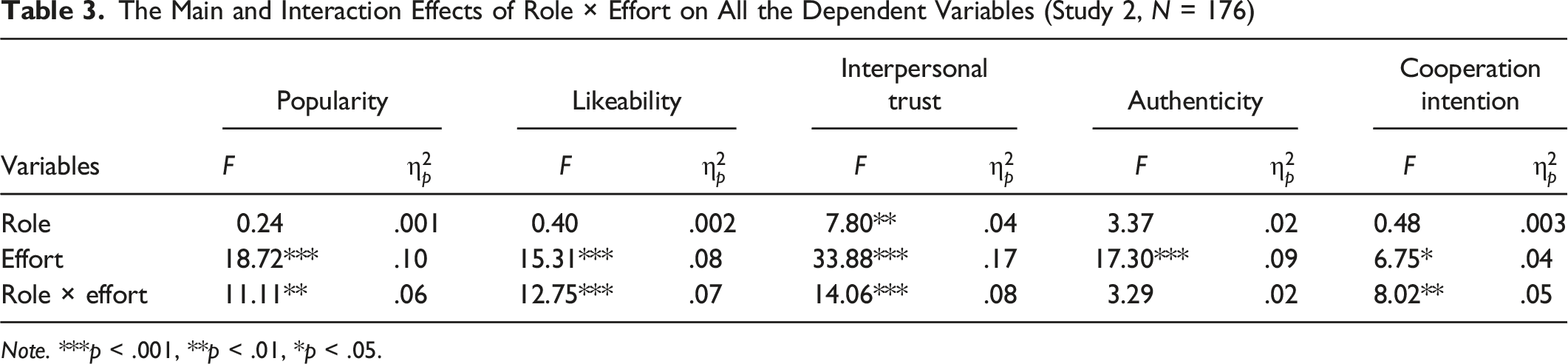
The Main and Interaction Effects of Role × Effort on All the Dependent Variables (Study 2, N = 176)
Note. ***p < .001, **p < .01, *p < .05.
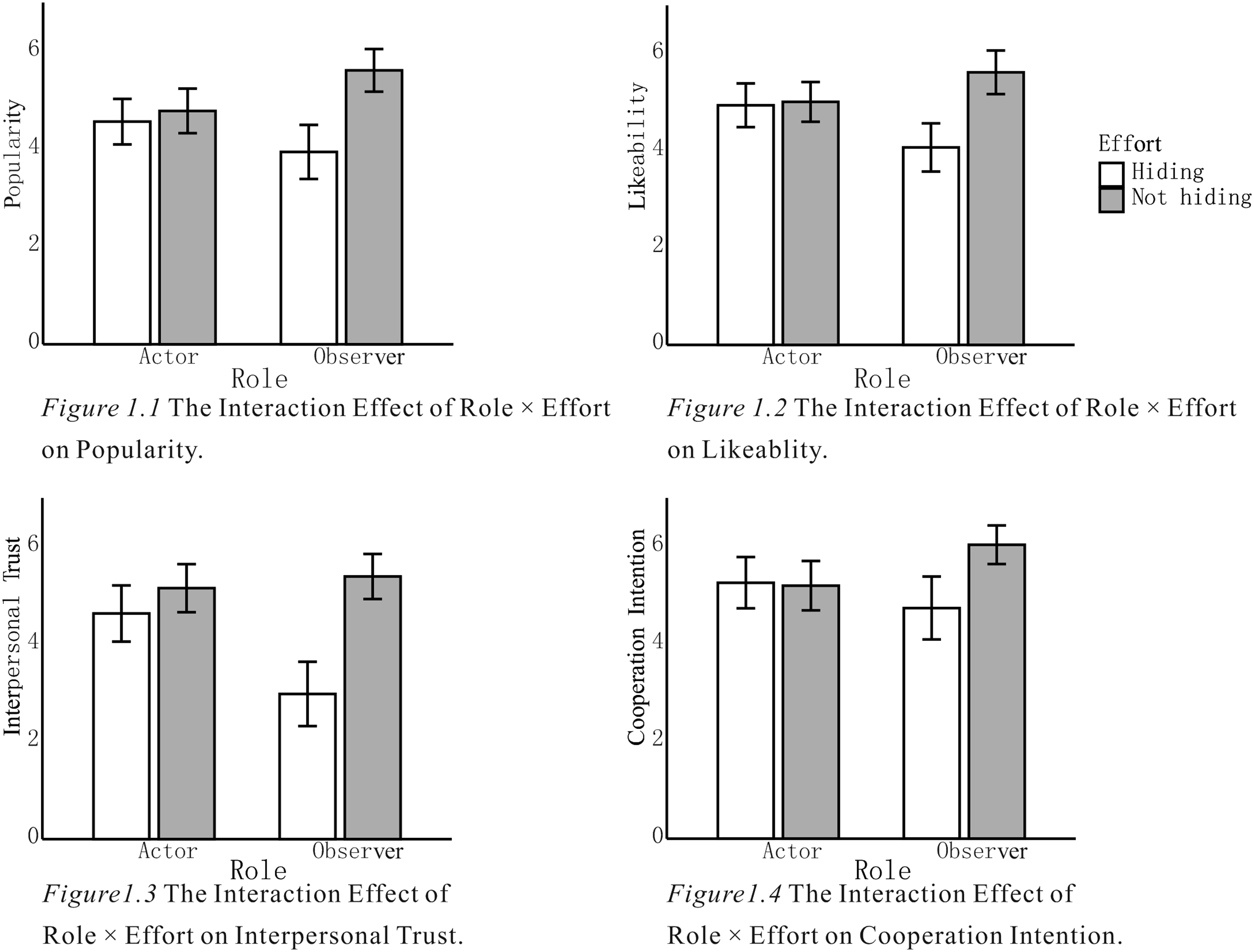
The Interaction Effect of Role × Effort on Impression Management Consequences. Note: Error bars represent one standard error.
Interpersonal Trust
As shown in Table 3, there was a significant main effect of Effort on adolescent interpersonal trust, F (1, 172) = 33.88, p < .001,
Authenticity
As shown in Table 3, there was a significant main effect of Effort on authenticity, F (1, 172) = 17.30, p < .001,
Cooperation Intention
As shown in Table 3, there was a significant main effect of Effort on adolescent’s cooperation intention, F (1, 172) = 6.75, p = .007,
Mediation Effect of Authenticity
Study 2 ran a mediation model with Effort as an independent variable (hiding effort coded 0, not hiding effort coded 1), and authenticity as the mediator variable. Presented in Figure 2, the results showed that authenticity mediated the effect of hiding effort on popularity (indirect effect = .22, SE = .08, 95% CI [.10, .37]), likeability (indirect effect = .26, SE = .07, 95% CI [.12, .44]), interpersonal trust (indirect effect = .28, SE = .08, 95% CI [.14, .45]), and cooperation intention (indirect effect = .21, SE = .07, 95% CI [.09, .37]). The results indicated that not-hiding efforts increased adolescents’ authenticity to enhance their popularity, likeability, interpersonal trust, and cooperation intention. Authenticity Mediates the Effect of Hiding Effort on Popularity, Likeability, Interpersonal Trust, and Cooperation Intention. Note: ***p < .001, **p < .01, *p < .05.
General Discussion
The present research used hypothetical scenarios to investigate the impression management consequences of hiding effort among adolescents. From the perspective of observers who witnessed hiding effort, Study 1 demonstrated that hiding effort decreased adolescents’ popularity, likeability, interpersonal trust, and cooperation intention among their peers. Study 2 verified the findings in Study 1 and found that the effort hiders were not aware of the negative consequences. Furthermore, Study 2 revealed that authenticity mediated the effect of hiding effort on popularity, likeability, interpersonal trust, and cooperation intention. The findings indicated that hiding efforts caused negative impression management consequences among adolescents.
The Mixed Impression Perception of Hiding Effort
The current study found a mixed impression perception of hiding effort from the perspective of actors and observers. Inconsistent with adolescents’ belief that showing efforts in front of peers meant low competency, which led to lower popularity than hiding efforts (Juvonen & Murdock, 1995; Kun, 1977; Zook & Russotti, 2012), Study 1 and Study 2 demonstrated that authentic effort presentation led to higher popularity and likeability. Towards other peers, adolescents preferred those who authentically displayed effort among peers, while towards themselves, they believed that it made no difference to their impression whether they hid effort or not. One reason for this contradictory phenomenon may be their misbelief that effort exertion indicated low competence (Zook & Russotti, 2012). Another reason may be that adolescents were inept in perspective-taking of others’ minds (Sezer, 2022; Steinmetz et al., 2017).
The findings suggest another possibility of how competence and peer status are perceived. Rather than associating effort with incompetence (Zook & Russotti, 2012), adolescents may now see it as an indicator of dedication and honesty and are likely to be rewarded with higher popularity and likeability. This aligns with broader societal trends that emphasize the importance of hard work and perseverance over innate talent (Steinmetz et al., 2017). On one hand, adolescents may fear that showing effort could make them appear less competent. On the other hand, they appreciate and value effort exertion. This paradox highlights the complexity of impression management strategies during adolescence, a period marked by increasing sensitivity to peer evaluation (Meehan et al., 2024). The results imply that encouraging adolescents to show their efforts could foster more positive peer relationships.
The Mediation Effect of Authenticity
Adolescence is a period of social reorientation when adolescents increasingly depend on peers for social and emotional support (Cheng et al., 2024; Seok & Doom, 2022). Through interaction with peers, adolescents can express and behave their authentic selves, and validate the appropriateness of their opinions and behaviors based on feedback from their peers (Vijayakumar & Pfeifer, 2020). Authentic self-presentation helps adolescents understand themselves and see how other peers perceive them, which is essential for their self-identity formation and interpersonal relationship development (Meeus, 2011). When adolescents present authentic selves in peer interactions, they are more likely to establish and deepen mutual interpersonal trust and enhance their peers’ cooperation intention (Kim et al., 2023; Sohmer, 2020). As adolescents tend to value and appreciate honest disclosure in peer interactions, not hiding effort increases authenticity to increase peer relationships. However, when adolescents hide efforts from their peers, they no longer present themselves authentically, which may create a sense of mistrust and suspicion (Gino et al., 2020). Hiding effort decreased authenticity, leading to lower popularity, likeability, interpersonal trust, and cooperation intention.
Theoretical and Practical Implications
The current study extends our understanding of impression management strategies by demonstrating that attempts to conceal or downplay one’s efforts can backfire in managing impressions. While Dramaturgical Theory emphasizes the actors’ motivation and strategies to control the observers' impressions (Leary & Kowalski, 1990), the current findings indicate that actors should consider the observers’ perceptions, starting in adolescence. Furthermore, the study underscores the critical role of authenticity as a mediator, highlighting that perceived genuineness is essential for fostering positive impressions. These findings imply that impression management strategies should incorporate authenticity as a key component to predict their success or failure.
In practical terms, educators and parents should foster environments where effort and authenticity are encouraged and rewarded. For example, schools can emphasize the value of effort in their curricula and create social skills training programs. The programs could teach adolescents the importance of authenticity and the potential negative consequences of concealing their efforts. These programs could help adolescents understand the long-term benefits of being genuine and putting effort into their social and academic activities, instead of hiding their efforts to conform to perceived social norms.
Presenting authentic effort to peers can gain positive peer relationships and efficient cooperation, which, in turn, can boost self-esteem (Ferguson & Ryan, 2019; Laursen & Veenstra, 2021; Seok & Doom, 2022). However, when adolescents hide their efforts, they may lose these benefits. Adolescents should keep in mind that showing efforts to peers is still a positive attribute and is appreciated by their peers.
Limitations and Future Research
There were several limitations in the present research. First, the current study used hypothetical scenarios, which may not always accurately reflect real-world situations or behaviors. Convenience samples do not represent the broader population (Stratton, 2021). The dropping rate of the participants was relatively high in both studies due to incorrect understanding of the scenario descriptions. Thus, future research could orally explain the definition of effort and hiding effort to the participants before the scenario experiment. Future research would further investigate hiding efforts in real-life contexts. Second, the current research did not examine the relationship distance between the actor and the observer. Close relationships prescribe stronger norms of sharing; therefore, hiding in a closer relationship may cause higher relational costs (Roberts et al., 2021). Thus, future research would investigate the consequences of hiding efforts between different relationship closeness levels among adolescents. Third, there might be cultural differences in hiding effort consequences as all the participants of the current study were Chinese adolescents in Eastern culture. Western culture is individuality-centered, and adolescents are encouraged to stand out from their peers, while Eastern cultures prioritize interdependence, and adolescents are encouraged to stay modest with peers to maintain harmony (Zhang et al., 2018). Future research could investigate cultural differences in hiding efforts on impression management consequences.
Conclusion
The present research investigated the impression management consequences of hiding effort from both actors and observers. The results found that hiding efforts led to lower popularity, likeability, interpersonal trust, and cooperation intention among adolescents via the mediation effect of authenticity. Adolescents should authentically display effort in peer interactions.
Supplemental Material
Supplemental Material - The Impression Management Consequences of Hiding Effort Among Adolescents: The Mediating Role of Authenticity
Supplemental Material for The Impression Management Consequences of Hiding Effort Among Adolescents: The Mediating Role of Authenticity by Zhongyan Su, Yuan Fang, Yiping Feng, and Zhiyan Chen in Psychological Reports
Footnotes
Author Contributions
Z.S. contributed to the conceptualization, methodology, formal analysis and investigation, and writing-original draft preparation; YP.F. contributed to the conceptualization, interpretation of the results, funding acquisition, and writing-review and editing; Y.F. contributed to the coordination of the study, methodology, and interpretation of the results; Z.C. contributed to the conceptualization, interpretation of the results, supervision, and writing-review and editing. All authors read and approved the final manuscript.
Declaration of Conflicting Interests
The authors declared no potential conflicts of interest with respect to the research, authorship, and/or publication of this article.
Funding
The authors disclosed receipt of the following financial support for the research, authorship, and/or publication of this article: This work was supported by the fellowship of the China Postdoctoral Science Foundation (Grant No. 2021M703467) and the Special Research Assistant Program of the Chinese Academy of Sciences (Grant No. E2CX0114).
Ethical Statement

Data Availability Statement
All the data and experimental materials are available on OSF.
Supplemental Material
Supplemental material for this article is available online
Author Biographies
References
Supplementary Material
Please find the following supplemental material available below.
For Open Access articles published under a Creative Commons License, all supplemental material carries the same license as the article it is associated with.
For non-Open Access articles published, all supplemental material carries a non-exclusive license, and permission requests for re-use of supplemental material or any part of supplemental material shall be sent directly to the copyright owner as specified in the copyright notice associated with the article.
