




Abstract
In this study, the mediating role of fear of happiness in the relationship between depression levels and rumination levels of university students was examined. The dependent variable of this study is depression, the mediating variable is fear of happiness and the independent variable is rumination. The research was conducted using the relational survey method. The sample consisted of university students studying at Selçuk University in the 2021-2022 and 2022-2023 academic year. Of the participants, 83.8% (290) were female and 16.2% (56) were male. In the study, bootstrapping method was used to test the significance of the indirect effect. It was observed that fear of happiness had a partial mediating role between depression and rumination levels in university students. From this point of view, it can be said that rumination and fear of happiness will increase depression in university students. At the same time, it can be said that rumination affects depression.
Introduction
In order to address the intricacies of depressive symptoms and design efficacious treatment approaches, it is imperative to comprehend the complicated link between rumination, dread of happiness, and sadness. In order to clarify the psychological and neurological foundations of this dynamic interaction between rumination and depression, this study attempts to go deeper into the mediating function of fear of happiness in this relationship. We can learn a great deal about how people with depression process emotions, deal with negative ideas, and ultimately experience and avoid happy feelings by investigating the possible consequences of fear of happiness as a mediator (Takai et al., 2023).
A complicated and severe mental illness, depression affects millions of people globally. Numerous physical and mental symptoms, along with persistent feelings of depression and disinterest in or enjoyment from activities, are what define it. Rumination’s function in the onset and maintenance of depressive symptoms has drawn attention in studies, despite the fact that many factors might contribute to the onset and aggravation of depression (Kock et al., 2023). According to Ghaznavi and Deckersbach (2012), rumination is a cognitive activity that feeds into pessimistic thinking and aids in the emergence and maintenance of depression symptoms. Rumination is the term for the obsessive and invasive concentration on one’s unfavorable experiences, feelings, and thoughts. But the topic of why people ruminate still has to be answered. The relationship’s dread of happiness acting as a mediator is one explanation.
One of the founders of positive psychology, Seligman (2002), claimed that psychology tends to focus more on negative features and people who have problems. good psychology challenges this conventional mindset, contending that happiness is best achieved by being more optimistic and concentrating on life’s good parts (Peterson et al., 2005). In this approach, it is not possible to completely eliminate negative emotions, but it is suggested that the existence of negative emotions should be accepted and positive emotions should be experienced. It also emphasized the concept of happiness (Seligman & Csikszentmihalyi, 2000).
It would be appropriate to emphasize that culture is very effective in the perception of happiness. In Eastern culture, there is a concept called fear of happiness, which is a common phrase among the people such as “if I laugh too much, I may encounter negative situations in my life”. For example, East Asians see happiness as a pressure against belonging to a group. This is because social harmony is very important in Japanese culture. Happiness can be perceived as a situation that may damage social relations (Uchida et al., 2004). Minami (1971) emphasizes that happiness should have limits in Japanese culture. According to another understanding, happiness makes people lazy and relaxed, so it is an obstacle to being cautious towards the environment (Uchida & Kitayama, 2009). It would be reasonable to define the dread of happiness from this perspective.
The term “fear of happiness” refers to the aversion or rejection of experiencing happiness or contentment. Because they are afraid of being happy, people with depression use rumination to suppress or prevent feeling happy (Zhao et al., 2022). Individuals with depression and executive dysfunction struggle to regulate their emotions effectively (Compare et al., 2014). This lead to a heightened fear of happiness, as they perceive positive emotions as overwhelming or uncontrollable. Rumination helps lead to the onset and persistence of sadness through a mechanism known as the fear of happiness. By continuously focusing on negative thoughts and avoiding positive emotions, individuals with depression reinforce their depressive symptoms and hinder their ability to engage in adaptive coping strategies. Additionally, fear of happiness exacerbate the negative impact of rumination on depression by perpetuating a cycle of negative thinking and avoidance of positive experiences (Denson et al., 2009).
For the purpose of creating successful treatment plans, it is essential to comprehend how the fear of happiness affects the connection between rumination and depression (Belen et al., 2020). Mental health practitioners customize treatment procedures to address the interrelated issues of rumination and fear of happiness. Therapists can help people engage in more balanced emotional experiences and break the cycle of ruminating and depressive symptoms by focusing on the fear of happiness. Mental health providers acknowledge the experiences of individuals with depression by recognizing the role that dread of happiness plays in the development and maintenance of depressed symptoms. This allows them to give focused support that addresses the emotional complexities involved with sadness.
In conclusion, understanding how dread of happiness functions as a mediator in the link between depression and rumination is essential to enhancing therapeutic approaches and promoting a more comprehensive understanding of depressive symptoms. By integrating interventions that target fear of happiness and executive dysfunction, mental health practitioners provide holistic support that empowers individuals with depression to navigate their emotions more effectively and ultimately improve their overall well-being.
This study looked at the function that dread of happiness plays as a mediator in the association between university students’ levels of rumination and depression. From this point of view, it is planned to seek answers to the following hypotheses in our research:
Participants’ rumination levels predict their depression levels.
Participants’ fear of happiness levels predict their depression levels.
Fear of happiness is efficient in moderating the link between depression levels and rumination, to a partially extent.
Method
The study employed the relational survey method (Weyant, 2022). The sample comprised students enrolled in the pedagogical formation program at Selçuk University during the 2021–2022 and 2022–2023 academic years. This program provides specialized training for prospective teachers, making this group suitable for gathering more comprehensive data (Kanadlı, 2019). Data collection over two academic years was intended to enhance the reliability and validity of the study’s findings, allowing for a more robust analysis (Wallen & Fraenkel, 1988). Of the participants, 290 were female (83.8%), and 56 were male (16.2%). The sample’s age distribution falls between 20 and 24 years old, with an average age of 22.71 (SD: 1.90).
Data collection tools
Rumination Scale for Interpersonal Error
The scale was developed by Wade et al. (2008) and adapted into Turkish by Arslan and Oral (2017). Consisting of 6 items, the scale is a 5-point Likert-type scale with “Strongly Disagree = 1” and “Strongly Agree = 5”. As a result of confirmatory factor analysis, fit indices were found as /sd = 3.82, p < .001, RMSEA = .096, SRMR = .04, GFI = .97, AGFI = .92, CFI = 98. The obtained fit indices show that the rumination scale for interpersonal error gives a good fit.
Fear of Happiness Scale
The scale developed by Joshanloo and Weijers (2014) was adapted into Turkish by Eliüşük-Bülbül (2018). Consisting of 5 items and a single dimension, the scale is a 7-point Likert-type measurement tool. Item total correlation scores ranged between .60 and .72. The unidimensional structure of the scale fit the model well (RMSEA = .06, AGFI = 0.92, NFI = .98, GFI = 0.9, CFI = 0.99, IFI = 0.99, RFI = .95, and SRMR = .03).
Beck Depression Inventory for University Students
Beck Depression Inventory for University Students, developed by Beck et al. (1961) and adapted into Turkish by Hisli (1989), will be used to measure the depression levels of the participants. Likert type is used for rating. Each item identifies a behavioral pattern specific to depression and includes 21 self-evaluation statements ranging from low to high (0 = positive statements about depression, 3 = negative statements about depression). Scores that can be obtained from the scale vary between 0-63. Cronbach’s alpha value was calculated as .80.
Data analysis
We first look at the dread of happiness’s mediating function in the association between depression and rumination. The schema for the mediating role is shown in Figure 1. Cronbach’s alpha values of the items of the Fear of Happiness Scale (0.73-0.82). χ2 (72) = 251.02; overall Cronbach’s alpha internal consistency coefficient was .85. Rumination about Interpersonal Error Scale (RIRS): Cronbach’s alphas of the items ranged from 0.72 to 0.85; (χ2 (93) = 323.02; overall Cronbach’s alpha internal consistency coefficient was .89. Beck Depression Inventory for University Students: Cronbach’s alphas of the items were 0.83 to 0.95. χ2 (70) = 359. 40; overall Cronbach’s alpha internal consistency coefficient was .93. The mediating role of fear of happiness in the relationship between rumination and depression.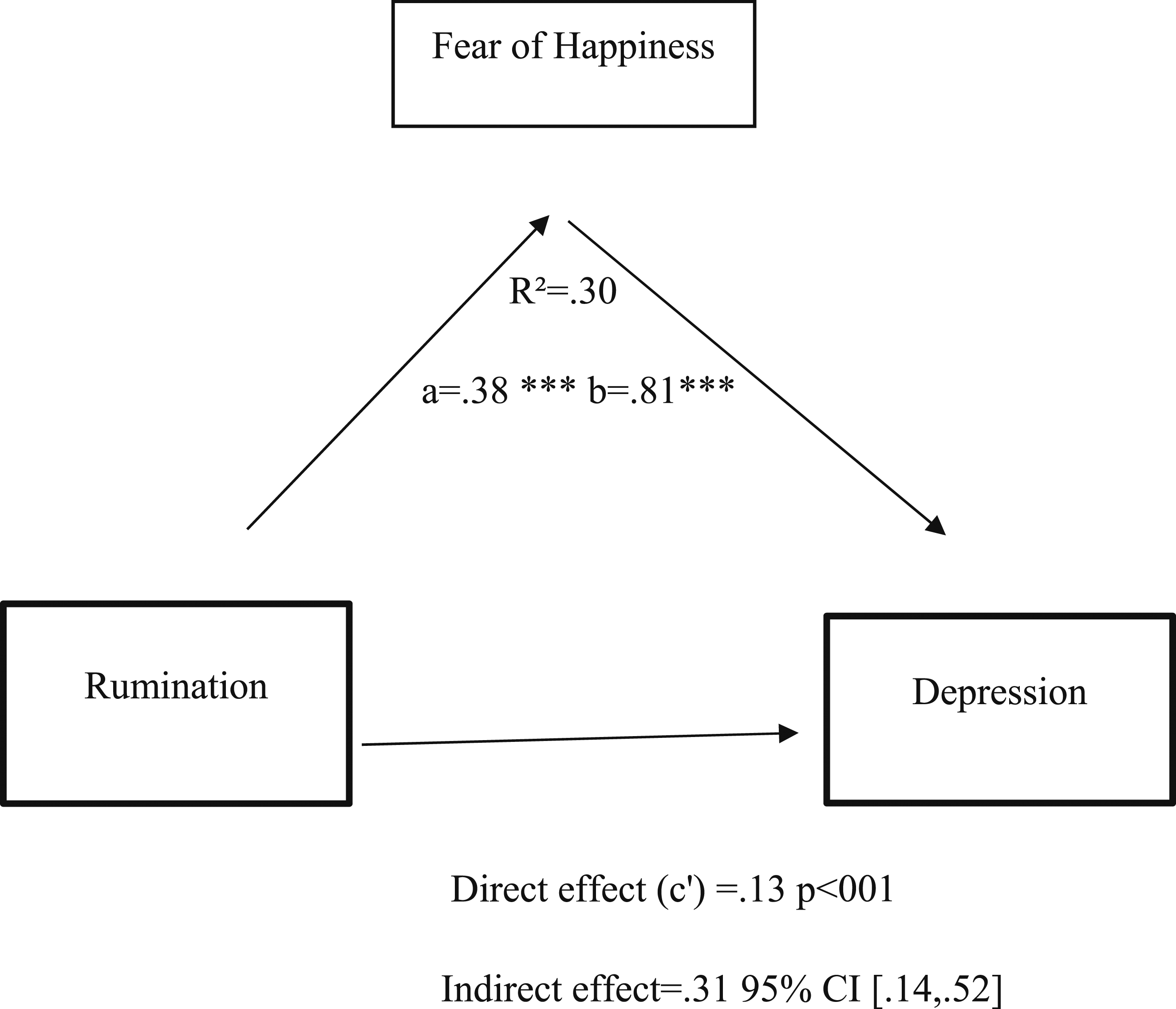
The mediation test created by Hayes (2018) was used to examine the mediation role between the variables. Regression analysis was carried out using bootstrap in this method. Analyses were conducted using Process Macro. The study employed the bootstrapping technique to demonstrate the significance of the model’s direct and indirect impacts. By using the resampling procedure, bootstrapping establishes upper and lower bound values (Hayes, 2013). It is stated as a consequence of the bootstrapping procedure that for the impact under study to be considered significant, the upper and lower bounds of the confidence level should not encompass zero. The mediation model realized through 5000 resampling with bootstrapping procedure at 95% confidence interval across 346 samples was built in this study to examine the mediating role effect.
Findings
First, the mediating role of fear of happiness in the relationship between rumination and depression will be examined. The schema regarding the mediating role is shown in Figure 1.
In the mediation model presented in Figure 1, it is seen that all path coefficients are significant in the mediation model of the effect of rumination and fear of happiness on depression in university students.
Rumination predicted depression positively (β = .38, p < .001), rumination predicted fear of happiness positively (β = .85, p < .001), and fear of happiness and rumination together predicted depression positively (β = .81, p < .001). The indirect effect was found to be (Indirect effect = −.31 95% CI [.14,.52]).
Regression Results for Mediation Test N = 346.
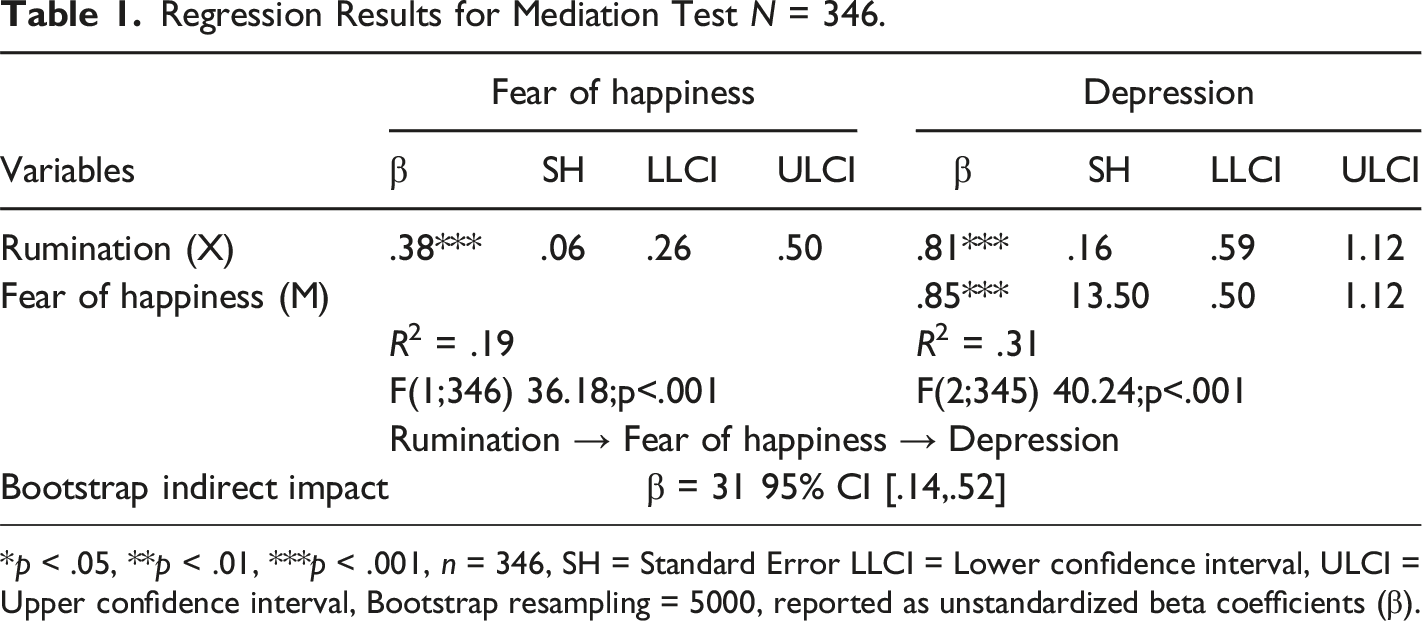
*p < .05, **p < .01, ***p < .001, n = 346, SH = Standard Error LLCI = Lower confidence interval, ULCI = Upper confidence interval, Bootstrap resampling = 5000, reported as unstandardized beta coefficients (β).
The bootstrap method of regression analysis was used to examine the potential mediating function of dread of happiness in the relationship between university students’ levels of depression and rumination. In the analysis, Hayes (2018)’s process macro was utilized. Table 1 presents the analysis’s findings. Consequently, it was shown that there was a considerable indirect relationship between sadness and dread of happiness. Consequently, it was concluded that the association between rumination and sadness is mediated by dread of happiness. (β = 31 95% CI [.14,.52]) is the indirect effect. Values of the bootstrap confidence interval encompass “0”. As a result, the study’s premise was confirmed.
Discussion
The relationship between rumination and depression in university students can be better understood by looking at the mediation role of dread of happiness. Studies have indicated that there may be a partly mediation function of dread of happiness in this association. For example, a study by Satıcı et al. (2020) revealed the mediating role of ruminating in the association between intolerance of ambiguity and mental health, suggesting that rumination can mitigate the impact of specific factors on psychological outcomes. Similarly, Wang et al. (2022) discovered that intrusive rumination partially moderated the association between cancer patients’ sadness and fear of recurrence, indicating that specific rumination patterns may function as mediators in the emergence of depressive symptoms.
Additionally, the research conducted by Işgör et al. (2022) demonstrated the impact of fear of happiness on mental health outcomes by demonstrating a robust positive correlation between university students’ depression levels and their fear of happiness. Yıldırım (2019) also looked at the role resilience plays as a mediator in the relationships between fear of happiness and affect balance, life satisfaction, and thriving. The results imply that resilience varies among people and can influence how happiness fear impacts overall wellbeing.
In conclusion, studies on the association between ruminating, depression, and fear of happiness in university students suggest that rumination and depressive symptoms may be mediated in part by fear of happiness. Comprehending the interplay between these variables can yield significant knowledge for interventions designed to mitigate depression and enhance mental health among university students.
The relationship between depression, rumination levels, and fear of happiness levels in university students is a complex interplay that has been extensively studied. Research indicates that as depression levels increase, both rumination and fear of happiness levels also tend to increase (Nolen–Hoeksema et al., 2008; Shors et al., 2016; Takai et al., 2023).
Rumination and depression have been studied by Nolen–Hoeksema et al. (2008) and Shors et al. (2016), who have shown how rumination can exacerbate depressed symptoms. Furthermore, Takai et al.'s research from 2023 has highlighted the connection between psychological outcomes and fear of happiness, indicating that a greater fear of happiness may be associated with more depressed symptoms.
Furthermore, Huang et al. (2019) showed that rumination mediates the emergence of depressive symptoms, suggesting that elevated rumination levels can accelerate the course of depression over time. The complex relationship that has been identified by Liu et al. (2022) and Chiang et al. (2022) between rumination, depression, and related psychological characteristics suggests that rumination is closely linked to depressive symptoms.
Overall, the existing literature provides substantial evidence to suggest that as depression levels rise, so do rumination and fear of happiness levels. Comprehending these interdependent connections can yield significant knowledge for therapies designed to combat depression and enhance mental health among university students.
Current evidence lends credence to the theory that rumination and depression are mediated by dread of happiness. revealed that resilience had a mediating role on flourishing and life satisfaction and partially mediated the impact of dread of pleasure on affect balance (Yıldırım, 2019). Furthermore, fear of happiness was found to be the strongest predictor of stress, anxiety, and depression by Gilbert et al. (2013), suggesting a substantial correlation between fear of happiness and symptoms of sadness. According to Jordan et al. (2020), there is a separate correlation between depressed symptoms and dread of happiness and negative affect interference. This finding emphasizes the significance of dread of happiness in exacerbating depression.
Moreover, Harmer et al. (2003) suggested that an enhanced perception of happiness could facilitate approach behavior and social interaction (Harmer et al., 2003). This aligns with the idea that fear of happiness, which may involve avoidance of positive emotions, can lead to increased rumination and ultimately contribute to depressive symptoms. According to the Forssman et al. (2013) study, depression is linked to paying more attention to social cues that express anxiety, which may be related to a fear of happiness.
To sum up, research on the impact of fear of happiness on mental health outcomes indicates that fear of happiness has a significant indirect effect on depression, modulating the relationship between rumination and depressed symptoms. These results highlight how crucial it is to treat fear of happiness in depression treatment plans.
Conclusion
The study’s findings showed that among university students, fear of happiness was shown to somewhat mediate the association between rumination and depression. In this context, it was determined that rumination and fear of happiness can increase depression together and this relationship is mediated through fear of happiness. It was found that rumination levels and fear of happiness levels tended to increase with increasing depression. Regression analysis utilizing the bootstrap approach validated the mediation function of dread of happiness in the relationship between university students’ depression levels and rumination levels. Based on the analysis’s findings, it was determined that fear of happiness had a considerable indirect impact on depression, supporting the theory that fear of happiness moderated the association between rumination and depression.
Limitations
The sample size constraints and the sample group’s limited capacity to accurately reflect a particular demographic are the main sources of this study’s shortcomings. Furthermore, the fact that data were collected using a single measurement tool and the results were based on subjective interpretations may pose some limitations in terms of internal validity. In addition, this study may not have controlled for or considered other potentially influential variables (e.g., personality traits, life events), which may have an impact on the generalization. Furthermore, this study’s correlational methodology may be inadequate for drawing conclusive findings regarding causal linkages; instead, an experimental design may be more appropriate. In conclusion, even though this study’s findings are significant, more in-depth analysis of these correlations should be done in future studies using bigger sample sizes.
Recommaditions
It is also critical for mental health practitioners to consider the implications of executive dysfunction in the context of fear of happiness and rumination. Developing interventions that specifically target executive functioning deficits, such as cognitive remediation programs, can help individuals with depression improve their emotional regulation and decision-making abilities. By addressing executive dysfunction, therapists can support individuals in managing their emotional responses and reducing the impact of rumination on depressive symptoms.
Footnotes
Declaration of Conflicting Interests
The author(s) declared no potential conflicts of interest with respect to the research, authorship, and/or publication of this article.
Funding
The author(s) received no financial support for the research, authorship, and/or publication of this article.
Ethical Statement

Data Availability Statement
The datasets analyzed in this study are available from the corresponding author upon request.
Author Biography
They completed their master’s and doctorate in guidance and psychological counseling department.