




Abstract
Rock PJ, Quesinberry D, Singleton MD, Slavova S. Emergency medical services and syndromic surveillance: a comparison with traditional surveillance and effects on timeliness. Public Health Rep. 2021;136(suppl 1):72-79. doi:10.1177/00333549211018673
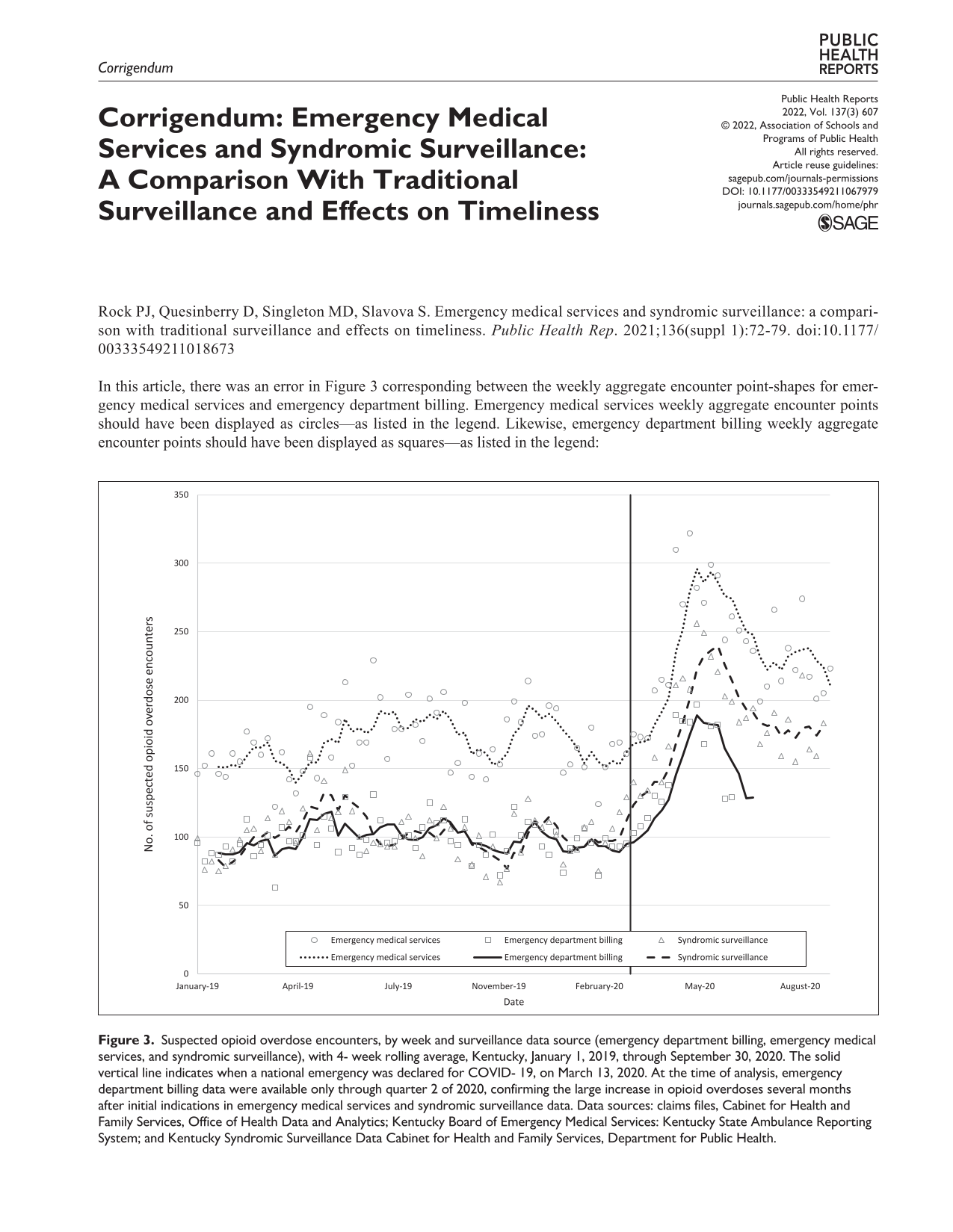
In this article, there was an error in Figure 3 corresponding between the weekly aggregate encounter point-shapes for emergency medical services and emergency department billing. Emergency medical services weekly aggregate encounter points should have been displayed as circles—as listed in the legend. Likewise, emergency department billing weekly aggregate encounter points should have been displayed as squares—as listed in the legend:

Suspected opioid overdose encounters, by week and surveillance data source (emergency department billing, emergency medical services, and syndromic surveillance), with 4- week rolling average, Kentucky, January 1, 2019, through September 30, 2020. The solid vertical line indicates when a national emergency was declared for COVID- 19, on March 13, 2020. At the time of analysis, emergency department billing data were available only through quarter 2 of 2020, confirming the large increase in opioid overdoses several months after initial indications in emergency medical services and syndromic surveillance data. Data sources: claims files, Cabinet for Health and Family Services, Office of Health Data and Analytics; Kentucky Board of Emergency Medical Services: Kentucky State Ambulance Reporting System; and Kentucky Syndromic Surveillance Data Cabinet for Health and Family Services, Department for Public Health.