



Abstract
Objectives:
Uninsured or underinsured Hispanic women in Minnesota use the state’s free cervical cancer screening program, Sage. Although the rate of screening program use is high, incidence of and mortality from cervical cancer persist in this group. We examined systemic barriers to follow-up cervical cancer care despite access to the free program.
Methods:
From fall 2020 through spring 2021, we conducted virtual focus groups with 23 Hispanic women in Minnesota who previously received Sage services. We interviewed 7 key informants, including service providers, clinic administrators, and Sage team members. Three bilingual researchers independently used inductive approaches to identify themes from transcripts, refined categories, and finalized analysis through feedback sessions. We used the social-ecological model framework to reveal barriers to follow-up care after an abnormal cervical cancer screening result.
Results:
Exploratory inductive analyses of data from focus groups and key informants identified 4 interconnected barriers: (1) reliance on community clinics and patient navigators, often causing navigator burnout; (2) scheduling and attending follow-up appointments at clinics outside of familiar community clinics, particularly in rural areas; (3) negative health care experiences and interpreter misuse that discouraged further care; and (4) confusion and anxiety from unexpected billing, despite Sage being a free program.
Conclusions:
To address the identified barriers, we recommend expanding and compensating patient navigator roles, strengthening interpreter use, and training hospital staff to reduce billing errors. Even with free screening available through Sage, structural failures (billing confusion, rural access gaps, navigator workload) undermined equitable care. Addressing these systemic issues is essential if programs like Sage are to realize their potential in reducing disparities in incidence of cervical cancer among Hispanic women.
Keywords
Hispanic women in the United States experience a disproportionate incidence of cervical cancer, with rates 43% higher and mortality rates 25% higher than among non-Hispanic White women. 1 Well-documented barriers, such as low income, lack of health insurance, irregular immigration status, and language obstacles, limit access to cervical cancer screening, diagnosis, and treatment.2-7 These barriers place low-income Hispanic women without health insurance (uninsured) or with limited health insurance (underinsured) at particularly high risk for undiagnosed invasive cervical cancer. 8
National initiatives such as the National Breast and Cervical Cancer Early Detection Program (NBCCEDP) have aimed to reduce disparities in cervical cancer incidence by expanding access to screening. 9 In Minnesota, the Sage Screening Program operates under this federal framework and is administered by the Minnesota Department of Health in partnership with community clinics, hospitals, and nonprofit organizations. 10 Sage covers Papanicolaou (Pap) tests, human papillomavirus (HPV) tests, and diagnostic follow-up (eg, colposcopy, biopsies) for low-income women in Minnesota who are uninsured or underinsured. Since its establishment in 1991, Sage has served 173 013 women. 10 During the period of this study from 2020 through 2021, Sage provided cervical cancer screening for women aged 40 to 64 years; however, since then, screening now includes women aged 30 to 64 years. 11 Clinic staff typically identify eligible patients, assist with enrollment paperwork, and submit claims directly to Sage for reimbursement. The program also employs patient navigators and local outreach workers who coordinate appointments, ensure communication between patients and health care providers, and support follow-up after abnormal results.
From 2018 through 2021, compared with non-Hispanic White and non-Hispanic Black women, Hispanic women nationally were the most likely to receive NBCCEDP services. 12 This finding was reflected in 2017-2021 data from Minnesota, which showed that 66% of cervical cancer screening recipients through Sage identified as Hispanic. 13 Despite this high screening uptake, Minnesota continues to report elevated cervical cancer incidence and mortality rates among Hispanic women. 14 This paradox suggests that barriers extend beyond initial screening to the critical stage of follow-up care. Prior research has shown that delays in follow-up care can greatly increase the mortality of invasive cervical cancer.15,16 Follow-up care can include repeat tests, regular checkups, invasive procedures such as colposcopies and cone biopsies, excision procedures, and additional imaging and blood tests.17,18
Barriers to follow-up cancer care for Hispanic people in the United States may overlap with barriers that limit initial screenings, but follow-up requires sustained engagement, including multiple visits, clear communication of results, and ongoing patient education. 19 Low-income Hispanic adults are less likely than non-Hispanic White adults to adhere to such care plans.20-23 However, little is known about how these barriers manifest in state programs explicitly designed to remove financial obstacles, such as Sage.
The study’s Minnesota-based community–academic research team developed the community-based project, Un Poco de Luz, to explore facilitators of cervical cancer screening participation among Hispanic women enrolled in Sage. The project’s main goal was to identify facilitators of engagement with Sage’s preventive services. However, as data collection progressed, participants repeatedly and spontaneously described difficulties in accessing care after abnormal cervical cancer screening results. This unexpected but consistent theme revealed a critical gap in follow-up care and prompted a shift in analytic focus. Therefore, in this study, we examined barriers to seeking follow-up care among Hispanic women in the Sage program after they received abnormal cervical cancer screening results, drawing on findings from participant focus groups and interviews with key informants conducted from December 2020 through June 2021.
Methods
Project Design and Approach
The study’s community–academic research team included 1 postdoctoral fellow at a large university and 4 members of a nonprofit organization in Minnesota dedicated to supporting the Hispanic community by generating relevant research with the hope of influencing public policy. Among members of the team, 4 identified as female and 1 as male, 3 identified as Hispanic/Latino, 2 identified as non-Hispanic White, and all had college degrees. The team modeled the study after the social-ecological model, 24 which provided a framework to structure the interview questions and examine how personal beliefs, social relationships, community environments, and institutional or policy contexts collectively shaped patients’ abilities to complete follow-up care after abnormal cervical cancer screening results.
The University of Minnesota Institutional Review Board reviewed the study and deemed the study exempt from formal review because the study was considered minimal risk with an adult population (STUDY00011342). The study protocols aligned with the principles of the Declaration of Helsinki. Study participants provided informed consent.
Project Advisory Board
The community–academic team selected 5 self-identified Hispanic women to form a project advisory board to advise the team and guide the research. Members came from rural and urban areas and included a Sage worker, a health promotion specialist, community health promoters and leaders, and a senior researcher. The board met 3 times to set study goals, review focus groups and interview questions, interpret preliminary results, and suggest dissemination plans.
Focus Group Participants
Sage provided a list of potential participants who met the study eligibility criteria: cisgender women who identified as Latina/Hispanic, were aged 40 to 64 years, were uninsured or underinsured, had income at ≤250% of the federal poverty level, and had been screened for cervical cancer through Sage during the past 10 years. Once authorized by Sage, the study team contacted potential participants by telephone using a standardized call script. The script introduced the study name, affiliated organizations, and objective and stressed the voluntary nature of participation. The team called approximately 80 women, and 23 women agreed to participate. Women who did not participate either did not answer repeated telephone calls or declined participation for personal reasons.
From fall 2020 through spring 2021, 23 Hispanic/Latina women participated in 1 of 5 focus groups, which were conducted virtually because of COVID-19 pandemic restrictions. Two groups included women from rural areas, 2 groups included women from urban areas, and 1 group included women from rural and urban areas. Two team members led discussions in Spanish that lasted approximately 90 minutes and followed a semi-structured interview guide, allowing flexibility for participants to share personal and secondhand experiences. The team continued data collection until thematic saturation was reached, defined as no new themes emerging across successive focus groups. Before interviews, participants completed a socio-demographic survey. Participants received a $20 cash card.
Key Informant Interviews
The community–academic team’s and project advisory board’s preliminary analysis of the focus group data revealed analytical gaps in findings; therefore, the project advisory board suggested collection of data from key informants involved in the delivery of Sage program services, including clinical care, patient navigation, and program administration, to address these gaps. Although the team did not collect formal demographic characteristics from the 7 key informants who participated, during conversations, all key informants self-identified as women, 5 identified as Latina/Hispanic, and 2 identified as non-Hispanic White or non-Hispanic Other. All key informants had experience in providing cervical cancer screening services, including as a clinic administrator, patient navigator, community outreach specialist, nurse practitioner, and family physician. Two team members who were trained in qualitative methods conducted the in-depth interviews online in the key informant’s preferred language using a semi-structured guide developed with the project advisory board. Interviews lasted from 20 to 45 minutes, which the team recorded for analyses.
Data Analyses
The community–academic team audio-recorded and transcribed verbatim the focus group sessions and key informant interviews in the original language (a technique proposed by Elderkin-Thompson and Waitzkin 25 ). We used pseudonyms to preserve anonymity. We used Stata version 16.1 (StataCorp LLC) to summarize demographic survey data.
Three bilingual researchers (A.J., R.G., G.B.) independently reviewed transcripts and conducted inductive coding by using hand coding in Microsoft Word. The group used recurring ideas to inform development of a preliminary coding framework, which they piloted and refined through team discussions. The group (A.J., M.C.Z., R.G., G.B.) applied the finalized coding system to the full dataset and coded at least 1 transcript independently to cross-check the process. The team used consensus to resolve discrepancies. The team collaboratively agreed on final themes; thematic write-ups emphasized differences in responses and opinions across participants while maintaining confidentiality. The team achieved triangulation by integrating focus group data with key informant interviews across multiple levels of cervical cancer screening services.
Results
Among 23 women who participated in the focus groups, 22 completed the demographic survey (Table 1). All focus group participants identified as female and Latina/Hispanic, and 18 of the 22 were born in Mexico. The average age was 50 years, and 13 had lived in the United States for ≥20 years. None of the women were fluent in English, 9 spoke English but preferred speaking Spanish, and 13 did not speak English. Education levels varied: 10 had completed elementary school or less and 12 had high school degrees or more. All women were up to date with cervical cancer screening guidelines (<5 y), having used Sage services. Seventeen participants were uninsured, and 7 had annual household incomes of <$20 000.
Self-reported demographic characteristics of Hispanic women who participated in a qualitative study on barriers to follow-up cervical cancer care, Minnesota, 2020-2021 a

The demographic survey was completed by 22 of 23 Hispanic women in Minnesota who previously received Sage services, Minnesota’s free cervical cancer screening program, and participated in focus group discussions on barriers to follow-up cervical cancer care. Discussions were conducted from fall 2020 through spring 2021.
One participant did not report their age or years in the United States but completed all other survey items. Accordingly, a row has been added to show this missing value to ensure n = 22 in all groups.
Other countries included Ecuador, El Salvador, and Honduras.
The social-ecological model, which was used to structure the study, enabled us to identify not only individual-level barriers (eg, knowledge, fear) but also systemic and structural challenges (eg, clinic procedures, billing policies, program design). During analysis, themes frequently spanned multiple levels of the social-ecological model rather than fitting into a single domain and were interpreted to reflect these cross-level interactions and inform potential multilevel intervention points. Our exploratory inductive analyses identified 4 interconnected themes related to barriers to follow-up care after an abnormal cervical cancer screening: (1) reliance on community clinics and patient navigators, (2) scheduling and attending follow-up appointments at clinics outside of community clinics, (3) negative health care experiences that deterred further care, and (4) frustration and apprehension due to billing confusion (Table 2).
Themes, subthemes, illustrative quotes, and implications on barriers to follow-up cervical cancer care identified from interviews with focus groups of 23 Hispanic women and with 7 key informants from the Sage program, Minnesota, 2020-2021 a
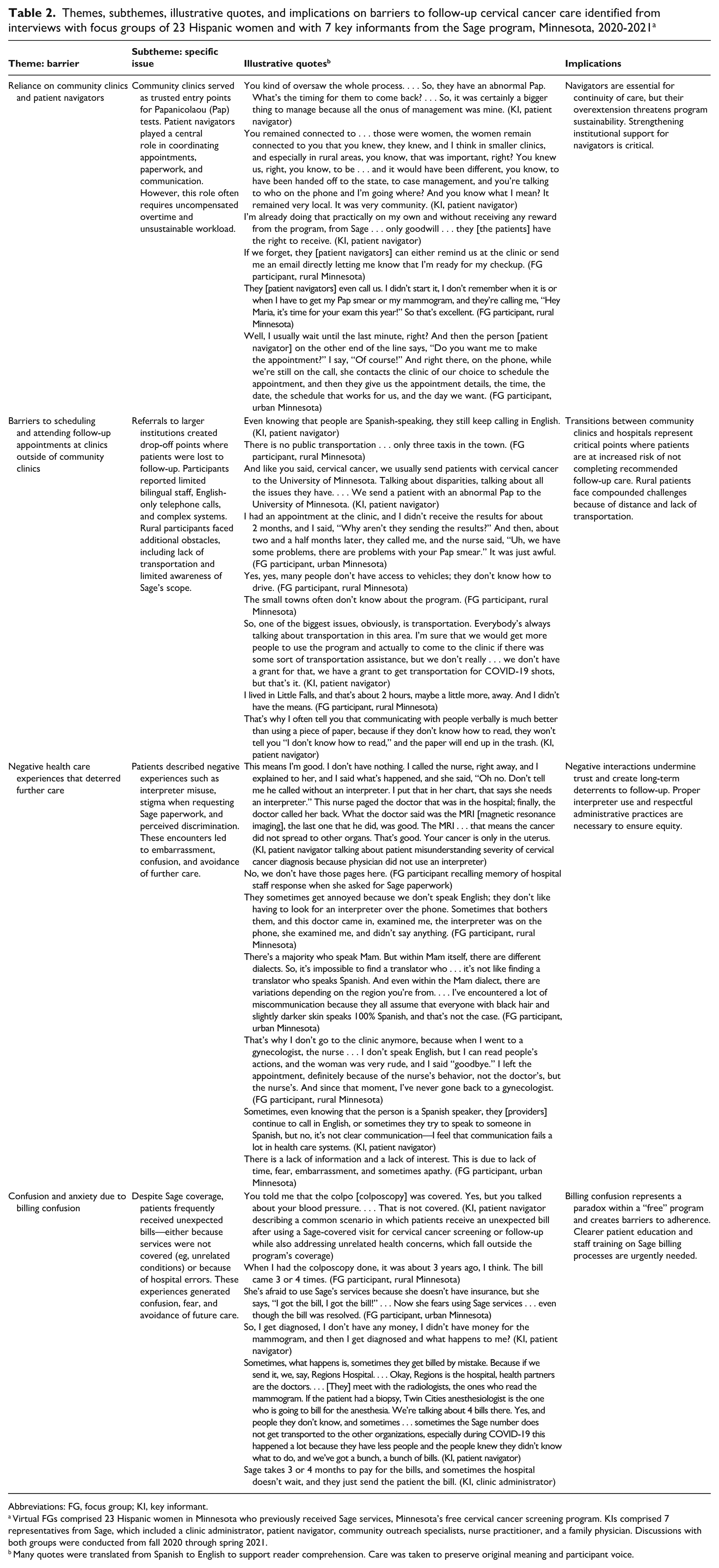
Abbreviations: FG, focus group; KI, key informant.
Virtual FGs comprised 23 Hispanic women in Minnesota who previously received Sage services, Minnesota’s free cervical cancer screening program. KIs comprised 7 representatives from Sage, which included a clinic administrator, patient navigator, community outreach specialists, nurse practitioner, and a family physician. Discussions with both groups were conducted from fall 2020 through spring 2021.
Many quotes were translated from Spanish to English to support reader comprehension. Care was taken to preserve original meaning and participant voice.
Reliance on Community Clinics and Patient Navigators
Community health clinics offering Sage services increased cervical cancer screening uptake among Hispanic women in Minnesota by reducing screening barriers through affordable services, having bilingual staff or interpreter access, and having patient navigators. Participants commonly reported that initial screenings, such as Pap tests, were routinely conducted at community clinics where staff were familiar with Sage and the necessary paperwork (Table 2).
Many community clinic administrators reported having someone who was almost exclusively dedicated to overseeing Sage cases and noted that this person was crucial in preventing loss of follow-up among Hispanic patients. Study participants highlighted the dedicated person’s role in scheduling follow-ups, handling communication, and resolving billing issues. However, dependency on patient navigators often led to a heavy workload for patient navigators outside of working hours, which was usually not compensated, raising concerns about sustainability. As noted by a key informant (a patient navigator), “I’m already doing that practically on my own and without receiving any reward from the program, from Sage.” In the social-ecological model, these examples of support reflected community- and organizational-level influences, where clinic infrastructure and sustained interpersonal support shape individual follow-up behaviors.
Barriers to Scheduling and Attending Follow-Up Appointments at Clinics Outside of Community Clinics
Participants noted that Pap tests were performed at community clinics; however, if further testing (eg, colposcopy) was needed after receiving abnormal results, patients were often referred to centers outside of community clinics. Participants described a sharp decline in support once referred to hospitals or specialists outside of their community clinics, as these centers often lacked bilingual staff or knowledge of Sage services (Table 2). Specifically, many focus group participants emphasized their preference for direct communication from community clinics, something that outside centers did not provide. Printed communication, often in English, placed the burden of navigating the system on the patient, whereas direct communication removed these barriers, facilitated scheduling and translation, and allowed immediate answers to questions. A key informant said, “That’s why I often tell you that communicating with people verbally is much better than using a piece of paper, because if they don’t know how to read, they won’t tell you ‘I don’t know how to read,’ and the paper will end up in the trash.”
Participants from rural areas listed more barriers to follow-up care than participants from urban areas, including transportation challenges and limited awareness of Sage services, which compounded barriers to accessing care (Table 2). In the social-ecological model, these barriers operated at the community/organizational and societal/structural levels, because institutional communication practices and access constraints directly affect a patient’s ability to engage in follow-up care.
Negative Health Care Experiences That Deterred Further Care
Past negative experiences, particularly misuse of interpreters (or forgoing an interpreter out of ease for the health care provider), miscommunication of results, and perceived stigma when requesting Sage paperwork, shaped participants’ willingness to pursue follow-up care (Table 2). One focus group participant described requesting Sage paperwork at a hospital and being met with disdain by the front desk: “No, we don’t have those pages here.” Many also reported embarrassment or fear of discrimination, leading to delayed or avoided appointments despite abnormal results.
Intertwined in many participants’ stories were examples of perceived bias against individuals because of their use of Sage services or their socioeconomic status. Despite differences in level of knowledge about Sage services, all participants agreed that negative past experiences during health care appointments deterred them from seeking future care (Table 2). In the social-ecological model, these experiences aligned with relationship-level influences, where interpersonal interactions in health care settings shape individual trust and willingness to pursue further care.
Frustration and Apprehension Due to Billing Confusion
Participants expressed confusion and anxiety about medical bills despite Sage covering the costs of all screening and diagnostic services (Table 2). Some participants received medical bills as a result of incidental findings not covered by Sage, whereas others were mistakenly billed by health care facilities unfamiliar with Sage processes and coverage, the latter occurring mostly when patients were referred to centers outside of their community clinics. Participants noted feeling stressed and shocked after they received unexpected bills for services that they believed were fully covered, which generated fear about pursuing follow-up care. Many participants also shared stories of friends or family members who had experienced similar billing issues, reinforcing apprehension toward the health care system. As explained by a focus group participant after her friend received a bill resulting from a Sage-covered diagnostic test, “I can’t explain why she got the bill and now she fears using Sage services. . . . There must be many who do not dare enter this service that is totally free for you.” These experiences eroded trust in the program and discouraged future follow-up, creating a paradox where a “free” service still generated financial fear. In the social-ecological model, this confusion reflected societal/structural-level influences, as program implementation and billing practices translated into individual-level fear and disengagement from care.
Discussion
This community-engaged study examined barriers to follow-up care among Hispanic women with low income and no health insurance in Minnesota’s Sage program after abnormal cervical cancer screening results. Although follow-up care guidelines recommend different procedures depending on individual risk and age,26,27 participants encountered persistent structural barriers despite the program covering the costs of screening and diagnostics under the NBCCEDP. This finding highlights a paradox in which free screening services do not necessarily guarantee equitable health outcomes.
Consistent with previous research, participants described how direct communication and patient navigation improved follow-up adherence.20,28-31 Several studies demonstrated that patient navigators reduce time to diagnosis and prevent loss to follow-up.23,29,32 Another study found that personalized telephone calls increase follow-up compliance by ensuring clear communication of results and the importance of follow-up. 33 Our results also confirmed that direct communication, especially personalized telephone calls from patient navigators, was more effective than written materials in supporting follow-up adherence and was perceived as personal, supportive, and actionable.28,31,33-35 Aguilar et al found that telephone counseling increases adherence to diagnostic recommendations, provides patient support, and helps patients navigate the follow-up process. 31 Our findings extend this previous work by showing that navigators in community clinics often fulfill these responsibilities without adequate compensation, creating unsustainable workloads.
As in a study of cervical cancer follow-up among Latina women in Montana, participants in our study also described inconsistent communication, confusion about coverage, and the loss of bilingual support once care was moved to centers outside their community clinics. 36 Both studies showed how structural and linguistic fragmentation across health care systems, rather than patient-level barriers, limit equitable outcomes, even in subsidized programs.
Our findings also aligned with a study by Guzman et al, who found that, although community health centers achieved high cervical cancer screening rates among migrant farmworkers, cervical cancer mortality in this population remained disproportionately high. 37 Together, our studies demonstrated a consistent national pattern: expanding screening access is insufficient without robust systems to ensure diagnostic follow-up, effective communication, and culturally responsive care.
Participants’ experiences further revealed how transportation, language, and administrative challenges collectively undermined follow-up care. Transportation and language barriers, commonly cited in the literature,23,28,35,38,39 were particularly prevalent among rural participants. Women described lack of public transportation, long distances, unfamiliarity with hospital locations, and reliance on others for rides, reflecting findings by Liang et al. 28 Language issues also persisted. Although prior studies have linked low education level to misunderstanding of cervical cancer screening results,40,41 our participants emphasized interpreter misuse and inconsistent bilingual communication as key drivers of confusion. This nuance highlights the role of institutional practices, rather than individual literacy, in perpetuating inequities.
Unlike many studies where lack of health insurance is a primary barrier,28,41,42 Sage eliminated this issue by covering the costs of screening and diagnostic services. However, participants reported fear of receiving unexpected bills as a result of hospital errors or uncovered incidental findings, which created apprehension to follow-up care comparable with health insurance barriers noted in other studies.28,41,42 This billing confusion, although not novel, remains a critical barrier to cervical cancer prevention. Similar confusion about coverage has been documented across screening for other cancers, including colonoscopy and mammography, where patients often misunderstand which services are classified as preventive, diagnostic, or therapeutic and, therefore, covered.43,44 These parallel findings suggest that billing-related uncertainty is a systemic challenge across preventive health care programs and undermines confidence in programs intended to remove financial obstacles. In addition, participants described perceived discrimination and stigma, commonly cited as a barrier to care,45,46 when requesting Sage services, suggesting that administrative practices themselves may reproduce inequity. Importantly, our findings illustrate how these concerns manifest in a state-administered cervical cancer screening initiative, highlighting opportunities for targeted program improvements.
Strengths and Limitations
This study had several strengths. First, we engaged Hispanic women from rural and urban areas of Minnesota, ensuring a diverse range of perspectives by age, education, and language ability. Second, the independence of our research team from Sage or the health systems providing Sage services fostered candid responses, and the inclusion of key informants offered multilevel insights into Sage operations. Third, conducting interviews in participants’ preferred language further strengthened data quality.
Our study also had several limitations. First, the sample size was small, which limited generalizability. Second, having virtual focus groups during the COVID-19 pandemic may have affected participation. Third, by focusing exclusively on Hispanic women in Sage, our findings may not extend to other populations or programs. Future studies should expand recruitment and consider in-person data collection to deepen engagement. Although the data were collected approximately 5 years ago, data captured experiences during a pivotal moment when the health care system was under strain from the COVID-19 pandemic and the Sage program was important. This timing provides insight into how systemic barriers persist even within a safety-net program during periods when access to care is fragile and patients experience reduced clinic availability, transportation barriers, financial instability, and racial and ethnic inequities.
Conclusions
Our findings underscore unique systemic failures—notably billing confusion under a free program and unsustainable reliance on overextended patient navigators. To improve patient experience and reduce cervical cancer mortality among Hispanic women in Minnesota, systemic reforms are needed. Expanding and adequately compensating patient navigator positions would ensure continuity of care without overburdening staff. Training hospital administrators and billing departments in Sage processes could eliminate billing confusion. Finally, consistent and appropriate interpreter use can prevent miscommunication and rebuild trust. Eliminating financial barriers at the policy level is insufficient unless implementation systems are also equitable, reliable, and culturally responsive.
Footnotes
Acknowledgements
The authors thank Annie-Laurie McRee, DrPH, University of Minnesota, for support as an academic mentor and the members of the Project Advisory Board for providing expertise in this project. We also thank the study members and key informants for offering their time and participation to allow this project to be completed.

Funding
The authors disclosed receipt of the following financial support for the research, authorship, and/or publication of this article: This work was supported by the University of Minnesota Program in Health Disparities Research (PHDR) Health Disparities Pilot Grant award HD20MCC02, which was administered by the University of Minnesota PHDR and funded by a National Institutes of Health Cancer Center support grant to the Masonic Cancer Center, University of Minnesota (P30 CA077598). Gabriela Bustamante’s research was supported by National Cancer Institute award T32CA163184 (for which Michele Allen, MD, MS, University of Minnesota, is principal investigator).
Declaration of Conflicting Interests
The authors declared no potential conflicts of interest with respect to the research, authorship, and/or publication of this article.
Disclaimer
The content is solely the responsibility of the authors and does not necessarily represent the official views of the University of Minnesota.