



Abstract
Objectives:
Homelessness is an important public health issue, and the number of individuals experiencing unsheltered homelessness has increased since 2020. On June 28, 2024, the US Supreme Court issued a 6-to-3 decision in City of Grants Pass v Johnson, which broadened the authority of local governments to prohibit public camping. The National Call Center for Homeless Veterans (NCCHV) offers a 24/7 virtual option for veterans to access services to address housing instability. The objective of this study was to assess whether expanded local enforcement authority affected inflow and characteristics of individuals contacting NCCHV after the Grants Pass decision.
Methods:
We used data from 418 814 contacts to NCCHV from January 1, 2023, through December 31, 2024. We conducted 3 types of analyses: (1) bivariate analysis comparing changes in contact characteristics using Wald χ2 tests, (2) direct comparisons of average weekly call volume using paired t tests, and (3) an interrupted time-series analysis using an autoregressive linear regression model.
Results:
While we did not observe seasonal variations in call volume, we found a significant increase in average weekly NCCHV call volume between the pre– and post–Grants Pass periods, from 3926.6 to 4394.8 calls (mean [95% CI] change in average weekly call volume: 468.2 [216.8-719.6; P = .005).
Conclusions:
This study provides an indication of the association between the Grants Pass decision and an increase in help-seeking behavior (potentially representing increased needs) among veterans experiencing housing instability. Future work should assess on-the-ground changes in the needs of individuals experiencing housing instability and responses offered by providers of homeless services.
Homelessness in the United States is a pressing and visible social challenge, characterized by fragmented policy responses, service delivery gaps, and intensifying public concern. The US Department of Housing and Urban Development’s 2024 Annual Homelessness Assessment Report to Congress 1 documented approximately 771 480 individuals experiencing homelessness nationwide at a single point in time, the highest figure since 2007. Nearly 45% of these people were unsheltered (ie, sleeping in locations not intended for human habitation) regardless of access to shelter services. Veterans are a particularly vulnerable subgroup in the homeless population1,2; they bear a substantial behavioral health burden 3 and have suicide rates roughly 1.5 times higher than nonveterans. 4 Policy shifts affecting unsheltered living conditions may have disproportionate consequences for their health and stability.
The association between unsheltered homelessness and poor health outcomes is consistent and strong, exacerbated by a lack of access to health care services. Unsheltered populations are more likely than housed or sheltered populations to experience chronic diseases, serious mental illness, and substance use disorders 5 ; unsheltered individuals have a standardized mortality ratio nearly 3 times higher than those in shelters. 6 Health care use among unsheltered populations remains low; unsheltered populations often lack health insurance, leading to untreated or poorly managed conditions. 5 Encampments (ie, informal clusters of tents or makeshift shelters inhabited by those who are otherwise unsheltered) are increasingly common in urban areas and pose serious public health risks but may provide residents with a sense of autonomy and community.7,8 However, these environments frequently lack basic sanitation and hygiene facilities, contributing to outbreaks of infectious diseases.9-11 Residents of encampments and other unsheltered settings also experience a high burden of chronic illness, mental health disorders, and food insecurity, compounded by disrupted health care access. 12
The legal landscape for unsheltered people was substantially shaped by the Ninth Circuit’s 2018 decision in Martin v Boise, which held that municipalities could not impose criminal penalties on homeless individuals for sleeping outdoors on public property when no alternative shelter was available. 13 The court found such enforcements to violate the Eighth Amendment’s prohibition against cruel and unusual punishment. Because Martin v Boise applied to Ninth Circuit states, including much of the West Coast, municipalities in these jurisdictions were legally constrained from enforcing camping bans when shelters were unavailable.14,15 This legal framework was fundamentally altered on June 28, 2024, when the US Supreme Court issued a 6-to-3 decision in City of Grants Pass v Johnson, overturning Martin. Originating in Oregon, the case centered on municipal ordinances that imposed fines and jail time for public camping. The Court ruled that such measures regulate conduct rather than status and do not contravene the Eighth Amendment. 16 This ruling substantially broadened the authority of local governments to prohibit public camping, even in the absence of available shelter beds. Supporters of the decision contend that it enables municipalities to address public safety and sanitation concerns by permitting enforcement of bans on sleeping and camping in public spaces. Many cities may now remove encampments more freely; however, without increasing shelter availability or support services, the underlying problem may persist or worsen.
Others have pointed out that Grants Pass merely allows local jurisdictions to determine whether and how to penalize individuals for public camping and sleeping on public property instead of having this decision made at the federal level. 17 States and municipalities may respond differently under the restored enforcement discretion following the Grants Pass decision; penalties for violating statutes about sleeping on public property vary from fines and fees (ie, treated as civil legal charges) to criminal charges. The literature has indicated that criminalization penalties do not reduce homelessness; rather, they can lead to displacement, trauma, arrest, and barriers to accessing care, substantially affecting mental and physical health outcomes for those affected. 18
Although homelessness among veterans has declined by 55% since 2009, the proportion of veterans who experience unsheltered homelessness increased from 33.1% in 2016 to 42.1% in 2022, heightening exposure to enforcement and service disruption.19,20 In response, the US Department of Veterans Affairs (VA) has emphasized low-barrier outreach strategies, including the National Call Center for Homeless Veterans (NCCHV), a 24/7 nationwide virtual triage service that provides direct linkage to housing, health care, and crisis support regardless of eligibility or location. NCCHV agents are VA staff who are trained to direct callers to VA and community-based services. From 2019 through 2023, 78.4% of 251 668 contacts were initiated by veterans, and 90.7% resulted in referral to a local VA medical center 21 ; earlier analyses (2018-2020) showed that most contacts were associated with increased engagement in VA homeless programs. 22
As a real-time nationwide point of contact, NCCHV call volume is a meaningful indicator of acute need and immediate public response to changes in policy and enforcement. NCCHV’s national reach and direct connection to service engagement make it a potentially valuable measure of change in needs among veterans experiencing housing instability following the Grants Pass decision. By using national VA data to analyze changes in call volume to NCCHV within the broader landscape of veteran homelessness, this study assessed whether expanded local enforcement authority affected inflow and characteristics of individuals contacting NCCHV after the Grants Pass decision.
Methods
Data Sources
We used data from contacts made to the NCCHV from January 1, 2023, through December 31, 2024. 21 We divided the observation period into four 26-week periods (designated time 1-4 [T1-T4]) (Figure 1). The pre–Grants Pass observation period includes T1, T2, and T3, comprising 18 months before the decision was made on June 28, 2024; the post–Grants Pass observation period includes T4, comprising 6 months following the decision. The 4 periods allowed assessment of seasonal comparisons within the pre–Grants Pass period (ie, comparing T1 and T3, which cover the first 6 months of the calendar year) and across the pre– and post–Grants Pass periods (ie, comparing T2 and T4, which cover the second 6 months of the calendar year). Details on construction of the cohort and relevant data sources are available elsewhere. 21
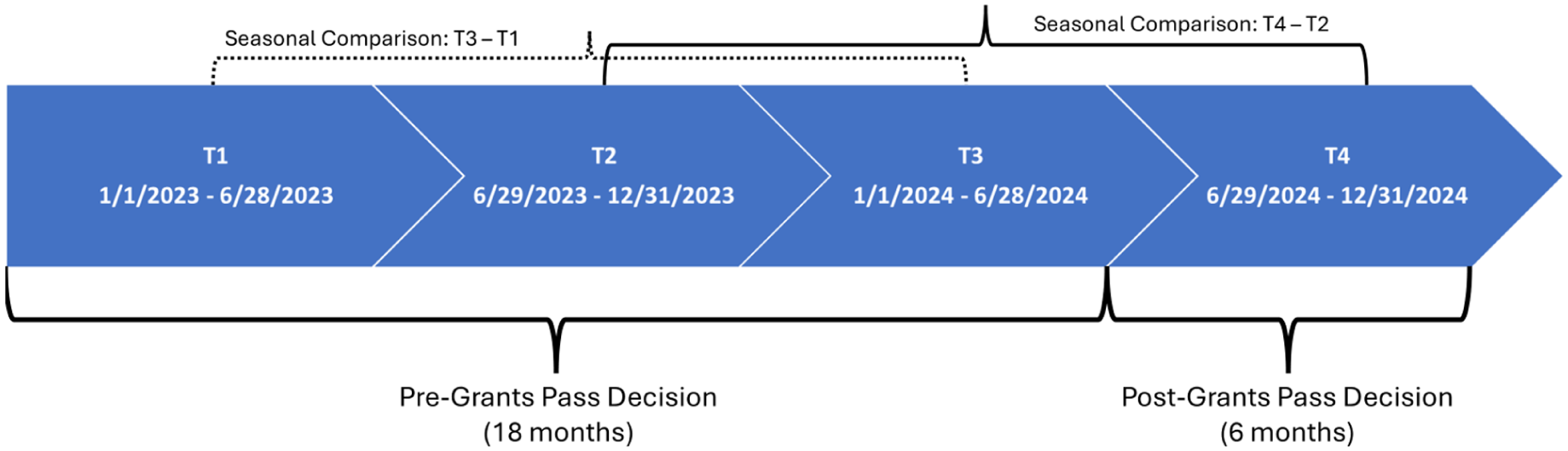
Observation periods for calls to the National Call Center for Homeless Veterans, United States. Time 1 (T1), time 2 (T2), and time 3 (T3) comprise the 18 months before the US Supreme Court’s June 28, 2024, 6-3 decision in City of Grants Pass v Johnson, and time 4 (T4) comprises the 6 months after the decision. The last weeks of T1 and T3 were 3 and 4 days (inclusive of all days) and business days (excluding weekend and public holidays, when the call center is not fully staffed and call volume is acutely lower), respectively. The last weeks of T2 and T4 were both 10 days but captured only 4 and 5 business days, respectively. Data source: contacts made to the National Call Center for Homeless Veterans from January 1, 2023, through December 31, 2024. 21
This project was reviewed and approved by the VA Central Institutional Review Board. In this retrospective study, all patient information was deidentified, and patient consent was not required. Patient data will not be shared with third parties.
Measures
The outcome of interest was call volume. We used a weekly, rather than daily, time frame to define call volume to avoid complex calendar adjustments, account for irregularities from weekends and holidays, and improve model stability. The main covariate of interest was the pre- and postdelineation of the Grants Pass decision. NCCHV data included information on the characteristics of each contact: the identity of the person making the contact (ie, veterans themselves or a family member or care provider) and the mode of contact (ie, telephone vs web chat). Veteran characteristics included age, sex, and the region from which the contact was made. Housing status represented the combination of 2 variables: (1) whether current homelessness or imminent risk of homelessness was reported by or on behalf of the veteran and (2) self-reported current living situation by or on behalf of the veteran (eg, unsheltered, sheltered, permanent housing). The data also included length of time homeless for those who self-reported current homelessness.
Analysis
We conducted 3 types of analyses: (1) bivariate analysis comparing changes in contact characteristics using Wald χ2 tests, (2) direct comparisons of average weekly call volume using paired t tests, and (3) an interrupted time-series analysis using an autoregressive linear regression model. For the first 2 analytic approaches, we descriptively assessed how contact characteristics may have been influenced by seasonal patterns versus longer temporal trends versus acute shifts. First, we compared contact characteristics by each of the 4 periods. We then compared average weekly call volume between T1 and T3 and then T2 and T4, which allowed us to directly account for seasonal trends without relying on any other model-based assumptions. Statistical significance was indicated by P < .05.
For the third analysis, we transformed our contact-level dataset into a week-level dataset. We then performed an interrupted time-series analysis using a linear regression, with the outcome being weekly call volume. The 2 predictor variables in the model were specified as time (in weeks) since the start of the observation period (January 1, 2023) and a dummy variable indicating whether the week was pre– or post–Grants Pass decision. The results from this initial model indicated that we needed to correct for autocorrelation (Durbin–Watson test, P < .001), so we used backward stepwise autoregression (AUTOREG procedure with BACKSTEP option specified, SAS Enterprise Guide 8.3; SAS Institute Inc) to select the appropriate autoregressive parameters. The selected autoregressive measures revealed short-term (2 w) and annual (52 w) autocorrelations. Using the same autoregressive approach, we split the variable measuring time (in weeks) into 2 variables: 1 representing time pre–Grants Pass and 1 representing time post–Grants Pass. This allowed us to assess any temporal trends in the 6 months post–Grants Pass that might signal a return to baseline.
Results
Characteristics of NCCHV Contacts by Observation Period
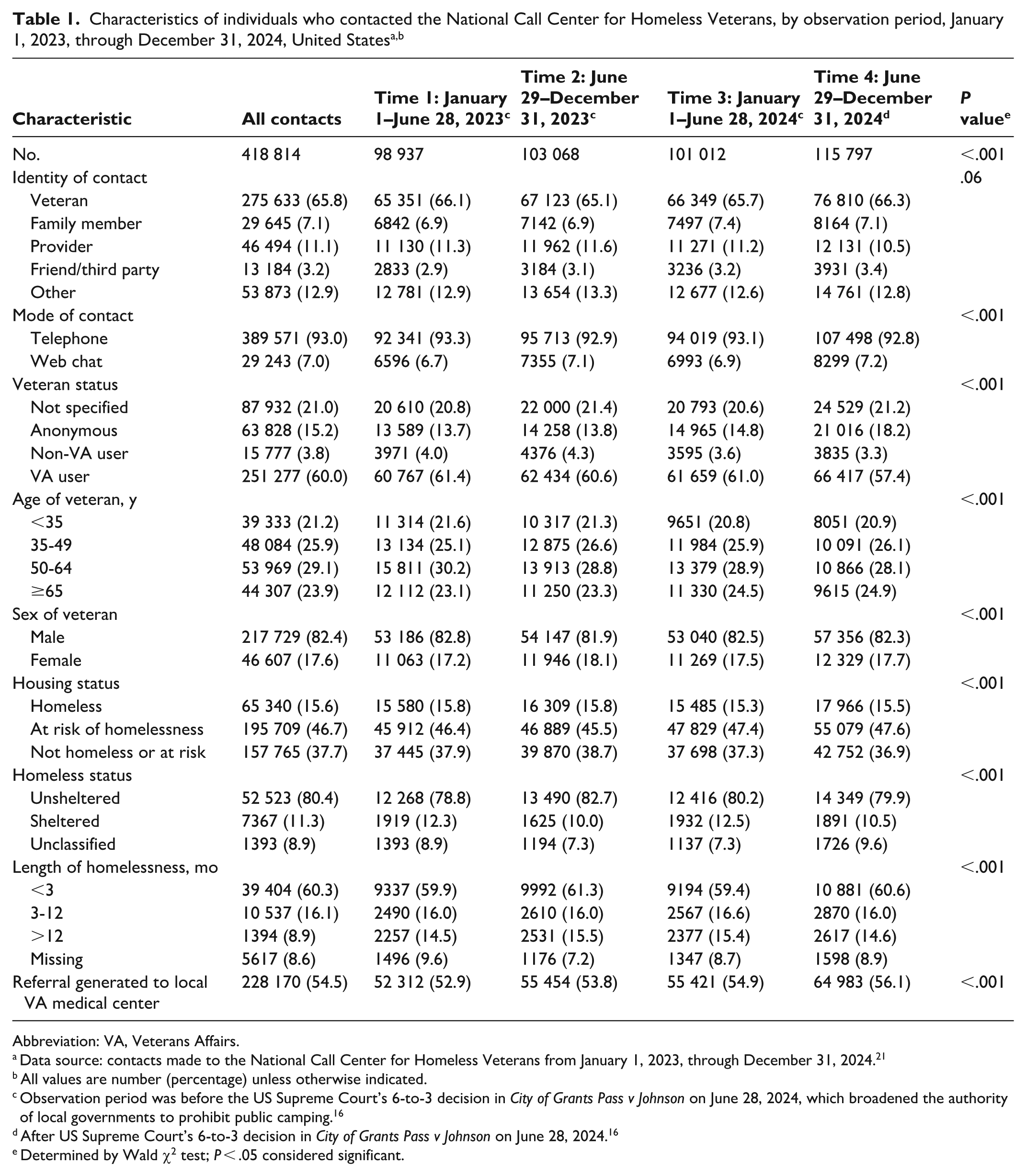
During the 2-year observation period, NCCHV received 418 814 contacts, most frequently from veterans themselves (65.8%) (Table 1); this frequency did not vary significantly over time. Although most contacts were made by or on behalf of a veteran who was engaged with VA care (60.0%), more than one-third of contacts were made by a veteran who remained anonymous or by a veteran or third party who did not specify a particular veteran (15.2% and 21.0%, respectively); we found an increase in the proportion of veterans who remained anonymous in T4/post–Grants Pass (18.2%) as compared with T1-T3/pre–Grants Pass (14.1% averaged). The age of veterans was split between those aged ≤49 and ≥50 years and most were male; although statistically significant, differences in the demographic composition of contacts over time were not substantive.
Abbreviation: VA, Veterans Affairs.
Data source: contacts made to the National Call Center for Homeless Veterans from January 1, 2023, through December 31, 2024. 21
All values are number (percentage) unless otherwise indicated.
Observation period was before the US Supreme Court’s 6-to-3 decision in City of Grants Pass v Johnson on June 28, 2024, which broadened the authority of local governments to prohibit public camping. 16
After US Supreme Court’s 6-to-3 decision in City of Grants Pass v Johnson on June 28, 2024. 16
Determined by Wald χ2 test; P < .05 considered significant.
At the time of their contact, the largest proportion of veterans reported being at risk of homelessness (46.7%) rather than experiencing current homelessness (15.6%); the remaining one-third of contacts were neither homeless nor at risk of homelessness (Table 1). Among contacts reporting homelessness, 80.4% were unsheltered, 11.3% were sheltered, and most had been homeless for <3 months; the proportion of contacts who were sheltered declined slightly over time. More than half of contacts received a referral to their local VA medical center; this proportion increased slightly over time.
Changes in Weekly Call Volume
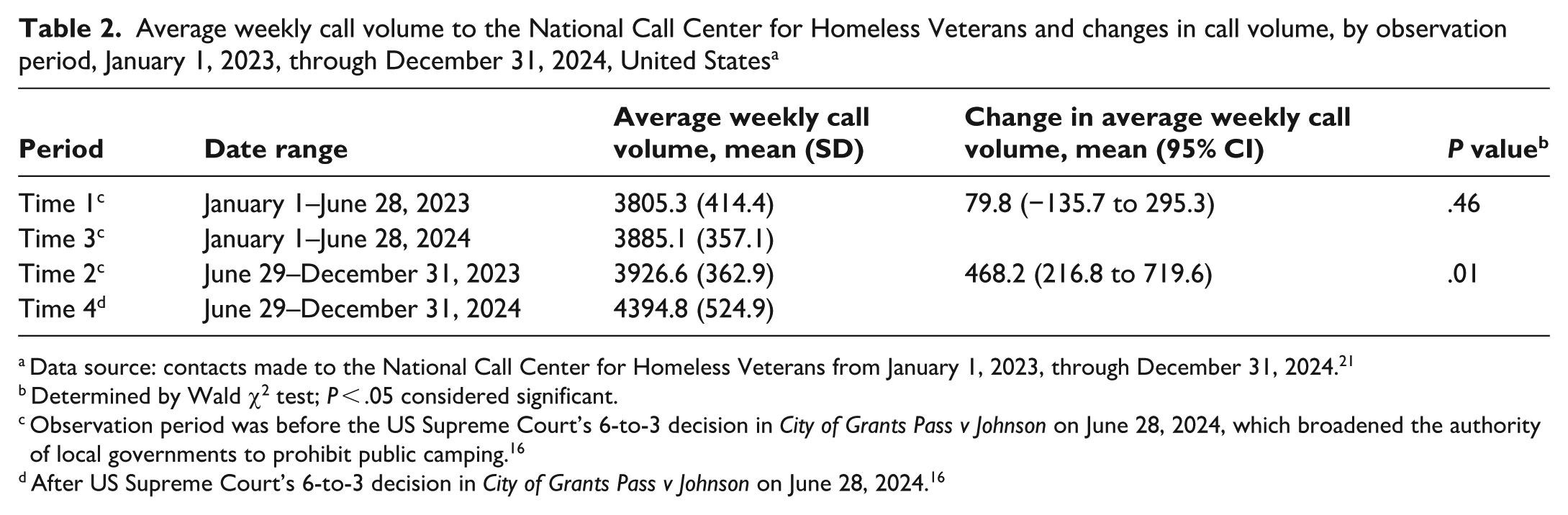
Descriptively, we did not observe a clear temporal trend in weekly average call volume during the pre–Grants Pass period (ie, from T1 to T2 to T3; n = 3805.3 vs 3926.6 vs 3885.1, respectively), but we did observe a distinct increase in the post–Grants Pass period (ie, T4; n = 4394.8) (Table 2). When we compared the average weekly call volume of T1 (3805.3) and T3 (3885.1)—which occurred during the first 6 months of 2023 and first 6 months of 2024—we did not observe a significant change in the average weekly call volume (95% CI, –135.7 to 295.3; P = .46). When comparing T2 and T4 (ie, last 6 months of 2023 and last 6 months of 2024), we observed a significant change in the average weekly call volume, from 3926.6 to 4394.8 calls (mean [95% CI] change in average weekly call volume: 468.2 [216.8-719.6]; P = .005).
Average weekly call volume to the National Call Center for Homeless Veterans and changes in call volume, by observation period, January 1, 2023, through December 31, 2024, United States a
Data source: contacts made to the National Call Center for Homeless Veterans from January 1, 2023, through December 31, 2024. 21
Determined by Wald χ2 test; P < .05 considered significant.
Observation period was before the US Supreme Court’s 6-to-3 decision in City of Grants Pass v Johnson on June 28, 2024, which broadened the authority of local governments to prohibit public camping. 16
After US Supreme Court’s 6-to-3 decision in City of Grants Pass v Johnson on June 28, 2024. 16
The results from the interrupted time-series analysis using an autoregressive linear regression model are similar to the results obtained from the paired t test approach (Figure 2). We found no overall temporal trend during the pre–Grants Pass period (ie, an increase of 0.78 calls per week; SE = 1.1; P = .49), while the weekly call volume increased by 484.7 calls (SE = 78.4; P < .001) during the post–Grants Pass period. When we examined the possibility of independent temporal trends pre– and post–Grants Pass, both of those variables had nonsignificant parameter estimates, indicating that no trend of increasing call volume occurred during the pre–Grants Pass period and that the call volume post–Grants Pass decision is not yet showing signs of returning to baseline (Figure 2).
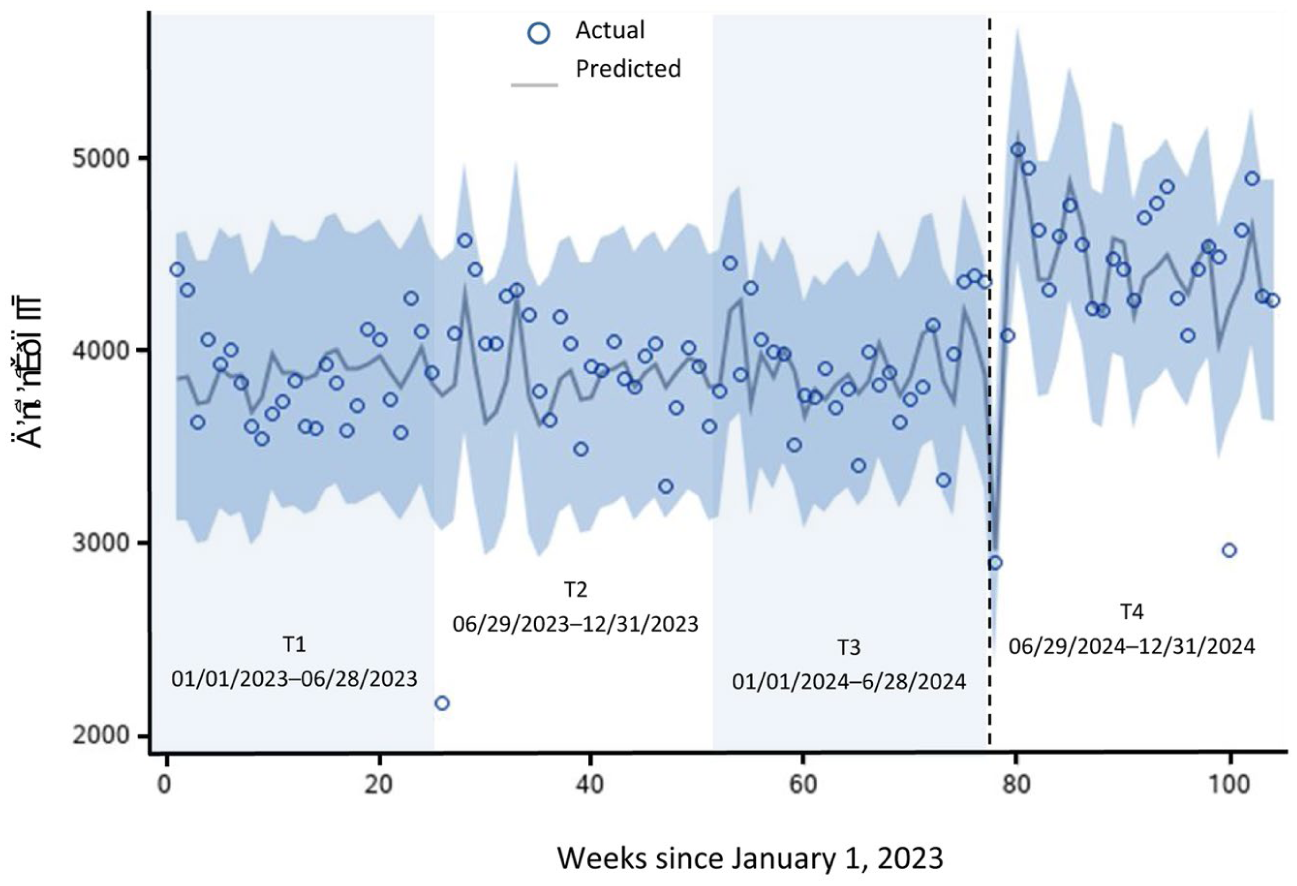
Interrupted time-series analysis depicting predicted and actual average weekly call volume to the National Call Center for Homeless Veterans from January 1, 2023, through December 31, 2024, United States. The vertical dashed line indicates the date of the US Supreme Court’s 6-to-3 decision in City of Grants Pass v Johnson, June 28, 2024, which broadened the authority of local governments to prohibit public camping. 16 Dark shading indicates 95% confidence limits. Data source: contacts made to the National Call Center for Homeless Veterans from January 1, 2023, through December 31, 2024. 21 Abbreviation: T1-T4, time 1-4.
Discussion
Our study assessed whether call volume to the NCCHV—a proxy indicating the need for housing-related assistance among veterans experiencing housing instability—changed following the Grants Pass decision by the US Supreme Court, which ruled that local governments may enforce public camping bans. While we did not observe seasonal variations in call volume, we did observe an increase in weekly NCCHV call volume between the pre– and post–Grants Pass periods. Specifically, a spike in calls to NCCHV during the post–Grants Pass period continued through December 2024, the end of our observation period. This spike may represent increased concerns and help-seeking behavior for assistance among veterans experiencing housing instability. While we could not determine whether this increased help-seeking was due to a perceived or actual impact of the Grants Pass decision, we surmised that at least some portion was due to increased concerns and preparation for possible changes in policies about unsheltered homelessness given the statistically significant and substantive increase in contact volume. Prior analyses demonstrated that NCCHV functions as an active gateway to housing and clinical services.21,22 Our findings provide early empirical evidence that a Supreme Court decision may be associated with measurable shifts in national help-seeking behavior among veterans, reflecting greater volume of contacts rather than changes in the composition of veterans seeking assistance, consistent with established epidemiologic patterns of veteran homelessness.20,23
In addition to increased needs of veterans experiencing housing instability, there may be a strain not only on the homeless services system in terms of providing sufficient shelter but also on the workforce responding to increasing calls and attendant referrals for health care and other services. Given the context of our study, responding to these needs may fall to the responsibility of the VA health care system, which does have a geographically comprehensive network of housing, health care, and other services in addition to NCCHV, such as Health Care for Homeless Veterans (https://department.va.gov/homeless/hchv). However, the VA does not operate in a silo but in partnership with thousands of community-based providers nationally, so the expiration of the federal Public Health Emergency for COVID-19 in May 2023, 24 which ended various forms of public health funding and policies, likely further strained resources and personnel. In addition, one study of VA homeless services providers during the post–COVID-19 pandemic period found high levels of reported stress and physical safety incidents. 25 Emerging research has also documented elevated levels of stress and safety concerns among VA homeless service providers in the postpandemic period, suggesting that increased call volume may intersect with workforce capacity challenges. 25
Our findings extend the literature by linking macro-level legal change to measurable shifts in help-seeking behavior in a national health care system. By leveraging national VA administrative data, our study provides early evidence that expanded enforcement authority may influence demand within federally operated housing and health care systems. Policy makers should therefore anticipate potential increases in service use following enforcement-related legal changes and align such authority with parallel investments in housing capacity, behavioral health services, and workforce stabilization, while integrating real-time administrative indicators—such as call center volume—into monitoring frameworks to guide responsive resource allocation and mitigate unintended consequences of enforcement-driven approaches. Future research should examine geographic heterogeneity in call patterns and longer-term trends beyond the immediate post–Grants Pass decision period, as well as downstream outcomes such as housing placement, health care use, and suicide-related indicators. Some concerted efforts to share effective practices and laws between regions and within VA catchment areas may be an important step in planning in the aftermath of the Grants Pass decision.
If increases persist in needs of unsheltered veterans and other adults, comprehensive strategies may be needed to increase housing options and offer mental health and substance use treatment that are provided in ways that align with current legal frameworks. Importantly, our findings suggest that enforcement authority alone does not eliminate demand for services; rather, it may shift demand toward centralized entry points such as NCCHV. This shift may be apparent, but what is less apparent is how such a response would be established in different jurisdictions based on local contexts. With a patchwork of different legal statutes by jurisdiction that may occur as a result of the Grants Pass decision, people experiencing homelessness, as well as housing and health care providers, may be confused about the rules and how they may affect working with neighboring communities to develop comprehensive strategies to meet the needs of unsheltered individuals. This confusion may be particularly impactful for VA, which operates a national health care network comprising veterans and various types of providers (ie, homeless services, health care, social work) at local facilities that must abide by local laws on public camping.
Limitations
Several limitations must be noted. First, our study assessed only 1 intervention (NCCHV) for a particular population (veterans). Although the intervention covers the entire US geography and is available for veterans and VA- and community-based homeless services and other providers, regardless of eligibility, veterans are a unique population whose needs may differ from those of populations such as families with children. Second, confounding events that affected help-seeking behaviors, including reductions in public health funding, may have occurred during the study period. Third, given that the analyses conducted for our study were largely observational, we cannot infer causality.
Conclusions
Our study indicates an association between the Grants Pass decision and an increase in help-seeking behavior (potentially representing increased needs) among veterans experiencing housing instability. Future research should continue to assess on-the-ground changes in the needs of individuals experiencing housing instability and the responses offered by providers of homeless services to address those needs and how that may vary geographically.
Footnotes

Funding
The authors disclosed receipt of the following financial support for the research, authorship, and/or publication of this article: This work was supported by the US Department of Veterans Affairs, Health Systems Research (IIR-22-048).
Declaration of Conflicting Interests
The authors declared no potential conflicts of interest with respect to the research, authorship, and/or publication of this article.