



Abstract
The aim of this pioneering study was to define and describe motivation for the acquisition of interlanguage pragmatic competence. Interlanguage pragmatic motivation was investigated from two perspectives: (1) general pragmatic motivation, displaying L2 learners’ motivation to acquire pragmatic strategies, pragmatic routines, politeness strategies, turn-taking patterns, and cultural familiarity; and (2) speech-act-specific motivation, representing learners’ motivation to acquire the pragmalinguistic forms and sociopragmatic norms of performing speech acts. Seventy-five EFL learners were studied using two pragmatic motivation questionnaires and a discourse completion task. The relationships among the general pragmatic motivation, speech-act-specific motivation, and pragmatic production were then investigated. The findings showed that EFL learners are highly motivated to learn English language pragmatic features from both motivational perspectives. Further analyses revealed that the learners fell short of having satisfactory L2 pragmatic production. Regression equations revealed that speech-act-specific motivation has the explanatory power of predicting pragmatic production in EFL learners but general pragmatic motivation does not manifest such an influence on L2 learners’ production. It is concluded that high general pragmatic motivation does not necessarily correlate with better pragmatic production.
Keywords
Introduction
The issue of individual differences has been explored as an indispensable aspect of second language acquisition (SLA). Among individual variables, motivation for language learning has been considered as an important area of inquiry. This personality factor indicates that learners differ in the degree of their impetus for the learning of a second/foreign language. A great number of studies have investigated the role of motivation in SLA (e.g. Dornyei, 1990, 2001; Kramsch, 2001; Oxford and Shearin, 1994; Shumann, 1998). However, the role of motivation in the acquisition of interlanguage pragmatics has only recently been investigated, and a few studies have been conducted in this regard (Cook, 2001; LoCastro, 2001; Niezgoda and Rover, 2001; Tagashira et al., 2011; Takahashi, 2001, 2005). These studies investigated the relationship between general language learning motivation and the acquisition of interlanguage pragmatics (ILP). They measured general language learning motivation using questionnaires in which integrative, instrumental, intrinsic, and extrinsic types of motivation were the main constructs (e.g. Schmidt et al., 1996). These constructs deal with the reasons for learning a second/foreign language, particularly grammar and vocabulary, personal goals, attitudes toward language class and language teacher, anxiety, learning preferences, and even learning strategies. However, no study has ever been reported about the motivation for the acquisition and development of pragmatic competence and its components. In other words, learners’ motivation for the acquisition of language functions, speech acts and their realization patterns, pragmalinguistic forms, and sociopragmatic norms have never been investigated. Thus, it is necessary to investigate a new construct which accounts for motivation for the acquisition of L2 pragmatics so that we will be able to describe and measure such a construct among EFL learners and its impact on pragmatic acquisition.
Literature Review
One of the factors that influence ILP acquisition is individual differences. In SLA literature, many studies have confirmed the relationship between SLA and individual variables such as age, gender, language aptitude, intelligence, self-esteem, anxiety, learning styles, and motivation (e.g. Arnold, 1999; Dornyei, 2005; Dornyei and Skehan, 2003; Horwitz, 2001; Kiss and Nikolov, 2005; Oxford, 1995, 1999; Robinson, 2002). One of the individual differences discussed in SLA is motivation. Research has shown that individual differences also influence ILP acquisition and development (Hassall, 1997; Kerekes, 1992; Kim, 2000; Niezgoda and Rover, 2001; Siegal, 1994). Therefore, motivation, as an individual difference, plays an important role in the process of ILP acquisition. However, only a few studies have investigated the relationship between motivation and ILP acquisition.
Takahashi (2001, 2005) investigated the relationship between Japanese EFL learners’ motivation for language learning and their processing of L2 pragmatic input. She made use of a modified version of the motivation questionnaire developed by Schmidt et al (1996). There were 47 items in the questionnaire that measured the EFL learners’ intrinsic motivation, extrinsic motivation, personal goals, anxiety, expectancy/control, attitudes, and motivational strength. The participants had to complete the motivation questionnaire and take a general English proficiency test. They were also required to complete a pragmatic awareness questionnaire following the treatment they received. The results indicated that there was a strong correlation between motivation, particularly intrinsic motivation, and pragmatic awareness.
Cook (2001) studied polite speech styles among Japanese EFL learners. The learners were required to listen to some speeches to find the right person who was polite enough for an advertised job position. It was observed that the same EFL learners who were taught by the same instructor differed in their understanding and discrimination of polite from impolite styles of speech. This difference was then attributed to the learners’ motivation for language learning. It was concluded that motivation, particularly intrinsic motivation, may lead to sociopragmatic awareness.
LoCastro (2001) investigated the relationship among attitude, learner self-identity, and willingness to accommodate to L2 pragmatic norms among Japanese EFL learners. The data were collected through focus group discussions, reaction papers, essays on exams, and a modified version of the attitude and motivation questionnaire already developed by Baker (1992). The results of the study indicated that motivation, along with some other individual differences, influences learners’ desire to gain an understanding of native speaker standards.
Niezgoda and Rover (2001) studied the effects of learning environment and proficiency on Hawaiian ESL and Czech EFL learners’ pragmatic awareness. The data were gathered through a videotape and a questionnaire that required the learners to select the appropriate response based on the video. The results showed that Czech EFL learners had more pragmatic awareness than the ESL group. Niezgoda and Rover believe that this significant difference can be attributed to the fact that the Czech students were highly motivated due to their participation in a competitive program.
Tagashira et al. (2011) investigated the relationship between motivation and pragmatic awareness among 162 Japanese university EFL learners. In order to measure the learners’ language learning motivation, the authors adapted Hiromori’s (2004, 2006) questionnaire with 18 items based on the constructs of intrinsic motivation, identified regulation, introjected regulation, external regulation, and amotivation. The learners’ pragmatic awareness was also measured using the questionnaire developed by Bardovi-Harlig and Dornyei (1998). The EFL learners were then categorized as moderately motivated group, self-determined motivation group, amotivated group, and externally regulated motivation group. The results suggested that EFL learners’ pragmatic awareness differed depending on their motivation and that more self-regulated learners were more aware of L2 pragmatic features.
It is noteworthy that all the above-mentioned studies investigated the relationship between language learning motivation in general and ILP acquisition. Hence, they do not account for EFL learners’ motivation specific to pragmatic acquisition. In other words, the above-reported studies did not describe language learners’ specific motivation to acquire and develop pragmatic competence and its components. Moreover, no findings have been reported about the motivation for the acquisition and development of speech acts and their realization patterns, pragmalinguistic forms, and sociopragmatic norms. Thus, it is important to investigate and model the construct of pragmatic motivation and to describe and measure its impact on pragmatic acquisition among EFL learners.
Purpose of the Study
The aims of this study were to investigate the construct of general and speech-act-specific pragmatic motivation and to measure its effect on pragmatic production. Therefore, the following research questions were formulated:
What is the construct of general pragmatic motivation and speech-act-specific motivation among EFL learners?
What is the status of general pragmatic motivation and speech-act-specific motivation among EFL learners?
Does general pragmatic motivation predict EFL learners’ pragmatic production?
Does speech-act-specific motivation predict EFL learners’ pragmatic production?
Methodology
Participants
The participants of the study were 75 university students chosen randomly from among intermediate EFL learners. They all took a standardized test of English proficiency that included three sections of grammar, vocabulary, and reading comprehension. The participants were also interviewed and rated based on Brown’s (2001) five-component model. Next, they were assigned to three levels in terms of their average score (0-33=Level C or ‘Elementary,’ 34-66=Level B or ‘Intermediate,’ and 67-100=Level A or ‘Upper-intermediate’). The total number of female participants was 40, whereas male participants were 35 in number. Their age range was between 18 and 46, with the average of 27.77. Nearly all participants had already received an average of four years of formal English instruction in institutes and universities. None of the participants had been to a foreign country for more than three weeks, and they all spoke the same first language. The participants were majoring in Law, Graphics, Engineering, and Financial Management from whom Level B students were selected.
Instruments
The first step in developing an instrument to measure pragmatic motivation was to review the SLA literature on motivation and ILP. Based on the review, the construct of pragmatic motivation was defined as the driving force to acquire L2 pragmalinguistic and sociopragnatic competencies, i.e. the impetus to learn the appropriate use of L2 in real-world situations, appropriate L2 pragmatic strategies, L2 speech acts and their appropriate realization patterns and production, L2 politeness strategies, and L2 pragmatics routines. Next, this type of motivation was operationally defined and realized into two types of questionnaires.
General Pragmatic Motivation Questionnaire (GPMQ)
The general pragmatic motivation questionnaire, composed of 42 items, focused on the motivation for the learning of L2 pragmatics. Thus, cultural familiarity, politeness strategies, familiarity with speech acts and situations, and strategies for meaning conveyance were investigated through different items on a five-point Likert scale, ranging from ‘strongly agree’ to ‘strongly disagree.’ The items checked whether the learners were motivated to focus on such important aspects of language use, or they were just motivated to add to their knowledge of vocabulary and grammar. The questionnaire was developed for the first time; therefore, it was piloted on 300 EFL learners, and then factor analyzed. The Cronbach alpha internal consistency reliability of the questionnaire was found to be .86.
Speech-act-specific Motivation Questionnaire (SASMQ)
The speech-act-specific motivation questionnaire focused on the motivation for three speech acts of request, refusal, and apology. It consisted of 20 items in three separate sections: five items tested the motivation to make requests; six items measured the degree of motivation to make refusals, and nine items tested motivation to apologize. The rationale behind the construction of the items was to measure EFL learners’ motivation for the acquisition of speech acts. That is, the items checked whether the EFL learners were motivated to use whatever knowledge of words and structures they possessed to produce the three speech acts appropriately. These items investigated the EFL learners’ motivation for the acquisition and development of many sociopragmatic and pragmalinguistic features necessary for performing the speech act. Thus, the participants had to read every item of the questionnaires and mark their response on a five-point Likert scale, ranging from ‘strongly agree’ to ‘strongly disagree.’ This motivation questionnaire was piloted on 300 EFL learners and then factor analyzed. The Cronbach alpha internal consistency reliability of the questionnaire was .94.
Written Discourse Completion Task (WDCT)
The written discourse completion task consisted of 15 situations, focusing on three speech acts of request, refusal, and apology. The production of each speech act was measured through five situations. The situations were adapted from previous studies (Beebe et al., 1990; Hill, 1997; Hudson et al., 1995; Jianda, 2006; Suh, 1999; Takahashi, 1998, 2001). However, certain factors were taken into account in selecting the situations, such as the real-life occurrence of the situations, the frequency of occurrence, and the generalizability of the situations. Therefore, topics such as teacher-student interaction, campus life, and even the workplace were abundant among the situations. The situations were written in Standard English using comprehensible vocabulary and structure so that the participants could easily read and comprehend them. In cases where there were some difficult or unfamiliar words or structures, the meaning, synonym, or paraphrase was provided in parentheses. Another criterion for the selection of the situation was the sociolinguistic variables, namely status (social dominance), degree of familiarity (social distance), and degree of imposition and severity. These variables are based on Brown and Levinson’s (1987) Politeness Theory.
Data Collection
Data collection was conducted in four subsequent sessions. All the applicants had to take a proficiency exam and a structured interview. Based on their test scores, they were assigned to an intermediate level (Level B). Therefore, from among all Level-B EFL learners, 90 were chosen randomly, but the number of the participants was reduced to 75. The first session was the introduction session. The participants were asked to fill out a demographic survey. Then, in the next three sessions, they were required to complete the questionnaires of the study.
Data Analysis
Since there were three instruments in this study, there were different types of analyses. Both general and speech-act-specific motivation questionnaires were on a five-point Likert scale, so they were scored from 1 to 5. Skewness and kurtosis were calculated to investigate whether the questionnaires and the WDCT items fell within the normal range. A factor analysis was applied to investigate the construct of the two questionnaires. Regression analysis was done to measure how well general pragmatic motivation and speech-act-specific motivation could predict pragmatic production.
As far as the rating of the situations in WDCTs is concerned, the researchers employed a six-point rating scale developed by Taguchi (2006). In this rating scale, scores for appropriateness range from 0 to 5. The scale embodies the appropriate use of linguistic expressions, proper level of directness, proper level of politeness, pragmalinguistic accuracy, and sociopragmatic aspects of speech act production in assigning scores. Appropriateness in this scoring rubric deals with the appropriate performance of speech acts in a social context, which includes pragmalinguistc and sociopragmatic considerations (Kasper, 1992).
Results
The Construct of Pragmatic Motivation
The first research question was concerned with the construct of general pragmatic motivation and speech-act-specific motivation among EFL learners. To address the question, a factor analysis was run.
Factor Analysis of General Pragmatic Motivation Questionnaire (GPMQ)
The factor analysis was carried out, using a principal component analysis with oblique rotation (N=300). To determine the number of factors to be extracted in the general pragmatic motivation questionnaire, a few points were taken into consideration to ensure that the minimum eigenvalue was 1.0, that each factor accounted for at least 2.5% of the total variance, and that the minimum loading of every item on each factor was .30.
As a result, 12 factors were obtained which accounted for 61.43% of the total variance in the learners’ general pragmatic motivation (Table 1). Among the 12 factors, factor 1 had the largest variance (V=16.66), whereas factor 12 had the smallest variance (V=2.51). The items loaded on the following components:
Psychological Barriers: Psychological hindrances to second language comprehension and production.
Cultural Familiarity: Familiarity with English culture, or awareness of L2 socio-pragmatic and socio-cultural norms.
Appropriacy: The appropriateness of language use in terms of situations and social variables.
Situational Acquisition: Acquisition of second language components (grammar, vocabulary, intonation, etc.) and communication strategies based on situations and language functions.
Difficulty in Language Use: The challenges and difficulties in the process of language use and meaning exchange.
Real-World Language Use: The desire to use recently acquired language components (grammatical structures, vocabulary items, etc.) in real-life communication.
Turn-Taking: The motivation to learn English turn-taking patterns.
Language Forms: Learning language use in terms of language forms.
Meaning Conveyance: The process of conveying meaning and intention.
Language Use Context: The interlocutors’ understanding of the situations and contexts in which language performance occurs.
Communication Needs: Real-life communicative needs.
Indirect Language Use: Learners’ motivation for the indirect use of language.
Cronbach Alpha, Questionnaire Items, and Factor Loadings of the Items for Each Subscale of GPMQ

Factor Analysis of Speech-act-specific Motivation Questionnaire (SASMQ)
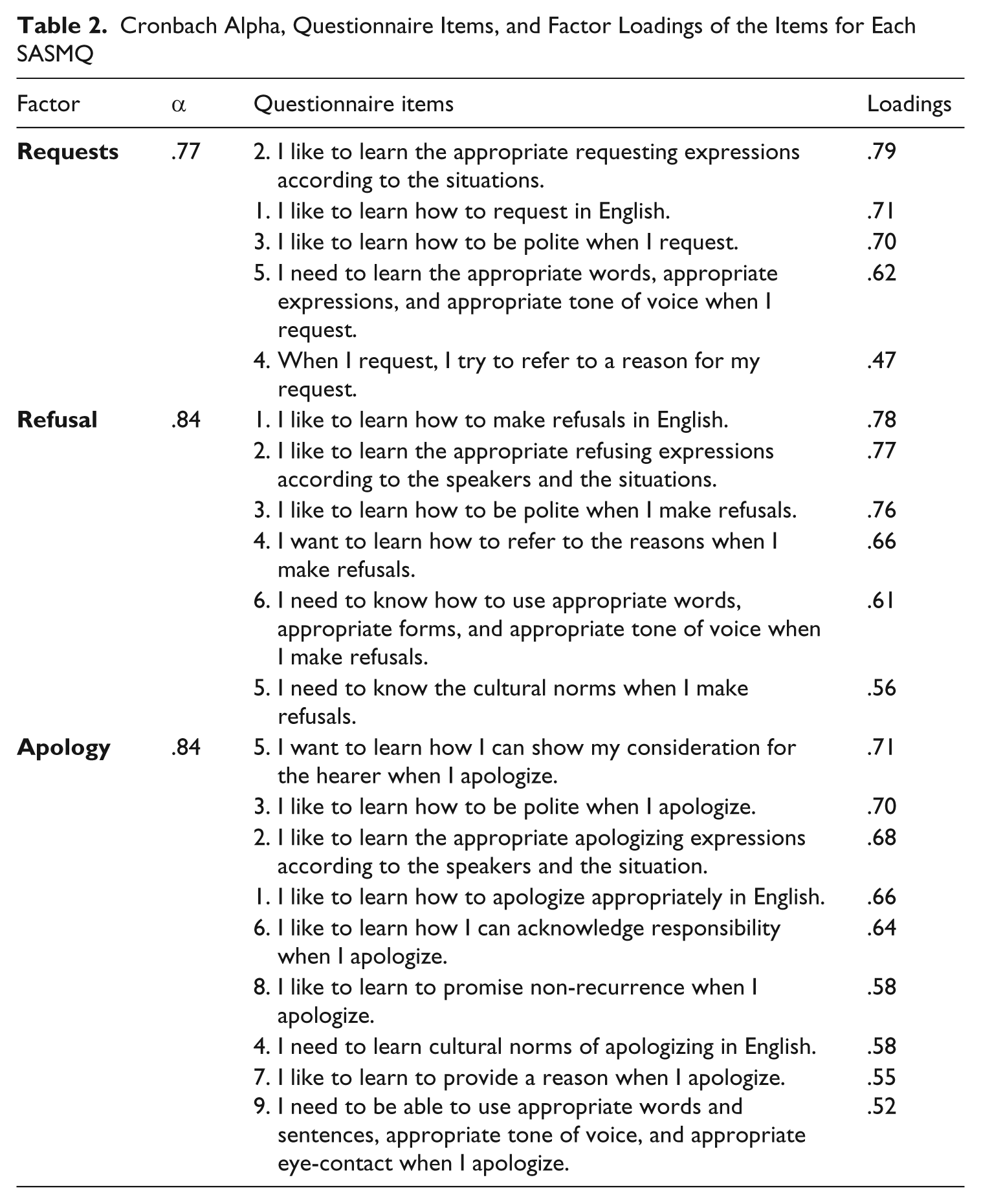
To determine the number of factors to be extracted in all SASMQs, the minimum eigenvalue was 1.0, each factor accounted for at least 2.5% of the total variance, and the minimum loading of every item on each factor was .30. In Request-SASMQ, one factor was obtained which accounted for 55.61% of the total variance. In Refusal-SASMQ, one factor was obtained which accounted for 56.77% of the total variance. Finally, in Apology-SASMQ, like the other two speech acts, one factor was obtained which accounted for 46.27% of the total variance. As a result, it was observed that every subsection (Request-SASMQ, Refusal-SASMQ, and Apology-SASMQ) loaded on one factor only, which confirms specific motivation for performing any of the speech acts. Table 2 shows factor loadings and Cronbach alpha internal consistency reliability for the three subsections.
Cronbach Alpha, Questionnaire Items, and Factor Loadings of the Items for Each SASMQ
EFL Learners’ Pragmatic Motivation
The second research question was, ‘What is the status of general pragmatic motivation and speech-act-specific motivation among EFL learners?’ To address it, every participant’s response to each item of the two types of questionnaires was analyzed. To this end, descriptive statistics were calculated (Table 3). The total mean of the general pragmatic motivation questionnaire was 3.71. In the general pragmatic motivation questionnaire, among the 42 items, item 28 had the highest mean of 4.43. To check the reliability of the questionnaire, Cronbach’s alpha was run, and the reliability coefficient was observed to be high enough (r=.87). To ensure normality, skewness and kurtosis analysis was also run. By checking the skewness and kurtosis values for the questionnaire, its skewness and kurtosis indices were found to be within the normal range: -.39 and .98, respectively. Since the questionnaire was on a 5-point Likert scale from ‘strongly agree’ to ‘strongly disagree’ and the mean score on the questionnaire was 3.71, it can be concluded that the participants of the study were highly motivated to acquire interlanguage pragmatics. An analysis of every item of the questionnaire revealed that the mean scores in 12 items were 4 and/or more than 4. These 12 items were mostly among the items loading on factors 3, 4, 5, 6, 7, and 9. The highest mean among the items (item 28, with a mean score of 4.43) indicated that the students were highly motivated to learn L2 turn-taking patterns.
Descriptive Statistics for General Pragmatic Motivation

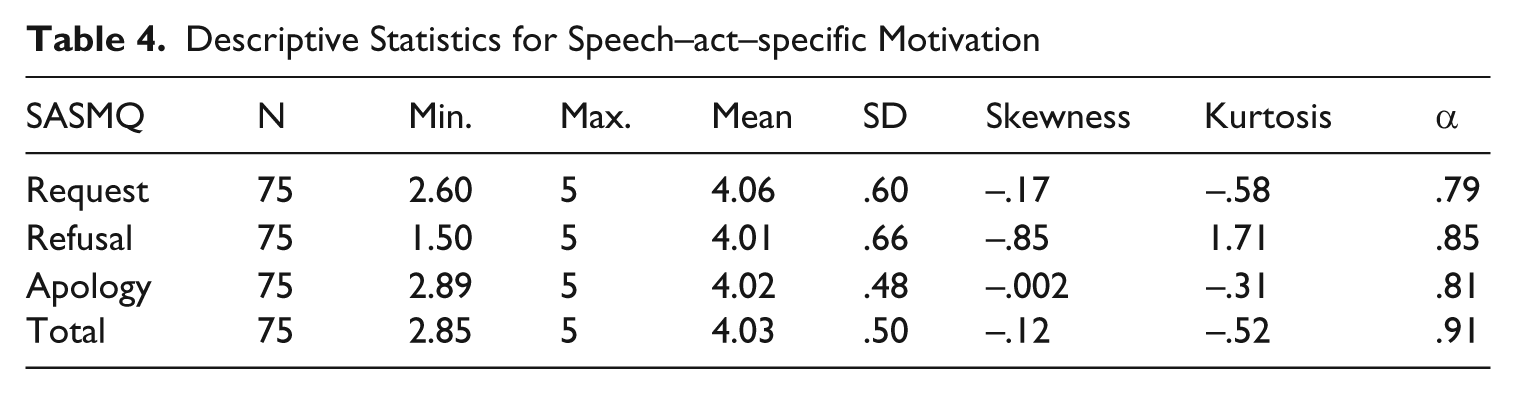
As far as the speech-act-specific motivation questionnaire is concerned, the same descriptive statistics were calculated to explore EFL learners’ motivation for every speech act of request, refusal, and apology (Table 4). The first subsection of the speech-act-specific questionnaire, ‘Request-SASM,’ included 5 items with a mean of 4.06. The results showed EFL learners’ high motivation to learn and use this specific speech act. The item with the highest mean was the first item, implying a high level of motivation to acquire pragmalinguistic forms of requests. As far as skewness and kurtosis are concerned, they fell within the normal range, which documents the normality of the distribution. The reliability of the subsection was also high, as Cronbach’s alpha displayed a coefficient of .79. Statistics for the ‘Refusal-SASM’ questionnaire showed a mean of 4.01, proving learners’ high motivation to acquire and use the speech act of refusal appropriately. Among the six items, item 3 represented the highest mean (4.2), which means that EFL learners had a high level of motivation to get familiar with politeness strategies and the sociopragmatic norms of making refusals. With regard to the last subsection of motivation for the speech act of apology (Apology-SASM), the observed mean was 4.02. This, again, indicates that learners were highly motivated to learn how to produce apology appropriately in L2. Among the 9 items, item 1 has the highest mean, showing that appropriateness is a language use factor that EFL learners are highly motivated to acquire. In this questionnaire, item 8 had the highest standard deviation. The distribution was seen to be normal since skewness and kurtosis values did not fall beyond +/-2. As with the reliability of the questionnaire, Cronbach’s alpha showed a high degree of reliability, with an index of .81. Adding the three subsections of questionnaires together, speech-act-specific motivation as a construct was also investigated. The total mean was seen to be 4.03, which indicates high speech-act-specific motivation among the participants. The whole speech-act-specific motivation questionnaire was analyzed for reliability and Cronbach’s alpha was observed to be .91. Table 4 summarizes the descriptive statistics for SASMQ.
Descriptive Statistics for Speech–act–specific Motivation
Predicting Pragmatic Production Based on GPM
To see how well general pragmatic motivation can predict pragmatic production, data collected from written discourse completion tasks (WDCT) were first rated by one of the two researchers based on a 6-point Likert scale. Then to ensure the reliability of the participants’ scores on pragmatic performance, 20% of the WDCTs were rated by an educated native speaker of English who was already trained to rate the WDCTS based on the framework. The reliability index showed a consistency of .83 between the researcher’s rating and the native speaker’s. Therefore, every participant’s score in each situation and speech act was calculated. To check the reliability of WDCT, Cronbach’s alpha was run, and the reliability coefficient for the total WDCT was observed to be high [r=.92]. To ensure normality, skewness and kurtosis analysis was also run, indicating the normality of the distribution. Table 5 shows the descriptive statistics for pragmatic production.
Descriptive Statistics for WDCT
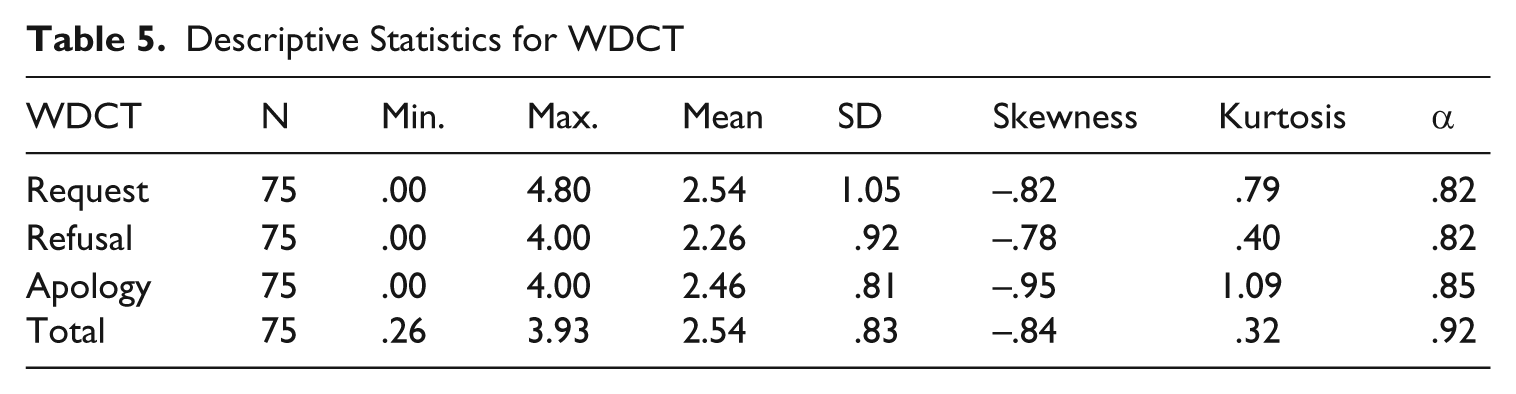
As it is displayed, the mean score was 2.54 in request, 2.26 in refusal, 2.46 in apology, and 2.54 in the total pragmatic production. This shows that EFL learners’ performance on WDCT was only slightly above 2.5. It means that the participants were not good at performing the three speech acts of request, refusal, and apology, although their scores ranged from 0 to 4.8; that is, they lacked the necessary sociopragmatic and pragmalinguistic knowledge to perform the speech acts.
The next step was to run a regression analysis to see whether pragmatic production could be predicted based on general pragmatic motivation. In this analysis, general pragmatic motivation was considered constant (predictor) and the three speech act productions were dependent variables. Therefore, first, regression was run for general pragmatic motivation as the predictor and production of request as the dependent variable. As Table 6 displays, the participants’ general pragmatic motivation could not predict their production of the speech act of request [β=.06, t(75)=.52, p<.01]. General pragmatic motivation explained a very small proportion of variance in request production in that the amount of variance overlap between GPM and production of request speech act was very low [R2=.06]. As with the other speech acts, it was observed that GPM could not predict EFL learners’ production of the speech act of refusal either [β=.04, t(75)=.36, p<.01]. The proportion of the variance explained by general pragmatic motivation was very low as well [R2=.04]. Still another regression analysis had the same results too. No predicting power was found in general pragmatic motivation with regard to the production of apology [β=-.10, t(75)=-.92, p<.01]. R squared was not high [R2=.10], indicating that general pragmatic motivation can only explain 10% of the variance. The last analysis was a regression between GPM and total pragmatic production, which confirmed that GPM cannot predict pragmatic performance [β=-.002, t(75)=-.02, p<.01, R2=.002].
Regression for General Pragmatic Motivation and Pragmatic Production
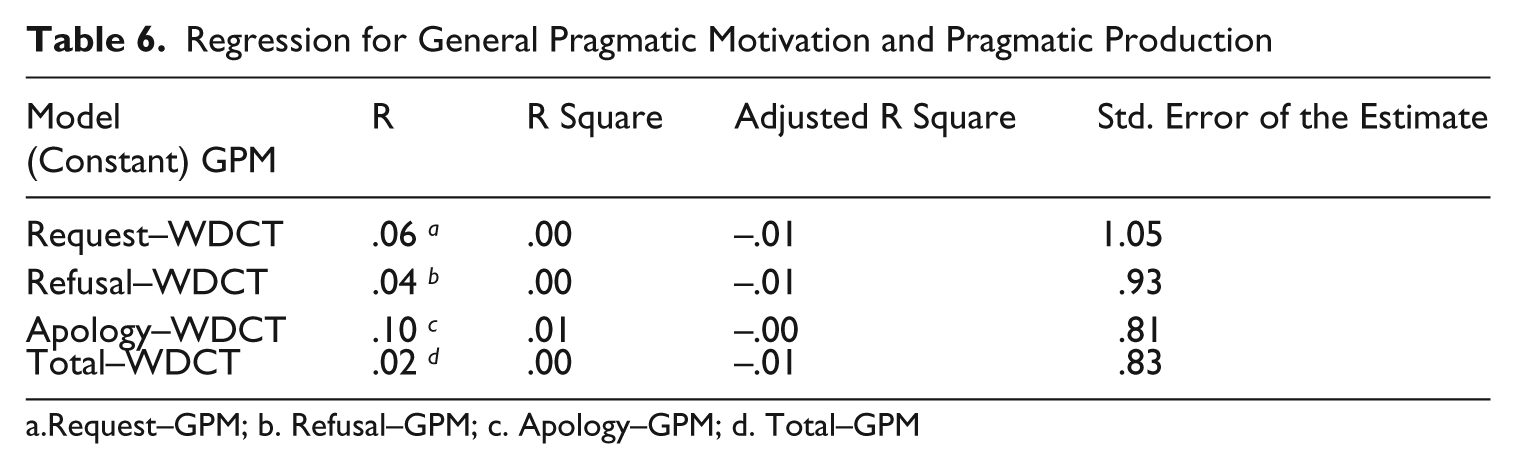
Request–GPM; b. Refusal–GPM; c. Apology–GPM; d. Total–GPM
Predicting Pragmatic Production Based on SASM
To investigate whether speech-act-specific motivation can predict pragmatic production, another regression was conducted. Since every speech act had a corresponding motivation questionnaire, regression was conducted for every speech act and the total construct. As Table 7 indicates, the participants’ motivation for the speech act of request (predictor) predicted their production of the speech act of request to a small degree [β=.23, t(75)=2.09, p<.01]. Speech-act-specific motivation explained some proportion of variance in request production, which is evident in the amount of variance overlap between Request-SASM and the production of the speech act of request [R2=.05]. Regarding the other speech acts, it was observed that Refusal-SASM could predict EFL learners’ production of the speech act of refusal to some degree [β=.27, t(75)=2.45, p<.01]. The proportion of the variance shared by Refusal-SASM and refusal production was small [R2=.04]. The regression between motivation for apology and production of apology was not significant. No prediction power was found in Apology-SASM with regard to the production of apology [β=.10, t(75)=.86, p<.01]. R squared was not high [R2=.01]. The last analysis was a regression between total speech-act-specific motivation and total pragmatic production, which confirmed that speech-act-specific motivation has the power of predicting pragmatic performance [β=.29, t(75)=2.64, p<.01, R2=.08]. A comparison between speech-act-specific motivation and general pragmatic motivation and their relationships with pragmatic performance revealed that motivation for a certain speech act can tell us more about one’s pragmatic production of that specific speech act. This means that pragmatic production is more dependent on speech act and its realization strategies than other pragmatic features tested through general pragmatic motivation.
Regression for Speech–act–specific Motivation and Pragmatic Production
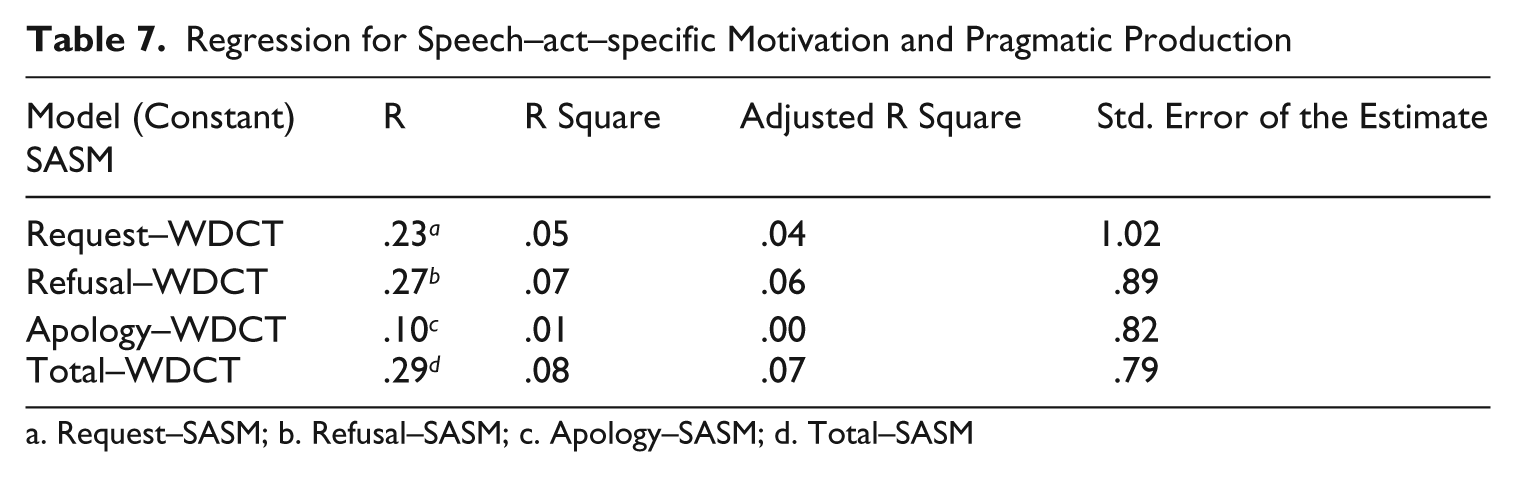
Request–SASM; b. Refusal–SASM; c. Apology–SASM; d. Total–SASM
Discussion
This study documented salient findings. First, it was found that there is a construct called ‘pragmatic motivation’ that accounts for learners’ motivation for the acquisition of pragmatic competence, including speech acts and their realization patterns, pragmalinguistic forms, and sociopragmatic norms. That is, pragmatic motivation represents learners’ desire to use second/foreign language appropriately in real-life communication, to get familiar with L2 culture, and to know about L2 social variables such as power, imposition, and familiarity. This construct is totally different from the construct of motivation as discussed in the SLA and ILP literature. In fact, none of the previous views of motivation (social-psychological model, Gardner and Lambert, 1972; cognitive-situated model, Crookes and Schmidt, 1991; process-oriented model, Dornyei, 2001) accounted for language learners’ motivation for the acquisition of pragmatic competence. These models of motivation have focused on some dichotomous categorizations such as intrinsic vs. extrinsic and integrative vs. instrumental since the 1950s. All these typologies mainly encompass learners’ reasons and goals for learning a language (e.g. to pass exams, to find a job, to travel abroad, to immigrate, and to make friends), their attitudes toward the second/foreign language (e.g. because a famous actor speaks English this language is the favorite language), their language learning anxiety (e.g. being afraid of speaking), their learning preferences (e.g. preference to work alone, not in pairs), and their learning strategies (e.g. memorizing grammar rules).
The literature on ILP reveals that, up to the present, in all those few studies that investigated the relationship between motivation and ILP (Cook, 2001; LoCastro, 2001; Niezgoda and Rover, 2001; Tagashira et al., 2011; Takahashi, 2001, 2005) motivation has been considered as a purely psychological trait with a focus on the degree of intrinsic/extrinsic motivation, anxiety, attitude, expectancy, personal goals, etc. However, acquisition of ILP deals with L2 use. Thus, the type of motivation that accounts for ILP acquisition must deal with some pragmatic aspects of L2 acquisition. Therefore, it can be claimed that pragmatic motivation is not a purely psychological trait; rather, it refers to a practical type of motivation that is psychopragmatic in nature that accounts for language learners’ motivation for the acquisition of L2 use and the appropriate use of their L2 linguistic resources.
Second, pragmatic motivation can be discussed in two levels of general and speech-act-specific. This dichotomy is parallel to Bachman’s (1990) dichotomous categorization of pragmatic competence: sociolinguistic and illocutionary competence. That is, General Pragmatic Motivation (GPM) can describe the motivation for the acquisition of sociolinguistic competence, whereas Speech-act-specific Motivation (SASM) is able to explain the motivation for the acquisition of illocutionary competence. As it was found, GPM loaded on 12 factors. This shows that EFL learners base their acquisition of L2 use and their appropriate use of L2, i.e. their L2 pragmatic knowledge, on 12 factors. The first factor includes the barriers to L2 use. This shows that even EFL learners with high linguistic competence feel worried about their lack of pragmatic competence; they feel afraid or even embarrassed when it comes to L2 use. This means that EFL learners suffer from a type of anxiety toward L2 use, but not toward L2 learning in general, in that they lack L2 pragmatic knowledge. Some learners have not acquired L2 pragmatic knowledge, and others do not have the necessary strategies to use their knowledge of the second/foreign language. The second factor highlights the motivating role of L2 culture in the acquisition of L2 use. This means that getting familiar with L2 culture and its socio-cultural norms motivates EFL learners to acquire appropriate L2 use. The third and the fourth factors emphasize the appropriacy of L2 use and the role of situations. It can be claimed that appropriacy of L2 use is a motivating factor for language learners and that the appropriate use of L2 is based on the situations in which the conversation occurs. It can also be added that the acquisition and appropriate use of language components (i.e. language forms) depends on the situations. This highlights the significance of sociopragmatics in building up one’s knowledge of L2 pragmatics. Difficulty in language use is the fifth factor which indicates the challenges that learners come across in their L2 use. The sixth factor reveals the learners’ intention to use whatever resources they have acquired. This means that the acquisition of L2 vocabulary, grammar, pronunciation, and other language components is considered pragmatically. The other six factors underlying general pragmatic motivation reveal the motivation for the acquisition of L2 use strategies based on communication needs and contexts. They show that EFL learners have a desire to learn the strategies to take turns and convey their meaning indirectly, for instance.
These 12 factors can also be categorized under three headings: (1) the desire to gain an awareness of the second culture (socio-cultural norms), (2) the desire to learn language components based on the situations in which the communication occurs, and (3) the desire to use language appropriately, naturally, and strategically. This last issue refers to some sub-constructs such as meaning-conveyance, sociolinguistic variables (power, distance, imposition), politeness strategies, turn-taking patterns, implicature, as well as psychological barriers and challenges in the process of language use. Thus, it can be argued that the four abilities underlying sociolinguistic competence − i.e. ‘sensitivity to differences in dialect or variety,’ ‘sensitivity to differences in register,’ ‘sensitivity to naturalness,’ and ‘sensitivity to interpret cultural references and figures of speech’ (Bachman, 1990: 95-98) − are all inherent in the construct of GPM.
Speech-act-specific motivation, on the other hand, represents learners’ specific motivation for the acquisition of pragmalinguistic forms, sociopragmatic norms, and the cultural aspects of performing speech acts. SASM describes learners’ communication needs and goals. In other words, SASM accounts for the learners’ tendency to acquire form-function relationship, cultural norms of speech act performance, and the ability to interpret the illocutionary meaning of the utterances. It shows that the factors that EFL learners take into account for the acquisition of one speech act are different from those for another speech act. That is, while their main focus is on the pragmalinguistic forms of performing the speech acts of request and refusal, EFL learners consider sociopragmatic norms as the main factor in performing the speech act of apology. It follows that SASM represents the motivation for the acquisition of illocutionary competence, as proposed by Bachman (1990).
The third finding of the study revealed that EFL learners were highly motivated to acquire and develop L2 pragmatics. This seems reasonable because EFL learners in this study had already spent seven years at secondary school to acquire and develop English vocabulary, reading, and grammar, but not language use. They did not know how to refuse an invitation, for instance, although they had already acquired the words and structure(s). Therefore, the first thing EFL learners are motivated to acquire is how to use language appropriately. Their high pragmatic motivation can be a strong impetus for their noticing ability, which can be scaffolded by more pragmatically competent learners or teachers. As far as the two types of pragmatic motivation are concerned, it was found that EFL learners’ speech-act-specific motivation is greater than general pragmatic motivation. This indicates the importance of speech acts and form-function relationships to EFL learners, who need to acquire both pragmalinguistic forms and sociopragmatic norms to be able to communicate in a second/foreign language.
The fourth finding of the study shed light on EFL learners’ pragmatic production. It was found that EFL learners lack necessary L2 pragmatic knowledge; they are not aware of L2 pragmatic features, resulting in inappropriate use of language. One reason is lack of necessary interactions in many EFL contexts; EFL learners are not exposed to the authentic use of the target language. There are other reasons for their high motivation but low awareness of ILP as well. As mentioned before, there is no focus on language use in their school and even university syllabi; as a result, EFL learners do not receive any instruction on ILP and are not exposed to L2 use. There is also the problem of generalizing linguistic forms, lexical items, and sociopragmatic norms in different situations by EFL learners due to L1 transfer, resulting in inappropriate L2 use. Therefore, EFL learners’ general pragmatic motivation cannot be indicative of their pragmatic knowledge, particularly their pragmatic production.
The last finding of the present study revealed that speech-act-specific motivation can predict EFL learners’ pragmatic production to a small degree, despite the fact that their general pragmatic motivation does not reveal anything about their current level of pragmatic knowledge. The reason is that both speech-act-specific motivation and pragmatic production largely hinge upon speech acts as an important aspect of ILP. However, general pragmatic motivation encompasses pragmatic factors other than speech acts. It follows that the probability of predicting pragmatic production based on the motivation for that speech act is higher.
Conclusions and Implications
Several conclusions can be drawn from the present study. First, language learners possess a specific type of motivation for the acquisition of interlanguage pragmatics, called pragmatic motivation, which refers to two interrelated types of motivation: general pragmatic motivation and speech-act-specific motivation. This newly investigated construct differs from general language learning motivation and does not consider language learners’ motivation for the acquisition of the second/foreign language as a whole. However, pragmatic motivation describes various aspects of pragmatic competence development.
Second, EFL learners are strongly motivated to acquire and develop English pragmatic features, i.e. their pragmatic motivation is high; however, they do not have the necessary pragmatic knowledge. This indicates that EFL learners are able to identify their real communication needs; they know that knowledge of vocabulary and grammar does not guarantee the appropriate use of language. Nevertheless, they lack the necessary ability for language use, while they may be good at the four skills, for instance.
Third, predicting EFL learners’ pragmatic production based on their speech-act-specific motivation is somehow possible since both pragmatic production and speech-act-specific motivation focus on learners’ illocutionary competence, i.e. language functions and speech acts. On the other hand, predicting pragmatic production based on general pragmatic motivation is largely impossible. To sum up, it can be concluded that high pragmatic motivation does not necessarily imply high pragmatic ability.
This study has a number of implications for motivation research, acquisition of interlanguage pragmatics, EFL teachers, and materials developers. As far as the theories of motivation are concerned, pragmatic motivation must be considered as a type of motivation which brings about individual differences among language learners. Thus, this type of motivation can be investigated, compared, and contrasted with other types of motivation. It also helps researchers have a better account of the process of second/foreign language acquisition. With regard to the acquisition of interlanguage pragmatics, the study highlights EFL learners’ need to acquire and develop interlanguage pragmatics. The study clarifies the importance of speech acts, together with their realization strategies. It manifests the significance of both sociopragmatics and pragmalinguistics. As with language teachers, they must consider the importance of L2 pragmatic features for such highly motivated EFL learners; they need to include ILP instruction in their teaching practice. However, dealing with highly motivated L2 pragmatics learners requires EFL teachers to use authentic materials. That is, necessary materials must be developed and authentic materials must be selected to improve EFL learners’ pragmatic competence. In line with the general relationship between motivation and noticing, it must be noted that a high level of pragmatic motivation indicates a high level of pragmatic noticing. Thus, appropriate selection and development of materials, along with ILP instruction, will lead to EFL learners’ noticing of pragmatic features which, in turn, results in the acquisition of interlanguage pragmatics.
Footnotes
Funding
This research received no specific grant from any funding agency in the public, commercial, or not-for-profit sectors.