



Abstract
The paper proposes a new conceptual perspective for understanding students’ engagement in L2 learning, in particular the concept of interest development in learning English. It investigates situational features that trigger interest in learning English, employing data from interviews with non-native English speaking students studying in TESOL programmes. Students were invited to reflect on critical moments which triggered their interest in learning English. These events were discussed in terms of three temporal stages: sources of interest in early years (primary), in teenaged years (secondary) and in adulthood (university and work). The findings show that what triggers interest is not just the ability to imagine and predict the vision of the future but the reimagining or revisioning of the past or one’s ability to postdict the past event in accordance with the present experience. It is not just the value of English (i.e. a property of topic or topic interest) per se that triggers interest but how its value is presented and experienced. For interest to be triggered, English must be presented or experienced in such a way that it creates surprise, unexpectedness, and encourages post-hoc understanding of the importance of English and one’s past interaction with English.
Keywords
Introduction
The global spread of English and ELT has led to new conceptual lenses offered to explain the complex English language learning experiences in various contexts. The notion of motivation is no longer adequate for many emerging experiences in diverse contexts. For example, ‘investment’ is proposed as an alternative to ‘motivation’ to explain the complex learning profile of adult immigrants in Canada (Norton, 2000; Peirce, 1995). Kramsch (2009), referring to formal language education that takes place in schools and universities, proposes the notion of ‘desire’ in language learning as ‘symbolic identification with the Other’ (Kramsch, 2009: 206) with manifestation of ‘human emotions, fantasies, and dreams beyond communicative success or professional benefit’ (Kubota, 2011: 486). On the other hand, referring to adult Japanese learners learning English in informal settings, Kubota (2011) proposes a new concept of learning English as ‘consumption’ rather than ‘investment’. Learning a foreign language, in particular English, can be ‘a lifelong hobby driven by intellectual curiosity’ (Kubota, 2011: 475), or a pursuit of ‘casual’ or ‘serious leisure’.
Although those various concepts with their emphasis on the affective and emotional rather than the cognitive aspect of motivation contribute to our understanding of complex language learning experiences in informal contexts, their application is limited in many formal educational settings where English is learned as a school subject, as a requirement rather than as an object of desire or personal choice. Emotion, devoid of cognition, found in such concepts often accounts for the absence of language development found in some studies. For example, Piller and Takahashi (2006: 59) note that a ‘desire’ for English demonstrated among Japanese females, is not linked to ‘success in a straightforward fashion’ and ‘the link may even be negative’. Similarly, Kubota (2011: 486) notes that a desire for English is linked with ‘maintaining rather than developing’ the language skills and knowledge.
Despite these limitations, these various concepts have invited the rethinking of the traditional concept of ‘motivation’, which often becomes a vague concept as it is used as a broad ‘umbrella’ term to explain so many variables and motives that underline the reasons for human behaviour. Motivation is ‘a complex, multi-dimensional construct’ (Dörnyei et al., 2006: 27) and used to ‘explain nothing less than the reasons for human behaviour’ (Dörnyei et al., 2006: 9). However, as researchers in recent years have contested, the complex ‘reasons for human behaviour’, in particular reasons for learning English in the globalized world, require new conceptual dimensions and alternatives.
This paper proposes that the concept of interest, which has been central to educators’ thinking about learning, is a pedagogically valuable alternative lens that could enrich our understanding of students who have studied English as a formal school subject and have developed an interest in learning English as a foreign/second language. This understanding could help educators to stimulate and sustain student interest for optimal learning. Interest combines both affect and cognition and is shown to have the ‘energizing function’ for deeper learning, a desired goal in many educational contexts (Del Favero et al., 2007: 636).
Rethinking ‘interest’ in Learning English
With the global spread of English as an international language, many students around the world learn English as part of their school curriculum and formal education. While some learn English because they are required to do so, others engage in the activity of learning English motivated by interest or develop interest as they engage in the learning task.
Although the term ‘interest’ appears in many discussions of L2 learning, often as a synonym for intrinsic motivation, it has not been separately investigated in L2 learning research. Interest, however, has received increasing attention in educational psychology and is now widely recognized as an important motivational variable that leads to deep learning. The literature on interest and interest studies has been conducted with reference to various subjects such as mathematics and science. However, there is a dearth of interest-focused studies in the discipline of L2 learning. Renninger and Hidi (2011) contend that given disciplinary differences between domains, it is important to investigate the development of interest in different types of disciplines. The present study explores an alternative perspective to understanding students’ engagement in L2 learning by applying findings and concepts from various interest studies in educational psychology. In particular, it explores the construct of ‘interest’ with reference to learning English as perceived by a group of non-native English speaking students, considering what situational features may have caused the emergence and triggering of interest in learning English. First, it is necessary to examine the ‘interest’ construct and its features proposed in educational psychology.
Defining ‘interest’
In educational psychology, interest is widely recognized as a critical motivational variable that influences learning and achievement (e.g. Del Favero et al., 2007). Among many variables that make up ‘motivation’, interest is one of the set of important motives that may result in intrinsically motivated behaviour. Many researchers identify interest as ‘a unique motivational variable’ or ‘a motivational variable with a difference’ (e.g. see Hidi, 2006), requiring separate attention of its own. Recent research on interest in learning is increasingly being used to complement research on motivation in mainstream education (e.g. Nolen, 2007).
With reference to language learning, ‘interest’ is ill-defined: it sometimes appears as a synonym of ‘intrinsic motivation’ or ‘inherent curiosity’ (Crookes and Schmidt, 1991; Dörnyei, 1994) and is often likened to liking and enjoyment. Drawing on interest research in educational psychology, a conceptualization of interest is now timely to complement L2 motivation research especially the ‘motivation’ theory itself has undergone many changes in recent years. Several unique features of interest identified by various researchers are described below:
Interest arises from interaction between a person and an interest object. This interaction is both a cognitive and affective process featured with focused attention, affect and concentration (e.g. see Hidi and Renninger, 2006). The amount of affect and cognition one experiences varies depending on the level of interest development. The interactive view of interest development indicates that interest is also content-specific. Rather than being globally interested, people have interest in some activity, task, subject, or topic (e.g. see Hidi, 2006). It also indicates that the development of interest may include both intrinsic and extrinsic motivational components and that it is inappropriate to describe interest as either intrinsic or extrinsic (Hidi, 2000).
Interest can be constructed as both a predisposition and a psychological state. A person may engage in an activity with interest acting as a predisposition, or may experience interest as a psychological state generated by both task and predisposition. A person may not always be metacognitively aware of interest being triggered during a particular task if he/she is so absorbed, although it may be possible to reflect on the sources of interest at a later stage (e.g. see Krapp, 2005; Renninger and Hidi, 2011).
Two types of interest have been proposed by interest researchers: situational and individual (e.g. Hidi and Anderson, 1992). Situational interest is temporary and context-specific and is often triggered by the attractive, novel and stimulating aspects of an object or environment. Individual interest, on the other hand, is a relatively stable predisposition to attend to and reengage with particular objects, ideas, events, or activities. Individual interest develops slowly over time and is associated with deepening of personal value, knowledge and positive emotions attached to the interest object. Situational interests become vehicles for more stable individual interests.
Similar distinctions have been made between ‘interestingness’ and ‘interestedness’ (Frick, 1992), or between ‘cognitive interest’ and ‘emotional interest’ (Kintsch, 1980). Cognitive interest is a type of situational interest (interestingness), resulting not from the type of topic or event but from the cognitive processing of information in the text or event. Emotional or topic interest (interestedness) is caused by ‘reasons such as preference or usefulness of a topic’ and ‘is usually paired with knowledge (or belief) about the topic’ or ‘preference about a topic’ (Campion et al., 2009: 3). Cognitive or situational interest has received increased attention because of its value for educators. Regardless of topics and individual preferences, any individual can be sensitive to cognitive interest as it can be generated by the structure of information in the text or the order of events one experiences.
Among various situational features that affect interest include prior knowledge, coherence and informational completeness, unexpectedness of information, concreteness and vividness, suspense, imagery and valuing (e.g. see Schraw et al., 2001), unexpectedness and postdictability (Kintsch, 1980).
Applying these various interest concepts proposed in educational psychology to L2 learning, the study offers an alternative interest-focused perspective to understanding students’ engagement in L2 learning. In particular, the study attempts to describe, clarify and understand the initial conditions and situational features that may contribute to triggering of student interest in learning English, transforming English into an object of personal significance and interest.
The Study: Methodology and Participants
‘Self-report’ is a common instrument used in interest research, asking participants to comment on the level or nature of interest experienced in a given situation. Renninger and Hidi (2011: 175) suggest that self-report questions can provide useful insights and should only be used to ‘assess the earliest phases of interest development’ because a respondent may not be metacognitively aware of interest being triggered during engagement. They note that self-report items used in interest research vary from those which simply ask about participants’ interest using the term ‘interest’ (e.g. How interested are you right now in the task/topic?) to those that ask using other components that make up ‘interest’ (e.g. Do you like the topic? How likely are you to do a task that is not assigned by the teacher?). Ailey (2006) argues that the use of a single item may be sufficient to measure interest as ‘interest’ is a construct relatively ‘well-known to the respondent’ (Ailey, 2006: 400). Instead of using some components that make up the construct ‘interest’, the present study uses the term ‘interest’ itself during the interviews, enabling us to see to what extent the features of interest proposed by interest researchers are reflected in the participants’ construction of interest.
In-depth retrospective interviews have proven to be a rich source of case material on interest in studies involving adult learners (e.g. see Barron, 2006; Renninger and Hidi, 2011). To capture the richness of human lived experience, qualitative researchers often use interviews to elicit languaged data or accounts from participants who have undergone the investigated experience. Merriam (2002) notes that participants are selected because they can enrich understanding of the characteristics and features of that experience. The researcher is interested in the experience itself rather than its distribution in a population and seeks to describe the aspects that make up the experience under investigation. As Polkinghorne (2005) notes, languaged data or accounts people give of their experience in interviews, however, are not mirrored images of the actual lived experience. Experiences are construed collaboratively in the process of interviews (e.g. see Hiller and DiLuzio, 2004). Construing and describing experience through language often involves narratives (Polkinghorne, 2005). Interviews, even structured interviews, provide ‘an occasion for story telling’ (Hiller and DiLuzio, 2004: 15) as respondents share their own experience through language. Qualitative researchers need to be sensitive to the significance of participants’ use of stories in their accounts and the collaborative and reflexive meaning-making nature of interviews.
In the present study, participants were selected from a larger group of students interviewed for a project which investigated interest in lectures offered to TESOL students. The present study selected only participants who talked about their English language learning experience when invited to talk about any interesting learning experience in the past. The selection was thus purposefully made based on the participant’s expressed interest in learning English as a foreign or second language. Moreover, English was an object of significance for their career and they had chosen English language teaching as a career. Participants in the study were recruited at three different institutes offering TESOL programmes. From a larger group interviewed (57 students), interviews with 11 students were selected for the present study based on the fact that the data would refine and enrich the description and understanding of the sources of ‘interest’.
The group selected includes different dimensions: gender, language teaching experience, nationality, location of the TESOL programme, and age (See Table 1). This means that although the group came from one discipline (i.e. TESOL), the different dimensions included, as Baxter and Eyles (1997) note, could add ‘confidence’ and ‘credibility’ to the findings. The selected participants had all learned English as a second or a foreign language, as a formal school subject, and could be regarded as successful in both their academic study and their English language competence. The undergraduate students in the study were all offered scholarships by their home institutions to study on a BEd TESOL programme at an internationally renowned university in New Zealand. The postgraduate participants were all enrolled in internationally renowned postgraduate TESOL programmes in three different countries: Singapore, Thailand and New Zealand. The majority of students were of Asian origin.
The Participants.
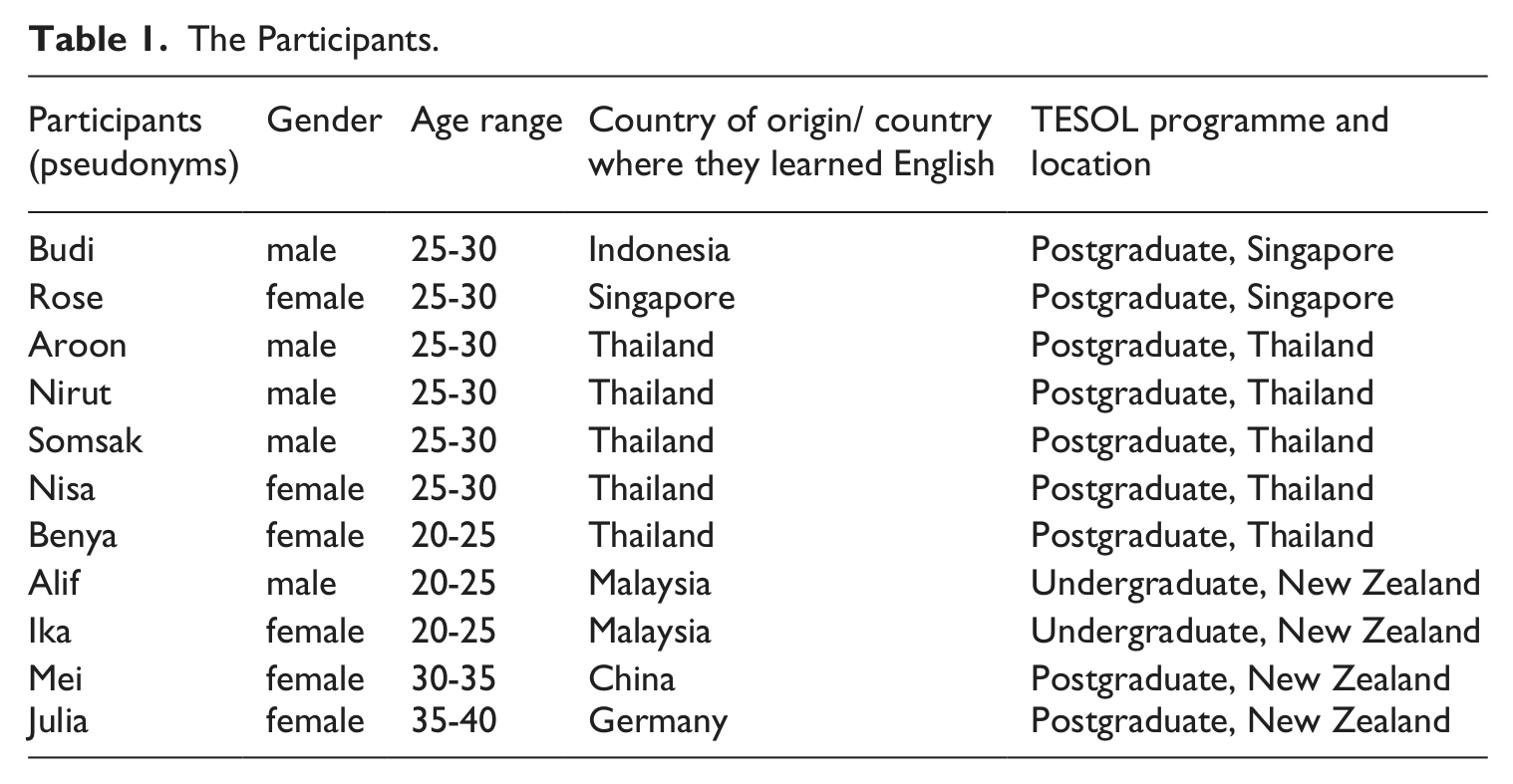
Each participant was interviewed individually in a quiet place. The interview lasted for about an hour. The first part of the interview gathered general information about the participants: their language teaching experience, their reasons for doing the TESOL programme and the courses they have studied in the programme. The second part explored their perceptions of the nature of interest with relation to the programme and their past learning experience. Participants who chose to talk about their English language learning experience as a very interesting experience in the past were prompted to reflect on past critical moments which caused the emergence of their interest in learning English. They were prompted with open questions (how and why they came to be interested in learning English). Apparently insignificant ‘initial’ events can in time give rise to the emergence of global structures such as interest in learning English. ‘Awareness of this concept can enable students and teachers to facilitate positive critical incidents and avoid harmful ones’ (Finch, 2010: 422). Asking students to reflect on past critical moments has been used in qualitative research interviews to investigate such critical incidents (e.g. see Finch, 2010). Although such reflections may not offer the direct mirrored image of the actual experience, they create ‘an occasion for story-telling’, enabling participants to revisit and make meaning of their lived experience through narrative.
In qualitative research, the collaborative meaning-making nature of interviews means that interview extracts should be interpreted with reference to the context in which they are produced (Rapley, 2001). The accounts participants give are partly construed by the questions that prompt the talk. Although the word ‘interest’, ‘interesting’, or ‘interested’ is used by the researcher in the interview question, respondents construe and describe their experience without necessarily using the word ‘interest’ or ‘interesting’ which prompts their account. This is, in fact, a feature of good story telling where the narrator ‘describes’ or ‘shows’ an experience or an emotion without naming it, in this case, using the word ‘interest’. A variety of words appear in respondents’ accounts of the triggering of interest in learning English such as ‘liking’, ‘enjoyment’, ‘inspiration’, ‘motivation’. These, as noted by interest researchers, are various aspects that make up ‘interest.’ Whether the types of accounts participants give would have differed if the questions had been asked differently without the word ‘interest’ is a methodological puzzle worth addressing in further studies.
The interviews were transcribed. Episodes where students talked about the past critical moment which triggered their interest in learning English were read comparatively and closely. Through repeated readings, the features and aspects that constitute the triggering of participants’ interest in studying English were identified and categorized. The content-specificity and interactive nature of interest mean that in accordance with the changing nature of the person and/or object, the interaction between them would also change. What triggers interest in English in childhood may not be the same as the interest triggering factors in adulthood. Renninger and Hidi (2011) propose that although interest can develop at any age, sources of interest and construction of interest differ across age groups and that it would be useful to explore the development of interest across different age groups. In the present study, when asked to recall past critical moments which developed their interest in English, the participants’ recall differs in temporal terms. The findings are divided into three stages: 1. sources of interest in early childhood, 2. sources of interest in teenaged years, and 3. sources of interest in adulthood.
Use of multiple participants provides a kind of triangulation on the experience under study, ‘locating its core meaning by approaching it through different accounts.’ (Polkinghorne, 2005: 140). Triangulation in this case is not to corroborate a particular account but to ‘allow the researcher to move beyond a single view of the experience’ (Polkinghorne, 2005: 140), to deepen understanding of the investigated experience. This view applies to the present study where extracts from various respondents are used to enrich understanding of the various aspects of interest triggering experience. Constant comparison is made between various accounts. Negative or disconfirming cases and accounts are also sought for. ‘Deviant’ or ‘negative case analysis’ helps refine the analysis until we can explain all or the vast majority of the cases under scrutiny (Baxter and Eyles, 1997).
Findings
Sources of Interest in Early Childhood
When the triggering of interest refers to early childhood or primary school, it is associated with highly positive affect such as liking, enjoyment, fun, success and the support of significant others such as parents, relatives, siblings, close friends/peers and encouraging teachers.
Early Success in Childhood
Success experienced at the early stage of a student’s life is important for generating interest. The success experienced which involves the use of English is often unexpected, making the student understand the past action retrospectively. This understanding in retrospect (understanding what they didn’t understand earlier) is called by interest researchers ‘postdictability’, one of the important sources of cognitive interest (Kintsch, 1980). This is illustrated in the responses by Benya: ‘I can do it’ Do you remember how you came to be interested in English? Because when I was in grade five, it’s the first year that I studied English and my mum prepared me to study English very well because she’s afraid, it’s very new for me. So, she prepared me very well before I started studying in school. I got one hundred score from one hundred, yeah. That’s why I feel that ‘oh, my God (laugh) I can do it.’ So, I have strong motivation to study more and more.
Benya’s mother taught her English from an early age using fairy tales and other exercise books. She forced her to study English even when they went to the hospital. Benya didn’t like it. But after her unexpected success at school in English, she realized the value of the past effort and became interested. Her previous negative feeling turned into positive ones and she came to understand the importance of her past action in retrospect and felt gratitude for her mother’s persistence: ‘Thank you’ We have free time and so, you open the book and do it, even in the hospital. I don’t like it, I hate it. I cried too. Mum said: ‘after you are successful, you will think of me.’ And it’s true you know, after I got one hundred scores, I told my mum, yeah, ‘Thank you’.
Benya’s interest was triggered not only by the unexpectedness of her success but also by her ability to identify the source of the surprising success at school (i.e. she got one hundred score from one hundred because of her past effort encouraged by her mother). This post-hoc understanding of a surprising event that has occurred in the past created the cognitive interest and a positive feeling of gratitude to her mother.
The Support of Significant Others: Parents, Relatives, Close Friends and Teachers
Postdictability and unexpectedness are not always necessary conditions for triggering interest. The attractiveness and enjoyment caused by support from significant others could also actuate interest in English in early years. Someone’s interest – especially the interest of significant others, can trigger interest in early childhood. Such cases are featured with positive affect. Nisa’s interest in English was triggered when she was very young due to the support of her family and the fun she had with them through English music and games.
‘My mother’, ‘my aunt’, ‘my sister’ What do you think made you become interested in English? When I was in kindergarten, my aunt, she is the teacher, and she gave me an English book and a cassette and I play the cassette and I listen to the cassette every day. It is basic English for beginner. I can remember because (laugh) at the first unit there would be music ‘ting ting’ and then ‘good morning, my name is’ something like this and they have a lot of game. I play the game with my sister. At that time my mother was interested in studying English and she bought herself a self-study book and cassette ‘Follow me’ something like that (laugh) and so, she studied her own book and I studied my own book (laugh) and she tried to speak English to me but I did not understand.
Apart from parents and relatives, peers and close friends also help trigger interest in early childhood. This is reflected in the response by Mei whose interest in English was triggered by her desire to ‘keep up’ with her best friend who was good at English. Apart from significant others, teachers are also reported as triggering interest in the primary level. Ika became interested in English at the age of 10 in the primary school because of the English teacher who was very nice, encouraging and taught clearly. That experience contrasted completely with other ‘evil teachers’ she had met: ‘Since this teacher came into my life’ I became interested in English when I was in Standard 4. I think because of this teacher, he’s very nice and very good. I’m really bad at mathematics, and the mathematics teacher is very like the evil person. The English teacher always helps me with my work and he encourages me. (…) Since this teacher came into my life, he made it all very clear. I didn’t know what I want to do when I grow up at that time, because I was just 10. But then my interest in English just comes unconsciously and I just continue studying English until now. I think he really taught clearly and he’s very nice to all of us and I think our English grades go higher that year. It was really a miracle.
It was not the presence of a clear future vision (‘I didn’t know what I want to do when I grow up at that time’) but the novelty of the pleasant experience (‘nice English teachers’) in contrast to the unpleasant one (the evil Maths teacher) that triggered her interest and motivated her to learn English.
There are also negative or deviant cases where students do not become interested in English despite the support of significant others. In such cases, parents act as authoritative instructors, forcing the child to spend time studying English instead of acting as a role model. For example, both Rose and Somsak reported that despite their parents’ emphasis on the value of English, they did not become interested in English until they got to the university. Rose’s mother used a somewhat authoritative approach. Rose did not understand the value of her mother’s instructions as a child, only realizing their significance when she grew up: ‘My mother asked me to do this and that’ Yeah, I did manage to learn (English) although it didn’t appeal much. (…) As a child, I cannot understand why it is that my mother asked me to do this, my mother asked me to do that. When I’m older now, I reflect, I think ‘oh, yeah, this is the reason why my mum asked me to do this’.
Similarly, as a child, Somsak was pushed by his father into an English speaking environment. His father brought home English-speaking colleagues and friends for his son to meet. Somsak’s interest in English was not there yet although he practised and learned English. Somsak reported meeting other students like himself when he became an English language teacher (‘Students are forced by their parents so they don’t see the importance of studying English until they reach this stage of maturity and they can realize that ‘oh, this is the thing that they have to do.’). In such negative cases, what is lacking is a pleasant, surprising and successful event in the early years such as the one encountered by Benya mentioned above which could help the child to postdict the value of English forced upon them by their parents.
Sources of Interest in Teenaged Years
Students who reported interest in English being triggered in the secondary or teenaged years often attributed it to the usefulness of knowing English itself and the pursuit of their emerging interests through English in other topics such as sports, movies, music. Preference, usefulness and emerging interests in other topics play an important role in teenaged years. Along with positive affect such as liking and enjoyment, in teenaged years, the property of English and topics – known to interest researchers as topic interest or emotional interest – are important.
Pursuing Emerging Interests
When asked how he came to be interested in studying English, Budi recalled his secondary school experience. He became interested not because of the benefit English could bring in terms of career and study (which he understood and experienced only now when he was studying in Singapore) but because he liked watching TV and all the movies at that time were in English. It was his desire to pursue what he enjoyed through English rather than a vision of future benefits that triggered his interest in English at secondary level.
‘All the movies at that time were in English’ Do you know how you came to be interested in studying English as a student? Well, I don’t know where I could begin. But to be honest with you, at that time when I was in the secondary school, I did not really see the benefit that I got now (…). I never dreamed that I could go abroad (…) because of benefit of English. But what I was really interested at that time, because I always watch TV. All the movies at that time were in English and that is one of the factors which very encouraged me to learn English.
Similarly, Alif’s interest in studying English came from his interest in sports. His grandfathers and forefathers did not like English and valued the Malay language more. He developed his English interest and proficiency by reading sports columns in English, by watching sports and sport documentaries in English on TV, by imitating people on those programmes and by copying sports columns in English. Alif did not like reading classic novels and literature. Although he realized the inadequacy of sports columns for developing academic English and his own insufficiency in terms of academic English, he believed that sport was the best way to teach English.
‘Sport is the best way to teach English’ Maybe it’s short, yeah, ‘stop, do this, rotate, go ahead’, something like that. Maybe it’s quite lean, but I do believe in that. Sport is the best way to teach English.
Unexpected Experiences Concerning the Usefulness of English
Experiencing unexpected success in using English with English speakers trigger interest in teenaged years. Feelings of surprise, enjoyment and liking arising from unexpected success are reported in association with interest experienced in teenaged years. For example, Julia received the worst mark in English in her first year at the secondary school and her English was bad. However, later when her sister’s pen friend visited her, Julia discovered that she could communicate with her even with her basic English. The unexpected discovery of her ability (post hoc understanding of the value of what she had learned) triggered interest and her English scores jumped from the lowest to the highest: ‘I realized I wasn’t hopeless’ I discovered that although I had a very low mark and I only had learned English for a year, that I could communicate with her and that made me so much more interested. Because suddenly it was like, ‘oh, that is cool’, you know you can talk with people from other countries and my grades just jumped from the lowest to the highest within two years. I realized I wasn’t hopeless. I realized, even with my basic English that I could, you know, put words together and communicate sentences although they were funny sentences.
A clear future vision is often proposed as motivating people’s behaviour. However, applying the interest researcher’s view, what triggers interest and motivates people’s behaviour is not just the future vision or the ability to predict but the understanding and discovering the meaning of one’s past self in retrospect or the ability to postdict a significant surprising event. This post-hoc understanding of the meaning of the past self can trigger interest and motivate people to attend to the object, changing the object (English) which they interact with from an object of general importance imposed by the society into an object of personal significance (i.e. usefulness not in a general sense but in a personal sense) as Julia sums up (‘My interest is connected to the usefulness of something. Maybe not in general, but to me, the usefulness to me, you know. And I got to use this’).
Similarly, unexpected witnessing of the usefulness of English triggered Aroon’s interest in English. During the school flag-raising ceremony, he was very surprised and impressed to see the teacher’s successful use of English with a foreign exchange student in front of the students. This surprising encounter with the successful use of English by his teacher triggered his desire to increase his knowledge and to be like his teacher: ‘I would like to be like that’ When I was in high school, I can remember that. When students stand in line, they have a flag-raising ceremony, raising flag and the teacher gave morale. The teacher invited an exchange student and they had a conversation, English conversation and I’m very surprised and interested, keen to know ‘oh, how the teacher can communicate with the student, the overseas student in English.’ The teacher speaks English very well, fluently, can understand, can communicate. It impressed me. So I would like to be like that, I would like to study more, I would like to go abroad, something like that. So I think maybe it stimulates me to learn, yeah.
A surprising event, according to Gendolla and Koller (2001), can motivate a causal search to find the cause of the unexpectedness in surprise and this causal search is beneficial for learning and education. Aroon was surprised to see his teacher successfully communicating with the overseas student in English and was keen to understand, ‘oh, how the teacher can communicate with the overseas student in English.’ Although Aroon didn’t fully understand how the teacher did this, he wanted to resolve the issue and became interested in English. Studies show that events and objects are particularly interesting ‘when they are not yet fully understood, but still require explanatory inferences’ (Campion et al., 2009: 2). In other words, cognitive interest can be triggered by the anticipation of postdiction, the anticipation of suppressing uncertainty, or the pleasurable aim of resolving issues.
Sources of Interest in Adulthood
Both pleasant and unpleasant events can trigger interest. Pleasant surprise can occur when a desirable event confirms unexpectedly (as in Aroon’s unexpected witnessing of the teacher successfully communicating with an English speaker), or when an undesirable event disconfirms unexpectedly (as in Julia’s realisation that she wasn’t hopeless in communicating with an English speaker even with her basic English). Unpleasant surprise, on the other hand, can be triggered when ‘a desirable event disconfirms unexpectedly, or when an undesirable event confirms unexpectedly’ (Bae, 2009: 17). While pleasant surprise can lead to positive affect such as happiness, unpleasant surprise results in disappointment and sadness. While pleasant surprises with positive affect are reported as interest triggering factors in early years (primary and secondary), unpleasant surprises with negative affect are reported in adulthood.
Unexpected Significant Failures and Understanding the Importance of English in Retrospect
When asked how they developed interest in learning English, some students referred to unexpected past failure in adulthood: a failure not in the exam but unexpected, significant failure or loss in real-life situations outside the class. Such failures often help students to see English not as an object of general significance but as having personal significance. The unpleasant surprise ‘evokes an attributional search – a spontaneous and active causal search to resolve the discrepancy between expectancy and what actually happened’ (Bae, 2009: 18-19).
Somsak attributed development of his interest in English to an unexpected significant failure experienced when using English in a real context. Despite his father’s support, Somsak did not pay much attention to English. His genuine interest came only later from an experience he had in a hotel. While doing his hotel management course as part of his undergraduate study, he had a chance for internship as a hotel waiter. One day, a customer of the hotel asked him in English for a cup of water but he did not understand. He eventually discovered what the customer wanted (‘Can I have a glass of water please?’) by asking another waiter. When the waiter explained what the customer said, Somsak was surprised at not having understood such a simple sentence, along with a post hoc understanding of the insufficiency of his English and his past learning experience. This created a motivational state to attend to English and acquire knowledge about English so as to resolve the gap in his current knowledge: ‘Oh, that’s why English is so important’ ‘What! oh, this is very easy sentence. Why I didn’t understand this at all? So there might have something unusual about my English.’ So, that’s my inspiration to study English seriously. I studied English seriously when I was 21 and I keep carrying on, keep studying more and more because I in that moment, it was my inspiration, made me pay more attention on studying English. Otherwise, I feel like what I’ve learnt from kindergarten until by that time is nothing. So, that’s why it was my inspiration to find out how to speak English fluently and accurately. So then I start seriously by that time. I learn ‘oh, that’s why English is so important. What we learn in the class is just nothing.’
Prior to his unexpected significant failure, English may have been just an object of importance in the general sense imposed by others (‘Ok, English is a compulsory subject that I have to pass, that is’), but not yet an object of personal significance. At the moment of failures, there was a post hoc understanding of the past (‘there must be something wrong with my English’). Such failures reported especially in their adulthood are featured with negative affect such as strong feeling of embarrassment and cognitive value (focused attention and desire to increase knowledge and to resolve the incongruity experienced). As interest researchers note, interest can function in an affectively negative environment (e.g. Panksepp, 2003).
Before that negative experience, Somsak waited for his father to push him into the English environment. Afterwards Somsak tried to push himself into English environments all the time, although English was not used widely in Thailand. He even practised thinking in English so that when the real situation came, he could use it straight away: ‘I tried to spend my time in the English environment, even thinking.’ But before that, I was lazy. I was waiting for my dad to push me into English environment. (…) But when I had the inspiration to study English, then I didn’t wait for any command (…) I knew that what I had to do (…) When I wake up, I turn on the English radio. I tried to spend my time in the English environment, even thinking. I don’t have anyone speaking English with me too. I speak Thai one sentence, if I have any chance to think, I think in English to practise my brain speaking English because I think that when I’m in the real situation, I can use it straight away, immediately, without thinking so much because my brain has practised it all the time.
Similarly, a significant failure triggered the interest and determination of Nirut. Before becoming an English language teacher and deciding to major in English for his postgraduate study, he worked as a marketing coordinator and had to coordinate with foreign customers. He once overlooked some language points in an email, causing loss to the company and resulting in his resignation. This incident made him want to improve his English: ‘I lost it’ Yeah, I was blamed. I think I had to decide to improve my English. The company had a very beautiful opportunity but I missed it, yeah, I lost it.
According to Gendolla and Koller (2001 cited in Bae, 2009: 59), ‘surprise intensity elicited by an important outcome with negative valence is higher than that elicited by an important event with positive valence.’ In other words, the intensity of surprise is enhanced when an outcome the individual considers both important and undesirable occurs, heightening the intensity of motivation to search for the cause of the unexpectedness. This causal quest for knowledge (a cognitive component of interest) enhances the experience of learning.
A Bigger Role to Play
When the triggering of interest is reported as occurring in adulthood, such cases display a higher degree of cognitive aspect and postdiction of the importance of English and one’s past interaction with English. With the changing ‘self’ (changing person), the interaction with English changes, deepening the personal value. For example, Rose managed to learn English as a child although she wasn’t much interested and didn’t understand the importance of her mother’s action. She understood it only when she grew up and was studying to become an English language teacher. Her realization that she now had ‘a bigger role to play in school’ as an English teacher evoked her interest in English and multiplied her effort, making her ‘go an extra mile just to know more about’ English. While sources such as comfort, enjoyment, play (affective components) are noted more often as fostering interest in early periods (primary, secondary), relevance to real life and work (value components) seem more important in adulthood.
In early childhood, experiencing success, in particular unexpected success, could help trigger interest in learning English. The support of significant others such as parents, relatives and friends also plays a part. Teachers, in particular the novelty of pleasant and supportive English teachers in contrast to other negative experiences (e.g. ‘evil teachers’) help to develop interest in learning English. Affective components such as liking and enjoyment seem more important in early periods. In teenaged years, interest in English develops along with the emergence of interests in other topics such as music, film or sports. Interest is also triggered by unexpected successful experiences in using English with English speakers. Finally, in adulthood, unexpected and significant failures in using English in real life situations, as well as the post-hoc realization of the importance of English in one’s career help develop interest in learning English.
Conclusion
English language learning takes place in various diverse contexts and many have proposed the need to rethink the traditional motivational literature. The notion of ‘interest’ proposed in this paper which originates in the discipline of educational psychology can explain the complex English language learning experiences in formal educational contexts where English is often imposed on students as a formal school subject. It helps us to understand how English can be transformed from an object of general significance imposed by society into an object of personal significance.
In the globalized world, learning English is no longer considered to be just for communication but in itself is an object of ‘desire’ (Kramsch, 2009), an act of ‘investment’ (Norton, 2000), or ‘casual or serious leisure’ (Kubota, 2011). This changing view of English as an ‘object of personal significance’ rather than ‘a communicative tool or an instrument’ complements the appropriateness of the notion of ‘interest’ in learning English. As defined earlier, ‘interest’ indicates content-specificity. Rather than being globally interested, people have interest in some activity, task, subject, or topic. This content specificity distinguishes interest from other motivational variables which focus on more general learning aspects (e.g. see Hidi, 2006).
Interest does not simply reside either in the person or in the object of interest. It exists in a particular relation between a person and an object. The usefulness and importance of English in international terms is a well-known phenomenon. But this property of English on its own doesn’t guarantee that interest will arise when students interact with English. The situation in which the interaction occurs plays an important part in triggering student interest. For interest to be triggered, English must be presented or experienced in such a way that it creates surprise, unexpectedness, and encourages post-hoc understanding of the importance of English and one’s past interaction with English.
For students studying English in formal settings, especially those in early years, what triggers interest in learning English is not the predictability or the presence of a clear vision of their future English self but the postdictability or the anticipation of the postdictability of the value of English and their past English self with reference to their present self. The majority of students in the study became interested in English as a result of their post-hoc understanding of a surprising pleasant or unpleasant significant event that has happened with reference to the past event. This notion of postdictability (understanding in retrospect) differs from the concept of attribution proposed by motivation researchers. In attribution theory, people’s ability to attribute causes to their perceived successes and failures affects their subsequent actions (e.g. Williams et al., 2001). Postdictability important for the triggering of interest involves not just the causal attribution but also the element of surprise, which heightens the intensity of motivation to search for the causes of the unexpectedness. This causal quest for explanation and knowledge enhances the experience of learning.
Research on second/foreign language learning has also highlighted the importance of context in understanding language learning experiences. The study indicates that age is an important contextual aspect. As interest arises from the interaction between a person and an object (in this case, English), with the changing self, the interaction changes. What triggers interest in learning English in early years may not work in adulthood. The study indicates that while pleasant surprise leads to triggering of interest in English in early years (primary and secondary), unpleasant surprise can intensify interest in learning English in adulthood. While positive affect such as enjoyment and liking are reported in early years, the value of knowledge (cognition) is reported in adulthood. This may be due to a developmental change, ‘consistent with theoretical suggestions that younger learners, compared with older learners, are more attuned to affective experiences’ (Wigfield and Eccles, 1992 cited in Linnenbrink-Garcia et al., 2010: 20-21).
Participants’ self-report may not directly represent their actual lived experience, as memories are unreliable. Longitudinal studies, recording students’ experience of interest as it occurs and develops, are required. Despite these limitations, the findings have useful implications for teachers teaching English as a second/foreign language in formal education settings. In particular, the various situational features reported could be created to help trigger students’ interest in learning English at various stages.
Footnotes
Acknowledgements
I am grateful to the student participants, the teachers and heads of departments who give me access to the field.
Declaration of conflicting interest
The author declares that there is no conflict of interest.
Funding
The study was funded by the University of Auckland, New Zealand.