




Abstract
As content-based instruction (CBI) programmes involve certain degrees of integration of second language (L2) and content learning, collaboration between L2 and content subject teachers has been strongly advocated. Whether this type of teacher collaboration can be successfully implemented will depend on many factors, one of which is teacher beliefs and attitudes. This study compares the beliefs and attitudes of L2 teachers with those of content subject teachers regarding their roles in CBI and cross-curricular collaboration. Data collected from the 261completed questionnaires, complemented with six semi-structured interviews, administered to teachers in Hong Kong secondary schools which practise CBI, show that the two groups of teachers have significantly different beliefs about their roles concerning language teaching in CBI. Even though they generally believe in the effectiveness of collaboration, they perceive some potential problems and are not fully committed to it. Such findings have important implications for the feasibility of cross-curricular collaboration, which is a practice often advocated to facilitate L2 learning in CBI. The findings can also shed light on teacher education in CBI.
Keywords
Introduction
Content-based instruction (CBI) programmes, where students learn some or all content subjects through a second language (L2), are becoming popular in different parts of the world (Stoller, 2008). As such programmes integrate language and content learning, it follows that collaboration between L2 and content subject teachers is helpful to facilitate student learning of both L2 and subject content, especially in contexts where CBI teachers are subject specialists. However, whether collaboration between L2 and content subject teachers (hereafter known as ‘L2-content cross-curricular collaboration’), can be successfully implemented depends on many factors, one of which is teacher beliefs and attitudes. Owing to the different nature of their subjects, L2 and content subject teachers tend to hold different beliefs about their subject disciplines and pedagogic roles, which in turn affect their willingness to work together. In addition, the status and power relationships of the two groups of teachers may influence their beliefs and attitudes towards collaboration. Most previous studies on L2-content cross-curricular collaboration were carried out in English-speaking countries and adopted qualitative approaches, such as interviews (e.g. Arkoudis, 2003; Creese, 2010). What seems to be lacking is a larger-scale quantitative study on the issue, especially in English as a foreign language (EFL) contexts (Trent, 2010).
Conducted among Hong Kong secondary schools which practise CBI, this study attempted to explore the perspectives of L2 (English) teachers and content subject teachers, particularly their beliefs regarding their roles in CBI and their attitudes towards cross-curricular collaboration. By looking at what these two groups of teachers think and believe, this study provides insights into the feasibility of this type of teacher collaboration. This study also yields implications for teacher education programmes on how to facilitate effective L2-content cross-curricular collaboration.
Literature Review
The Emergence of L2-content Cross-curricular Collaboration
Researchers have been advocating teacher collaboration through various ways including peer coaching, partnership teaching and mentoring. It is suggested that teacher collaboration can enhance school effectiveness, facilitate student learning and promote professional development (e.g. Musanti and Pence, 2010; Pugach and Johnson, 2002). Given its potential benefits, teacher collaboration is worth investigating. This study focused on L2-content cross-curricular collaboration.
L2-content cross-curricular collaboration can be regarded as a particular kind of interdisciplinary team, which involves L2 and content subject teachers. Such a form of collaboration has been advocated by researchers in CBI programmes (Crandall, 1998; Davison, 2006). CBI is a bilingual education programme generally characterized by students learning content subjects through an L2 so as to facilitate L2 learning. However, CBI is implemented in different forms in various educational contexts for different purposes, all of which have implications for L2-content cross-curricular collaboration.
In English-speaking countries such as the US, UK and Australia, CBI is mainly for English-second-language (ESL) or English-additional-language (EAL) students. In those contexts, L2-content cross-curricular collaboration involves ESL/EAL teachers working with mainstream content subject teachers, with the aim of helping ESL/EAL students attain the required English proficiency before returning to the mainstream classes where English is the default medium of instruction. In countries where English is not the majority language but enjoys high socio-economic status (e.g. continental Europe and Asia), CBI is implemented to enhance the L2 proficiency of students, which will make them more competitive in the era of globalization (Navés, 2009). Examples of CBI in those contexts include Content and Language Integrated Learning in Europe and English-Medium education in Asia.
Despite different contexts or purposes of CBI, the rationale of L2-content cross-curricular collaboration is similar – ESL/L2 teachers do not possess sufficient knowledge or confidence in teaching content knowledge and subject-specific language, whereas (mainstream) content subject teachers are usually not trained in L2 teaching (DelliCarpini, 2009; Mehisto et al., 2008). Hence, to achieve the ultimate goal of CBI (i.e., students learning L2 without sacrificing content learning) (Stoller, 2008), content subject teachers and L2 teachers are encouraged to collaborate (Coyle et al., 2010; Davison, 2006), so that they can more effectively assess students’ existing levels and needs – both linguistic and academic – when designing the curriculum (Snow et al., 1989). This will then facilitate student learning of L2 and learning of content subjects through the L2 (Crandall, 1998; Creese, 2010).
Tensions Involved in L2-content Cross-curricular Collaboration in CBI
A small body of research has examined the implementation of L2-content cross-curricular collaboration. Some studies proposed or described various practices of collaboration (e.g. Crandall, 1998; García and Vázquez, 2012) and others highlighted the barriers to this kind of collaboration, especially in terms of the tensions between the two groups of teachers, which will be briefly reviewed here.
Teachers’ Epistemological Beliefs
Department culture or subject boundaries have been observed in schools (Siskin, 1994). It may not be surprising to find such a boundary between L2 and content subject teachers because of the different nature and characteristics of the subjects. Arkoudis’ discourse analyses (2003) revealed that language and content subject teachers in Australia had different epistemological beliefs and assumptions about their own disciplines (e.g. what ‘content’ means for the two groups of teachers). Similarly, Trent’s interviews with teachers in Hong Kong (2010) demonstrated that the two groups of teachers had different views about ‘the real world’ which they attempted to connect their students to. Content subject teachers wanted to equip students with a particular set of knowledge and skills, whereas language teachers had a less bounded or well-defined set.
Teachers’ Perceptions of Their Roles
As highlighted, CBI programmes are characterized by the role of L2 being both the medium and the target of learning. Hence, it has been argued that ALL teachers are responsible for students’ language learning to some extent (Man, 2008). On the one hand, L2 teachers need to equip students with some academic language required for studying content subjects. On the other hand, content subject teachers have to be more language aware of the academic language related to their subjects so that they can provide support for students (DelliCarpini, 2009; Llinares et al., 2012). However, Tan’s study of Malaysian CBI teachers (2011) showed that they perceived themselves as ‘L2 teachers’ or ‘content subject teachers’ only. The Mathematics and Science teachers in that study did not consider language to be very important in their subject, and hence were observed to include few linguistic elements in their classroom teaching. Similarly, in Hong Kong, Trent’s study (2010) revealed how teachers constructed separate identities as language teachers or content subject teachers, whereas teachers in Man’s questionnaire survey (2008) tended to believe that it was mainly the responsibility of L2 teachers to help students enhance their academic language proficiency. That probably explains why in the eight Science CBI lessons Walker (2011) observed in Hong Kong, the Science teachers were not language aware and they did not use or draw students’ attention to academic language related to Science (e.g. nominalization and explanation texts).
Different Foci in Teaching
Even when the two groups of teachers engage in collaboration, they bring along their different foci – L2 teachers tend to put more emphasis on the pedagogy of language teaching whereas content subject teachers stress mainly delivering the subject content (Creese, 2010). In more examination-driven education systems such as Hong Kong and Malaysia, content subject teachers were observed to be more concerned with aligning their teaching with the demands of exams and they were very concerned about student achievement (Tan, 2011; Trent, 2010). Though language teachers also had to prepare students for examinations, they were more concerned about how to motivate students to participate in the lessons and whether students could communicate in the real world (Trent, 2010). Such different emphases make the negotiation between L2 and content subject teachers very difficult when they try to collaborate (Arkoudis, 2006; Creese, 2010).
Teachers’ Attitudes and Willingness to Collaborate
Attitudes can simply be defined as people’s stance (Freeman, 1989). Previous research found that teachers had different attitudes towards cross-curricular collaboration, ranging from implicit or explicit rejection to a very positive attitude (Davison, 2006). Such variation in attitudes is partly affected by some of the above intra-personal factors, namely teachers’ beliefs about their subject disciplines, their pedagogic roles and their pedagogic practices. In addition, teachers’ attitudes towards collaboration are also affected by their beliefs about the effectiveness of cross-curricular collaboration (i.e., the results or outcomes) and other contextual or external factors such as workload, school policy and culture (Trent, 2010).
Teachers’ Positioning/Power Relationship
One source of conflict among school subjects can be their differentiated status and social recognition (Goodson, 1987). Most previous studies on L2-content cross-curricular collaboration were conducted in English-speaking contexts such as the US and the UK. A common theme highlighted by those studies is the positioning of ESL/EAL teachers compared to mainstream content subject teachers. ESL/EAL teachers are assumed to ‘assist’ mainstream content subject teachers and it seems that this group of teachers are marginalized or regarded as having lower status (e.g. Creese, 2010; DelliCarpini, 2009). However, in contexts where English (or other languages) is adopted as the medium of instruction in schools because of its socio-economic value (e.g. in continental Europe, Hong Kong, Malaysia), L2 teachers are a significant group (Nunan, 2003). The power relationship between L2 and content subject teachers in these contexts may be different from that in English-speaking contexts, which will in turn affect their collaboration. Therefore, it is worth exploring L2-content cross-curricular collaboration in other educational contexts, such as Asian countries (Trent, 2010).
From the above review, several gaps in the literature can be identified. First, in terms of methodology, almost all of the previous studies (except the questionnaire survey conducted by Man, 2008) adopted qualitative case studies and/or interviews to investigate teacher beliefs and attitudes. Building on the interesting insights provided by those previous studies, a larger-scale quantitative study can further explore the issue and verify the findings with a larger sample. The second gap lies in the research context – there has been a lack of research on L2-content cross-curricular collaboration in Asian educational contexts. The current study addressed these two gaps by investigating teachers’ beliefs underlying cross-curricular collaboration in CBI and their attitudes towards it. The decision to focus on teacher beliefs and attitudes is based on the assumption that one’s intentions and then actions are determined by one’s beliefs, attitudes, and perceptions of what others think as well as the perceived control one has over the action (Ajzen, 1991). According to Borg (2001), investigating teacher beliefs and attitudes can contribute to a better understanding of teacher behaviours. By exploring the beliefs and attitudes of L2 and content subject teachers, this study aimed to provide practitioner insights into the practicality of cross-curricular collaboration.
The specific research questions of this study are:
What are the beliefs of L2 teachers and content subject teachers about their roles in CBI programmes?
(What are the beliefs of L2 teachers and content subject teachers about the effectiveness of cross-curricular collaboration?
What are the attitudes of L2 teachers and content subject teachers towards cross-curricular collaboration?
Are there any significant differences between the beliefs and attitudes of L2 teachers and those of content subject teachers?
Methodology
This study was a cross-sectional survey, employing questionnaires and semi-structured interviews, to investigate the beliefs and attitudes of a sample of teachers in Hong Kong, where there has always been a strong demand for high levels of English (L2) proficiency, and hence an overwhelming preference for English-medium schools (where CBI is practised) (Tsui, 2004).
Sampling
The population of this study was L2 (English) and content subject teachers in Hong Kong secondary schools which provide either full or partial English-medium education (i.e., schools where some or all content subjects are taught through the L2, English). Based on the criteria of geographical location and students’ ability, a stratified sample of 13 schools participated in this study. These schools were located in different districts, with different types of sponsorship, different years of establishment, and students of different socio-economic backgrounds and academic abilities.
Research Instruments and Data Collection
Questionnaires
The major source of data was a self-administered questionnaire. The questionnaire was drafted with reference to previous literature (e.g. Man, 2008), and was piloted with a group of pre-service and in-service teachers. The questionnaire consisted of three main sections. This paper will report the findings of Section 2, which consisted of a number of statements exploring various aspects of teacher beliefs and attitudes related to the research questions. Teachers were asked to indicate their opinion on a 5-point Likert scale (with 1 being ‘strongly disagree’ and 5 being ‘strongly agree’). The wording of the questions for English and content subject teachers was slightly different but most questions were comparable.
A total of 534 questionnaires were dispatched to the participating schools, and 261 questionnaires were collected and included in the data set (92 English teachers and 169 content subject teachers). The profile of the teacher respondents, compiled based on their responses to questions asking for their background information, reveals a similar profile between the two groups of teachers, in terms of their teaching experience, education and professional qualifications, and the academic ability of students in their schools. The overall reliabilities of the questionnaires for English teachers and content subject teachers, measured by Cronbach α, are 0.84 and 0.86, respectively.
Semi-Structured Interviews
At the end of the questionnaires, participants were asked to indicate their willingness to be interviewed. Six interviews were successfully conducted. It is noted that six interviews out of the 261 participating teachers represented a low response rate and constituted a limitation of this study. Yet, the interview data helped elaborate on the statistics obtained via questionnaires. Among the six interviewees, three teachers were content subject teachers (identified as CST1-3) and the others were English teachers (identified as ET1-3). The teachers came from different types of schools and had different teaching experience. The interviews lasted for around 30 minutes, during which teachers were asked similar questions to those in the questionnaire but were given more opportunity to express their views. Details of the teacher interviewees are shown in the Appendix.
Data Analysis
From the questionnaire data, descriptive statistics were computed to reveal the general beliefs and attitudes of all the teacher respondents. In addition, to identify any significant differences between L2 and content subject teachers, independent-sample t tests were employed to compare the responses of the two groups where appropriate. It may be argued that the 261 teachers were nested within 13 schools and so independent-sample t tests were not appropriate. However, the foci of this study are ‘beliefs’ and ‘attitudes’, which are arguably highly conserved and individualistic (Parajes, 1992), and so the nesting effect of the school environment was not taken into account in the analysis of this study.
All the interviews were transcribed verbatim and then analysed. The author first coded the major categories emerging from the data which were related to the research questions. These categories were given to a second researcher, who then coded the transcripts with those categories to enhance the reliability of data analysis.
Results
The results are presented in three major sections, according to the research questions. The questionnaire responses are presented first and, wherever appropriate, the responses between English and content subject teachers are compared. Relevant quotes from the interviews are also presented to elaborate on the questionnaire data.
Teachers’ Beliefs about Their Roles in CBI
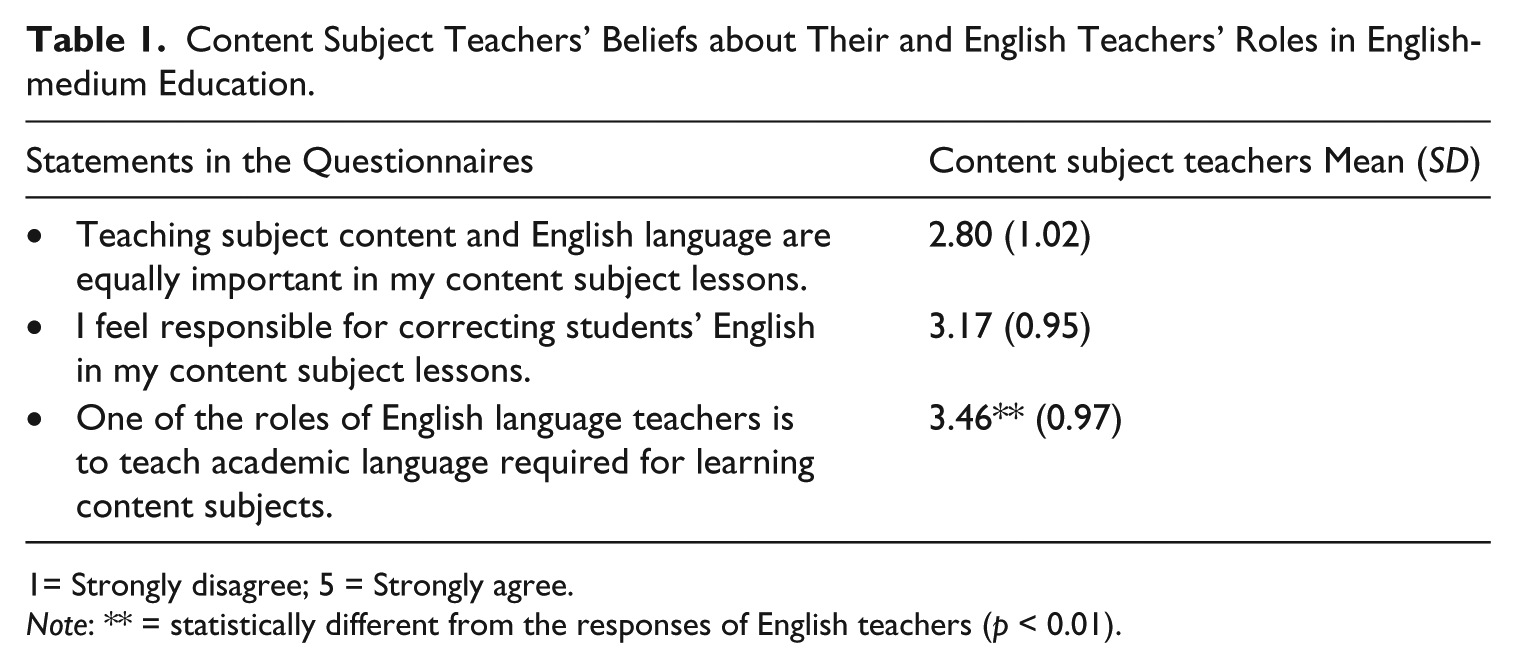
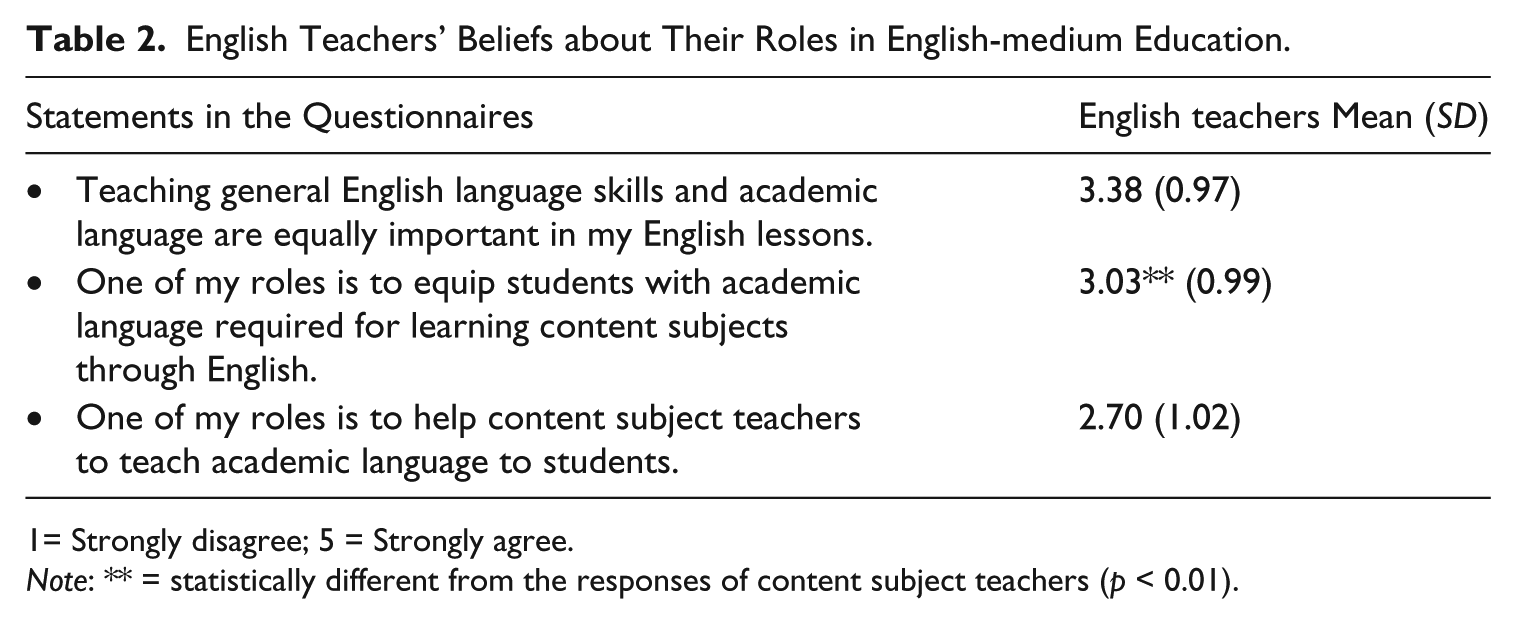
The teacher respondents were asked to indicate their agreement to statements about the roles of L2 (English) and content subject teachers in English-medium education. The responses of content subject teachers and English teachers are shown in Table 1 and Table 2, respectively.
Content Subject Teachers’ Beliefs about Their and English Teachers’ Roles in English-medium Education.
1= Strongly disagree; 5 = Strongly agree.
Note: ** = statistically different from the responses of English teachers (p < 0.01).
English Teachers’ Beliefs about Their Roles in English-medium Education.
1= Strongly disagree; 5 = Strongly agree.
Note: ** = statistically different from the responses of content subject teachers (p < 0.01).
Table 1 shows that content subject teachers did not agree that teaching content subject and the English language were equally important in the lessons (M = 2.80, SD = 1.02). It is more likely that they believed teaching subject content was more important than teaching the English language. However, they did feel, to a certain extent, that they were responsible for correcting students’ English mistakes in their lessons (M = 3.17, SD = 0.95). This may imply a fairly reactive, rather than proactive, role in language teaching in the mind-set of content subject teachers. In the interviews, CST2 pointed out, ‘Sometimes reported speech is required for writing reports. If students cannot handle it, I have to explain to them how to write’. Therefore, it can be seen that content subject teachers also recognized the need to teach language, but such teaching may be confined to the language required for their particular subject.
On the other hand, Table 2 reveals that English teachers tended to recognize more strongly their role in teaching academic English in the sense that they gave similar weighting to the teaching of general English and academic English (M = 3.38, SD = 0.97). They also agreed, though to a lesser extent, that it was one of their roles to teach students academic English required for learning content subjects (M = 3.03, SD = 0.99). This is probably because they believed that both general English and academic English were English language knowledge. As ET2 said, ‘Both are very important for our students. They have to lay a solid foundation for academic English as they desire to be promoted to universities. But general English is needed for daily communication’. Here, there were some significant differences between the beliefs of content subject and English teachers, with the former showing a stronger belief that English teachers were responsible for teaching students academic English (t = 3.38, p < 0.01). While English teachers revealed that they would teach academic English in lessons, they did not feel that it was their role to ‘help’ content subject teachers to teach academic language.
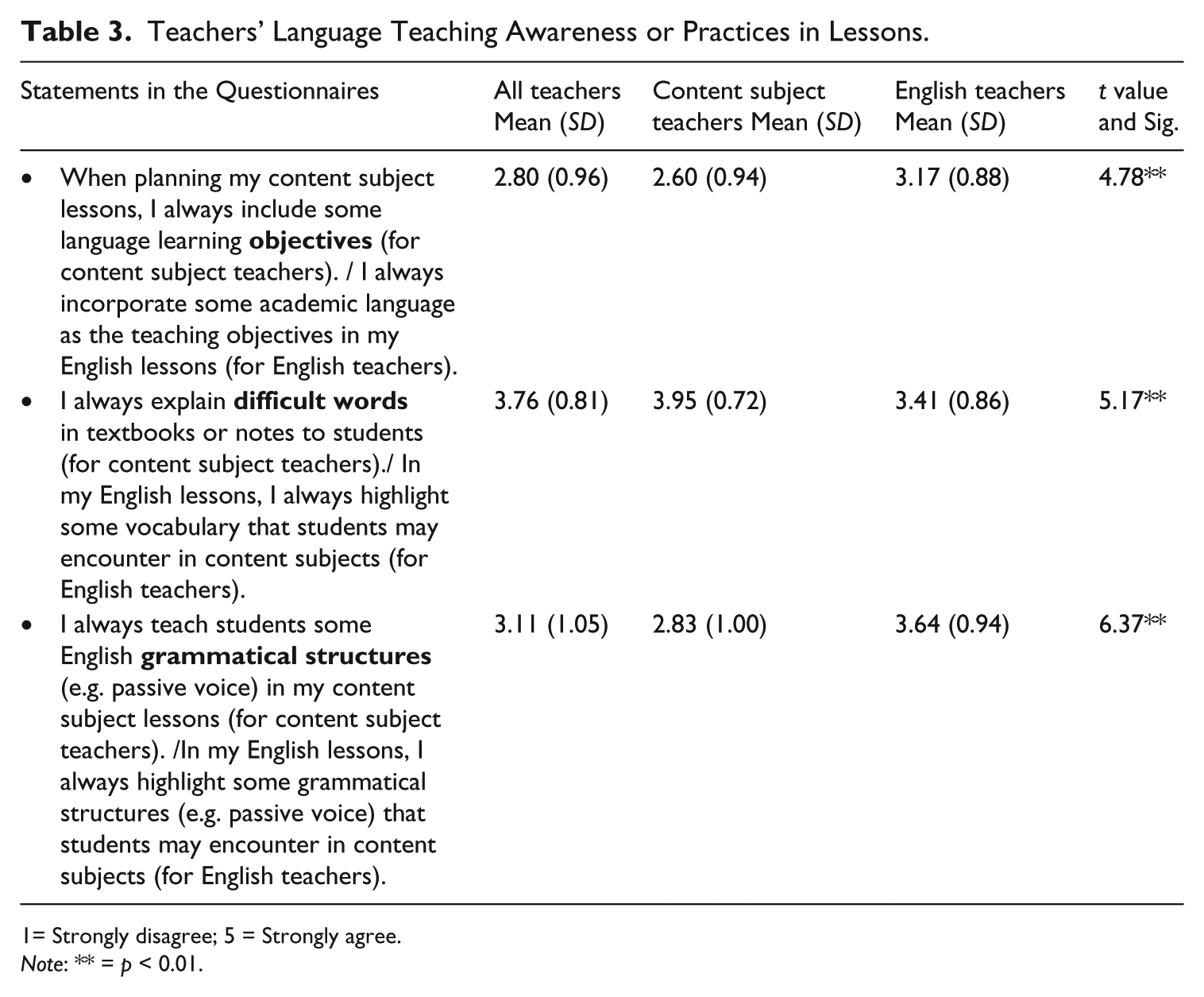
Closely related to teacher beliefs about their roles are their practices of language teaching in lessons. Such practices reflect teachers’ pedagogical foci in lessons, thereby disclosing their commitment to language teaching. Three statements in the questionnaires explored this aspect, and the results are shown in Table 3.
Teachers’ Language Teaching Awareness or Practices in Lessons.
1= Strongly disagree; 5 = Strongly agree.
Note: ** = p < 0.01.
Table 3 shows some significant and interesting differences between content subject and English teachers regarding the planning and delivery of lessons. At the stage of lesson planning or preparation, content subject teachers reflected a lower awareness of language teaching (t = 4.78, p < 0.01). This corresponds to the finding presented above that content subject teachers did not give equal weighting to content and language teaching. However, when it came to language teaching in lessons, content subject teachers paid more attention to constant vocabulary teaching than English teachers (t = 5.17, p < 0.01), but the opposite was true for grammatical structures (e.g. passive voice) (t = 6.37, p < 0.01). Such a difference may be due to the assumption that acquiring academic vocabulary is important for students to grasp the subject content whereas grammatical accuracy may play a less significant role in this aspect.
During interviews, the content subject teachers did mention some of their practices to help students with the language. For example:
I will use around 5% of (lesson) time to help students revise English vocabulary … We have also designed some worksheets about the structures of questions to help students.
When teaching them (students) how to write procedures, I first give them a list, teach them ‘add’ something ‘to’ something and give them a lot of fill-in-the-blank questions.
However, with reference to the questionnaire data, these intentional language teaching practices in content subject lessons may be regarded as exceptions rather than the norm.
Teacher Beliefs about the Effectiveness of Cross-Curricular Collaboration
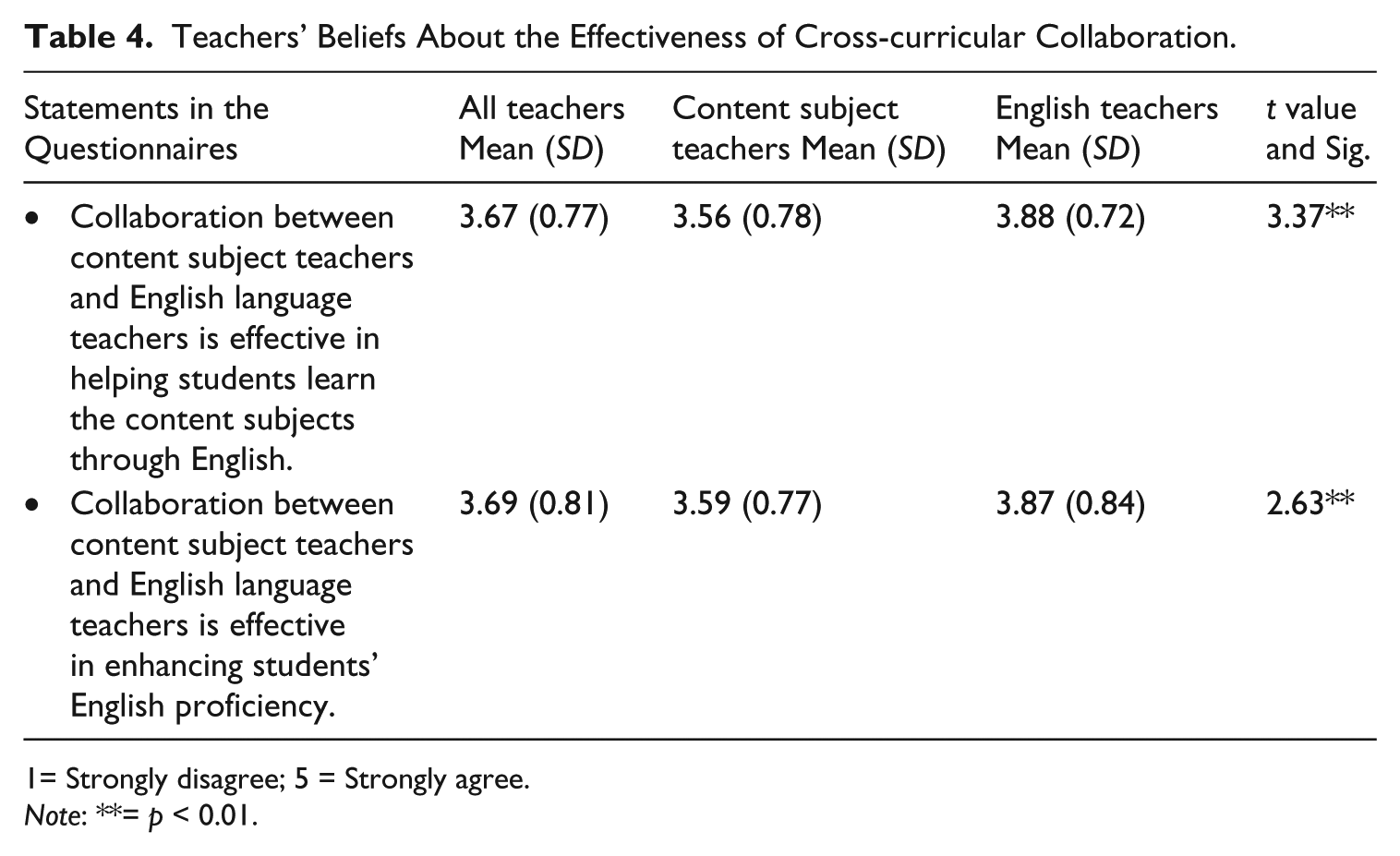
Teacher beliefs about the effectiveness of cross-curricular collaboration were explored through 2 statements in the questionnaires, the responses to which are shown in Table 4.
Teachers’ Beliefs About the Effectiveness of Cross-curricular Collaboration.
1= Strongly disagree; 5 = Strongly agree.
Note: **= p < 0.01.
Both groups of teachers agreed that cross-curricular collaboration could help students learn the content subject and English language (M = 3.67, SD = .077; M = 3.69, SD = 0.81), with English teachers showing significantly stronger agreement than their colleagues teaching content subjects.
The teacher interviewees elaborated on the perceived effectiveness of cross-curricular collaboration. For instance, ET2 highlighted the idea that ‘knowledge cannot be divided’, in the sense that whenever students read something in English, the content of that reading may involve some other disciplines. Also, the teachers reflected that if some vocabulary or grammar items had been taught in English lessons, students could then apply such knowledge in content subjects and would find it easier to learn (CST1 and ET2).
Teacher Attitudes Towards Cross-Curricular Collaboration
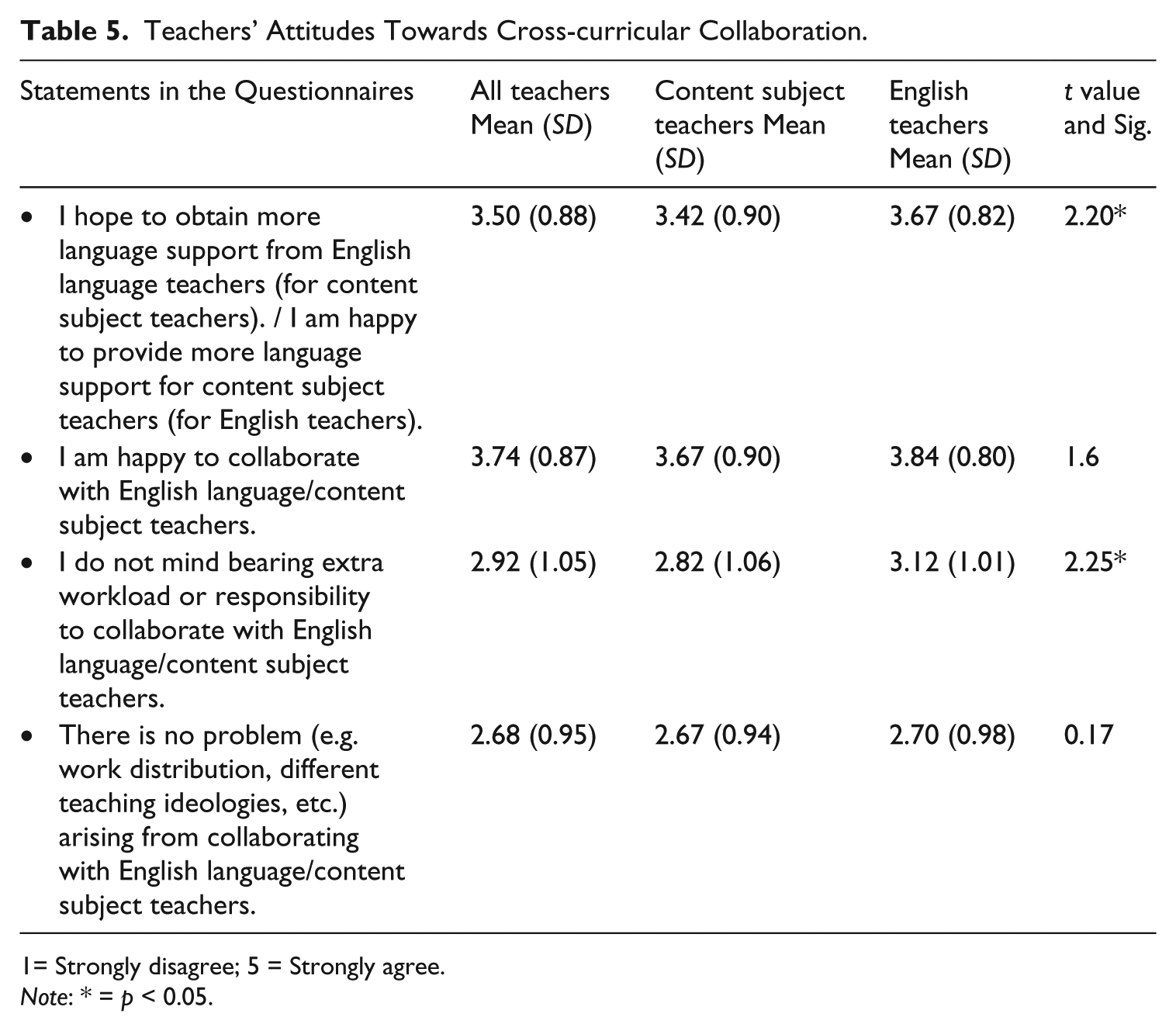
Teacher attitudes towards cross-curricular collaboration were explored through 4 statements asking teachers to indicate their happiness to help and collaborate, in the face of some environmental factors such as workload and perceived difficulties. The results are presented in Table 5.
Teachers’ Attitudes Towards Cross-curricular Collaboration.
1= Strongly disagree; 5 = Strongly agree.
Note: * = p < 0.05.
In response to the statement ‘I hope to obtain more language support from English language teachers’, content subject teachers indicated their desire for this (M = 3.42, SD = 0.90). For the corresponding statement, ‘I am happy to provide more support for content subject teachers’, English language teachers expressed a significantly stronger agreement (M = 3.67, SD = 0.82). Also, when being asked whether they are ‘happy’ to collaborate with each other, both groups of teachers indicated a fair degree of willingness to do so (M = 3.74, SD = 0.87).
However, it seems that such willingness to collaborate came with the condition that teachers did not need to carry an extra workload or bear additional responsibility (M = 2.92, SD = 1.05). The questionnaire data show that content subject teachers were particularly concerned about the potential increase in workload involved in cross-curricular collaboration. In the interviews, all the teachers expressed the concern that teachers already had heavy workloads and so they could not afford extra time to collaborate with each other.
In addition to the extra workload or responsibility, both groups of teachers could foresee some problems arising from cross-curricular collaboration (M = 2.68, SD = 0.95). Such problems were further explained by the teacher interviewees. First, different groups of teachers may have different ideologies or foci, which may eventually result in conflict. CST1 provided an example: ‘Science subjects normally use passive voice, something which English teachers don’t like. But in Science subjects, using active voice is forbidden. In this aspect, the two subjects may have some conflicts’.
Another problem experienced in cross-curricular collaboration is the distribution of work across different groups of teachers. ET3 mentioned that many teachers would be involved in cross-curricular collaboration and so it might be difficult to decide who should carry the responsibility or take the initiative. ET2 also pointed out that sometimes teachers of other subjects may rely on English teachers too much. Whenever students had any difficulties in language, content subject teachers tended to think that it was the responsibility of English teachers to help them. ET2 believed that English teachers also had their own syllabus to cover and so content subject teachers may also need to handle students’ language problems. Such a view actually echoed teacher beliefs about their roles in English-medium education presented above (i.e., while content subject teachers agreed it was the role of English teachers to teach academic language to students, English teachers did not think it was their role to ‘help’ content subject teachers).
Discussion
This study investigated L2 and content subject teachers’ beliefs and attitudes towards cross-curricular collaboration, which is seen as one potentially beneficial form of teacher collaboration in CBI programmes. By contrasting L2 and content subject teachers’ beliefs and attitudes in different areas, this study corroborates previous research and further identifies some tensions involved in L2-content cross-curricular collaboration in CBI in EFL contexts.
First, there seems to be tension between content subject teachers and L2 teachers regarding their beliefs about their pedagogic roles and practices in CBI. Echoing other researchers’ observations (Man, 2008; Trent, 2010), content subject teachers believed it was the role of L2 teachers to teach students academic language required for learning other subjects in CBI, and they did not demonstrate strong commitment to language teaching when planning their lessons. In contrast, L2 teachers agreed that they would teach students some academic language, yet they did not think their role was to ‘help’ content subject teachers. This actually reflects a distinctive feature of cross-curricular collaboration in contexts where the L2 is pragmatically valued and hence is itself a core subject. There, L2 teachers (e.g. English teachers) are an independent group, who have their own syllabus to teach and are responsible for helping students cope with external L2 examinations. They enjoy at least the same power or status as other core content subject teachers, like Science and Geography teachers, and may hence develop a stronger feeling of their independent role (Goodson, 1987). The power relationship between L2 and content subject teachers in these contexts is apparently different from the contexts where cross-curricular collaboration is mainly implemented to help ESL/EAL students to transit to the mainstream English-medium classes (e.g. the USA and the UK) (Crandall, 1998; Creese, 2010). Hence, it seems that the implementation of cross-curricular collaboration in different contexts should be separately investigated, considering the socio-linguistic context, different status of the target language and hence the different status of teachers involved.
Second, there seems to be tension between the ‘ideals’ and ‘realities’ of implementing cross-curricular collaboration. Though both groups of teachers generally believed in the effectiveness/benefits of collaboration and demonstrated positive attitudes towards it, they did express some reservations when the working environment (e.g. workload, distribution of responsibilities) was considered. It therefore seems that teachers did consider both the ‘potential’ effectiveness and ‘realities’ of collaboration, especially in examination-driven education systems such as Hong Kong. As Trent (2010) suggested, L2 and content subject teachers are primarily concerned about students’ achievements. Considering the fact that the L2 and content subject examinations are separate and students’ language proficiency is not given strong emphasis in content subject examinations, the two groups of teachers may lack the initiative and motivation to engage in collaboration, which they perceived as time-consuming and a potential source of problems.
However, when comparing the attitudes of the two groups of teachers, L2 teachers were significantly more open to the idea of collaboration. Such a tendency can be explained by the different characteristics of the subjects. In the case of L2-content cross-curricular collaboration in Hong Kong, the nature of content subjects (e.g. Science, Geography) may be more well-defined, given the stipulated syllabi for public examination and the press for content coverage. Hence, content subject teachers may have a stronger sense of their own discipline and feel less ready for others to ‘intrude’. On the other hand, the English language subject, though also subject to external examination and syllabus, tends to be more open and less well-defined in nature (Trent, 2010), since students are tested on their general language skills. L2 teachers may thus be more willing to collaborate with others and perhaps incorporate the elements (e.g. academic vocabulary) of other content subjects into their language lessons.
This study has provided new insights into the tensions between L2 and content subject teachers when they are involved in cross-curricular collaboration. The study findings have important implications for teacher education. To promote cross-curricular collaboration in CBI, teacher educators may consider the following when mounting professional development programmes for both groups of teachers to attend:
Introducing to teachers the rationales behind and principles of CBI (i.e., content and language integration). This will then pinpoint the fact that ALL teachers have a role to play in helping students acquire L2 (Man, 2008).
Exemplifying various ways and levels of cross-curricular collaboration. For instance, small-scale collaboration may start with content subject teachers seeking advice from L2 teachers on the language used in the teaching materials, which can later develop into more in-depth collaboration such as cross-curricular planning or even co-teaching (Davison, 2006; Tan, 2011).
Sharing effective practices of cross-curricular collaboration in schools, especially in terms of student learning outcomes. According to Guskey (1986), changes in student learning outcomes are very likely to result in significant changes in teacher beliefs and attitudes.
Despite these interesting findings, this study has certain limitations. The first one is the low response rate to both the questionnaire and interview invitations. Though efforts were made to elicit more participating schools and teachers, the response rate remained not particularly high. Hence, generalizations based on the findings should be made with caution. Another limitation is that this study only explored what teachers ‘think’ or ‘say’, without the triangulation of seeing what they ‘do’ (i.e., observations). Although it is a common practice to infer teacher beliefs from what they say, researchers have also warranted that teachers’ behaviours should also be examined (Pajares, 1992). Observing teacher behaviours was beyond the scope of this study and so this constitutes a potential limitation.
Conclusion
Collaboration between L2 and content subject teachers has been encouraged in CBI programmes, but there has been limited research investigating such kind of teacher collaboration, particularly in Asian contexts where a pragmatically valued second/foreign language (e.g. English) is the target language and teachers tend to be highly specialized in either L2 or content subject teaching. One important factor in effective implementation of L2-content cross-curricular collaboration is teacher beliefs and attitudes. This study explored this important factor by comparing the beliefs of L2 and content subject teachers, thereby revealing where the disparities mainly lie. In addition, being contextualized in Hong Kong English-medium schools, this study also highlighted an issue related to the positioning of L2 and content subject teachers. This study does not intend to suggest that teacher beliefs and attitudes are the only factor affecting the effectiveness of cross-curricular collaboration, nor that teachers are the ones to be blamed for lack of effective cross-curricular collaboration. It is acknowledged that other external contextual factors also have a significant role to play. Yet, by examining teachers’ beliefs and attitudes, this study has revealed important implications for teacher education regarding how to encourage teachers to engage in a way that will enhance the effectiveness of teaching and learning.
This study also provides some insights into the feasibility of L2-content cross-curricular collaboration. Instead of dividing teachers into two broad groups, perhaps future research can examine the beliefs and attitudes of particular content subject teachers (e.g. Science, Humanities) to see which groups are more receptive to cross-curricular collaboration. Researchers may also examine the actual collaboration processes between L2 and content subject teachers to discover what problems may arise. Another direction of research, which is currently lacking, is effectiveness research. It will be significantly insightful if the perceived effectiveness of L2-content cross-curricular collaboration can be supported by empirical evidence.
Footnotes
Appendix
Details of the Six Teacher Interviewees.
| Identification | Types of schools currently teaching at | Years of teaching experience | Subject(s) currently teaching |
|---|---|---|---|
| CST1 | Government aided Chinese-medium school with English-medium classes | 2 | Science; Computer Literacy |
| CST2 | Government aided English-medium school | 20 | Science; Computer Literacy |
| CST3 | Government aided English-medium school | 4 | Science; Liberal Studies |
| ET1 | English-medium school under direct subsidy scheme | 10 | English |
| ET2 | Government aided English-medium school | 7 | English |
| ET3 | Government aided English-medium school | 3 | English |

Funding
This research was supported by the Hong Kong Institute of Education research grant.