



Abstract
This article reports on a principle-based evaluation of eight dedicated extensive reading coursebooks published in mainland China and used in many universities across the country. The aim is to determine the extent to which these coursebooks reflect a core set of nine second language acquisition and extensive reading principles. Our analysis shows that while some of the coursebooks contain features that comply with these principles to an extent, the rest exhibit features of traditional intensive reading coursebooks. Most of these coursebooks contain reading materials that are linguistically too demanding and tasks that are cognitively and affectively unappealing. As a result, they are unlikely to achieve their designated purposes.
Introduction
Since the publication of Richard Day and Julian Bamford’s book Extensive Reading in the Second Language Classroom (1998), numerous empirical studies have been conducted to examine the language learning benefits of extensive reading (ER). Most of these studies have now been documented in a specialized ER bibliography on the Extensive Reading Foundation webpage (http://erfoundation.org/wordpress/er-bibliography). Results of these studies generally confirm the beliefs held by many experienced language teachers that ER can have a beneficial impact on learners’ second language (L2) development. L2 learners who read in quantity over a period of time tend to enjoy many cognitive, affective, and linguistic benefits. As Bamford and Day (2004: 1) point out: Good things happen to students who read a great deal in the foreign language. Research studies show they become better and more confident readers, they write better, their listening and speaking abilities improve, and their vocabularies get richer. In addition, they develop positive attitudes toward and increased motivation to study the new language.
Given the many positive benefits of ER, L2 scholars, including ELT experts (e.g. Macalister, 2014; Maley, 2005, 2008), L2 reading specialists (e.g. Day and Bamford, 1998; Grabe, 2009; Nuttall, 2005), coursebook researchers (e.g. Brown, 2009; Tomlinson and Masuhara, 2013), and SLA researchers (e.g. Ellis, 2005; Nation, 2007) give ER a respectable place in language teaching. Indeed, Maley goes so far as to suggest that ER is perhaps ‘the single most important way to improve language proficiency’ (2005: 354).
The theoretical underpinnings of ER can be traced back to Krashen’s comprehensible input hypothesis (Krashen, 2009). This hypothesis suggests that learners need plentiful language input in order to learn a language. Not all input is useful however; only that which learners comprehend can lead to acquisition. In addition, this input will have to be meaningful to learners and available in a large quantity. Although not all L2 researchers agree with Krashen’s comprehensible input hypothesis in its entirety, no one disagrees that input is a key factor in language learning, especially in contexts where language input is often lacking. Support for Krashen’s claim about the importance of comprehensible input can be found in the recent writings of renowned L2 researchers (e.g. Ellis, 2005; Nation, 2007). Working independently, they each came up with a set of pedagogical principles for L2 teaching which include the provision of large amounts of comprehensible language. Nation’s (2007: 9) first two principles, for example, stress the key role of ER in language instruction:
Principle 1: Provide and organise large amounts of comprehensible input through both listening and reading.
Principle 2: Boost learning through comprehensible input by adding a deliberate element.
However, despite strong empirical evidence for the benefits of ER and recommendations by ELT experts that ER be made an important part of a language programme, it has not always been fully embraced by teachers. While many believe that ER is important, there are some practical concerns that often hinder the full adoption of ER in the classroom. Some of these concerns are summarized below (Brown, 2009; Day and Bamford, 2002; Jacobs and Farrell, 2012; Maley, 2008; Renandya, 2007; Renandya and Jacobs, 2002):
The impact of ER is not immediate. It may take up to one year to see tangible effects on learners’ language development (Renandya, 2007). Since teachers are often under pressure to produce tangible results of their teaching, they tend to avoid projects that have delayed impact on learning.
ER means that students read silently and independently for a period of time without interruption. When students read silently, some teachers may feel uncomfortable because they often view teaching as involving talking to students and explaining language points. As Day and Bamford (1998) rightly point out, being silent during a reading lesson is something that teachers are not accustomed to.
The last and perhaps the most important reservation that stakeholders have about ER has to do with the issue of legitimacy. Students doing independent silent reading in class are often ‘not perceived as a class learning, let alone being taught, both by the students themselves and the school administration’ (Prowse, 2002: 144). Because of this, ER is often perceived as an optional extra (Yu, 1993) and therefore seen as playing a peripheral role.
The last point above deserves elaboration. If we are interested in encouraging a wider adoption of ER in language programmes, it has to be perceived as a legitimate activity. Unless teachers and administrators are convinced that ER is a credible and legitimate learning activity, not many schools will implement ER. One way to overcome the issue of legitimacy would be to integrate ER into coursebooks. Coursebooks, according to Brown, can provide legitimacy and credibility because they are often seen as ‘powerful legitimizing tools, for teachers, for learners, and for institutions’ (2009: 240).
We find the idea of incorporating ER into coursebooks intriguing and deserving further exploration. We agree with Brown (2009) that coursebooks can be a powerful and effective vehicle for promoting ER’s wider adoption in schools. As far as we know, there are some commercially available coursebooks that attempt to incorporate ER. Brown (2009), for example, discussed several ELT coursebooks that included ER ideas, which he categorized into two types. The first type included those that made casual mention of ER with suggestions that students read easy, graded materials in their spare time but without actually providing specific titles. The second type included actual extracts or complete stories from graded readers, thus providing students with first-hand experience to enjoy reading easy and interesting materials. Brown, however, did not mention any coursebooks that were specifically designed to teach ER in the classroom, i.e. ones that contained easy and interesting materials and ER-friendly post-reading tasks and activities.
We were therefore excited when we came across dedicated ER coursebooks for use with undergraduate EFL students in China. We were curious to find out what these coursebooks look like and also wondered if they are written in ways that reflect current SLA and/or ER principles. This paper therefore aims to evaluate the overall quality of several dedicated ER coursebooks published and used in many universities in China and identify those that come close to what we think an ‘ideal’ ER coursebook should contain.
We must, however, mention that ER coursebooks are no replacement for a full-fledged ER programme, where students do large amounts of self-selected reading. It is not realistic to expect coursebooks to provide this type of reading because ‘the resulting books would be large ungainly things’ (Brown, 2009: 241) and the cost of producing these books would be prohibitively high. ER coursebooks, however, can and should introduce students to the joys of reading by enabling them to read short and easy reading materials and by encouraging them to do further ER in their own time. It is with this goal in mind that we set out to evaluate a number of ER coursebooks produced for university students in China.
We describe below the coursebooks that we selected from a range of textbooks that we managed to get hold of. This is then followed by a description of the principles that we used for evaluating these coursebooks.
The ER Coursebooks
In the Chinese EFL context, reading instruction holds a unique and dominant place in college English teaching. Among the five macro language skills (i.e. listening, speaking, reading, writing, and translation) specified by China’s Advisory Committee on Foreign Language Education in Higher Education, only reading is offered as a compulsory degree course for both undergraduate English majors and non-majors, whereas other skill-based courses are either optional or required only for English majors. Reading instruction is typically provided in two separate courses in Chinese universities: intensive reading and extensive reading. Given the unique importance of reading instruction and our aforementioned interest in the incorporation of ER into coursebooks in China, we decided to examine officially designated ER materials for the second type of reading instruction.
We began by casting our net wide on the dozens of ER coursebooks available in the market. We then screened these coursebooks systematically according to a set of selection criteria we agreed on. These criteria are summarized below:
We would only consider ER coursebooks published by highly reputable publishers (e.g. Foreign Language Teaching and Research Press; Shanghai Foreign Language Education Press) and/or those whose editors-in-chief are well-known scholars (e.g. Hu Zhuanglin and Dai Weidong). The reason is simple: such coursebooks are likely to have a larger market share and, consequently, may exert a great influence on how ER is implemented in Chinese universities.
The ER coursebooks selected for further analysis should include those written for both English majors and non-English majors. Despite differences in their English proficiency and in instructional and assessment requirements for these two groups of students, we believe that ER coursebooks produced for them should be subjected to an evaluation by the same fundamental learning principles.
Like graded readers, English coursebooks designed for undergraduates in China are also graded. Usually, an ER coursebook set consists of four books, with each one intended for use in a semester of 18 teaching weeks. Thus, Books 1 and 2 are for the two semesters of the freshman year, whereas Books 3 and 4 are for the two semesters of the sophomore year. As students’ English proficiency and reading competence grow, their ER needs are also likely to change. Consequently, we needed to sample ER coursebooks intended for use at different year levels so that we could examine examine the extent to which the ER coursebooks made deliberate attempts to cater to students’ developing command of English. In view of the recognised importance of ER to lower-proficiency stages, we decided to focus on Book 1 or Book 3 of each shortlisted coursebook set.
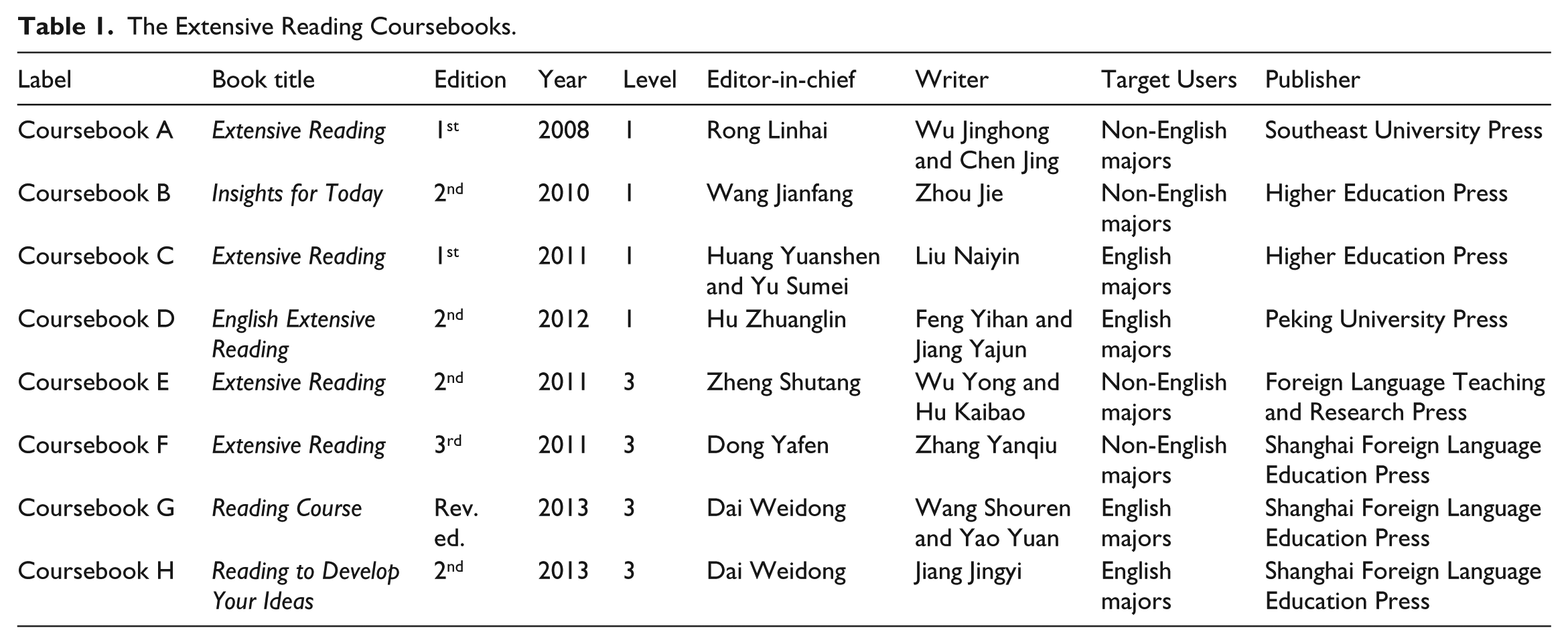
The application of the above criteria led us to settle on eight ER coursebooks for undergraduate students. Table 1 presents general information about these sampled coursebooks. We decided to sample three units from each chosen coursebook for detailed analysis. These units, we believe, would yield a representative sample of the ER materials in each coursebook. If a coursebook had no more than 10 units, units 3, 5, and 7 were selected. If there were more than 10 units, units 3, 7, and 11 were chosen. In total, 24 units were sampled from the eight coursebooks for evaluation. These units were divided among us equally so that each unit would be evaluated by two of us independently.
The Extensive Reading Coursebooks.
All the reading texts in each unit were word-processed and then submitted to a Flesch-Kincaid readability analysis in Microsoft Word and a vocabulary frequency analysis with VP-Compleat (http://www.lextutor.ca/vp/comp/), an online vocabulary profiler that has been used widely for teaching and research purposes. The resultant readability indices were averaged over the three units of each coursebook to derive combined statistics. The numbers of word tokens from different frequency levels identified in the vocabulary frequency analysis were summed over the three units in each coursebook, and the percentages of word tokens beyond the first 4,000 most frequent words were computed. The readability indices and vocabulary frequency information complemented our comprehensibility judgments based on a close reading of the texts.
Principles for Evaluating the Coursebooks
Following a selective review of the literature, we identified a set of principles from a number of published sources. We focused in particular on L2 learning principles suggested by SLA researchers (e.g. Ellis, 2005), ELT specialists (e.g. Nation, 2007; Nation and Macalister, 2010; Tomlinson, 2012), and L2 reading experts (e.g. Day and Bamford, 2002; Nuttall, 2005; Williams, 1986). We then narrowed them down to principles that could be used to help us evaluate ER coursebooks. The resulting set of nine principles is listed below:
The coursebook provides interesting and comprehensible reading materials. As Williams writes, ‘In the absence of interesting texts, very little is possible’ (1986: 42). In addition to being interesting, these texts should also be relatively easy for students to understand (Krashen, 2009). Ideally, students should know about 98% (or more) of the words in the reading passages (Hu and Nation, 2000).
The coursebook provides plenty reading materials. Quantity is one of the key features of ER because the language learning benefits of ER begin to emerge only when students read in quantity (Jacobs and Farrell, 2012). Although some ER researchers suggest ‘a book a week’ (Day and Bamford, 2002) for students to obtain the benefits of ER, this desirable target would need to be adjusted when applied to coursebooks.
The coursebook contains tasks and activities designed to help develop students’ fluency in reading. Fluent reading is a result of fast and automatic processing (Hu, 2013). Research shows that unless students have developed some automaticity in processing textual information, they will have difficulty building a coherent understanding of the text (Grabe, 2009). Tasks that require students to engage in repeated reading of the same material, and activities that encourage students to read faster, for example, can help students achieve fluency in reading (Macalister, 2010). Care, however, should be taken so that the fluency activities do not take away students’ reading enjoyment.
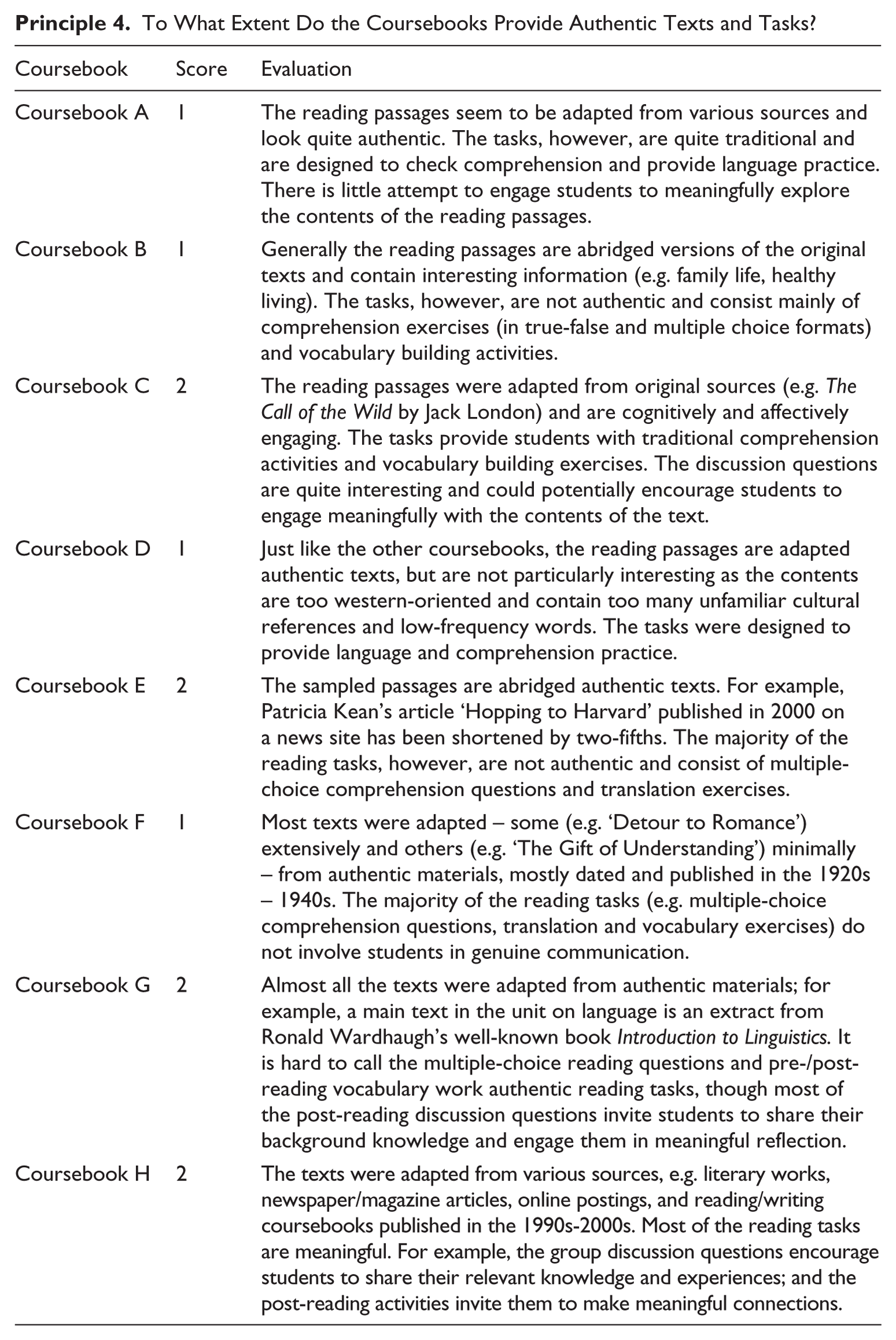
The coursebook contains authentic texts and tasks. Texts and tasks of an authentic nature involve natural language and are pragmatically relevant (Rilling and Dantas-Whitney, 2009). The notion of authenticity is controversial; some people define authenticity in terms of who produces the text and/or the purpose for which the text is produced. For the purpose of our paper, we adopt Tomlinson’s definition of authentic text and task, as follows: ‘an authentic text is one which is produced in order to communicate rather than to teach, and an authentic task is one which involves the learners in communication in order to achieve an outcome, rather than practice the language’ (2012: 162).
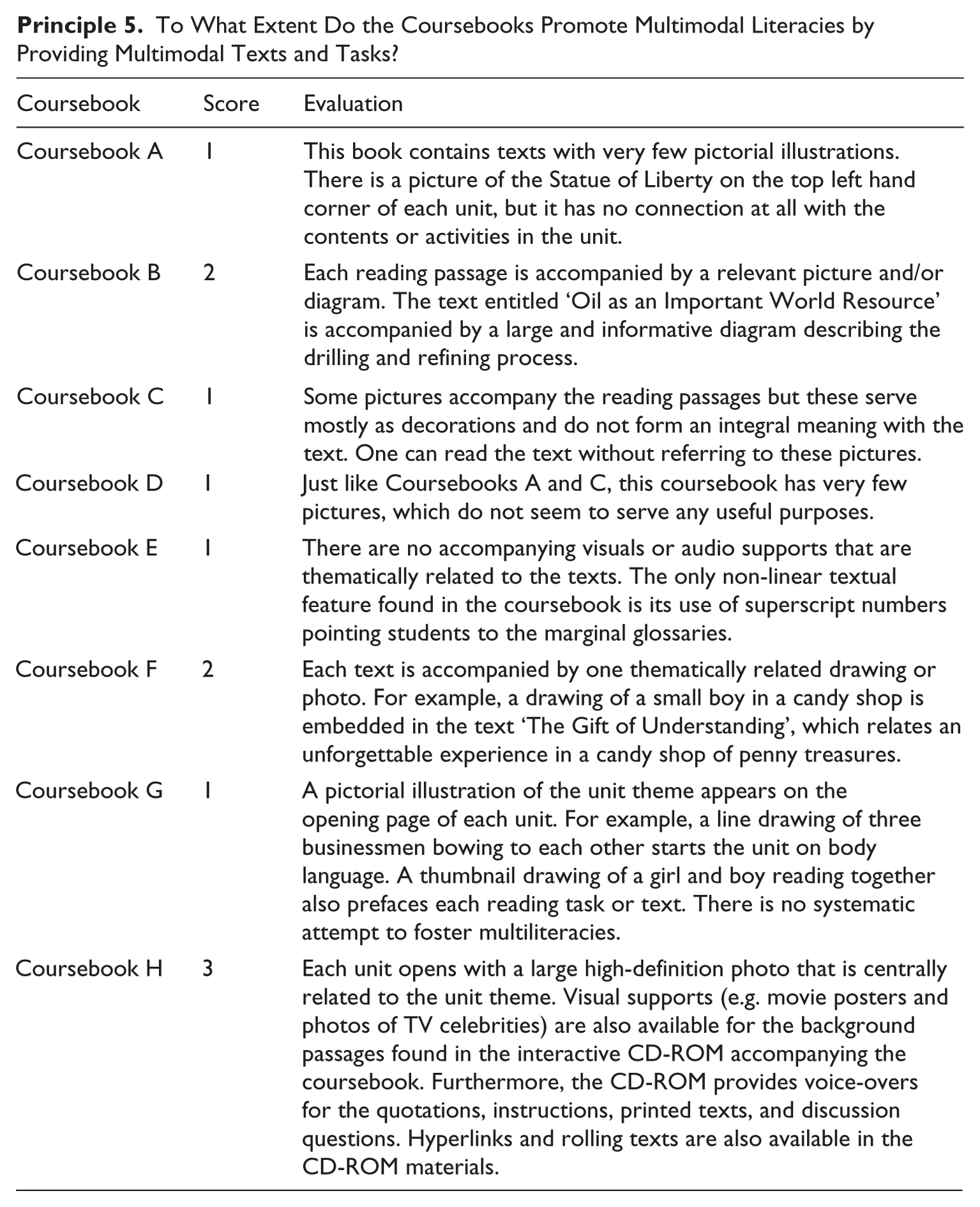
The coursebook contains multimodal texts. Such texts convey meanings through a combination of different semiotic modes – verbal, audio, and visual (Lankshear and Knobel, 2011). With the advances of information technology, reading materials in the real world have become increasingly multimodal in nature. Thus, effective comprehension of such materials requires skills in simultaneous and complementary processing of information presented in multiple modes (Smolin and Lawless, 2003).
The coursebook contains texts and tasks that are cognitively and affectively engaging (Tomlinson, 2003). Coursebooks often include texts and tasks that are bland and unappealing, and are hence unlikely unlikely to lead to deeper learning. For, as Tomlinson rightly points out, ‘without affective and cognitive engagement there is little possibility of deep processing … and therefore little hope of enduring acquisition’ (2012: 164).
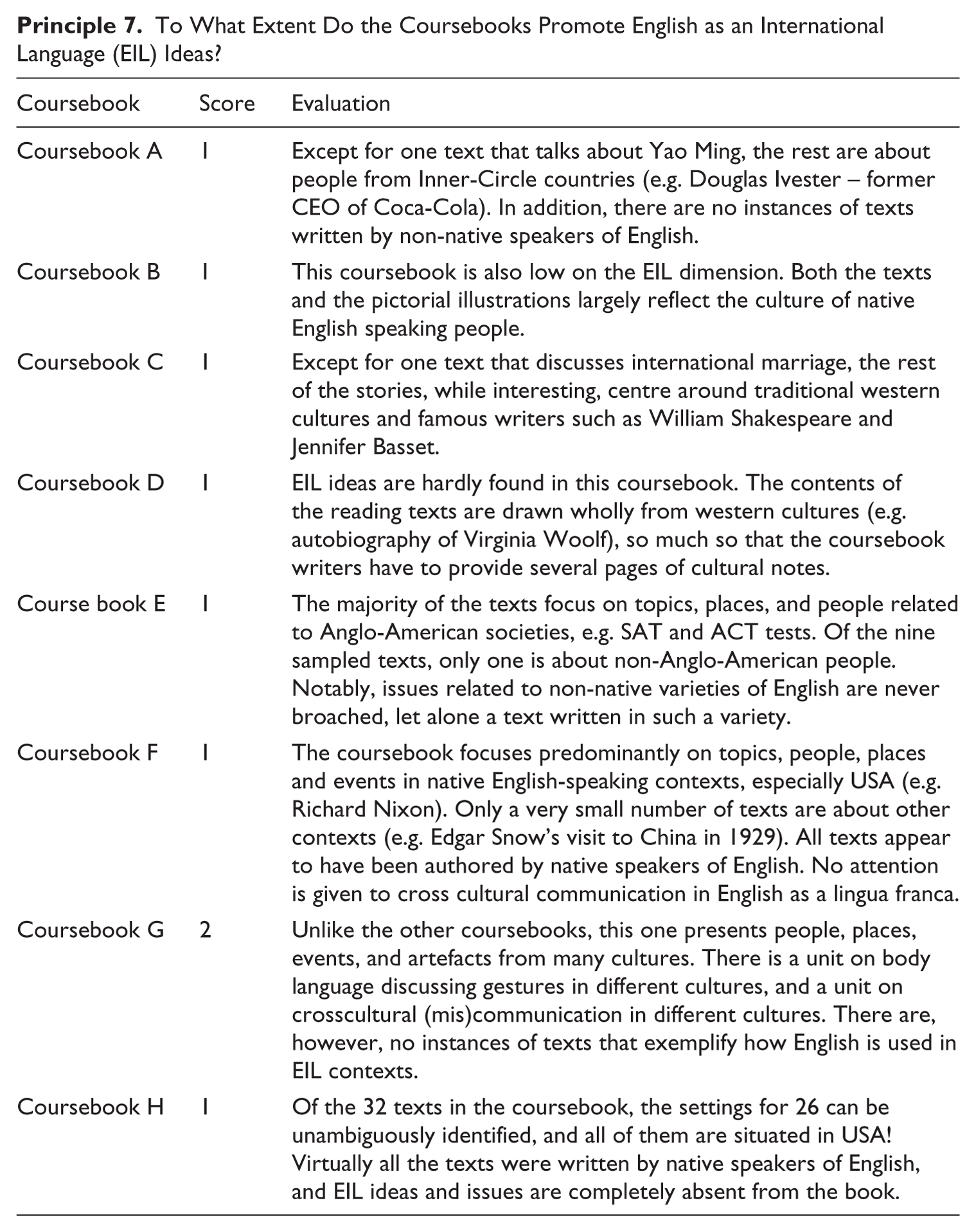
The coursebook provides texts that reflect how English is used in the world today. Because of the status of English as an international language, coursebooks should include texts written by both native and non-native speakers of English (Hu and Mckay, 2014). This will sensitize students to the different varieties of English used by a wide range of people in the world today.
The coursebook provides opportunity for learners to develop autonomy (Day and Bamford, 1998). Carrell and Eisterhold argue that an ultimate goal of L2 reading programs is ‘to develop independent readers outside the EFL/ESL classroom, readers whose purpose in learning to read in English as a foreign or second language is to learn from the texts they read’ (1983: 569). ER can be a natural and effective way of cultivating independent readers and fostering learner autonomy (Farrell and Jacobs, 2010; Maley, 2008).
The coursebook contains reading materials of various topics and text types (Maley, 2008). The availability of a variety of reading materials is key to encouraging students to read extensively. As our students are likely to have diverse interests in and purposes for reading, coursebooks should strive to provide for students’ varied needs (Day and Bamford, 2002).
The Evaluation of the Coursebooks
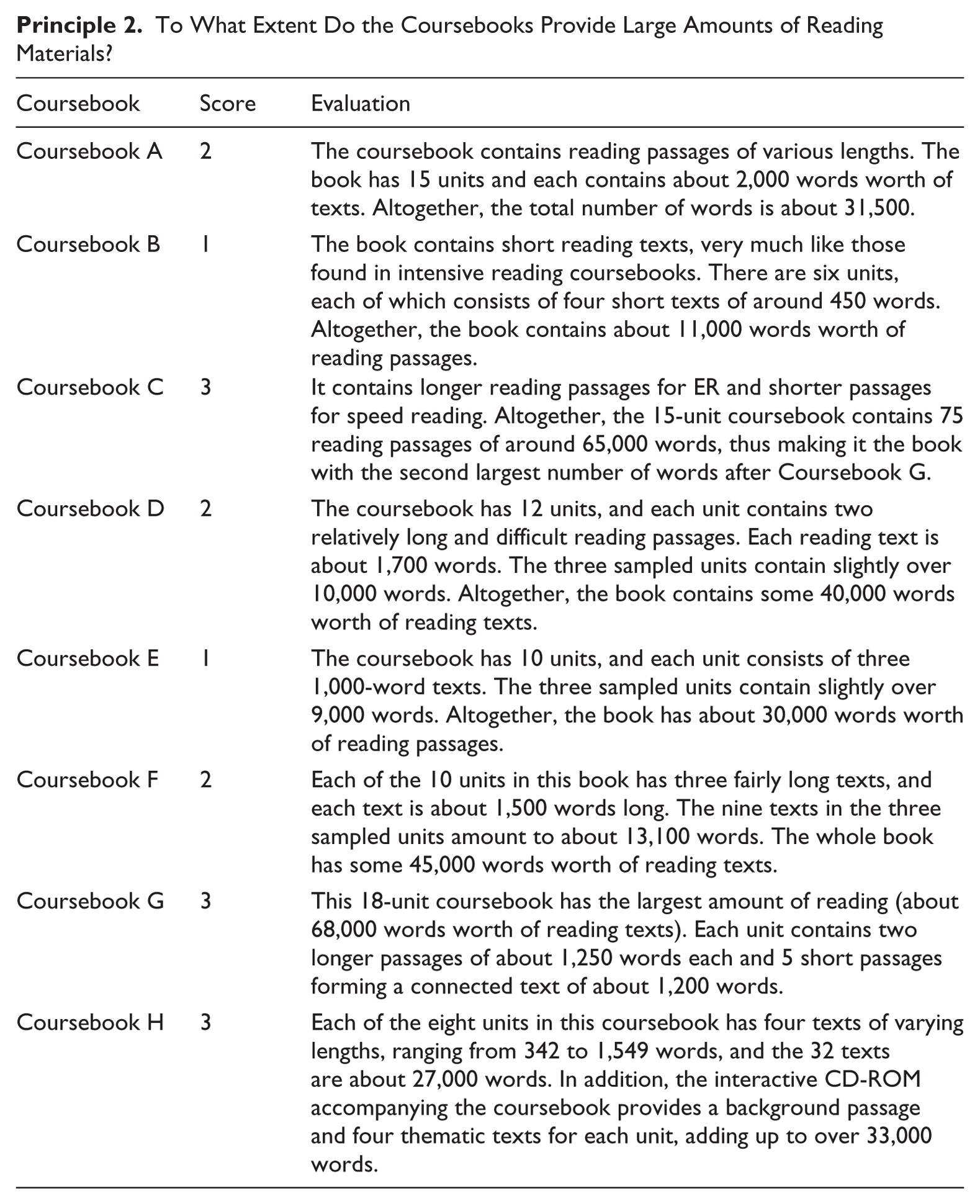
We present below our evaluation of each of the eight coursebooks using the nine principles we described above. We turned each principle into a question and then discussed the extent to which the contents of the coursebooks fit this principle. Following Tomlinson and Masuhara (2013), we present the findings in table form below. Each coursebook is given a score (1=little, 2=somewhat, 3=much) showing the extent a principle is reflected, followed by a brief commentary.
To What Extent Do the Coursebooks Contain Interesting and Comprehensible Materials?

To What Extent Do the Coursebooks Provide Large Amounts of Reading Materials?
To What Extent Do the Coursebooks Provide Texts and Tasks that Promote Reading Fluency?

To What Extent Do the Coursebooks Provide Authentic Texts and Tasks?
To What Extent Do the Coursebooks Promote Multimodal Literacies by Providing Multimodal Texts and Tasks?
To What Extent Do the Coursebooks Promote Deeper Learning by Providing Cognitively and Affectively Engaging Texts and Tasks?

To What Extent Do the Coursebooks Promote English as an International Language (EIL) Ideas?
To What Extent Do the Coursebooks Promote Learner Autonomy?

To What Extent Do the Coursebooks Provide Varied Materials?

Conclusion
Our aim was to find out whether the ER coursebooks we selected reflect a set of SLA-based principles. Our analysis shows that not all of the coursebooks come close to what an ER coursebook should contain. Only three of the eight coursebooks have received fairly high scores on the nine evaluation criteria. Coursebooks H has received the highest score (21 out of a maximum of 27), followed by Coursebooks C (18) and G (17). The writers of these coursebooks seemed to be aware of the key features that distinguish extensive from intensive reading. They also made a deliberate attempt to include these features in the design of their coursebooks.
We note, however, that although Coursebook G performed quite well overall, it scored poorly on our first criterion, i.e. comprehensibility. In fact, our readability analysis shows that the reading passages in Coursebook G are linguistically the most demanding. We feel that a major rewrite of the reading passages is in order so that they contain shorter, less complex sentences and fewer low-frequency words.
Upon closer inspection, we have also found that in general the books written for second-year students contain more comprehensible reading passages than those for first-year students. Also, the books written for English major students tend to be more comprehensible than those intended for non-English major students. As first-year, non-English major students generally possess lower proficiency in English, they should be exposed to material that more closely matches their linguistic competence and language learning experience. Research shows that when students understand what they read, they tend to enjoy reading and become more motivated to do more reading on their own (Day and Bamford, 1998; Nuttall, 2005). This then is one area of concern that ER coursebook writers should take note of.
Except for the three coursebooks mentioned above (C, G and H), the rest score quite low on the nine criteria. They contain reading passages and tasks that look more like those found in traditional intensive reading coursebooks, i.e. short and demanding texts that are specifically selected to teach reading comprehension skills or strategies and provide students with language practice. Thus, it would seem that major revisions would be needed before they could be legitimately called ER coursebooks. Such revisions would include adding longer reading passages that are not only varied in terms of contents, language and text types, but also linguistically, cognitively and affectively appropriate for the target students. The post-reading tasks would also need to be revised so that they allow students to interact with the texts in ways that are cognitively and emotionally meaningful. We believe that tasks that engage students in personally meaningful ways would motivate them to do self-selected reading outside the classroom in their own free time.
Footnotes
Funding
This research received no specific grant from any funding agency in the public, commercial, or not-for-profit sectors.