



Abstract
Investigating supervision comments, as a form of interaction between the teacher and the learner, is an area of research that has received little attention so far in spite of being crucial in creating an atmosphere of friendship and confidence-building. Previous research in this area has emphasized the role of affect in supervision comments in distance learning, however, this issue has not been investigated with regard to native versus non-native supervisors’ comments in face-to-face supervision settings. To address this, an attempt was made, in this study, to examine the use of affective markers in the supervision comments provided by native/non-native supervisors on MA TESOL/TEFL Iranian students. To do so, the written comments of the supervisors on the students’ theses were analysed using a framework called Cross-Cultural Speech Act Realization Project (CSARP) Coding Manual. The results indicated that the non-native supervisors tended to rely entirely on ‘bold on record’ strategies for providing written comments on their students’ theses and this was in contrast to the native supervisors’ tendency to use ‘redressive moves’ with affective markers rather than non-redressive or direct moves. The percentage of application of internal and external ‘redressive moves’ was another finding of the present study.
Introduction
Academic writing is a social practice and the problems related to writing at Doctoral or Masters level are not only attributed to skill-based issues of the learners but to many other factors in the broader context of the academic community, including the feedback provided by supervisors and how learners react and use that feedback (Kamler and Thomson in Can, 2009).
Among the three traditional categories for learning objectives along with knowledge and skills, one can refer to affective considerations in learning and teaching. Although, learning objectives are not officially set for conversations between a PhD/MA supervisor and a student, affect in the feedback provided by the supervisor is nevertheless an important consideration. The interaction between a PhD/MA supervisor and a student is also a learning and teaching context, though not a lesson, although objectives are not officially set. Nevertheless, a supervisor may have some affective objectives such as appreciating the student’s work, request for minor changes, and proposing new ideas (Reinders et al., 2013) that may be represented in his/her comments on writing the proposal or the chapters of the thesis.
There is considerable room for misunderstandings in the interactions that take place between supervisors and students from different cultural and language backgrounds. In such an environment supervisors need to take affective aspects of this interaction into account. Research such as that of Randall and Thornton’s (2001) has confirmed the importance of the role of affect in PhD/MA supervision. Randall and Thornton examined the role of the supervisors and how the key skills required for producing effective feedback can be developed. The findings of their study, in fact, provides an opportunity for those involved in offering feedback to reflect on the methods which can be used to maximize the effectiveness of their feedback. However, studies concerning the ways in which supervisors take affect into account in practice, especially in their written feedback are rare, especially regarding Iranian students and the comments they receive from their supervisors all the way through their higher education studies abroad or in Iran. Such studies are rare worldwide and to the best of our knowledge absent in terms of supervisions provided to Iranian learners by native or non-native supervisors.
This study, hence, sought to investigate how MA TESOL/TEFL supervisors used affective and politeness strategies when giving written feedback on their Iranian students’ theses, an area that has been neglected so far and has not undergone investigation. The main purpose is to add to the literature on practice by providing insights into the types of feedback provided by native versus non- native learners in their academic writing. The reason behind selecting native versus non-native supervisors are twofold. First, the majority of TESOL/TEFL teachers/supervisors worldwide are non-native English speakers, and no research has yet been conducted on these supervisors and their written comments during MA/PhD supervisions. Therefore, considering the role of these non-native speaking teachers/supervisors in the context of the global need for English language teachers, especially in EFL countries, investigating their role in supervision comments seems imperative. Second, coming up with a set of strategies for providing comments on students’ work by native and non-native supervisors would provide an opportunity for comparing the uptake of students of these strategies in the follow-up studies and consequently offering the most effective feedback types to be practiced by supervisors. To this end, we scrutinized the written interaction between five British supervisors and their Iranian students studying in the UK and compared them to the written comments provided by five Iranian TEFL supervisors on their Iranian students’ theses in Iran. The supervisors’ written feedback were analysed to determine the types and frequency of affective markers in the comments.
The present study was guided by the following questions:
How much of the written feedback in native versus non-native supervisions uses affective markers; that is, ‘redressive moves’ as opposed to ‘bold on record’ moves?
What percentage of different types of affective markers (redressive moves) is used by the native versus non-native supervisors?
Review of the Related Literature
Along with cognitive factors in the learning objectives taxonomy, affective factors such as motivation, anxiety, and empathy have been shown to have a great impact on the amount and quality of interaction between teachers and learners in all learning contexts including provision of comments by supervisors on learners’ theses with the purpose of developing a psychologically secure environment (Aoki, 1999; Léger de Saint and Storch, 2009). Storch and Wigglesworth (2010), concluding from the findings of their study, stated that uptake and retention of the comments may be affected by a host of linguistic and affective factors, including the type of errors the learners make in their writing and, more importantly, learners’ attitudes, beliefs, and goals, meaning that these affective factors play an important role in uptake and retention of feedback by the students, in general. Research has shown that both implicit and explicit feedback fosters students’ awareness of gaps in their knowledge; however, depending on the type of feedback provided by the teacher, students’ uptake may also differ. According to Campilio (2004), explicit feedback may serve a double function including raising students’ awareness of the mismatch between their knowledge and the target form and helping the students to find the correct solutions.
Providing friendly and supportive supervision along with constructive criticism and comments are among the students’ expectations of good supervision. Other expectations include: receiving timely supervision, reading students’ work, good insight into the subject, providing references, facilitating communication, assisting students in networking and even assistance in the students’ careers after graduation (Hallberg et al., 2012).
The concept of feedback in the learner-teacher relation refers to ‘the practice of providing accurate data on students’ performance and/or how others may view them’ (Spârleanu, 2006: 51) and should not be altered and transformed into an instrument of criticism and blaming students rather than encouraging and guiding them. According to Coffin et al., (2003 in Can, 2009: 128): ‘[F]eedback will (necessarily) differ in different teaching contexts: while there is evidence that feedback is not always as effective as it might be, what counts as effective feedback will differ, to some extent, between different lecturers and students, academic areas, cultural contexts, etc’. In fact, teaching academic writing is not something that comes naturally to supervisors, though they might be experts in their particular field. There are many factors that play a role in the supervision process.
Randall and Thornton (2001) also argue that for the teacher’s advice and comments to be internalized and consequently be put into practice, one ought to create an appropriate atmosphere in terms of affect and positive relationship in addition to addressing factual/content information. Of course, one must not lose sight of the fact that power as ‘the ability to influence one another’s circumstances’ (Holmes, 1995: 17) plays a vital role on this type of interaction since there is an uneven relationship between the learner and the supervisor. Consequently, supervisors rely on politeness strategies (Brown and Levinson, 1987) or linguistic markers ‘to guise this unevenness’ to use Reinders et al.’s (2013) term since the existing social gap and status difference between the interlocutors and in this case the learner and the supervisor can be mitigated through applying politeness strategies, especially, on the part of the dominant participant that is the supervisor.
To name a few studies in this area we can refer to Aijmir, 2005; Bowden, Hallahan, Hall and Soon, 2012; Can, 2009; Carayannopoulos, 2012; Erichsen, Bolliger, and Halupa, 2014; Hyland, 2003; Kumar and Stracke, 2007; Marchant, Anastasi and Miller, 2011; Renc-Roe, and Roe, 2006, Li, and Seale, 2007, and Thonus, 1999. All of these studies investigated the supervisor’s written feedback on MA/PhD dissertations/theses and came up with a model of analysis of students’ written work, some of which will be elaborated on below. The findings of these studies highlighted the significance of interaction between the supervisor and the students and the role that interaction plays in the induction of the students into the academic community.
One related study is Hyland’s (2003) in which he identified four types of mitigation strategies used by teachers in their comments on students’ writing. These were characterized as criticism along with praise or suggestion, hedging by using modals, personal attributes through using markers, such as those used by an ordinary reader, for example, ‘I’m sorry, but when reading this essay I couldn’t see…’, and finally, the interrogative forms that include an element of doubt and uncertainty.
In another study Kumar and Stracke (2007) came up with three functions of feedback namely referential, directive and expressive where the first refers to the editorial and content issues, the second includes suggestions, questions and instructions used by the supervisor to strengthen the content and the last consists of the criticisms, praise and opinions of the supervisor and benefits the students most.
Overall, successful PhD/MA graduation requires students to work closely with their supervisors and implement their feedback and comments as much as possible; hence, this is a crucial step for their accomplishment of their thesis. Additionally, feedback is at the heart of writing a PhD/ MA dissertation or thesis (Kumarand Stracke, 2007: 461). In fact, these two are inextricably intertwined and deserve more attention. However, research into the ways in which this collaboration is done, particularly on the part of the supervisor, is far from sufficient and requires more attention and investigation. The paramount role of feedback is well-known and as Li and Seale (2007) rightly argue, harsh or excessive criticism may lead the learners to lose face and create a feeling of embarrassment or loss of confidence and, in the worst scenario, result in them leaving the PhD/MA degree unaccomplished. The opposite is also quite common since constructive feedback is a necessary element in the supervision process and leads to confidence-building of the learner and a more positive and constructive atmosphere between the interlocutors. Therefore, feedback, especially of the negative type, needs to be delivered with care; otherwise, the results could be disastrous. As Connell (1985: 41) puts it ‘Criticism is…more likely to be well received (and constructively used) if it is clearly made in the context of respect and interest’.
Due to the important role of affect in supervision feedback and a paucity of research in the area of learner-supervisor interaction, the present study aimed to investigate the comments made by native versus non-native supervisors in such situations to give insight into the ‘redressive markers’ that supervisors use to minimize the potential negative impact of their feedback in the specific context of MA TESOL/TEFL supervisions. To this end, the Cross-Cultural Speech Act Realization Project (CSARP) Coding Manual, which includes a range of politeness schemes and categories for requests and apologies (Blum-Kulka et al., 1989) was used.
Methodology
Participants
The data were derived from the interaction between five British and five Iranian supervisors with their TESOL/TEFL students who were pursuing MA studies and were in the process of completing their research as a requirement for the MA programme. The students were male and female Iranian advanced L2 speakers of English studying in the UK and Iran and the supervisors were male or female native/non-native speakers of English. Some of the students were English teachers in state or private schools in Iran and were enrolled in Iranian universities. Others, who were based in the UK, were either English teachers on leave to pursue their higher education, or prospective teachers studying in the UK universities.
Instrumentation
The supervision took place through a combination of written asynchronous/email correspondence and oral face-to-face interaction from which the former comprised the data needed for the purpose of the present study. Cross-Cultural Speech Act Realization Project (CSARP) Coding Manual was the coding system that was used in this study.
Procedure
The written comments of the supervisors over the process of completing the MA degree were collected and analysed in order to come up with the methods employed by the supervisors in managing the affective aspect of providing feedback to their students.
The current study was a content analysis of an exploratory nature which aimed at finding out about the patterns of affective marker use and its percentage of use in the supervision comments provided by the supervisors.
As for the data analysis, the written comments provided by the supervisors on the students’ drafts were taken into account. The researchers first analysed these comments to identify affective markers, which were defined in this study as any utterance that included features that function to reduce potential face threats for the interlocutor. Cross-Cultural Speech Act Realization Project (CSARP) Coding Manual, which includes a range of politeness schemes and categories for requests and apologies (Blum-Kulka et al., 1989), was used for further analysis. The mentioned coding scheme includes internal and external ‘redressive moves’. ‘Redressive moves’ are defined as indirect or off-record strategies used by the speaker/writer to avoid the responsibility of damaging the addressee’s face (e.g. ‘It’s a bit stuffy in here’ is an indirect request to open the window. These are different from ‘ bold on record’ moves or without redress strategies which are used to perform acts by which the speaker shows little concern for the hearer’s face (Buitkene, 2006).
Internal Moves:
(1) Subjectivisers or linguistic devices such as ‘I think’ and ‘In my opinion’, emphasizing that the opinion is only on the part of the speaker, mitigating assertive force of the message (e.g. ‘I believe it is somewhat related to second one’);
(2) Past tense modals such as ‘could’ and ‘might’ which may downgrade the assertive power of the statement (e.g. As I mentioned, you could ask them to look at their recordings’);
(3) Politeness markers such as ‘please’ which soften utterances;
(4) Downtoners which are intended to make suggestions to the listener, but using sentential or propositional modifiers such as ‘perhaps’ (e.g. Perhaps you could add some more from a portfolio perspective’);
(5) Projecting the interlocutor through using suggestions proposed from the interlocutor’s perspective, thus reducing illocutionary power (e.g. ‘You may want to rephrase this…’);
(6) Phrasal modals that can reduce the effects of reinforcement resulting from suggestions (e.g. ‘You’d better move this up to the literature section’).
External Moves:
(1) Grounders which are defined as any reasons, explanations or justifications given for suggestions (e.g. ‘Think about how you are going to classify the difficulties – otherwise you won’t be able to compare them.’);
(2) External politeness markers which are suggestions that request cooperation from the interlocutor (e.g. ‘No thoughts here? How about the complexity of autonomy?’);
(3) Preparators which include any moves in which the speaker asks about the potential possibility of carrying out the suggestion, or asks for the interlocutor’s permission to make a suggestion in order to prepare the interlocutor for the ensuing suggestion without giving away the content of the speech act (e.g. ‘This may seem like bit picking but it is an important distinction and you’ll need to make it clear’);
(4) Downgrading commitments or modifiers that the speaker employs to minimize the degree of his/her commitment to a suggestion, but placed sentence-externally (e.g. ‘Although I don’t disagree with the below it seems to me that a crucial element is the teacher’s view of learning’);
(5) Imposition minimizers which are elements through which the speaker tries to reduce the imposition placed on the interlocutor by his/her suggestion (e.g. ‘if you want to avoid this rather specific term which has a particular meaning you could say ‘what do strategies do in dealing with their academic writing difficulties?’).
Therefore, the data was first categorized into comments with affective markers (redressive markers) and comments without such markers (e.g. ‘bold on record’ moves). Next, comments with affective markers were further analysed for the type of marker used. In cases where different types of markers were simultaneously adopted in one sentence, each instance was counted separately. The percentage of each of the markers was then calculated for the feedback given to students by their native/non-native supervisors.
Results and Discussion
The present study aimed at investigating the role of affective/redressive markers in the supervision comments provided by the native versus non-native supervisors on TESOL/TEFL students’ theses. The questions posed at the outset of this study were the following and are addressed one by one.
Q1: How much of the written feedback in native versus non-native supervisions uses affective/redressive as opposed to ‘bold on record’ markers?
Broadly speaking, comments in the supervision were divided into two different categories with the first category focusing on the comments that indicated the supervisor’s agreement with the work done by the student whereas the second category showed signs of disagreeing with the student’s opinion. Disagreement was indicated through either ‘bold on record’ comment or incorporating ‘redressive moves’ (with affective markers) to mitigate the potential impact of the affective strategies employed. Table 1 illustrates the application of redressive versus non- ‘redressive moves’ by native/non-native supervisors.
Percentage of Redressive versus Non- ‘redressive moves’ in Native/Non-native Supervision.
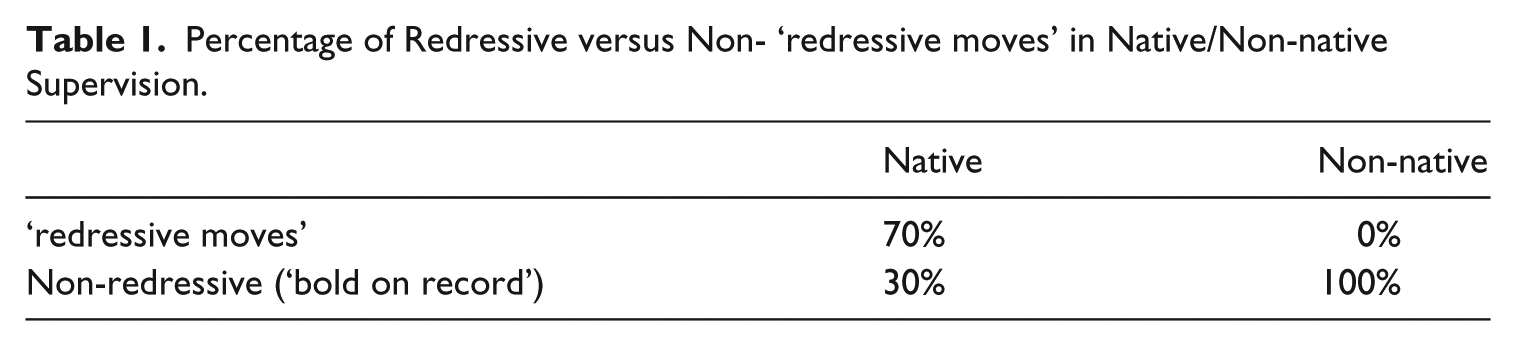
As Table 1 indicates, in the non-native supervision, the comments provided were entirely ‘bold on record’ that is direct and without any attempt on the part of the supervisors to mitigate the effect of their negative feedback or disagreement. In the native supervision, however, disagreement comments were mainly of redressive type (70%) as opposed to the ‘bold on record’ ones (30%). This is an indication of the fact that native supervisors tended to address feedback more frequently with the use of affective markers than without, in order to reduce potential face threats to their students. This variation in the use of moves could be due to cultural differences, since native supervisors are more apt to create a friendly and supportive atmosphere for their students in general and for their foreign students in particular. In contrast, non-native supervisors mainly tend to keep the power difference between them and their students who are of the same cultural background. By doing so, they probably attempt to make students take their feedback more seriously, something that needs to be acted upon as quickly as possible. Figure 1 illustrates this difference more clearly.
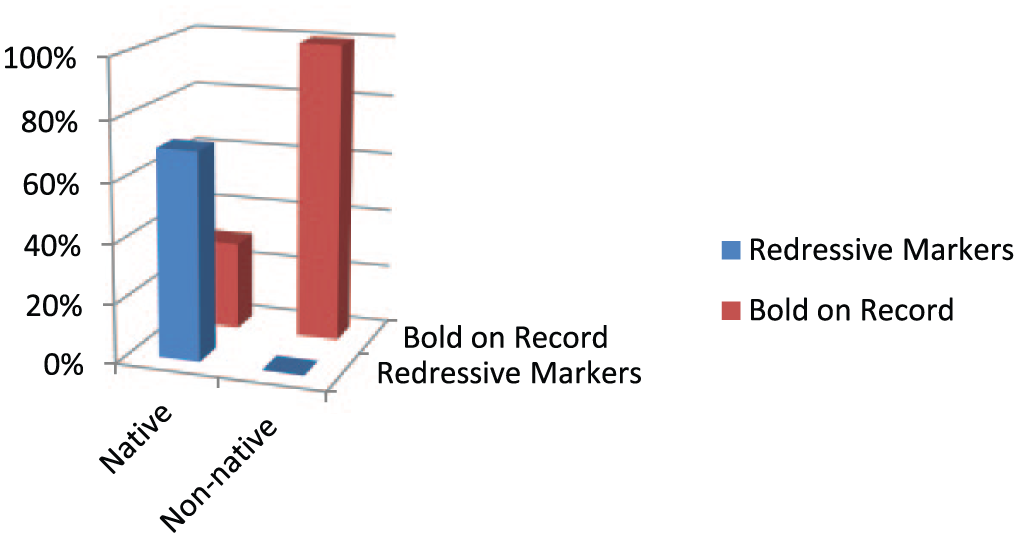
Redressive/Non-redressive Moves in Native/Non-native supervision.
Q2: What percentage of different types of the affective/redressive markers is used by the native versus non-native supervisors?
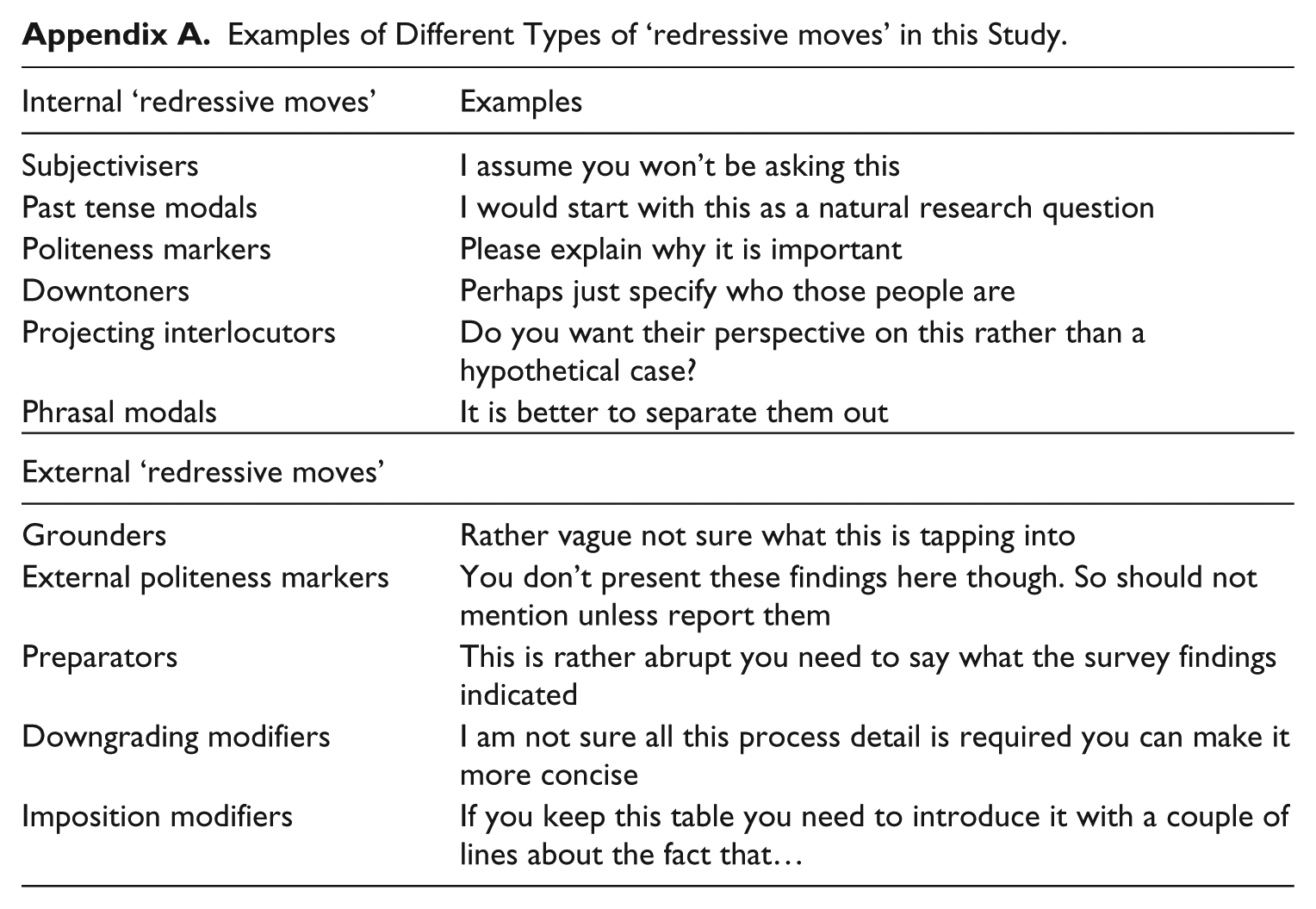
Table 2 and Figure 2 summarize the results of our analysis regarding the second question. As the table reveals none of the moves in the non-native supervision were redressive whereas the native supervision comments incorporated both utterance internal and utterance external ‘redressive moves’. The internal ‘redressive moves’ were further divided into six different types including subjetivisers, past tense modals, politeness markers, downtoners, projecting interlocutors, and phrasal modals. External moves encompassed five categories namely grounders, external politeness, preparators, downgraders, and imposition modifiers (see Appendix A for instances of external/internal ‘redressive moves’ in this study).
Percentage of Different Types of ‘redressive moves’ in Native Versus Non-native supervision.
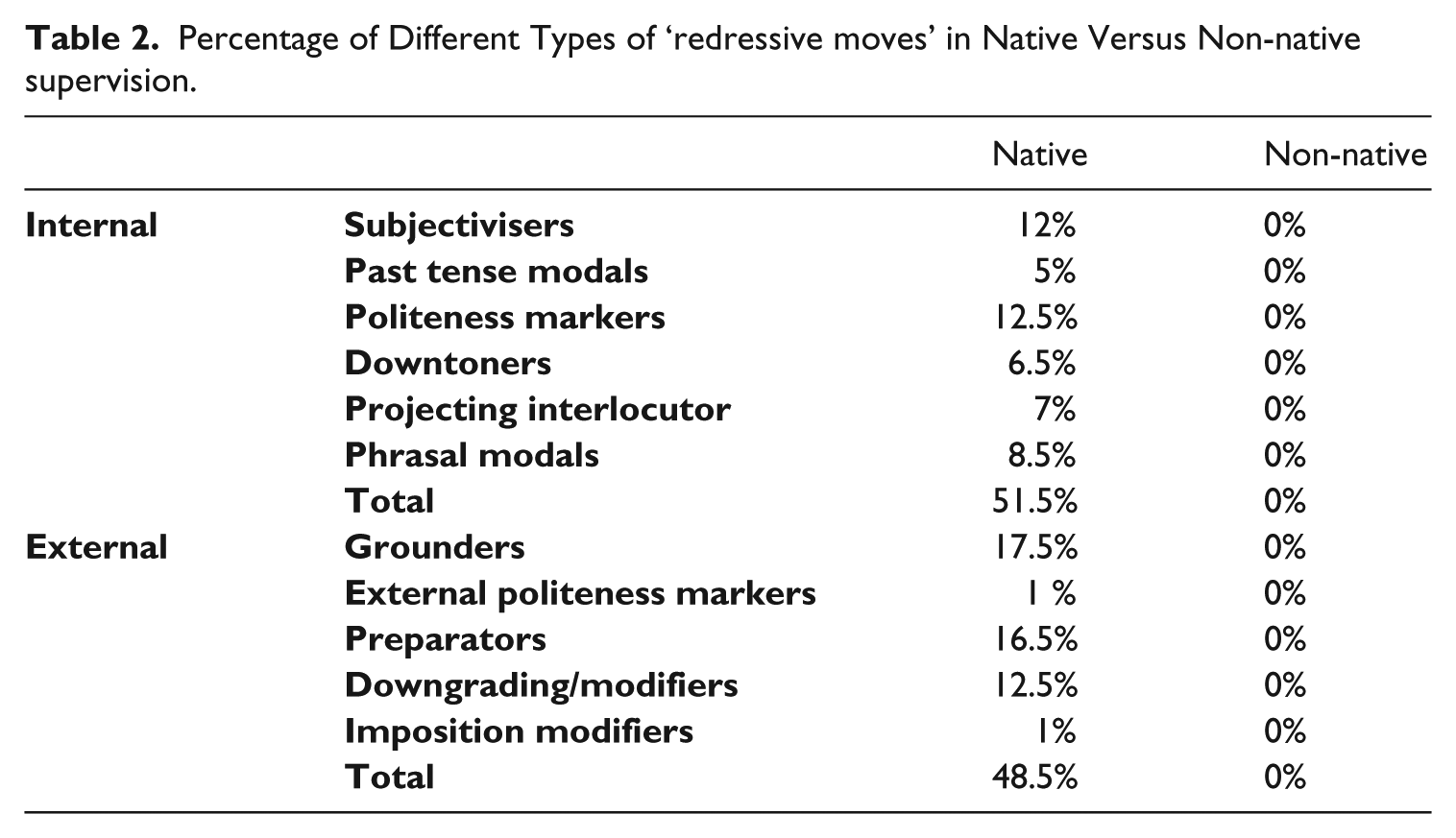
As Table 2 reveals, the percentage of internal ‘redressive moves’ is higher than the external ones – that is 51.5% for the former and 48.5% for the latter – indicating that the native supervisors tended to use more internal, i.e. linguistic elements within the suggestive comments, rather than external or non-linguistic elements. This finding is in line with the findings of Reinder et al.’s (2013) study in which they found that the native supervisors incorporated more internal elements in their distance supervision comments.
As for the internal moves, politeness markers were the most frequent ones (12.5%) to soften the tone of the utterances provided by the supervisor. These were followed by subjectivisers (12%), phrasal modals (8.5%), projecting interlocutors (7%), downtoners (6.5%), and past tense modals (5%). For the external moves, grounders were the most frequent moves (17.5%), followed by preparators (16.5%), downgraders (12.5%) and external politeness and imposition modifiers (each 1%). The high frequency of grounders suggests supervisors’ willingness to provide reasons and justifications for their suggestions so that students would act upon the comments provided in a more responsive way. This finding was also consistent with the findings of Reinder et al.’s (2013) in distance supervision.
One of the new categories that emerged from the analysed data was the use of students’ first names in front of other forms of redressive/non- ‘redressive moves’ in native supervisions such as: ‘Hamed, you need to break this question down, participants won’t understand it like this’ or ‘Can you sort this table out, Matin?’ Using a student’s first name in the ‘bold on record’ cases in native comments was probably an attempt to soften the tone of the negative comment and create a friendly atmosphere as in face-to-face interactions. The appearance of such a feature in native comments as opposed to non-native comments might be due to cultural differences where in western cultures having a friendly and non-threatening relationship with the student is a norm whereas in Asian culture, in this case in Iran, it is thought that supervising the students from a more powerful position would be more influential; otherwise the results would be counterproductive and thus lead to the students not taking the comments as being serious.
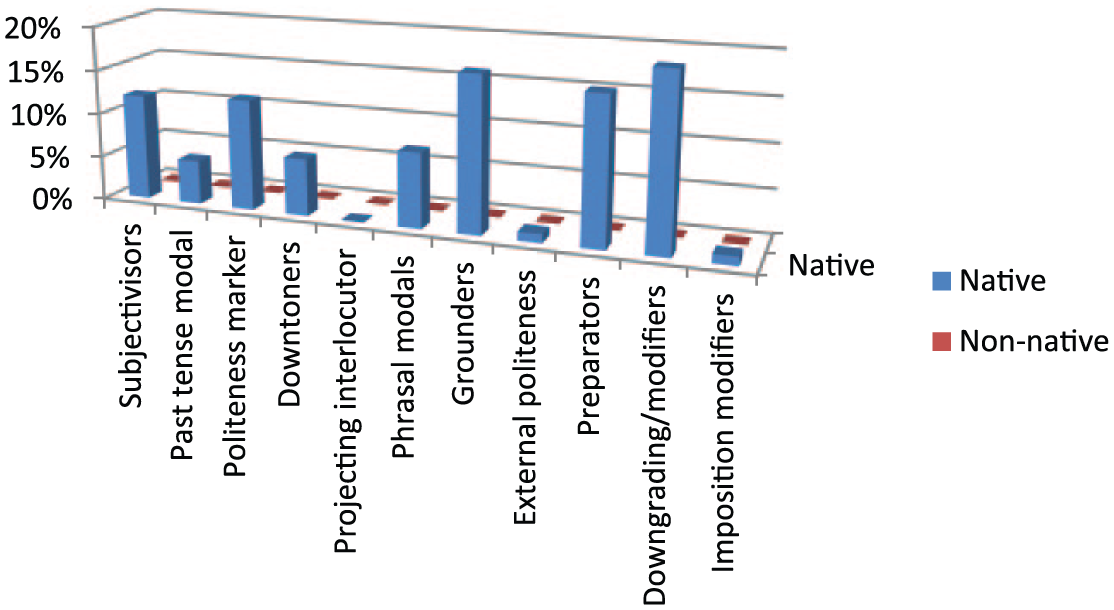
Internal/ External ‘redressive moves’ in Native Supervision.
Conclusion
This study aimed at elucidating a few points concerning issues related to the use of affective markers in the supervision comments of native versus non-native supervisors. In so doing, the Cross-Cultural Speech Act Realization Project (CSARP) Coding Manual was employed. The results indicated that the non-native supervisors employed only ‘bold on record’ comments – that is all the comments provided by the native supervisors were direct and no attempt was made on the part of the dominant interlocutor, in this case the supervisors, to reduce the burden of the negative impact of the disagreeing comments and face threat to the student. The native supervisors, on the other hand, used more redressive comments than non-redressive or ‘bold on record’ ones with the purpose of mitigating the impact of their negative comments and reducing the face threat to the students. The ‘redressive moves’ employed were either internal (51.5%) or external (48.5%), each divided into further categories, namely, subjectivisers, past modals, politeness markers, downtoners, interlocutor projectors, and phrasal modals in the internal category and grounders, external politeness markers, preparators, downgraders, and imposition modifiers as belonging to the external category.
Among the internal ‘redressive moves’, the politeness markers had the highest frequency as the supervisors tended to soften their comments, relying on these strategies. These were followed by subjectivisers as an indication of the fact that they tended to mitigate the assertive force of the comment produced on students’ theses. Hedging by using modals and the interrogative forms that include an element of doubt and uncertainty that were identified in Hyland’s study (2003) were also two common strategies in the present study.
As for the external ‘redressive moves’, grounders were the most frequent ones since providing reasons and explanation to justify the suggestion made was considered by the supervisors as one way of reducing the negative impact of the disagreeing comments provided by the supervisors. Preparators were the second in the range of external strategies so that the supervisor could ask about the potential possibility of carrying out his/her suggestions.
Interestingly, the native supervisors relied on using the student’s first name before or after some of the redressive/ non-’redressive moves’ as another form of strategy to create a rather friendly and supportive atmosphere and thus tone down the impact of their negative comments on students’ theses.
Surely, this study has practical implications for the committee responsible for assigning supervisors in general and for the supervisors themselves in particular. Supervisors may be experts in their field but this does not mean they can guide students all the way through conducting their PhD or MA degrees, since this requires not only enthusiasm and the thirst for learning/teaching but some degree of training organized by the organization responsible for assigning and confirming supervision sessions. Supervisors, on the other hand, should take students’ affect and feelings into consideration as creating a threatening and non-supportive atmosphere would lead to the student feeling disappointment and losing face. This would, consequently, have an impact on their confidence-building and thus future career and prospects.
As with all research, there are opportunities for improvement and further investigation. This research has focused solely on MA TESOL/TEFL supervision but it would be beneficial to expand the study to include the supervision comments from other disciplines. According to Bardovi-Harlig (cited in Reinders et al., 2013) extensive research has shown that indirect speech acts are more difficult for second/foreign language learners to understand, therefore, native supervisors of non-native speakers are presented with a dilemma which is maintaining the politeness and risk lowering comprehensibility or increasing comprehensibility and risk offending the non-native students (Thonus, 1999). It seems to us that the supervisors in the present study chose the first option at the expense of comprehensibility of the given feedback. Investigating the politeness strategies used by the supervisors and comprehensibility of the comments by the students from their perspective could be one interesting area of research and needs further investigation. Furthermore, the gender of the supervisors and their corresponding interlocutors could be a factor in affecting the supervision comments and the types of moves employed. This is clearly an area for continuous research. Last but not least, as pointed out by Hyland and Hyland (2001: 202) ‘while recognising the importance of mitigation strategies as a means of minimizing the force of criticisms and enhancing effective teacher–student relationships, such indirectness carries the very real potential for incomprehension and miscommunication’. Therefore, investigating the uptake of students to different types of feedback provided by supervisors and consequently offering guidelines on how to provide written comments to the supervisees from different cultural and language backgrounds would be another interesting topic for research.
Footnotes
Appendix
Examples of Different Types of ‘redressive moves’ in this Study.
| Internal ‘redressive moves’ | Examples |
|---|---|
| Subjectivisers | I assume you won’t be asking this |
| Past tense modals | I would start with this as a natural research question |
| Politeness markers | Please explain why it is important |
| Downtoners | Perhaps just specify who those people are |
| Projecting interlocutors | Do you want their perspective on this rather than a hypothetical case? |
| Phrasal modals | It is better to separate them out |
| External ‘redressive moves’ | |
| Grounders | Rather vague not sure what this is tapping into |
| External politeness markers | You don’t present these findings here though. So should not mention unless report them |
| Preparators | This is rather abrupt you need to say what the survey findings indicated |
| Downgrading modifiers | I am not sure all this process detail is required you can make it more concise |
| Imposition modifiers | If you keep this table you need to introduce it with a couple of lines about the fact that… |
Funding
This research received no specific grant from any funding agency in the public, commercial, or not-for-profit sectors.