



Abstract
This study investigates the effects on developing L2 listening fluency through doing extended listening-focused activities after reading and listening to audio graded readers. Seventy-six EFL university students read and listened to a total of 15 graded readers in a 15-week extensive listening programme. They were divided into three groups (Group 5, n = 30; Group 10, n = 20; Group 15, n =26) according to the number of post-listening-focused activities they completed. Another group who did not receive extensive listening served as the control group (Group 0, n =39). All participants were given a pre-test containing teacher-developed tests and a full-length simulated Test of English for International Communication (TOEIC) listening test. Similar tests were repeated at the end of the programme. The study addresses the effect size of improvement that students made from listening to audio graded readers and doing post-listening-focused activities, the degree to which students progressed on their TOEIC listening test, and the transferring effect from narrative-type input to conversational-type listening. Results show that the effect size was very small, medium, and very large on the listening improvement for Group 5, Group 10 and Group 15 respectively. On their post-TOEIC tests, Groups 5, 10 and 15 made approximately 2, 9 and 16 points out of 100 respectively. Finally, only Group 15 demonstrated some transfer effect from narrative to conversational input type of listening. This study also discussed the reasons low-level learners need to read many more texts to see more significant improvement.
Introduction
In the teaching of second/foreign language (L2), the receptive skills of reading and listening have traditionally been taught separately. Recently, this tendency has gradually changed, due mainly to the advancement of technology, which has made the learning and teaching of the two skills much easier. Some researchers and language teachers have started to consider using the more developed skill to assist the other less developed one (Chang, 2009; Stephens, 2010). For example, L1 children may use their more advanced listening skills to assist reading development whereas for L2 learners, they may use the more accessible skill, reading, to help them develop their listening skills. With the combination of the two skills, it is more likely that L2 learners are able to develop their competence. Having said that, if a learner intends to improve his/her listening/reading fluency, some effort that focuses solely on one skill may be necessary after relying on the support of the other skill. This study explores the effect of developing listening fluency through doing extended listening-focused activities in an extensive listening programme.
Theoretical Background to Reading and Listening Fluency
Fluency has been suggested as one of the four strands of a well-balanced language course (Nation, 2007); however, up to the present, it has not been done extensively in L2 learning and instruction. What then is fluency, and how does one develop it? The three fundamental components of fluency are accuracy, speed and fluidity (Segalowitz, 2000). In second language teaching, much effort has been placed on accuracy, while speed and fluidity normally receive little attention. In reading, the term fluency refers to having ‘the ability to read text rapidly, smoothly, effortlessly and automatically with little attention to the mechanics of reading such as decoding’ (Meyer, 1999: 284). Previous research has shown that reading a large quantity of easy texts allows learners to meet the same patterns of letters, words, and combinations of words repeatedly. Learners then become quicker and more accurate in processing words, and develop a large sight vocabulary (Day and Bamford, 1998). Background or topical knowledge is another important component in developing reading fluency. When learners are exposed to a large quantity of varying texts, their topical knowledge may be enhanced (Grabe, 2009). With much sight vocabulary and background knowledge, a learner’s reading rate should improve. By the same token, listening fluency can be characterized as listeners reasonably understanding aural input delivered at a normal speed effortlessly and accurately. In real-life listening, listeners have to process what is heard at a speed determined by the speaker. During the listening process, listeners usually have no time to stop to think about what is being said and this means that the listening process must be completely automatic – the more automatic the processing, the better the comprehension otherwise comprehension may be downgraded. In reviewing literature on developing L1 reading fluency, many approaches have been found effective in improving reading fluency, one being extensive reading. If extensive reading improves reading fluency, it can be proposed that listening fluency can be developed through extensive listening and similar effectiveness can be expected.
Developing Listening Fluency through Extensive Listening
Extensive listening (EL) may have derived from extensive reading or from first language (L1) listening. The practice of EL in L2 teaching is a relatively novel idea and its theoretical framework is undeveloped, so not many language teachers have the knowledge to carry it out. Although several scholars (Chang and Millett, 2014; Renandya and Farrell, 2011; Ridgway, 2000; Stephens, 2010) have emphasized the need for implementing extensive listening to enhance L2 learners’ listening competence, very limited empirical data can be found in the literature (Brown, 2007). Not until recently did Chang (2011, 2012, Chang and Millett, 2014) conduct a series of studies by adopting simultaneous reading and listening to audio graded readers. In the study by Chang (2011), seven secondary school students read and listened to a total of 244 graded readers, during a period of 26 weeks. Compared to students who did not receive the extensive reading while listening treatment, the seven students improved significantly not only in their general vocabulary knowledge but also in their comprehension of both narrative and conversational spoken texts. The results suggest that intensively reading and listening simultaneously to a large quantity of (audio) graded readers improved students’ vocabulary and listening competence. Furthermore, the listening competence gained from listening to narrative types of input (audio graded readers) was transferred to comprehension of conversational types of spoken input. To be more specific, the seven students studied an average of 1.08–1.50 books per week, and their performance on the official TOEIC test scored between 550 to 680, which was considered satisfactory for year 11 students.
These impressive learning outcomes warranted further investigation so Chang (2012) implemented the treatment with 31 university students, who read and listened to eight level-one and seven level-two graded readers over a two-semester period. Although a significant improvement in listening performance was further confirmed the effect size was small. The EL students gained only 7 points (approximately 35 points in the actual score) in their TOEIC test after a 26-week period, and the overall listening performance remained quite low, at 50%. Students’ limited improvement could be due to the fact that the treatment was spread over 26 weeks; students studied an average of only 0.6 books per week, and the intervals between books were too far apart.
The above two studies demonstrated consistent findings that reading while listening is beneficial to L2 learners’ listening development, but it seemed that these L2 students in the above two studies were not provided opportunities to focus their attention on listening only or to practise what had been learned at a faster speed. It could also be possible that some students might have overly relied on written texts and paid little attention to the aural input. To improve the students’ learning quality Chang and Millett (2014) followed Nation and Newton’s (2009) suggestion of developing fluency by adding an extended activity that focused solely on listening after simultaneous reading and listening. In this study, three groups of college students received one of the three treatments: reading only, reading while listening, and listening only. The results show the listening comprehension scores for the reading-while-listening group were the most consistent throughout the post-tests because they had opportunities to repeat what they studied through doing the extended listening-focused activities.
Research Questions
Despite the convincing evidence reported above, some questions remain: What is the minimum quantity of books that students have to study to see its effect, and can the competence gained from ER be transferred to sitting standardized tests? Previously, Nation and Wang (1999) suggested that L2 learners must read five graded readers in each level to move on to the next level. More recently, Webb and Chang (2015) examined secondary students’ vocabulary learning rates and found low-level students were not ready to move to higher level texts after studying 10 level-1 graded readers and the acquisition rates varied according to the students’ prior-knowledge levels. To expand this concept to improve listening fluency through extensive listening, this study involves 76 students receiving extensive listening treatment over a 15-week period and doing varying amounts of post-listening fluency practise. The study sought answers to the following three research questions:
RQ1: What degree of advancement did students doing varying amounts of post-listening activities make on listening improvement? What are the effect sizes on listening improvement for the different amounts of extensive listening-focused practise students did?
RQ2: To what degree did students in each subgroup make progress on the standardized TOEIC test?
RQ 3: Could L2 learners’ listening competence gained from listening to narrative type of input be transferred to conversational types of aural input?
Methodology
The Participants
This study involved three intact classes, two receiving extensive listening and one receiving form-focused instruction. The participants were adult vocational students from a university in northern Taiwan. The majority of the students were studying tourism and hospitality, and business design; male and female students were evenly distributed. As can be seen from their TOEIC scores presented in Table 2, their English proficiency was low, estimated from beginning to low intermediate level. There were a total of 150 students; however, 35 students were excluded from the present study because they did not attend the class regularly. All participants were taking a two-hour required English course focusing on listening and reading. This was the only English course they had. Their vocabulary knowledge was measured through the 1,000 1 and 2,000 2 bilingual vocabulary levels test administered during the first class of the course. This showed that the average score for the 1,000 words was 24/30 (80%), and 20/30 (68%) for the 2,000 word level. At the end of the treatment, the EL participants were divided into three subgroups based on the number of assignments they completed: 1–5 (average = 4.32), 6–10 (average = 8.86), and 11–15 (average = 14.85), termed Group 5 (n = 30), Group 10 (n =20), and Group 15 (n =26) respectively. The form-focused class served as the control group, receiving no EL, and was called Group 0 (n = 39).
Study Materials and Lexical Profiles
For the two experimental groups, 15 level-one (400 headword) graded readers with their corresponding audio CDs were used. All the study materials were selected from the Oxford Bookworm series. The book titles, word counts, and speech rates are presented in the appendix. The 15 books contained a total of 85,712 words. Approximately 96% of the words in the study materials comprised words in the first 2,000 word group plus proper nouns. These 15 books had been used by many previous students and were reported to be very interesting and suitable for low-level L2 adults and young adults. The control group however adopted a commercially published four-skill book as their textbook, receiving no extra reading or listening.
Post-listening-focused Fluency Practise Questions – the Assignments
To develop L2 listening fluency, listeners need to do a great deal of listening focus practise, and it will be more efficient if they have opportunities to repeat what is familiar, so as to increase the processing speed. With this in mind, a research assistant and the second author developed approximately 3,000 listening fluency questions based on the 15 graded readers, approximately 200 questions for each reader. Each week after finishing reading and listening to a graded reader in the classroom, the book was collected and a booklet containing the listening fluency questions was given to the EL students, who were required to finish the assignment within a week. The audio files for each book were uploaded to the university learning website, and only students who enrolled in the course were able to access it. To increase the effectiveness of fluency, they were told to do only one or two chapters per day rather than completing a book in one sitting. On average, an assignment took some two hours to complete. The EL students had to hand it in in the following week before they received a new book. To ensure that students did the practise regularly, the first author monitored the students’ practise on the website every week. Late assignments were not accepted to prevent students from copying answers from others.
Dependent Measures
Listening comprehension tests were administered to the participants before and after the treatment. The tests involved two teacher-developed tests based on two stories and a full-length simulated TOEIC listening test. Each measure was described as below:
The teacher-developed tests: The two tests contained two narrative texts (a and b). Each test had 55 questions, which involved varying question types – yes/no, multiple choice, true/false, gap-filling, and short-answer questions. The text type was similar to the texts which the students usually practised, but the content was new. Two different texts were used to determine whether students’ performance would be consistent between texts. Text-a was a 1,791-word story describing a poor young man who was going to find a job in another country, and met two young American women on a train. He did not reach his destination because he was arrested by the Bulgarian police for bringing too many US dollars into the country. Text-a was used in the pre-test and post-test-a. Text-b described a poor farm boy who found an old piano in his boss’s garage and asked his boss to let him keep it. His friends helped him to move it to a primary school. This text was used in post-test b.
A full-length simulated TOEIC listening test: The listening test was taken from New TOEIC Official Test-Preparation Guide (2007); it contained 100 multiple-choice items divided into four parts: 10 photograph description, 30 question-response, 30 short conversation and 30 short talks. Each of the latter two parts contained 10 texts, and each text had three questions. The question difficulty levels were incremental. The TOEIC test is a test that every student must take before they graduate from the university. It took 45 minutes to complete the whole test and was marked by a computer.
Data Analysis
SPSS version 22 for Windows was used to analyze the data. The independent variable was group containing four levels – Group 0 (the control group), Group 5 (who finished 1–5 assignments), Group 10 (who completed 6–10 assignments), and Group 15 (who did 11–15 assignments). There were five dependent measures: a pre-test, a post-test-a, a post-test-b, pre-TOEIC, and post-TOEIC. The reliability was calculated with Cronbach’s alpha. The first two research questions adopted the same data analysis. Paired-sample t-tests were conducted, and the effect sizes using Cohen’s d were calculated manually to determine the effect sizes of improvement within each subgroup (the first research question), and the degree of progress the participants made on the TOEIC test after (the second research question). The third research question explored whether the competence gained from listening to narrative type of input through audio graded readers could be transferred to comprehending conversational type of input, which was measured through a standardized TOEIC listening test. Paired-sample t-tests were further conducted to compare the scores between the post-TOEIC and post-test-a, and the scores between the post-TOEIC and post-test-b.
Procedure
Before the study began, a vocabulary levels test on the 1,000 and 2,000 word level and the two formal pre-tests were administered to all participants. In the following 15 weeks, the participants in the two experimental classes started to read and listen to 15 audio graded readers in the classroom and did extended listening-focused practise outside the class, one book per week. No quizzes were given during the treatment period. The participants in the two experimental classes received exactly the same treatment not only on the same day but also were guided by the same teacher. The control group, however, received form focused instruction only. After the 15-week treatment, the tests administered before the treatment were repeated. A group interview was conducted with four EL students, who had completed the full programme and agreed to share their feelings concerning the treatment. The purpose of the interview was to understand how these adult students perceived the extensive listening. Their reported data were selectively used to explain the test outcome.
Results and Discussion
The first research question examines the degree of students’ improvement in comprehending narrative type of listening texts after reading while listening and doing varying amounts of listening assignments. Three independent variables were used – a pre-test, post-test-a, and post-test-b, and the reliabilities were .82, .89, and .87 respectively. As shown in Table 1 and featured in Figure 1, the three experimental subgroups made varying degrees of improvement. A consistent pattern indicates that the more practise they had, the greater their gains (see Figure 1). Group 5, who did one to five assignments, improved only marginally from the pre-test to post-tests a and b, and their comprehension levels were similar to those in Group 0 (the control group), who did not do EL. The comprehension levels of Group 10, who completed 6 to 10 assignments, were between 47% and 50%, and were 66% to 68% for Group 15, who finished 11 to 15 assignments. Table 2 presents the effect sizes of improvement within each individual group. The effect sizes were very small for Group 5 (0.08 and 0.32), medium for Group 10 (0.51 and 0.8), and very large for Group 15 (1.38 and 1.41).
Listening Comprehension Scores (in Percentages) in the Pre-test, Post-test-a and Post-test-b and the Gain from Pre-test to the Post-tests in Each Subgroup.
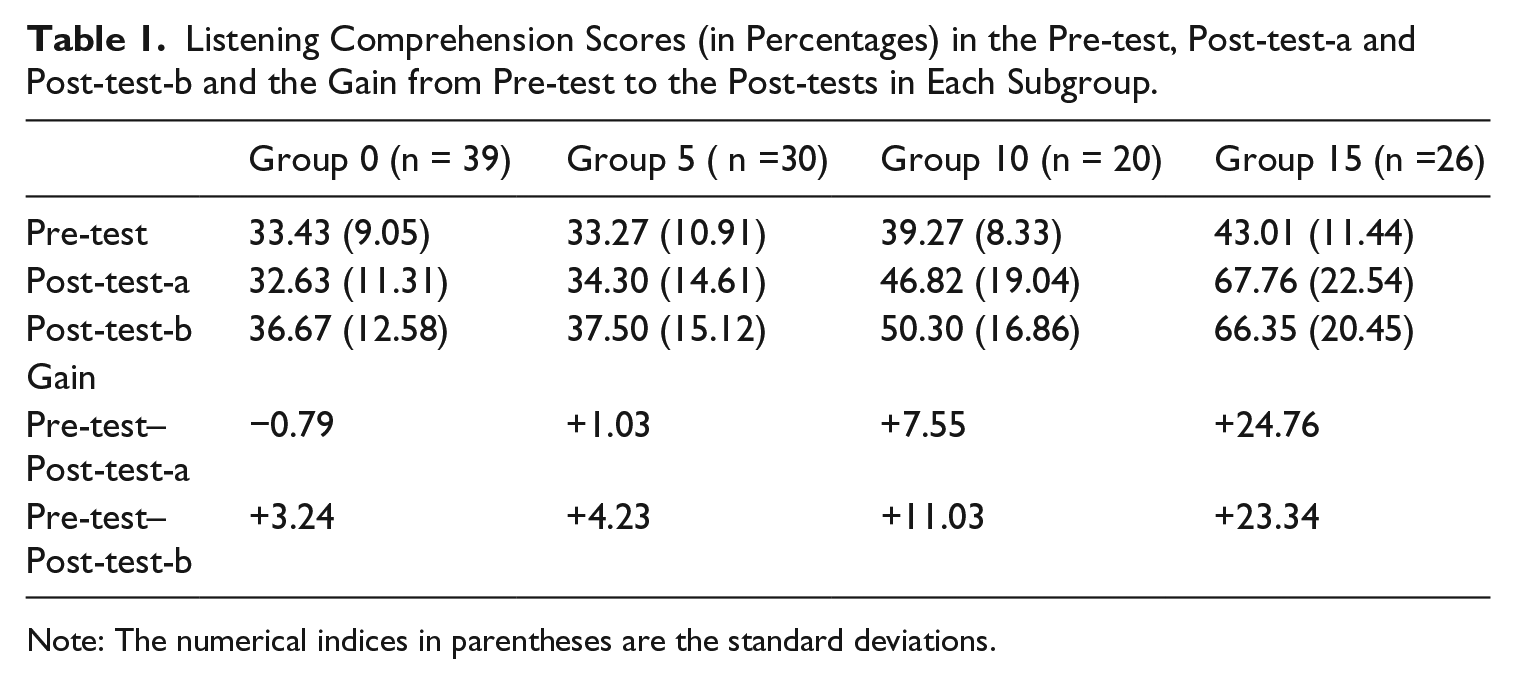
Note: The numerical indices in parentheses are the standard deviations.
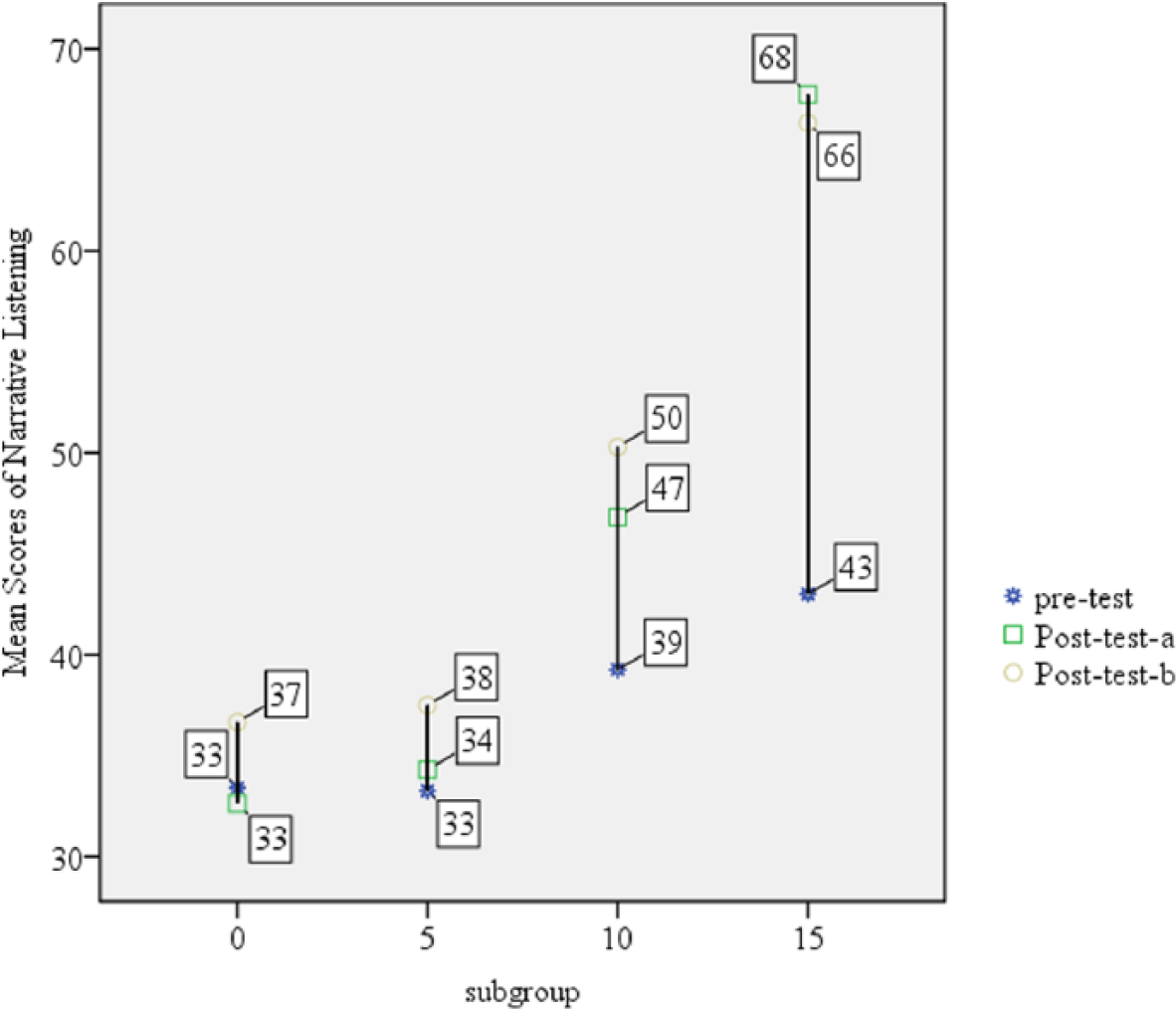
Mean Scores of Listening in the Pre-test, Post-test-a, and Post-test-b for the Narrative Texts.
Paired-sample t-tests for the Differences between the Pre-test to Post-test-a, and to Post-test b in Each Subgroup.
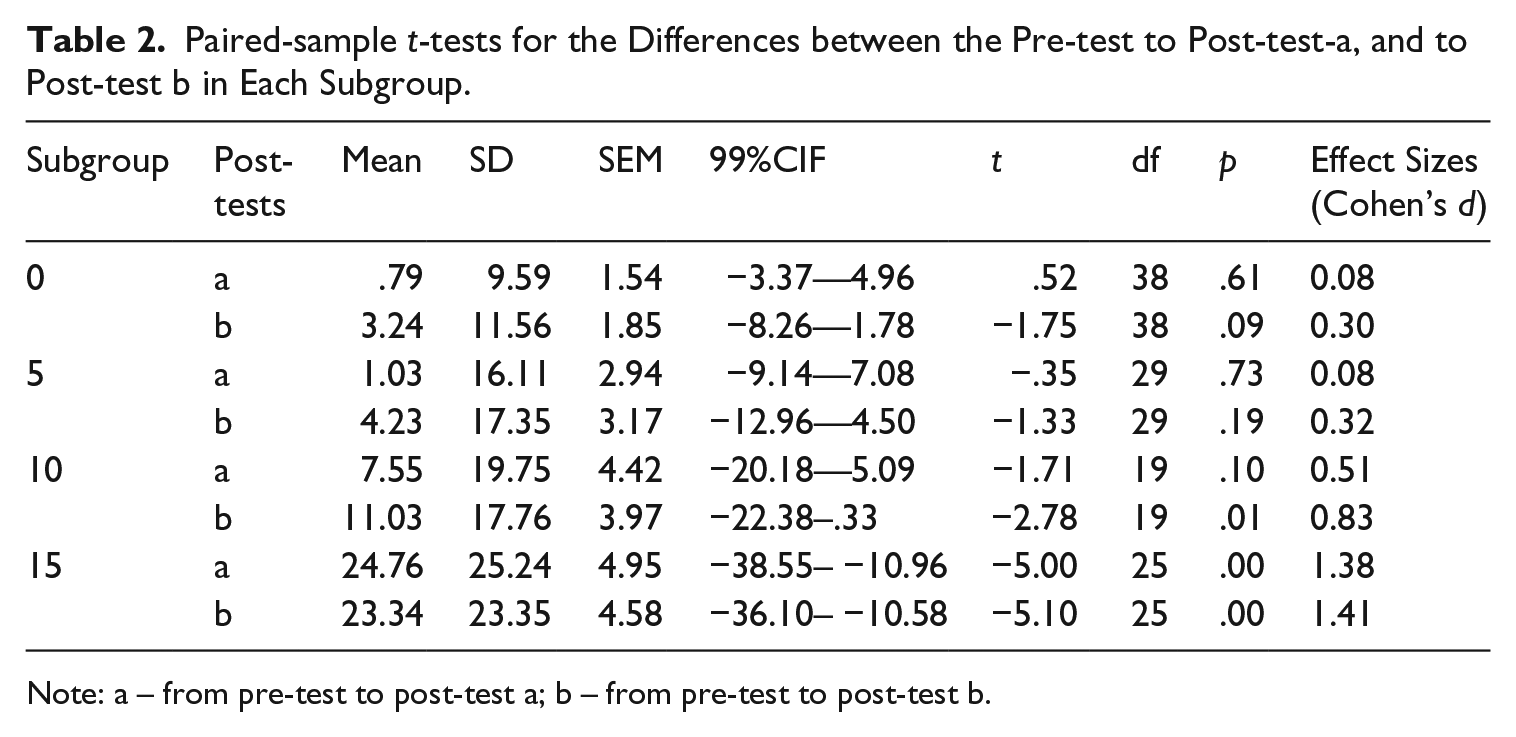
Note: a – from pre-test to post-test a; b – from pre-test to post-test b.
The above results indicate that low proficiency learners not only have to read and listen to 15 audio graded readers but also have to do more than 10 listening fluency activities to see significant improvement. The answer to the first research question regarding the effect sizes of listening improvement after doing varying amounts of post-extensive-listening activities is that low-level students need to do at least 11 to 15 post-extensive-listening activities to see consistent effects. Doing 6–10 activities may not be sufficient to see a consistent effect. Doing 1–5 assignments is equal to no treatment.
In Chang and Millett’s study (2014), the reading while listening group improved approximately 28% across post-tests, from 46% in the pre-test to around 74%–75% in the post-test. In the present study, Group 15 improved around 24%, from 43% in the pre-test to 66%–68%. Only Group 15 made advancement comparable to the reading-while-listening group in Chang and Millett’s study; however, one important difference between the two studies was that the present study adopted unpractised texts in the post-tests whereas practised texts were used in Chang and Millett’s study. Given this difference, the performance of Group 15 in the present study could be seen as higher than the reading-while-listening group in the study by Chang and Millett.
Group 10 made much less improvement than Group 15. The effect size for the improvement from the pre-test to post-test-a was medium (d = 0.51), only reaching the benchmark of being strong (d = 0.83, + 11.03) from the pre-test to post-test-b. Despite there being some improvement the results were not consistent. With regard to Group 5, their improvement was marginal. There were no significant differences from the pre-test to post-tests-a and -b. The same was true of the control group (Group 0). There is one important factor that may explain the unsuccessful outcome of Group 5. That is low level students may learn little in the beginning. They may be struggling in the beginning trying to become used to this kind of input. A previous study by Webb and Chang (2015) shows that low level students may need to read more than 10 books before they move on to a higher level. In this study, according to the report of the students interviewed, they learned little and comprehended nearly nothing for the first few books. This explains why if students just read or listen to four or five books, they are not yet ready to learn or acquire linguistic knowledge from the input. They are still at the warm-up stage. That was why in the present study no effect was found for Group 5, and only students who did more than 10 assignments showed salient improvement.
The second research question examined students’ listening improvement through a standardized test – TOEIC. The results for each subgroup are presented in Table 3. As shown, Group 0 regressed 4.41 points, and Group 5 improved only 1.77 points. The effect sizes for the changes in the two groups between pre-TOEIC and post-TOEIC (see Table 3) were very small. Group 10 gained 9.05 points, whereas Group 15 gained 15.73 points. The effect sizes for both groups were very large. To estimate the actual score on the TOEIC test, one correct item was worth about five points. That meant that Group 10 might have improved 45 points and 80 points for Group 15. The answer to the second research question, therefore, is that only Group 10 and Group 15 made significant advancements on the TOEIC test, with estimated converted marks of 45 and 80 for Groups 10 and 15 respectively.
Means, Standard Deviations, and the Differences Between the pre-TOEIC and the Post-TOEIC Listening Test Across the Subgroups*.

Note that in raw scores the maximum = 100.
When the TOEIC results of the present study are compared to the previous study by Chang (2012), whose university students also read and listened to 15 graded readers (8 level-1 and 7 level-2), the gains for Group 15 were much larger than that for the previous study. There are two major possibilities that may explain the difference between the results of the two studies. First, the study by Chang in 2012 did not involve doing listening-focused practise. Second, reading while listening to eight level-one graded readers might not be sufficient for them to move to level-2 texts. This is an important point because if the students have never had the kind of input (EL in this study), it may take them some time to become used to the input. Some students may need to study four or five books before they feel comfortable with the input type. The higher gain in Group 15 of the present study suggests the importance of quantity and quality. Quality here refers to doing post- extensive listening activities, which provides an opportunity for learners to practise what has been learned and focus on listening only.
One of the three approaches suggested by Nation and Newton (2009) on developing fluency is ‘repetition’ or ‘the well-beaten path approach’. This approach mainly involves ‘repeated practice on the same materials so that it can be performed fluently’ (2009: 157). Another approach for developing fluency is using the linking of skills. In this study, the students read while listening to the graded readers first, followed by a listening-focused activity. Before doing the listening-activities, the students had gained background knowledge of the input, so they could listen more carefully and focus on the details. These two reasons above may explain why Group 15 improved more than the students who did not do post-listening-focused activities in Chang’s study (2012).
The score gains of Group 5 were marginal, only 1.77. This result implies that reading and listening to graded readers alone without doing listening-focused activities was not sufficient to see improvement in listening competence; however, it may maintain students’ competence without further decay. Whether EL is effective seems to be closely linked with how much and how frequently the students do listening-focused practise. More practise leads to higher gains.
The third research question explores whether the competence gained from listening to audio graded readers can be transferred to TOEIC test scores. To answer this question, paired-sample t-tests were conducted within each group in order to determine whether there were any significant differences between the post-tests and post-TOEIC test scores. As shown in Table 4, no significant differences were found across subgroups. This meant that students performed comparably across post-tests, but this does not mean that all participants’ scores in the post-tests were transferrable to the post-TOEIC because the comprehension levels of Group 0 and Group 5 were not significant (lower than 40%). Furthermore, the two groups’ advancement from pre-test to post-tests was limited. This implied there was no transfer effect for the two groups. There were no significant changes in their performance. Figure 2 shows the score variations in each subgroup.
Paired-sample t-tests Comparing the Differences Between Post-TOEIC and Post-test-a /Post-test-b within Each Subgroup.

Note: a–post-TOEIC vs. post-test-a; b–post TOEIC vs post-test-b.

The Listening Scores (in Percentage) of Post-test-a, Post-test-b, and the Post-TOEIC.
The improvement in the comprehension levels for Group 10 and Group 15 were confirmed. Group 10 made an average of 9.29% (7.55% and 11.03%) in the post-tests and also made 9.05 points in the post-TOEIC. Group 15 improved an average of 24% (24.76% and 23.34%) in the post-tests and 16 points in the post-TOEIC (see Table 1 and Table 3). The performance of Group 10 and Group 15 suggests two things. First, students’ performance in the teacher-generated unpractised texts was comparable to their scores in the standardized TOEIC test; second, students’ listening competence improvements from practising narrative-type listening were transferrable to conversational-type listening input. Although one may argue that the comprehension levels of the two groups were not quite satisfactory, it has to be noted that the participants’ starting points were very low: 39% and 43% respectively. The low proficiency at the start might have made their progress slower (see Webb and Chang, 2015). Furthermore, it might have taken some time for these students to become used to the new approach. In interviews with the four students, all reported that they had had great difficulties comprehending the stories at the beginning of the EL programme, and they even doubted the effectiveness of this way of teaching because of their different previous experiences with this form of input. Another reason was that post-test-a and post-test-b were quite difficult and demanding and they were unpractised texts. For these two reasons, the scores might be satisfactory enough to make the claim that Group 10 made some small improvement seen from their slight advancement on the TOEIC test.
Due to the limited prior studies that can be compared with the results of the present study, reference is made to studies of extensive reading (ER) in relationship to the TOEIC test. The longitudinal study by Nishizawa, Yoshioka, and Fukada (2009) with Japanese junior college students over 120 weeks revealed no significant differences in mean TOEIC scores if students’ reading amount was around or less than 100,000 words. They further point out that students would start to see a significant increase in TOEIC score after reading 300,000 words – a threshold amount. Although the EL participants in this study read/listened to fewer than 100,000 words, the improvements were significant. The results could be attributed to doing the post-listening-focused activities and to the fact that participants had opportunities to repeat what they had read and what they had listened to.
Pedagogical Implications and Conclusion
The present study found that including post-listening-focused activities after extensive reading/listening is likely to significantly improve listening competence, and the enhanced listening competence is more likely to be transferred to TOEIC test scores if the L2 learners had done a reasonable amount of practise. It was not surprising that the more post-listening-focused activities students did, the higher the improvement they showed; however, one important point that was reported by the four interviewee students from the experimental groups has to be particularly mentioned here. They reported that while, in the beginning of the treatment they could hardly understand anything, after reading/listening to four or five books, they gradually comprehended more and more. One of the interviewees reported he nearly dropped the course in the beginning. However, he persevered through the initial stages and never missed a single class. After reading/listening to 10 audio graded readers, he became engrossed in reading and listening. Sometimes, when the first researcher raised a question from the study content, that student was the first one to provide the answer. The changes in his attitude from the beginning to the end were dramatic and encouraging. The other two interviewees also complained in the beginning that the ER/EL was not helpful to their TOEIC preparation. They doubted the value of reading and listening extensively. However, at the end of the treatment, they reported that ER and EL were very interesting and they did not want to study just one course book throughout, as in their previous learning experience.
The results of the present study together with the students’ reports had some pedagogical implications. First, lower level students require more time to become used to reading or listening. When deciding the quantity of study materials, L2 teachers should take into account their students’ level. It is certain that lower level students need to read many more lower-level texts than the higher level ones before they can feel comfortable with reading and listening, and then start to improve their language skills and to acquire linguistic elements. Second, extensive listening provides L2 learners opportunities to become exposed to abundant spoken language; however, to improve learning effectiveness, learning quality is important. The size of this study is significantly smaller in terms of quantity and treatment period than the study by Nishizawa, Yoshioka, and Fukada (2009) with Japanese junior college students over 120 weeks. The essential components of the present study, however, are the quality of input and repetition. The study adopted the linked skills approach simultaneous reading and listening at the first stage, then repeating the input by focusing on listening without referring to the written texts.
Finally, the study did not measure participants’ reading comprehension and reading speeds though they had both reading and listening input. It is likely some participants have increased their reading speed and comprehension (Chang and Millett, 2015). It is also likely that some participants might have shown improvements in their reading TOEIC scores if they had been tested. Future studies may look at L2 learners’ gains from various perspectives, including the two just mentioned.
Footnotes
Appendix
Profile of 15 Level One/Two Graded Readers: Book Titles, Audio Duration, Word Count and Speech Rates (wpm).

| # | Title | Audio Duration | Word Count | WPM |
|---|---|---|---|---|
| 1 | The Monkey’s Paw | 00:41:33 | 4,642 | 112 |
| 2 | The Elephant Man | 00:50:36 | 5,416 | 107 |
| 3 | Ned Kelly | 00:58:16 | 6,018 | 103 |
| 4 | White Death | 01:16:25 | 6,643 | 87 |
| 5 | Remember Miranda | 00:51:15 | 5,070 | 99 |
| 6 | The Phantom of the Opera | 01:00:58 | 6,048 | 99 |
| 7 | Sherlock Holmes and the Duke’s Son | 00:59:16 | 5,796 | 98 |
| 8 | The Coldest Place on Earth | 00:59:17 | 5,527 | 93 |
| 9 | The Withered Arm | 01:03:10 | 5,702 | 90 |
| 10 | Good-bye Mr. Hollywood | 00:57:34 | 5,177 | 90 |
| 11 | Christmas in Prague | 00:54:06 | 4,699 | 87 |
| 12 | A Little Princess | 01:08:41 | 5,881 | 86 |
| 13 | Love or Money | 01:13:08 | 6,010 | 82 |
| 14 | The Witches of Pendle | 01:05:09 | 5,147 | 79 |
| 15 | The President’s Murderer | 01:09:03 | 5,288 | 77 |
Note: WPM: words per minute.
Acknowledgements
We would like to thank the anonymous RELC reviewers for their constructive comments.
Funding
This research was supported by a grant obtained from The Ministry of Science and Technology in Taiwan (MOST 103-2410-H-266 -006).