



Abstract
Despite the importance of reflection on critical incidents (CIs), there are only a few studies in ELT literature addressing English language teachers’ CIs (Farrell, 2008). Accordingly, this study was conducted to explore and discuss how six in-service EFL teachers reflected on and reported their CIs. In so doing, the participant teachers reflected retrospectively and introspectively on their CIs for 12 sessions. They put their CIs in a blog each session in order to share them with their colleagues. After the treatment, the three stages of grounded theory were employed in order to analyse the CIs. The results, revealing six categories and 12 subcategories, shed light on the ‘what’ and ‘why’ of teachers’ reflections on their CIs. Results may have implications for teacher education and can add to the existing literature on unpacking teachers’ CIs.
Introduction
Postmethod pedagogy signifies an awareness gained from observing the cyclic birth, life, death, and rebirth of methods (Kumaravadivelu, 1994). Kumaravadivelu (1994: 29) claims that the first and the most important condition which the postmethod era marks is a ‘search for an alternative to method rather than an alternative method’.
This absence of method has indirectly influenced teacher education; ‘now that method is gone … teacher educators must look for sophisticated alternatives capable of responding to the pedagogical/socio-political demands made of ELT teachers’ (Akbari et al., 2010: 211). Reflective teaching is the concept which is, as it seems, informally agreed upon by teacher educators of the field to be a suitable alternative (Akbari, 2007; Halliday, 1998, cited in Akbari et al., 2010).
It is argued that teacher education programmes should encourage reflection among teachers since experience does not guarantee reflectivity and there are many experienced practitioners who may not reflect adequately on their work in order to improve it (Kagan, 1992). From among topics that teachers can choose to reflect on their practice, some teachers and teacher educators have employed CI technique to improve teaching through reflection on classroom incidents (Thiel, 1999; Farrell, 2008; Finch, 2010).
Doyle and Carter (2003) emphasize the importance of unpacking teachers’ reflections in that practice embodies knowledge. Similarly, Romano (2006: 947) maintains that unpacking and analysing teachers’ spontaneous decisions which are laden with built-in reflections on their teaching practice is ‘necessary for the teacher who wishes to continually develop as an effective practitioner, and for the novice teacher who is learning the complexities of the practice’.
However, in contrast to the significance and necessity of reflection on CIs (Woods, 1993; Johnson and Golombek, 2002; Farrell, 2007, 2008, 2013, 2015; Finch, 2010; Shapira-Lishchinsky, 2011), there is a dearth of research in ELT targeting English language teachers’ CIs (Farrell, 2008). Accordingly, this study attempted to analyse and examine teachers’ reflections on their teaching practice through in-depth unpacking of their CIs, the closer examination of which might help us to better understand teachers’ reflections and thinking processes.
Theoretical and Empirical Background
Amidst World War II, as an offshoot of the Aviation Psychology Program of the US Air Force, the CI technique came into existence for choosing and categorizing aircrews (Flanagan, 1954). The literature reveals that CIs have been defined differently (Angelides, 2001; Husu et al., 2008): an unexpected or difficult to understand situation that seems to be a unique case and encourages reflection (Schön, 1987); unexpected happenings that occur in class and provoke awareness of teaching and learning (Richards and Farrell, 2005); or a typical happening which is ‘an interpretation of the significance of an event’ (Tripp, 1993: 29).
Richards and Farrell (2005) note that CIs make teachers stop for a while and think about the meaning of the incident and its long-term ramifications. They go on to argue that documenting and analysing CIs can assist teachers to learn more about their practice, themselves, and their students. Likewise, Romano (2006) claims that a closer examination of the processes of reflection on CIs can reveal what teachers are reflecting on, their thoughts and also the knowledge that they bring to such occasions.
Both positive and negative classroom occurrences can come under CIs. Thiel (1999) maintains that there can be ‘teaching high’ or ‘teaching low’ incidents in the classrooms. In this regard, Richards and Farrell (2005) contend that in a speaking class an unplanned interference or a change in the lesson plan that can influence the lesson positively by promoting students’ participation can be a teaching high. On the other hand, puzzling and problematic classroom incidents, such as reflecting on a student’s behaviour after they suddenly stopped continuing a conversation for no obvious reason can be a teaching low.
Although the importance of reflection on CIs has been pointed out in the literature (Johnson and Golombek, 2002; Romano, 2006; Finch, 2010; Farrell, 2013), there are only a few studies in ELT literature targeting English language teachers’ CIs (Farrell, 2008). In what follows, the relevant literature is reviewed.
To begin with, Finch (2010) investigated CIs from the perspective of EFL students. In this study, 30 graduate and 44 undergraduate students were asked to reflect on their past school CIs for one semester. Finch (2010: 423) concluded that ‘sensitivity to initial events (CIs) does occur in language learning, but that the learner needs to “notice” the incidents for triggering or realization to take place and to influence subsequent learning’. In her study, Griffin (2003: 218) attempted to probe the effectiveness of CIs in heightening the reflective and critical thinking skills of pre-service teachers. The results of this study revealed that writing CIs increased pre-service teachers’ willingness for ‘growth and inquiry from concrete thinker to alert thinker’. Similarly, Farrell (2008), in a Singaporean context, had 18 trainee English language teachers reflect on their teaching and identify at least two CIs. Unpacking their CIs led to the emergence of the following categories: language proficiency, class participation, behaviour, gender, classroom space, lesson objectives, classroom activities, attention spans, and additional class assistance, respectively. Farrell concluded that teachers can face and handle the vicissitudes of their career better by formal reflection on their CIs.
Shapira-Lishchinsky (2011) attempted to examine the ethical dilemmas in CIs. In addition, she tried to explore how teachers with different educational backgrounds react to them. Shapira-Lishchinsky (2011) concluded that analysing teachers’ CIs may help one to understand how teachers perceive the classroom events. Finally, in a similar study, Pope, Green, Johnson and Mitchell (2009) explored teachers’ perceptions of ethical dilemmas connected to students’ assessment. The reported CIs revealed that most of the dilemmas were concerned with ‘score pollution, and conflicts frequently arose between teachers’ perceptions of institutional demands and the needs of students’ (Pope et al., 2009: 778).
The present study expands on the previous studies in three ways: first, it explores six in-service EFL teachers’ CIs. Second, it was conducted in an EFL context where no research has been conducted in this area. Third, we gathered more accurate and detailed accounts of CIs since we had teachers reflect on and share their CIs in a blog environment, which provided a safe venue for sharing without inhibition; otherwise, teachers might have refrained from writing narratives on teaching lows.
Method
Context and Participants
The present study was conducted in an EFL context in Iran. The data were collected, through convenient sampling, from six teachers (three males and three females) who joined an in-service training course in a private institute. The participant teachers held BA or MA degrees in English teaching or translation. The teachers’ ages ranged from 24 to 35 with four to nine years of experience and they had a profile of teaching in colleges, schools, or private institutes.
Design and Data Collection
Creating a Blog
Shapira-Lishchinsky (2011) argues that most teachers tend to repress CIs. Similarly, Angelides (2001) argues that we need a system for decreasing teachers’ emotional involvement when they are required to analyse their CIs. Taking these considerations into account, we assumed that blogs might help teachers to exchange their CIs freely while their anonymity is preserved and their inhibition is lowered. Hence, for the purpose of the present study, a blog was created (www.Tedprogram.blogfa.com). In this blog, the idea of reflection on CIs was briefly introduced and clarified. Moreover, information about what could be considered a CI, and how people would normally perceive and define CIs were provided, which were followed by some samples of CIs.
Introduction to the Course
In private sessions with each teacher, the second researcher introduced CIs to the teachers and the way they were written in the narratives. They were also briefed on how to operate and use the created blog. Moreover, teachers were made familiar with ‘teaching high’ or ‘teaching low’ incidents (Thiel, 1999) and were given the option to reflect upon and report either type of them.
Reflection on CIs and Sharing Comments
After a quick introduction about the course, the participants started reflecting retrospectively and introspectively on their CIs, and reported them in narratives. Then the participants left their CIs in the blog looking for their colleagues’ prospective reflection. All the teachers continued reporting a CI for 12 sessions, except Peiman (in all instances pseudonyms are provided) who failed to post his tenth CI and Sepehr who continued posting CIs to the eighth session. A total of 67 CIs were collected within seven weeks.
Data Analysis
The collected CIs (n=67) were analysed using grounded theory (Glaser and Strauss, 1967). Grounded theory was utilized since it highlights the importance of finding out about human behaviour via a process of ‘induction’ and ‘discovery’ rather than ‘deduction’ and ‘hypothesis testing’ (Elliott and Lazenbatt, 2005). Data analysis was conducted by following the three iterative stages of coding in grounded theory, outlined and espoused by Strauss and Corbin (2008) as follows:
Open Coding
In the open or initial coding phase, the researcher continually compares data and asks questions about what is understood or not understood. In a systematic manner, by employing various techniques, parts or the whole document is examined in order to identify categories or different dimensions (Strauss and Corbin, 2008). Open coding sets the stage for axial coding (Benaquisto, 2008).
Axial Coding
During the axial coding phase, data are put back together in new ways, which allows for connections among categories. The process of connecting subcategories to a category is the most significant characteristic of axial coding (Strauss and Corbin, 2008). It is worth mentioning that diagrams and memos can facilitate the process of identifying core categories and pinpointing the gaps in the emerging theory (Benaquisto, 2008).
Selective Coding
In selective coding stage, the core category is identified and decided upon (Strauss and Corbin, 2008). Grounded theory is developed as a result of the process of integrating and refining all the main categories into one core (central) category.
Assigning CIs to neat categories is sometimes a difficult process (Farrell, 2008). The reason is that many CIs are inferential and oftentimes carry multiple meanings (Farrell, 2008). To overcome these issues and in order to increase the reliability of the findings, we analysed the data separately and then met to discuss the cases of disagreement and reached a final consensus. Calculation of the number of agreements over disagreements indicated 90% inter-rater agreement.
Results
Data analysis indicated six categories and 12 subcategories of critical incidents. As Figure 1 shows, the most frequently reported category referred to ‘behaviour’ (15 CIs) which was supported by a three-pronged subcategory, including ‘students’ behaviour’ (8 CIs), ‘teachers’ behaviour’ (4 CIs), and ‘students’ gender’ (3 CIs). The second most frequently reported category was ‘language proficiency’ (13 CIs), which was supported by one subcategory, namely ‘students’ language proficiency’ (13 CIs). The third category was ‘clashes’ (12 CIs), which was supported by a four-pronged subcategory, including ‘clash with superiors’ (5 CIs), ‘clash with colleagues’ (4 CIs), ‘clash with institutional rules’ (2 CIs), and ‘clash with parents’ (1 CI). The fourth category was ‘individual differences’ (10 CIs), which was supported by one subcategory, called students’ ‘individual differences’ (10 CIs). The fifth main category was ‘class participation’ (9 CIs), which was supported by a single-pronged subcategory, named ‘students’ class participation’ (9 CIs). The last category was ‘teachers’ unpreparedness’ (8 CIs) which was supported by a two-pronged subcategory including ‘full-time teachers’ (5 CIs) and ‘substitute teachers’ (3 CIs). As Figure 1 shows, the core category was ‘English language teachers’ CIs’. Each category and subcategory is elaborated on in the following sections.
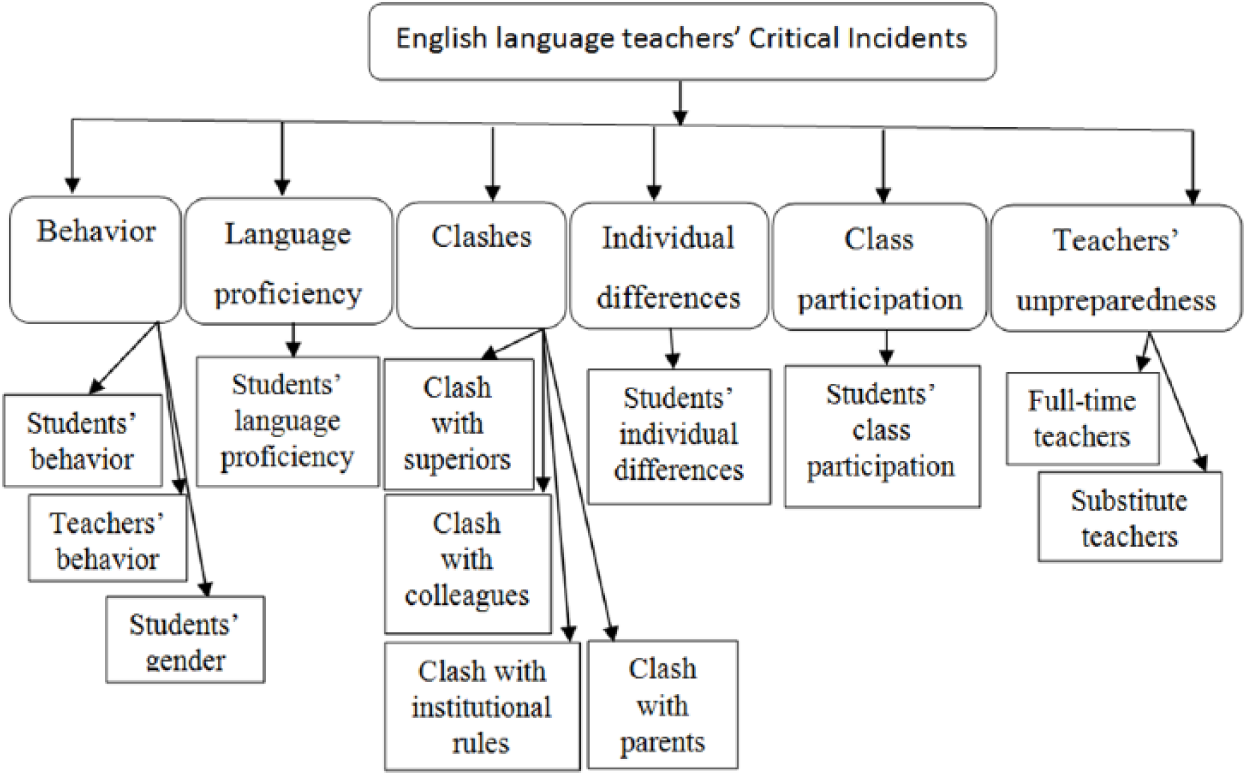
Results of Unpacking Teachers’ CIs.
Behaviour
This category was considered as critical and subsumed students’ inappropriate and unseemly behaviours, teachers’ naïve and inappropriate behaviours, and students’ gender. To begin with ‘students’ behaviours’, for example, Tristan perceived his students’ behaviour of murmuring and making inconveniences as critical.
Five years ago, as a newly recruited teacher I entered my class, enthusiastic about teaching. After some sessions I heard two students murmuring against something. I tried to find out the reason, but I failed. Anyway, after a few sessions I found out the reason by seeing one of the students talking loudly about their previous teacher. He said “can you remember Mr. X? I miss him a lot. Last term I could learn English much better than this term. I may leave this class, don’t you want to leave it, too”. These words shattered me badly. I continued that lesson as if I hadn’t heard anything. Those words always kept my mind occupied and I felt incompetent. A few years afterwards, having faced similar situations, I have come to a better understanding of class routines. Now, I know a class with different students is intertwined with different tastes and ideologies. And as a teacher it’s hard to keep them all fully satisfied, although we must do our best to do so (Tristan, CI 11).
The second example refers to teachers’ naïve and inappropriate behaviours. These incidents raised the teachers’ awareness regarding their own behaviours which could trigger puzzling moments for them.
Last year, I had an academic English workshop. As I am really flexible in treating students, I did not care about the number of sessions students cut the classes. There were a couple of students who had missed several key sessions. After 2 weeks, they came in with no excuse. In addition, they kept talking irrelevant to the class. I was about to lose my temper. However, something came into my mind. While they were talking, I asked other students to leave the class and find an empty room for continuing the class. Unbelievably, the noisy students were so busy that they did not notice when we moved to the new class, [after some time] they wrote a letter to express their regrets. However, I did not accept it and I made them to retake the course. Too much flexibility causes teachers to lose their professional administrative power (Peiman, CI 8).
Peiman believed that his flexible behaviour was the source of his students’ ignorant and unruly behaviours. Therefore, he decided to make some changes to his behaviour. Although he believed that a teacher should be flexible and democratic, he noted that too much flexibility may lead to chaos and anarchy.
The final example is gender which refers to some students’ unnatural behaviours towards the opposite gender, at least from their teachers’ point of view.
There is a class in my workplace with a big window to the yard. Once I had a pre-intermediate class with some teenage boys. We were working on a reading meanwhile I could see one of the students looking at a girl who was walking in. I ignored him. In second glance, he was looking at some girls again; He couldn’t help himself not to look at them. I had to bring him back, so I called his name to concentrate. But it didn’t work he was all out. This time he was pointing one of them to his partner. Therefore, I put a chair next to mine and asked him to sit beside me. He walked to it as the others were making fun of him. He nagged a bit that why I changed his place. He was completely uncomfortable until the end of the class. Ever since I think about this CI there is something incomplete that doesn’t let me to do it again (Annabel, CI 9).
A student’s behaviour towards the opposite gender made Annabel decide to change his place. However, Annabel seemed unhappy with what she had done because the other students laughed at that student and he felt uncomfortable until the end of the class. Annabel noted that she might not do it again.
Language Proficiency
The second category includes CIs that language teachers face due to their students’ language proficiency which could bring about puzzling moments for their teachers. For example, Sepehr expressed his regret for his student who had a low language proficiency and could not keep up with Sepehr’s expectations and his classmates’ pace.
This is about a moment in my career that made me think and reflect more on the homogeneity issue. I had a student in one of my classes whose level of competence was much lower than that of others. One of the problems that I usually had with this student was his unwillingness to communicate with others. This was due to his much lower level of proficiency. He sometimes asked me to switch to Persian [students’ first language] to make the points clear. Actually, I did sometimes change the language of instruction. Due to the fact that he was a single example, I could not actually make every effort to accommodate his demands. Actually this happened in my case, and I truly regret those days (Sepehr, CI 8).
In exchanging comments with his colleagues, Sepehr hypothesized that such problems may be because of ‘the inefficiency of screening methods employed by language institutes and administrators’.
Clashes
This category emerged as a result of clashes teachers had with their superiors, colleagues, institutional rules, and students’ parents. To begin with ‘clash with superiors’, for example, Sepehr expressed his regret for his inaction in front of his superior’s wrong action.
I was teaching English in a language institute whose manager didn’t pay any attention to quality. She had a strange strategy in obtaining more money by putting more than twenty students in each class, although it was a private institute. I was given a class with 27 students. After a few sessions a student screamed loudly as a sign of protest. I couldn’t guess what was wrong with him. I asked him “what is wrong, dear Ali”. He burst into tears and said “It all because of you, it’s the third consecutive session in which you haven’t asked me any question”. I was embarrassed. I made my apologies. At home I dug deep into my thoughts to see why that happened. Suddenly, I found out the real reason. Yes. Although I was to be blamed too, but the large number of students was the real reason. From that time on I take notice of students’ number and many other factors. Anyway a question is still bothering me: why didn’t I question the manger’s actions??!!?? (Sepehr, CI 6).
Sepehr considered his manager’s act of putting a large number of students in one class unethical and not in line with the rules of private institutes. However, he was regretful for his own inaction which brought him to an awareness of the need to be more critical of his superiors’ actions and decisions.
The second example refers to ‘clash with colleagues’ in which teachers were puzzled by their colleagues’ actions, beliefs, or maxims and most of the time attempted to help their colleagues to make a change. For example, Peiman found his colleague’s behaviour questionable and attempted to help him to reconsider his assessment procedures, although he failed.
My students know me as a person who is frank. This frankness sometimes creeps into other classes. Two years ago, some students came to me and wanted me to talk to their teacher to reconsider his assessment procedures, which as they said was not fair. Unfortunately, I wasn’t familiar with their teacher’s behaviour. Although it was somehow hard for me, I agreed to do so. You can’t even imagine how angry he got, when I talked to him. He promised to reconsider his assessment. After a while his students informed me that he had admonished them for keeping me informed. He didn’t change anything. That incident has still occupied my mind, and I can’t understand why he reacted like that. I am not sure what I would do again in facing such incidents. I may do the same (Peiman, CIs 11).
However, in exchanging comments, Peiman appeared more doubtful about doing the same if he experienced the same incident, and outlined considering other alternatives such as encouraging and empowering students to convey their feelings to their teachers.
The third subcategory describes teachers’ ‘clashes with institutional rules’. For example, Sama found herself in a situation in which she had to choose between going with institutional rules or students’ needs.
A few semesters ago I faced this challenge in an intermediate class. The lesson was past perfect modals and my teenage students seemed to have no notion of could/might/must +have +pp. There is a strict ban in that place for teachers to speak Persian. Whatever I did, the answers were not correct. I risked and asked them to tell me in Persian what they meant by their answers. Translation of their sentences echoed a complete cognitive chaos. I was like: I’m not here to satisfy administrators. Thus, I broke the curfew and explained the rule in PERSIAN. You should see their ahhha-faces. Yes, I was badly criticized. But all way through, I was thinking about learners’ faces and the result I got; I mean they got (Sama, CI 5).
Sama perceived this as critical for what she had to choose and she chose students’ learning over adhering to the rules of the institute. In the follow-up discussions, Sama claimed that the sources of such CIs are some institute managers who ‘do not update their maxims’.
The last subcategory under ‘clashes’ is ‘clash with parents’. For example, Nargues was perplexed by a parent’s expectations and was not sure as to how to react to her.
I had a class with boys with the age of 10 in Let’s Go level. Since it was fall, around 6 p.m. it was dark. It was at the end of the class. Suddenly, the door of the class opened; one of the student’s mothers came in and told her son “it’s night now and it’s rainy too, I left your baby sister alone at home to come for you … why didn’t you come home earlier, if you want to stay here till this time, I can’t let you come to the class anymore” I was completely shocked, whatever I said, she didn’t hear and said, “please change the time of the class or my son can’t come”. Then she left the institute. I was all confused. It was not my fault. After that neither I changed the time of the class nor she came to complain. I guess she understood that she could have had better reaction. The student continued the class. I just let him to leave the class a few minutes earlier than the others (Nargues, CI 1).
Nargues perceived the parent’s behaviour as inappropriate. Accordingly, since she could not change the class time, she decided to let that student leave the class a bit earlier than the others. This way she could keep a good balance and make both the parent and the institute manager feel satisfied.
Individual Differences
This category refers to ‘individual differences’ and how they could cause problems for teachers and raise their awareness of every single act and reaction of students. For example, Sama said:
I’ve always provided my students with thorough feedback on their writings. Once, when I was giving their papers back, I told one of students, who was a very shy girl, that her paper was not among those of others. When I asked for clarification, she said that she had handed it in along with papers of other students. This was quite a shock. I promised her to bring it next session. The paper was nowhere to be found. She was so shy to ask me again about her paper. Yet I kept thinking about compensating for it later on, I provided her with a heartening feedback, though I don’t think this made the amends. I had treated that poor girl the same as others. Since then on, in addition to doubling my care about assignments, I have tried not to let the natural flow of classroom events make me ignorant of students’ individual traits (Sama, CI1).
Sama considered this incident critical because she did not take her student’s individual traits into account while asking for her paper in front of the whole class. Sama put it this way ‘I needed an answer; she needed privacy’.
Class Participation
‘Students’ class participation’ is the next category. For example, Annabel perceived her student’s arrogant behaviour bothersome and attempted to find a way to encourage her to participate in class activities.
I had a class full of passionate girls. Among them there was a student who was badly reluctant to do her activities she was somehow arrogant! I tried my best to persuade her to be a bit active but it was all ineffective! She was listless and never tried to even listen. Once I saw her coming to class while she was listening to music. That day I started the class with the topic of kinds of music they were interested in, it was incredible. She started talking magically! She used nearly all the vocabulary and grammar that we had learned, I was wrong. After her speech some students gave her five for having same taste of music. After that she never kept silent. All I know now, I shouldn’t keep ignoring students (Annabel, CI 1).
Moreover, Annabel claimed that teachers’ reflection on their students’ reluctance could help them to find a way to encourage their students’ active participation.
Teachers’ Unpreparedness
The last category to emerge revolves around ‘teachers’ unpreparedness’ including ‘full-time teachers’ and ‘substitute teachers’. Teachers may face such incidents mainly due to lack of enough practice and knowledge before going to their classes. For example, Sepehr who had faced a CI stemming from his unpreparedness strongly argued for teachers’ full preparedness beforehand.
The first day of my teaching: It was about 5 years ago. I entered the classroom, puzzled and with no idea how to get started and manage to look like an experienced teacher. At first, I tried to talk about every corner of my handicapped knowledge. I am totally sure that the very facial expression of mine naively revealed that I was hopelessly inexperienced and of course the most willing individual to call it a day. It could have been all about exchanging the greetings, or talking about their appearance. I don’t know, whatever it was, I don’t wish to remember. Yes, I admit I was unprepared. At that session I used to talk about strange issues. I should not have been recruited as a language teacher at that time mainly because I could ruin my students’ language learning habits. When I look back, I always regret those days (Sepehr, CI 3).
The other subcategory refers to CIs which substitute teachers face. For example, Annabel said:
My boss asked me to be his sub. It was a grammar course, To impress my boss I accepted, honestly I had no idea which grammar they were working on. We started the class as a normal one. It was about Tag Questions. I must confess that I had taught tag questions a while ago, so my mind was kind of gloomy over it. The story begins when I wanted to give some examples. I started with this: “Snow is white, isn’t it? Snow is black. Isn’t it? Snow isn’t black is it?” We were going well until another one crossed my mind “IT’S HARDLY SNOWED THIS YEAR …?” All of a sudden my mind went blank. All I saw was some faces with question mark on their head. They thought this new teacher doesn’t know the answer and actually saw one of them smirking. At this time I tried to make it a multiple-choice A) Is it? b) Isn’t it? c) Has it? d) Hasn’t it?. I could finally survive then (Annabel, CI 4).
Following this incident, Annabel strongly argued for substitute teachers to find out what they were going to teach before going to their classes.
Discussion
The existing literature has addressed the effects of utilizing CIs in promoting teachers’ reflection on their practice (see Griffin, 2003; Finch, 2010), or built-in ethical dilemmas of CIs (see Pope et al., 2009; Shapira-Lishchinsky, 2011). However, this study went a step ahead and unpacked teachers’ CIs in an EFL context. We attempted to explore six in-service English language teachers’ reflections on their CIs.
Overall, the results of this study revealed that teachers’ writing of their CIs can be useful in encouraging and promoting reflection. ‘Documenting’ and ‘reflecting’ on them can be a starting point for teachers to understand more about themselves, their learners and the teaching processes. Documenting and analysing incidents which might initially appear unimportant can trigger new insights and encourage teachers to view them more seriously (Richards and Farrell, 2005). The findings revealed that students’ behaviours, teachers’ behaviours, or students’ gender could result in CIs. This finding may reveal that behavioural incidents need to receive more attention in teacher education programmes. Behavioural issues were the third most frequently reported incident in Farrell’s (2008) study and here they were the first one. This can indicate that teachers teaching in different contexts and cultures may perceive and judge class incidents rather differently and what is considered critical in one context could be perceived as typical in another context.
Behavioural CIs can stem from teachers’ lenient behaviours. For example, Peiman in his eighth CI, regretted his frivolous behaviour and upon reflecting on it called for teachers to attempt to keep the balance between rigidity and flexibility in their classes. In addition, teachers’ experience and reflection on their practice could lead them to see and judge their CIs differently. For instance, Tristan’s reflection and further reconsideration of what he considered critical (see Tristan, CI 11) led him to new insights of teaching. This CI indicates that teachers may see and judge their CIs differently as they gain more experience. This finding is in line with Farrell (2008) arguing that more experienced teachers may perceive incidents differently from the less experienced ones. Many of the incidents which are judged as critical by novice teachers may be considered as normal by more experienced teachers (Farrell, 2008). It can be argued that providing novice teachers with a collection of CIs to reflect on prospectively may provide them with the opportunity to share the experience of other teachers and could assist them to stay calm and confident in cases where they then confront similar CIs. This is in line with Shapira-Lishchinsky (2011: 656) arguing that ‘we can expect that by studying teachers’ CIs and the ethical dilemmas they raise, teachers will be exposed to a wide range of CIs and ethical dilemmas long before they encounter their own’.
‘Language proficiency’ was the second most frequently reported category. Here students’ heterogeneity was the main dilemma which caused perplexing moments for the language teachers. Language proficiency-related CIs can be context-related (Farrell, 2008). Likewise, the occurrence of such CIs, which seems to be frequent in Iran, can be accounted for in terms of the context. Because Iran is an EFL context, the English language is only spoken in English classes. This may result in students’ low language proficiency and could trigger such CIs. In particular, this is common when a large number of students, with different levels of proficiency, are put in one class.
The clashes category emerged as a result of the teachers’ confrontation with their superiors, colleagues, institutional rules, and students’ parents. The teachers considered such situations as critical mostly because they found themselves between two options which resulted in what Berlak and Berlak (1981) called ‘ethical dilemma’ referring to ‘an inner conversation with the self- concerning two or more available propositions’ (Shapira-Lishchinsky, 2011: 648). Although the teachers guessed that their reactions might result in resentment from their colleagues, superiors or the students’ parents, oftentimes they did what they perceived to be right.
When teachers fail to consider their students’ individual differences and treat them all the same, CIs will be inevitable. Such CIs might make teachers feel embarrassed and they should think of a solution or a way out thereafter. ‘Class participation’ CIs resulted from students’ reluctance, laziness, or lack of interest in participating in class activities. It can be argued that teachers who see themselves as active agents can find ways of dealing with the problem of students’ lack of class participation and cooperation.
Reviewing ‘teachers’ unpreparedness’ CIs reveals how important it is for teachers to get prepared before going to class. Having a step by step lesson plan and reviewing the materials beforehand can be a good way to decrease such incidents.
We analysed the obtained corpus carefully in order to classify positive and negative CIs, or, to put it another way, ‘teaching highs’ and ‘teaching lows’ (Thiel, 1999). Our analysis revealed that six out of 67 (8.95%) CIs were ‘teaching highs’ and the rest, 60 out of 67 (90.05%), were ‘teaching lows’. The results are in line with those of Francis (1995) and Farrell (2008) indicating that teachers reported a considerably larger number of negative CIs than positive ones. The researchers of this study believe that these findings do not necessarily mean that teachers experience negative incidents much more frequently than positives ones. It may be just a matter of recalling, i.e. teachers may experience many positive CIs during their teaching careers as well as negative ones. However, as Francis (1995) and Farrell (2008) concluded, teachers tend to recall negative incidents easier and faster than the positive ones.
Conclusion
This study examined the CIs reported by six in-service EFL teachers. To do so, the participants reflected retrospectively and introspectively on their CIs and shared them with their colleagues in a blog environment. Analysis of the CIs using grounded theory revealed six categories and 12 subcategories. The most frequently reported category referred to ‘behaviour’ followed by ‘language proficiency’, ‘clashes’, ‘class participation’, and ‘teachers’ unpreparedness’, respectively.
Romano (2006) maintains that during the practice of teaching teachers are to make on-the- spot decisions which carry built-in reflections persuading them to special actions. To find out ‘how and why’ (Romano, 2006: 974) a teacher acts in the classroom, it is necessary to have them reflect on their practice. Accordingly, analysis of teachers’ reflections, in the way it was done in this study, could help us to find out what incidents are considered critical by teachers, why they consider them critical, and it could help us to capture teachers’ reflections on their practice. Teacher educators can consider incorporating CIs technique into their teacher education programmes. As Shapira-Lishchinsky (2011: 655) contends, ‘exposure to a variety of critical incidents will provide teachers with the tools to develop autonomy in making ethical decisions’. In addition, exposure to CIs may help teachers ‘to think ahead, to recognize novel situations as harbingers of good or ill, and to speedily and imaginatively solve problems’ (Flanagan, 1991: 319). We believe that exposure to CIs should not be done haphazardly, rather it should be done systematically. By systematically we mean that, for example, teachers should be exposed to CIs in accordance with the frequency of their occurrence and with regard to the context in which pre- or in-service teachers are going to teach. Also, as Francis (1995) states, effective usage of CIs in groups of teachers may begin with each teacher’s personal and detailed description of an incident as well as their own reflection on it followed by friends’ reactions to the incident and alternative ways of viewing the same incident. Finally, each teacher can build up a new interpretation of the incident in light of the insights gained from peers in the group. The findings of this study could help in this regard. However, caution should be exercised when generalizing the results of this study to other contexts as teachers teaching in other contexts may face rather different CIs and possibly have different interpretations of their class incidents. The results could add to the existing literature on unpacking English language teachers’ CIs, which if taken notice of in EFL teacher education programmes would be an effective step towards teachers’ professional development.
Footnotes
Funding
This research received no specific grant from any funding agency in the public, commercial, or not-for-profit sectors.