




Abstract
Despite the high frequency of occurrences of wh-interrogatives in daily use, there are repeated negative comments about the poor mastery of the wh-interrogative structure among Hong Kong students. However, so far little attention has been paid to their difficulties in the acquisition of the structure. There is a strong need to understand what linguistic knowledge they possess, and identify the learning difficulties in order to seek ways to address them. This study obtained its quantitative data from three classes of Hong Kong Secondary 3 students through a written test and an oral test. The major learning difficulties found include the word order transfer from the Chinese language, failure to use correct verb phrase structures, and erroneous use of some wh-words (whose, which, and how) and wh-phrases (e.g. how far, whose bag). The findings also reveal learning difficulties related to learner variables. Students of different English proficiency levels showed wide variation in their understanding of interrogative structures. The pedagogical implications are discussed.
One wonders why after learning English for at least 11 years, candidates are still unable to ask a proper question. Questions like: ‘Where you sleep?’ or ‘When you get your last illness?’ occurred frequently (Hong Kong Examinations Authority, 2000: 138).
Introduction
Until 2006, Secondary 5 (Year 11) students sitting the Hong Kong Certificate of Education Examination (HKCEE) had to conduct a role play in the oral examination, in which they were required to ask an examiner questions based on headings such as ‘place party held’ and ‘things you do with your father’. Comments about candidates’ poor questioning techniques appeared every year in the examination reports published by the Hong Kong Examinations and Assessment Authority (HKEAA), formerly known as the Hong Kong Examinations Authority (HKEA) (e.g. HKEA, 2000, 2001, 2002; HKEAA, 2003, 2004, 2005). Examiners reported that the problems were ‘perennial’ (HKEA, 2002: 139; HKEAA, 2004: 176), and around 75% of the candidates had difficulty asking correct grammatical questions (HKEAA, 2003). Given that questions are commonly used in news, academic texts, and conversations, with an average of one question per 40 words in conversation (Biber et al., 1999: 211), Hong Kong students’ failure to ask proper questions after over ten years of English learning warrants educators’ attention.
Hong Kong students’ poor mastery of the wh-interrogative structure does not reflect what the curriculum covers. According to the Curriculum Development Council (2004), students start to learn wh-interrogatives in Key Stage 1 (Primary 1–3), which should be consolidated for learning in other Key Stages. The English Language syllabus (Curriculum Development Council, 1999) states that students in Key Stage 1 should learn to ask wh-questions to find out a person’s identity (what, who), time (what time, when), age (how old), place, position or direction (where), means, quantity and price (how, how many, how much), and various kinds of specific information (what, what colour, etc.). Students in Key Stage 2 (Primary 4–6) should be able to ask wh-questions to find out the reason/purpose (why), distance, (how far), time length (how long), and which person something belongs to or is associated with (whose).
Despite being functionally simple, wh-interrogatives are formally complex as they involve not only placement of an appropriate initial wh-word, but also subject-auxiliary inversion (except for subject questions), performing do-support if there is no auxiliary, and inflecting do for tense and number. However, the learning of these forms for question formation is not mentioned in the English Language syllabus. How and in what order they are taught, to a large extent, depends on the choice of textbook writers and school teachers.
Linguistic input strongly influences learners’ language performance, and the main linguistic input for Hong Kong students is from the textbooks they use in English lessons (Yang et al., 2000). Hong Kong teachers depend heavily on textbooks for their classroom instruction and activity. If the teaching methods adopted by textbook writers are not effective, the teaching and learning processes will be adversely affected. According to Ellis (2002), traditional explicit grammar teaching is still evident in many grammar books. These books emphasize descriptions of grammatical points and highly controlled exercises, and adopt a fractured, disjointed approach divorced from reading, writing, speaking, and listening. In line with this observation is Lee and Collins’s (2009) study of Hong Kong English textbooks, which, reveals that a number of Hong Kong grammar books are over-reliant on mechanical drills, where the primary motivation seems to be memorization of set patterns. The positive impact of this kind of explicit-deductive grammar instruction and manipulative sentence-level grammar drills is limited for many Hong Kong English learners, who show the ability to finish such mechanical exercises as gap filling and sentence completion without much difficulty but fail to use the target structures for communication. This is evident in HKCEE candidates’ generally unsatisfactory command of interrogative structures, where candidates failed to automatize the rules and construct grammatically correct questions when communicating with the examiners in the role play (HKEA, 2000, 2001, 2002). It is deemed important to sensitize textbook writers and teachers to students’ different ways of understanding the object of learning, and, accordingly, modify the teaching approach and design appropriate lessons to cater for students’ learning needs.
The present paper aims to examine ESL students’ major learning difficulties in wh-interrogative formation and those which are specific to learners of different English proficiency levels. The subjects involved in the present study were three groups of Hong Kong Secondary 3 (Year 9) students whose mother tongue was Cantonese and whose English abilities were different. Since Cantonese and Mandarin (or ‘Putonghua’) share many grammatical similarities in the formation of wh-interrogatives, as in the placement of wh-words and the use of sentence-final particles (PRT), 1 the findings of this study will provide important insights not only to Hong Kong educators, but also to their counterparts in the regions where Mandarin is the mother tongue.
Previous Studies on Wh-interrogatives
With the assumption that learning difficulty, in part at least, is a universal phenomenon, and the same grammatical features are easy or difficult to master for all learners, following the natural order (Ellis, 2006), findings from studies on English-speaking children’s early acquisition of wh-interrogatives (e.g. Bloom et al., 1982; Rowland and Pine, 2000; Stromswold, 1995; Valian and Casey, 2003) could provide insights for our understanding of the acquisition of wh-interrogatives among ESL/EFL learners to some extent.
In their study of L1 speakers’ developmental patterns in wh-question word acquisition, Bloom, Merkin and Wootten (1982) found that the pronominal forms what, where and who are learned before the sentential forms how, why and when, which are learned before the adjectival forms which and whose. Park (2000) found the six Korean children learning English as an L2 in an immersion context followed the same developmental sequence observed by Bloom et al., (1982).
With regard to the syntactic structure of wh-interrogatives, according to Maratsos (1979), there are three stages of auxiliary placement in wh-questions: ‘omission’ (e.g. *Where we put that?), ‘misplacement’ (e.g. *Where we should put that?), and ‘correct placement’ (e.g. Where should we put that?). Similar findings were noted in studies of ESL/EFL speakers. For example, the participants in Chen’s (1986) study were asked to translate 55 Chinese questions rapidly and the results revealed two major error types: (1) confusion between auxiliaries do and be, and (2) failure to invert. Bahns (1991) investigated do-support and discussed reasons for common errors among L2 speakers, including tense copying (as in *What did you bought?) and auxiliary copying (as in *Whose is that is?).
One difference between L1 speakers and ESL/EFL learners is that rule learning may not be required for L1 speakers. According to the input hypothesis (Krashen, 1995), if learners are immersed in large amounts of comprehensible language input, they will acquire the target language naturally. This hypothesis is supported by Rowland and Pine (2000), who analyzed longitudinal data from one child from the Brown corpus. They argued that correctly inverted wh-questions can be produced without access to a subject-auxiliary inversion rule, but can be explained in terms of the child’s knowledge of particular lexically-specific wh-word + auxiliary combinations (e.g. why don’t [you]), and the relative frequencies of these combinations in the mother’s speech.
Rowland and Pine’s ‘input-based’ conclusion, nevertheless, is challenged by Van Valin (2002), who argues that some non-inverted combinations have a higher frequency of occurrence in the input sample than many of the inverted combinations. According to Van Valin (2002), certain learning difficulties are grammar-based. For example, it has been noted that why questions resist subject-verb inversion more than other wh-questions (Labov and Labov, 1978; Bloom, 1991). Van Valin explains this on grammatical grounds: (1) a semantically similar interrogative expression, how come, does not involve inversion, and (2) unlike other wh-words, why is adsentential in nature (e.g. You did it. Why (you did it)?), and learners tend to expand a Why? question by appending the previous sentence related to it, without reversing the subject and the auxiliary.
The input-based and grammar-based debate extends to the discussion on the acquisition of subject questions and object questions. Stromswold’s (1995) analysis of Child Language Data Exchange System (CHILDES) transcripts of 12 children revealed that object questions were acquired at the same age as, or earlier than, subject questions, one possible reason being that more object questions are asked than subject questions. Other studies (e.g. Chen, 2013; Fahn, 2003), however, found that subject questions are easier for Mandarin-speaking learners to produce and comprehend than object questions, because the former do not require subject-auxiliary inversion.
In addition to the difference pertaining to the role of language input and rule learning in the course of first language and second language learning, another difference relates to the influence of the mother tongue on second language learners. There has been a widespread acceptance of the notion that first language influences can greatly affect second language acquisition (Chan, 2004; Odlin, 1989; Webster et al., 1987; Yip, 1995). Second language learners tend to transfer the forms of their native language to the target language. In her Singaporean study with an English- and Cantonese-speaking child, Kwan-Terry (1986) found that interlanguage transfer was evident with regard to the position of interrogative words. Chan’s (2004) study of syntactic transfer from Chinese to English revealed negative transfer, the extent of which was particularly large for complex structures and among lower achievers.
The Present Study
Methodology
The goal of the present study is to systematically assess Hong Kong English learners’ knowledge of wh-interrogative formation and their learning problems. The following two research questions are addressed:
What are the structural features of wh-interrogatives that cause learning difficulties for Hong Kong Chinese learners of English?
Do students of different English abilities encounter the same learning difficulties?
A group of Hong Kong high school teachers adopted a Learning Study approach (Lo, 2006) to examine how their students understood the rules of wh-interrogative formation, the aim of which was to enhance teaching and learning effectiveness. Because of length constraints, the present article focuses on analysis of students’ learning difficulties. Three Secondary 3 classes of high (H), medium (M), and low (L) English ability in a Chinese-medium Band 2 school 2 participated in this project. One limitation of the study was that the streaming of the students was not managed by the investigator but organized by the school based on the students’ performance in formative and summative assessments in the English Language subject in Secondary 2. The present study was conducted in the second term in the year of Secondary 3, and any significant progress in the students’ English proficiency achieved in the first term was not taken into consideration. The teachers teaching the three classes, nevertheless, agreed that the streaming reflected the students’ English proficiency levels.
The students were invited to take a test comprising two main sections: a written test and an oral test. Eighty-three students (30 students in Class H, 27 in Class M, and 26 in Class L) participated in the written test, and 76 students (30 students in Class H, 27 in Class M, and 19 in Class L) in the oral test.
Types of Tests
Written Test
The written test included three sections: blank-filling, sentence transformation, and a multiple-choice cloze. The test was completed section by section, each section being collected immediately after its completion. This was to prevent students from seeking help from the test paper itself. The following presents details of the test.
1. Blank-filling
This test aimed to examine the informants’ linguistic knowledge of wh-words. The students were required to complete 15 short dialogues using suitable question words. Eight of them were on one-word interrogatives (e.g. who, what, how), and seven on wh-phrases with the interrogative modifier how (e.g. how long, how far).
Examples:
‘
‘
2. Sentence Transformation
The students were presented with 14 statements with an underlined phrase in each. They were asked to transform the statements into questions with the underlined phrases as the answers. Each question was analyzed according to whether the following components were used correctly: (1) wh-word, (2) choice of operator, 3 (3) form of the lexical/main verb, and (4) word order (including subject-operator inversion and placement of the wh-word). Each component was analyzed independently. Inappropriate responses were ignored if they were irrelevant to the four examined components.
Examples:
The
Student answer: *Mary’s hat is what?
Analyses: wrong wh-word; correct operator; wrong word order; lexical verb form – not applicable
Mr Lau paid
Student answer: *How many did Mr Lau paid to the new CDs?
Analyses: wrong wh-word; correct operator; wrong lexical verb form; correct word order; ‘to the new CDs’ – ignored
3. Multiple-choice Cloze
Students were presented with an email with 15 gaps in it. The students were asked to choose the best answers from the options given. Eleven of the gaps were on the wh-interrogative structure, focusing on the word order, choice of the operator, and form of the lexical verb.
Examples:
How

Oral Test
Seven school scenarios were presented in Cantonese to each individual student by a teacher, one at a time, and the student had to ask the corresponding English question immediately. The oral test was videotaped for data analysis. Similar to the sentence transformation test, each question was analyzed according to whether the following components were used correctly: (1) wh-word, (2) choice of operator, (3) form of the lexical verb, and (4) word order. An example scenario is presented below:
ji4 gaa1 hai6 jing1 man2 tong4, nei5 soeng2 man6 Miss Wong nei5 dei6 gei2 si4 cak1 jim6 Now be English lesson, you want ask Miss Wong you when test
It is the English lesson now. You want to ask Miss Wong when you will have the test.
Results and Discussion
Blank-filling on Wh-words
As shown in Table 1, while most students possessed knowledge about how to use one-word interrogatives such as (1) what, (3) where, (5) who, (6) why, and (9) when, Class L students had problems with (10) which, (12) whose, and (13) how – with the success rates being 53.8%, 19.2%, and 46.2%, respectively. Of these three question words, whose was the most difficult not only for students of lower English ability, but also for those of average English ability: only 37% of the students in Class M opted for (12) whose. This finding suggests that the later emergence of how, which, and whose in the developmental sequence of wh-interrogatives, as observed by Bloom et al., (1982), occurs not only among L1 speakers, but also among L2 English learners.
Blank-filling Test on Wh-words – Correct Responses (%).

Except for the wh-phrases (7) how many, (8) how much, and (14) how old, Class L students generally found the interrogative modifier how difficult to master, with the success rates ranging from 8% for (4) how often to 30.8% for (15) how tall. Class H students generally produced many fewer errors with the interrogative modifier how, although about 30% of them found (4) how often and (11) how far difficult. This finding is in line with the past performance of HKCEE candidates, who often failed to use an appropriate wh-word to talk about frequency (HKEA, 2001, 2002; HKEAA, 2005). The present study also provides evidence supporting Ellis’s (2006) argument that the structures with a higher frequency of occurrences (e.g. how many, how much) are more readily acquired by language learners than structures with a lower frequency of occurrences (e.g. how often, how tall). 4
Sentence Transformation
Of the 14 questions tested, eight included one-word interrogatives (e.g. how, who) and six included wh-phrases with the wh-word as a determiner or a modifier (e.g. which hat, whose ruler, how far). Similar to the findings of the blank-filling test, the sentence-transformation test confirms that most students demonstrated competence in the use of one-word interrogatives, with the success rates ranging from 77.1% for (5) who/whom to 94% for (6) and (7) when (see Table 2). The question word how, however, was found to be more difficult to master for Class L students, as shown by their low success rates of 34.6% and 50% for (4) and (11) respectively. With regard to determinative/modifying question words, (2) how much and (8) how many were familiar to 81.9% and 94% of the respondents respectively. A much lower percentage of students, nevertheless, correctly chose (1) which hat (50.6%), (3) how often (60.2%), (10) whose ruler (38.6%), and (13) how far (54.2%). Class L students were especially weak in the command of these wh-phrases, with the success rates being only about 20%. This confirms that although most Hong Kong Secondary 3 students possess knowledge about how to use one-word interrogatives, a number of them, especially students of lower English proficiency, had problems with the selection of the interrogative word how and determinative/modifying question words, a finding that supports the developmental sequence of wh-words among L1 speakers (Bloom et al., 1982).
Sentence Transformation – Correct Responses (%).

The present study shows that the students tended to produce more errors with those questions that require do-support and the associated change of lexical verb from the singular -s inflection or the past tense inflection to the base verb form, as found in (2) How much did Mr Lau pay …?, (3) How often does Joanne go …?, (9) What did she buy …?, and (14) Where does Mandy play the piano …?. It is clear that Class L and Class M students had particular problems with this verb phrase structure (see Table 2). This is not surprising as do-support and inflected verb forms are not present in the Chinese language and are more cognitively demanding for Hong Kong learners.
In addition to wrong choice of operator, a number of Hong Kong students simply omitted the operator in interrogatives that require do-support, ranging from 10.8% for (11) How does Jack go home …? to 33.7% for (2) How much did Mr Lau pay …?. Compared to the lower operator omission rate (from 3.6% to 9.6%) for the other interrogatives whose declaratives contain an operator, those that require do-support appear to be more difficult for Hong Kong English language learners to master.
It is also worth noting the high operator omission rate for (13) How far is Dan’s office from the MTR station?, for which 21.7% of the respondents did not include copula is. This might be due to transfer from its Chinese equivalent Dan ge3 gung1 si1 lei4 gong2 tit3 zaam6 gei2 jyun5 aa3? (Dan’s office distance MTR station how far PRT), which does not require the presence of a copula be. The findings reveal the potential negative influence of L1 on ESL learners (Zhang, 2010), and provide evidence to support Chan’s (2004) study of syntactic transfer from Chinese to English.
As for word order, a comparison of the test scores on subject questions with those on non-subject questions reveals that Hong Kong students produced fewer word order errors with the former. As shown in Table 2, the two subject questions, (1) Which hat is Mary’s? and (8) How many teachers were running …?, attracted only around 10% word order errors. This finding is in line with that of Fahn (2003) and Chen (2013), but contrary to that of Stromswold (1995). Stromswold’s argument that object questions are acquired at the same age as, or earlier than, subject questions because of the higher exposure to object questions may be relevant only to L1 speakers. For ESL/EFL learners, who are not immersed in the target language daily, the less cognitively demanding subject questions, which do not require subject-operator inversion and which follow a regular pattern, seem to be easier to process.
Meanwhile, students of different English proficiency levels show wide variation in their understanding of the word order of the interrogative structure (see Table 2): while 70% to 96.7% of Class H students succeeded in mastering the inverted word order of non-subject wh-questions and initial placement of the question word, Class L students displayed a shaky command, the success rates ranging widely from 26.9% to 76.9%. The wide gap reveals learner variables and learners’ difficulty in mastering the interrogative structure at different developmental stages.
Multiple-choice Cloze
The findings of the cloze test confirm that students of different English proficiency levels showed wide variation in their knowledge of the interrogative word order structure. Question (3) When will you go on another one? reveals the widest spread, with 90% correct for Class H, 63% for Class M, and only 23.1% for Class L (see Table 3). Similar wide spreads occurred with (6) How often does he go to class? and (10) When will they come back to Hong Kong? Around 30% of Class L students wrongly chose the declarative word order they will go on for (3), he goes for (6), and they will come for (10).
Multiple-choice Cloze – Correct Responses (%).
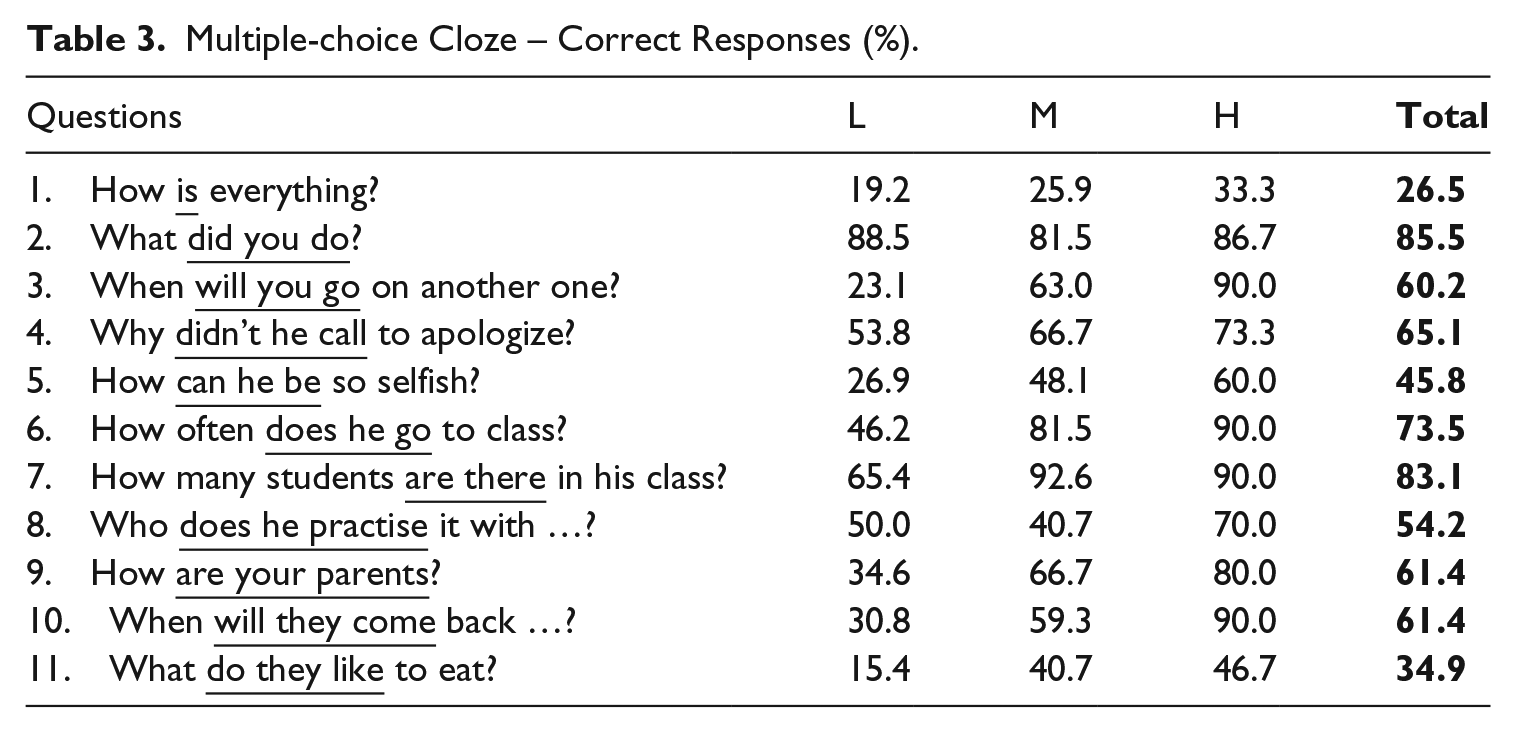
Overall, more than 70% of Class H students succeeded in choosing the correct options for many of the multiple-choice questions. This suggests that most of the high achievers had sound knowledge of interrogative structures. Nevertheless, they also showed considerable confusion in some cases. For (1) How is everything?, 33.3% of the students in Class H selected the plural verb are, the same percentage as that for the correct answer is. The concord problem shown probably derived from the plural meaning of the word everything, as mentioned by one student after the test. For (5) How can he be so selfish?, although 60% of the students in Class H correctly chose can he be, 30% chose can he, without the copula be as the main verb. This might be due to transfer from its Chinese equivalent heoi5 dim2 joeng2 ho2 ji5 gam3 zi6 si1? (he how can so selfish), in which the predicative adjective gam3 zi6 si1 (so selfish) does not require the presence of a copula. Another interesting finding was with (11) What do they like to eat?. Only 46.7% of the students in Class H correctly chose do they like, whereas 25.9% opted for are they like. This might be due to the multiple word class membership of the word like – it can be a verb (used with dummy do in non-assertive contexts) or a preposition (used with copula be). These findings support Hulstijn and De Graaff’s (1994) distinction between ‘rule learning’ and ‘item learning’ in their discussion about learning difficulty: while high achievers have acquired knowledge about the rules of wh-interrogative formation, structures that involve item learning (e.g. learning of the class membership of individual words) are more difficult to master.
Oral Test
Similar to the written test, the oral test revealed that the vast majority of Hong Kong students were able to command one-word interrogatives, with an error rate in the order of only around 10%. However, as Table 4 shows, about 70% of Class L students and half of Class M students failed to form questions with how far and whose book in the oral test. Some used how long for (6) How far is your home from school?, and who, who book, what book, or which for (7) Whose book is this? Meanwhile, about 40% of Class H students also had difficulty in forming questions with whose book. These findings suggest that many Hong Kong ESL learners have not yet acquired knowledge on how to use determinative/modifying question words.
Oral Test – Correct Responses (%).

As seen in Table 4, a large number of participants, including some Class H students, failed to use an appropriate operator when constructing wh-interrogatives. Some wrongly constructed questions with a missing or a wrong operator found in the oral test are presented below:
*Where Mr Tang go to lunch?
*Where are Mr Tang have lunch?
*What is Miss Wong say?
Of the seven questions tested, the respondents produced more operator errors for (2) Why must I see you after school? and (6) How far is your home from school?, the overall error rate being around 75%. About half of them failed to supply any operator. These findings seem contrary to those obtained in the written transformation test, in which students made fewer errors with be and the modal verb as the operator than with do-support. One possible explanation is that many learners realized the need to follow the subject-operator inversion rule when an operator was present in the transformation test. However, they had not yet achieved ‘automatization of the rules’ (DeKeyser, 2003: 329) and failed to supply their own operator in the oral test.
In addition to failing to choose the correct operator, many Hong Kong students were unable to supply the correct verb form of the lexical verb. The overall percentages of correct responses for the lexical verb ranged from 32.9% for (2) to 69.7% for (1). This finding further confirms that many Hong Kong students have an inadequate grasp of verb phrase structure, and that more heed should be paid to this before they can develop an adequate command of the wh-interrogative structure. Examples of using the wrong form of the lexical verb are presented below:
*Who is sing in the hall?
*What did Miss Wong said?
*Where did principal eating lunch?
The word order of the interrogative structure is another common problem. Some lower achieving students were under the influence of L1 and failed to master wh-fronting and the inverted subject-verb order, thereby producing faulty sentences for (7) Whose book is this? as follows:
*Who this book is?
*This book is who?
*This is who book?
Unlike English, the interrogative words in Chinese do not have a fixed position (Matthews and Yip, 2011; Ross and Ma, 2006). In (7) Whose book is this? (nei1 bun2 syu1 hai6 bin1 go3 ge3) (this CLASSIFIER book be whose), the Chinese interrogative word bin1 go3 ge3 (whose) is put after the verb hai6 (be). The placement of who / *who book after is in some students’ oral responses indicates that their acquisition of Chinese wh-questions impacts negatively on their learning of English interrogation. A student from Class H made the following observation about the influence of Chinese:
We probably use our mother tongue to learn English. We speak Cantonese. If we use literal translation, the structure will become incomprehensible… The wh-word is placed at the end in Cantonese, but in the initial position in English.
The production of *This book is who? and *This is who book? also reflects L1 transfer on the choice of wh-words. Some Hong Kong students seemed confused about the choice of who and whose, as both interrogative words can be translated into bin1 go3 in Cantonese.
The present study also echoes the findings of some studies that why questions resist subject-operator inversion more than other wh-questions (e.g. Bloom, 1991; Labov and Labov, 1978). The low success rate for word order for (2), 25%, seems to support Van Valin’s (2002) grammar-based argument that why is adsentential in nature.
Conclusions and Implications
Despite its clear, distinct function and its high frequency in authentic English, the English wh-interrogative structure is not easy for Hong Kong ESL learners, especially the lower English achievers, to process. It is formally complex, requiring learners to know metalinguistic terms to formulate the rules of its formation and a number of critical grammatical features that are different from the normative Chinese interrogative structure. The findings of the present study support Chan’s (2004) conclusion that the extent of negative transfer from Chinese to English was particularly large for complex structures and among lower achievers.
With regard to question words, while most Hong Kong Secondary 3 students have an adequate command of one-word interrogatives, the interrogative words whose, which, and how, and question phrases with the wh-word as a determiner or a modifier attract higher error rates and require more attention. Hong Kong students have particular problems with the use of whose, probably because its Chinese translation is similar to that of who and which. This suggests that at the high school level, instead of repeating exercises on the differentiation of familiar question words, teachers and textbook writers should pay more heed to learners’ acquisition of wh-words such as how, which, and whose, and interrogative phrases with the wh-word as a determiner or modifier. Given the Hong Kong students’ good command of the high frequency interrogative phrases such as how many and how much, it is considered important to enhance language input and expose students to target wh-word structures in meaningful classroom and social English repeatedly so as to develop automatization of the wh-phrases.
As for the structural features in wh-interrogatives, many Hong Kong students fail to use an appropriate operator, especially for those questions involving do-support. Another finding associated with this is that they produce more errors with non-subject questions, which require subject-operator inversion. Apart from helping students perceive the differences between the English and Chinese wh-interrogative structures, teachers can consider the principle of teaching cognitively less demanding concepts before the more complex ones, that is, teaching subject questions earlier than non-subject questions, and teaching those questions that require do-support later. Further, to help ESL/EFL learners master English verb phrase structures, teachers should familiarize students with the different kinds of auxiliaries and the associated form of the lexical verb, especially in non-assertive contexts, for example, through Thornbury’s (2001) consciousness-raising activities, followed by tasks aiming at broadening learners’ procedural knowledge (Larsen-Freeman, 2003), in order to help them use grammar structures accurately, meaningfully, and appropriately.
Educators should also design an English curriculum with teaching materials that can cater to learner differences. The present enquiry reveals that students of different English abilities show different kinds of learning difficulty, with wide variation not only in their mastery of question words, but also in their linguistic knowledge of the interrogative word order and the verb phrase structure. While a number of lower achievers tend to be under the influence of Chinese word order and need guidance on subject-operator inversion and wh-fronting, the more capable students may have already developed a good command of these. The attention of the latter, instead, could be drawn from rule learning to item learning, and they could be introduced to some linguistic complexities, such as the relationship between meanings and forms, and the multiple-class membership of individual words.
Considering the commonly-found erroneous interrogative structures in the oral test, it seems that repetitive mechanical written exercises may not be effective in advancing ESL/EFL learners’ questioning skills or addressing their learning needs at different stages. Instead, more natural language input and communication opportunities should be provided for them to practise asking questions in authentic meaningful contexts, so as to help them consolidate the grammatical knowledge acquired and develop implicit learning (Larsen-Freeman and Long, 1991). In other words, both the teaching materials and the grammar teaching approach adopted by teachers and textbook writers should be adjusted to expose learners to input rich target structures, engage learners in discovery-type grammar activities for raising their grammar consciousness, and incorporate tasks to induce input processing and free production of the target structures in meaningful contexts (Ellis, 2002).
To cater for learner differences, educators are strongly urged to design a more comprehensive English programme to facilitate students’ developmental sequence in the learning of wh-interrogatives. The significance of this study lies in the fact that with an improved understanding of the learning needs of students of different English abilities, teachers and textbook writers are in a better position to design useful materials to facilitate wh-interrogative acquisition in their design of the horizontal curriculum for students of different abilities in the same year level, as well as in their design of the vertical curriculum for students across different year groups.
Footnotes
Acknowledgements
I would like to express my thanks to Ms Shuwen Lin and the school teachers who made valuable contributions to the Learning Study project ‘Developing students’ ability to distinguish between “verb-to-be” and “verb-to-do” in wh-question formation’.
Funding
The author(s) disclosed receipt of the following financial support for the research, authorship, and/or publication of this article: This research was funded by HKMA KS Lo College.