




Abstract
Secondary schools in Australia have long benefited from state policies aiming to increase the academic success of English language learners (ELLs). Complementary pre-service and in-service teacher education programmes have been implemented to raise the expertise of subject teachers who teach ELL students. However, subject teachers may not be receptive to learning from such programmes.
This article explores the attitudes, knowledge and skills of Australian secondary teachers from schools with high numbers of ELL students. Six cases were drawn from a multiple case study investigating how teachers described their understandings about teaching ELLs, and how these understandings developed. Qualitative data were gathered using interviews and a questionnaire that prompted participants to reflect on their theories and practices relating to ELLs. These data were coded thematically, and then analysed according to Davison’s (2001) conception that professional learning occurs only when dissonance disrupts a teacher’s existing beliefs.
Findings suggest that teachers’ repertoires developed primarily through classroom experience and teachers did not readily accept professional learning outside their existing epistemology. This raises questions about how in-service and initial teacher education might generate the necessary dissonance for professional learning.
Keywords
The Context of the Study
Australia has a long history of teaching English language learners (ELLs) in secondary schools. In response to large numbers of ELLs entering secondary schools, policies have been implemented at the state level, particularly in New South Wales where over 30% of the school population has a dominant language (L1) other than English. Significant and long running policies include: the establishment of Intensive English Centres (IEC) which provide an educational orientation for ELLs new to schooling in New South Wales; state funding for specific projects including teacher professional development (PD) programmes and materials; and strategic placement of teachers with specialist qualifications in teaching English as a second language (ESL). 1 As a result, the structure of school faculties and departments has adapted to provide learning pathways for these students. Teachers in public schools where there are high numbers of refugees are accustomed to co-teaching with ESL or other specialist teachers. They are also accustomed to projects or special courses requiring ELLs to be withdrawn from mainstream classes. Such a context suggests that experienced teachers working in schools with a high proportion of ELLs have had many opportunities to learn how to accommodate ELLs within their classes.
This article reports on a multiple case study of subject teachers working in large public and multilingual schools in Sydney. It investigates the knowledge about teaching ELLs reported by content teachers and how this impacts teacher education.
Review of Literature
The literature informing this study falls into two streams that ask: what knowledge do content teachers of ELLs need?; and how do teachers acquire new learning about ELLs?
Content Teacher Knowledge for Teaching ELLs
Approaches required to promote ELLs’ learning in schools where English is the medium of instruction can be theorized from research into three general teaching principles (Walqui and van Lier, 2010: 84-85).
Sustain academic rigour: A quality curriculum builds on students’ prior knowledge and experiences, and encourages student autonomy (Hammond and Gibbons, 2005). Teachers engage students in higher order thinking about key concepts within the discipline. Disciplinary concepts are not dumbed-down, but amplified to provide message abundancy (Hammond and Gibbons, 2005). Teachers use multiple modalities that engage students in varied ways and provide another source of abundancy (Santos et al., 2012). Students are supported-up to increasingly challenging texts (Hammond, 2014) by strategic and differentiated instruction (Kibler et al., 2014).
Engage students in sustained, quality interactions (with teacher and students): Language acquisition is a socio-cultural phenomenon (Hammond and Gibbons, 2005), so knowledge is constructed and language is appropriated through negotiated and extended exchanges between a learner and knowledgeable others (Walqui and van Lier, 2010). Ideally, learning takes place in ‘a social, peer-supported structure that requires students to engage in metacognitive and content-related knowledge building’ (Kibler et al., 2014:12).
Teach with a pedagogical language focus: Mainstream teachers need ‘deep content knowledge that is pedagogical in nature’ (Santos et al., 2012: 106), but also substantial theoretical knowledge about how to contextualize language teaching within their subject (Hammond, 2014: 525). This pedagogical language knowledge can be conceptualized as ‘knowledge of language directly related to disciplinary teaching and learning and situated in the particular (and multiple) contexts in which teaching and learning take place’ (Bunch, 2013: 307). This involves ‘disciplinary linguistic knowledge needed to unpack the language demands associated with a particular content area’ (Turkan et al., 2014: 6).
Teachers may not have considered how language promotes understanding within their subject area or appreciate that they have a critical role to play in supporting disciplinary language learning (Bunch, 2013). Therefore, teaching ELLs according to these principles may seem counter-intuitive to some subject teachers and challenge them to adapt to new ways of teaching.
Approaches for Content and Language Teaching
The school environments where this study took place modelled their approaches for teaching ELLs loosely on content-based language learning (Lyster and Ballinger, 2011). Although withdrawal classes were in operation, teaching was subject-matter driven with support available from ancillary staff like ESL teachers. The PD in operation in these schools was oriented towards developing subject teachers’ language knowledge.
Professional Learning and Development for Teachers of ELLs
Literature on teacher learning suggests that subject teachers develop a theoretical knowledge base in initial teacher education, and then most commonly extend or consolidate their teaching skills on the job (de Vries et al., 2014). For this knowing-in practice (Webster-Wright, 2009) to expand beyond their experiences, teachers must engage in reflective action. Reflective action involves first identifying, and next critically challenging their initial assumptions.
Different systems of teacher education have been devised to address the issue of preparing teachers to teach language as well as content. In Australia this is managed by individual universities which may offer ESL specializations. However, it is not unusual for pedagogical language knowledge to be subsumed within generic courses about managing diversity, or special needs.
One approach to achieving a dual focus on language and content is team teaching. The participants in this study engaged in a form of partnership teaching where a content teacher was paired with an ESL or support teacher (Davison, 2006). They managed shared classes by separating out the ELLs for the ESL teacher to teach using a sheltered version of the content, while the content teacher taught those students who were not considered in need of extra language support. The subject teacher planned the content and teaching, while the ESL teacher offered point-of-need language support. The rigour of such partnerships has been questioned in past studies that revealed how the knowledge and skills held by ESL teachers were under-used or unrecognized by their colleagues (Arkoudis, 2003; Creese, 2006; Lo, 2013). However, partnerships have potential for teacher learning if colleagues surface their divergent assumptions ( Davison, 2006; de Vries et al., 2014).
This study hoped to find whether university courses, in-service PD or collaborative relationships led subject teachers to question their existing beliefs and add new understandings of how ELLs learn.
Theoretical Framework
This article uses a socio-cultural theoretical framework to explore the formation of and potential changes to teachers’ beliefs about teaching ELLs ( Davison, 2001).
Teachers develop specific content knowledge and specific pedagogical knowledge (Shulman, 1986). They know the subject matter they must teach and they learn effective ways to teach particular content (Van Driel and Berry, 2012). In the case of subject teachers of ELLs, this pedagogical content knowledge (PCK) may not include resources for teaching ELLs.
Teacher beliefs and knowledge solidify in response to influences from their teaching context. These beliefs are unlikely to change markedly unless teachers are discomforted by inconsistencies between their beliefs and theoretical understanding (Davison, 2001). It may not be necessary for these to be resolved, but teachers must register dissonance between existing and new theories before new learning can take place. In fact, it may be necessary ‘‘for teacher education programmes to challenge the apprenticeship of personal experience and…identify what future teachers need to
This article uses the analytical framework represented in figure 1. It explores participants’ descriptions of their knowledge about teaching ELLs and how this is implemented in practice; and then examines whether disconfirming evidence has prompted them to unlearn old theories and add new understandings of how ELLs learn in subject classes.
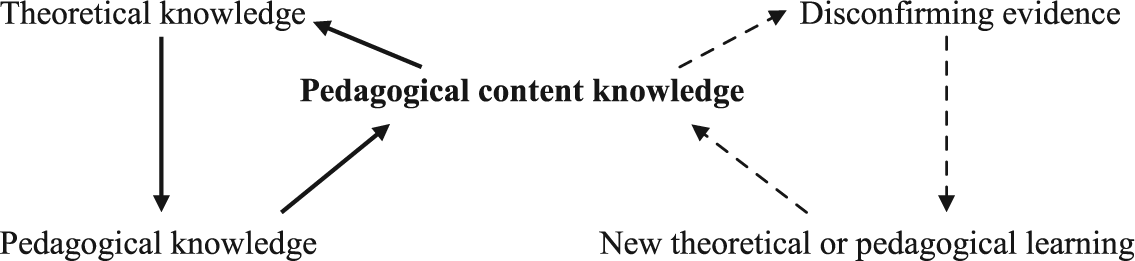
Conceptualization of Teacher Change.
The two research questions asked:
What do subject teachers report as good practice for ELLs learning in their content area?
To what professional learning do teachers attribute their beliefs and practices about teaching ELLs?
Methodology
This article reports six cases from a larger qualitative multiple case study. The cases were deliberately selected to include the experiences and perceptions of teachers with different subject specializations, at different phases of their teaching careers.
Participants
Participants for the wider study were 11 volunteer teachers from two public secondary schools with school populations of over 70% ELLs, and one feeder Intensive English Centre for new arrivals to Australia. These teachers taught visual art, science, history, English, Indonesian, mathematics or ESL. For conciseness, this article reports on six teachers purposively selected from the wider study.
Research Process
The teachers gave informed consent to the use of their data as required by the two universities involved in the study. They then completed a questionnaire that captured demographic information such as their years of teaching, qualifications and recent PD experiences.
Next the participants brought their completed questionnaire to an audio-recorded interview scheduled at a time and place at the school that was convenient to them. The questionnaire was used to prompt each teacher to share their perceptions of best teaching practice for ELLs in their subject area. Most interviews took about 40 minutes and the longest lasted 82 minutes.
Data Analysis
The interview data were transcribed and coded thematically, identifying references to participants’ beliefs about teaching ELLs, their teaching practices and any specialist teacher education or PD. Deductive coding was also used for the questionnaire and teaching artefacts such as a co-planning template. In the next phase of analysis these categories were reviewed to identify dissonance among the teachers’ beliefs and understandings about teaching ELLs.
Findings
This section explores the perceptions of Neil, Karl and Shona (all pseudonyms) who taught at school A; Beth who was head of the adjacent IEC; and Marie and Rosa who taught at school B. These teachers varied in terms of their curriculum specialty, years of experience and PD opportunities. In each case, brief examples from their interviews illustrate their understanding of key principles for teaching English language learners, and how they believed that these understandings arose.
School A
ESL provision in School A was organized within an ESL faculty which comprised of part-time ESL teachers with varying qualifications. This school was involved in a wide number of partnerships with the wider social, educational and commercial community that aimed to support ELL students to transition into Australian life. Neil, Karl and Shona had different views about the efficacy of these programmes.
Neil: ‘PD by stealth’
Neil described himself as a teacher trained to teach ESL although he could not remember the ESL qualification he had gained. He had spent most of his professional life teaching a foreign language, though recently he had worked as a support teacher for deaf students. Neil had started working at School A as an ESL teacher only two years earlier. He explained that although he had not taught ESL in his previous 33 years as a teacher, ‘I’ve been teaching languages, so I have got an understanding of the problems kids encounter when they’re learning a foreign language’.
Neil believed that he had acquired the skills necessary to be an effective teacher through his long experience. He was ‘comfortable teaching ESL [and had] never worried about doing it’. He also enjoyed collaborating with teaching colleagues. Working in geographically distant schools to support deaf students had given him the confidence to work alongside different teachers in different classrooms.
He did not recall specific instances of PD or teacher education that had informed his practice over the past five years apart from a three-day course for beginning ESL teachers and a course on teaching spelling that he remembered as being ‘pretty handy’.
Neil had a strong grasp of metalanguage and grammar and recalled instances of teaching comparatives and superlatives. However, he did not identify this linguistic knowledge as a unique asset that he brought to team teaching. The strength that he was most aware of was an ability to collaborate with his subject teaching colleagues, and even step in to teach if one happened to be away. He struggled to think of any ESL skills that might differentiate his teaching from his colleagues’ unless it was an awareness of technical vocabulary. He stated categorically, ‘I don’t give advice to colleagues’, as he saw his role as facilitating the job of the subject teachers and ‘to support the language side of things’ when necessary during their classes. This occurred more frequently in history than in maths as he felt maths posed fewer specific linguistic challenges. He did not engage in developing curriculum or believe that he had a role in maintaining academic rigour.
Neil admired the resilience and conscientiousness of the ESL learners he taught and made an effort to connect new concepts to topics of interest to them. He saw the value of oral interactions and recommended beginning any task with a discussion and then encouraging students to write short but creative passages. He also encouraged learners to gloss English texts in their L1. He felt that effective teaching for ELL students required a focus on spelling and punctuation. This suggests that while Neil had linguistic content knowledge, he had not developed pedagogical language knowledge to guide or challenge his colleagues.
Karl: ‘Try to make them speak’
Karl had taught maths at School A for many years. Karl was trilingual and read grammar books out of his own interest though he had never done ‘proper linguistics’. What he remembered about PD offered at School A was that it largely consisted of reports from the IEC about students who were soon to enter School A. Karl did not find these useful as he preferred to trust his own judgement about the maths and English language proficiency of the ELLs entering his classes.
It’s good to know if they can read and write in their original language because they are often illiterate in their original language as well as English. I don’t say “Have you done third class, fourth class…?” I figure my way around with questions… and I can see pretty quickly where they’re at, what’s their arithmetic like …
His instinct for teaching ELLs was that they should be encouraged to talk about their learning as much as possible in their L1 and also in English.
I’ve got a year 11 applied mathematics class where a lot of discussion goes on in their language, especially if I am giving them word problems or questions with a lot of English in there. I put the words on the board … but they can talk about it and that way I can find out actually if they know the idea and understand the idea in their own language.
He felt that other members of the class were useful resources in explaining new concepts to members of their own language groups. He himself tried to learn key maths terms in the L1 of his students.
Karl was concerned that the strongest community represented at his school did not have a culture of learning or talking about maths. His students came from families who were often illiterate and therefore could not provide models to demonstrate the value of maths in real life. He contrasted the limited expectations and difficult experiences of refugee families with those of his highly ambitious international student ELLs. In response, Karl made an effort to make maths relevant to his students’ interests, which experience had taught him were money, cars and childcare. He explained that he wanted students with limited prior education to gain enough numeracy ‘to stop them from getting ripped off by the phone company or in shops’. He felt that equipping ‘them for living in the real world where they’re going to encounter numbers’ was more important than following a syllabus that did not meet their needs.
He found that talking about problems and looking at models provided by past examination papers were effective tactics for preparing his students in examination streams. Karl did not believe that writing was an important skill for his maths students and remarked that generally he read past any grammatical or spelling errors because he was ‘more interested in getting the sense in what they want to convey’. He was happy to offer extra classes too, but strongly resented the many transition projects that took students out of classes.
Overall, Karl believed that idioms and spelling provided the biggest challenges to ELL learners, which led him to focus on meaning rather than form. He encouraged students to use their strengths in oral language to talk through problems both in their L1 and in English. Karl’s strong focus on oral interaction was congruent with research from educational linguistics, but he had no desire to complement this with advice from experts from the IEC or elsewhere.
Shona: ‘building rich tasks which engage students’
Shona was a visual arts teacher who specialized in teaching using technology. Although she had never undertaken specific TESOL training, Shona was a senior member of staff who team-taught across a number of learning areas and demonstrated a great deal of confidence in her ability to teach ELLs. She had a keen interest in on-going professional learning that incorporated technology, and offered workshops to other teachers (including ESL teachers) on student centred pedagogies that integrated digital technologies. She was also involved in interviewing students across the school to determine how best they liked to learn, and concluded that students like to learn collaboratively. These data were significant in informing her beliefs about teaching.
However, Shona appeared to be even more influenced by a programme operating in the local primary school. Shona explained that Focus on Reading was well-suited to secondary as well as primary learners because ‘we have a lot of students that fall into primary age reading groups’. In addition to observing the cooperative skills practised by very young learners, Shona most was impressed by the ways that primary teachers were ‘building students up to be able to access [a] particular text’ using prediction and discussions with a ‘quality thinking partner’. Shona discovered that secondary students resisted the primary school model of sitting ‘eye to eye and knee to knee’ on the floor but she persevered with the core strategies of the programme and was extremely enthusiastic about the results. She noted that all her students were engaging with text and demonstrating high levels of cognition. Shona also felt that interactive whiteboards were excellent tools for engaging students including in cases where teachers highlighted key nouns in a text.
Shona emphasized that whenever she thought about teaching approaches, she considered the needs of ELL students. The greatest need for these learners was to be able to engage with content in different ways. She highly recommended using think-aloud processes to introduce prezzie, Rewrite think, glogsterBlog Ed, Testmaster and other interactive platforms so that students would be able to work together and present and assess their learning in different ways. Other practices that contributed to ‘building rich tasks which engage learners’ included using learning intentions, although she was not convinced that these needed to be as specific as language learning intentions. She also felt that it was important for each student to set learning goals.
Shona’s understanding of how ELLs learn was informed by her school research into collaboration, working in partnership with a primary school, and common-sense ideas that were sometimes congruent with educational linguistics. She was an active, eclectic learner completely confident that she taught ELLs effectively without requiring formal education in this field.
Beth: ‘Are we really meeting the students’ needs?’
Beth was the only participant whose background and qualifications were specifically in teaching ESL in secondary schools. She had been a head of learning support on the strength of her ESL expertise, and she had also been seconded to work on projects transitioning refugees into mainstream environments. In short, Beth had built strong pedagogical language knowledge in school and IEC contexts. Her current role was to prepare new learners of English to transition into the five local high schools within the funded timespan of three or four terms.
She supervised teachers who had qualifications in both ESL and curriculum content. Beth regularly assessed new arrivals against the ESL band-scales and worked hard to establish a rigorous curriculum that would extend her students’ language proficiency within the context of learning subject-matter so that they could transition relatively seamlessly into mainstream classes. She tried to
encourage hands-on group work, rich tasks, real life, you know… more project-based kind of things … things where we’re getting that talk happening to start with because for a lot of the students that’s where we have to start with them. It’s difficult to find secondary age texts at a really low literacy level that are not… like patronising
Beth noted that ‘every student who exits [the IEC], has an Exit report’ to go with them to the receiving schools which included data about ELLs’ proficiency in ‘English, maths, science and welfare information, as well … [as] portfolios which had examples of their current writing’. She was uncertain how or whether schools used this information.
Although Beth had delivered language-related PD in school A and others, it was a challenge to convince management teams of their worth. The most successful language programmes that she had observed were long-term and collaborative. Beth felt that subject teachers were driven by ‘content, content, content’ and PD was unlikely to stick unless it was long-term and collaborative. Some of her own long-serving IEC teachers were also disinclined to extend their professional learning.
because they’ve been around for 25 years but many of the staff stayed and they’ve only ever taught in that setting and there’s been little contact or… you know, cross fertilisation of ideas. So I’m always trying to encourage… working together with the high school teachers.
Beth hoped that the national curriculum would prompt subject teachers to look more closely at the language of their subject and collaborate actively with their ESL colleagues, but that had not been her experience. She kept in close contact with students who had graduated from the IEC. ‘We asked the students: what do you need when you go to high school? What are the things that you want? And they were saying: academic language, assessment tasks’. So Beth was working on teaching approaches within the IEC to facilitate these.
School B
School B was an all-boys school with otherwise very similar demographics to School A. A key difference between the schools appeared to be that the Head of the Faculty of Learning Support in School B was a qualified ESL teacher who also occupied a key position in senior management.
Rosa: ‘Maybe I should become qualified for the job I’m already doing!’
Unlike the other participants, Rosa had undertaken a specialist course in ESL during her pre-service teacher education and had actively sought a practicum in School B to practise these skills. A bilingual Australian herself, something clicked for Rosa when she realized how many students at School B came from non-English linguistic backgrounds. Rosa returned there to work and appreciated the mentorship she received from the Head of Learning Support.
Rosa recommended using visual supports for new learners of English. She thought it important to create a safe learning environment where students would feel confident participating in class discussions and building on their own experiences. Although she knew that interactive tasks could be valuable scaffolds into academic writing, she focussed on supporting the writing skills of her senior students. A recommended paragraph structure had been implemented across the school and Rosa found that this helped students to structure their writing. She used this framework along with strategic questioning to co-construct paragraphs with her classes. She recognized that different subjects favoured different genres and had thought about different approaches to use in supporting music, history and English.
Rosa was also the only participant who was already planning to gain a specialist qualification. She offered several reasons for this. One was the New Scheme Teacher Accreditation that required new teachers to engage in further PD. Another reason was that the proposed Australian Curriculum required teachers to have knowledge of the language forms within their discipline. She was aware that her ESL content knowledge was limited and wanted ‘to be able to look at a kid’s writing and be able to identify [why it wasn’t correct] and give them the strategies’. Although she had picked up ideas from initial teacher education, from PD and from talking to people, she wanted ‘to have it packaged, have it laid out how you’re actually supposed to do it’. In essence, Rosa recognized that teaching ELLs involved specialist knowledge and skills: ‘There’s huge value in ESL learning pedagogy and strategies that we can take on board’. The knowledge she had gained in her first two years of teaching suggested to her that ESL strategies were applicable across all subject areas.
Marie: ‘The more kids contribute, the more engaged they are’
Marie was a first year teacher of science who had not undertaken any specialist ESL courses during her initial teacher education. She struggled to remember any specific mention of ELLs in her pre-service teacher education.
There was a large focus on technology and a large focus on learning diversity for the students who had learning disabilities but not much of a focus dealing with kids who can’t read or write…
Marie appeared to have developed her own approach to meeting her ELL students’ needs by a combination of professional reflection, and ‘talking to other teachers… especially when you have support teachers’. Through problem solving, largely on her own, Marie had developed an extensive repertoire of activities for her learners. She recognized that the textbook appeared impenetrable to her students and implemented a process of summarizing key concepts using visuals, videos and power-point displays. She regularly began topics by asking her students, ‘Does anyone know what this topic might be about?’, and used their answers to inform her planning. She encouraged students who understood new concepts to explain to those who didn’t:
if one student understands and another one doesn’t, they’d usually just go like : “you know how your dog does this…” They sort of help along and if not, we … usually just discuss it more with examples.
This discussion phase was central to her teaching.
Marie found that her students’ interest was piqued when she introduced topics using non-technical terms and challenged them to find academic words that expressed the same idea. She would ask them to use academic vocabulary to fill the blanks in a cloze exercise. This resulted in notes that were glossed from common vocabulary (poo) to the scientific (faeces). She was also adept at using retrieval charts to enable students to work together to capture connections among ideas which may have been presented in another medium such as on video. In addition Marie felt that it was motivating to sprinkle many small assessments over the course of a term rather than waiting for one large and demoralizing test at the end of each unit. She would include questions from past exams so that students gained a sense of mastery of the curriculum.
Nonetheless, Marie seemed to have a hazy conception of what differentiated ELLs from students with learning or literacy difficulties. She insisted that particular students born in Australia into families from the Middle East were not ELLs because their oral English was fluent and they did not have foreign accents. This confirmed to her that the mother tongue had no place in her classroom. Furthermore, she worried about the students’ inability to spell,
Before I came to this school I thought by the end of primary school you can spell most of the common words and you can construct sentences. And here I’ve encountered students who don’t know the alphabet and they’ll write letters like “b” and “p” and they’ll get mixed up.
As a result, many of her exercises focussed on the word or even letter level. Yet Marie had high expectations of her ELLs and instinctively realized that oral interaction was a crucial step towards literacy. Her desire to meet their needs led her to draw heavily on her students’ prior knowledge, and motivate them by using manageable assessments. Her developing understanding about teaching ELLs was informed by problem-solving and reflection and she was appreciative of tips offered by colleagues from learning support.
Discussion
More than ten years ago, Davison (2001: 79) noted that professional learning about ESL in Australia was developing haphazardly from two directions ‘education down and practice up’. The tension between the two at least partially explains the sources of information about ELLs reported by the participants in this study. It appears that many of these teachers maintained an equilibrium between content and practical knowledge about teaching their subject. Because they did not perceive any friction between their subject teaching beliefs, professional knowledge and practices, and those related to teaching ELLs, they saw no need to seek out additional specific professional learning (Davison, 2001). As there was no sense of dissonance (Figure 2), they did not engage in new learning that might have allowed them to un-learn their preconceptions or common sense understandings about learning through another language (Snow, 2011). The teachers most open to developing pedagogical language knowledge (Rosa and Marie) were those who felt that their existing PCK was inadequate to support teaching ELLs. The others (like Shona) were only open to new learning when their individual practice or personal research suggested it was necessary.
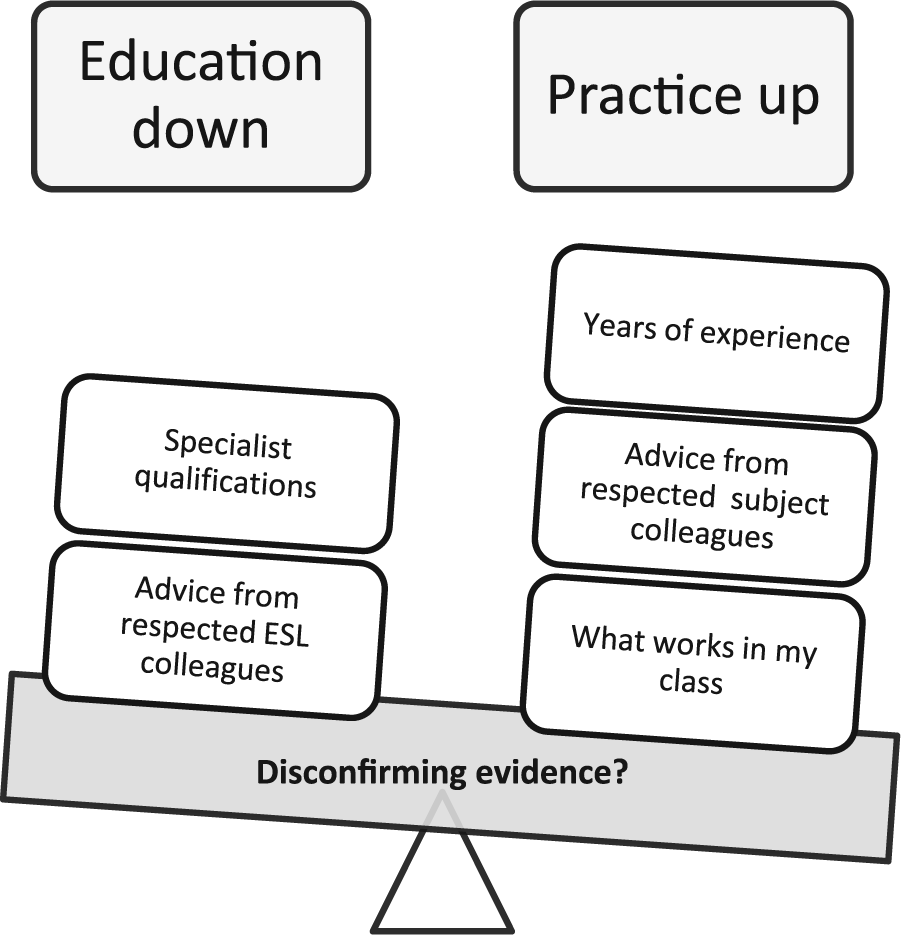
The Weight of Disconfirming Evidence.
Education Down
The participants seemed unaware that there was more they could learn about teaching ELLs. They reported enjoying learning from colleagues that they perceived to be knowledgeable and whom they respected. In school A the ESL staff was part-time and did not identify as experts in the field of ESL suggesting they were unlikely to convey a sense of professional authority to their colleagues. This may have contributed to their limited sense of agency for sharing specialist ESL skills, and encouraged them to play a subordinate role to the dominant subject-matter expert. The actual language expert, the coordinator of the IEC, appeared to be both geographically and epistemologically separate from her School A colleagues. None of the participants was receptive to the knowledge about ELLs that she tried to share with them, and they persisted in replicating low-challenge teaching practices like a focus on spelling and essay memorization that common sense told them would be effective. Timperley and Alton-Lee (2008: 350) note that ‘Knowing what students can or cannot do, … serve[s] to shape teaching practice in ways that promote deep student learning only if teachers have sufficient depth of pedagogical content knowledge on which to base teaching decisions.’ The participants did not use data about ELLs’ language proficiency or prior education to inform their teaching, but preferred to assess ELLs according to criteria that they had formulated through experience. The participants’ PCK was thus based on teaching their subject rather than teaching language.
In school B the head of learning support was also head of teaching and learning and thus brought prestige to the ESL work of his faculty. As a result, teachers such as Marie were happy to seek advice from support staff. Rosa, who worked in learning support, had had a taste of ESL specialist learning in her initial teacher education so she was aware of a distinct body of knowledge and eager to learn more. These two newer teachers had less experience to draw on and appeared to be more open to new learning about how to teach ELLs than their more experienced colleagues.
Confusion between Literacy and ELL Approaches and Needs
All of the participants had developed or learnt skills that promoted language learning. They all prioritized accessing their learners’ prior knowledge and experiences, saw the value in hands-on activities, and regularly engaged students in oral interaction. However, their understanding of how to systematically develop learning through the medium of a new language was patchy. They were not able to distinguish between ELLs and students with literacy or learning difficulties. For example, almost every teacher in this study worried that their students’ spelling was indicative of poor literacy. While the participants observed the marked difference between their students’ oral language and their writing proficiency, few appeared to realize that this is a common phenomenon in acquiring an additional language, or knew how to transition students from oral to written skills. While most participants used questioning and whole class discussions, they did not fully exploit group activities in ways that would deliberately enhance subject language development.
Education from whom?
Teachers seemed open to certain kinds of PD. The issue was to whom they gave their attention and respect. Neil explained that knowledge about teaching a foreign language and skills acquired in teaching the deaf were adequate preparation for supporting ELLs. Armed with this background, he had little interest in furthering his pedagogical language knowledge. Sonia felt that her expertise in IT and a primary school literacy course she had attended qualified her to understand best practice for the adolescent ELL students in her care as well as new teachers for whom she was responsible. Her position as a senior leader meant that this claim was unchallenged by others in the school.
Practice Up
An attitude of practice-up learning predominated, particularly from the teachers with many years in classrooms. Teachers like Sonia, Neil and Karl overtly attributed their practices for teaching ELLs to their familiarity with working with this student population. Their initial teacher education was long past and any PD they had received about ELLs had not made an impression upon them. There was also evidence that even a first year teacher like Marie was actively shaping her teaching philosophy by reflecting on her classroom experiences. Of all the participants, Rosa represents a middle ground. She was sufficiently new to teaching to remember pivotal learning from her initial teacher education, and her two years in the classroom confirmed to her that she needed to hone her skills in teaching ELLs.
Unlearning Conceptions
None of these teachers reported feeling discomfited enough to change their practice. They attributed any changes in their approaches to teaching ELLs to the influence of respected colleagues and in Rosa’s case, a desire to grow their expertise. Unfortunately, the colleagues from whom they sought advice were not always best skilled to provide it.
Implications
This study adds weight to the idea that teachers need to become aware of a disconnection between their beliefs, knowledge and practice before they are disposed to engage in new learning. The participants in this study were comfortable in their subject knowledge and practices. This may explain why ongoing PD about teaching ELLs in curriculum subjects was barely mentioned, and why specialist information offered by the staff from the IEC was disregarded. Further research might address the question of what kinds of PD it would take to provide the friction necessary to provoke teachers to engage in pedagogical language learning.
Footnotes
Funding
This research received no specific grant from any funding agency in the public, commercial, or not-for-profit sectors.