



Abstract
This article describes the gathered experience in using corpora in an IELTS preparation course. The practice demonstrates an attempt to reduce negative washback effects occurring when preparation courses just concentrate on the test format neglecting the importance of development of learners’ language skills and general study skills. Some corpus-based activities, which were used in a group of Russian university students for teaching vocabulary and writing, are provided. The author’s experience in using corpora proves such positive effects of corpus teaching as an increase in the learners’ understanding of usage patterns, drop in the number of collocation errors they make, enhancement of the students’ autonomy and self-correction skills.
Introduction
The International English Language Testing System (IELTS) is an internationally reputable standardized test. According to the British Council, the number of test takers exceeded 2.5 million in 2015 (British Council, 2016). Some educational institutions choose tests in the IELTS format as a tool for measuring their students’ English proficiency (Qian, 2007: 19). It is not surprising that EFL teachers are striving to find the most efficient ways of preparing their students for the test: they introduce special teaching activities, develop new teaching materials and make learners practice test papers extensively. However, over-concentrated on familiarizing learners with the test format and boosting their scores, some IELTS preparation courses may downplay the importance of ‘the real business of learning the language’ (Zhengdong, 2009: 25) as well as the enhancement of learners’ autonomy and critical thinking skills. I believe the use of corpora in a language classroom is an indispensible aid for solving this problem. Based on my experience, corpus-based teaching in an IELTS preparation course can improve both students’ language abilities and general learning skills.
The article is organized as follows: The Teaching context section gives a short description of the audience who were taught with the use of corpora. The next section, Reasons for the Innovation, explains what problems prompted the employment of corpus analysis in the IELTS preparation course. The Innovation section describes the role of corpus linguistics within the framework of existing approaches to teaching EFL. Next, in the Use of Corpora in the IELTS Preparation Course section, some corpus-based activities and their effects are presented. The final section reports on the positive effects and some limitations of using corpora in ELT classrooms.
The Teaching Context
Corpus-based teaching was used in the groups of first-year undergraduate students of the National Research University Higher School of Economics, Perm, Russia (hereafter abbreviated HSE) which is one of leading Russian higher educational institutions. It offers Bachelor’s and Master’s degree programmes in economics, management, political science, law and other disciplines. All the target learners were Russian, with Russian being their first language. About one third of the learners were male and two-thirds were female. Their age varied from 17 to 19 years. All the students had finished secondary school and were majoring in economics. Their English proficiency corresponded to the Common European Framework of References for Languages (CEFR) levels of around B1. The course taught by the author was a six-month course. The aim of the course was to prepare the learners for the IELTS test which was chosen as the common English proficiency assessment at the HSE.
Reasons For the Innovation
It is commonly known that some test preparation courses, including the ones focusing on IELTS, often just concentrate learners’ attention on ‘practicing and mastering item types for the test and thus neglect the learners’ actual language development’, improvement of their language proficiency and ability to use a target language (Zhengdong, 2009: 24). This phenomenon is referred to as ‘negative washback’. In the light of the works focusing on washback (see Bailey, 1996; Hughes, 1993; Tomlison, 2005; Zhengdong, 2009), an effective test preparation course, apart from raising learners’ awareness of the test format, should be aimed at developing their language skills and general learning skills. To improve the IELTS preparation course traditionally taught at the HSE, which suffered from the aforementioned drawbacks, the author decided to implement the corpus-based approach: on the one hand, it allowed the author to address some learners’ language problems in a more efficient way; on the other hand, it helped to foster the students’ autonomy and critical thinking. The two areas that involved corpus use – teaching target vocabulary and writing – were chosen for the following reasons.
One of the most serious language problems the first year students of the HSE have is their limited vocabulary range. Even when most of their grammatical problems have been cleared up, the learners still tend to make a lot of vocabulary and collocation errors. They usually find it difficult to deal with the IELTS test because it puts a great emphasis on assessing learners’ vocabulary range: candidates’ performance in both speaking and writing is assessed against the lexical resource criterion which makes up 25% of the total mark. Besides, quite extensive vocabulary is necessary to succeed in the listening and reading sections.
The use of corpora in the classroom for solving this problem was very efficient because when examining corpus lines, being guided by the teacher, learners develop a crucial element of learning skills (see Cohen, 2003), particularly, the ability to recognize patterns of language structure and use. Corpus-based activities in the classroom help students not only learn new vocabulary but also understand how the given language units are used for meaningful communication.
Secondly, in the author’s teaching context, corpus analysis use was incredibly helpful in training the students in the IELTS writing tasks as the learners no longer needed to rely on their intuition about what sounds natural or on judgments of grammmatical accuracy. Corpus analysis was employed both while doing a writing task and in self-correction activities when the students addressed the lexico-grammatical errors they had made in their writing.
The Innovation
A corpus is defined as ‘a finite collection of machine-readable texts, sampled to be maximally representative of a language or variety’ (McEnery and Wilson, 2001: 197). Corpus linguistics is the empirical study of language which uses computer-assisted technologies for analysing large databases of texts (Conrad, 2000: 548).
Corpus linguistics was established as a new framework of linguistic data analysis in the late 1950s by a small group of researchers who began the compilation of the Survey of English Usage Corpus at the University College London under the direction of Randolph Quirk (Lüdeling and Kytö, 2008: 10). Nowadays, methods of corpus linguistics are used in the investigation of various areas of language-related disciplines, including language pedagogy.
Corpus studies have been used in language teaching since the late 1980s when the first corpus-based dictionary for learners of English called Collins COBUILD English Language Dictionary was published. The dictionary was one of the products created as a result of Professor John Sinclair’s COBUILD project which used the so-called KWIC (key word in context) concordance data of a 20 million word corpus of contemporary English, created by the specialists from the University of Birmingham. Today, it is widely accepted that corpus linguistics offers exciting perspectives in a wide range of areas of EFL teaching, e.g. materials design, grammar and vocabulary teaching, self-correction and peer-correction.
The use of corpora in teaching EFL is associated with a Data Driven Learning (DDL) approach (Johns, 1991; Johns, 1994) which is about providing language learners with access to linguistic data to meet their learning needs (Johns, 1991: 2). DDL deals with extensive databases of English texts (corpora) and aims at raising learners’ grammatical consciousness. Corpora are studied with special software programmes called concordancers, which help to identify common patterns in authentic language samples (Rutherford, 1987). However, according to Gabrielatos (2005), corpus teaching should not be restricted to any single teaching methodology because the use of corpora is consistent with all methodologies which explicitly focus on language structure and use, i.e. teaching frameworks that concentrate on noticing or awareness/consciousness-raising (see also Lightbown, 1985; Schmidt, 1990; Sharwood-Smith, 1981).
The Use of Corpora in the IELTS Preparation Course
Teaching Target Vocabulary
As has been mentioned earlier in this article, one of the challenges the author faced when preparing the learners for the IELTS test was attempts to increase their language repertoire.
To test the effectiveness of corpus use for addressing this problem the author conducted an experiment with a sample of 36 first-year students of the HSE. The students were given a list of target vocabulary selected from the text which they had read in class. To teach the words the author followed the steps of the traditional PPP approach (i.e. presentation, practice, production) and collected the sentences created by the learners at the final stage. Subsequently, the students were given some corpus data to examine.
In this article the activity is demonstrated by the example of the word tantamount. The author printed out some corpus lines from the BNC regarding the target vocabulary (10 examples for each unit) (see Handout 1) and gave the learners the following tasks which focus on lexical meaning and collocation patterns:
Examine the corpus lines and try to find out the difference in meaning between the words tantamount and equivalent, which in the Oxford Advanced Learner’s Dictionary are given as synonyms.
What words (verbs, particles, nouns) combine with tantamount? Try to identify some usage patterns.
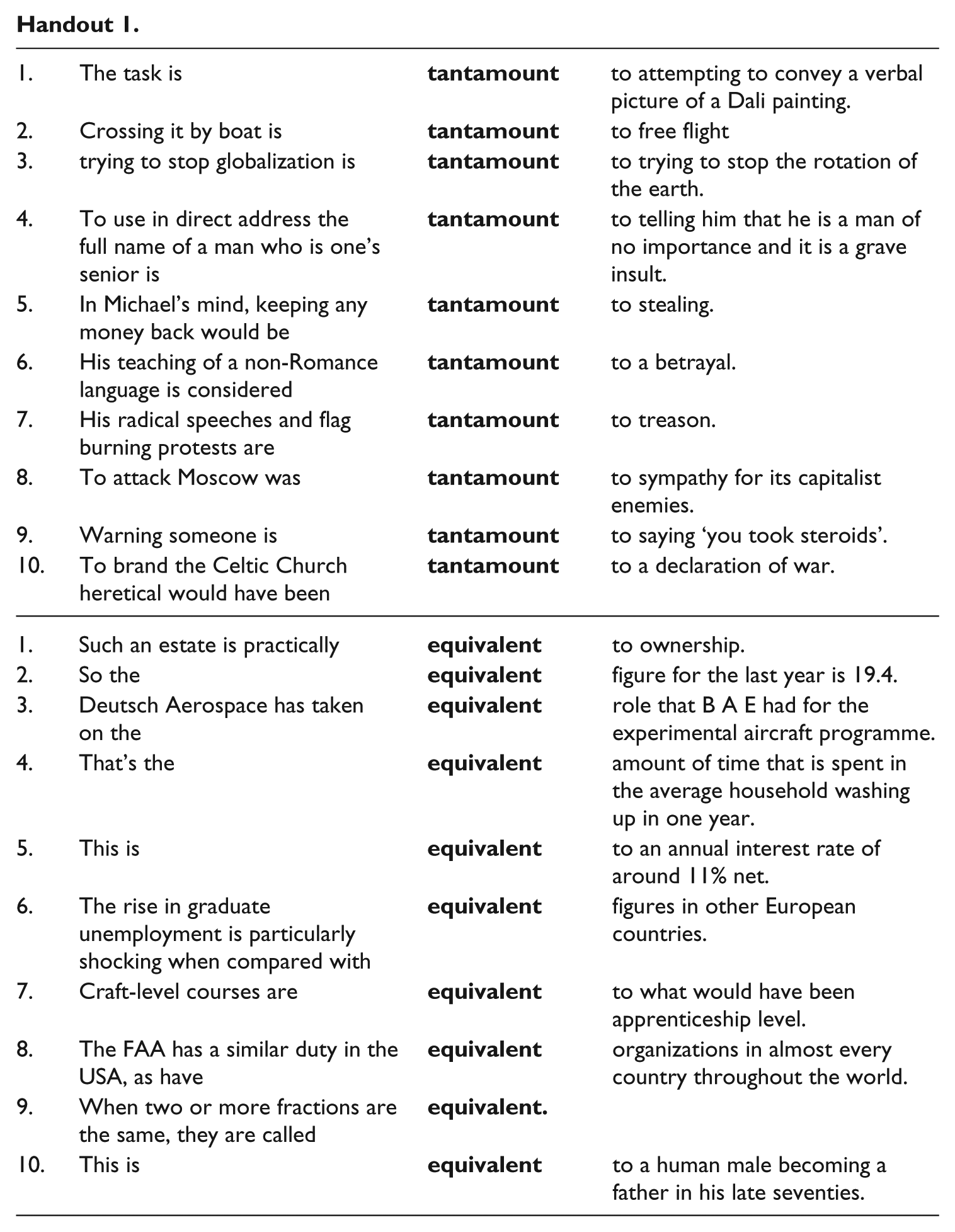
The second task involved the so called ‘mental contextualisation’ (McCarthy, 1990: 36), as the learners were supposed to group the patterns in a meaningful way.
Several students stated that the word tantamount has a negative meaning, while equivalent is neutral. Another observation was that tantamount is used to describe people’s actions, whereas equivalent is frequently combined with different figures. As for the usage pattern, the learners noticed that tantamount followed by to and a noun or gerund. Unlike the adjective equivalent, the word tantamount does not appear before a noun; it is only used in the phrase to be tantamount to.
Apparently, to draw such conclusions the learners would have needed to read a large number of texts, where the words in question are used, which would have taken a considerable amount of time. However, with the help of the corpus samples the time needed decreased dramatically. Gabrielatos (2005) calls reading a corpus condensed reading. When reading corpus samples learners focus on the behaviour of specific language features. It enables them to engage with language use in context in order to formulate and check hypotheses about language structure and use.
At the final stage, the learners were asked to make up their own sentences with the words again. The analysis of the students’ sentences has shown that initially they had written only 30% of sentences with the word tantamount correctly, but after the examination of the corpus examples, the number of accurate sentences soared to 75%.
Another positive result was their attempts to make up more complicated sentences after being exposed to the corpus samples (1).
before: The act is tantamount to a murder.
after: Not taking off your shoes when you enter a house in India is tantamount to insulting the host.
Interestingly, 21% of students did not create new sentences but corrected the ones they had initially made. This means that the corpus use contributed to the enhancement of their self-correction skill (2a, b):
2a before: *Plagiarism is an act tantamount theft.
after: Plagiarism is tantamount to theft.
2b before: *To use English is a tantamount problem for me as to deal with Math for my group mates.
after: To use English for me is tantamount to dealing with Math for my group mates.
Similar tasks were assigned as homework throughout the course and in class the author only got the feedback from the learners.
Teaching Writing
The second area where corpus analysis was applied was training the students in the IELTS writing section.
When marking the students’ graph descriptions or essays (IELTS Writing tasks 1 and 2 respectively), the author selected some errors which she believed the students could correct with corpus data and had them work on them in class or at home. For example, in a graph description one of the students wrote:
4. *In 1999 sales increased on 15 percent.
To find out the correct preposition the student was told to search for the corpus examples where increased collocates with percent setting the interval of two or three words on the right (the BNC provides users with this tool). The search results demonstrated that the preposition that links increased and percentage is by (see Figure 1). So the learner had to replace on with by in the sentence.
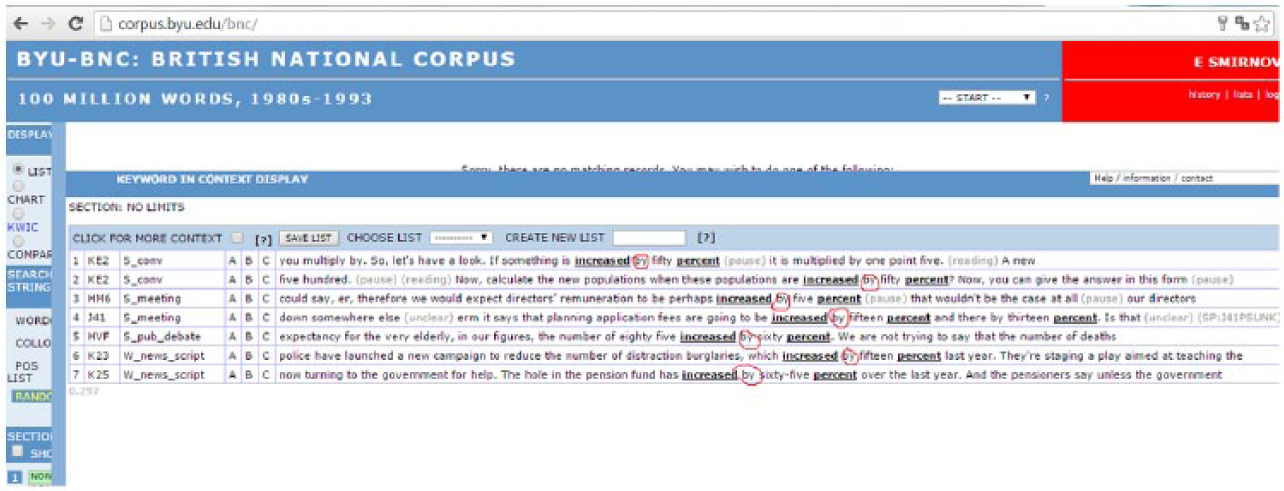
Search results of query ‘increased’ collocating with ‘percent’ in BNC.
Another way to enhance the learners’ writing skills with the help of corpora was to teach them to use corpus data when they are doing writing tasks and doubt about what word to choose. For example, when writing a paragraph in class a student couldn’t choose the appropriate adjective for the word experience. A bilingual dictionary which he consulted gave him the two options – priceless and invaluable. The author advised the student to check if the words collocate with the noun in the BNC. The results showed that there are no examples of the phrase priceless experience and 18 sentences which contained the collocation invaluable experience. The search for the collocation not only increased the student’s motivation for learning and his autonomy but also helped him to remember the phrase much better than if he had been given the correct answer by the teacher. Gabrielatos (2005) notes that when consulting a dictionary, learners are given fish; when they are involved in analysing corpora, they are taught how to fish. When marking the learners’ papers, the author noticed a decrease in the number of collocation errors made by those who claimed to have checked collocations using corpora at home after being shown how to do it in class.
Reflection
The number of students participating in the corpus-based preparation course was quite small which is an obvious limitation of this report. However, the author’s experience in implementing the corpus analysis in the IELTS preparation course at the Russian university confirmed the claims of those who see corpus-based language teaching and learning highly efficient (see, for example, Breyer, 2009; Frankerberg-Garcia, 2014; Gabrielatos, 2005; Gries, 2008; Johns, 1994; McEnery and Wilson, 2001; Sinclair, 1986; Thomas, 2015).
According to the author’s findings, the use of corpora in the classroom makes the process of preparation for the IELTS test more efficient and interesting for the learners and helps to develop their general learning skills and language abilities, thus creating beneficial washback. When using corpora or corpus-based materials, learners start noticing features of the data for themselves (Johns, 1997: 101) which enhances their autonomy and improves their self-correction skills. Corpus learning also contributes to students’ better understanding of lexico-grammatical usage rules and patterns and critical understanding of grammar (Liu and Jiang, 2009: 68–69). Similar effects can be obtained via extensive reading which enables learners to observe a usage pattern in context but needs a lot of time, so exploiting corpora in a language classroom gives noticeable economy of time.
However, it is necessary to mention some limitations that corpus-based learning has. Firstly, this approach might not be suitable for low-level students and even higher level students need the teacher’s guidance and control for effective learning (Aston, 2001). To overcome this problem, teachers can edit the samples to remove sentences that they consider too difficult for the learners when using corpora in the classroom.
Secondly, despite all the aforementioned benefits of corpora, there is a danger of an over-reliance on corpus data. Teachers and learners should bear in mind that even the largest corpus is, by definition, only samples and is unable to capture the entirety of language (Gavioli, 1997: 85). Learners ought to be informed that even if they have found the phrase they were looking for in a corpus, it is necessary to take into consideration its frequency and the context of use before drawing a conclusion about its acceptability and whether it is appropriate for use in their own speech or piece of writing.
To conclude, I believe, the implementation of the corpus-based approach is an efficient way of reducing negative washback in IELTS preparation courses. The approach offers great pedagogical implications in a wide range of areas of teaching EFL and there are still a considerable number of potentialities of corpus use to be revealed.
Footnotes
Acknowledgements
I thank the anonymous reviewers for their helpful comments on earlier drafts.
Funding
The author(s) received no financial support for the research, authorship, and/or publication of this article.