



Abstract
How does teachers’ target language proficiency correlate with their ability to use the target language effectively in order to provide optimal learning opportunities in the language classroom? Adopting a conversation analysis approach, this study examines the extent to which teachers’ use of the target language in the classroom creates learning opportunities for L2 learners. The article also explores the relationship between teachers’ target language proficiency and the ways in which they use the target language in the classroom to engage learners in the learning process. Analyses of the lesson extracts show a complex relationship between teachers’ general language proficiency and their ability to make use of their proficiency to support student learning in the L2 classroom. The article concludes that while teachers’ general proficiency significantly affects the way they use language in the classroom to promote learning, their classroom proficiency is at least as important as their general proficiency. This has implications both for teachers and teacher educators.
Introduction
Efforts to raise the quality of instructed English language learning across the globe have placed greater demands on teachers’ target language proficiency, which has been recognized as an important aspect of teacher expertise, an essential factor affecting student learning (e.g. Andrews, 2007; Chen and Wang, 2004; Butler, 2004; Richards, 2015). However, it is not clear what minimal level of language proficiency teachers need to acquire in order to teach effectively. Neither is there sufficient empirical evidence of the relationship between teachers’ proficiency in the target language and the quality of their classroom teaching in terms of student learning. Without solid information about these issues, it would be difficult to design effective teacher education programmes that can help teachers to raise their proficiency level in the target language to the desired level.
Literature Review
The challenge in researching teachers’ target language proficiency lies in how the construct of language proficiency is defined. While Bachman and Palmer (1996) identify six interrelated areas including organizational knowledge, grammatical knowledge, textual knowledge, pragmatic knowledge, functional knowledge, and socio-linguistic knowledge, it is difficult to have an objective measure of teachers’ proficiency in the target language. As discussed by Lantolf and Frawley (1988), proficiency, by nature, is difficult to define as it is an open system and thus difficult to measure. Pasternak and Bailey (2004: 163), therefore, argue that ‘whether or not a teacher is proficient depends on how we define this multifaceted construct’. Freeman, Katz, Gomez, and Burns (2015) call for a reconceptualization of teacher language proficiency, not as general language proficiency but as a specialized subset of language skills required to prepare and teach lessons. In that sense, teachers’ language proficiency is ‘anchored in – or drives – particular uses of specific content, which are situated both interactionally and contextually in the classroom’ (Freeman et al., 2015: 133). Richards, Conway, Roskvist, and Harvey (2013) define teachers’ language proficiency as one component of teachers’ subject knowledge in addition to knowledge of second language acquisition theory, pedagogical knowledge, curricular and syllabus knowledge and cultural knowledge. Richards (2015: 113) further specifies teachers’ target language proficiency into competences in:
providing good language models
maintaining use of English in the classroom
giving explanations and instructions in English
providing examples of words and grammatical structures
giving accurate explanations of meanings of English words and grammatical items
using and adapting authentic English-language resources in teaching
monitoring one’s own speech and writing for accuracy
giving correct feedback on learner language use
providing input at an appropriate level of difficulty
engaging in improvisational teaching.
The aim of this study is to use teachers’ language proficiency as a referent point for the comparison of the ways teachers with different proficiency levels use language in the classroom to provide affordances and learning opportunities for language acquisition. Therefore, teachers’ proficiency is defined, in the most abstract term, as the overall scores they gain in the standardized tests. While this definition is not unproblematic, it is more appropriate to the purpose of the study whose focus is on the relationship between teachers’ certified proficiency and their ability to use language to promote learning during the lesson.
It is recognized in the literature that ‘language proficiency does affect how well a teacher can teach a second language’ (Richards, 2015: 113, original emphasis). Teachers with a high level of target language proficiency are believed to be more competent in providing extensive input for learners, which, as Ellis (2005) states, is a key principle for successful instructed language learning. Second language acquisition theorists (e.g. Ellis, 2005; Krashen, 1985) have recommended that learners acquire second language through exposure to comprehensible input, i.e. input +1, or input that is within their zone of proximal development, to use Vygostky’s (1978) term. This type of input is defined as the language which is at the students’ next level of development. In the English as a foreign language (EFL) context, teachers often serve as the key source of input (Kim and Elder, 2008), and to fulfil this function, teachers need to have an advanced level of target language proficiency. In addition, less proficient teachers might face difficulties in distinguishing and correcting learner errors (Farrell and Richards, 2007).
However, empirical evidence on whether or not teachers’ language proficiency leads to a higher quality of teaching which results in student learning is lacking. Butler (2004) is one of the key pioneers in this research area. He conducted multiple case studies of how Korean, Taiwanese, and Japanese EFL elementary school teachers of English self-assessed their proficiency in English with reference to their pedagogical needs. The results showed that these teachers perceived substantial gaps between their English proficiency and the minimum level required for effective teaching, and the widest gap was identified in the productive skills, i.e. speaking and writing. While Butler did not specify what level of proficiency is needed, he recommended that ‘elementary EFL teachers need… more than basic conversational skills’ in addition to their ‘strategic knowledge of English and the ability to use it’ (2004: 270). Butler’s study reported the results of teachers’ self-assessment of their proficiency level and their perceived gap between their current proficiency level and the desired proficiency; but it did not show how teachers used English in the classroom to support student learning.
The second study was reported by Richards et al., (2013), who compared the classroom practices demonstrated by teachers with limited subject knowledge, i.e. their target language proficiency, with those with more extensive subject knowledge. These teachers were teaching French, Spanish, German, Chinese and Japanese as a foreign language in schools throughout New Zealand. The findings showed that teachers’ target language proficiency was the determining factor explaining the variance in the effectiveness of teachers’ classroom practices. Teachers with an advanced level of target language proficiency were able to manage various aspects of language teaching and expose learners to a wider range of language structures and vocabulary, and to repeat target language instructions so as to give students sufficient time to understand and respond better than those teachers with lower target language proficiency. The authors concluded their research as follows: Teachers need to have an advanced level of TL [target language] proficiency so that they can also provide meaningful explanations, rich language input for learners and respond spontaneously and knowledgeably to their learners’ questions on language and culture. Teachers also need an advanced level of proficiency in order to take learners beyond the beginner level of study. This is particularly important in the high school context where learners have the opportunity to progress through five years of language instruction (Richards et al. 2013: 244).
In short, although teachers’ knowledge of target language use in the instructional settings ‘almost …certainly plays a crucial part in determining the success (or otherwise) of classroom second language learning’ (Kim and Elder, 2008: 167), it is not clear how teachers’ proficiency affects the ways they use language in the classroom. Agreeing with Kim and Elder (2008), Freeman et. al., (2015) maintain that the relationship between teachers’ target language proficiency, their classroom teaching and student learning is far more complex than it appears on the surface.
Affordance and Learning Opportunities
Van Lier (2004) borrows the term ‘affordance’ from James J. Gibson as an alternative to the commonly used term ‘input’ to describe the way in which learning opportunities are created in the L2 learning environments. According to van Lier (2004: 92), ‘learning opportunities arise as a consequence of participation and use’. The term ‘affordance’, therefore, is related to a number of influential concepts in second language learning pedagogy such as ‘noticing’ (Schmidt, 1990), ‘the interaction hypothesis’ and ‘negotiation of meaning’ (Long, 1996). It recognizes the unique relationship between individual learners and the learning environment in which teachers can influence the learning process by creating ‘the optimal environment necessary for learning to take place’ (Kumaravadivelu, 2003: 48). Thus, teachers play the role of the catalysts of learning opportunities, which ‘include noticing, uptake, restructuring of the interlanguage, and proceduralization of knowledge, as well as metacognitive, affective, and other factors that may lead indirectly to language learning’ (Anderson, 2015). Teachers use the target language in the classroom to fulfil this role. According to Walsh (2002: 5), Where [teachers’] language use and pedagogic purpose coincide, learning opportunities are facilitated; conversely, where there is a significant deviation between language use and teaching goal at a given moment in a lesson, opportunities for learning and acquisition are, I would suggest, missed.
Walsh further contends that the features of teachers’ classroom language use that can facilitate learning include direct error correction, content feedback, checking for confirmation, extended wait-time, and scaffolding. By contrast, teachers’ use of language in the classroom does learners a disservice if there is no negotiation of meaning, no clarification, and no confirmation checks. That use of language is characterized by turn completion, i.e. teachers’ latches to smooth over the discourse, teacher echoing the learner’s utterance, and teacher interrupting the learner, causing him or her to lose the thread of what he or she was saying. From a conversation analysis perspective, Wong and Waring (2010: 278) advise teachers to be highly alert and deeply reflective about their instructional practices so as not to shut down opportunities for student participation with their language use. Drawing on the results of his study, Walsh also recommends that teacher education programmes should ‘devote more time and attention to language use in the classroom’ (2002: 20). Towards that goal, we need to have more empirical evidence of the complex relationship between teachers’ target language proficiency, their ability to use language appropriately for pedagogical purposes and student learning. The purpose of the current study is to shed light on the nature of this complex relationship.
The Study
Purpose
The study was conducted in Vietnam, where teachers’ proficiency in English has of late become a national issue. Data from the Vietnamese Ministry of Education shows that many English language teachers do not possess a desirable level of proficiency in the English language, a level that is considered sufficiently high for teaching purposes. In Vietnam, secondary school teachers and university teachers are required to achieve level C1 on the Common European Framework of References for Languages (CEFR) (Council of Europe, 2001), but two-thirds of them are unable to meet the requirement. The situation in Vietnam is not unique. Ministries of education in several other countries in Asia (e.g. Malaysia, Japan and Thailand) have also expressed concerns regarding the proficiency level of English teachers. This is understandable given the status of English as a global language today and the need for people to raise their English proficiency in order to stay competitive in the job market. The general consensus seems to be that English teachers would need to reach at least C1 (ideally C2) on the CEFR scale.
However, as was pointed out earlier, we do not seem to have firm empirical data to decide on the minimum level of proficiency. More importantly, we do not seem to know much about the relationship between proficiency and effective pedagogical practices in the L2 classroom. The present study therefore seeks to find answers to the following questions:
In what ways do teachers, through their use of classroom language, provide affordance and learning opportunities in the EFL classroom?
How is teachers’ general English proficiency related to their use of classroom language for the purpose of providing affordance and learning opportunities?
Participants
Three teachers, coded as A, B, and C were selected purposefully, i.e. according to their achieved level of general proficiency in English, to participate in the study. All of them were based in Hanoi, Vietnam and had eight years of teaching experience. Teacher A was teaching pre-intermediate students at one of the biggest public universities while Teacher B and Teacher C were teaching Grade 12 students (the last grade of secondary school education) at two public upper secondary schools. Teacher A scored 8.0 on the International English Language Testing System (IELTS) administered by the British Council while Teacher B and Teacher C were certified to be at C1 and B2 levels respectively by a Vietnamese mandated testing institution.
Data Collection and Data Analysis
Data were collected by means of video-recorded observations. Each teacher was observed for two 45-minute lessons, but only the second lesson was recorded. All the observed lessons were fully transcribed for data analysis. The transcripts were carefully examined, and then certain episodes were selected for analysis according to their capacity to provide valuable information in relation to the research questions. ‘Episode’ is defined as being made up of sequences that, individually and cumulatively, contribute to the achievement of an activity or task goal. Each sequence consists of an exchange and each exchange consists of obligatory Initiating and Responding moves and may also contain a Follow up move (Nassaji and Wells, 2000: 383). Selected episodes were analysed against some aspects of affordance (van Lier, 2004) and learning opportunities (Anderson, 2015) characterized as including negotiation for meaning, corrective feedback, content feedback, checking for confirmation, requesting clarification, scaffolding, and wait-time.
A conversation analysis (CA) approach was adopted for the data analysis. The analytical power of CA as a potential methodological resource for second language acquisition has been acknowledged (e.g. Markee, 2000). CA regards a classroom context as a dynamic entity which is co-constructed by participants and renewed by means of the various linguistic and pedagogical purposes emerging from lesson to lesson (Cancino, 2015). In this approach the data are allowed to speak for themselves so that they can clearly show the quality of the interaction between teacher and learners (Cancino, 2015), thereby highlighting the relationship between teachers’ language use and affordance and learning opportunities (Walsh, 2002). In addition, a CA methodology enables the researcher to cope with the goal-oriented nature of institutional discourse, in which the behaviour and discourse of the participants are influenced by the goal(s) toward which they are striving (Walsh, 2002).
Results
Below are the lesson episodes that were selected for analysis because they helped to answer the research questions. Each teacher participant’s episodes are presented individually.
Teacher A – Episode 1
In this episode, the teacher was organizing a task which required the students to work in groups to choose a qualified person for the hypothetical National Space Committee. The students were expected to use language related to personal qualities and attributes. In the extract below, Teacher A was giving instructions on how the task should be completed.
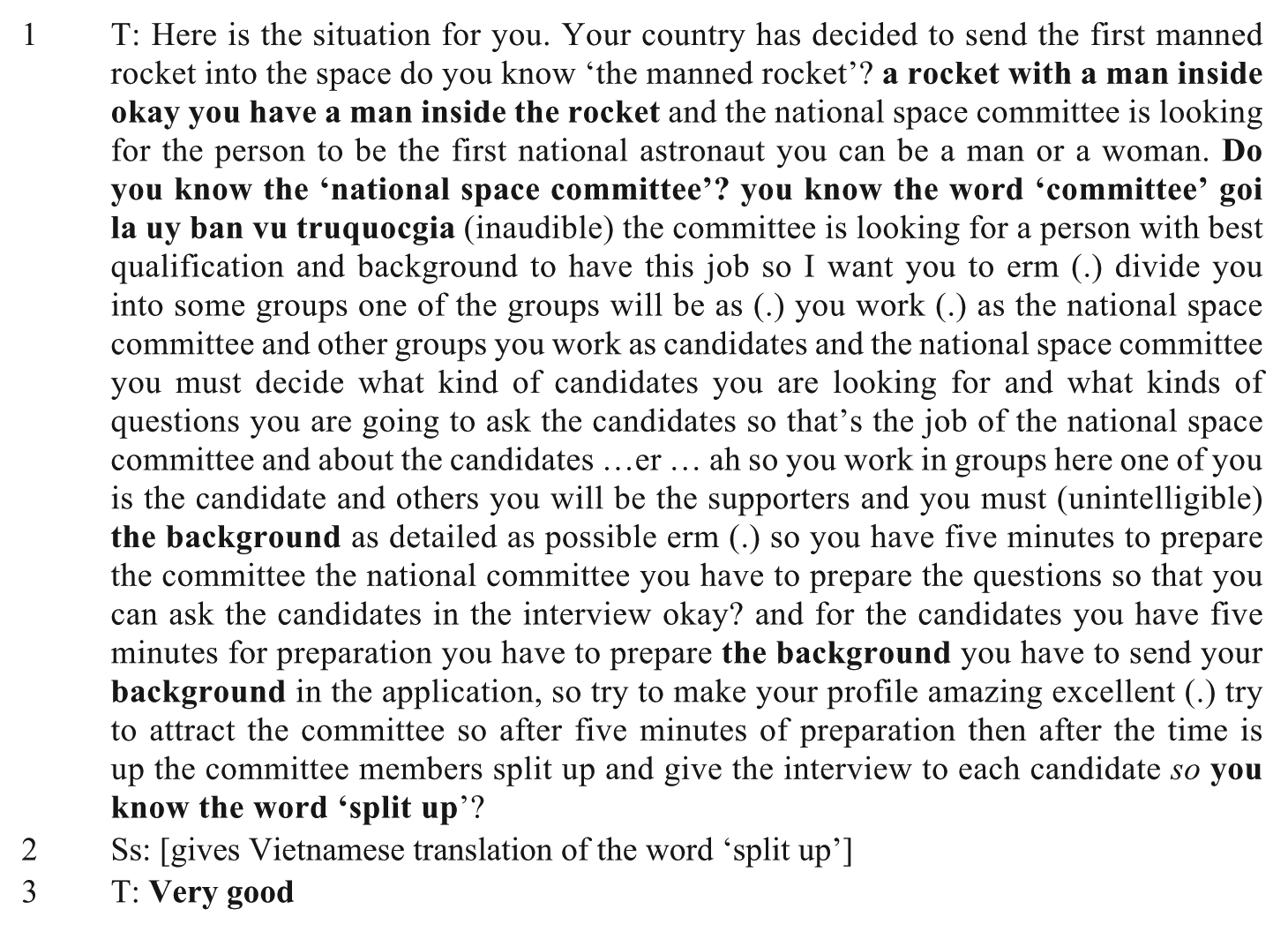
In the above episode, although the teacher was giving instructions on how to complete the task, her language could be said to be within the students’ zone of proximal development because all the students seemed to understand what they were supposed to do. The teacher explained the lexical unit ‘manned rocket’ by paraphrasing the word in a comprehensible manner (a rocket with a man inside). She then used Vietnamese (L1) to explain the phrase ‘the national committee’ to scaffold the students’ understanding. At the end of her instruction, she used the word ‘split up’ meaning ‘divide’. She thought the word was unknown to the students, but the students were able to provide the Vietnamese equivalent. However, it was not clear whether by ‘background’, which was repeated three times, she meant educational background or family background or experience relevant to the job. In addition to this, her speech was not quite coherent and contained unnecessary repetitions, making the instructions unnecessarily lengthy. She closed the interaction with a positive feedback (very good) on the students’ translation.
Teacher A - Episode 2
This episode is about the interaction between the teacher and one student (S1). After the students had completed the task in their groups, the teacher asked each group to report the task outcome, i.e. the person they had identified as being qualified to be the astronaut. The student (S1) represented his group reporting the outcome.

In turn 6, the student misused a word (pronounce) but the teacher probably ignored this because she did not want to interrupt the student when the focus of the lesson was on fluency. Then in turn 7, she tried to elicit a response from the student by asking the question ‘Can you say why you choose this candidate?’ In turns 9, 11, 13, 15, and 17 she just echoed the students’ utterance. The teacher also used a lot of latches, indicated by (=) to smooth over the discourse.
Teacher B - Episode 1
In this lesson episode, the teacher was presenting and getting the students to practice the structure: ‘I like/don’t like + Noun Phrase+ very much; I don’t like + Noun Phrase + at all’.
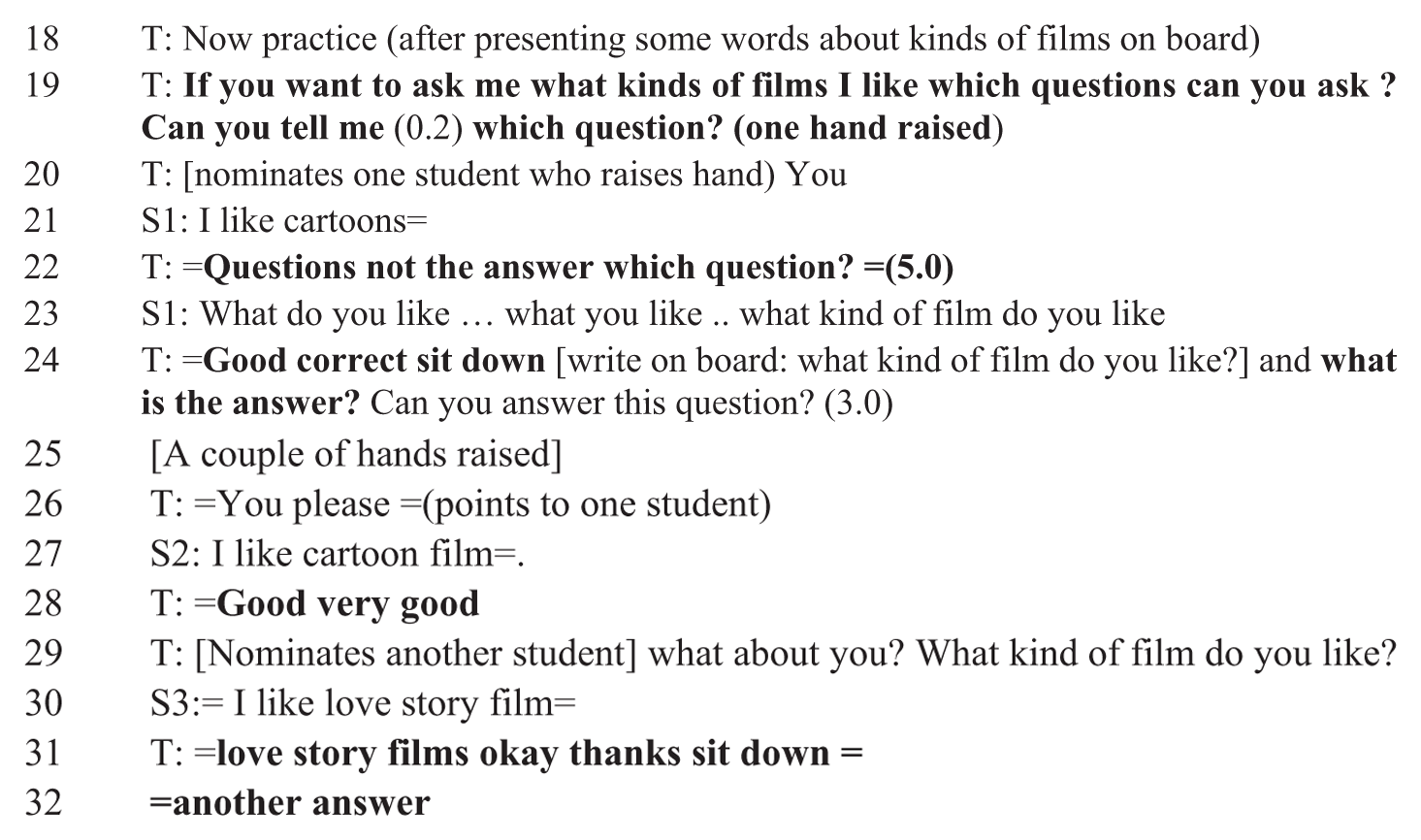
The teacher was trying to help the students to ask a question using the target structure (i.e. what kind of film do you like?). He initiated the topic by giving a hypothetical situation ‘If you want to ask me how…’. However, given the students’ limited English, his language seemed too complicated for the students to understand. This is shown by the student’s misunderstanding (turn 21). When the student managed to produce a response (turn 23), he terminated the turn so abruptly with an explicit positive assessment item (turn 28) in the feedback slot in order to allocate another turn. This behaviour is repeated in turn 28. While in turn 31 the teacher did correct the student’s error (film) by means of a recast, he did not encourage the student to extend her turn, again, with his use of ‘okay thanks sit down’ (turn 31).
Teacher B – Episode 2
The teacher drew a three-scale table on the board: ‘very much’,’ not very much’, and ‘not at all’, and then got the students to practise using these scales to express their likes.

Although the teacher wanted to elicit the question from the student, he completed the turn by asking the question (turn 34). In turn 35 he repeated his question, but then asked another question. While the student gave an answer (turn 36), he terminated the turn instead of encouraging the student to extend her turn. Turn 38 may be confusing to the students and this explained why only one student volunteered the answer, but the answer is ungrammatical. At this point, the teacher provided the correct answer, but unfortunately did not give the student an opportunity to reformulate her utterance. Interestingly, in turn 44, the student produced a similar ungrammatical utterance, but the teacher did not correct her. Instead, he terminated her turn and moved on with the lesson (turn 46).
Teacher C – Episode 1
The following episode is the first part of a reading comprehension lesson on the topic of non-verbal communication. The teacher was conducting a pre-reading task.
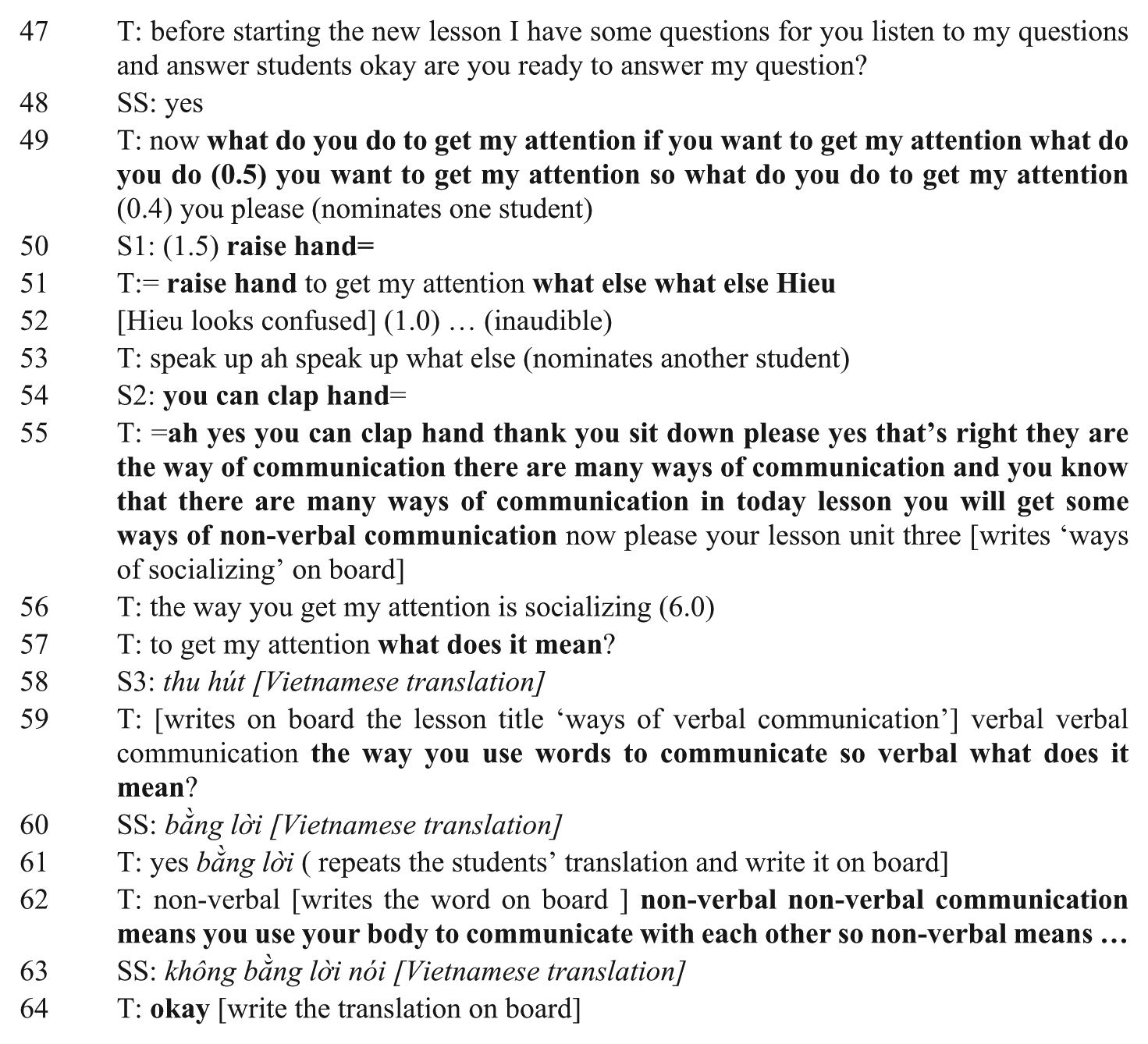
In this episode, the teacher intended to elicit answers from the students that in addition to verbal communication, humans also used gestures and body language (non-verbal ways) to communicate. However, her question in turn 49 is not well-worded for the students to understand even though she repeated the same question three times. Even in turn 55, her language was not clear enough (there are many ways of communication) to help the students understand that people communicate both verbally and non-verbally. While all the students’ utterances were copied exactly from the coursebook, the teacher echoed these utterances most of the time, probably to amplify the student’s utterance to the whole class. Again, her language is ambiguous (turn 62) and does not explain clearly to the students that people could use different forms of body language such as facial gestures, eye contact, etc. to communicate without using the language.
Teacher C – Episode 2
The following episode shows what was happening after the students had finished silently reading the reading text, and the teacher was eliciting the students’ answers to the reading comprehension questions.

The teacher’s question in turn 65 is a display question, i.e. the question to which the teacher already knows the answer because the text says, ‘There are two forms of communication: verbal and non-verbal’. So the students’ answers in turns 66 and 70 are, in fact, copied directly from the text. There is no attempt by the teacher to find out whether the students actually understand what they have read. This is confirmed by the subsequent turns when the teacher asked them to provide examples of different forms of non-verbal communication (turn 71), which are all presented in the text; however none of the students was able to provide the answer. When the nominated student failed to answer the question (turn 76), the teacher did not show any effort to scaffold him. Instead, she allocated another turn (turn 77). In turn 66, the student made an error of the plural form, but the teacher ignored this.
Discussion
The analysis of the selected lesson episodes suggest that while teachers’ target language proficiency really matters in providing good models of the target language for the students, the relationship between teachers’ target language proficiency and their classroom language use is not always straightforward. Two of the three teachers in this study, Teacher A and Teacher B, were certified as highly proficient, but the way they used English in the classroom provided limited affordance and learning opportunities for the students to acquire the target language. In the case of Teacher A, while she scored 8.0 on the IELTS test, her proficiency did not seem to give her much pedagogical advantage. She gave unnecessarily lengthy instructions, and there was very little negotiation of meaning among the students. Put another way, although the students in her class were quite fluent in English, and they used a great deal of English, there was little evidence that the teacher was aware of the need to teach appropriate communication skills. However, it is worth noting that Teacher A was really confident in using English, which might help explain why her students seemed to be more motivated to participate more actively during the lesson. There were more student-to-student interactions while they were carrying out the task in their groups than in the lessons by Teacher B and Teacher C.
For Teacher B, while his teaching context was different from that of Teacher B, and he himself was also certified as ‘an expert user of the language’ (i.e. C1 level on the CEFR – Council of Europe, 2001), he rarely offered affordance or nor did he respond to it when it happened. He did not show any sign or intention to encourage the students to extend their turns. Instead, he terminated their short turns by either echoing their utterances or latching.
Teacher C was the least proficient of the three teachers in this study (she achieved B2 level on the CEFR – Council of Europe, 2001), and the way she used English in the classroom confirmed, to some extent, this fact. None of the questions she asked were referential questions, and most of the language she used in the classroom was from the textbook. Whenever she moved away from the textbook, she showed problems in the way she used English in the classroom (e.g. the plural form or her inability to use appropriate English to elicit responses from the students or to explain simple English words such as ‘verbal communication’ and ‘non-verbal communication’.
In general, while teachers’ general language proficiency seems to play an important role in providing good models of language use to the students, helping the teachers become more confident, and in enhancing the student participation in classroom tasks, the lessons conducted by the three teachers showed a common limitation: limited instances of negotiation of meaning and interaction. This limitation can be explained, at least to some extent, by teachers’ lack of classroom language proficiency. The teachers’ inadequate classroom language proficiency may, on the one hand, lead to their inability to utilize the interactional features of the language that can provide affordance and learning opportunities. For example, the excessive use of explicit positive assessment items such as ‘very good’ or the evaluative comments such as ‘okay’ seems to limit rather than increase opportunities for student participation. Similarly, Teacher A’s unnecessarily lengthy explanations seem to suggest that her high proficiency in the language does not always translate into effective classroom teaching.
Conclusion
While native-like proficiency may not be necessary for teachers to teach well, ELT experts generally agree that teachers need to have a good level of proficiency to deliver effective lessons. Having an advanced level of proficiency would support teachers in their job and enable them to use the target language fluently and confidently in the classroom, to serve as good language models, to select and adapt teaching materials for more effective use, and to give appropriate feedback on students’ oral and written work. In addition, as demonstrated by Teacher A in this study, high proficiency can increase teachers’ confidence in using the target language in the classroom and in helping teachers develop more interesting and engaging classroom activities. Research also shows that language proficiency can contribute to teachers’ teaching skills, enabling them to ‘manage classroom discourse so that it provides maximum opportunities for language learning’ (Richards, 2010: 103). Finally, students tend to have a more positive perception towards their more proficient teachers than the less proficient ones believing that the former are more capable of helping them improve their language skills.
Given the important role of language proficiency in supporting teaching, it seems reasonable to suggest that it should be given greater attention in second language teacher education programmes. One promising line of approach to addressing the issue of language proficiency is to include a language improvement component in methodology courses. By integrating language skills development into a methodology course, teachers get the opportunity to enhance their language skills in the context of learning specific instructional strategies. Kamhi-Stein (2009) for example reports on some successful teacher development programmes that use this approach to address the language proficiency issue among EFL teachers, but suggests that more should be done to raise the proficiency level of non-native teachers. She maintains that low proficiency may undermine teachers’ confidence, which may in turn affect their pedagogical practices.
To conclude, the role of the teacher is that of a learning mediator, who uses language as a psychological tool to scaffold student learning through social interaction (Vygotsky, 1978). In other words, optimal learning can be achieved when it is assisted or well-scaffolded through the way the teacher uses language appropriately in the classroom. To function effectively in the classroom, English language teachers, no doubt, need to have an advanced level of general proficiency in English. However, classroom English proficiency is no less important than general English language proficiency. Indeed, one of the defining characteristics of an effective English teacher is one who is not only highly proficient in the language but also adept at using the language to create conducive learning environments and to scaffold student learning by engaging them in pedagogically meaningful interactions. Thus, there is a need for a balanced approach to addressing the language proficiency issue in teacher education programmes, an approach that takes into account the need to increase not only student teachers’ language proficiency but also their ability to make use of the target language to create optimal learning environments.
Footnotes
Appendix: Key to Transcription System (Adapted from Van Lier,1988 and Johnson,1995)
T: teacher
S: individual student
SS: students (e.g. answering in chorus)
[nominates one student] : researchers’ comments
= turn continues, or one turn follows another without any pause.
Funding
The author(s) received no financial support for the research, authorship, and/or publication of this article.