



Abstract
New conceptualizations of English are challenging traditional norms of what the language is, as well as how it is taught and by whom. These changes, coupled with the expansion of teaching English across the educational spectrum from younger grades to tertiary levels, present challenges to many national education systems. The role of teachers’ English competence, particularly in public-sector teaching, is central to how these educational changes play out in countries around the world. How classroom English language ability is described connects to many dimensions of teaching. This article argues that conventional definitions that connect general English proficiency, often based on generic statements about language use, do not address the type of classroom language teachers need in order to teach. Further, language training focused on general language fluency often does not directly address teachers’ particular professional needs. Policies and practices based on these definitions disadvantage most English language teachers by defining problems of teaching quality in terms of deficits in general English proficiency. English-for-Teaching, a conceptualization of the English teachers’ use in classroom language teaching, is based on a languages for specific purposes (LSP) methodology. The construct defines three functional areas of classroom language use – managing the classroom, understanding and communicating lesson content, and assessing and giving students feedback. The article outlines the construct and a professional development programme based on it. Analyses from implementing these programmes provided by ministries of education to pre- and in-service teachers in Japan and in Vietnam are discussed.
Keywords
“Any jackass can kick a barn down; it takes a carpenter to build one”
– Attributed to Samuel Rayburn Speaker of the United States House of Representatives (1940–1961)
1
The place of English language teaching 2 (ELT) in public-sector education 3 is expanding. English is increasingly becoming a part of the core national curriculum in many countries; it is taught often beginning in primary schools, and sometimes continuing as a medium of instruction through tertiary levels. This expansion in English teaching is connected to the global role of English as a lingua franca (e.g. Jenkins, 2000). New conceptualizations of English are challenging traditional norms of what the language is, as well as how it is taught and by whom (Canagarajah, 1999). The role of teachers’ English competence is central to how these educational changes are playing out in countries around the world. The ways in which classroom English language ability is described connects to many dimensions of teaching. The model of language that is used defines the content of lessons, organizes methodology, and conveys connections to a world beyond the classroom. These dimensions shape what students take from – or ‘learn’ in – their English classes (Freeman, 2016). Likewise, English competence defines – at least ostensibly and publicly – who the teacher of English is. English competence functions as a form of professional identity, within the syllogism that the more fluent in English, the more effective the teacher. This logic substitutes the teacher’s English competence as a measure of professional performance, shaping – practically and pragmatically – what the teacher does in the classroom.
This article unpacks the conventional thinking about language fluency that underlies generally accepted definitions of teachers’ English competence in teaching. The article has two sections. The first outlines a three-part argument that challenges the widely promoted notion that general English fluency is central in classroom teaching competence. While not disputing the role that teachers’ control over English plays in teaching it, I question some of the core ideas that are often invoked to support the premise that ‘the more fluent in English, the better the teacher’. ‘Native-speakerism’ (Holliday, 2006; Holliday, 2005) and general English competence are two of these core ideas, which I argue promote a deficit view that if teachers are not fluent or ‘native-like’, they are not likely to teach at their best. This is the ‘barn’ that has been built over the years. The thinking leads to a characterization of the vast majority of ELT teachers globally as lacking or deficient linguistically. Common sense says it needs to be ‘kicked down’ if we are to improve instruction in English classrooms around the world.
The second part of the article builds a different barn. It presents a view of teachers’ classroom English that is built on the ideas of Languages for Specific Purposes (see Trace et al., 2015). The concept of English-for-Teaching (Freeman et al., 2015) as a form of English used by the teacher in classroom teaching is summarized, and examples from professional development programmes in Japan and Vietnam are discussed. In these programmes, new and experienced teachers have had the opportunity to study English-for-Teaching and to document what they can do through an independent assessment that is fully aligned with the course. The article concludes with some observations about how this new ‘barn’ can support teachers’ improvement of classroom English teaching. In making these arguments and proposals, the goal is not to ‘kick down the barn’, in the words of the opening quote, but rather to contribute ‘as carpenters to building a new one’.
Section 1. Why ‘Kick Down the Barn’ that Equates General English Fluency with Classroom Teaching Competence?
The argument that English competence equates to classroom performance can be traced to three assertions – the idea of ‘native speakerism’; a mischaracterization of language use (as in the Common European Framework); and equating purpose with language use – each of which is examined in turn. I begin by summarizing the problematic assumptions that underlie what Holliday (2006; 2005) referred to as ‘native-speakerism’. These assumptions amount to a de facto assertion that language competence, defined geo-politically, is key to effective classroom ELT.
Point #1: ‘Native-speakerism’ = Language Competence = Effective Classroom Teaching
In language teaching generally, and in English language teaching (ELT) specifically, ‘native-speakerism’ asserts a supposed connection between language competence, teacher identity, and classroom teaching performance. Holliday describes ‘native-speakerism’ as a social and theoretical position which asserts that ‘so-called “native speakers” are the best models and teachers of English because they represent a “Western culture” from which spring the ideals both of English and of the methodology for teaching it’. (2005: 6) The view is based on the claim that being a ‘native’ member of a language community fosters cultural and linguistic knowledge which can translate into both the content and processes of classroom teaching. The argument connects implied linguistic knowledge to power and social position generally; however, these judgments about who is (or is not) ‘native’ are socio-geographic and not linguistic ones (Canagarajah, 1999). In fact, a ‘native’ standard in a language cannot be defined in purely linguistic, sociolinguistic, or pragmatic terms (Jenkins, 2000; Braine, 1999).
Native-speakerism is basically an ideological position. It persists on the operational level throughout ELT as an industry and socio-professional community, in how assessments are promulgated; how teaching standards are set; and, to a lesser degree, how language curricula and classroom materials are developed (see Garton and Graves, 2014). The persistence of native-speakerism, it could reasonably be argued, reflects the continuing role in managing ELT by what Kachru (1982) called as ‘first-circle countries’. Although it may be ideologically anchored, the steadfastness of the term ‘native speaker’ may be rooted in something more pragmatic. As a label, it provides a short-hand for what seems to be a logical relationship between knowing a language and teaching it. Native speakerism connects content knowledge with pedagogy and with teacher identity, towards a goal of learning outcomes: that students will themselves use the language they are studying ‘like natives do’. Beyond the fallacy in this simple causal formulation that teaching causes student learning (Larsen-Freeman and Freeman, 2008), the label itself creates a dichotomous socio-geographical world (Phillipson, 1992), which oversimplifies the role of contexts in using language. As Holliday (2015) points out:
these concepts may be too limiting and prevent us from seeing a wider picture. They may imply that educational problems reside in particular types of circumstances. … This search must not, however, be stylised within prescribed notions of “context”, especially where they correspond with national cultural profiling and any notion of cultural deficiency.
Holliday’s observations bring us to the second point in this three-part argument: the idea of language use in particular contexts.
Point #2: Performance (Not Competence) = Language Use
The Common European Framework for Languages, or ‘CEFR’ (2001), has offered a powerful conceptualization of language use, which was intended to blur the dichotomous lines that Holliday speaks about above. By describing languages in terms of how speakers could use them, in a set of can do statements, the CEFR meant to move away from simplistic assertions of competence as native-speakerism. The framework was intended to describe an architecture of language uses by providing a leveled set of generic descriptions of those uses which could help in linking different national educational standards for language learning outcomes across European countries. As Schaerer explained:
it is not the function of the CEFR to lay down the objectives that users should pursue or the methods they should employ, it has to provide decision makers with options and reference points to stimulate reflection and facilitate the formulation of coherent objectives for their specific educational contexts (2007: 11).
Despite these intentions however, the CEFR has been operationalized as a set of English-language standards that are now invoked prescriptively around the world. Essentially, the ‘can’ in the ‘can do’ descriptors has been buried under the ‘do’ of generalized descriptions of language use. In this way, descriptions of general language performance have supplanted the individual’s goals for using the new language in ‘specific educational contexts’ that Schaerer described. In spite of its original spirit and motivation, the CEFR is now often used as a globalized set of generic language-learning outcomes in which an individual’s language learning intentions are co-opted by a set of generic obligations for all users at a certain level. Schaerer seemed to foresee the socio-political process that befell the CEFR when he observed almost a decade ago in 2007, ‘Tools and documents once published lead their own lives. They tend to be interpreted, used or not used, applauded or criticised out of a wide variety of perspectives’ (2007: 11). 4
Although the CEFR has been operationalized in ways that generally run counter to the intentions of its original design, the notion of language use is a powerful one. Conceptually, ideas of language use shift thinking away from trying to define the endpoint of proficiency. Instead language use focuses on social context to define particular language in terms of ‘what users mean to do with it’. In this way, language use becomes about performance in particular circumstances, which was Hymes’ original (1964) argument: that while competence supports performance, it is performance that furnishes the point of reference. Competence is actually a moot point; it is a theoretical notion linking similar performances across diverse contexts. Competence itself can never be seen; it only shows up in how speakers are using language in specific social circumstances, as de Saussure (1916/1983) and others pointed out. In other words, we attribute this idea of consistent language use across settings to competence, when all we really have to work with are contextual performances.
The idea of performance – that languages are always used in specific social contexts and circumstances – seems straightforward, but it collapses or blurs two dimensions that are often either ignored or else over-differentiated (see Widdowson, 1983 for an early discussion). One is the dimension of use, which is defined as what people generally do with the language in these ‘specific’ circumstances. The other is the dimension of purpose, what they are trying to do in using that language. Consider a simple example: A teacher will often say ‘please sit down’ as students arrive at the beginning of the class. The phrase is generally used to get students to take their seats, which may be why the teacher is using it under these circumstances. But the purpose could also be to quiet students down in order to start the lesson. Thus the phrase ‘please sit down’ could be being used for two purposes: to get the students seated and to quiet them down. The point is that social contexts can define uses of language generally, but the specific purposes that actually animate these uses in particular circumstances have to be inferred. Use is an observable behaviour, while purpose must be attributed to the language user.
These two dimensions of language performance are combined in the phrase, ‘what users mean to do with language’. ‘Mean to do’ links circumstances – the opportunity for language – with the idea that when particular language happens in these particular circumstances, it is creating both purpose and use simultaneously. In the preceding example, there is an opportunity at the beginning of class, as students are coming in and settling down, for the teacher to say, ‘Please sit down’. The opportunity creates a context of use, which the speaker’s purpose can define. In this instance, the purpose for which the phrase is being used is to get students organized to begin the lesson. However it can mean both for students to be seated and to be quiet. Separating the two doesn’t make sense.
These ideas of purpose and use have been central to a Languages for Specific Purposes (LSP) approach to materials development and teaching. Strevens’ statement is often cited as the operating definition of the LSP approach which aims to develop materials and curricula that are ‘designed to meet specified needs of the learner; related in content to particular disciplines, occupations, and activities; [and] centered on the language appropriate to those activities, in syntax, lexis, discourse, semantics, etc’ (1988: 1–2). In ELT, the LSP approach of English for Specific Purposes (ESP) has sometimes been contrasted with English for General Purposes (EGP) and to TENOR, Teaching English for No Obvious Reason (Abbot, 1981). Beyond the facetiousness underlying the latter acronym, the fundamental contrast is clear. As Trace et al., summarize it:
Language for specific purposes (LSP) courses are those in which the methodology, the content, the objectives, the materials, the teaching, and the assessment practices all stem from specific, target language uses based on an identified set of specialized needs. Common examples include courses like Japanese for Business, Spanish for Doctors, Mandarin for Tourism, or English for Air-traffic Controllers. In each of these cases, the content and focus of the language instruction is narrowed to a specific context or even a particular subset of tasks and skills (Trace et al., 2015: 2).
These three conventions – that curricula and materials are 1) based on professional activities and content, 2) oriented to learners’ needs and purposes, and 3) employ language from those activities– help to describe what a user does with the language under particular circumstances (Hutchinson and Waters, 1987).
Purpose, Use, and the Example of SeaSpeak
SeaSpeak (Weeks et al., 1984) was one of the early transnational efforts to work within the LSP approach. The aim was to simplify the maritime communication that takes place in English primarily among ship captains and between captains and harbour pilots. To this end, standard tasks (or language uses) were defined and particular language exemplars where then elaborated based on these tasks. Seaspeak was developed out of a specific, well-established social and institutional context, which had accepted ways of using English. Like other LSP curricula, there are language users in this context who are socially acknowledged as established members of the language community; we might call them ‘natives’ in it. Their ‘nativeness’ stems from their roles in the particular practice; it is expressed in their language, which is used for a particular purpose. In this sense, nativeness to the particular ESP world comes from a mix – or intersection – of socio-institutional positioning and the appropriate use of the language that accompanies it. Whether the position defines the appropriate language use or the appropriate language use contributes to the position is difficult to unpack; indeed it is probably not that important. Medical personnel in a clinic, for example, use certain language to do their work as nurses, technicians, or doctors, and using medical language is part of what defines who they are and what they do in the setting.
SeaSpeak, and similar ESP efforts like ‘airline English’, refine this general LSP approach in useful ways. They start from the premise that English is being generally used between people for whom it is not the first language. The situation of language use is primary; the roles become secondary. In other words, while there are ships’ captains who use English in other circumstances as their first language, they are a subset of the community that uses SeaSpeak. As first-language users of English, even these speakers need to learn how to adjust their general English in order to function effectively in these circumstances. Consider the example below in which a range of possible statements in general English are captured in a single SeaSpeak version:
SeaSpeak Example. 5
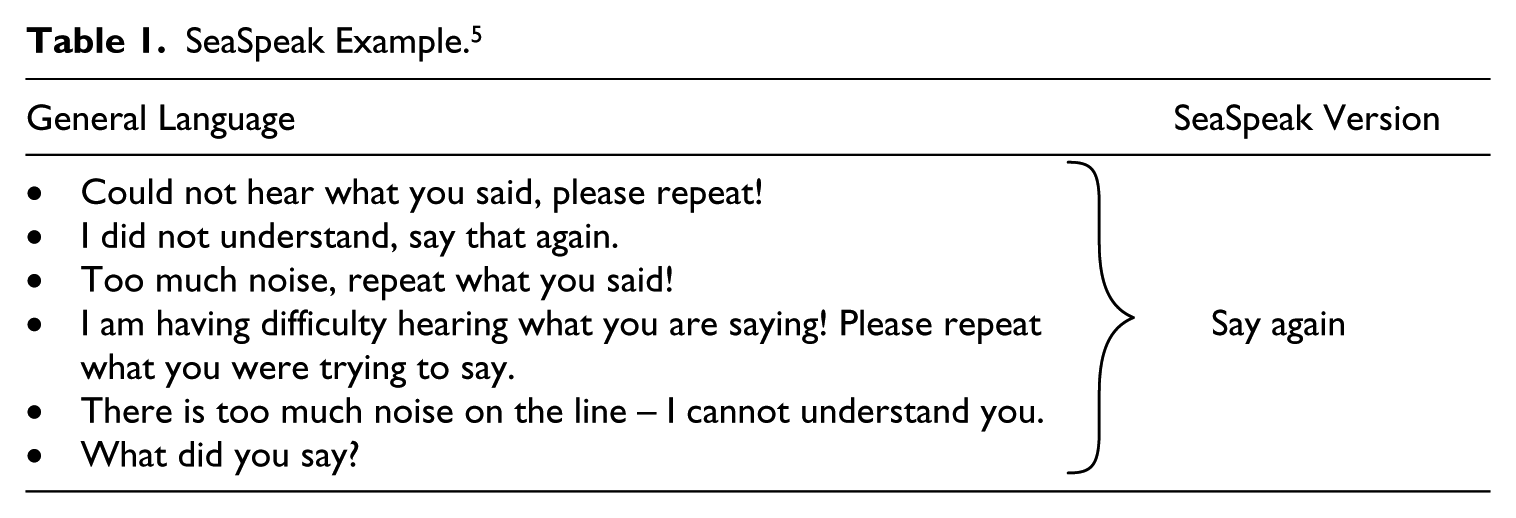
While general English certainly provides the language resources that these English speakers draw on for the specific statement in Seaspeak, their proficiency does not give them additional authority or standing in this situation of captaining or piloting the vessel. In learning a specialized language, like Seaspeak in this case, users draw from their existing linguistic resources along with their understanding of the use situation: This is the use dimension. They are guided by what they need to accomplish – the tasks they need to do to carry out the work of the situation: This is the purpose dimension. In this way, the purpose drives the language use, and the use draws on a defined domain of language. A ship captain is a captain, and SeaSpeak English helps him or her to do the job and carry out that role. While the professional purpose circumscribes the language use in the context of the professional practice, other language resources can certainly be available. These are separate from getting the work done, however. For instance, airline pilots are likely to use their first language (providing it is mutually available) when they are chatting in the cockpit, but they use a version of aviation English when they do routine tasks like taking off or landing the aircraft or interacting with the air-traffic control.
This situation of purpose and use differs from someone learning medical English, for example, who cannot do any of the work without the specific language. The full identity as a medical practitioner is only available through the use of the specialized language in the circumstances of the medical clinic. For example, medical personnel who immigrate to an Anglophone country can often function effectively in the medical role in their first language, however they need ‘medical English’ in order to use their medical knowledge in an English-medium clinical setting. If they want to play a professional role in these circumstances, they need to use medical English. In these situations, the use of the language dominates the individual purposes.
Point #3: How the Idea of General English Competence Leads to Deficit Thinking
In the context of ELT, this intertwining of purpose and use suggests a different strategy for supporting teachers to improve their classroom language use. Broadly speaking, general English language proficiency has been treated as the language resource necessary for ELT teachers to do their jobs. This view assumes that language use, defined as general English fluency, should support the individual teacher’s purposes in classroom teaching. The assumption, which amounts to an assertion rather than a researched proposition, is flawed in several ways, however. First, it contributes to enshrining the standard of ‘native-speakerism’ discussed earlier. If general English proficiency (however defined) is necessary for classroom teaching, and if some people are socio-geographically qualified in that proficiency as ‘natives’ of the language, then those who bring these ‘native’ language attributes are, by definition, prepared to teach. Arguing that there is additional knowledge needed, although that may well be the case, does not fundamentally alter the assumption. Language fluency is still the marker of teaching competence in this view. But as the assertion of ‘native-speakerism’ has become both unpalatable socio-politically and untenable as a feasible criterion for the global ELT teaching force, it has been replaced by measures of general fluency in English, as in the CEFR levels that predominate in many national policies.
Second, at this point we have only a partial understanding of how a teacher’s language use in the classroom contributes to student learning. There are commonsense intuitions – such as the argument that when the teacher uses the target language regularly in the classroom, the language becomes more authentic for students. Research has also identified particular ways in which teachers’ language use seems to support students’ classroom language learning, but these practices do not automatically happen if a ‘native speaker’ is teaching. For example, learning to adjust language input so that it is comprehensible to students is a skill that any teacher needs to master regardless of first language or general proficiency.
Third, connecting these assumptions – that general English proficiency directly and automatically qualifies some to teach, and that the teacher’s general English proficiency directly and automatically improves student learning outcomes – has contributed to creating a situation which de facto undermines the sense of teaching competence for the majority of ELT teachers around the world. The reasoning creates a tightly knit argument that:
Labels the majority of ELT teachers globally as ‘non-native speaking teachers’ (or NNESTs).
Who usually learn through professional preparation that they ought to use English in the classroom.
Yet they often remain uncertain about the specific teacher language to use in these situations (perhaps because they themselves did not learn in a classroom that was taught in English).
And they are positioned to accept, through national policies and professional pronouncements, that improving their general English proficiency will address the issue.
I use the term ‘argument’ to describe the way in which this closely organized, cumulative reasoning builds towards, and anchors, a conclusion. Taken together, these assertions have contributed in powerful ways to a wide-spread deficit view of the classroom teaching abilities of a majority of ELT teachers around the world.
The argument operates on several levels. In terms of policy, national decisions often use general English proficiency measures to define optimum indicators of teacher quality. In Vietnam for example, as Minh, Hoa and Burns (2017: 22–23) explain, the Ministry of Education and Training (MOET) established, in a series of policy decisions, a national target for teachers’ general English proficiency. The policy states that ‘Teachers must satisfy the minimum requirements for language proficiency, that is, [CEFR] B2 for primary and junior secondary teachers, and [CEFR] C1 for high school teachers, to be eligible to teach these curricula’. In Chile, ministry (MINEDUC) standards introduced in 2015 also define the CEFR B-2 level as the English language outcome for pre-service teacher education. Societally, in national contexts in which English functions as an economic lingua franca, such policies may inadvertently foster views that ‘those who can’ use English well will do so for economic and social access, while ‘those who can’t’ will teach it. These assumptions are most pernicious at the classroom level, however, where they can erode teachers’ classroom confidence and sense of efficacy. This deficit argument may be creating a problem in ELT teacher competence, rather than promoting ways to address it and improve classroom instruction.
Part 2: What Does ‘It Take to Build a New Barn’?
The aim of the critique in the first part of this article is not to simply ‘kick down the barn’ of general English fluency as the measure of teachers’ classroom English proficiency. Rather, the focus should be on what ‘it takes to build [a new] one’. My colleagues and I who have worked on this problem contend that what is needed is a form of Seaspeak for teachers in the English classroom. This strategy entails using an ESP-based approach to define the particular English that teachers use in teaching, the construct that we have called ‘English-for-teaching’ (Freeman et al., 2015). We have discussed elsewhere (Freeman et al., 2013) how the construct was used to design the English-for-Teaching course.The language was identified through an iterative process of global review of standards and policy documents, drawing on the specifics of 13 national curricula, referring to research on classroom language use in various countries, and consulting with two international consensus panels. Then a completely aligned assessment, the Test of English-for-Teaching (or TEFT) was developed, piloted, and validated (Young et al., 2014). The designs – of the course and the aligned assessment – constitute the ‘new barn’, the blueprints of which I turn to now.
English-for-Teaching as a Construct
As a construct, English-for-Teaching is defined as ‘The essential English language skills a teacher needs to be able to prepare and enact the lesson in a standardized (usually national) curriculum in English in a way that is recognizable and understandable to other speakers of the language’(Young et al., 2014: 5). The user of this professional language is described as a teacher who:
May or may not use English partially or completely as the medium of instruction, although he or she is familiar with the curricular content.
Is familiar with classroom routines, including basic classroom management and teaching strategies, and can carry out these classroom tasks and routines that are predictable.
Is expected to use a defined (often nationally prescribed) curriculum.
Draws English language support from instructional materials.
Is teaching students who are at the beginning or intermediate levels of general English proficiency.
Uses English to interact with students in simple and predictable ways (2014: 6).
These descriptors outline a set of interactions between language use and the teacher’s purposes. How, then, are they enacted in teaching? As represented in Figure 1 below, the language knowledge draws on and is supported by the national curriculum as it is being taught in a particular classroom setting. These social and pedagogical interactions situate its use. The framework identifies three functional areas that structure the barn as it were: Teachers use language knowledge to manage the classroom [A], to understand and communicate lesson content to students [B], and to assess students and give them feedback [C].
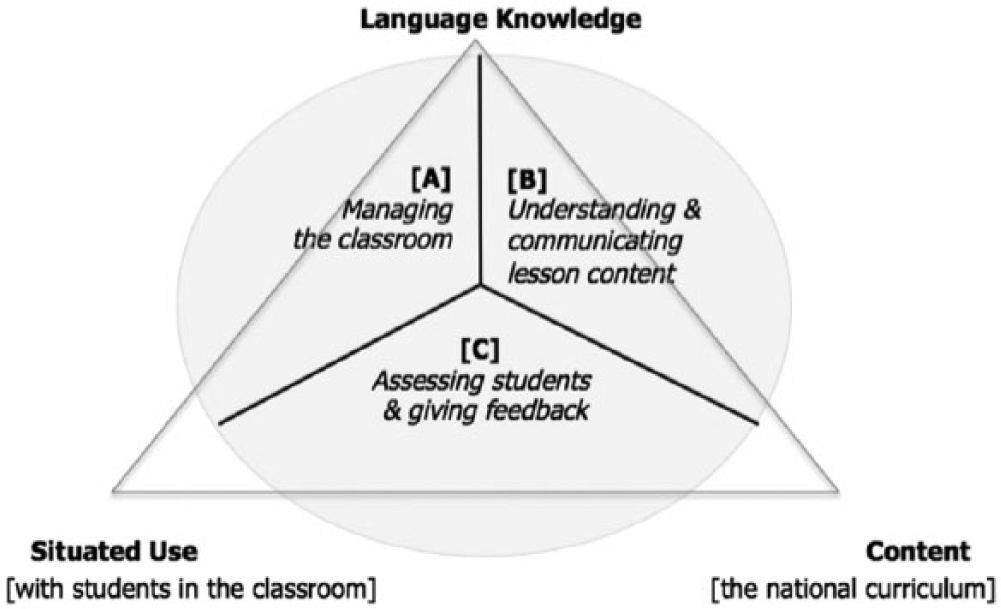
The construct of English-for-Teaching.
Teachers carry out tasks in each of these functional areas. For example, to manage the classroom, a teacher takes attendance, makes announcements, organize students by telling who to work with whom, and so on (see Freeman, 2015). These tasks are all implemented in and through language.
The English language a teacher could use in enacting classroom tasks is inherently flexible and context dependent. It is also essentially unbounded. To organize a pair-work activity for example, a teacher could tell students to ‘work with a partner’, or ‘talk with a friend’, or ‘turn to the person next to you’, or ‘find someone who has the same birthday’, etc. Each of these language exemplars – and there are many others – accomplishes both the task criterion (organizing pair-work) and the language criterion of being ‘recognizable and understandable to other speakers of the [English] language’. Identifying one or two ways to give the directions for pair work – for example, ‘Work with your partner/ talk to your neighbour’ – creates a defined set of language resources that teachers can use in their particular circumstances according to their particular purposes in the classroom. By anchoring these resources to a purpose – what the teacher wants or needs to do at that point in the lesson – the language supports teachers in enacting what they already know how to do. In other words, the individual can perform as an ELT teacher according to global norms and expectations by using what they already know pedagogically to do what they do in English. Having these language resources at their disposal in the classroom can address – and perhaps even help to overcome – the teachers’ feelings of professional deficit that they are not ‘fluent enough’ to teach in English and thus that they are not meeting the public perception of ‘being a good ELT teacher’.
Critiques of the LSP View of Classroom Language
Several critiques could be leveled at this apporach to defining an English for Specific Purposes for the classroom teacher. Some might argue that students would benefit from a richer variety of language input and that limiting classroom language impoverishes that input. Others might say that specifying particular language exemplars is arbitrary and artificial, and that controlling a wide variety of language options to carry out a classroom task is part of the job of English language teaching. In this view, defining the language the teacher uses somehow limits how the job is done. The former argument, while it has some support in research on classroom language acquisition, falls down in two areas. There is the assumption that students generally respond positively to a wide variety of language input. In actuality however, many teachers who have fluent control of English often use the shared first language to teach in the classroom precisely because they believe or find their students will not respond to instruction in English. Beyond this practical concern, the impoverishment argument essentially makes ‘the great the enemy of the good’. The argument that teachers need to use great variety of language can eclipse the instructional good that is accomplished in ELT classrooms when the teacher can use a defined set of language resources appropriately.
The latter argument – that limiting the language somehow limits how the teacher does the job – amounts to reasserting the values of native-speakerism discussed above, but under a new guise that links language fluency to professional competence. The position further confuses English fluency, which supports an individual’s capacity to participate in English language teaching as a global professional enterprise, with the English used in classroom teaching. The formulation ties professional identity as an ELT teacher to general English fluency, which is then supposed to translate directly into improved classroom practice. This view is pernicious in at least two ways. It confuses teacher identity with pedagogical ability, an assumption which casts as deficient a vast majority of ELT teachers globally because they either cannot or do not choose to participate in the global ELT community. It is a view of teacher competence as based on general English fluency that, in essence, leads to disenfranchising the vast majority of ELT teachers globally. Further, the view that language fluency equates to teaching competence simply replaces the outmoded notions of native-speakerism by privileging those who are more fluent in general English. Because improving one’s fluency as a language user is broadly seen as within one’s own control, teachers who lack this general control of English can be portrayed as less committed to the work they do in the classroom. This not-so-subtle argument conflates improving fluency with improving ELT teaching. Teacher language use is certainly part of the improvement challenge, but using general language fluency as the sole metric tends to privilege the positions of institutions in what Kachru (1982) called ‘first circle’ or Holliday (1994) referred to as BANA countries, and thus to reinforce their predominant roles in training, curriculum, and assessment.
English-for-Teaching and Knowledge-for-Teaching Languages
The foregoing points argue for English-for-Teaching as a construct, developed using the approach and within the conventions of Languages for Specific Purposes. The construct identifies the English language that teachers can use in the classroom to do their work. In so doing, the construct bounds this set of language resources within the broader sweep of general English proficiency. The bounding is grounded by the situations and circumstances in which the teacher uses (may use; needs to use) English in the activity of teaching. These boundaries circumscribe the language resources, but it is the teacher’s particular purpose that animates their use. Like the maritime personnel using SeaSpeak for their work as ships’ captains or pilots, English-for-Teaching furnishes a set of language exemplars that can function as tools in teaching. This use of English as a public tool in the activity of teaching connects the construct to the broader conceptualization of knowledge-for-teaching. The connections, which have been elaborated elsewhere (see Freeman, 2016; also Young et al., 2014: 4–5), point to how teachers use what they know in the activity of teaching.
Research on how teachers use knowledge in teaching in various fields (e.g. in mathematics, see Ball et al., 2008) has documented that they do not simply apply disciplinary knowledge when they teach lesson content. Rather, there is a particular form of content knowledge that arises out of – and is used in – the process of teaching. This form is referred to as knowledge-for-teaching. The hyphenation underscores the fact that the purpose, for teaching, shapes the knowledge itself.
The concept of knowledge-for-teaching challenges the idea that teaching simply involves applying general knowledge in specific situations. As Ball and her colleagues have shown in mathematics (Hill et al., 2008), elementary teachers use a form of mathematical knowledge that blends disciplinary knowledge of mathematics with specific understandings of how students make sense of that content. 6 The circumstances and purposes not only drive the use of the knowledge, but they shape how that knowledge is expressed in language through instructions, tasks, and interactions with students. In English language teaching, we have held onto a different model up until now, one that promotes the notion that teaching English entails applying general knowledge of the language to the specific situation of the classroom. This can lead to the premise, as I have said earlier, that the more general English a teacher knows, the better they can apply it in their teaching. English-for-Teaching as a construct changes the parameters of that argument to assert that not only is there a specific form of English that teachers use in teaching, but using that language is not simply derived from general proficiency. Rather as a form of knowledge-for-teaching, English-for-Teaching integrates linguistic resources with methodology so that in using the language, the teacher is enacting forms of instruction.
The next section illustrates how this new model of classroom English proficiency has been introduced in two national contexts: in Japan in an implementation trial with pre- and in-service teachers, and in Vietnam as part of the national reform.
Implementing English-for-Teaching in Two National Contexts 7
Japan
Taking the ELTeach program felt like I was getting the “missing piece” of what I needed to work in the classroom –Elementary school teacher, Hachioji City, Tokyo
In its 2014 English Education Reform Plan, released in anticipation of hosting the 2020 Summer Olympic Games in Tokyo, the Japanese Ministry of Education, Sports, Science and Technology (MEXT) announced a number of initiatives to strengthen English language education. Among them, starting in 2016, English language instruction was to be introduced in 3rd grade and would become compulsory in 5th and 6th grades. As with many ambitious policy goals, MEXT, and local education authorities (prefectural and municipal boards of education), have faced the challenging task of training and empowering public-sector ELT teachers so that classroom instruction at the junior and senior high school levels will be in English. In response to this professional development demand, two groups of teachers were recruited to trial the English-for-Teaching course: an in-service cohort of 102 teachers from Hachioji City in Tokyo and a pre-service cohort of 51 students from two universities (Aichi Prefectural University and Hokkaido University of Education).
In the English-for-Teaching course, participants progress through the activities at their own pace, knowing they will be tested at the end on the entire content. The course starts with a self-assessment in which participants are asked to rate their confidence in doing various classroom tasks in English. The course then presents functional English to carry out these tasks. The language is introduced in short classroom-based scenarios, and supported with various forms of practice including speech-recognition activities in which participants can rehearse oral language and receive automated feedback on their accuracy. The pronunciation models underlying these activities are based on an international speech sample collected from 2000 classroom teachers, so that the language and pronunciation in the course reflects the actual ELT professional world. The Learning Management System (LMS) documents how participants use their time as they work through the course units and activities.
The English-for-Teaching course is designed as a self-access professional development opportunity, which means individuals manage their own time as they study. As could be expected, individuals in the Japanese implementation trial spent differing amounts of time on the course. In-service teachers (17 hours on average) tended to spend slightly more time than pre-service teachers (15.5 hours on average). We also analysed the amount of time spent on the speaking activities since these activities seem to contribute to teachers’ confidence in using classroom English. In-service teachers spent 121 minutes on average on the speech-recognition activities, while pre-service teachers spent 113 minutes. In a post-course survey, a majority of respondents in both groups reported they were less inclined to use Japanese in their classrooms, and correspondingly they were more willing to teach in English. Indeed 89% of teachers from both cohorts stated that the programme would be useful to their English teaching in the future.
Completion rates on the course were extremely high. Ninety-six percent of the in-service teachers and 85% of the pre-service teachers completed the course and took the Test of English-for-Teaching (TEFT), which is offered on-line at independent test centers. TEFT scores place teachers’ performances in one of three bands (see Freeman et al., 2016 for a description of the bands). Each individual receives a score report detailing what they know how to do in English. For the 96 in-service TEFT test-takers, the results were relatively equally distributed across the three bands: 39% scored in Band 3, 39% in Band 2, and 32% in Band 1. Results for the pre-service test takers clustered in the highest band, with 86% scoring in Band 3, 12% in Band 2, and 2% in Band 1. These results for the pre-service teachers may reflect their more recent study of general English.
As part of this implementation trial, an independent researcher tracked changes in participants’ general English proficiency. The English-for-Teaching course focuses on classroom language use. Although it was thought that participants would also improve their general English proficiency through the course, the premise had not been studied. The separate research project (Otani 2015) gathered data on the in-service participants’ general English proficiency before and after participating in the course. The researcher identified improvements in general English proficiency using a commercially available general English proficiency test which showed improvement from a mean of 39.6 (out of 100) prior to the course to 49.9 at the end of the course 8 .
Like many ELT reforms globally, MEXT policies emphasize teachers using English fluently and comfortably in classroom teaching in order to make the language real and engaging for students. The analysis of this implementation trial offers a window into the challenges of meeting this policy goal. Using data on what participants did in the course, which was available through the course’s Learning Management System (LMS) and on how they performed on the TEFT, from the on-line test platform, we are able to probe how the development of this command of classroom language might differ for pre-service versus in-service teachers. Two aspects of this analysis stand out in particular: 1) how the participants used the course to practise and gain control over the classroom language, and 2) how their self-rated confidence in using that language seemed to predict their performance on the TEFT assessment. The former question was examined using the LMS and test data described above; the latter using the confidence ratings that participants gave at the beginning of the course and relating them to the TEFT scores.
In terms of the first point – gaining control over classroom language – we found that teachers’ oral command improved throughout the course. Since the English-for-Teaching participants studied independently using on-line materials, this finding might seem to run counter to conventional thinking about language training, which emphasizes face-to-face classes. The course activities that used speech recognition seem to play a central role in this improvement. As represented graphically in Figure 2, the more each group of participants engaged with the course activities using speech recognition, the better their results on the TEFT measures of spoken classroom English.
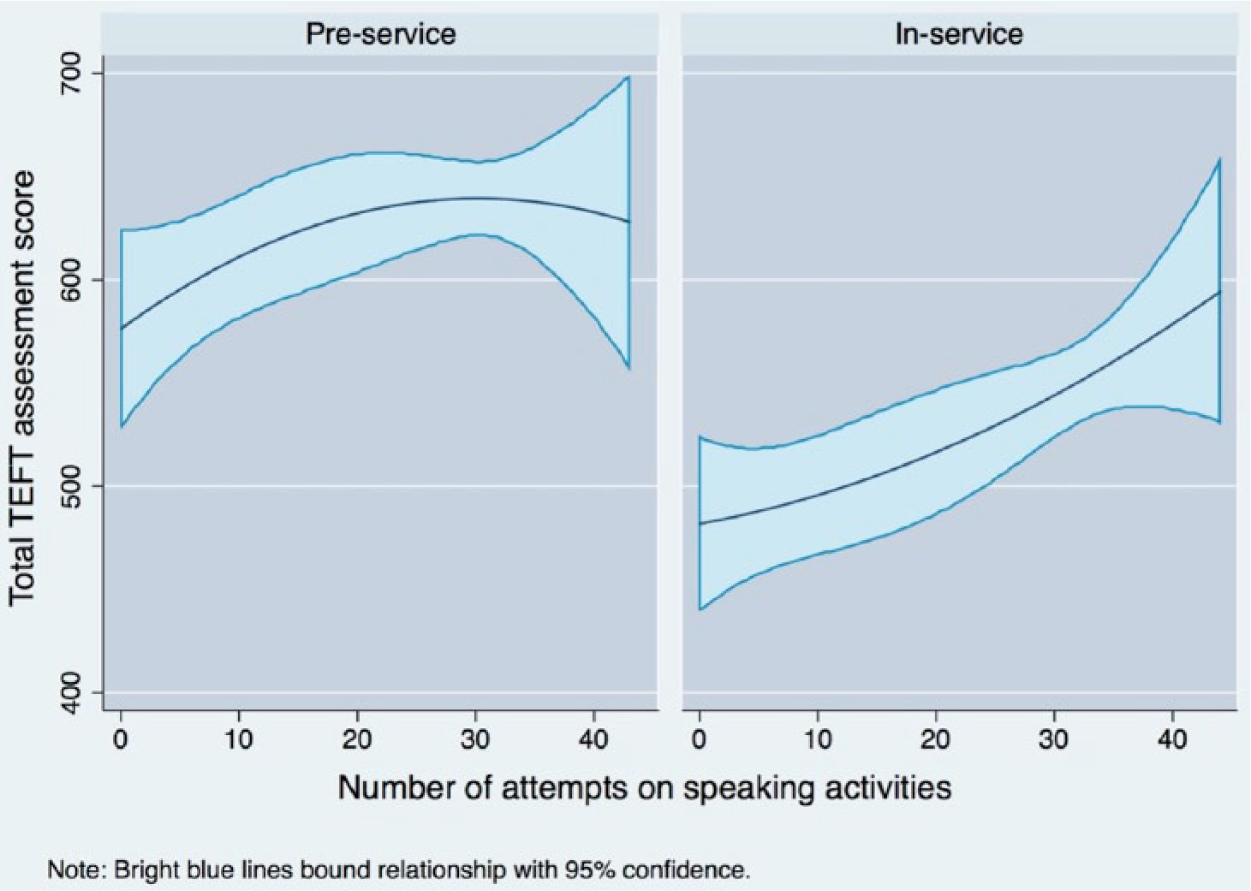
Attempts on speaking activities as related to TEFT Assessment scores – pre-service teachers (left) and in-service teachers (right).
There were differences between the two groups, however. Although time spent on speech-recognition activities predicted TEFT performance for both groups, the two curves differ (see Figure 2), making it a stronger predictor for the in-service teachers than for their pre-service counterparts. For every 10 additional uses 9 of speech-recognition activities, pre-service teachers (on the left) scored 16 points higher on the TEFT, while in-service teachers (on the right) scored 24 points higher. There could be several explanations for this pattern:
In-service teachers may be ‘rustier’ with the particulars of classroom language and need more practice.
Or they may be more accustomed to using Japanese when they teach and using the speech-recognition activities helps in-service teachers to transition to using English.
Or because they have immediate experience with the complexities of day-to-day classroom teaching, in-service teachers may either need (or use) the time to build their confidence with the language.
Confidence proves to be a much more elusive concept to track, and it is beyond the scope of this article to examine it fully. In reviewing the data however, we did find some initial evidence that teachers’ level of confidence in their abilities to do the specific classroom tasks in English (e.g. take attendance; make class announcements; put students into groups; etc.) predicted their overall performance on the TEFT. The first course activity, called the Pre-course planner, asks participants to rate their confidence in doing the classroom tasks in the course in English. We examined these self-assessed confidence ratings for both groups, and they turned out to be more strongly associated with TEFT performance for in-service teachers than for pre-service teachers. The analysis showed that for each unit increase in rated professional confidence (on a three-point scale), in-service teachers scored 20 points higher on the assessment, while pre-service teachers showed an 8-point improvement. One possible interpretation is that in-service teachers’ classroom experience may be helping them, more than the pre-service teachers, to visualize and evaluate their confidence in what they can do in English in the classroom, and this was reflected in the assessment results.
These distinctions in pre- and in-service teachers’ performance suggest different approaches to supporting the development of classroom English proficiency. Pre-service teachers seem to approach the English-for-Teaching course on the basis of their recent or concurrent academic training. For them, the course seems to connect what they know through their general English proficiency to the specific requirements of using that language in the classroom. However, probably because they don’t yet have much classroom teaching experience to draw on, they are likely unaccustomed to the actual complexities of using English in teaching. We could argue that in-service teachers recognize from their on-going experiences in the classroom what they needed to improve linguistically and the self-access design allows them to focus their practice. The opportunities for individualized practice, which are readily supported in an on-line course environment, are less feasible in conventional face-to-face training, which is designed around group needs.
In fact, this opportunity for teachers to focus on what they feel they need to learn has emerged as a central feature in the course (see Freeman et al., 2016). It may seem a truism that how in-service teachers rated their professional confidence in classroom English would accurately predict what they could do with the language as measured by the TEFT. However, this fundamental premise is often ignored in the design and implementation of professional development language programmes. Starting with this self-evaluation, knowing their teaching contexts and recognizing that they would be tested at the end of the course, in-service teachers seem to focus on getting better at using oral language in the classroom and they show significant gains when tested. A comment from a teacher in the in-service cohort captured this trajectory: ‘I often found myself in the classroom remembering language I had learned in English-for-Teaching and finding opportunities to use it with the students’.
Vietnam
Starting in 2008, Vietnam launched a new national language policy, with the goal that:
[B]y 2020, most young Vietnamese graduates of professional secondary schools, colleges and universities will have a good command of a foreign language which enables them to independently and confidently communicate, study and work in a multilingual and multicultural environment of integration; to turn foreign languages into a strength of Vietnamese to serve national industrialization and modernization. [Decree 1400, 2008: 1] (Cited in Manh et al., 2017: 20)
The National Foreign Language Project, known variously as ‘NFL 2020’ or ‘Project 2020’, has been the national initiative that is geared to achieving this goal of improving both student and teacher English proficiency. As Manh, Hoa, and Burns describe it:
The advent of NFL 2020 has radically impacted language education in Vietnam … Two of the most significant changes brought about in English language teaching are access and pedagogy (i.e. who should learn English, at what age and level in the educational system, and what methodology should be adopted) (2017: 20).
To implement the goals of NFL 2020, the general strategy has been to support improvement of teachers’ proficiency through general English courses. The training is usually conducted face-to-face through group instruction, and is often assessed using general English proficiency tests. The assumption has been that this type of conventional instruction will lead to more teachers teaching English in English.
The results to date have been uneven, and perhaps somewhat questionable, however. Manh, Hoa, and Burns (2017: 24–25) report in their recent analysis that the percentage of underqualified teachers dramatically decreased from 87% to 46% in a three-year period, from 2011 to 2015, as measured by local general proficiency assessments. However, they note that these tests, known as VSTEP, ‘may not accurately assess teachers’ language proficiency’ (Manh et al., 2017: 26). They cite Dudzik and Nguyen who have enumerated various problems with the tests, ranging from the tests themselves – ‘some institutions employ longer or more tests than others, while some use one or two standardized assessment instruments (for example, the listening and speaking sections of Cambridge, IELTS, or TOEFL tests in place of instruments created by the various testing institutions)’ (2015: 49) – to how the VSTEP tests were developed and implemented, noting there was ‘little or no validation of tests developed and used within and across the institutions’ (2015: 49). Manh, Hoa, and Burns (2017: 26) conclude that ‘even though teachers may achieve the mandated proficiency level, one may question whether the measures of these teachers’ language proficiency are reliable, or more importantly, whether these teachers can effectively use English for teaching purposes’.
Starting in 2013, Vietnamese policy-makers began to adopt a different approach. Between June of that year and March 2016, 4,353 Vietnamese teachers completed the English-for-Teaching course, and 94% took the independent assessment, the Test of English-for-Teaching (TEFT), which is fully aligned with the course content. The results of this intervention are discussed in more detail elsewhere (see Freeman and LeDrean, 2017). The discussion in this article focuses on one particular analysis that examined the issue of increasing equitable access to professional development for teachers across Vietnam.
Providing professional development through face-to-face training designs, while it is the norm particularly for English language improvement, cannot escape two persistent issues: access – how to support widespread participation, particularly for teachers in rural areas, and therefore equity, how to support improvement for all teachers and students across the national education system. In terms of access, often travel to training can be problematic and costly for teachers; scheduling becomes complex, and ultimately teachers in far-flung locales either end up with fewer opportunities or perhaps with opportunities that depend on ‘multiplier’ training. In the latter designs, one person (usually a fellow teacher) is ‘trained’ and returns to ‘multiply’ that training by ‘cascading’ it to peers. The results of multiplier-cascade training can be less than effective (see for example Suzuki, 2008). Inputs are filtered and become diluted so that teachers who have less physical access end up with less direct contact with the expertise and input that they want or need. (The phenomenon is similar in the childhood game of ‘Telephone’ in which one person starts a message that is then whispered ear-to-ear around the group). This differential access then leads to problems with equity, in which students and their teachers in rural or underserved areas receive less training, or training that is delivered less effectively. As with other social services like health, it is often precisely these areas that need the most support to realize educational improvement.
The experience of English-for-Teaching in Vietnam shows that issues of access and equity can be addressed through a self-access training design. To examine the experiences of urban and rural teachers, two subsets of participants were created. For the purposes of comparison, teachers from ‘urban’ areas were drawn from Ho Chi Minh City, while those from ‘rural’ areas came from Yen Bai, Phu Yen, Soc Trang, Hau Giang, and Long An provinces. 10 We then examined TEFT performance as a function of the time the two groups of participants spent studying the course. Teachers who lived in urban areas scored 48 points higher on the test overall and did better in all sub-areas of the TEFT. However, teachers who lived in rural areas tended to spend slightly more time on the course (30 hours average versus 28 hours average for urban teachers) and their test performance improved as a function of the time they spent. As shown in Figure 3, these rural teachers made gains according to the additional time they spent that were similar to the gains in the scores of teachers from urban areas.
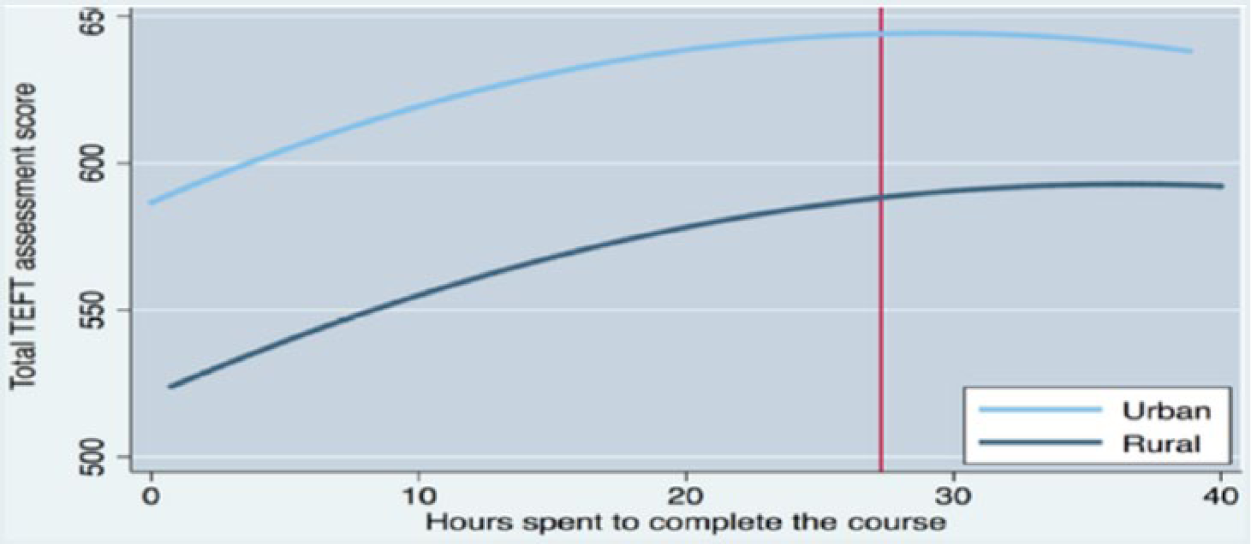
Total TEFT scores by hours spent on the course by teachers from urban/rural regions.
The vertical line in Figure 3 shows the average amount of time all teachers spent on the course. Up to this line, the urban teachers scored approximately 50 points higher for every additional 10 hours spent on the course. Beyond 28 hours, the additional time was not associated with higher scores for urban teachers.
A previous study (National Geographic Learning, 2014), prepared for the NFL Project 2020, which was conducted with a smaller sample of 506 teachers, showed a similar finding. The teachers in this study were drawn from ten Departments of Education and Training (DOETs) across the country: the rural teachers came from Bac Can, Ben Tre, Dong Thap, Nghe, Quang Nam, and Thai Nguyen, while the urban teachers were drawn from Da Nang, Hai Duong, Hue, and Thai Binh. Again the two areas were designated by the MOET. In that analysis, rural teachers performed as well as urban teachers on the TEFT, and there was no significant difference between the groups. These findings came despite the fact that two factors generally associated with performance – self-confidence and self-rating in English – were significantly different for the two groups. Rural teachers rated their confidence as 0.5 points lower (on a 3 point scale) than urban teachers, and were 15% less likely to rate their English as ‘upper-intermediate/advanced’.
The self-access format of the English-for-Teaching course is designed to permit access wherever and whenever teachers can get on-line. While connectivity is admittedly more challenging in rural areas, these technological circumstances are changing rapidly, particularly in Vietnam. However, on-line, self-access courses alone are not the solution to creating more equitable access to professional development opportunities. In view of the documented high levels of attrition in massive open on-line courses (MOOCs) (Onah et al., 2014), and other forms of on-line training (Lee and Choi, 2011), simply ‘putting training on line’, while it does create access to learning opportunities, is not in itself an equitable approach. In contrast to MOOCs for example, the completion rates of the English-for-Teaching course have been high, ranging between 80% and 95% in different contexts (Freeman et al., 2016). The fact that the course includes an independent, scheduled assessment – the TEFT – seems to be an important factor contributing to these completion rates. The TEFT seems to create a sort of finish line that may serve either to motivate or to pressure participants. More basically however, the direct connection between the course content and teachers’ classroom responsibilities appears to stimulate teachers’ involvement. Nhung (2017) studied 19 Vietnamese teachers from provinces in the Vietnamese Central Highlands, 11 of whom had taken the course. Having observed their teaching and gathered and analysed data on how they used classroom language, she concluded that ‘teachers with slightly lower general English proficiency, when trained with English-for-Teaching, can use English to fulfil all pedagogical functions in their classrooms. They also use a wider range of expressions in their classrooms [than the teachers who did not do the course.]’ (Nhung, 2017: 81).
These analyses are encouraging in that they show that equitable access to professional development opportunities across geographical regions is possible. Teachers, regardless of where they live and work, know what they need to learn and will make the effort and spend the time to learn it, provided that the opportunities to learn are readily available. The finding is particularly important in view of the Vietnamese government’s stated commitment to training teachers in all areas of the country (see Manh et al., 2017).
Closing Comments
This article has argued that the challenges of expanding instruction in ELT globally, coupled with new understandings of English as a lingua franca, require a different approach to classroom language. I have argued for an approach that is grounded in models of using the language in classroom contexts which we refer to as ‘for-teaching’. The phrase anchors the purpose of the language thereby repositioning the teacher-user. In general fluency language training, teachers are not learning English specifically in order to use it in teaching. The challenge is that teachers who are teaching need specific language support to do so. The English-for-Teaching construct defines an asset-, rather than deficit-, based view of the place of English in ELT teaching knowledge. The design of the eponymous course and the aligned test has allowed implementation of the construct as a ‘proof of concept’. On this basis, we can say that the design creates an approach to professional development that serves the needs of teachers, particularly in the expanding public sector of English language teaching, more effectively than most conventional, general proficiency language training that is usually offered face-to-face.
The implementations of the English-for-Teaching course have demonstrated this ‘proof of concept’: that providing equitable professional development opportunities to improve teachers’ classroom English proficiency is possible across diverse contexts (see Freeman and LeDrean, 2017; Freeman et al., 2016). The challenge, therefore, is no longer what to do; rather, it lies in changing the norms of how to provide language improvement in ELT professional development. Delivering face-to-face training, based on conventional models of general language proficiency, embeds, albeit unintentionally, the very assumptions of native-speakerism that need to be debunked. In building this new barn of teacher classroom language, outmoded ideas of fluency in general language use, which ultimately refer back to native-speakerism, need to be replaced with the notion that ELT teachers are ‘native’ to their classrooms. This professional definition of nativeness means that teachers know what they want to do in their teaching; they understand the purposes and uses that English needs to accomplish in their classrooms. What they are seeking is the specific language ‘for-teaching’ to do so.
Footnotes
Acknowledgements
My thanks to Anne Katz for her close readings and contributions to this article.
Funding
The author(s) disclosed receipt of the following financial support for the research, authorship, and/or publication of this article: The research analyses reported in this article were variously supported by National Geographic Learning and the University of Michigan. The views expressed are the author’s own.