




Abstract
This article presents a case study that examined the beliefs and practices of one female English for Academic Purposes (EAP) teacher in relation to teaching second language (L2) speaking. Overall, the findings indicate that the teacher’s stated beliefs converge with her classroom practices. However, instances of divergence were also observed. Potential reasons for the patterns of divergence include the programme expectations, the need to maintain the instructional flow of the class, and the novice teacher’s lack of teaching experiences in an EAP programme. Results suggest the need for EAP teachers to explore the sources of their beliefs and systematically, and regularly, examine their classroom practices through reflective practice in order to monitor their beliefs and classroom practices.
Introduction
There is a growing body of research evidence in the field of teaching English to speakers of other languages (TESOL) that language teachers hold complex beliefs about teaching and learning and that these beliefs have tremendous impact on classroom practices (Basturkmen, 2012; Farrell and Bennis, 2013; Farrell, and Ives, 2015). Thus there is a constant need for language teachers to unpack their beliefs, and also examine their classroom practices in light of their beliefs to see if they are convergent or divergent. However, just how much influence teacher beliefs have on actual classroom practices of EAP teachers has not been the focus of detailed research. One way of encouraging EAP teachers to articulate their beliefs as ‘a meaningful basis for discussion and reflection on planned aspects of practice’ (Basturkmen, 2012: 291) is to have them engage in reflective practice (Farrell, 2007: 2015). This article presents a case study of the reflections of one female EAP teacher who was teaching L2 speaking in an EAP programme in Canada.
Reflecting on Beliefs and Practices
Reflective practice generally means that teachers subject their beliefs about teaching and learning to critical analysis, and thus take full responsibility for their classroom actions because these beliefs are reflected in these classroom actions (Farrell, 2015). In order to engage in reflective practice, teachers must systematically collect information (data) about their beliefs and classroom practices, and then examine if there are any inconsistencies between their beliefs and practices (Farrell, 2015). As Borg has maintained, ‘teachers are active, thinking decision-makers who make instructional choices by drawing on complex practically-oriented, personalized, and context-sensitive networks of knowledge, thoughts, and beliefs’ (Borg, 2003: 81). Nevertheless, not all language teachers are aware of their beliefs or the extent in which their beliefs are reflected in their classroom practices (Farrell, 2015). Developing such awareness is important because as Knezedivc has pointed out, it is the beginning of a ‘process of reducing the discrepancy between what we do and what we think we do’ (Knezedivc, 2001: 10).
To date not much research has been conducted on the beliefs and practices of EAP teachers and especially on their teaching of L2 speaking. One reason may be that L2 speaking is often considered a neglected teaching skill in second language education (Nation and Newton, 2009). However, one particular study within the field of L2 speaking in English as a foreign language (EFL) context conducted by Mak (2011) discovered that teachers’ previous experience of learning and their beliefs about teaching filtered the ways in which they conceptualized teaching and thus limited their instructional considerations when teaching speaking. However, not many studies explored the relationship between EAP teachers’ beliefs and practices so the case study reported on in this article is one attempt to add to the literature by reflecting on the beliefs and classroom practices of one EAP teacher in Canada when teaching L2 speaking classes.
Methodology
The research outlined in this article is a qualitative case study and provides insight into one EAP teacher’s beliefs and classroom teaching experiences. This qualitative research was conducted in the form of a case study in order to examine the relationship between the EAP teacher’s beliefs and observed classroom practices with regard to second language speaking (Bogden and Bilken, 1982). The study utilized a case study method (Merriam, 2001) that was exploratory and descriptive in nature to arrive at basic information (Bogdan and Bilken, 1982). The use of case study methodology was chosen because it best facilitates the construction of detailed, in depth understanding of what is to be studied, and because case study research can engage with the complexity of real-life events (Stake, 1995). We focussed on one EAP teacher’s reflections because as van Lier (2005: 195) has pointed out, such a rigorous analysis on one teacher can provide in-depth insights into complicated pedagogical and contextual issues in a way that ‘cannot be adequately researched in any of the other common research methods’. Other TESOL scholars have successfully utilized such a case study approach for similar types of research (e.g. Farrell and Ives, 2015; Tsui, 2007). Farrell and Ives (2015) for example, utilized a case study approach to report on the reflections of one EAP teacher in Canada over one semester of teaching. Tsui (2007) also used a case study approach to explore teacher identity formation of one EFL teacher in the People’s Republic of China over his six years of teaching.
Participant
Megan (a pseudonym) is a female EAP teacher who has taught for five years in an EAP programme at a university in Canada. Megan, who has a BA in Applied Linguistics and a TESL Certificate, volunteered to explore the relationship between her teaching beliefs and practices in relation to L2 speaking in an effort to support her ongoing in-service professional development and her interest in seeking to raise her personal awareness towards reflective practice.
Context
During the period of the study, Megan was teaching English for academic purposes (EAP) at a university language school designed to prepare L2 learners for entrance to university. The students had five one-hour classes per day and each class focussed on one language skill (listening, reading, writing, speaking, and grammar). Megan was teaching an elementary level speaking class that consisted of 19 students from many different countries. According to the official curriculum, the main objectives for the speaking class were to improve students’ oral communication skills.
Data Collection
Data were collected over four 50-minute sessions of non-participatory classroom observations along with field notes on the second week of a summer semester. After observations were completed, each lesson was recorded, transcribed verbatim and coded. Other sources of data include lesson plans collected before each lesson, 30 minutes of pre- and post-observation interview before and after each observation, and a final interview after all the classroom observations. The interviews were semi-structured in that all questions were flexibly worded and the interviewer added questions to the list to mediate the situation if required, given interview questions were prepared beforehand (Merriam, 2001). The pre-, post-observation interviews and the final interview were transcribed and coded as well.
Data Analysis
The case study sought to answer the following three main research questions:
What are the stated beliefs of a female EAP teacher in relation to teaching L2 speaking?
What are the EAP teacher’s observed classroom practices regarding teaching L2 speaking?
What is the relationship between the EAP teacher’s stated beliefs and observed classroom practices?
These research questions guided the collection and analysis of data. When all of the observations and interviews were transcribed, they were coded and analysed. In order to ensure the data were reliable, all of the transcripts were coded and analysed on four separate occasions by the researchers in order to ensure that the codes were consistently identified (Miles and Huberman, 1994). Once it was concluded that all of the categories were concrete, they were compared with the other types of data (e.g. classroom observation notes) to investigate similarities. This data triangulation was used as a strategy to increase the validity of evaluation and research findings (Mathison, 1988). Before terminating data analysis, various member checks were performed whenever possible to elicit feedback from the teacher (Megan) on the appropriateness of the analysis and interpretations presented in the findings below and we added his comments and reflections on these findings as a means of further validating the data (Lincoln and Guba, 1985; Miles and Huberman, 1984).
Findings
We now present the findings as answers to the three research questions.
1. What are the stated beliefs of a female EAP teacher in relation to teaching L2 speaking?
Table 1 below outlines a summary of Megan’s stated beliefs with respect to the three categories; these include Megan’s stated beliefs about teachers’ role, teaching L2 speaking, and students’ role. Findings are outlined based on the thematic categories listed in Table 1.
Megan’s Stated Beliefs.
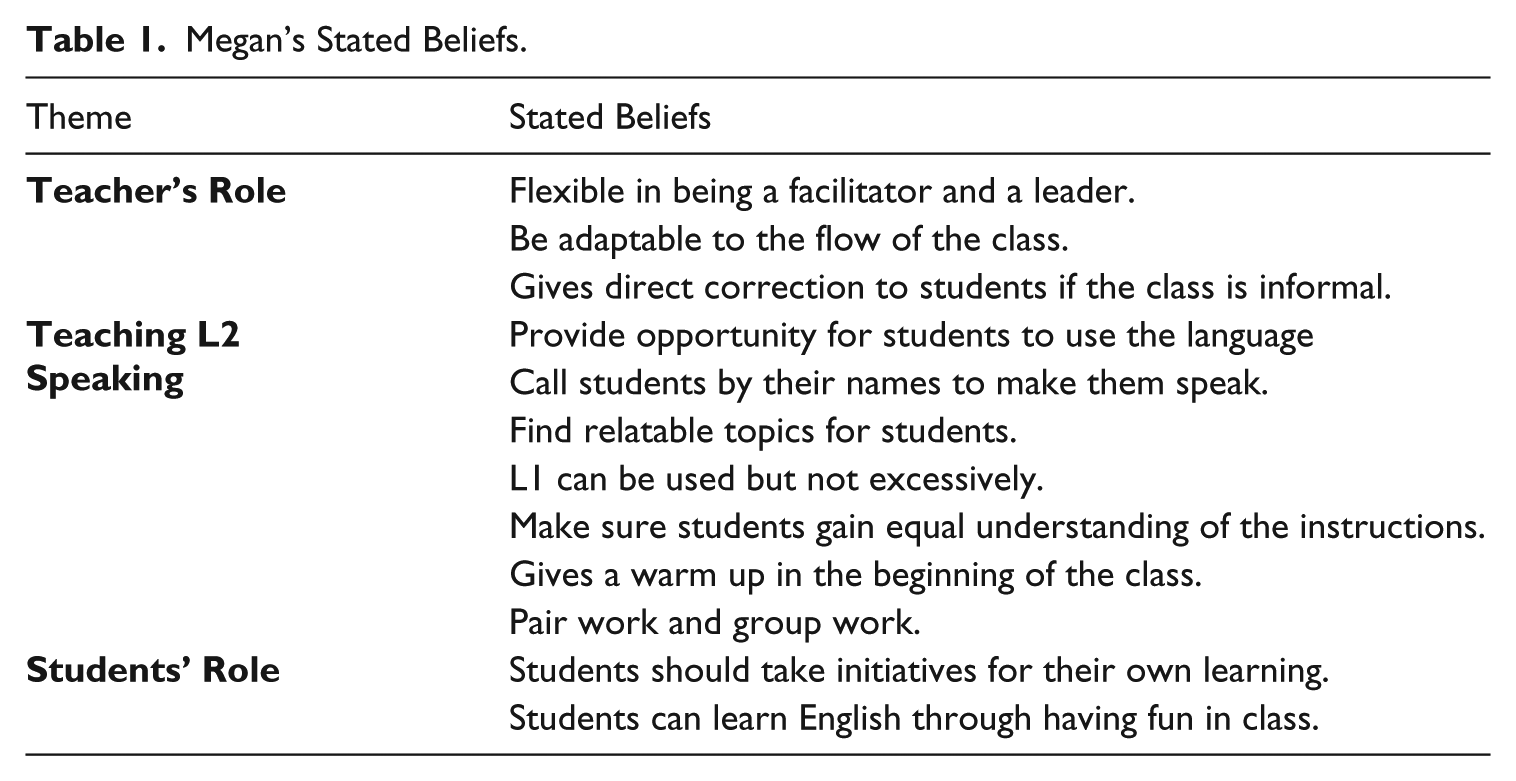
The first thematic category highlighted in Table 1 is Megan’s beliefs about a teacher’s role. Megan stated in the interview that teachers should be flexible in being a leader and a facilitator in the class. For example, Megan maintained that: ‘the teacher has to be adaptable so they might just need to be a facilitator but then they need to be a leader, because it depends on the students’ experiences with the language or what they are learning in class’. In order to be flexible in being a facilitator as a teacher, Megan remarked that a teacher needs to be adaptable to the flow of the class and be aware of students’ progress carefully in the classroom. She commented that lesson plans are useful to guide the instructional flow of the lesson; however, she said that the teacher still needs to be adaptable in adjusting the lesson plans based on students’ abilities and their progress.
In terms of the teacher’s role for error correction, Megan remarked that for example, if it was a pronunciation problem that affects comprehension, she would repeat the word to signal error location, and try to explain the position of the tongue and lips for the learners to repeat the sound, then she would ask the other students to practise voicing the sound. However, she stated that if the students are presenting something, then she ‘will not stop and correct the grammar, unless it’s a very serious problem, but if it’s more of an informal thing where I’m talking to a small group or individual students, I feel more error correction happens’.
The second thematic category indicated in Table 1 is Megan’s stated beliefs regarding the actual teaching of L2 speaking. Megan commented that the main objective of teaching L2 speaking is to provide an opportunity for students to use the language as much as possible: ‘Basically it is just to get them to talk. It doesn’t matter if they are making mistakes or if they need to take their time to think ahead. I just try to get them to use English’. Megan also stated that by giving students more opportunities to speak English, they can build confidence in speaking L2: ‘I hope by them using it more frequently, they can just gain the confidence’.
In addition, Megan expressed her tolerance towards students’ first languages (L1) used in class if not too excessively; she stated: ‘At this [basic] level it is inevitable to find students using L1s, and so as long as they are using that language to help each other understand it’s okay. I’m not like a police officer’. However, Megan maintained that she would indirectly encourage students to explain certain vocabulary in English if possible. In addition, Megan expressed the importance of giving students a warm up activityat the beginning of the class. She provided an example of using a video and relating the video to a certain topic at the beginning of the class that can activate students’ schema and allow them to ‘think more critically on a certain topic’.
Additionally, Megan remarked on the importance of pair and small group work. Megan commented that she prefers dividing students into smaller groups because students may experience lower anxiety when speaking in smaller groups: ‘I always think of getting them to do things in groups first so there’s less pressure for them having to speak in front of the entire class’. Megan stated that she would make students talk in smaller groups first, so students can practise speaking with fewer students, as they might find sharing with the entire class to be too intimidating.
Regarding her beliefs about the role of the students, Megan suggested that she prefers that her students be active learners and ‘take initiative in for their own learning’. Megan also stated that students can learn to speak the language while having fun; she remarked: ‘I like to have fun with them too and treating them as individuals and not as robots, I believe learning is important but you can have fun doing it too’. Thus far, Megan’s stated beliefs have been outlined. The next section of the case study reports on the observed classroom practices in Megan’s Level 2 speaking class.
2. What are the EAP teacher’s observed classroom practices regarding teaching L2 speaking?
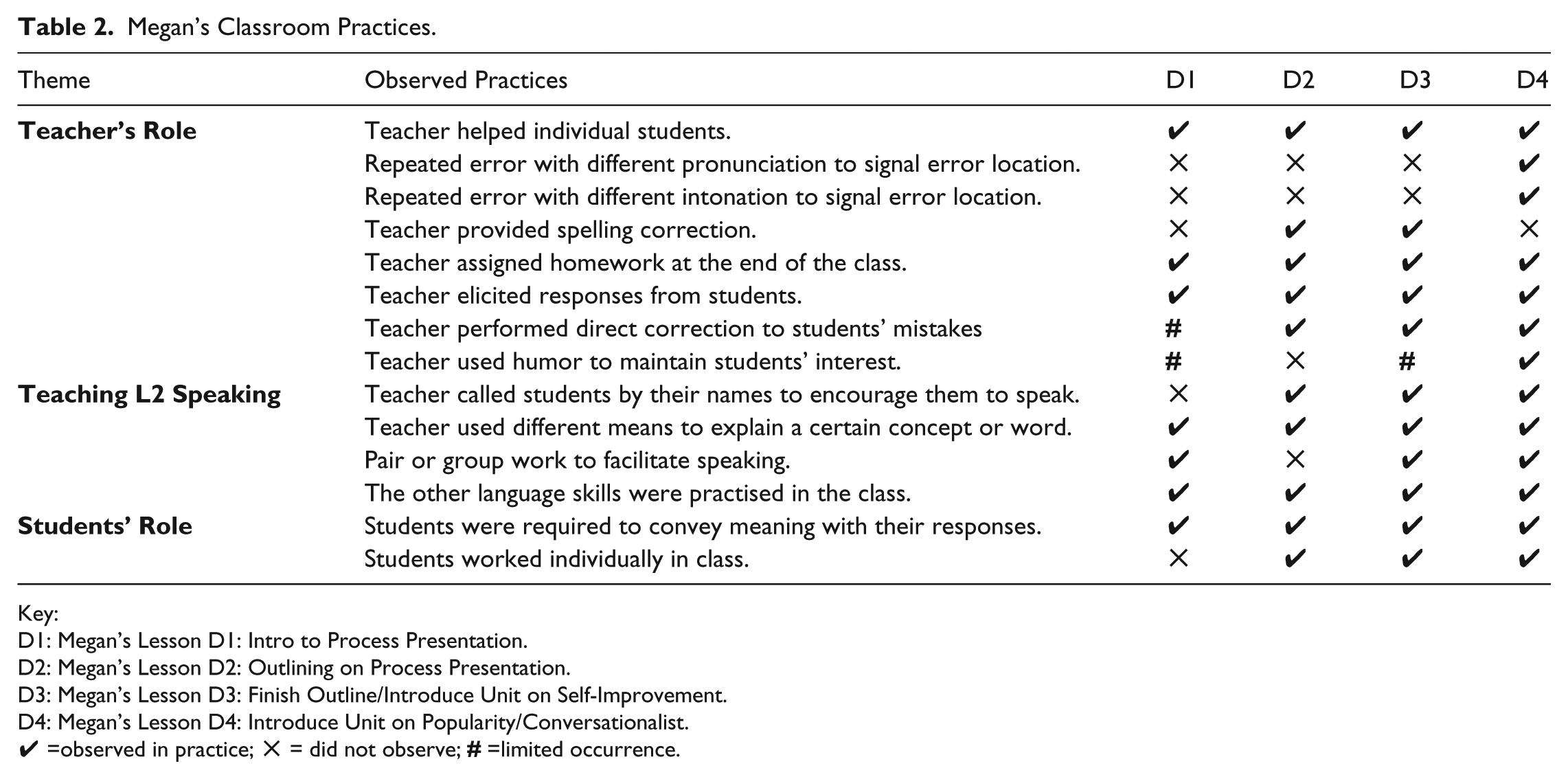
Table 2 reports a summary of observed practices in Megan’s speaking class.
Megan’s Classroom Practices.
Key:
D1: Megan’s Lesson D1: Intro to Process Presentation.
D2: Megan’s Lesson D2: Outlining on Process Presentation.
D3: Megan’s Lesson D3: Finish Outline/Introduce Unit on Self-Improvement.
D4: Megan’s Lesson D4: Introduce Unit on Popularity/Conversationalist.
As Table 2 indicates, Megan actively provided students with explanations and instructions, and elicited responses from the students on their knowledge of vocabulary items. In Megan’s first observed class (D1) she stated that she planned to have students deliver their presentation individually the following week, therefore she said that this class was aimed at providing a foundation for students to become familiar with the upcoming presentation. Megan began the class by asking students if they’ve ever planned before performing an action. One student provided an example of a test and Megan elicited responses from the students as to how they would plan for a test. As students were responding, Megan used different means to guide students to the idea of the steps involving planning a test. After approximately 15 minutes, Megan displayed a rubric of the process presentation on the projector and read the instruction to the students. While Megan was reading out the instructions of the presentation, it was observed that certain vocabulary were explained and clarified to ensure students’ understanding of the procedure that the presentation involved. When students gave a one or two-word answer, it was observed that Megan would ask the students to elaborate on their responses if possible. After Megan explained the instruction, each student was given a practice outline on the topic of ‘planning a vacation’ and then asked to complete the outlines in groups of three. While students were working in groups, Megan checked with each group’s progress. However, although the instruction was given at the beginning of the class, many students seemed to be still unclear about the assignment, and Megan then re-explained the instructions to some students individually. Towards the end of the class, Megan displayed a Wiki on the topic of ‘Planning a Vacation’ to illustrate this subject.
The teaching objective of the second observed lesson (D2) was to approve students’ chosen topics for the process presentations. At the start of the class, Megan elicited from the students the items they had discussed in the previous class. Then, Megan moved around the class and checked with each student on their selected topic for the process presentations while also making notes for their potential topics. In addition, she evaluated the students’ topics and provided direct feedback in order to help students critically evaluate their selected topics.
Megan’s third observed lesson (D3) was on finishing the outlines and discussing the concept of ‘self-improvement’ in the textbook. As Megan stated, many students were still unsure about the given assignment and she had planned to collect students’ assignments at the end of the class. Megan then gave an extra 15 minutes at the beginning of the class for students to complete their outlines, even though this information was not presented in the lesson plan. As observed, Megan moved around the classroom and checked on students’ progress for their outlines. While she was helping the students, she provided explicit feedback for each student depending on their individual progress, which included providing spelling correction, giving suggestions and explanations of issues that the students needed more clarification on.
The teaching objectives of the last observed lesson (D4) were to return the outlines to the students along with feedback and continue with the remaining unit in the textbook from the previous lesson. Megan started the class by returning the students’ outlines and then she continued with the topic of ‘conversationalist’ in the textbook. Megan first asked the students the meaning of ‘conversationalist’. Then students were asked to complete a section in the textbook individually and the answers were discussed all together as a class. While the answers were taken up, it was observed that Megan would first call students by their names to read the questions out loud and answer the questions. As observed, Megan also asked each individual to provide an answer to a particular question to ensure every student had spoken in front of the class. With respect to error correction, Megan directly pointed out the pronunciation and intonation errors with the correct version when they occurred. After this all the students practised voicing the sound with its correct pronunciation and intonation. At the end, Megan reminded students to prepare.
3. What is the relationship between the EAP teacher’s stated beliefs and observed classroom practices?
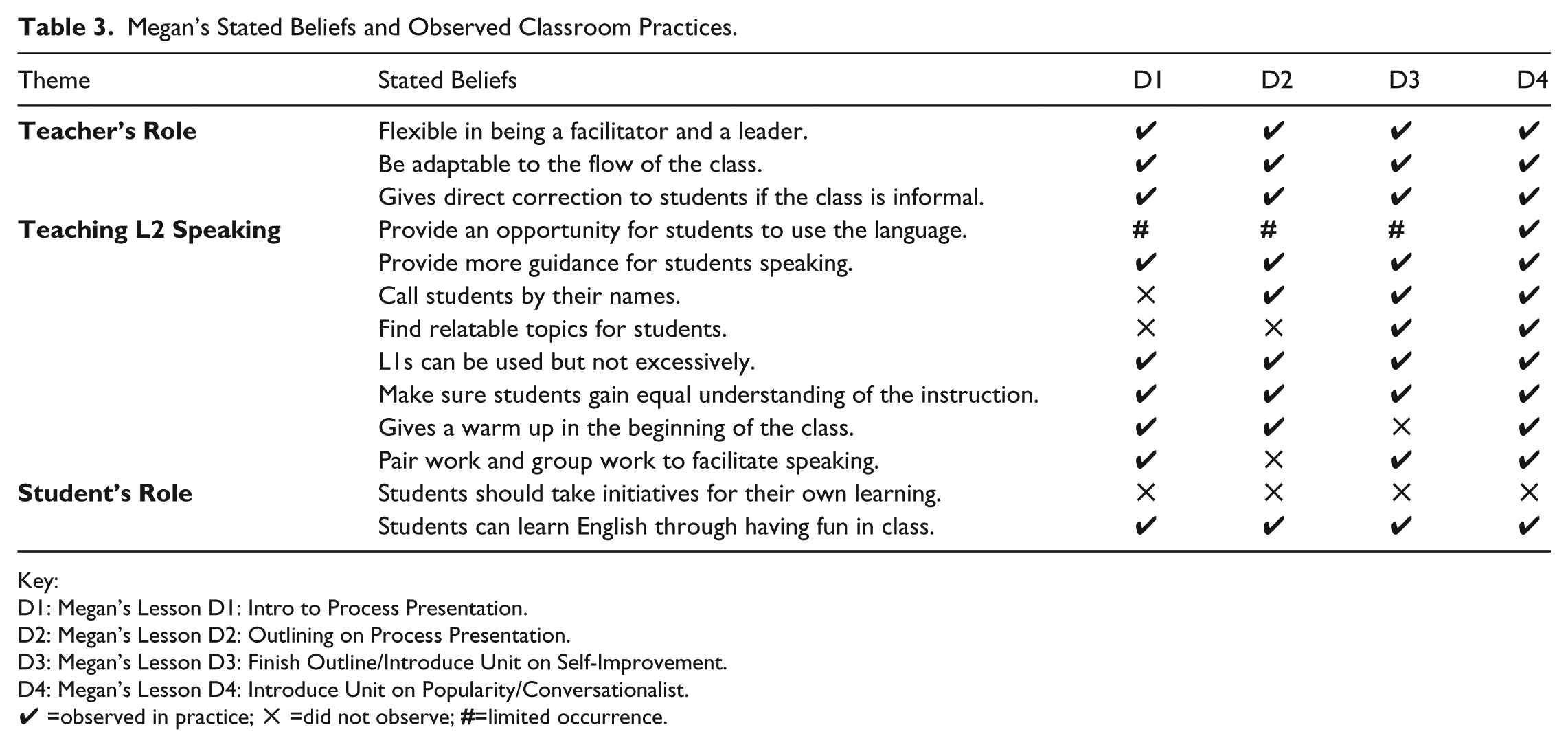
Table 3 outlines a comparison between Megan’s stated beliefs and her observed classroom practices.
Megan’s Stated Beliefs and Observed Classroom Practices.
Key:
D1: Megan’s Lesson D1: Intro to Process Presentation.
D2: Megan’s Lesson D2: Outlining on Process Presentation.
D3: Megan’s Lesson D3: Finish Outline/Introduce Unit on Self-Improvement.
D4: Megan’s Lesson D4: Introduce Unit on Popularity/Conversationalist.
Overall, as Table 3 indicates, Megan’s beliefs tended to converge with her observed classroom practices but there were still some instances where they diverged. In particular, Megan’s beliefs about the teacher’s role seem to show the strongest convergence with her classroom practices. Consistent with her stated beliefs that a teacher should not only be a leader but also a facilitator, Megan moved around the class and offered help to the students in all the observed lessons. Megan was also adaptable to the flow of the class. For example, in the third lesson, Megan provided students with an extra 15 minutes to finish up their homework because she found that many students still had not gained a full understanding of the instructions of the task. Further, there was a convergence in regard to error correction. Megan stated that she would give students direct correction if the class was informal. She provided direct correction explicitly either to students individually or to the whole class.
In terms of Megan’s beliefs about teaching L2 speaking, there was mainly convergence with her practices except for the limited occurrences observed where students were given opportunities to speak the L2 in the classroom although Megan had stated before that teachers need to provide opportunities for students to use the language. Megan also commented that she likes to start the class with some warm ups, either starting with a random conversation about their daily lives or a class discussion on a certain topic. She demonstrated this belief in the observed lessons through initiating a warm up question in the beginning of the class except in lesson 3, where she began the class by asking students to take out their homework. Students were divided either into pairs or small groups to complete certain tasks in the class.
Megan’s beliefs about the students’ role exhibited both convergence and divergence when compared to classroom practices. Although Megan remarked that she believed students should take initiative for their own learning, Megan was observed to initiate a lot of the learning in class and she asked most of the questions across all lessons, which indicates some divergence between her stated beliefs and classroom practices. Megan also expressed the belief that students can learn through having fun in the classroom. This was also observed in all the lessons as Megan incorporated humour in her teaching, and students were found to respond favourably to her use of humour in an interactive manner.
Discussion and Implications
The findings from this case study indicate that, for the most part, Megan’s beliefs converged with her actual instructional practices despite some instances of divergence. There were several possible reasons for these convergent and divergent patterns found in this case study.
There could be many possible reasons as to why Megan’s stated beliefs and classroom practices converged. First, Megan followed the order of the textbook when introducing new topics in the last two lessons, therefore textbook materials might be one of the factors that formed Megan’s beliefs. Second, Megan commented that she usually participates in discussions regarding the lesson plans and classroom practices with her colleagues; she remarked: ‘I always talk to people (colleagues) about how their lesson went compared to mine because if we plan a lesson together I like to see their feedback about things’. Thus, her beliefs about teaching L2 speaking might be still forming and continually be influenced by her discussions with her colleagues and thus were not fixed.
In addition to the external factors such as textbooks and conversing with other teachers, internal factors such as her prior experiences may also have contributed to her beliefs. During the final interview for example, Megan remarked that her beliefs are influenced by her past experiences of teaching and language learning experiences. Megan remarked: ‘I feel my past experiences for sure (teaching experience), and also when I think back to my language learning experiences (learning French as the L2), I know there are certain things I wish that I had been pushed more to do, so because of that I’m definitely more aware of what I’m doing in the classroom and trying to make certain changes for myself’.
Reasons for convergence were outlined above, however, some patterns of divergence were also observed. For example, Megan commented that students should take initiative for their own learning. This belief diverged from her classroom practices, as it was not observable in all lessons. As observed, Megan initiated most of the questions and responses during the class. However, the potential reason for this divergence might be due to the level of English proficiency of the students. Since the class was an elementary level speaking class, the students were probably not proficient enough to produce English sentences very fluently. Thus, Megan had to provide more teacher-guided support in order to enhance the students’ level of understanding and English comprehension.
Divergence between Megan’s stated beliefs and lesson planning were also revealed. For example, in the third lesson, Megan decided to provide students with an extra 15 minutes at the start of the class to finish their outlines, given that this information was absent in the lesson plan. Farrell (2015) describes the classroom as an environment where teachers make certain on-the-spot (reflection-in-action) instructional decisions in order to ensure a smooth continuous flow of the activities. This incidence also indicates that Megan underwent reflection-in-action because she perceived the need to change her plan for the lesson. Megan stated that she could not predict what to plan for the class. Megan stated: So I’m just gonna kind of see how it goes, and also if they’re really struggling with anything again, I might extend the due date of the outline, so you know, if I can see if they are really trying and they are just struggling with it, I’m not gonna hand it in tomorrow, if they need more time with me there then I rather give them that you know?
Therefore, the immediate context of teaching might be another possible reason for the divergence.
Another example of the divergence between Megan’s stated beliefs and the lesson plan was in relation to the syllabus provided by the school programme. Although Megan was mandated by the EAP programme to administer the process presentation in the first two lessons as indicated on the lesson plan, she stated that she found this project to be too challenging for students at this level and she stated that she believed the school could have provided more materials and support for the teachers. Megan expressed that the programme should provide enough support for the teachers in developing the classroom materials for the process presentations. Megan continued: Yeah, some sort of guidance (from the school), cause I’ve never done this type of presentation before. I need to think of how would I need this to be presented to myself, and so you know, it’s challenging to always trying to put yourself in their shoes and to think what’s the best way for them to understand this.
Megan also expressed that teachers had to prepare all lessons by themselves based on the subject areas mandated by the school programme. Therefore, although Megan carried out the process presentation in classroom practice, which was according to the syllabus provided by the school programme, a divergence between Megan’s stated beliefs and the lesson plan was found.
It should also be noted that sometimes as Senior (2006) has observed, language teachers may vary in the extent they can articulate their beliefs and we also observed some classroom practices that were not stated during the interviews. One in particular, that was observed but was not stated as a belief relating to a teacher’s role, was spelling corrections. This practice was observed when the students asked Megan the correct the spelling of a particular word while completing the tasks in class during the second and the third lessons. However, in those two lessons, Megan helped the students with spelling corrections only on a one-on-one basis. Extract 1 illustrates the way Megan repeated a student’s error with a different pronunciation and intonation to signal error location in the speaking class:
Extract 1.
Okay and the last one, Jeremy, can you read it for us?
Sincerity.
SinCErity
SinCErity
Yeah that’s good, that’s the intonation right?
SinCErity.
SinCerity. So what does it mean to be sincere?
Sincere?
Like honest okay? Genuine. Yeah who doesn’t lie, they are very true about themselves right? So how important is this?
Very important.
[Key: M= Megan; S1= Student; Ss= Students; (Capital Letters) = Stress emphasized.]
The information above discusses the areas where observed practices converged or diverged from stated beliefs with reference to factors that might influence a particular classroom practice in relation to teaching L2 speaking. With convergence, Megan formed her beliefs through textbook materials, talking to colleagues and prior experiences in teaching and learning, whereas with divergence, the contextual factors such as the programme’s expectations influenced Megan’s stated beliefs. Other observed practices that were not stated as beliefs were also perceived; these included pointing out students’ pronunciation and intonation errors, providing spelling corrections, and practising other language skills.
As the results of this case study suggest, generally language teachers do not consciously reflect on their beliefs about teaching speaking or other skills. This was also true for Megan who had never systematically reflected on her practice before. However, we maintain that it is important for teachers to be aware of their usually tacitly held beliefs and their impact on classroom practices because of the possibility of divergence between the two or unconscious adherence to a false perceived assumption; as Woods has cautioned, language teachers must be on guard against any claim of ‘allegiance to beliefs consistent with what they perceive as the current teaching paradigm rather than consistent with their unmonitored beliefs and their behaviour in class’ (Woods, 1996: 71).
Prior to participation in this study, Megan was not consciously aware of her beliefs about teaching L2 speaking and had difficulty articulating her beliefs when asked. In addition, she also had difficulty expressing her reasons for teaching in the manner she did. This finding shows the importance of providing opportunities for language teachers to be able to bring their beliefs to the level of awareness. We are not sure if Megan has overtly changed any of her beliefs and practices as a result of these reflections as this was the first time she articulated them and considered their importance to her as a language teacher and in particular when teaching L2 speaking. Now that Megan is more aware of the importance of articulating and reflecting on her beliefs, she can continue to examine and reflect on them more closely and observe if they were reflected in her classroom practices.
Since language teachers’ beliefs about successful teaching form the core of their teaching behaviour, the results of this case study have suggested that opportunities be provided for practising language teachers in preservice and inservice courses to articulate and reflect on their beliefs and classroom practices. By engaging in reflective practice teachers can construct and reconstruct their own beliefs and practices so that they can provide optimum learning conditions for their students. Farrell (2007; Farrell, 2015) suggests that language teachers should reflect on their teaching beliefs and classroom practices in order to increase their awareness about their practices as well as greater awareness of discrepancies between their stated and unstated beliefs and classroom practices. In particular, Farrell (2015) has developed a holistic reflective practice framework that EAP teachers can follow when reflecting on their work. The framework takes teachers through reflecting on their philosophy, principles, theory, practice and beyond practice.
In addition, the methodology of this case study can be replicated by other teachers who are interested in reflecting on their beliefs and practices.
We realize that although generalizations from this one case study may be difficult to make or even not considered feasible, language teachers can nevertheless learn about the importance and method of comparing their own beliefs with their practices through such reflection. Consequently, rather than working to generalize, following the work of Richards (2011: 216), we suggest that this case might generate ‘illustrative outcomes’ (drawing strength from ‘the rich particularity’ of this individual case).
Conclusion
This exploratory case study investigated the stated beliefs and actual instructional practices in relation to teaching L2 speaking of an EAP teacher. Although the research findings suggest that, generally, there was convergence between the EAP teacher’s beliefs and practices with regards to teaching L2 speaking, there were still some instances of divergence. In particular, the study illustrates the manner in which the teacher’s instructional decisions in teaching L2 speaking were shaped by the interaction of her teaching and learning experiences, and the teaching context. We believe the divergence noticed was because of the teacher’s need to make certain classroom decisions based on the realities of the lesson in order to maintain a continuous instructional flow of the class. The purpose of this exploratory study was not to examine the best teaching practices but to articulate and reflect on a teacher’s beliefs and classroom practices. By engaging in such reflection EAP teachers can construct and reconstruct their own beliefs and practices so that they can provide optimum learning conditions for their students.
Footnotes
Funding
The author(s) received no financial support for the research, authorship, and/or publication of this article.