



Abstract
This article introduces Peer Review Circles (PRC), a classroom task that fully engages learners in the peer review process. The authors had observed their undergraduate students were reluctant to do peer review and even more reluctant to use the comments received. To improve the peer review process, the authors decided to change it into a multi-party oral, opinion gap task. Mimicking literature circles, we put students into teams of three and asked them to follow an expanding sequence of Monologue-Dialogue- Discussion (MDD) to discuss each essay. First, one reviewer gave a brief monologue about the writing, then another reviewer joined in and they had a dialogue about the writing while the writer remained silent. Finally, only after listening to the monologue and dialogue could the writer enter the discussion to ask the reviewers about what was said, get further feedback, or explain themselves more fully. This article first explains how to run a PRC and then justifies doing PRCs by using classroom data that demonstrates how interaction during the MDD sequence refines peer feedback from vague/general to specific/detailed and encourages peer review.
The Teaching Context
Many textbooks include peer-review checklists or sets of questions to be completed by the reviewer and discussed with the writer, typically through pair work. However, our experience teaching South Korean university undergraduates had shown that most students disliked peer review, ignored peer comments, and valued feedback only from their instructor. Students complained that peers often only complimented their writing and gave vague or little feedback. Yu and Hu (2017: 32) had a similar complaint with their observation of a student named Leo who held back negative opinions about content and language out of consideration for his partner’s feelings. Unlike Leo, who withheld his criticism to maintain group harmony, our students replaced criticism with praise to maintain harmony. This may have smoothed the discussion but was privately disliked. One complained, ‘I just exchanged papers with others and they wrote good things…[that] did not help me to fix my research paper’ (student end-of-semester survey response). We also observed limited discussion of the reviewer’s comments. After returning the reviewed papers, our students would quickly skim the commentary and then wait silently for the teacher to end the activity or talk to each other in L1 on other topics.
Feeling that discussion is an essential element of both peer review and language learning (Swain, 2010) and that reviewing another’s draft would improve their own writing (Lundstrom and Baker, 2009), we determined to upgrade our peer review process. Using Literature Circles (Daniels, 1994) as our model and Rollinson (2005) as a guide, we designed an interactive peer review activity which required interaction and collaborative discussion. We call this approach ‘Peer Review Circles’ (PRC).
The Innovation: Peer Review Circles
Briefly, a Peer Review Circle (PRC) is an opinion-gap, pedagogical task (Ellis, 2003). Students are divided into small groups. We made triads: Writer (W), Main Reviewer (MR), and Secondary Reviewer (SR). Each member gives a copy of their draft to the other members. Everyone reads everyone else’s writing. The MR also answers a set of questions on a feedback question sheet (FQS) about the work. The MR starts the discussion with a 2-minute monologue about the essay they just read.
Rollinson writes, ‘Oral feedback may usefully involve reader discussion preceding the reader-writer conference’ (2005: 29). Following his idea, we included an opening monologue to promote discussion. We asked the MR to speak to another reader to mitigate threats to the W’s face and the 2-minute minimum time ensured enough was said to give the others something to respond to (similar to Yu and Hu, 2017: 32 mentioning a 30-word minimum response). Therefore, the MR starts the discussion while the other group members remain silent. Then, the SR and MR jointly discuss both the essay and the MR’s feedback while the W remains silent. The MR-SR dialogue gives both reviewers a chance to clarify their ideas so the W receives jointly-negotiated feedback, not just one reader’s opinion. It also gives the MR input on the feedback they have given: the SR may disagree, offer alternatives, agree, or contribute something the MR had not considered. The W remains silent and may take notes if desired. After five minutes, the W joins the discussion to answer any concerns, give explanations, or ask for feedback on something not yet covered. The whole process is repeated until all essays have been reviewed.
Unlike what is usually included in many EFL writing textbooks – a set of questions to answer privately and return to the writer – the PRC is a group process of public discussion of each writer’s writing. It requires students to publicly explain to others what they think – thereby engaging linguistic, discourse, and socio-pragmatic knowledge. By requiring public talk about a peer’s writing, a communicative event is created in which the speaker (MR) makes and justifies claims, and the listeners (W and SR) then evaluate, accept, challenge, or collaborate to improve the writing and the feedback. By providing both an audience for the writing and for the evaluation of the writing, we encourage learners to make a robust effort at providing feedback. For two semesters, we used PRCs in our writing classes. We recorded students’ PRC talk, observed their discussions, asked students to reflect on and critique the PRC, and we then adapted the PRC to resolve their concerns. The next section explains the process of doing this ‘revised’ PRC.
Peer Review Circles: Setting Up and Running
The PRC is a sequence of: (1) setting up the class and assigning roles, (2) reading another’s work and analysing it, (3) performing three monologue-dialogue-discussion (MDD) cycles, and (4) reflecting.
Stage 1: Setting Up the Class
Before class, students write a draft of their assignment and print two copies. They also print one set of peer review feedback questions (FQS) – a set of questions from which the writer selects questions they want the reviewers to answer, for example: ‘Does the title get your attention?’ and ‘How does the writer prove their ideas?’
In class, the students are divided into groups. We chose triads as our standard arrangement, but in even-numbered classes, using groups of four students is possible, but the teacher must adjust the timing of stages 2 and 3 (below).
We divided students randomly, but teachers may wish to consider, at least for their initial PRC, placing students into groups based on proficiency level. It has been reported that exposure to excellent peers’ work might sometimes demotivate weaker students (Rogers and Feller, 2016), and we found that occasionally more proficient students were not satisfied with their partners’ feedback – particularly the first time a class did a PRC.
Once groups are made, students are assigned roles: A, B, and C. The teacher then tells the students to re-read the FQS and select the questions they want the reviewer to answer. Students were encouraged to write additional questions if they wanted feedback on aspects of their writing that the FQS did not address. 1
Then, student A passes one draft copy to student B and C respectively, and the FQS to student B only. Similarly, student B passes essay drafts to C and A, and the FQS to C only; student C gives drafts to A and B, and the FQS goes to A only. Each student will therefore have a turn to be the writer (W), main reviewer (MR), and secondary reviewer (SR) during the PRC task. The roles change each time a different essay is reviewed.
Stage 2: Reading and Analysing (15 min)
Once the drafts and FQS have been passed to the designated students, all students read all the drafts and plan the feedback to be given to the writer. Each student reviews two essays and answers one writer’s selected question(s) for one essay.
Stage 3: Monologue-dialogue-discussion (MDD) Cycles (12 minutes each)
MDD cycles are the heart of the PRC task. When students are in triads, there are three cycles (one for each student’s essay) 2 with three steps per cycle. In the first cycle, student A is the writer (W), student B is the main reviewer (MR), and student C is the secondary reviewer (SR).
M: Main Reviewer’s (MR’s) Monologue (2 min)
To start the PRC, the MR faces the SR and speaks without interruption for two minutes. In the monologue (M), the MR gives feedback first on the specific FQS questions which the writer (W) had put forward to be answered and adds further feedback about the writing until two minutes have elapsed. To avoid minimal contributions, such as ‘It’s good’, the MR is required to keep speaking until the two minutes are exhausted. The other two students remain silent 3 (See Figure 1).
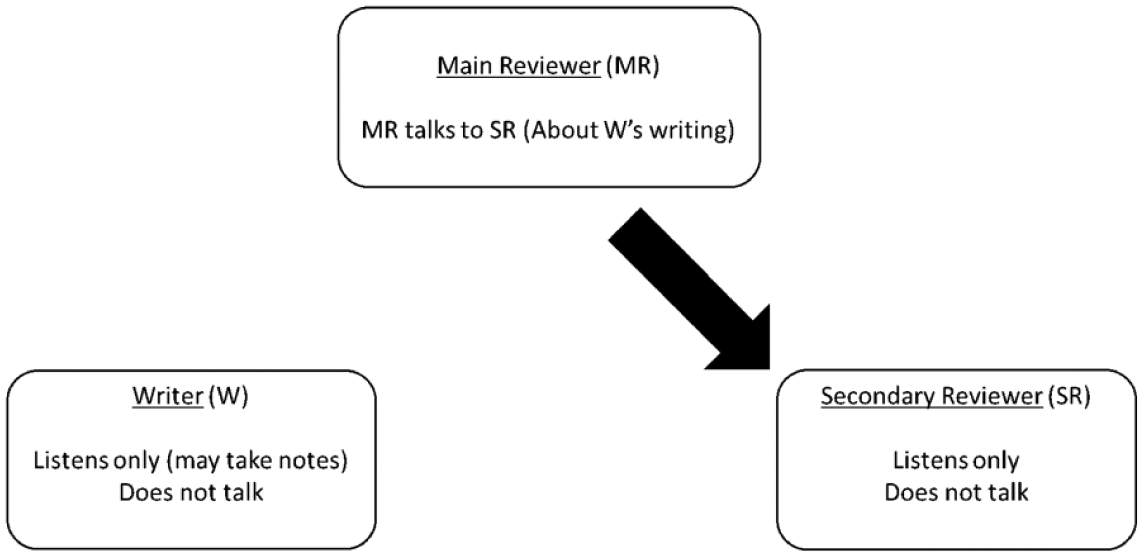
MDD cycle, step 1: main reviewer’s monologue.
D: ‘Reviewers’ Dialogue’ between MR and SR (5 min)
The monologue provides the basis for the Reviewers’ Dialogue. The dialogue is a question-answer session between the two reviewers, while the writer (W) continues to remain silent. The SR comments on what the MR said and adds feedback on the essay. The MR and SR make suggestions to improve the writing, attempt to clarify parts they did not understand, and try to determine the writer’s intentions. The two reviewers keep talking until the time limit is reached. The reason for keeping the writers silent for two steps is to give them a feeling for how others understand and relate to their work – i.e. a notion of any difference between their intentions versus their audience’s potential interpretation (See Figure 2).
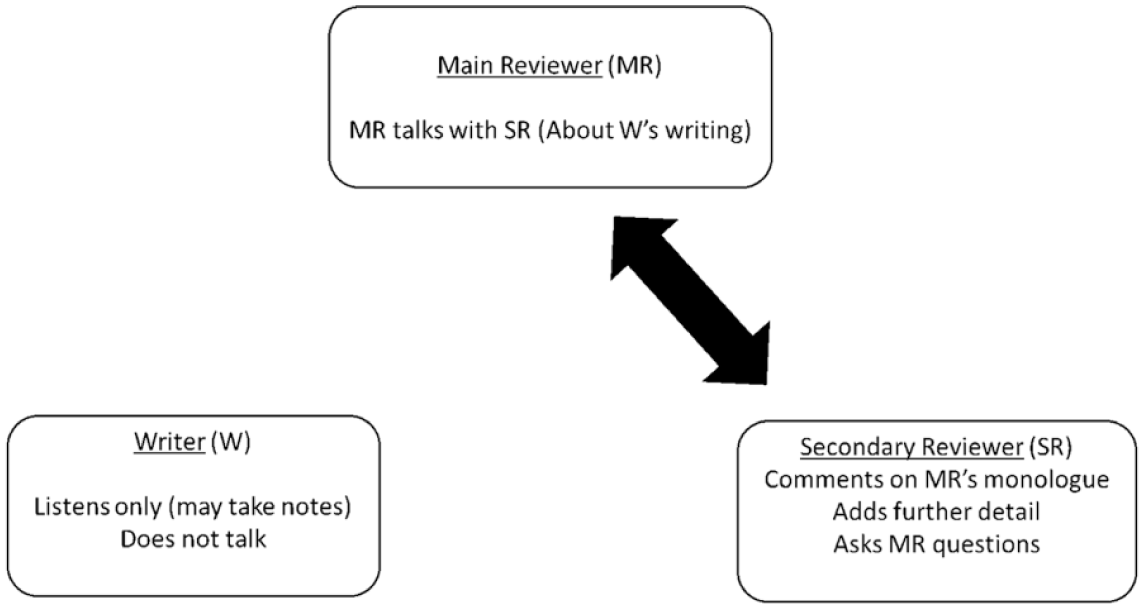
MDD cycle, step 2: main and secondary reviewers’ dialogue about the writing.
D: ‘Discussion with the Writer’ – W and MR and SR Talk (5 min)
Now, the W joins the conversation. The W may clarify issues the others had with the writing, ask further questions, request feedback on other points, or collaborate with the reviewers to rephrase problematic parts (See Figure 3). After time expires, students switch roles and briefly skim the next essay (2 minutes) before starting a new MDD cycle.
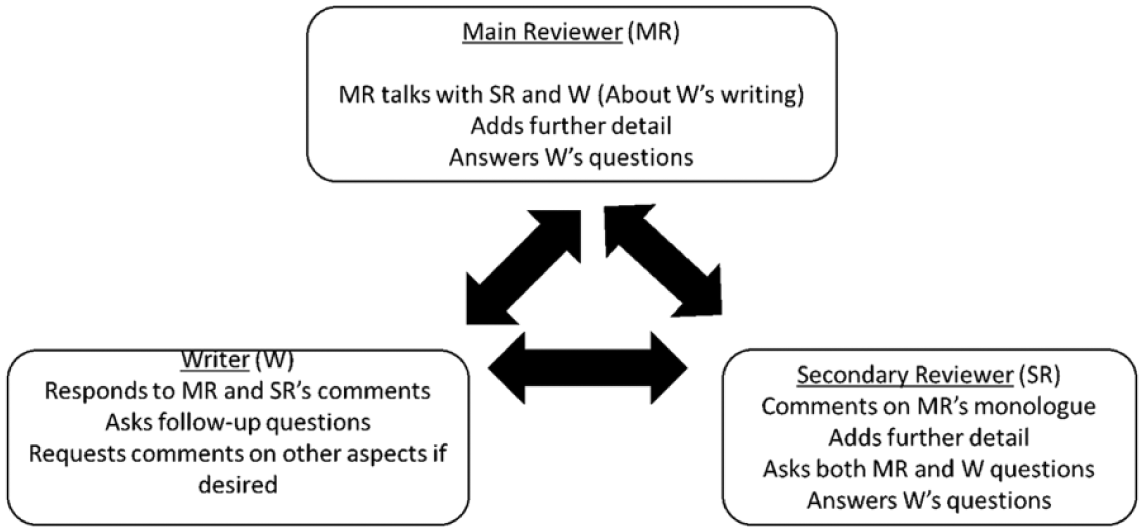
MDD cycle step 3: writer joins the discussion.
Stage 4: Reflection
The PRC also has two reflection stages: immediate and delayed.
Immediate, Personal Reflection
After the final MDD Cycle, students write in their notebooks for five minutes. They write about anything they learned in the PRC, their feelings about the PRC, or what they need to do to revise their essay. This reflection was not collected.
Delayed, Public Reflection
One week after the PRC, when final essays were submitted, students also gave a 100-word answer to each of the following questions. The questions in parentheses ( ) are for later PRCs.
Think about your peer feedback circle. What helped you the most (this time)?
Think about your peer feedback circle. What helped you the least (this time)?
(Did you do your PRC differently this time? In what way?) What will you do differently the next time you do peer review?
How else did you get feedback on this essay before you submitted it? How was this feedback different from your peer review circle (PRC)? Was it more or less helpful? Explain.
Reflection is an often-overlooked activity, but we included it because reflection is a form of communication between student and teacher and also aids in strategic thinking. Student reflective feedback directly led to improving the PRC, including having the W select the FQS questions for the MR to address and reviewing the next essay for 2 minutes after each MDD cycle.
An Example: The Discursive Development of a Thesis Statement in PRC Talk
This section outlines a single case of how PRC talk led to a more precise thesis statement in the final draft of a student-writer’s essay. Three students, Julie, Joseph, and Jean (pseudonyms) performed a PRC on an essay Jean had written (W). Julie is the MR and Joseph is the SR.
The PRC began with the main reviewer’s (i.e. Julie’s) monologue. During the monologue, she said:
(1) ‘it was kind of hard to know the three things in the thesis statement so I could notice two things which was [A] and [B] but the first one it was kind of, I think vague in a way, because it just said that um you have to consider the current situation of international marriage and I think that’s kind of not specific information…’
Julie’s mentioning of ‘three things’ is referring to the course instruction 4 that thesis statements should contain: the topic, the writer’s claim about the topic, and a three-part writing plan that outlines the subtopics to be covered in the essay. Julie has noted two problems with the draft’s thesis statement: there are only two elements, and the first element is vague. However. Julie does not offer any advice on how to remedy the situation.
The next step in the MDD cycle is a dialogue between the MR and SR while the W listens. Joseph begins the dialogue with:
(2) ‘I also agree with you [Julie] that it is hard to find a writing plan in the thesis statement.’
This aligns with Julie’s comment. Yet, in the spirit of a collaborative reviewer, he continues the line of discussion to include specific help to the writer, who he knows is listening.
(3) ‘I tried to find out the stuffs that were discussed in the body paragraphs… first was the procedures of a marriage takes place. The second was the problems of some deceptive matchmakers, and third was the support for the foreign women.’
Joseph has identified the topical content of Jean’s essay’s body paragraphs and is using it to offer a potential three-part writing plan for her thesis statement. Julie acknowledges this with a brief, ‘Yeah.’
Joseph’s advice is a suggestion and Jean, as writer, has the option to accept or reject it. She both uses and improves it. Her final thesis statement contained a clear writing plan (underlined in [4]) to help her readers follow her argument:
(4) ‘Since international marriage has become an unavoidable trend, it is necessary to think about why some international marriages failed:
Jean has changed the wording and the order of the subtopics. ‘Expense’ specifies the key part of the ‘procedures of a marriage’ Joseph stated in (3). The final two subtopics have been switched in order to reflect Jean’s focus. The term ‘economic debt’ specifies why foreign women need support, and what Jean had considered the biggest problem: ‘deceptive matchmaking agencies’, has been moved to the end of the thesis statement.
Although the initial monologue did not proffer specific advice, it prompted a dialogue in which the SR clarified the MR’s observations while the W could not interrupt. This change in discussion dynamics allowed time and space for the review to be refined. Although the W did not comment on the thesis during the discussion, preferring to discuss other things, her final version shows she heard the advice and adjusted it to accommodate her views. Thus, by expanding peer review from one reviewer to two, requiring dialogue in the review, and requiring the writer to listen first before responding, feedback is honed, resulting in appropriate, actionable feedback on the writer’s work.
Reflection and Future Directions
This article has outlined an interactive task that encourages communication about the quality and effectiveness of another student’s writing. We feel that it has improved our students’ writing and that students have become more interested in getting feedback in general – evidenced by more student visits to our offices and by self-reported showing of their essays to friends or family members before submission, two rare events in classes without PRCs. These anecdotal observations should be verified by further research.
In the rare event that a student arrived at the PRC without their draft, we provided a sample, or placed them in a group as a reader only. They then gave feedback but could not receive any. For lower proficiency learners, the writing assignment would necessarily be shorter, and PRCs can be adapted through simpler questions, or allowing more reading time.
It may appear that the PRC is overly structured yet, the Monologue-Dialogue-Discussion format allows feedback to evolve from a vague concept to a specific fix through talk. The public nature of the MDD cycle pushed students to perform up to expectations set by their peers (cf. Willis and Willis, 2007). It allowed multiple iterations of new language; practise in turn-taking; and many opportunities to express, clarify and defend opinions about content and language – all activities relevant to learning language and improving writing. Performance expectations were explicated in students’ reflections. Early-semester PRC reflections contained student complaints about compliments and vague feedback along with promises not to do this. Later PRC reflections had no such complaints. Recordings of PRC talk revealed that talking about the writing allowed the two reviewers to give more precise comments (Extracts 1 and 3) to the writer, and to avoid the pitfalls we noticed in one-to-one peer review activities: simple compliments, vague feedback, and limited discussion. Finally, several students reported it was ‘less stressful’ to listen to others discuss their work than to be told directly. We feel that by creating an activity requiring phases of public talk and roles for each person in each phase (the PRC) we encouraged students to create a classroom culture which valued peer review.
Footnotes
Funding
The author(s) disclosed receipt of the following financial support for the research, authorship, and/or publication of this article: This research has been supported by the Hankuk University of Foreign Studies Research Fund of 2018.