



Abstract
In response to the increase in demand for teachers of English in Thailand, many Filipino teachers are now working as English as a Foreign Language (EFL) teachers in Bangkok. This study explores the perceptions of 56 Filipino teachers about the conditions and challenges of being EFL teachers in Bangkok, Thailand. A modified questionnaire and an individual follow-up interview were used to collect the data. Likewise, a qualitative content analysis was performed on the data in the study. Findings revealed that teacher-participants held a positive view with regards to being EFL teachers in Bangkok. Some reasons why they came to teach in Bangkok include good salary rates, a chance to provide for their families’ financial needs, an opportunity to widen their teaching experience, and a chance to work with people from different cultural backgrounds. However, some professional and personal issues like the perceived lack of teachers’ professional development programmes, cultural differences, language barriers, and absence from family celebrations and other important occasions were also noted. The findings suggest that although the experience was generally positive, Filipino teachers encountered some personal and professional issues, including those which stemmed from their status as so-called ‘non-native speaker teachers’ (NNEST) of English.
Introduction
With the Association of South East Asian Nations (ASEAN) economic integration taking place among its member states, the demand for learning and improving English has considerably increased (Baker, 2012; Crocco and Bunwirat, 2014; Kirkpatrick, 2011; Loo et al., 2019). Although the countries in the region represent different linguistic backgrounds (Kirkpatrick, 2011), the English language has become a lingua franca and is now given emphasis in the school curriculum from elementary to tertiary education. Since Thailand has a low level of English compared to other ASEAN countries (Hickey, 2014), it is currently working to improve the English language skills of students through the expansion of its language education and bilingual programmes (Tanielian, 2014).
The demand for English has prompted some education institutions in the ASEAN region generally and in Thailand specifically to employ foreigners who speak English to teach English. In Thailand, many public and private schools in the country hire foreign English teachers (Hickey, 2014) with a preference for teachers from traditional English-speaking countries such as the United Kingdom, United States, Canada, Australia and New Zealand, often described in the literature as ‘native English speaker teachers’ (NESTs). Nevertheless, there are an increasing number of teachers of English from the Philippines teaching EFL in Bangkok. Some of the issues faced by Filipino teachers include the perceived dichotomy between native English speaker-teachers (NESTs) and nonnative English speaker-teachers (NNESTs) (Farrell, 2015; Yuan, 2019), differences in compensation, where NESTs are paid more than their counterparts (Hickey, 2014; Frederiksen, 2014); students’ preference for the NESTs over the NNESTs (Songsirisak, 2015); homesickness; language barriers (Frederiksen, 2014); and workplace discrimination (Hickey, 2014). Thus, the purpose of this article is to explore the experiences, conditions, and challenges of Filipino EFL teachers in Bangkok. Exploring these issues may be helpful for other transnational teachers as well as for all education institutions in reviewing and formulating teacher recruitment and retention policies.
Before proceeding, a word about terminology is needed. Generally, in the field of TESOL, there are two main types of teachers: native speaker teachers of English (NESTs) and non-native speaker teachers of English (NNESTs) (Farrell 2016). Although the labelling of English teachers in this way is highly problematic and inappropriate (Reis, 2011), the use of the terms ‘NESTs’ and ‘NNESTs’ has been firmly established in the literature (see, for example, Kubota and Lin, 2006; Mahboob, 2010; Medgyes, 1992; Merino, 2006; Walkinshaw and Duong, 2012). Thus, for conciseness and clarity, these terms will be employed in the present study but mainly as tools for analysing and problematizing the status and experiences of teachers from a range of backgrounds. However, the use of these terms and the purpose of the study are not to emphasize the distinction between NESTs and NNESTs or to elevate one over the other but to describe the experience of Filipino teachers teaching English in Bangkok, Thailand.
Literature Review
In the field of English language teaching (ELT), although there is no clear conclusion as to what constitutes the ‘ideal’ teacher, the dichotomy between NESTs versus NNESTs has been discussed extensively by many scholars (Kubota and Lin, 2006; Mahboob, 2010; Medgyes, 1992; Merino, 2006; Walkinshaw and Duong, 2012). Merino (2006) argued that the effectiveness and the success of English language teaching depended not on whether the teacher is a NEST or NNEST but on the particular teaching context. For example, NESTs and NNESTs alike may be less effective if teaching a topic they are unfamiliar with. Medgyes (1992) asserted that all English teachers can become equally good and effective teachers depending on certain linguistic and cultural factors. Methanonppkakhun and Deocampo (2016) emphasize that NEST teachers are not the only ones who should be given the privilege of teaching English. Authors, such as Merino (2006), Medgyes (1992), and Yeo et al. (2017) have emphasized that teachers should not be judged on factors such as language background, ethnicity or race, citizenship, educational level or socio-economic status but on the relevant training, qualifications and experience they have as teachers of English.
NNESTs now outnumber NESTs in the field of English language teaching (Floris, 2013; Mahboob, 2010). There are more NNESTs teaching English in some parts of Asia, especially in the ASEAN region (Waterworth, 2016). Nevertheless, hiring practices have remained an issue as schools and other educational institutions generally prefer to hire NESTs. Although this practice has been criticized widely (Kubota and Lin, 2006; Mahboob, 2010; Medgyes, 1992; Merino, 2006; Walkinshaw and Duong, 2012), the preference for NESTs by some schools across the world is still prevalent, with the skin colour of a person influencing hiring decisions, that is, with native speakers associated with being white and non-native speakers as non-white (Kubota and Lin, 2006). This practice clearly suggests an ongoing undervaluing of the status of the NNESTs who, despite the equal qualifications and professional status with the NESTs (Mahboob, 2010), are still disadvantaged in the field of English language teaching.
In the context of Thailand, in order to address the problem of Thai students’ low English proficiency, the government through its Ministry of Education allows all schools across levels in the country to employ foreign English teachers. The Ministry believes that by employing foreign English teachers, the standard of English in the country will be improved (Methanonppkakhun and Deocampo, 2016). Although there is no official policy guiding the hiring of foreign teachers of English in most schools across year levels, it has been noted that NESTs are preferred over the NNESTs (Choklap, 2015; Songsirisak, 2015; Todd and Pojanapunyal, 2009) as NESTs are considered to be good models of the language and are believed to have more linguistic and cultural knowledge than the NNESTs (Matsuda, 2018). However, Methanonppkakhun and Deocampo (2016) emphasize that NESTs are not the only ones who should be given the privilege of teaching English as, with the right qualifications, teachers from countries neighbouring Thailand, such as those in ASEAN, can also be effective English language teachers.
Although there are only a few studies that explore ASEAN nationals as English teachers teaching in the ASEAN region, two of the more relevant and recent studies were done by Waterworth (2016) and Kobayashi (2017). Waterworth (2016), in his study on the experiences and perceptions of 28 English teachers from eight out of 10 ASEAN nations with regards to language teaching in their country, reported that teachers shared the same opinions of the importance of having quality English language teaching programmes. However, it was also revealed that most of these teachers faced a number of issues in language teaching. Among these issues were the lack of teaching resources, lack of support for quality English teaching, big class sizes, and teachers’ low levels of English proficiency. While Waterworth (2016) revealed from his study that the goal of English language learning is the ability of the students to speak with native speaker accuracy, Kobayashi (2017) noted otherwise. In her study on ASEAN English teachers as models for international English learners, Kobayashi’s (2017) participants, who were Malaysian ESL professionals, asserted that they did not have to speak like a native English speaker. Their common goal was to speak the English language clearly, accurately, and correctly. Although the participants acknowledged that they were not native English speaker-teachers, they felt that it did not disqualify them as English language teachers. Being qualified and trained TESL professionals was more important than having to speak like a native English speaker.
Other studies that concentrated on foreign English teachers’ teaching experience abroad were conducted by Frederiksen (2014) and Choklap (2015). While Frederiksen’s (2014) study was on the same topic as Choklap, she focussed only on Filipinos as EFL teachers working abroad. With interviews as her primary research method, she found that the primary role of Filipino teachers was to teach communication and literacy skills. She also revealed that Filipino teachers chose to work abroad because of better salary rates and a good working environment. However, none of these Filipino teachers were teaching in Bangkok. On the other hand, Choklap’s (2015) study was focussed on the teaching experiences of four NESTs in Thailand. The findings revealed that although the participants perceived teaching English as a valuable means of learning and teaching, they also pointed out some challenges and problems. Among these were mismatches of cultural expectations and needs, lack of career choice, and heavy teaching loads.
Lastly, while many of the studies mentioned above have dealt with some issues relating to the present study, namely the experience of ASEAN nationals as English teachers teaching in the ASEAN region, neither the study of Waterworth (2016) nor Kobayashi (2017) stated whether Filipinos were part of their studies. Neither did they address teachers’ perceptions of the benefits they experience from teaching. Identifying the benefits and perceptions of Filipinos who are teaching English as a foreign language in Bangkok is necessary in order to understand their identities as English language teachers. Building on these previous studies, this research intends to augment our understanding of the perceptions of Filipino teachers of English in Bangkok by responding to the following questions:
What are the perceptions of the Filipino English teachers of English as a foreign language (EFL) in Bangkok?
What are the challenges and issues encountered by these Filipino English teachers?
Methodology
Context and Respondents
This study was carried out in Bangkok, Thailand, where a large number of Filipino teachers are teaching in private and public schools. Through the researcher’s visit to schools, these teachers were identified and asked if they would be willing to take part in a research study. They were informed about the study and its objectives. Furthermore, it was emphasized that their participation was voluntary and all the data gathered would be treated with utmost confidentiality.
There were 78 full-time Filipino teachers from 11 schools who agreed to participate in the study, but only 56 teachers (34 males and 22 females) returned the answered questionnaire, and 11 of them agreed to be interviewed. These teachers were aged 22–46 and had a span of 10 months to 18 years of teaching experience both in the Philippines and in Thailand. Forty-eight of these teachers held Bachelor’s degrees in English and in Education, while eight were Master of Arts or Master of Science degree holders. Moreover, 27 teachers were teaching in secondary schools, 14 in elementary, ten in kindergarten, and five in colleges and universities.
Data Gathering Procedure
Before beginning the data collection, an informal pilot interview was conducted with three teachers at a local school for feedback on the instruments and research questions. This data was not included in the study. The respondents suggested that the questionnaire be made available online. From eleven local schools, 78 Filipino teachers were sent a letter explaining the study and requesting participation. Following this, the survey which was written in English, was uploaded to surveymonkey.com. The link to the questionnaire online was then individually forwarded to 78 teachers. Of these, questionnaires were returned by 56. It is noted that there are variations in gender (34 males and 22 females), age (22–46 years), type of school setting (kindergarten through university), years of experience as teachers (under two years to more than 18 years), teaching status (full-time and part-time), education level (48 held bachelor’s degrees, eight held master’s degrees) and in the number of teachers in any given school (ranging from 32 in one school to only one or two in several other schools). Lastly, follow-up individual interviews with 11 teachers were done in person and through Facebook chats. The interview concentrated on some items in the questionnaire that identified the teachers’ perceptions of teaching English in Bangkok, their challenges, and their working conditions.
Research Tools
An English-language questionnaire was modified and adapted from Frederiksen (2014) which focussed on perceptions of foreign teachers regarding teaching in other countries. Some questions were modified for relevancy. Part 1 of the questionnaire dealt with agreeing or disagreeing with a series of statements on reasons for teaching in Bangkok, perceptions of the school environment and the support staff, and the job offer or contract. Part 2 focussed on challenges faced by Filipino English teachers in Bangkok. The questionnaire was posted on surveymonkey.com, an online survey channel where respondents preferred to answer the survey questions. The interview, on the other hand, was centred on the respondents’ English teaching conditions in Bangkok, including the issues, challenges, and problems.
Data Analysis
All the data in the study was subjected to a qualitative content analysis. The analysis of the survey questionnaire was done through the use of frequency count of strongly agree, somewhat agree, neutral, somewhat disagree, and strongly disagree. Likewise, the data from the interview were coded and grouped in relation to the research questions posted in this study.
Findings
Reasons for Teaching in Bangkok
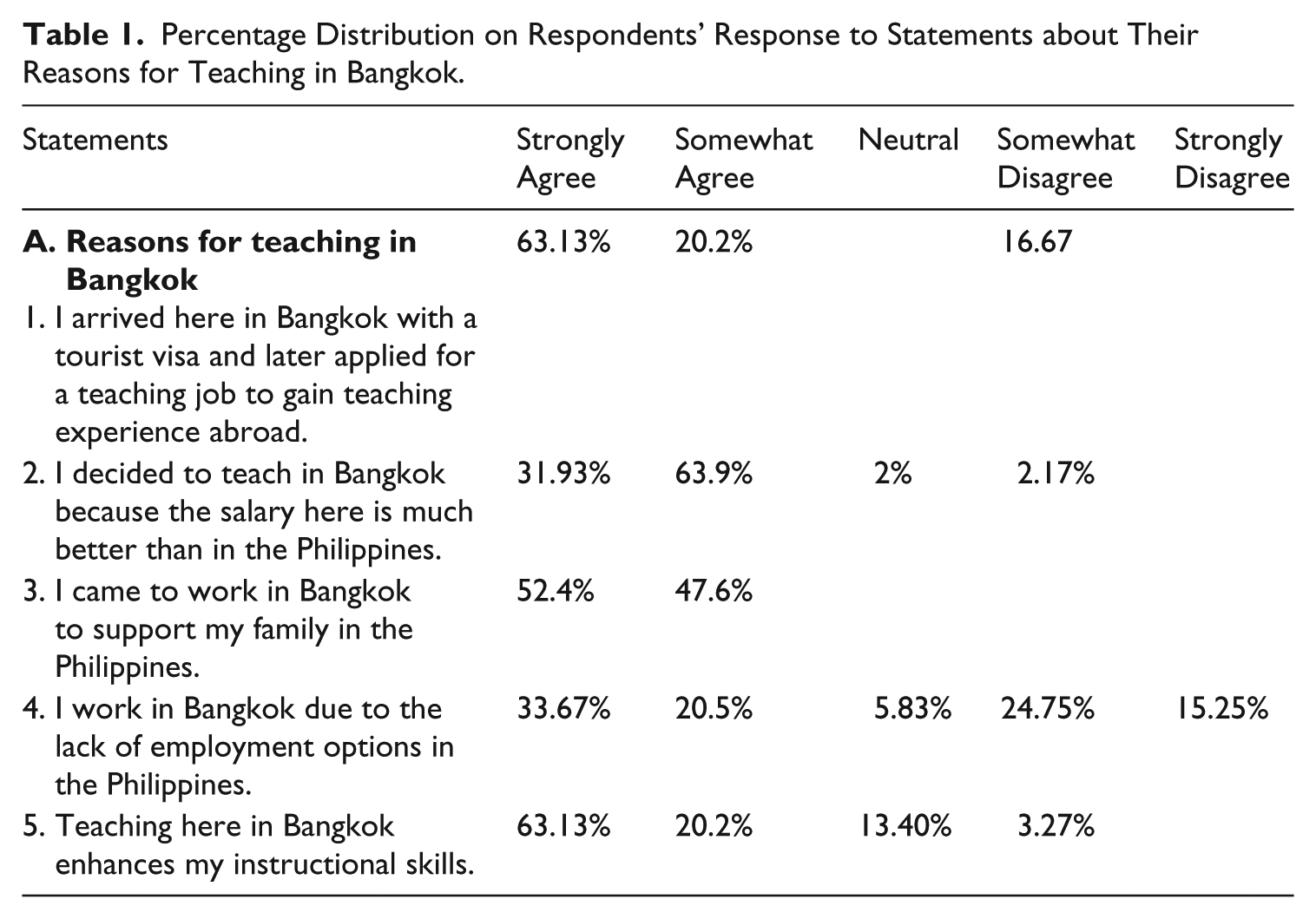
Part 1 looked at the reasons for teaching in Bangkok, perceptions of the school environment and the support staff, and the job offer or contract. The reasons are reported in Table 1. The results show most of the respondents relocated to teach in Bangkok to support their families back in the Philippines. The respondents believe the Philippines is suffering from a lack of employment options. In the interview, two teachers commented as follows: Personally, I decided to come to Bangkok and apply for a teaching job because I want to provide for the needs of my family. I am a breadwinner and my teaching job salary in the Philippines is not enough to cover all the expenses. I also believed that having a teaching experience abroad will open new opportunities for me and for my teaching career. (Teacher 4) My main reason why I chose to teach in Bangkok is the salary and the opportunity to experience different classroom and teach different students. I admit that the salary here is much better than in the Philippines; however, I also value the experience of teaching students from other countries. (Teacher 8)
Percentage Distribution on Respondents’ Response to Statements about Their Reasons for Teaching in Bangkok.
Perceptions of School Environment and Support Staff
Participants were also asked about the school environment and the support staff. Data in Table 2 shows the majority (75%) of the respondents indicated that the schools provided them with teaching materials to use in class and that their Thai teacher counterparts helped and supported them in their classroom teaching (78%). However, with regards to opportunities for teacher training or professional development, 60% of the respondents reported that they were not aware of these. It may be that opportunities existed but were advertised in the local language.
Percentage Distribution on Respondents’ Response to Statements about Their School Environment and the Support Staff.

In the interviews conducted, teachers made these comments: I am happy that in my workplace, all the staff, local teachers, and the administration treat us all fairly and equally. My co-teacher is so kind that she always sees to it that everything in my classroom is ready before I teach. She even assists me in dealing with the students. (Teacher 5) Overall, I can say that teaching in Bangkok is better than in the Philippines because everything here is provided. When I say everything, I mean all the teaching materials that I use in my classroom teaching: from textbook, board marker, class records, and even technology are all provided. (Teacher 6) Although we are provided with teaching materials, I would like to be afforded with teacher training and other professional development programme so that I will grow also as a teacher and for me to be able to apply the skills to my classroom teaching. (Teacher 7)
It should also be noted that a majority of the respondents (70.83%) stated that they did not feel any discrimination in any form in their school. Yet 78% of the participants said that the salary they received was lower than the NESTs in their schools. Interestingly, the respondents did not think this was a form of discrimination.
Definitely, I do not see it as a problem receiving lower salary rates than the NESTs. First of all, I come to teach in Bangkok because I find the salary here much better and higher than what I received in the Philippines. I did not come here to compare my salary with other people. I am just very thankful that I was given the opportunity to work here. (Teacher 5)
Thai Students and Their English Classroom
In commenting about their students and teaching, as the data in Table 3 shows, nearly all of the respondents have had a positive experience thus far as an EFL teacher in Bangkok. However, there was a 50% split in opinion as to whether their students would like them to have a native-like accent to teach EFL. Nonetheless, teachers still felt respected by their students, although respect does not mean preference as students may respect these teachers but prefer NESTs. However, all of the respondents expressed confidence in teaching English to Thai students. Furthermore, teachers employed interactive activities, games, and other student-centred activities to make their English classrooms fun places to learn English. According to them: Honestly, I do not have problem dealing with my students (thanks to my co-Thai teacher). I mean, my students are so respectful even if I am a foreigner here. (Teacher 9) In my classroom, I do a lot of games and activities related to my lessons to keep my students motivated to attend my class. Even if some of my students can hardly understand English, but I can see that they are enjoying my class. (Teacher 10)
Percentage Distribution on Respondents’ Response to Statements about Their Thai Students and Their English Classroom.

Other challenges and issues that the respondents spoke about in the interview concerned separation from their families, cultural differences, and the lack of provision on teacher enhancement and development programmes. Two teachers stated: Working and living away from my family is very challenging as I always miss some family celebrations and other important occasions. (Teacher 1) I find it very challenging to adapt to their culture and to speak and understand their language which are so different from the ones we have back in the Philippines. (Teacher 2)
Lastly, although the very reason Filipino teachers come to Bangkok to teach is to earn higher salaries, they also admitted that they needed to enhance and develop their teaching careers. One teacher explained: I think being an EFL teacher here in Bangkok is a daunting task. That is why I think we also need teacher training or other teacher development activities on how to handle Thai EFL classroom and students. (Teacher 3)
Discussion and Implications
This study examined the perceptions of the conditions, problems, and challenges faced by Filipino teachers of English as a foreign language in Bangkok. The findings have highlighted some issues and concerns for Filipinos as NNESTs.
Firstly, the study found that there was no perceived differences between NESTs and NNESTs based on the perspectives of Filipino teachers teaching English in Bangkok. Although a number of studies (Songsirisak, 2015; Farrell, 2015; Ulate, 2011; Merino, 1997; Walkinshaw and Duong, 2012; Walkinshaw and Duong, 2014) have presented the dichotomy between NESTs and NNESTs, perceptions about the difference, and students’ preference for NESTs as problematic, Filipino teachers believed that there was no discrimination between them and their NESTs counterparts despite the fact that 78% of the participants said that their salary was lower than the NESTs in their schools. The teachers were only concerned about their own salaries, admitting that their salary in Bangkok was better than what they had received when they were still teaching in the Philippines. Nevertheless, the disparity in salary can be regarded as a form of discrimination as this implies unequal and unfair compensation, where NNESTs received much lower salaries compared with the NESTs for doing the same work.
Moreover, contrary to the findings presented by Hickey (2014), Filipino teachers did not see or experience any workplace discrimination in the form of school’s heads or students favouring the NESTs over them. In fact, based on the interviews, the teachers were happy about their work and felt that the work environment was supportive. They also felt that their students respected them even if some of them (50%) perceived that their students preferred NEST accents.
Secondly, although Filipino teachers have sufficient pedagogical skills to teach English as a second language, they perceived a lack of opportunity for professional development to enhance their skills in teaching English as a foreign language. Table 1 shows that among the reasons why Filipino teachers came to Bangkok to teach was to enhance their instructional skills. However, there was a lack of provision of teacher training and other professional development opportunities for them. There may be teacher training and other professional development opportunities available, especially those which are sponsored by large universities, such as Chulalongkorn and Ramkhamhaeng, but the teachers in this study may not have been able to attend these as the training may only have been limited to schools connected with these universities. Likewise, given the language education situation in the country, where schools are already struggling to improve the English language proficiency of their students, conducting training and providing seminars and workshops for the teachers may be something the management had yet to consider taking onboard. It may be a challenge for all education institutions in Thailand to focus on two things: improving the English language proficiency of the students and updating the teaching skills of the teachers, but this is necessary since teachers play an essential role in students’ learning. Professional development which includes teacher training and seminars and workshops on other teaching methodologies/strategies should also not be ignored. Nonetheless, the participants maintained that they were confident in their ability to teach English and they employed different interactive activities, games, and other student-centred strategies; making their classroom a fun place to learn English.
Thirdly, although there are a number of variables to consider, and even if some Filipino teachers in Bangkok did not consider salary inequality between them and NESTs to be discrimination, results from the questionnaire (Table 2.11) indicate that NESTs received much higher salaries. This can be attributed to the belief that these teachers can teach the language more effectively. Schools in the country are determined to improve the English proficiency of their students, and many think that hiring NESTs can be the solution to the problem. As Thailand is the only country in the region which was not colonized by the West (Strate, 2015) and the English language proficiency index is lower than the neighbouring countries (Educational Testing Service, 2010), the belief may be that paying for NESTs is a good investment towards improving students’ use of the English language. On the other hand, teachers who come from the same region may share common language learning styles and strategies, yet NESTs are generally still preferred because they ‘provide a degree of fluency in language classroom that is not easily replicated’ (Grubbs et al., 2010: 573).
Kirkpatrick (2011; Kirkpatrick, 2012) in ‘English as an Asian lingua franca and the multilingual model of ELT’ presented some arguments that have implications for the present study. He argued that a local multilingual English teacher who shares the same linguistic abilities as other people in the region can be a better teacher than the native English speaker-teacher. Kirkpatrick (2011) noted that the goal of English language learning should not be to acquire a native-like proficiency but to use English successfully in a multilingual setting. The focus should be on mutual intelligibility (Kobayashi, 2017) rather than having a native-like accent. Therefore, qualified teachers who are NNESTs may be as effective as their NEST counterparts. Giving them equal compensation regardless of their status as NNESTs will make them feel valued and dignified as English language teachers in the region. Inequality and discrimination of these teachers through salary differences (Hickey, 2014) should be avoided and hiring opportunities should be increased.
Accordingly, well-trained and qualified NNESTs are equally if not more suitable language teachers (Kirkpatrick, 2012) than those NESTs who lack any training (Kobayashi, 2017) and who have no proper qualifications. Following this argument, this implies that NNESTs can play an important role in the teaching of English in the region. NNESTs and those teachers with teaching experience in the region know the language needs of those who share with them the same cultural and linguistic norms. They understand the needs of their students and they can address these needs based on the teaching styles and strategies that they perceived to be effective and appropriate for the language proficiency levels of their students. NESTs who are inexperienced in teaching and also unaware of the culture of their students may not be able to understand the challenges that the students face when learning the language. They may not identify themselves with the students as they do not speak the same language, share the same culture, or live with the same norms in life. NNESTs who come from the same region may easily identify themselves with their EFL students as they belong to the same region, experience the same challenges in learning English, and share the same cultural norms. By having NNESTs in class, EFL students may feel more relaxed and confident about learning the language.
However, for these NNESTs to be effective in teaching English, they should attend and participate in professional development in and outside of the country. Teacher training and other development activities should not only be provided and be paid for by the schools. Indeed, this should be a shared responsibility for each teacher. Training the teachers and/or attending to various professional development programmes to improve and become more competent in English language teaching (Kobayashi, 2017) can be one of the best ways to improve the language education in the ASEAN region. Through different teacher professional development activities, teachers can update their teaching skills and practices, develop more of their confidence in teaching the language, and become more competitive and qualified English teachers (Ulla, 2017; Ulla, 2018). Thus, teachers should be sent to various training opportunities and other professional development programmes in order to equip them with the necessary skills of language teaching, making them effective teachers (Ulla, 2017; Ulla, 2018).
Lastly, although this study has provided key issues on NNESTs in Bangkok, the findings are only limited with regards to the whole context and the selected participants. Given the limited time and space for this study, this was only conducted in selected schools in Bangkok and with a limited number of Filipino participants; hence, it is not representative of the entire population. Although the focus of this study has been narrowed to Filipino teachers teaching in Bangkok, the findings may have implications for studies of NNESTs in Thailand and potentially to other countries not just in the ASEAN region but to all parts of the world.
Conclusion
Generally, this study presented the perceptions of the experiences, including the challenges and issues that Filipino English teachers face as EFL teachers in Bangkok. Findings revealed that respondents held a positive view with regards to being NNESTs teaching English to EFL students in Bangkok. Although one of the primary reasons they came to Bangkok and teach was to support their families in the Philippines, they also believe that teaching abroad provides them with knowledge on some teaching strategies and methodologies for EFL students. In fact, despite the lack of provision of teacher training and other development programmes for teachers, they have learned to address the challenges and found probable solutions in their classroom teaching, making them good language teachers. However, some challenges and issues were also noted. Among these issues included the perceived inequality of monthly compensation and the perceived lack of teachers’ professional development programmes.
The results presented here suggest that NNESTs play an equally important role as NESTs in the English language improvement in the ASEAN region. Therefore, when hiring foreign English teachers, schools and other educational institutions should consider the right qualifications, teaching experience, and appropriate degree of a teacher regardless of whether he/she is a NEST or a NNEST. As noted, English language teaching is not about the teacher’s accent. It is about how a teacher makes his English language classroom effective for students’ language learning. Thus, continuous teacher training and other development programmes for teachers are also needed in order to update the teaching skills of the teachers to be more effective in the classroom. Likewise, the challenges and issues that NNESTs face while teaching English as a foreign language should also be given consideration as they may have a positive or negative impact on the teaching of English in the region. Education institutions should be able to address these issues for the betterment of language education in the ASEAN nations.
Footnotes
Acknowledgements
I would like to express my gratitude to CamTESOL, to IDP Cambodia, and to University English Centres Australia (UECA) for this year’s research grant; and to my research mentor Ms. Nicolle Lima, of The University of Sydney, Australia, for support with the article; to my reviewers and to Dr. Marie Yeo of RELC for accepting the manuscript.
Funding
The author(s) disclosed receipt of the following financial support for the research, authorship, and/or publication of this article: The author would like to thank CamTESOL, IDP Cambodia, and University English Centres Australia (UECA) for the financial support.