



Abstract
This study examines how English as a Foreign Language (EFL) teachers’ motivational practice affects learners based on a motivational design for learning and performance, the Attention, Relevance, Confidence, Satisfaction (ARCS) model of motivation. There was also an examination of how learners’ perceptions of teachers’ motivational practices were contributing to learners’ L2 proficiency. A total of 242 high school EFL learners completed questionnaires on their teachers’ motivational practice, and 12 of the learners’ teachers completed complementary questionnaires to indicate their use of motivational tactics or strategies. One-to-one interviews with eight learners were additionally conducted. Results indicated that the learners were underutilizing the motivational strategies (MS) that their teachers claimed to use. On the other hand, teachers’ attention-getting strategies and confidence-building strategies were significant predictors of learners’ language proficiency. Interview data revealed that the learners’ underutilization of teachers’ motivational practices was due to problems in lack of MS variability, motive mismatching, and natural consequences. Although teacher’s use of MS is generally believed to enhance learners’ motivation, the findings provide empirical evidence on how MS need to be implemented to accommodate learners’ vocational aspirations, and support classroom climates that can promote communicative language teaching practices.
Introduction
Motivation explains nothing less than why we behave and think as we do. Indeed, motivation provides the primary impetus to initiate second or foreign language (L2) learning and later the driving force to sustain the long and often tedious learning process. Similarly, it is non-debatable that the role of teachers and the strategies that they execute in the classrooms to maintain or arouse learners’ motivation will be critical for the outcome of learning success (e.g. Bernaus and Gardner, 2008). In particular, strategies and tactics that teachers use to motivate L2 learners can be referred to as motivational strategies (Dörnyei, 2001; Williams and Burden, 1997). Dörnyei defines motivational strategies as ‘the motivational influences that are consciously exerted to achieve some systematic and enduring positive effect’ (2001: 28). Guilloteaux and Dörnyei (2008) further propose that motivational strategies are instructional interventions applied by the teacher to elicit and stimulate learners’ motivation. However, the influence of teachers’ execution of motivational strategies (MS) is not simple. One reason is that the effectiveness of English as a foreign language (EFL) teachers’ MS is likely to vary according to how well they are received and perceived by the learners, who exhibit particular motivational profiles of their own (Chen et al., 2005; Chon and Shin, 2019). In other words, what teachers report to do in their actual classrooms and the motivational effects that the strategies and tactics claim to have may not be perceived in the same way by L2 learners. However, the literature on MS indicates that there are few studies that have actually looked at practical applications of MS (Guilloteaux and Dörnyei, 2008; Moskovsky et al., 2013).
Taken together, there has been very little research conducted to answer a crucial question: Are proposed MS and tactics actually effective in language classrooms? In the present study, we investigated one of such contexts, where learners were in need of teachers’ ongoing efforts to execute MS in the classrooms since English is more of a medium restricted to the classroom, that is, in an EFL context. In the context of the present study, we defined MS as tactics and strategies that teachers implement to stimulate and sustain L2 learners’ motivation when in the process of designing and delivering instruction. The specific aim for using MS would be to employ a systematic approach in dealing with the motivational aspects of instructional design and teaching. The utilization of MS is expected to help teachers who feel that they lack the skills or repertoire of strategies in managing learners’ motivation.
Background
Second Language Teachers’ Motivational Strategies
Research abounds with literature defining and categorizing motivational techniques to be used in the classroom (e.g. Dörnyei, 2001; Dörnyei, 2006; Pintrich and Schunk, 2002; Williams and Burden, 1997). A number of studies have proposed ways in which motivation can be developed and supported. For example, Dörnyei and Csizér (1998) presented 10 commandments for teachers directed at improving learners’ motivation based on responses to a questionnaire that was administered to teachers asking them to identify teaching strategies that prompted learners’ motivation. However, no learners were included in the investigation. In more recent studies, teachers of English were asked to rate a list of MS (Cheng and Dörnyei, 2007), and an observational analysis was conducted on teachers’ MS practices (Maeng and Lee, 2015). Guilloteaux and Dörnyei (2008) and Moskovsky et al. (2013) also found robust results in finding that the language teachers’ motivational practice was linked to increased levels of learners’ motivated behaviour as well as their motivational state. While the studies are commendable for establishing teacher-driven motivational models incorporating practical strategies and tactics for EFL classrooms, they have less influence on how learners in actual classrooms perceive teachers’ execution of MS. The effects of MS may diverge from being successful when the learners have different expectations or when there are social and educational constraints that teachers find difficult to circumvent. As such, the current findings on MS warrant further research by means of more narrowly defined strategy domains (Guilloteaux and Dörnyei, 2008) in order to explain how MS will have a practical impact on learners within the classroom context. From this perspective, the ARCS model (Keller, 1987; Keller, 2010), a motivational design for learning and performance, provides an effective heuristic for theorizing and analyzing MS in classroom contexts.
The ARCS Model
The ARCS model originated in the macro theory of motivation and instructional design developed by Keller (1987). Subsequently, the original version of the ARCS model was conceptualized as a parsimonious system of four main dimensions – attention, relevance, confidence, and satisfaction (Keller, 2010). In the ARCS model, attention, relevance, and confidence are the primary components and are considered to be the backbone of the theory, whereas satisfaction is dependent on the other components and is the combined outcome of the others. The four components of the ARCS model encompass the major factors that influence learners’ motivation to learn (Keller, 2010).
Attention contains motivational variables related to stimulating and sustaining learners’ curiosities and interests. In a learning context, the concern is with how to manage and direct learners’ attention. This is done by using cues and prompts in such a way as to lead the learner to focus on the stimuli or parts of stimuli that are specifically related to the learning objectives. For attention-getting strategies, the challenge is to find the right balance of consistency, novelty, and variation since learners may differ in their tolerance of stimulation. Keller (2010) postulates that there are three subcomponents of attention, which are perceptual arousal (novel approaches for injecting personal and/or emotional material), inquiry arousal (generating inquiry and nurturing thinking challenges), and variability (variations in presentation style, concrete examples, and unexpected events).
The next step is to ensure that the learner believes that the learning experience is personally relevant. Learners may ask ‘Why do I have to study this?’ Even if a learner does accept the need to learn the content, he or she might simply feel alienated from others or the learning environment. Before learners can be motivated to learn, they will have to believe that the instruction is related to important personal goals or motives and feel connected to the setting. The subcategories and supporting strategies for relevance strategies are goal orientation (present goals or have learners define them), motive matching (make instruction responsive to learner values by providing personal achievement opportunities), and familiarity (make materials/concepts familiar by providing concrete examples related to learners’ work/background).
Even when learners believe that the content is relevant and they are curious to learn it, they still might not be appropriately motivated due to too little or too much confidence, or expectancy for success. A characteristic of confidence is the perception of control. For these situations, the learning materials and environment, including the instructor’s behaviour would have to be designed so that the learners become convinced that they can learn the content and experience actual success on tasks and assignments. The subordinate concepts and tactics that help define confidence have been claimed to consist of learning requirements (explain the requirements for success and evaluative criteria), success opportunities (increase belief in competence by providing experiences that increase learning success), and personal control (provide feedback that attributes success to personal effort).
Once learners are successful in achieving the first three motivational goals (i.e. attention, relevance, confidence), they will be motivated to learn. Next, in order for them to have a continuing desire to learn, they must have feelings of satisfaction with the process or results of the learning experience. Satisfaction can result from extrinsic factors (e.g. grades, opportunities for advancement, certificates, and rewards) and intrinsic factors (e.g. accomplishments that enhance their feelings of self-esteem and feelings of competence). The components of satisfaction are reflected in the concepts and tactics as in intrinsic reinforcement (provide feedback that reinforces positive feelings for personal accomplishments), extrinsic rewards (use praise and symbolic rewards to reward learners’ success), and equity (make performance requirements consistent with stated expectations and measurement standards for all learners’ accomplishments).
Since research began focussing on second language (L2) motivation from the perspective of classroom situation in the 1990s, the ARCS model has been adopted into a variety of subsequent studies related to motivation (Kim and Keller, 2008; Song and Keller, 2001). Dörnyei’s (2001) four conditions of classroom components (interest, relevance, expectancy, and satisfaction) are rooted in the work of Keller (1987). Similarly, Crookes and Schmidt (1991) validated that Keller’s four dimensions of motivation are important components of EFL classroom practice. This model provides teachers with effective strategies for providing a motivational design in improving learning environments and also in providing guidance on how to incorporate such strategies into formal instructional design and curricula. The categories of ARCS enable teachers to quickly gain an overview of the major dimensions of human motivation, especially in the context of learning motivation, and how to create strategies to stimulate and sustain motivation in each of the four areas.
Within the framework of the ARCS model, the following research questions guided the study:
To what extent does EFL learners’ perception of teachers’ MS agree with the teachers’ actual employment of those MS in the classroom?
How does learners’ L2 proficiency play a role in the learners’ perception of teachers’ MS, if applicable?
How does EFL learners’ perception of teachers’ MS contribute to improving their L2 proficiency?
Method
Participants
The participants in this study were 242 high school EFL learners and 12 teachers. To strengthen our interpretations, a matching procedure between the learners and teachers was implemented during data collection. The learners were from private high schools in the area of Gangneung, South Korea. All the learners were L1-Korean learners of English. The age of the learners who participated ranged from 16 to 17. There were also eight learners who were asked to participate in the interviews with one of the researchers of the study. The learners were of low (by pseudonym Shiyeul and Mookyung), mid (Sehee, Juhyun, Haeun, and Jinhee), and high proficiency (Taeseung and Hansue).
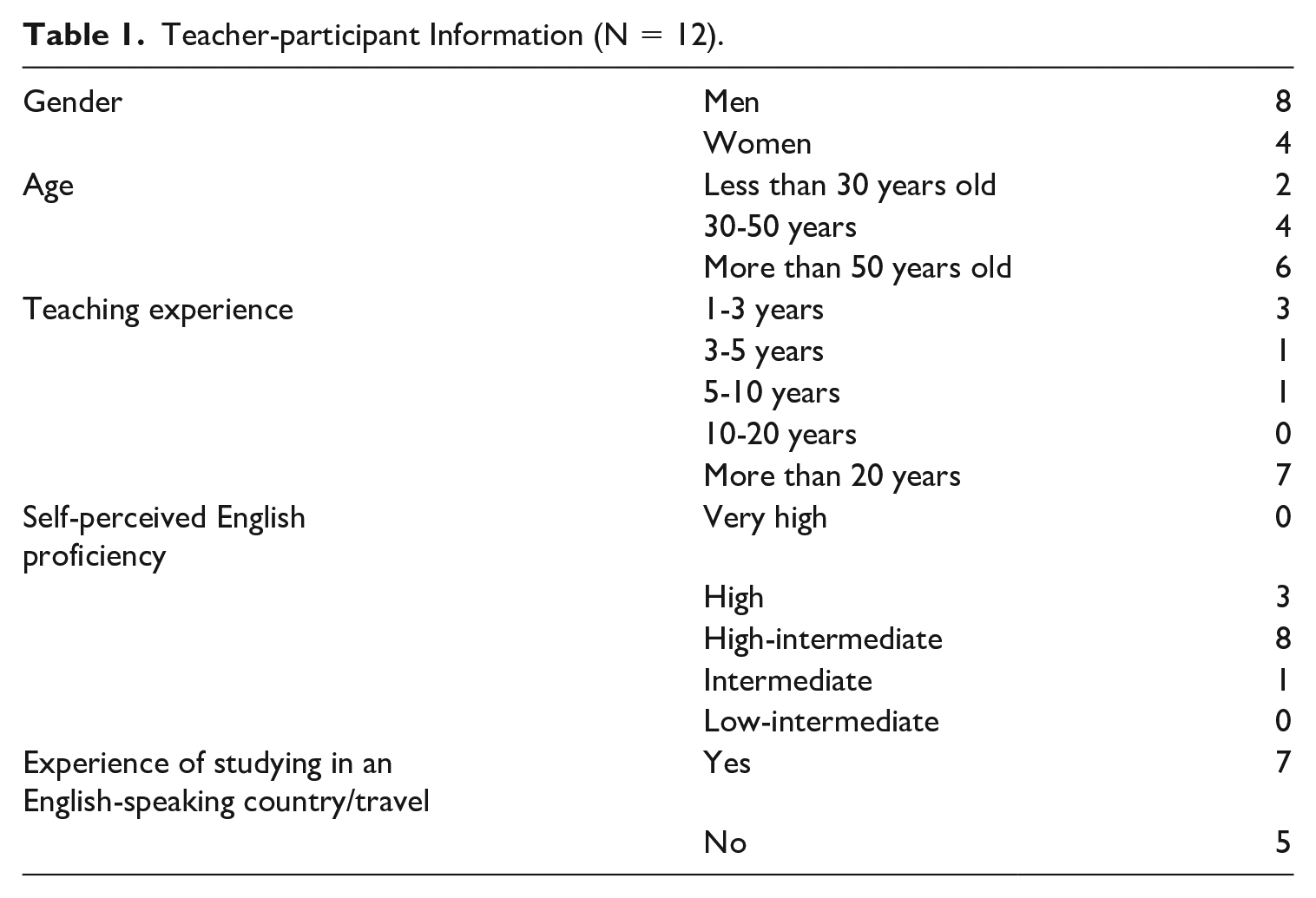
The ages of the 12 high school teachers ranged from 29 to 60, and their teaching experience ranged from one year to thirty-four years. Table 1 presents the composition of the profile of the teachers that participated in the study. The teachers and learners all consented to providing responses for the study.
Teacher-participant Information (N = 12).
Educational Context
The learners in the study had been learning English since they were ten years old. In the schools that they were enrolled, the learners were taught English three times a week, 50 minutes per session. The use of English was primarily limited to the classroom. In the Korean context, a combination of the audiolingual method and the grammar-translation method is used for instruction. Actual teaching in the classroom is generally focussed on reading comprehension and test-taking, where most of the learners aim for college entrance.
Questionnaire Instruments
We developed two types of questionnaires that were complementary, respectively for the learners and teachers. While there were two subsections in each questionnaire, the first section collected the demographic information of the learners or teachers. The second section asked the learners to rate the extent to which their teachers were using MS in the classroom when teaching English. Similarly, the teachers were also asked to report how often they were using the same MS as presented in the learners’ questionnaire. The tool was administered in Korean, the learners’ and teachers’ native language (see Appendix 1). To ensure that the teachers’ questionnaire items were addressing descriptions of identical MS, it was also administered in Korean.
We operationalized the notion of EFL learners’ and teachers’ use of MS through four subcategories: attention, relevance, confidence, and satisfaction according to the ARCS model (Keller, 1987; Keller, 2010). There was a representation of items which we expected to be particularly sensitive to the teachers’ actual use of MS. We adopted 40 items from existing studies within the area of MS (Maeng and Lee, 2015; Keller, 1987; Keller, 2010) and modified them in consideration of the construct’s situation-specific nature and the local educational context (Keller, 2010) while breaking down the macro-strategies into specific motivational techniques. The motivational strategies framework served as a background to our investigation for designing the questionnaire. The attention subscale (10 items) asked about the strategies that teachers used to capture learners’ interest or stimulate learner curiosity. The relevance subscale (10 items) asked about the strategies teachers used to meet the personal needs of the learners to create a positive attitude. The confidence subscale (10 items) dealt with the strategies teachers used to help learners believe/feel that they will succeed and be able to control their success. The satisfaction subscale (10 items) were involved in asking learners to report on the strategies teachers used to reinforce accomplishment with internal and external rewards. We used a 5-point rating scale, with 1 indicating ‘strongly disagree’ and 5 indicating ‘strongly agree.’ We categorized 40 items into four subscales, but they were randomly ordered in the questionnaire.
Scores for L2 Proficiency
In the questionnaire, the learners were also asked to report on their recent achievement of the nation-wide proficiency test of English, a preliminary test developed and administered in identical ways to the actual high-stakes national Korean College Scholastic Ability Test (CSAT). In the context where the study was conducted, the English section of the CSAT is regarded the most valid measure of high school learners’ English proficiency. The learners were asked to provide responses to whether their levels were ‘high’ (levels 1-3), ‘mid’ (levels 4-6), or ‘low’ (levels 7-9) according to the stanine 1 levels of their proficiency that they had been informed on for the results of the test.
The Interviews
We conducted semi-structured interviews with the eight learners based on prepared questions (see Appendix 2), in order to elicit qualitative information about the effects of teachers’ MS. The results of the interview were used to triangulate how the learners had perceived the effectiveness of their teachers’ MS. Eight learners participated in a one-to-one interview in Korean. Each interview lasted about seven to nine minutes and was audio-recorded to ascertain common themes among the learners.
Data Collection and Analyses
Data were collected during the learners’ normal classroom sessions in the middle of the semester. The matching teachers were also asked to complete and return the questionnaires. Interviews were conducted with the learners by appointment within the week their questionnaires had been completed.
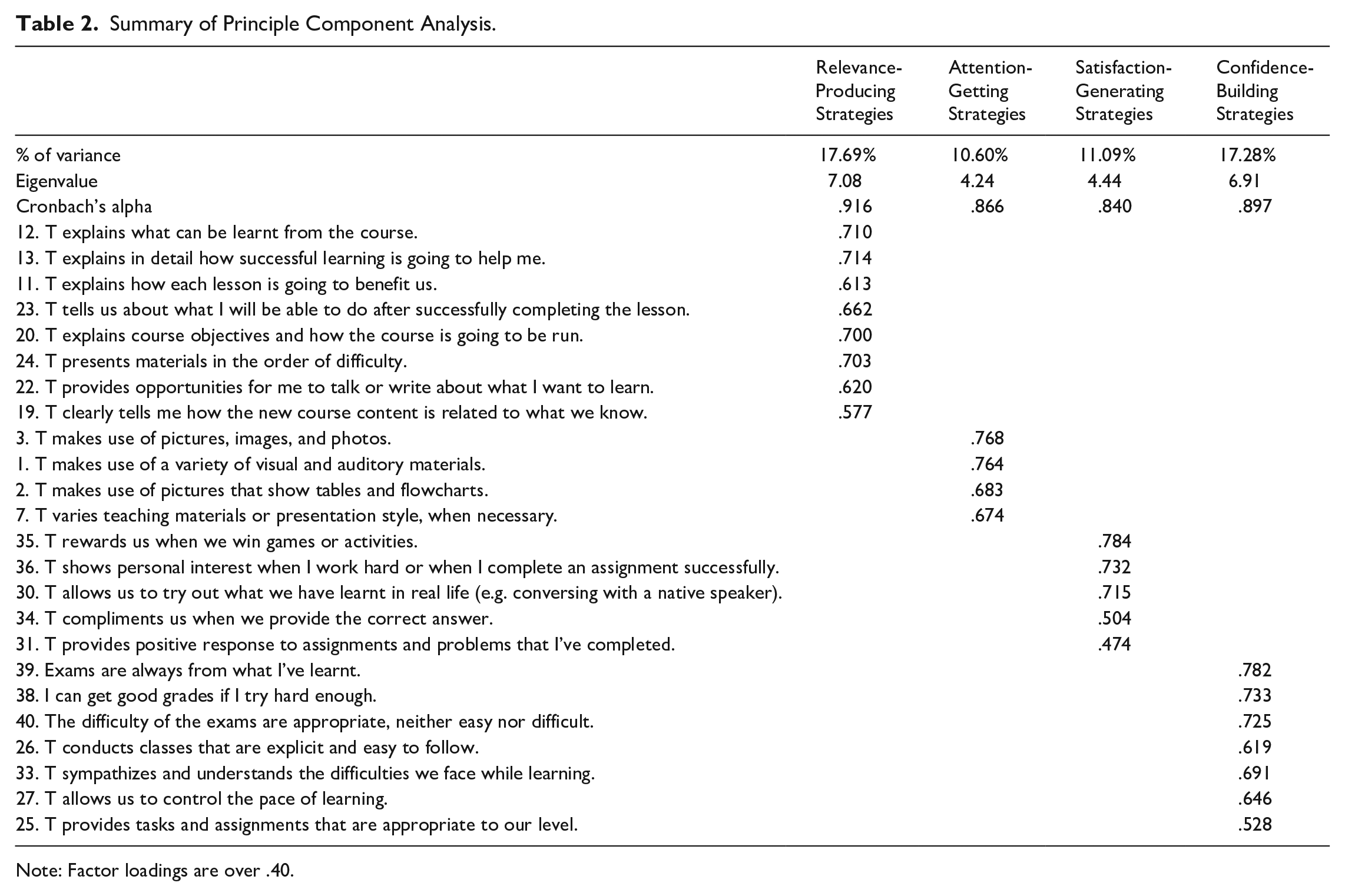
In order to identify the underlying constructs of learners’ MS, an exploratory factor analysis was performed with SPSS 21.0. A principal component analysis (PCA) was conducted with orthogonal rotation (varimax). The Kaiser-Meyer-Olkin (KMO) measure verified the sampling adequacy for the analysis, KMO = .932 (Field, 2009). Bartlett’s test of sphericity χ2(780) = 6533.356, p < 0.001, indicated that correlations between the items were sufficiently large for PCA. The number of factors extracted was based on examination of factor solutions’ eigenvalues via a scree plot. Of the 40 items, 14 items were eliminated due to low commonality. The resulting four-factor solution loaded 24 items saliently (loading value > 0.4), accounting for 68.50% of the total variance in learners’ responses to the questionnaire items. The reliabilities with Cronbach’s alpha for each factor demonstrated high internal consistency when values were >.80. For each factor, Table 2 reports the total variance explained, eigenvalues, Cronbach’s alpha, and item loadings. Cronbach’s alpha for the teachers’ questionnaire also resulted in high reliability on all four factors: relevance-producing strategies (.956), attention-getting strategies (.838), satisfaction-generating strategies (.795), and confidence-building strategies (.850).
Summary of Principle Component Analysis.
Note: Factor loadings are over .40.
The first factor (17.69% variance explained) loaded on items such as ‘what to learn’, ‘successful learning’, ‘learning outcome’, and ‘difficulty level’, and we labelled it relevance-producing strategies (8 items). The second factor (4.24% variance explained) loaded on items like ‘visual materials’, ‘photos’, ‘instructional materials’, and ‘variability,’ and we labelled it attention-getting strategies (4 items). The third factor (6.91% variance explained) loaded on items such as ‘good grades’, ‘exams’, ‘appropriate level/assignments’, ‘clear directions’, and ‘self-directed learning’, and we labelled it confidence-building strategies (7 items). The fourth factor (4.44% variance explained) loaded on items that were related to statements on intrinsic and extrinsic rewards, and we labelled it satisfaction-generating strategies (5 items).
Further statistical analyses were conducted to calculate descriptive statistics (means, SD) on the four subscales of MS for both learners and teachers. Next, we performed independent t-tests with Bonferroni correction to examine any significant differences between the two groups in their perception of MS. We also conducted repeated measures one-way ANOVA to ascertain whether there was a difference in the use of MS respectively within the learner group and the teacher group. To examine how learners’ L2 proficiency may have a role in the learners’ perception of teachers’ MS, one-way MANOVA was conducted with learners’ L2 proficiency as the independent variable, and the four subscales of MS as the dependent variables. The learners’ proficiency was categorized as low, mid, and high according to the stanine levels obtained on the standardized proficiency test (see previous section on Scores for L2 proficiency). To research if learners’ perception of their teachers’ MS was contributing to L2 proficiency, multiple regression was also conducted. To delve deeper into how teachers’ MS was affecting the learners, we analysed the interview responses by linking them to the learners’ questionnaire answers. For this purpose, we went through a reiterative process of comparing the learners’ data with those of the questionnaire responses.
Results and Findings
Questionnaire Results
Regarding research question one, there were significant differences between the learners’ perception of MS and those of the teachers (p < .0125) on all subscales of MS (Table 3). The teachers’ rating of MS was higher than those of the learners. This indicated that the learners may have undervalued the worth of the teachers’ MS or the teachers may have been unsuccessful in meeting the learners’ needs by executing MS that did not match learning style or L2 proficiency.
Learner and Teacher Agreement of Motivational Strategies.

Note: *p < .0125 (Bonferroni correction).
Further findings on the extent to which the learners had perceived the use of teachers’ MS were checked with repeated measures one-way ANOVA. The results of MS subscales indicated that the learners had perceived the four types of MS differently, F(2.721, 655.738) = 170.728, p < .001. Bonferroni post-hoc tests and pairwise comparisons indicated that there were significant differences between the four subscales in the way the learners had perceived the execution of teachers’ MS (p < .001); confidence-building strategies had been most frequently perceived, followed by relevance-producing strategies, satisfaction-generating strategies, and attention-getting strategies.
Repeated measures one-way ANOVA was also conducted on the four teachers’ MS. There were significant differences between the four subscales of MS, F(3, 33) = 12.486, p < .001, and follow-up pairwise comparisons indicated that attention-getting strategies had been used least frequently (M = 3.25). The employment of attention-getting strategies was significantly different from the other three strategies (p < .01). However, the use of the three strategies was not significantly different from one other. Although the number of teachers is small, the statistical results lend support that MS may have not been clearly operationalized among the teachers during their teaching.
As posed for research question two, one-way MANOVA was conducted to examine the role of L2 learners’ proficiency (low, mid, high) on their perception of MS. The mean values on all four subscales indicated that the more competent learners were readily able to perceive teachers’ MS for more sustainable efforts to learn English (Table 4). A statistically significant difference was also found for each of the MS according to learners’ L2 proficiency, F(8, 472) = 15.28, p < .001; Wilk’s Λ = 0.631, partial η2 = .206.
Learners’ L2 Proficiency and Motivational Strategies.

Post-hoc comparisons using a Tukey HSD test indicated that the mean scores for the learners’ perception of teachers’ MS were significantly different between the three proficiency groups for confidence-building strategies (p < .001). The results illustrated that the extent to which the learners had noticed the teachers’ employment of MS to elevate their confidence levels or sense of control was dependent on their ability to function in a second language. On the other hand, post-hoc comparisons for attention-getting strategies, relevance-producing strategies, and satisfaction-generating strategies uniformly evidenced that it had been the low proficiency group learners that had differed significantly in their degree of perceiving the MS in comparison to the mid proficiency group (p < .001) and the high proficiency group (p < .001). However, the mid proficiency group and the high proficiency group did not differ significantly on their perception of the three MS. The largest difference occurred for confidence-building strategies, that is, between the low proficiency group and the high proficiency group (Mean difference = 1.2), indicating that the low proficiency learners indeed needed to be stimulated to see that they can succeed in learning L2. (See later Discussion for specific strategies.) As such, lack of L2 proficiency can provide an account for how MS may not always be utilized by the learners even when teachers make an effort to systematically employ MS in their classrooms.
For research question three, simultaneous multiple regression was conducted to examine the contribution of the four MS to learners’ L2 proficiency (Table 5). The four MS predictors together contributed to 35% of learners’ L2 proficiency. Among the four MS, attention-getting strategies and confidence-building strategies significantly predicted L2 learners’ proficiency. This meant that more use of the two MS was likely to result in learners improving their L2 proficiency. Relevance-producing strategies and satisfaction-generating strategies did not seem to have any effect on L2 learners’ proficiency. The results also indicated that confidence-building strategies (B = .526), which can assist learners in building a positive expectation for success, were found to have a larger effect on L2 proficiency than attention-getting strategies (B = .180). Results overall indicate that the learners were able to enhance their L2 proficiency when there were persistent efforts by the teachers to support perceptual-inquiry arousal (i.e. attention) and belief in competence and expectancy for success (i.e. confidence).
Regression of L2 Proficiency on the Subscales of Motivational Strategies.

Note: **p < .001.
Interview Findings
In addition to the questionnaire responses, learners’ reflections were elicited through interviews to explore how the teachers’ motivational teaching practice was affecting learners’ perception of classroom motivation. How teachers’ MS affected the learners could be explained within the framework of the ARCS model.
First, the learners did not seem content with their teachers’ motivational practices due to their teachers’ lack of motive matching. This would be a subcomponent of relevance-producing strategies through which learners’ opportunities to make personal achievements can be maximized. Most of the learners, regardless of their proficiency levels, dominantly reported that the lessons were geared towards the more proficient learners. In particular, feelings of alienation and apathy prevailed among the low proficiency learners (Shiyeul and Mookyung) who explained that some learners were allowed to doze off and pay attention to the lesson only when they wanted to. For instance, Juhyun felt that the teacher-centred lessons were not helpful when the teacher was often engrossed in solitary reading and translation of the reading passages. Juhyun also explained that some learners were having problems with basic decoding of the text, but the teacher was either unaware or was unable to attend to this. With the same example, the more proficient learners (Taeseung and Hansue), in contrast, took a positive stance towards their teachers’ use of MS when they evaluated that it would be confounding for the teachers to address individual needs and motives of learners within the classrooms for learning English.
Do you think the difficulty level is appropriate?
I think the lessons are targeted for those learners doing well . . .The lessons are done in a way where it’s for those who want to listen. The teacher would leave alone the learners who want to sleep or don’t understand. Yeah . . .in spite of that I think if you try hard enough you can catch up. There is nothing more the teacher can do about this.
Second, learners’ lack of approval for teachers’ MS could be attributed to lack of variability, a subcomponent of attention getting-strategies which refer to the range of variations in presentation style, detailed examples, and unexpected events (Keller, 2010). The learners overall reported on their teachers’ use of attention-getting strategies which ranged from surprising stories, photos, pop songs to (unguided) movie watching as stimulants. Juhyun and Haeun, of mid proficiency levels, also identified the teacher’s strategy for asking learners to wake up when a learner was found to be dozing off during the lesson. However, they noted that this was a situation for which the teacher’s role was limited.
What is most difficult for you?
I often miss what the teacher is saying. I feel so sleepy, I can’t understand or concentrate.
How does the teacher attend to this?
Yeah.. the teacher calls on me and asks me to wake up. Then I wake up and if I fall asleep she calls on me again. I actually don’t think there’s any other way . . .
Finally, the interviews indicated that the teachers’ confidence-building strategies were geared towards the national college entrance exam rather than vocational goals of the learners, which was the learners’ more primary reason for wanting to learn English. To help instill confidence, a majority of the learners reported that their teachers had often talked to them about the importance of the college entrance exam and the need to obtain good grades for their in-school exams. However, there seemed to be a discrepancy between the teachers’ use of confidence-building strategies and the learners’ expectations. Learners were concerned about the utility of learning English for accomplishing tangible goals (e.g. for becoming a nurse, actuary, patisserie), and the learners’ responses highlighted the need for teachers to make this connection. For instance, Juhyun mentioned that she wished to become a flight attendant, and pointed out how she wanted her English classes to potentially help her improve her speaking skills. Juhyun and Sehee reported that they would want to see the teacher being more involved in communicating with them in English for real life issues rather than for reading with the purpose of analyzing grammar structures and translation of reading passages.
Discussion and Implications
The current study represents a small but important advance in providing empirical evidence on the direct comparison between learners’ perception of MS and teachers’ reporting of those MS. The results were expected to provide implications for implementing the appropriate strategies and tactics to develop and sustain classroom motivation (Cheng and Dörnyei, 2007; Dörnyei and Csizer, 1998).
When learners’ perceptions of teachers’ motivational practices were researched with a mixed-methods approach, the results revealed that the teachers’ MS were being underutilized by the learners. Evidently, the effect of teachers’ MS was not readily recognized by the learners, pointing to the need for teachers to focus on specific subcategories of MS. The regression analysis evidenced attention-getting strategies and confidence-building strategies to be adaptive for improving learner proficiency and in helping learners deal with the tedious process of learning English in the non-communicative classroom. However, the learners’ account of their teachers’ motivational practices revealed that there were deficiencies, such as a lack of variability for attention-getting strategies accompanied by ambiguous perspectives towards enhancing learners’ belief in their own competence and increasing the chances of success for achieving their vocational goals. This echoes the findings of Bernaus and Gardner’s study (2008) who found that the teachers’ intention towards MS was not always recognized by the learners. One possible explanation is that some teachers may use strategies because of an individual teaching style or because learners lack motivation. Some learners might not be able to value the MS employed by teachers simply because they are not interested in the subject. In such cases, the lessons are unlikely to be aimed at the learners’ needs or interests and consequently, the learners will not pay attention to the strategies used by the teacher.
The comparison of questionnaire responses from teachers and learners, and corroboration through the interview results demonstrated as to how the teachers may be restricted in using MS. For instance, teachers may have been restricted in the use of MS when they were hard-pressed to cover the official curriculum established by schools and education authorities (Cheng and Dörnyei, 2007), leading to very little time for teachers to develop a variety of extra visual and audio materials. There are also administrative and temporal constraints, which may prevent teachers from having the flexibility they need or time for interpersonal communication between the learners. The sleep-inducing conditions often produced in the classrooms seemed to be another constant barrier to the use of effective MS (Choi and Lee, 2018). Nevertheless, the motivational constructs, and the strategies and tactics needed to operationalize them (Keller, 2010), have been noted as linked to increased levels of learners’ motivated behaviour as well as their motivational state (Guilloteaux and Dörnyei, 2008; Maeng and Lee, 2015; Moskovsky et al., 2013). This has some implications for the effective employment of classroom-based MS (see later discussion).
Taken together, although the teachers reported on using a variety of MS to motivate learners, they were more effectively taken up by the learners with increased levels of L2 proficiency (Maeng and Lee, 2015). Seeing that the learners’ level of perception was not clearly different between the mid proficiency group and the high proficiency group for attention-getting strategies, relevance-producing strategies, and satisfaction-generating strategies, the pattern of results indicates that learners may need to reach a threshold level of L2 (i.e. mid proficiency) to be able to voluntarily utilize the MS that their teachers are trying to implement to expedite L2 learning. For instance, the interviews corroborated that teachers’ use of relevance-producing strategies, in particular for motive matching, which can offer learners opportunities to optimize personal achievement, were not perceived with the same level of utility by both the higher and lower achieving learners due to the teachers’ focus on instructing higher proficiency learners. The interviews indicated that the lower proficiency learners’ perception towards the teachers’ MS was weak. The lower proficiency learners evaluated that the lessons were run at the cost of excluding the slow-achieving learners, that is, themselves. The teachers may have been successful in generating external goal orientation and utilitarian motivation, but they failed to respond to the learners’ personal motives or allow them space to control their own learning. However, Keller (2010) has pointed out that setting goals that learners and teachers can both identify with is a key component of relevance.
Regarding satisfaction-generating strategies, which failed to be a significant predictor, the learners lacked what can be referred to as the ability to create ‘natural consequences’ (Keller, 2010). This suggested that there had been insufficient opportunities for them to use the newly acquired knowledge, in particular towards their vocational goals. For this purpose, as the learners expressed in the interview, communicative tasks (Canale and Swain, 1980; Littlewood and William, 1981) would have better enabled the teachers to utilize what is taught in terms of English. In the classroom, tactics that may be used for meaningful application opportunities are case studies, simulations, and experiential learning activities (Keller, 2010: 53) after which the learners can be led to develop more internally driven types of motivation (e.g. intrinsic motivation). However, as claimed by Keller (2010), if the learner is taking a course only for extrinsic reasons (e.g. to pass an exam), the use of extrinsic rewards can be more effective to reinforce the development of new skills and for learners to feel good about fulfilling their requirements.
The configuration of results on the learners’ perception of teachers’ MS and interview protocols can provide a number of implications for classroom-based MS instruction. Attention-getting strategies turned out to be the least adopted by teachers and the least perceived by the learners, but the type of strategy was simultaneously found to contribute to L2 proficiency. For teachers’ use of attention-getting strategies, this may indicate that the type of MS is most susceptible for influencing EFL learners’ motivation (Maeng and Lee, 2015), particularly in contexts where the grammar-translation method dominantly prevails with minimal interaction between the teachers and learners. That is, strategies for attention and curiosity will need to be employed to ‘capture learners’ interest’ for illustrating ideas and abstraction through concrete examples, ‘stimulate inquiry’ by presenting a problem to solve with new knowledge or skill, and ‘maintain attention’ by variation in layout, typeface, and types of material. Given access to the more recent availability of multimodal literacy, teachers are now in a position to be able to share a larger range of resources with learners via paper-based multimodal texts (e.g. picture books, textbooks, graphic novels, comics, and posters), live multimodal texts (e.g. dance, performance, and oral storytelling), and digital multimodal texts (e.g. film, animation, slide shows, e-posters, digital stories, podcasts, and web pages) (Cope et al., 2017).
Teachers can rely on ‘confidence-building strategies’, another significant predictor of L2 proficiency, for ‘building success expectations’ by providing clear statements on what is expected of the learners. This can be achieved by pointing out specific language functions that need to be learnt rather than leaving impersonal comments on the need to do well on exams. Similarly, ‘success opportunities’ can be used to make the overall challenge level appropriate. ‘Personal responsibility’ can be encouraged by giving learners choices in sequencing to go at their own pace. The specific tactics related to success opportunities may consist of organizing the content in a clear sequence, sequencing tasks from simple to difficult, setting overall challenge levels appropriate for learners, and providing exercises that are consistent with the objectives of the lessons. This will allow learners to build positive expectations and personal control in learning English.
For learners to develop agency in learning English, strategies for relevance would need to be ‘related to goals’. Teachers can achieve this by stating the immediate benefit of instruction. Teachers can also ‘match interests’ by making learners feel their teacher knows them. Other strategies suggested in the ARCS model for creating a non-competitive and collaborative learning context include providing preparation time, using silent reading techniques, employing risk-taking strategies, or using humour to alleviate language anxiety.
Strategies for promoting feelings of satisfaction can be used once motivation has been maximized through the three preceding strategies (Keller, 2010; Song and Keller, 2001). Such strategies rely on increasing ‘intrinsic satisfaction’ by including positive comments for accomplishing difficult tasks, providing ‘rewarding outcomes’ by including extrinsic rewards, and ensuring learners receive ‘fair treatment’ by ensuring the content in the final task is consistent with the knowledge practised in the materials. According to Maeng and Lee (2015), competent L2 teachers were found to use diverse intrinsic reinforcement tactics by providing sufficient application opportunities via project work, games, or story-writing activities while also effectively mixing corrective, direct, indirect, positive, and negative feedback in a way that was not detrimental to learners’ confidence. Moreover, teachers can offer extrinsic rewards such as verbal praise or tangible rewards in conjunction with intrinsic reinforcement (Keller, 2010). The ARCS model also postulates that the best tactic for fostering equity is to ensure that learning activities and outcomes are consistent with goals, objectives, and the criteria proposed in advance.
Conclusion
The present study set out to test our theory that EFL learners and their teachers may disagree about the value of MS, and this was confirmed. From this finding, we conclude that teachers may use MS that is of value to learners, but for the strategies to be effective in influencing learners’ attitudes and motivation, they must be perceived as such by learners. Knowing that it is often difficult for teachers to evaluate their MS and tactics in the classroom, teachers should be given opportunities to focus on analysis, evaluation and reflection. Comments and feedback from learners and peer-instructors can serve as valuable sources of revision and enrichment for their MS. The taxonomy of MS within the ARCS framework, when applied appropriately to L2 teaching contexts with an a priori analysis of the learners’ perception of teachers’ MS, can be expected to help teachers influence L2 learners to develop more self-determined forms of motivation.
Supplemental Material
APPENDICES – Supplemental material for Teacher Motivational Strategies for EFL Learners: For Better or Worse
Supplemental material, APPENDICES for Teacher Motivational Strategies for EFL Learners: For Better or Worse by Moon Hong Min and Yuah V. Chon in RELC Journal
Footnotes

References
Supplementary Material
Please find the following supplemental material available below.
For Open Access articles published under a Creative Commons License, all supplemental material carries the same license as the article it is associated with.
For non-Open Access articles published, all supplemental material carries a non-exclusive license, and permission requests for re-use of supplemental material or any part of supplemental material shall be sent directly to the copyright owner as specified in the copyright notice associated with the article.
