



Abstract
Online discussion forums are a popular learning tool commonly used in blended learning. Despite the widespread use of this tool, pre-service English as a Foreign Language (EFL) teachers’ conceptions of learning disciplinary concepts through online-discussion forums are under researched. This study aims at filling this gap by describing the conceptions of learning through such forums held by a group of 16 Mexican, pre-service EFL teachers enrolled in an undergraduate Second Language Acquisition course. Interviews were conducted and analysed using phenomenography. We found three experiential categories: Going over the content, Expanding knowledge metacognitively, and Negotiating knowledge. These involve different ways of approaching course material, writing and responding to messages, and relating to the teacher. WhatsApp was used as a parallel forum to negotiate potential conflicts without the instructor’s presence. The results suggest the need to train pre-service teachers to use online discussion forums (ODFs) with a deep approach to learning that includes meaning negotiation.
Introduction
Computer-mediated communication (CMC) has been widely used as a tool for learning and teaching in higher education. According to Wikle and West (2019: 206), the most widely used CMC tool for student-student and student-instructor communication ‘is asynchronous online discussion forums’, hereafter ODFs. As established by these authors, ODFs are often implemented in courses that include both online and face-to-face components, or blended-learning courses. A key assumption underpinning the use of ODFs in education is that dialogue among peers facilitates collaborative knowledge building, which results in deeper, more meaningful learning. Other benefits of ODFs may include encouraging language learners’ participation and self-expression (Cantor Barragán, 2009) and encouraging teachers to reflect on their syllabi and to design new tasks (González Moreno, 2011). However, studies have also shown some of the negative effects of ODFs, such as leading to misconceptions (Yap and Chia, 2010), not engaging in collaboration (Delahunty, 2018), and perceiving ODFs as purposeless and boring (González Moreno, 2011).
In a meta-analysis, Lucas, Gunawardena and Moreira (2014) found that most studies using the Interaction Analysis Model or IAM (Gunawardena et al., 1994) to look at ODFs and learning showed limited collaborative knowledge building. Lucas et al. (2014) conclude that more research is needed on students’ perspectives on what constitutes collaborative knowledge building in ODFs. In particular, studies of Asian teachers have found that these teachers are reluctant to evaluate and challenge others’ claims (Sing and Khine, 2006; Hou et al., 2009, 2011).
In language teacher education, a number of studies have addressed teachers’ perceptions of the use of ODFs in their training (Arnold et al., 2006; Arnold and Ducate, 2006; Biesenbach-Lucas, 2003; Delahunty, 2018; Delahunty et al., 2014; Lord and Lomicka, 2004; Lord and Lomicka, 2008; Sardegna and Dugartsyrenova, 2014). The findings of these studies, like those of studies focusing on students, are mixed. For example, some studies have found that ODFs are useful in creating a sense of belonging to a community of practice (Lord and Lomicka, 2004; Lord and Lomicka, 2008), helping develop pre-service teachers’ autonomy, and providing good models for future technology use (Sardegna and Dugartsyrenova, 2014). Yet some pre-service teachers prefer face-to-face activities to ODFs (Sardegna and Dugartsyrenova, 2014), or perceive ODF interaction as forced, unnatural, and burdensome (Biesenbach-Lucas, 2003).
Studies focusing on both perceptions and online discourse have found that building positive interpersonal relationships and the instructor’s presence are key in favouring pre-service ESL teachers’ collaborative learning (Delahunty et al., 2014). Students’ active attention to the posts of others is also a key factor; its absence brings about negative consequences for motivation and learning (Delahunty, 2018). Studies analysing in-service FL teachers’ messages in ODFs have generally found positive attitudes (Son, 2006) and some knowledge building (Nami et al., 2018), although they have also highlighted the need for more collaboration among teachers.
Against this backdrop of mixed results, we agree with Shin and Kang (2018) that more research is needed on the use of online tools for language teacher education. Focussing on pre-service teachers’ experiences with such tools, and in particular ODFs, is important because the quality of such experiences is likely to influence their future decisions on whether and how to use ODFs in their own teaching (Dooly, 2009; Guichon, 2012). Accordingly, understanding pre-service teachers’ experiences of learning aspects of language teaching with the help of ODFs can have meaningful implications for pedagogical designs that address pre-service teachers’ learning needs. This is a worthy goal in light of recent calls to interrogate ways to maximize the impact of language teacher education on language teachers’ thinking and practice (Kubanyiova and Feriok, 2015). It also aligns with calls to increase language educators’ awareness of ‘the constraints and possibilities for making meaning and communicating in online venues’ (Guichon and Hauck, 2011: 193).
This article addresses these needs by presenting the results of a phenomenographic case study carried out with a group of Mexican undergraduate pre-service EFL teachers enrolled in a blended-learning SLA course. The study aims at describing participants’ conceptions of learning SLA concepts through ODFs in a blended-learning SLA class using Moodle. The focus is not on how well they learned concepts. Instead, we focus on their conceptions of ODFs as learning tools.
Research Questions
The following questions were addressed:
What conceptions of learning through ODFs are held by the participants?
What strategies for learning through ODFs are reported by the participants?
What reasons do the participants hold for using certain strategies?
Our method was phenomenography, which is gaining popularity in language studies (Chang, 2016; Nohriza Mohd, 2010; Polat, 2013; Norberg et al., 2018). Although it has been used to investigate e-learning in other disciplines (Ellis et al., 2006; Tsai, 2009), phenomenography has not been used widely in investigating ODF-mediated language teacher education.
Methods
Phenomenography is both a theoretical perspective on learning and a methodological approach. According to Harris (2011: 110), ‘within the phenomenographic research approach, conceptions are the central unit of description about people’s experiences’. Conceptions are defined as ‘different ways of understanding’ (Marton and Pong, 2005: 335). Conceptions are the minimal units of experience, understood as the self-aware internal perception and interpretation of external phenomena (Feldon and Tofel-Grehl, 2018). According to Marton and Booth (1997), for any given phenomenon there will be less and more complex ways of experiencing it. The more complex ways include more aspects of the phenomenon (i.e. more conceptions) that bring it into sharper focus.
The goal of phenomenographic studies is to produce a hierarchical grouping and arrangement of conceptions. Such groupings are called categories (Tsai, 2009). Their hierarchical arrangement is called an outcome space (Marton and Booth, 1997). Besides the categories, the outcome space may include the themes that are perceived across the categories (Marton and Booth, 1997); these may be called dimensions (González, 2009), or critical attributes of variation (Heinone et al., 2017). The intended use of the categories in the outcome space is ‘to guide teachers to approach learning from their students’ perspectives, or at least to understand why their students might be thinking or doing certain things’ (Polat, 2013: 114). The categories in the outcome space should be plausible, distinct, parsimonious, and hierarchically related (Marton and Booth, 1997). There are different ways of presenting outcome space. Some include quantifications of the number of participants holding a conception and of variant and invariant conceptions. We follow the purely qualitative approach for presenting the outcome space in Gonzalez (2009; Gonzalez, 2012) and Norbert et al. (2018) because it is a good fit for our data and design.
According to Marton and Booth (1997) learning experiences have what they call referential and structural aspects. Phenomenographers vary in the ways they understand and apply these terms, and it is therefore recommended that scholars define them explicitly (Harris, 2011). For us, referential aspects relate to how the students understand the object of learning (i.e. their learning of concepts), while the structural aspects relate to how they approach learning (how they understand the act of learning and the strategies they use to learn) and why they do it that way (González-Ugalde, 2014). In accordance with our goal to focus on conceptions of ODFs as a way to learn, rather than on the concepts being learned, this article thus centres primarily on structural aspects. Referential aspects are addressed only inasmuch as they are essential to understand structural ones.
The Context, Participants and Data Collection
The study was conducted in the context of a five-month SLA course taught in the fourth term of the Bachelor of Arts degree in English course at a small, urban, public university in Mexico. This course was selected for theoretical and practical reasons. Among the theoretical reasons are our interest in the connections between SLA theory and teaching, which is a longstanding topic in language teacher education. Another theoretical reason is that it presents an interesting case because the professor who teaches it, unlike many other teachers who teach SLA courses in Mexico, has a great deal of expertise and international recognition in the field of applied linguistics. He earned both his Master’s degree and his doctorate at American universities under the supervision of renowned American and British scholars. The practical reason is that this professor is a long-time friend of the lead author, who facilitated the team’s access to the course. The professor was approached in the Fall/Autumn of 2017 to explain the specifics of the study and to ask for his permission to conduct it in the following year. Upon his request, the study was registered with and approved by the university’s Research Office, with the lead author as the principal investigator.
Twenty-seven pre-service teachers were enrolled in the SLA course in the Fall/Autumn of 2018, when data collection took place. At the beginning of the course, all the participants were invited to participate by the lead author. The lead author came on the first day of class, presented the study to them, asked if they agreed to participate and asked them to fill out and sign informed consent letters. All of them did so. The sample for this study consists of 16 of them as this was the number at which we achieved saturation of categories of description. Note that small samples are common in phenomenographic research (González, 2009; González-Ugalde, 2014), and our sample complies with the minimum of 16 participants recommended by Trigwell (2000) to capture variation. The participants were 11 females and 5 males, aged 19–20 years old. They were all students of the second year of the university’s BA in English, which focusses on ELT. They did not have any prior experience with blended learning, ODFs, or the online platform Moodle. We aimed for saturation as a sampling strategy rather than a census sample because of time constraints inherent to the project.
Three semi-structured interviews were conducted with the participants, one at the beginning of the instructional period in focus, another one in the middle, and the last one at the end. The shortest interview was 7 minutes and 5 seconds long; the longest interview was 19 minutes and 3 seconds long. The interviews took place in the lead author’s office and were recorded on a Motorola G6-plus mobile phone. They were transcribed manually by an assistant. Interviews are the most common technique of phenomenographic data collection (Walsh, 2005). The interview protocols were designed following the guidelines in Booth (1997), Marton and Booth (1997), and Åkerlind (2005) and included ‘how’ and ‘why’ questions. They were validated using the Interview Protocol Refinement Framework (IPRF, Castillo-Montoya, 2016). All the interviews were conducted in Spanish, the participants’ native language. Interview excerpts in this article are translations.
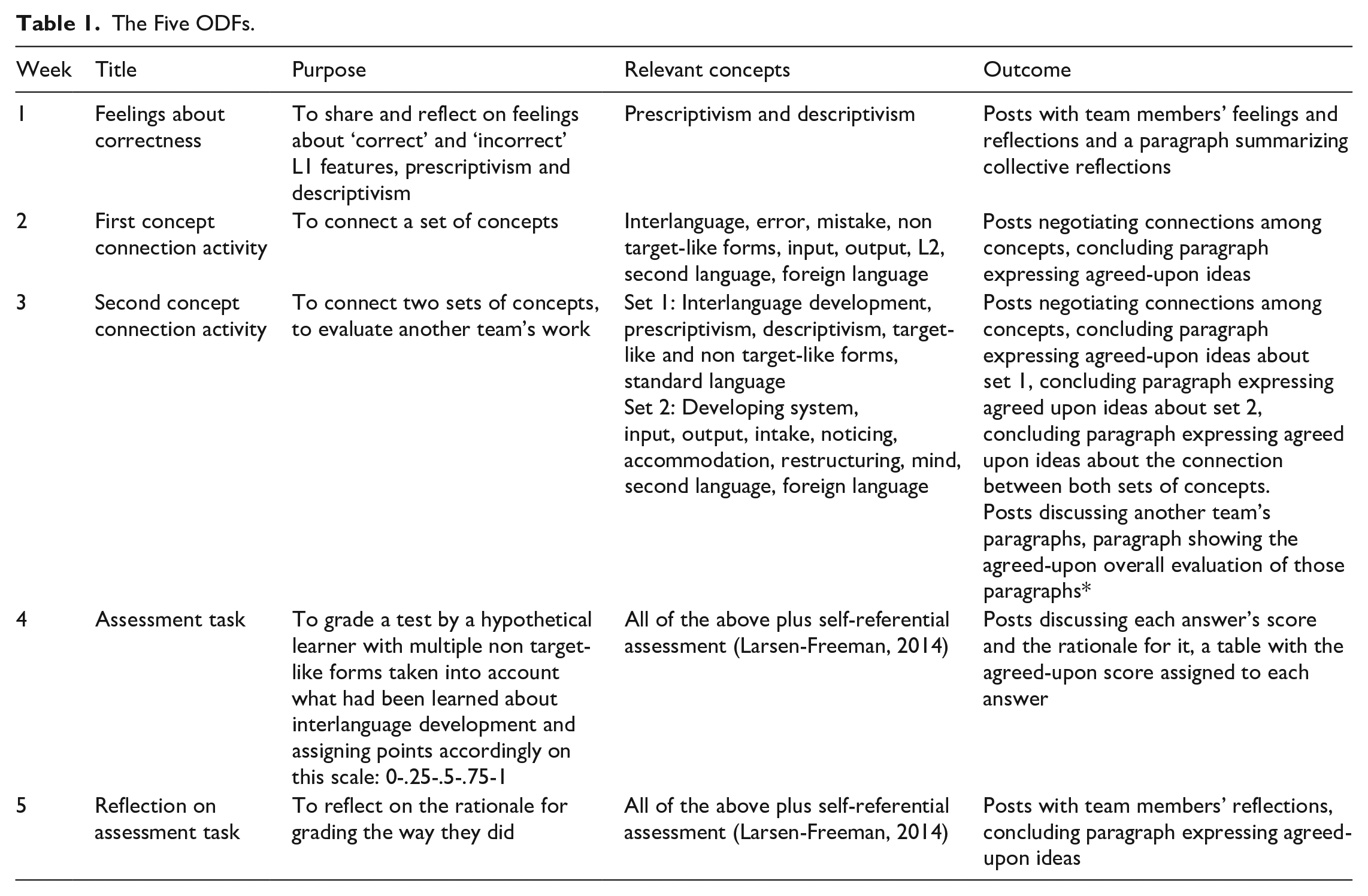
The SLA course was taught using a blended-learning approach: the class met once a week for two hours and then students completed activities using the learning platform Moodle. This study focusses on only one unit, that on interlanguage development, which lasted five weeks. The online activities for this unit were five ODFs. Table 1 presents relevant information about them. This information was gained from an interview with the professor conducted by the lead author and from screen captures of the Moodle platform. All the ODFs had the following features in common: it was mandatory to contribute at least twice, once with a new contribution and at least once with a response to someone else’s posts. Messages were not graded for quality; students were encouraged explicitly to ask questions and express and negotiate disagreement; the outcome of each ODF except four was a paragraph that summarized the team members’ conclusions. There was no word limit on individual posts or the final paragraph; the professor intervened when students’ showed misunderstandings or misconceptions. The instructions for each ODF stated its purpose, listed the relevant concepts, established the desired outcome, and outlined the participation requirements. No explicit etiquette guidelines were provided beyond statements like ‘it is okay to ask questions and disagree’. The participation structure was in teams of four students. Participation was kept intra-team except for ODF 3, which had both an intra-team and an inter-team component.
The Five ODFs.
Data Analysis
We followed a discovery-based, team approach. In a discovery approach, categories emerge from the data; prior theories on the phenomenon are not used and the researchers keep their own conceptions at bay, at least initially (Walsh, 2000). Phenomenography can be conducted by a scholar working alone (Åkerlind, 2005), or by teams of scholars (Bowden, 2005). Our process was iterative and involved moments of both individual and collective work and constant checking of emerging categories against the data, which are all typical features of phenomenographic data analysis (Walsh, 2000; Bowden, 2005). The steps we took are explained below.
The lead author transcribed all the interviews.
The lead author randomly selected four participants and read all their interviews thoroughly (12 interviews) to develop an initial set of in vivo codes, categories, and dimensions. This process involved reading the entire transcripts and comparing them for similarities and differences (Åkerlind, 2005), looking for conceptions in the structural aspect, and grouping the conceptions into categories and dimensions in an initial outcome space. MAXQDA 2018 was used to code the interviews.
The initial coding scheme and tentative categories were audited and validated by the fourth author by applying it to the analysis of two interviews given to him in uncoded form. A comparison of his coding with the lead author’s revealed that he found almost the same codes in the same places but suggested a few new codes. This is the strongest type of validation in phenomenographic research (Walsh, 2005). These preliminary results were presented at a conference and feedback was obtained from the coauthors and the audience. This is also a type of phenomenographic validation (Åkerlind, 2005).
This resulting coding scheme and categories were applied to the remaining interviews by the three first authors collectively until saturation was achieved. As a result, a few new codes emerged, and the categories and dimensions in the outcome space were refined. These were constantly compared to the transcripts and the existing codes, categories and dimensions. This analysis was also conducted with MAXQDA.
All the 48 transcripts were read again by the lead author to verify the applicability and descriptive power of the refined categories, dimensions, and outcome space. No modifications were needed.
The fourth author applied the resulting outcome space to a set of randomly selected five interviews. He found it adequately descriptive and in no need of modifications.
Results
Learning through ODFs was conceived as providing different kinds of learning opportunities. These depended on how participants conceived their roles in the tasks, the role of the face-to-face classes, and their relationship with the teacher in the context of the ODFs. These different ways of experiencing learning through the ODFs are captured by the three categories below:
Category 1. Going over the content.
Category 2. Expanding knowledge metacognitively.
Category 3. Negotiating knowledge.
As mentioned above, the categories emerged from learner’s conceptions about various task and contextual features. These were arranged in the following dimensions:
- Connections with the material covered in the face-to-face classes.
- Writing one’s own messages.
- Reading and responding to the messages of others.
- Relating with the teacher.
Category 1. Going Over the Content
The participants whose conceptions we grouped under this category used the Spanish verb ‘repasar’ to express their view of learning through ODFs. This verb means ‘to go over what has been studied’ (Diccionario de la Real Academia de la Lengua Española, repasar entry), hence our label. With regard to the connections with the material covered in face-to-face classes, the conception is very simple and self-explanatory: ODFs provided an opportunity to rehash or summarize the same ideas presented by the professor, in the same way. The strategy that is associated with this category is re-reading and summarizing content.
Example 1. Moodle led us to like a summary I think. . . a reminder of what we covered in class. . . these activities force us to re-read (P1)
In terms of the reasons to use this strategy, the goal is to commit the concepts to memory by having to repeat them. The same function of repetition-memorization is ascribed to the dimension of writing one’s own messages (Examples 2 and 3) and relating to the teacher (Example 4).
Example 2. When accessing the. . . Moodle activities. . . that is the moment of expressing what we have learned (P2).
Example 3. I think the forums were useful to strengthen our knowledge because I believe in memorization. . . if you repeat something many times you will retain it better (P6).
Example 4. It was then that the teacher intervened and explained the concept again (P15).
The dimension of reading and responding to the messages of others did not appear as a theme in this category. That is, conceptions of how one interacts with others to learn beyond just repeating or memorizing ideas appear to be distinctive of only the more advanced categories as described below.
Category 2. Expanding Knowledge Metacognitively
This category involves understanding ODFs as providing opportunities to question and expand one’s knowledge. These processes involve interrogating and/or noticing gaps or inconsistencies in participants’ knowledge or stances as a result of ODF task features, and/or changes in knowledge or stances as a result of engaging with others in the ODFs. For example, some participants added material to the one covered In the face-to-face classes as a result of questions that emerged during the ODFs that could not be answered by such material. Searching for additional, related material online is thus a strategy in this conception, and this is done to learn more and satisfy curiosity.
Example 5. I had my notes and I did my own online research. . . because I wanted to learn more about the topic (P8).
Example 6. Working on Moodle was helpful because, when the professor posted the forums, if I didn’t know something like a technical term, I would search for extra information on the Internet (P12).
In this experiential category, the process of writing one’s own messages was understood as an opportunity to check one’s understandings (Example 7), or discover questions that could then be posed to the teacher (Example 8).
Example 7. Once you type it on Moodle uh you realize you have expressed an idea and then you can ask yourself, did I really understand it? (P7).
Example 8. The professor gave us the concepts in the classroom and we wrote them down and we felt we’d learned them. But when we expressed our ideas on Moodle we realized we had questions, and then we asked those questions in the face-to-face class (P13).
Reading and responding to the messages of others was also seen as a way to discover one’s own gaps in knowledge (Example 9), and learn from others’ examples or ideas beyond what the teacher had presented in class (Example 10)
Example 9. Sometimes my classmates explained things and, upon reading their messages I thought oh I didn’t know that. . . but before reading I hadn’t noticed I didn’t know it (P4).
Example 10. I think my favorite contributions were X’s, because they weren’t uh, so based on concepts. . . she mostly gave examples and that helped me (P12).
As seen in Example 8 above, in this category, the professor was understood to play a metacognitive role: repairing misunderstandings. This role was intertwined with the discovery of such misunderstandings while reading the professor’s responses to the posts of other participants:
Example 12. While I was reading their comments I saw the teacher corrected their views.. then that helped me to learn because I was wrong about that concept too (P14).
Category 3. Negotiating Knowledge
This category encompasses conceptions of ODFs as opportunities to present and question claims, express disagreements and come to agreements, hence the label ‘negotiating’. In this category, writing one’s own messages and reading and responding to those of others are intertwined because the messages of an individual participant are intended to either respond to another message or to invite a response. This is a key difference with regard to the conception of one’s own writing in the previous categories. In category 2, Expanding knowledge metacognitively, writing one’s own messages was conceived as a way to discover gaps in one’s knowledge. In category 3, one writes to stimulate debate by, for example challenging other peoples’ messages.
Example 13. And then we discussed, we thought it was this or that way. . . then we reached a point where we thought we were right and they probably weren’t. . . so we told them what we thought so they could realize their misconception and the topic would become clear to them as it did for us (P11)
In this category, the material covered in the face-to-face classes is regarded as the ultimate source of authority. In example 16, Participant 11 explains that she and her teammates referred to the material in order to adjudicate a disagreement with another team. Likewise, the way of relating to the teacher was seeing the teacher as an adjudicator. There were no instances of challenges to the teachers’ or the material’s authority, which is perhaps to be expected from undergraduate pre-service teachers at the very beginning of their careers.
Example 16. As we were reading their messages, we came to think that we were in the wrong but, then we checked our notes and what the teacher had said in class. . . and we decided we were right (P11)
A very interesting feature of this conception is a strategy that consists of developing parallel conversations using WhatsApp as a way to orchestrate the Moodle ODFs. The goals of this strategy varied. One conception is that WhatsApp texting assisted with the logistics of asynchronous participation and facilitating responses:
Example 17. Sometimes I sent them pictures of my posts so they could start thinking about what to respond to me (P10).
Yet another purpose of conducting parallel conversations on WhatsApp was avoiding, negotiating, or softening disagreements. WhatsApp afforded the chance of letting one’s peers know about negative evaluations and challenges to claims in advance in order not to hurt their feelings. This is shown in examples 18 and 19 (bold face added for emphasis):
Example 17. Then what we wrote on Moodle was very different from what we wrote on WhatsApp. . . if one of us was wrong, the others would tell her on the WhatsApp group,
Example 18. We specified what the work was and how we were going to do it, what we would say, how we were going to
In these examples, the participants’ statements express the reason for conducting parallel conversations on WhatsApp, which have to do with agreeing on the linguistic-discursive expression of meaning negotiation so it would not cause interpersonal friction. This is an interesting structural conception in that it relates to findings in previous studies focussing on collaborative knowledge building by Asian and Mexican students as discussed below.
Discussion and Conclusions
Research question one focussed on the participants’ conceptions of learning through ODFs. We found three categories (groupings of conceptions): Going over the content, Expanding knowledge metacognitively, and Negotiating knowledge. The second question enquired about the strategies for learning. These include 1) re-reading content, 2) reading others’ posts and the teachers’ posts attentively, 3) searching for additional information, and 4) using WhatsApp as a parallel ODF site to negotiate logistics and potential interpersonal friction. The third question focussed on reasons for using strategies. The reasons for using the first strategy are mostly connected to memorization, although the content was also re-read in order to adjudicate claims. The reasons for using the second and third strategy had to do with curiosity and a desire to check understanding. The reasons for using the fourth strategy had to do with logistics and, more interestingly, with the need to follow politeness norms.
The parallel discussions on WhatsApp were conceived as a way to reduce potential interpersonal friction that could otherwise have emerged in the Moodle ODFs. This implies that the Moodle ODFs were thought of as potentially face-threatening, and participants were therefore reluctant to make face-threatening acts in the Moodle ODFs. Interestingly, the fact that participants were willing to express critiques and negotiate disagreements on WhatsApp suggests that the face-threatening potential lay not in the acts themselves but in the teachers’ witnessing of those acts. This reluctance to engage in unmitigated, non-choreographed debate mirrors López-Islas’ (2001) finding that Mexican college students in several social science disciplines avoid expressing and negotiating conflict in ODFs. The need to first negotiate potentially conflicting meanings and then stage the negotiation may stem from Mexican politeness conventions. Earlier studies with Mexican EFL learners have found that they are reluctant to disagree with or criticize their peers because doing so would be face-threatening and go against cultural politeness norms (Mugford, 2011; Sandoval-Cruz et al., 2019). Similarly, limited ODF engagement in evaluation and negotiation of claims by Asian teachers and learners have been attributed to cultural conventions (Biesenbach-Lucas, 2003; Lucas et al., 2014).
In parallel, studies with Master of Arts TESOL students have found that cultivating good interpersonal relationships and feeling safe when expressing critiques and disagreement assisted collaborative knowledge building in ODFs (Delahunty, 2018; Delahunty et al., 2014). The role that discursive cultural norms play in learning through ODFs can therefore not be ignored, and should be addressed more pointedly by future studies. Teacher trainers should also be aware of the need to teach pre-service teachers discursive strategies for evaluating and negotiating claims. This can be done using interventions of the kind developed by Meskill and colleagues (Meskill and Anthony, 2007; Meskill, 2009; Meskill and Sadykova, 2011). Examples include microanalysing and reflecting on simulated conversations (Meskill and Anthony, 2007; Meskill, 2009), and the Moodle fishbowl technique (Meskill and Sadykova, 2011), with a specific emphasis on experts’ modelling and pre-service teachers’ observing and analysing the expression and negotiation of disagreement. These tasks should address politeness norms and their role in facilitating or impeding learning through ODFs.
Future studies might also explore conceptions of WhatsApp and other social networks as parallel spaces of meaning negotiation and knowledge construction. Nevertheless, such research would not come without risks. It is possible that students think of and use such spaces to escape teacher surveillance, which in principle might afford them opportunities for more meaningful, authentic exchanges. Therefore, any attempt to deepen our understanding of social network use as parallel sites of knowledge building must be undertaken with great care, lest we kill precious spaces where the kinds of learning we want to promote might already be happening on their own.
The categories we found are somewhat similar to those reported for engineering students by Ellis et al, (2006). The less advanced e-learning categories in that study were Checking ideas and Acquiring ideas, and the most advanced ones were Developing ideas and Challenging ideas. Our category of mere repetition, or Going over the content, was absent in their data. Their categories of Checking, Acquiring, and Developing ideas seem to be encompassed by our second category, Expanding knowledge metacognitively. Our and their most advanced category seem to be equivalent, as they both involve a focus on debating ideas.
Crucially, our study has shown that the more advanced category, Negotiating meaning, includes a different way of attending to peers, one that involves not just reading but also responding to others’ messages, and writing with the goal of eliciting a response. This finding echoes that of Delahunty (2018) on the importance that attending to others’ messages, and having one’s messages attended to, holds for collaborative knowledge building to happen in the context of ODFs. Nevertheless, even in the more advanced category, the material and the professor were not challenged but remained the ultimate resource for adjudicating claims. Although this is perhaps appropriate at the undergraduate level, it might be desirable to find ways to promote critical questioning of the material and the professor.
The least advanced category in our outcome space, Going over the content, can be said to represent a shallow, fragmented approach to learning. In this category, learning through the ODFs is conceived of as offering opportunities for memorization through repetition. This conception is not very conducive to autonomous learning or deep learning. As a result, interventions need to be designed in order to scaffold changes from this conception to more advance ones. Besides the techniques outlined above (e.g. the Moodle fishbowl), such interventions should include work on metacognition, self-regulation, beliefs about learning, and beliefs about collaborative knowledge building.
A limitation of this study is that we did not analyse the Moodle or WhatsApp posts. Such analysis might reveal possible instances of knowledge expansion and meaning negotiation in participants who are not aware of their engagement in such practices. Further, the fact that all our participants were unfamiliar with Moodle ODFs implies that a different sample of more experienced participants might yield a different outcome space. A strategic decision for this study was to exclude the referential aspect of learning, which in this case had to do with key SLA concepts such as interlanguage, and attitudinal shifts from prescriptivism to descriptivism as defined by the professor. Future studies should therefore examine ODFs in connection with interview transcripts to characterize referential conceptions and probe possible connections between those and the structural aspects reported here. Future studies should also examine pre-service teachers’ conceptions of the face-to-face classes. In this study, the face-to-face setting was conceived of predominantly as a source of truth to adjudicate claims, but more focussed interview questions with a different sample might cast further light on its role vis-a-vis the ODFs.
