



Abstract

It is well documented that listening to large quantities of input can greatly facilitate foreign/second language (L2) learning, and there are L2 learners who have reached high levels of proficiency through exposure to authentic aural input (Chang, 2016; Rost, 2005). The rise of digital technologies and the increased accessibility of the internet have made authentic resources easily available. However, many learners – and, unfortunately, many teachers – are either not familiar with these online resources or spend their valuable time on those that afford few learning opportunities, hence the necessity of bringing such materials to their attention. To this aim, in this tech review article I will introduce the National Public Radio (NPR) website – www.npr.org – arguing that it has four unique features that, in light of evidence from L2 listening comprehension research (Richards, 2015), make it an excellent resource for both classroom-based and informal L2 learning.
NPR is a nonprofit US-based media organization and has a monthly audience of over 120 million across various platforms including radio, the internet, the NPR App, and podcasts. Its website not only publishes news articles but is also home to every single NPR show that goes on air, downloadable in small MP3 audio files with transcripts. Right on top of the home page, there is a gray ribbon with a link to all broadcast shows in the middle (Figure 1). Once in the home page of a particular show, the user can see a list of previously aired episodes, from the most recent one to the very first ever aired. As users click on a particular episode, they will be directed onto its page where they can either play it online or download it for later listening (Figure 2). Additionally, on the top right hand corner of each page, there is a media player, giving visitors the choice between the 24-hour NPR live stream or a five-minute hourly newscast of the latest stories (Figure 3).
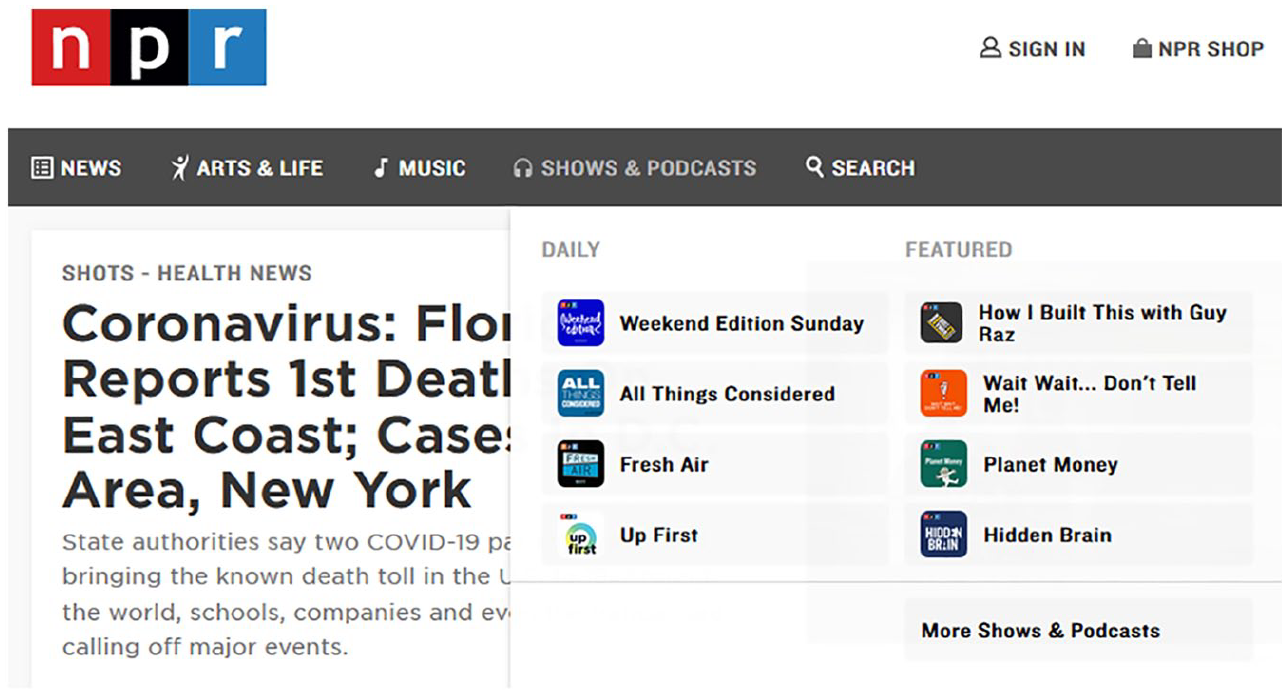
The gray ribbon on top of the home page directing visitors to shows and podcasts.
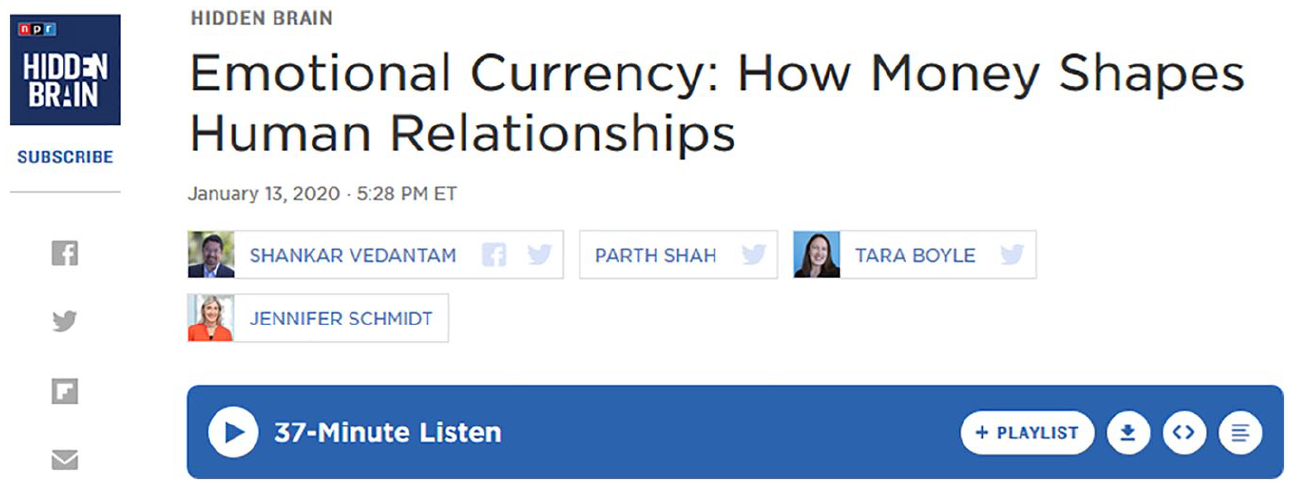
Options available on the episode page.
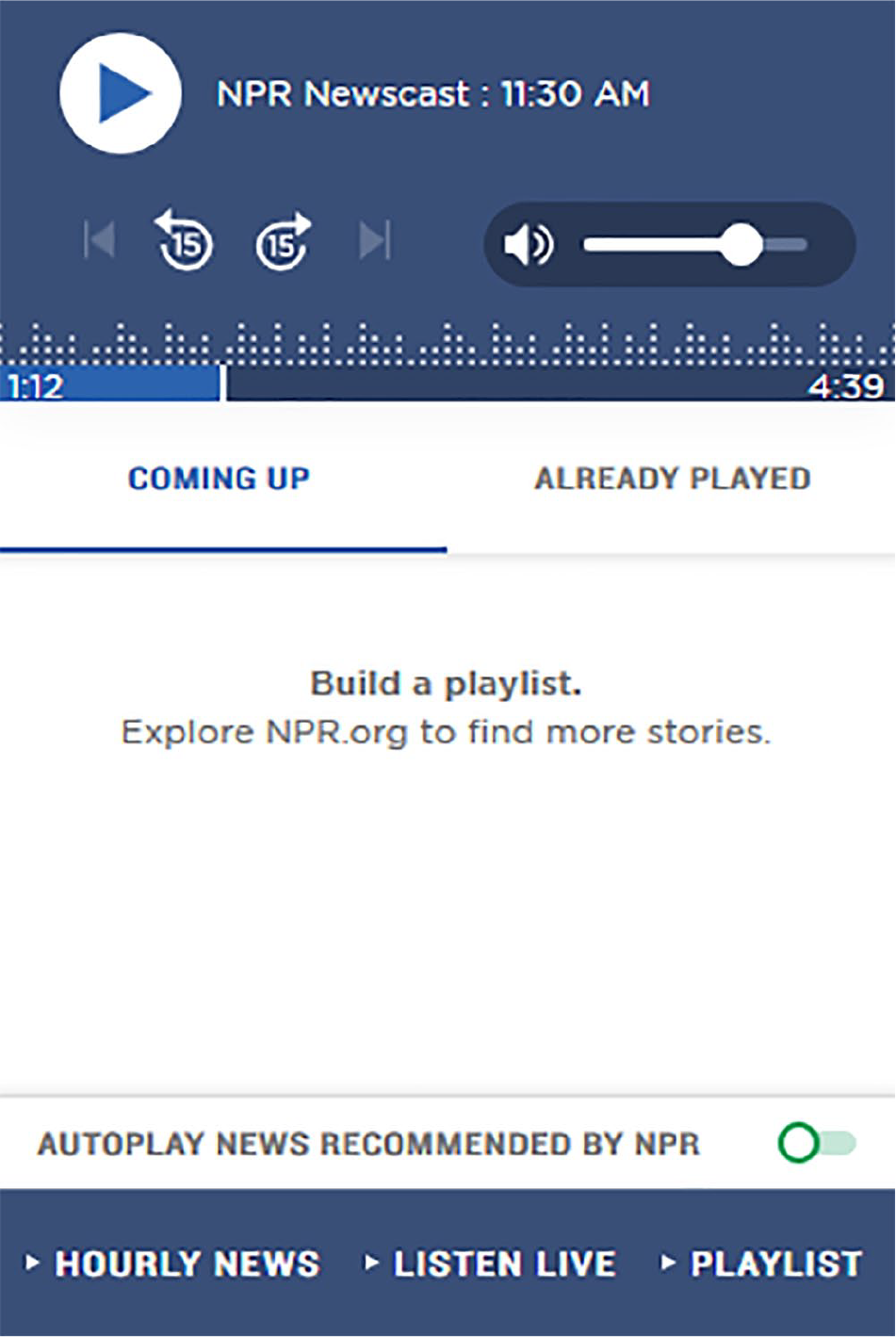
The NPR media player.
The first distinctive feature of the NPR website is related to the quality as well as the speech rate of its audio files. As NPR shows are produced for radio, they are recorded in studios with high fidelity sound equipment which renders the audio files especially crisp. Furthermore, NPR hosts and the guests who appear on shows speak more slowly and deliberately than individuals on TV, making the audio files particularly useful for lower proficiency learners. Griffiths’ (1990) early pioneering work demonstrated that unlike native speakers who have no difficulty comprehending texts of 300 words per minute (WPM), lower speech rates of around 150 WPM can greatly assist lower-intermediate learners in their comprehension. The speech rate of NPR shows varies from 125 WPM in unscripted interview shows like Fresh Air to 200 WPM in scripted drive-time newscasts like Morning Edition, and thus can be suitable for a range of proficiency levels.
The second distinguishing feature of the website, also contributing to the comprehensibility of shows, is provision of accurate transcripts for all broadcast episodes, which allows learners to read and hear the same content simultaneously. Research on L2 listening comprehension has shown that this has two potential benefits. First, learners can develop a feel for the L2 by picking up pronunciation of single words and rhythm of speech when they approach a text both visually and aurally (Gibson, 2008). Also, transcripts can provide learners with necessary world knowledge and schemata, which can scaffold their comprehension and give them access to authentic materials whose understanding may hinge on cultural knowledge (Schmidt-Rinehart, 1994).
NPR offers a wide array of shows, featuring different topics and programming styles that can appeal to a wide audience. This diversity of topics, ranging from politics and daily events to science, history and pop culture, has affordances for narrow listening – repeated listening to recordings of a particular topic, which can make topic-specific lexical items more salient and boost comprehension (Chang, 2019). On the NPR website, learners can find either a series of episodes from different shows on a topic of interest or a single show regularly covering one favorite topic. Furthermore, research on classroom-based second language acquisition has shown that learners are all too often exposed to formal speech in classrooms, which leaves them unprepared for the social situations they later face (McBride, 2009). To become better prepared for future social interactions, learners can listen to podcasts that showcase various speech styles and registers, from formal speech in scripted newscasts to casual style in unscripted comedy shows.
The last distinguishing feature of NPR is that it affords opportunities for intercultural awareness, an important component of L2 learning. NPR offers a neatly organized searchable archive for all its shows – even those that have been discontinued, making the audio files permanently accessible. By browsing through the archive of daily news podcasts, like All Things Considered, learners can access broadcasts aired at the time of momentous past events and better understand the American way of life. For instance, an EFL learner who has just read about Hurricane Katrina in a coursebook can listen to newscasts aired on the day this tragedy occurred and learn firsthand about its aftermath as well as the people’s reactions to it, getting a deeper appreciation of American culture. Besides, there is growing consensus that, to achieve intercultural awareness, L2 learners need exposure to a variety of narratives, voices, and personal stories from people in the target community (McBride, 2009), an aim that can be accomplished by listening to Talk of the Nation, a call-in show where US citizens from all over the country call and express their views on current topics, and Story Corps where ordinary Americans record and share their personal stories of love, loss, and friendship.
Although these four features may be found, to varying degrees, in other online tools, the NPR website offers them all in one place and in the highest quality possible. This website, as a useful learning and teaching resource, can offer great affordances for extramural learning, but teachers must exercise caution before using it. While the podcasts are rich in lexical items, they are not produced with learners of English in mind, a fact that necessitates careful pedagogical mediation before a decision is made to play them in class or direct less proficient learners to listen to them on their own. Otherwise, we run the risk of overwhelming the less experienced learner with material which is clearly beyond their competence and would inadvertently result in confusion and/or demotivation. Notwithstanding this caveat, www.npr.org is a great learning tool for higher proficiency, autonomous learners and a goldmine replete with pedagogic resources for English teachers working with lower proficiency learners who are on the verge of becoming independent and need the motivational boost resulting from comprehending authentic English input.
