




Abstract
Technology reviews are becoming an increasingly common genre within English language teaching and learning journals. This is due to the proliferation of technologies and their affordance in language learning. Although journals provide editorial guidelines for how to write technology reviews, they can be quite general. This short article offers some practical considerations and ideas, and includes published technology review as an example in the online appendix, showing the rhetorical moves for writing technology reviews in the field of English language teaching and learning.
Keywords
Introduction
Technology reviews, unlike book reviews, are a relatively new genre. They have become more common in academic journals due to the exponential increase in educational technology and their utility in the classroom. A technology review is a description and analysis of a technology that has application for teaching and learning. A review should focus on how the technology enhances teaching and learning, and not only describe its technical affordance or functionality. Although journals provide editorial guidelines for how to write reviews, they can be quite general (e.g. word count, brief article scope) and there are many possible technology review formats, leaving the potential writer unsure about what to include and how to structure the review. This short article provides some practical considerations and ideas for writing technology reviews in the field of English language teaching and learning.
What Can Be Reviewed?
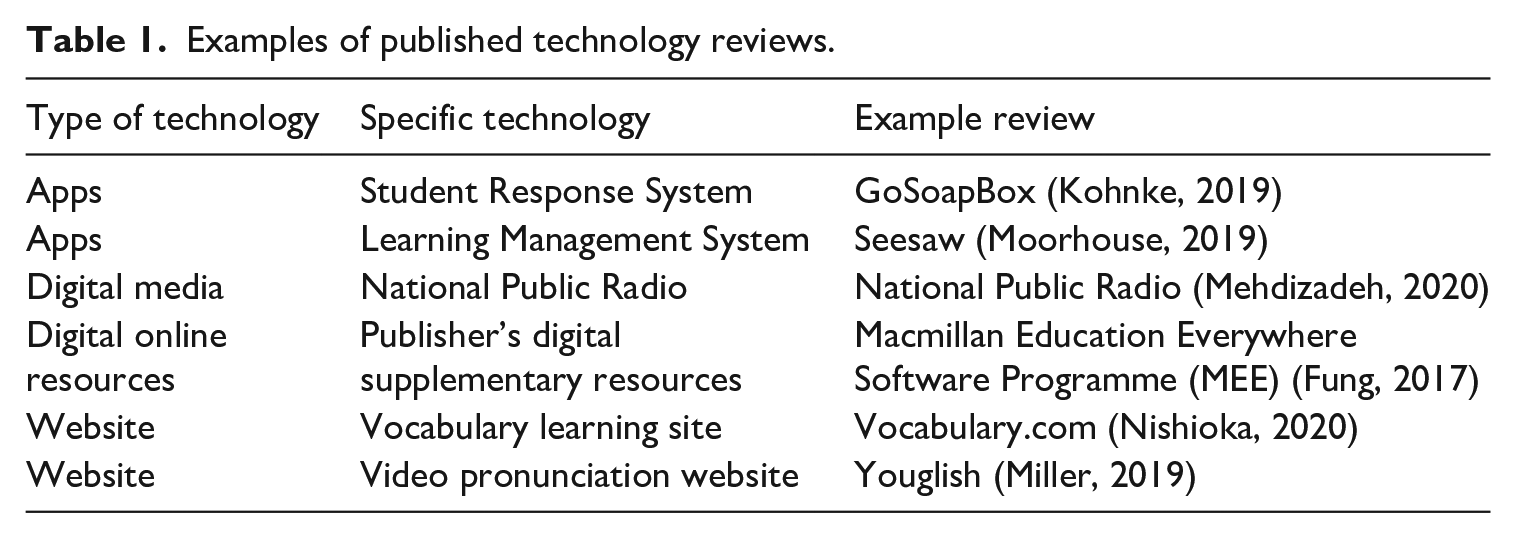
Technology reviews cover a large and growing amount of resources and media. These can include apps, websites, digital media, digital online resources, downloadable software, and other technology tools that can be leveraged for learning. (See Table 1 for example technologies and reviews.)
Examples of published technology reviews.
For English language teaching and learning journals, the technology reviewed should have the potential to enhance language teaching and learning. While some technologies are specifically designed for language learning, such as Duolingo (see Teske’s (2017) review), many other technologies have multiple features and utilities. If a technology is not specifically designed for language classrooms, the review must focus on how the technology can be leveraged for English language education, such as Moorhouse and Kohnke’s (2020) review of Mentimeter.
Why Should You Write a Technology Review?
Writing a technology review is a common way an academic can share knowledge and new technological innovations with the wider community. As teachers and learners increasingly become dependent on technology to manage and facilitate learning, such reviews are an excellent way practitioners and scholars can contribute to the field. Reviews provide an avenue to disseminate in-depth insights into a specific technology. If you are a novice writer, a review can help you become familiar with academic writing and the peer-review process. Writing a review can be a gateway to publishing full-length articles in the future.
Which Journals Publish Technology Reviews?
As the use of tech is a growing area of interest, an increasing number of journals are publishing technology reviews (also known as Media reviews), including TESOL Journal, TESL-EJ, CALICO, and the current publication, the RELC Journal. For novices, you might want to write reviews for established non-referred journals and magazines, such as English Teaching Professional, Modern English Teacher, and Humanizing Language Teaching. Once you have set your eyes on a specific journal, familiarise yourself with it by reading a couple of recent technology reviews within it and research the journal requirements. These requirements can be found on the ‘Manuscript Submission Guidelines’ pages of the journal’s website. Make sure that your technology review matches the requirements.
What Should You Include in a Technology Review?
In this section, we suggest what to include in your technology review and how you might organise it. We provide examples of the wording to help you get the right balance of evaluation and critique.
Section 1: Introduction
This section should describe the problem or issue in your context of English language education and how the technology addresses it. Perhaps the technology improves engagement, bolsters knowledge retention, encourages individual learning, facilitates peer collaboration, or provides benefits for teachers. This section is the foundation for the body of the article, so it must clearly state the main purposes and uses of the technology and indicate its users (e.g. primary, secondary, or tertiary students/teachers). It is good practice to end the introduction section with a summary of the article content. Here are some example phrases:
[The technology] allows teachers and learners to capitalise on and extend the benefits of . . .
Often in the language classroom, teachers can have difficulty . . ., [the technology] can help address this difficulty by . . .
Effective language learning requires . . . . To facilitate . . ., [the technology] . . .
The technology review provides . . .
Section 2: Utilising the Technology for Language Teaching
In this section, you should expand on the pedagogical soundness and appropriateness of the technology in your teaching context. This evaluation can be achieved by discussing if the technology is interactive, collaborative, facilitative, or instructional. Highlight why this technology supports second-language acquisition (e.g. writing, reading, listening, speaking) and if it can be tailored to learner differences and strategies. While this section discusses the technical affordances, it must focus on how the technology enhances language learning and teaching, and it must have a theoretical base from Teaching English to speakers of other languages/applied linguistics. You could consider utilising the following example phrases:
. . . particularly useful for learners to notice a mismatch between their language production and the target form . . .
Teachers can highlight cohesive devices in an essay, explain grammatical concepts . . .
It is helpful to readers if you include images (screenshots) that guide their attention with descriptive language regarding key features. Remember to capture high-quality images with the highest screen resolution possible.
Section 3: Challenges in Using the Technology for Language Teaching
A technology review should entail a critique and overview of the technology. Consider if teachers and students need any technical skills and outline any features that are more challenging to use (e.g. group discussions, recordings, speech recognition) and any potential security issues when using the technology. You could consider using the following example comments:
Although [the technology] has clear potential in the language classroom, it does present challenges. These include . . .
[The technology] has several limitations. For example, . . .
In addition, potential security issues exist, such as . . .
Section 4: Conclusion
Finally, summarise why the technology is important and outline the key benefits for language teaching and learning. Highlight the platform compatibility (PC/Mac, mobile), price (single user, class licence), and where readers can find more information about the product and its features. The following are some suggested phrases:
This review has shown the potential [the technology] has for language learning. The key benefits include . . .
[The technology] is available on . . . . There are several versions available. The free version . . .
For more information on [the technology] and its features, visit . . .
There is no perfect structure for a technology review, and the sections suggested previously are what we have found helpful in writing our technology reviews. The online Appendix 1 shows an example of a review published in the RELC Journal (Kohnke and Moorhouse, 2020), with comments in the margin explaining what the reviewers are writing in each part of the review. This review and comments should not be considered a formula or prescription but an illustration of one way to write a technology review.
A Final Note from the Authors
It can be challenging to get full-length research articles published in prestigious journals. For novice writers, technology reviews can be a way to contribute to the field while also gaining invaluable experiences with the journal review process. Both authors have found their academic writing performance develop through writing technology reviews, and writing them becomes easier with experience. Most of all, remember to familiarise yourself with the journal guidelines and read a couple of published technology reviews before you begin writing. That way, you will ensure your submission includes the right content, style, and tone the target journal desires. I hope you find writing technology reviews as rewarding as we have!
Supplemental Material
Appendix_I – Supplemental material for ‘There’s an App for That!’ Writing Technology Reviews for Academic Journals
Supplemental material, Appendix_I for ‘There’s an App for That!’ Writing Technology Reviews for Academic Journals by Lucas Kohnke and Benjamin Luke Moorhouse in RELC Journal
Footnotes
Author’s note
Benjamin Luke Moorhouse is currently affiliated with Hong Kong Baptist University, Hong Kong.
Funding
The authors received no financial support for the research, authorship, and/or publication of this article.

Supplemental material
Supplemental material for this article is available online.
References
Supplementary Material
Please find the following supplemental material available below.
For Open Access articles published under a Creative Commons License, all supplemental material carries the same license as the article it is associated with.
For non-Open Access articles published, all supplemental material carries a non-exclusive license, and permission requests for re-use of supplemental material or any part of supplemental material shall be sent directly to the copyright owner as specified in the copyright notice associated with the article.
