



Abstract
In recent years, the use of English corpora to instruct grammar in writing classes has become increasingly popular. In English for Specific Purposes classes, such a novel approach is critically important since it not only allows teachers to achieve a profound understanding of which syntactic structures should be instructed, but it also increases students’ exposure to a massive amount of language examples present in the corpus. Given the necessity of corpus-based grammar instruction, the article provides a detailed description of the utilization of AntConc, a concordance software program, to teach grammar in IELTS writing classes. The innovation aims to assist teachers to write teaching materials that accommodate students’ needs while enhancing students’ learning motivation and independent learning.
The Teaching Context
The International English Language Testing System (IELTS) is one common standardized test that non-native English students might need to take to pursue their study at an English-medium university. On the IELTS writing test, students’ essays are assessed based on the four marking criteria: task achievement, coherence and cohesion, lexical resources, and grammatical range and accuracy, each equally accounting for 25% of the overall IELTS writing score.
The innovation was applied in an IELTS writing class, which lasted 12 weeks and comprised 25 Vietnamese university students. Prior to their enrollment, students wrote a simulated argumentative IELTS essay within 40 minutes to determine their writing proficiency. Their scores ranged from 5.0 to 5.5 out of 9.0 on the IELTS scale (IELTS, 2020). The objective of the course was to provide grammar and vocabulary practice and familiarize students with different types of IELTS essays.
Reasons for the Innovation
As an IELTS instructor, I have seen students’ consistent attempts to employ grammatical structures which, based on my teaching experience, are seldom used on the IELTS writing test. Meanwhile, other students overused certain linguistic features such as personal pronouns. In the 13,860-word IELTS expert corpus (a description of this corpus will be discussed in the following section), the personal pronoun “you” appeared 12 times, whereas “he” occurred only four times, which indicates that personal pronouns should be used with caution in IELTS writing. Unfortunately, my advice often met with reservation. Some students suspected, “Is it based on your personal experience?”, whereas other students asked, “How can we know which structures we should study for the IELTS writing test?”
Such questions are thought-provoking for many reasons. First, we, as language teachers, usually have wrong intuitions about language use (Cobb and Boulton, 2015). Therefore, grammatical explanation, if based purely on personal teaching experience, may not satisfy students’ inquiries. Second, given time constraints, teachers must be selective about what to teach. However, the question is how they can identify which structures should be given more attention in their writing classes. Finally, most students seem to have a poor genre knowledge – that is, they often attempt to use a variety of grammatical structures without considering whether these structures are appropriate for the writing test.
A corpus-based approach to grammar instruction could be a helpful solution. Through corpora, teachers can uncover common linguistic features in a specific writing genre. Accordingly, they can decide on which syntactic structures should be taught and which should be excluded (Cobb and Boulton, 2015) and create activities and teaching materials that properly meet students’ needs (Folse, 2016). In the context of IELTS writing, if teachers obtain a good command of popular IELTS structures, they can devote more instructional time to such structures. In doing so, they can expedite students’ acquisition and mastery of the target structures required on the IELTS writing test. Meanwhile, when students attain an increased understanding of common IELTS structures, they will be able to formulate a strategic study plan with a clear focus on necessary grammatical constructions in IELTS writing. This, in turn, will contribute to the development of their writing skills.
In what follows, I will describe the use of AntConc (Anthony, 2019) to identify common syntactic structures in IELTS writing. The innovation aims to enable IELTS teachers to obtain insights into which grammatical structures should be given more attention while improving students’ awareness of popular structures in IELTS writing. For an illustration, I will describe how to use AntConc to extract passive constructions from the IELTS expert corpus.
Description of the Innovation
AntConc is a freely available software program. A detailed description of AntConc can be found at http://www.laurenceanthony.net/software/antconc/. Below is the utilization of AntConc to investigate passive constructions in IELTS writing.
Step 1: Collect IELTS Essays Written by IELTS Experts
The first and foremost important step is the selection of writing samples. Teachers must have a clear idea of what types of corpora (e.g. learner corpora or expert corpora) they want to create since different types of corpora will generate different patterns of language use. Furthermore, given time constraints and teaching responsibilities, the sample size is a critical consideration. Teachers usually lack time and technological skills to collect and process a large corpus of millions of words. For the present illustration, 50 IELTS essays written by native-English IELTS examiners were collected. Specifically, 37 essays were written by Corcoran (2020), seven essays by Cullen et al. (2014), and six essays by Hashemi and Thomas (2011).
Step 2: Use AntConc to Examine Passive Constructions
After the compilation of the IELTS expert corpus, the writing samples were converted into plain-text files and loaded onto AntConc. In search of passive constructions, words such as “be”, “am, is, are”, “been”, and “was, were” were keyed in the search box to extract potential passive constructions. In the end, there was a total of 554 search results. Following this, the extracted passive constructions were categorized as in Table 1. The searching and classifying process took about 20 minutes.
Passive constructions in IELTS writing.
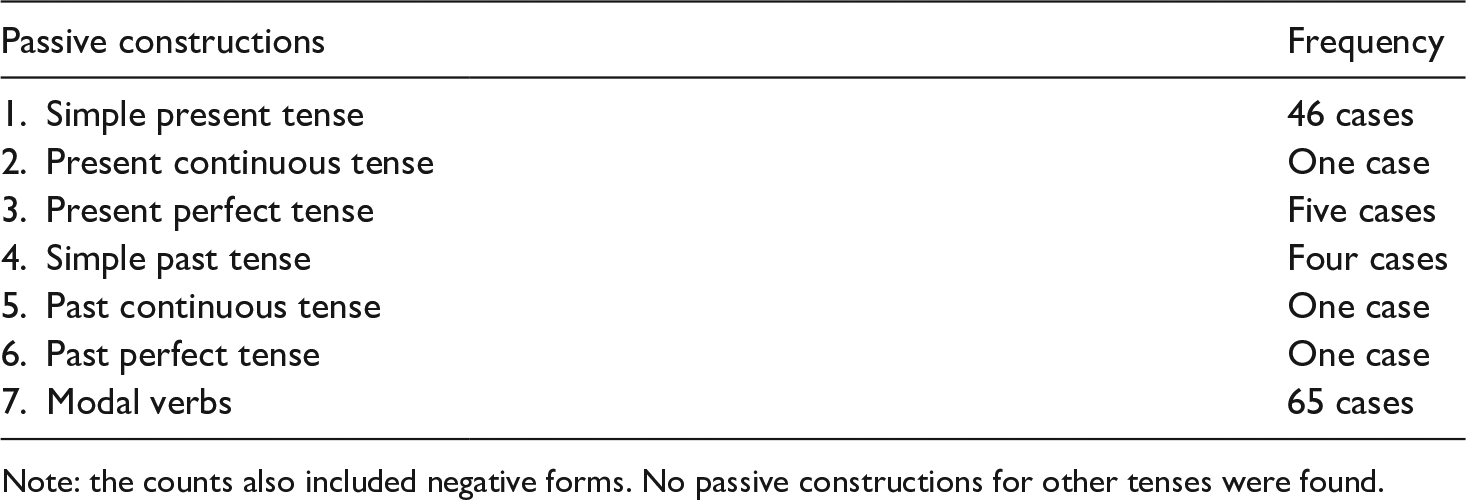
Note: the counts also included negative forms. No passive constructions for other tenses were found.
The results indicate that in argumentative IELTS writing, present tense and modal passive constructions are the most common, suggesting that a greater amount of class time should be devoted to teaching these passive constructions in IELTS writing classes. It was also found that the “by somebody” construction (e.g. commercial products are sold by businessmen) was rare (only nine out of the 123 passive instances). The passive construction “be + verb past participle + to-infinitive” (e.g. be required to do something) occurred 15 times. The construction “it + be + verb past participle + that” (e.g. it is argued that) occurred seven times. From these results, a discussion activity on the following questions was held: (a) Why are the present tense and modal passive constructions commonly used in argumentative IELTS essays? (b) Do you think it is necessary to use the “by somebody” construction in argumentative essays? If yes, when should this construction be used? and (c) What is the function of the “it + be + verb past participle + that” construction? Such questions would direct students’ attention to the usage of passive constructions in IELTS writing, eventually increasing their pragmatic knowledge of “what people mean by the language they use” (Larsen-Freeman, 2003: 35) in a specific writing genre.
Step 3: Train Students to Use AntConc
First, students were sent the link to download the software at https://www.laurenceanthony.net/software/AntConc/. Students were told to watch tutorial 1 at https://www.youtube.com/watch?v=O3ukHC3fyuc and tutorial 2 at https://www.youtube.com/watch?v=uAYCA8dYbr4. After that, writing samples were sent to students so that they could practice using AntConc before class.
Step 4: Provide Students with Hands-on Experience with AntConc
Students were asked to install the software in advance and bring their laptops to class. Students were told to open AntConc and load the writing samples onto the program. Following this, they worked in groups of four and typed “be”, “am, is, are”, “been”, and “was, were” in the search box (please see Appendix 1). To find passive constructions, students were told to examine the past participle verbs that follow “to be” forms. Students were informed that there were about 500 search results that potentially consisted of passive constructions, and thus, they should share the responsibility and determine who would search for which “to be” form. Once students completed their search, they were asked to count and classify the passive constructions. Such an activity afforded an opportunity for learners to become language researchers who were actively exploring a linguistic phenomenon (Johns, 1991).
Subsequently, a short discussion as in Step 1 was organized to foster students’ pragmatic knowledge of the target passive structures in IELTS writing. Mechanical activities (e.g. fill in the blanks and sentence transformation) that concentrated on the most popular passive structures in IELTS writing were presented to consolidate students’ explicit understanding of the target forms. For homework assignments, students were required to use AntConc to search for five present tense passive sentences and five modal passive sentences (the two most common types of passive voice in argumentative IELTS writing) in the IELTS expert corpus. After that, they would transform the passive into active and determine which voice was more appropriate based on the context. The activity aimed to reinforce students’ pragmatic knowledge and self-discovery skills.
Reflections
The use of AntConc in the language classroom is useful. First, the extraction result could suggest which structures should be taught in the context of IELTS writing. Such information would bolster teachers’ confidence in preparation for teaching materials and activities that accommodate students’ needs. Moreover, it facilitates students’ realization of popular structures in IELTS. This heightened awareness of popular linguistic features in a specific writing genre (e.g. IELTS writing) is conducive to the promotion of students’ writing skills (Dong and Lu, 2020). Finally, students reported a greater sense of ownership of their learning since they also utilized AntConc in search of other linguistic phenomena of their interest outside the classroom.
Nevertheless, there are many caveats teachers should take into consideration. One issue is that in some classroom settings, not all students have a laptop to operate the program. Therefore, teachers should organize group work activities where students collaborate to share their resources. Furthermore, using AntConc in the classroom might take up a great deal of class time. Thus, teachers should estimate the time it takes to extract a linguistic phenomenon. For example, for the illustration above, it took about 20 minutes to count and classify the passive constructions in the corpus of about 14,000 words. With that information, groups of four students were organized so that students could share the responsibility for the categorization of the passive constructions in the corpus.
Second, as described earlier, the present IELTS corpus size is small, only about 14,000 words. Thus, the results may not be representative. However, as Cobb and Boulton (2015: 480) contended, a corpus built for language teaching is not “necessarily meant to be representative of a language in its entirety.” From a pedagogical standpoint, such a purpose-built corpus is valuable for two main reasons. First, most teachers are not well-trained in corpus linguistics. It will be difficult, if not impossible, to ask teachers to compile and analyze a huge corpus. Second, the analysis of a large corpus is extremely time-consuming, and teachers will not have time to conduct an extensive search of a linguistic structure because of other teaching responsibilities. The corpus size of 15,000 to 20,000 words is sufficiently good as a starting point of investigation for classroom use. Apparently, if teachers have more time, they should compile a larger corpus.
Third, the IELTS expert corpus in the current article was compiled from the essays written by native-English IELTS examiners for two main reasons. First, since the essays were prepared by native-English speakers, it ensures a good quality of language use. Second, writers of these essays are IELTS examiners. Therefore, they must have an excellent command of which grammatical structures should be used to achieve a good IELTS writing score. If teachers cannot find high-scoring writing samples prepared by IELTS examiners, they can build the IELTS expert corpus by selecting high-scoring IELTS essays written by IELTS candidates (e.g. 8.5 to 9.0 out of 9.0 on the IELTS scale). Nevertheless, some important considerations should be discussed. First, teachers should be aware of the source and the raters of the writing samples. Otherwise, there will be an issue with the score reliability that might affect the quality of language use. One recommendation is that teachers should compile high-scoring essays assessed by trained IELTS experts. Second, if the essays are written by second-language learners, teachers should be aware that “learner corpora tend to contain a much higher error rate than native corpora” (Granger, 2009: 24). Therefore, teachers might need to read over the essays and correct spelling errors, which will entail a tremendous amount of time and effort.
One final remark is that teachers might want to introduce meaningful activities that follow the extraction of a syntactic structure. For example, teachers can have students write IELTS essays and collect their essays to build an IELTS learner corpus. Then, teachers can have students use AntConc to compare the type and frequency of a syntactic structure between the IELTS learner corpus and the IELTS expert corpus. The activity will enable students to recognize which constructions they are inclined to overuse or underuse when they write an IELTS essay. Another interesting activity is that teachers can use AntConc to extract the most common errors and create guided activities to assist students to self-correct errors in their essays.
Future Pedagogical Directions
Although the innovation was applied in an IELTS writing class, it can be employed in many other writing contexts. For example, in business writing classes, teachers can utilize AntConc to direct students’ attention to common phrases used to make polite requests in email writing. Meanwhile, in English for Academic Purposes classes, teachers can take advantage of AntConc to assist students’ realization of the usage pattern of grammatical constructions commonly found in academic writing. Another point is that in the article, AntConc was utilized to teach grammar. However, teachers might employ it to explore lexical phrases in a corpus by means of the n-gram or collocate functions.
Secondly, if teachers have time and strong technological skills, they should collect more writing samples to build a larger corpus. Still, given time constraints and teaching responsibilities, a small corpus of 15,000 to 20,000 words does provide teachers with some guidance on which syntactic constructions should be taught in the classroom. One suggestion is that teachers can cooperate with their colleagues to build a reasonably good corpus size, from which they will be able to produce a more reliable search result.
Finally, the application of AntConc in the classroom can be time-consuming. Thus, if the extraction process takes a huge amount of time, teachers are advised to turn the in-class corpus-based activity into a project-based activity where students use AntConc to investigate the corpus collaboratively. Following this, they will discuss their findings with other groups in class. The activity will provide excellent learning opportunities for students to boost their teamwork ability and sharpen other fundamental skills such as independent learning and critical thinking.
In conclusion, a corpus-based approach to grammar instruction in IELTS writing classes is beneficial and important. It not only enhances teachers’ understanding of which syntactic structures should be taught in the context of IELTS writing but also promotes students’ learning autonomy, learning motivation, and critical thinking skills.
