



Abstract
This study compares the attitudes of Indonesian student teachers to the use of Bahasa Indonesia (BI) in primary and secondary school English classrooms to that of the instructors in their teacher training programmes. It also examines the metacognitive orientations the student teachers have towards its use in their future teaching. Questionnaire responses by student teachers finishing their final-year practicum (N=75) from seven university programmes showed two distinct attitude sets toward BI use. Approximately 40% were ‘Avoiders’ who intended to use BI never or only occasionally, while another 20% were ‘Embracers’ who intended to use it regularly or often. There was a demonstrable relationship between the intended use and the practice and attitudes of the instructors the students had in the teacher training programme. Avoiders were more likely to have programme teachers who avoided BI use, while Embracers were the opposite. The student teachers also displayed a strong sense of agency in approaching future BI use. Although more explicit attention to the topic in the teacher training curriculum was welcomed, the majority also felt confident they could deal on their own with the challenges presented by future BI use. Potential effects on responses of practicum class size and school level were examined, but neither was significant. An important finding from the study for teacher training programmes is the effect, intentional or incidental, that teacher educator behaviour may play in shaping student teacher attitudes.
Introduction
A fundamental concern for any teacher, novice or experienced, is how to approach the use of the learner’s first language (L1) in the second language (L2) classroom. 1 Teachers vary in how they do this, and the attitudes and beliefs that develop reflect their training, experience and the educational contexts in which they function. A growing body of research has examined these attitudes and how they are reflected in L1 use in the classroom (Hall and Cook, 2013). Studies have compared L1 attitudes and uses by both the teachers and learners (Hall and Cook, 2013; Leoanak and Amalo, 2018; Littlewood and Yu, 2011; Manara, 2007; Pasaribu, 2001; Storch and Wigglesworth, 2003; Usadiati, 2009; Yulia, 2013), primarily from the teacher’s perspective (Mohebbi and Alavi, 2014; Polio and Duff, 1994; Zacharias, 2004) or mainly from the learners’ viewpoint (Brooks-Lewis, 2009; Macaro, 2005; Scheffler et al., 2017). There is also an emerging body of international research that focusses on how student teachers approach L1 use (Hirsu and Zacharias, 2019) in specific contexts, including Japan (Miura, 2010; Turnbull, 2018), Turkey (Yildiz and Yesilyurt, 2016), and Israel (Orland-Barak and Yinon, 2005).
The findings are diverse, but a dominant theme emerges across actors and contexts in L1 use is reluctantly accepted in the L2 classroom as unavoidable. This is particularly the case in L2 English settings, and especially at the beginner levels (Hall and Cook, 2013). While the dominant theme, this view is challenged both by traditional immersion approaches that categorically exclude L1 use (Ellis and Shintani, 2014), and by those that believe the L1 can make a positive and unique contribution to L2 learning outcomes (Rolin-Ianziti and Varshney, 2008). This is particularly the case in the growing field of translanguaging, where the L1 and L2 are both seen as playing a central role in L2 learning and use (Hirsu and Zacharias, 2019; Vogel and García, 2017). Translingual pedagogy was originally developed to address issues in English as a second language settings, particularly in North America (Vogel and García, 2017) and to date has only had a limited impact in Indonesia.
A handful of studies have examined the use of Bahasa Indonesia (BI) in the Indonesian EFL context. To varying degrees, all echo the idea that BI use, while not desirable, is often unavoidable. The university teachers in Zacharias (2004) saw some use for BI in class. However, it was felt such use should be kept to the minimum, though what that minimum was less clear. Manara’s (2007) tertiary level teachers and students strongly endorsed the notion of the English-only classroom but also recognized that the realization of this ideal differs by interactional settings, student-student, teacher-student, and teacher-class, as well as the particular task or activity, e.g. giving instruction versus creating class rapport. High school teachers in Leoanak and Amalo (2018) found BI use beneficial in English learning particularly when codeswitching was implemented. The tension between the English-only ideal and the BI-use reality was also evident among students (Haryanto et al. 2016). Though like Zacharias (2004), the respondents in Haryanto et al. (2016) were very unsure how much BI use is appropriate.
This study builds on these findings. The focus is on pre-service student teachers and their attitudes toward BI use at the start of their careers, attitudes that are being formed in teacher training programmes where little curricular attention is given to the topic. The study is distinctive in that BI attitudes and use by student teachers are compared with that of their programme lecturers. The potential effect of the programme lecturer on the likelihood of the student-teacher using BI in their future teaching receives particular attention.
Method
This study examines the practices and beliefs of Indonesian student teachers of English toward the use of L1 Bahasa Indonesia (BI), set against the backdrop of their own experience as students in an undergraduate English language teaching major. The study attempts to identify (1) the practices and attitudes toward BI use that programme teachers exhibit, (2) student teacher attitudes in respect to their own BI use, (3) what, if any, relationship exists between programme teachers’ attitudes and practices and student teachers’ attitudes, and, finally (4) student teachers’ attitudes toward the treatment of BI use in their teacher training programme.
A questionnaire was used to identify the student teachers’ experience with BI in their undergraduate English training. This included how their university English teachers used BI in the classroom and the students’ attitudes toward this use. They were then asked about how they used BI in their teaching practicum experience, their attitudes toward its use, and how they planned to use it in future teaching. Finally, the student teachers were asked about how the use of BI was addressed during their teacher training programme. The questionnaire was followed up by interviews with a subset of the participants. This article presents the questionnaire findings.
Participants and Setting
The participants were 75 student teachers (49 females, 26 males) who had recently completed a capstone teaching practicum in East Nusa Tenggara Province. Participants were recruited from seven regional universities through online social media platforms and messaging services. This was done both privately (i.e. private message) and publicly (i.e. through online social media). They were given a brief explanation of the research project and the link to access the questionnaire. Participation was voluntary. The study was approved by the Human Research Ethics Application (HREA) Board of The University of Queensland, Australia.
At the time of the study, the participants were either completing the teaching practicum unit as part of their final undergraduate year of the English Education Study major or had completed the unit three to four months earlier. The length of the teaching practicum varied from three to six months, depending on the local junior or senior high school where it took place, as well as on the specific requirements of their programme. The practicums took place across classes of differing sizes and levels, allowing the potential effects of teaching context on practice and perception also to be examined (Hall and Cook, 2013).
As throughout Indonesia, English is learnt as a foreign language in the area where this study took place. Even though English is learnt throughout the 12-years of compulsory school, it is not commonly used in learners’ everyday lives. There are more than 70 local languages in this area (Ethnologue Languages of the World, 2020), yet BI is the dominant language of instruction including in the English classroom.
The Questionnaire
The questionnaire collected demographic data (e.g. gender, teaching practicum duration, class size, etc.), the participants’ experience with the use of Bahasa Indonesia (BI) in learning English at university, their experience with the use of BI during the teaching practicum duration, and their opinion of its use in the English classroom. Ten respondents volunteered to participate in a follow-up online interview.
The questionnaire had 30 items eliciting data on the type and frequency of BI use by both the teachers in the English language teaching programme and student teachers during their teaching practicum, as well as the attitudes the student teachers had towards BI use, currently and in the future. Two checklist items elicited data on BI use by the programme teachers and student teachers. The remaining items were Likert-type statements. They examined the overall frequency of BI use by the programme teachers and student teachers (8 items) as well as specific domains of BI use by the students during their English study and by the practicum students they observed (8 items). They also targeted attitudes by the student teachers towards BI use both by the programme teachers and in their own teaching, present, and future. Two items also addressed how BI use was approached in the training programme. The questionnaire ended with a section for further comment. The questionnaire items were adapted from Hall and Cook (2013), with several additional items also included. The eight items on specific domains for student use were not included in the current analysis, which focusses on teacher behaviour.
Participants had the option of completing the questionnaire in BI or English. Both versions were piloted to ensure the items were understandable for the prospective participants. The English version was examined for wording by three English teachers in two Indonesian universities and the Indonesian version by a professional translator. Some rewording was then made accordingly. Fifty-nine participants completed the Indonesian version and 16 completed the English version. In the initial analysis, the responses for the alternate versions were analysed separately. The pattern of response indicated little differences between the two, and so the responses for the two versions were combined in the main analysis.
The online questionnaire was administered using Google Form, with links distributed through Facebook as well as WhatsApp. Both versions of the questionnaire and the raw responses are available from the Open Science Framework website, https://osf.io/3hegt/files/.
Results and Discussion
The results are in two parts. The first part compares BI use by the training programme teachers in the course with that of the student teachers during their practicum. The findings establish the amount and type of BI use as a backdrop against which student-teacher attitudes are examined in the second part. Also of interest is the degree to which the stated likelihood of using the BI in their future teaching is related to the student teachers’ programme experience, particularly to the attitudes about BI use expressed by their teachers. The effect of teaching context on the questionnaire responses is also considered by comparing the results by the practicum school level and class size.
The five-point Likert item scales were reduced for ease of presentation and discussion. Frequency judgments were converted from the original five-point scale to a three-way scale of never/occasionally – sometimes – often/regularly, and those concerned with the degree of agreement converted to a three-point scale (strongly disagree/disagree – undecided – agree/strongly agree). Table 1 reports the original five-point findings for the target items for reference.
Likert Item Raw Percentages for Student Teacher Responses.
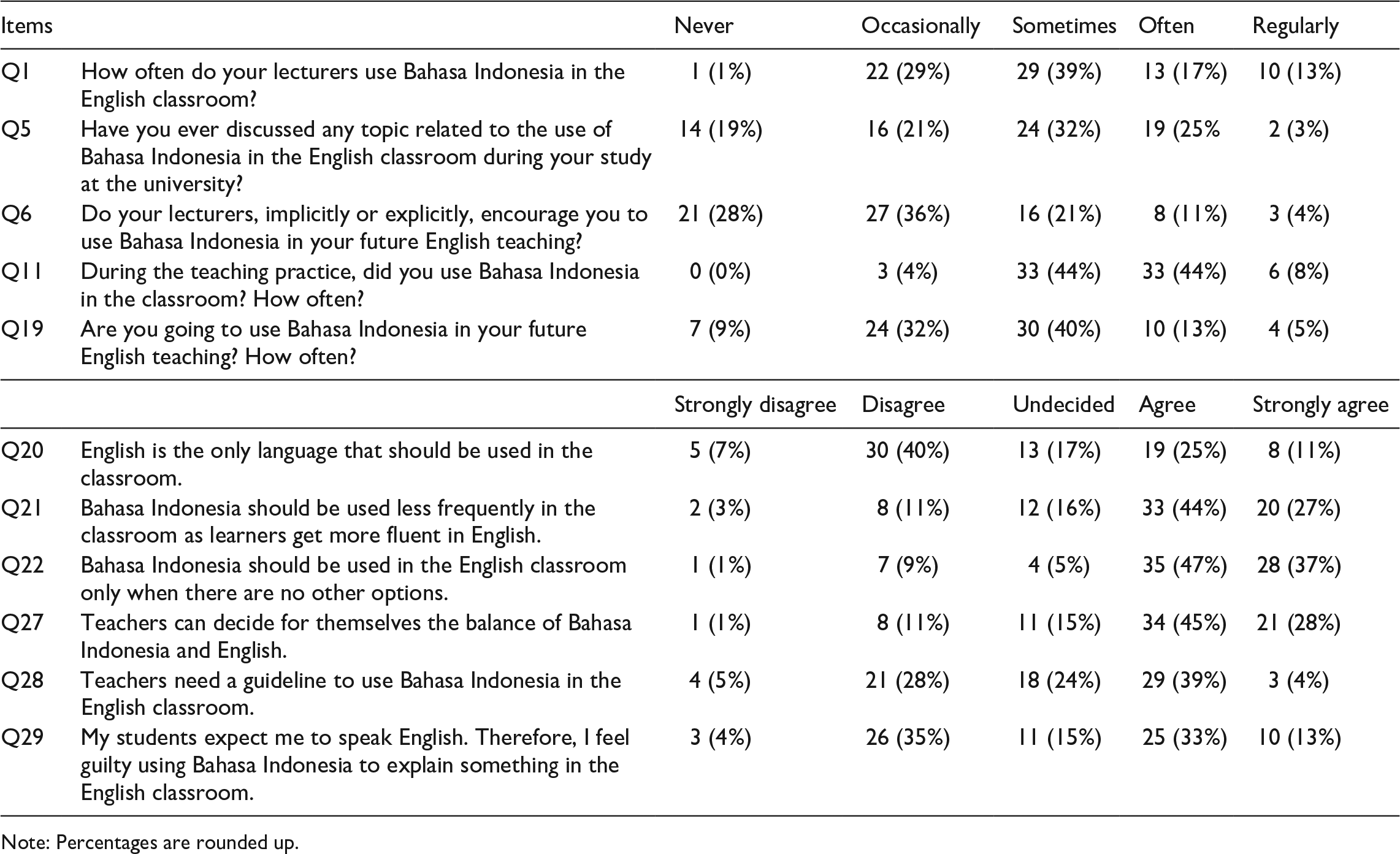
Note: Percentages are rounded up.
BI Use in Indonesian Teacher Training Programmes
First, we will profile BI use by the programme teachers and student teachers as reported by the student teachers.
How often do programme teachers use BI?
When asked how often the programme teachers in their teacher training programme used BI in class (Q1), the responses were split evenly across the three-point scale, with both never and often each selected 30% of the time and sometimes the remaining 40%. As with the international survey results, a general tendency toward at least some BI use was countered by a sizeable number – one-third – that never or only occasionally used the BI. Students were also asked how often their teachers discussed topics related to BI use (Q5). Most programme teachers (40%) never broached the subject, counterbalancing the 30% who discussed BI use often. Nearly 65% of the student teachers reported receiving little or no encouragement to use the BI in their own teaching (Q6).
When asked about their own BI use in the teaching practicum (Q11), 45% of the student teachers reported they used it at least sometimes and a further half reported using it often. Thus, the student teachers used BI far more often than the programme teachers, though this may be due to differences in the English proficiency levels of the students taught in the respective contexts. However, when the student teachers were asked about whether they intended to use BI in their future teaching (Q19), the pattern of responses differed markedly. Only about 20% thought they would use it often and 40% never. We will return to these results below where the student responses to future teaching intentions (Q19) are cross-plotted with the programme teacher use to detect possible relationships between programme teacher behaviours and future use of BI by students.
Uses of BI
In addition to asking how often the BI was used, what it was used for was also considered. Participants responded to a checklist of BI uses drawn from Hall and Cook (2013). Two types of uses by their programme teachers (Q2) and their own BI use in the practicum (Q12) were canvassed. Language-related uses involved explaining, exemplifying and correcting aspects of the target L2 that might otherwise be difficult to address effectively or at all (Brooks-Lewis, 2009). Figure 1 compares the language-related responses for the programme and student teachers. The programme teachers were more likely to use the BI for an explanation of tasks, grammar, and vocabulary, while the student teachers tended to use it for correcting and providing feedback, as well as explaining cultural concepts.
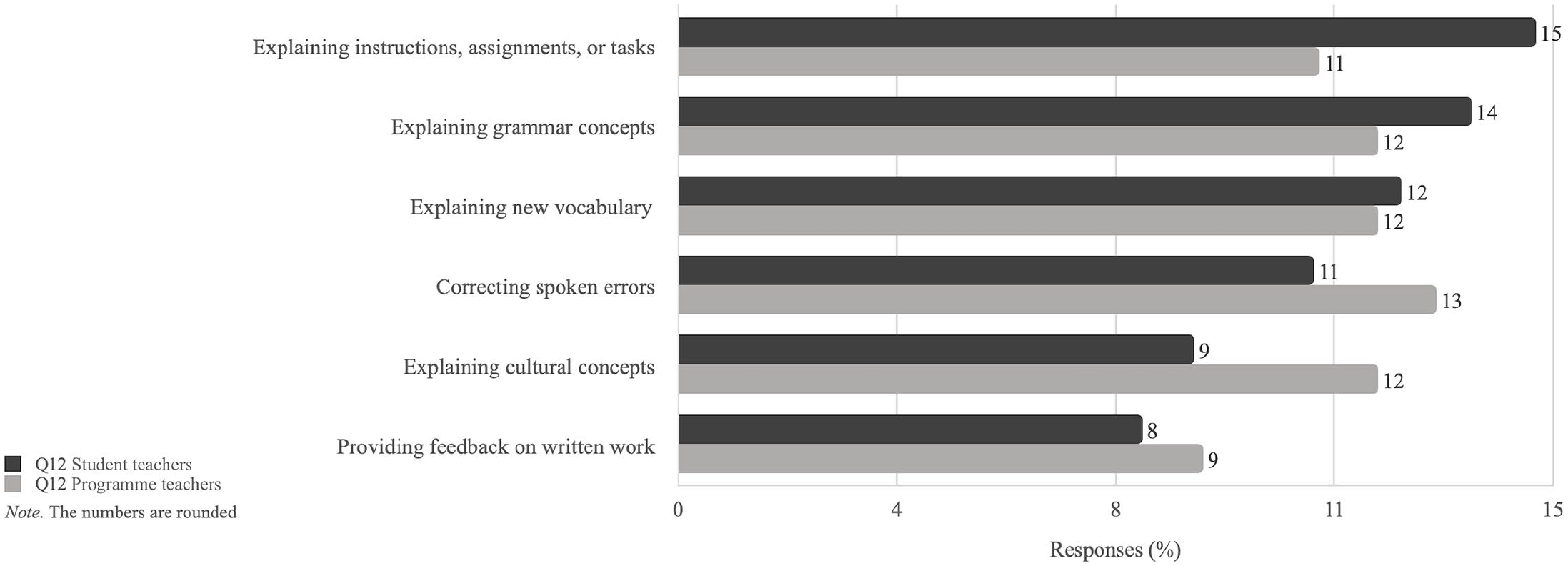
Checklist Responses for Uses of Bahasa Indonesia for Language-Related Functions by Programme Teachers and Student Teachers.
Classroom management uses of BI include managing tasks and classroom ambiance. Classroom management uses by the programme and student teachers are given in Figure 2.
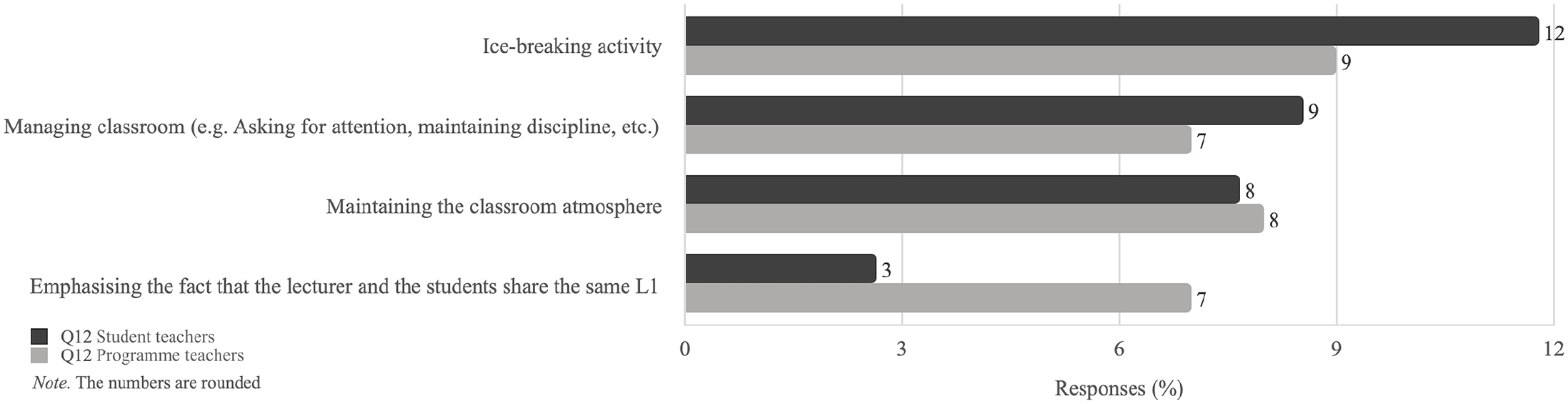
Checklist Responses for Uses of Bahasa Indonesia for Classroom Management by Programme Teachers and Student Teachers.
Programme teachers tended to use BI more in ice-breaking activities, while the student teachers used it more to express solidarity with the students. Overall response numbers are low for both figures, with the highest response, explaining instructions, was only chosen by 15% of participants. This was also the most common response in the Hall and Cook (2013) survey. Comparisons are also limited by the difference in the learners in the respective teaching contexts. If the practicum teachers are using the BI for essential classroom management functions like giving instructions and clarifying tasks, then there may be less need to use BI to reinforce the fact that the teacher and learner share the same language.
Future BI Use by Student Teachers
The student teachers are about to begin careers as English language teachers in Indonesia. Here we present the attitudes toward the use of the L1 they take forward as novice teachers and discuss factors that may contribute to the development of these views. We considered whether the student’s practicum experience, reflected in both class size and schooling level (junior and high school), might play a role in student-teacher responses. Neither factor played a statistically detectable role. 2
Do the student teachers plan to use the BI in their future teaching?
The majority of the participants believe there is a role for BI. However, there were big differences among the group in enthusiasm. A sizeable 40% of the participants, whom we will call the ‘Avoiders’, said they were never, or only occasionally, going to use BI in future teaching (Q19). This is approximately the same number (36%) that strongly agreed that English is the only language that should be used in the classroom (Q20). At the other end of the continuum, a smaller group, just under 20%, of ‘Embracers’ intended to use BI regularly or often.
Although most respondents approved of some use of the L1, it was widely viewed in remedial terms. More than 70% suggested that BI should be used less frequently in the English classroom as learners get more fluent in English (Q21), and nearly 85% agreed that BI should only be used when there are no other options available (Q22). The reluctance to use BI is further underscored by the fact that almost half agreed that they felt guilty when not using English in class (Q29). These findings are in line with other studies that have examined student teachers in various settings, including Japan (Miura, 2010; Turnbull, 2018), Turkey (Yildiz and Yesilyurt, 2016), and Israel (Orland-Barak and Yinon, 2005). Not surprisingly, the lower the proficiency of the students taught the more likely the use of the L1 is endorsed (Orland-Barak and Yinon, 2005).
What effect did the programme teachers have on future BI use?
The results show BI use is pervasive in the Indonesian university classrooms, but student teachers differ in how they approach it. A large group of Avoiders approaches BI as possibly necessary but not desirable, while Embracers intend to incorporate its use in their regular teaching practice. Given the uniform educational background of the student teachers, and the fact that all will teach at the pre-tertiary level upon graduation, the differences in attitudes are somewhat of a puzzle. One possible source for the observed divergence is how the student teachers were socialized in BI use during their teacher training programme. More specifically, to what extent the programme teachers used and promoted the use of BI in the classroom affects student-teacher attitudes toward future BI use.
The participants were asked about three aspects of BI use in the teacher training programme. These concerned how often the lecturer used BI in the classroom (Q1), whether topics related to BI use were discussed (Q5), and whether the lecturer encouraged BI use (Q6). Q1 and Q6 directly involve the lecturer. Q5 asked about discussions of BI use at the university, which does not exclude discussions among the students themselves but is assumed to involve the lecturer. BI use varied distinctly. For frequency of use, the programme teachers were split evenly, with 30% never using BI, another 30% using it regularly, and the remainder using it sometimes. Just under half the student teachers indicated BI use was never discussed, while another 35% said there was a regular discussion (Q5). Finally, a substantial majority (65%) responded that their teachers never encourage B1 use, with the remaining responses split between sometimes and regularly.
The student teachers were thus exposed to a range of BI use during their teacher training programme. Can this experience be correlated with their intention to use BI in future teaching? In the questionnaire, the student teachers were asked how often they planned to use BI in their teaching (Q19). Only 20% of student teachers planned to use BI regularly, and the rest were split evenly between sometimes and never/occasionally. Student-teacher responses were correlated with the responses for three aspects of BI use (Q1), discussion (Q5), and encouragement (Q6), respectively. The cross-item comparison is presented in Table 2.
Comparison of the Three Items Concerning BI Use in the Programme (Q1, Q5, Q6) with the Three Response Categories for Student-Teacher Intended Future BI Use (Q19), Never, Sometimes and Regularly.
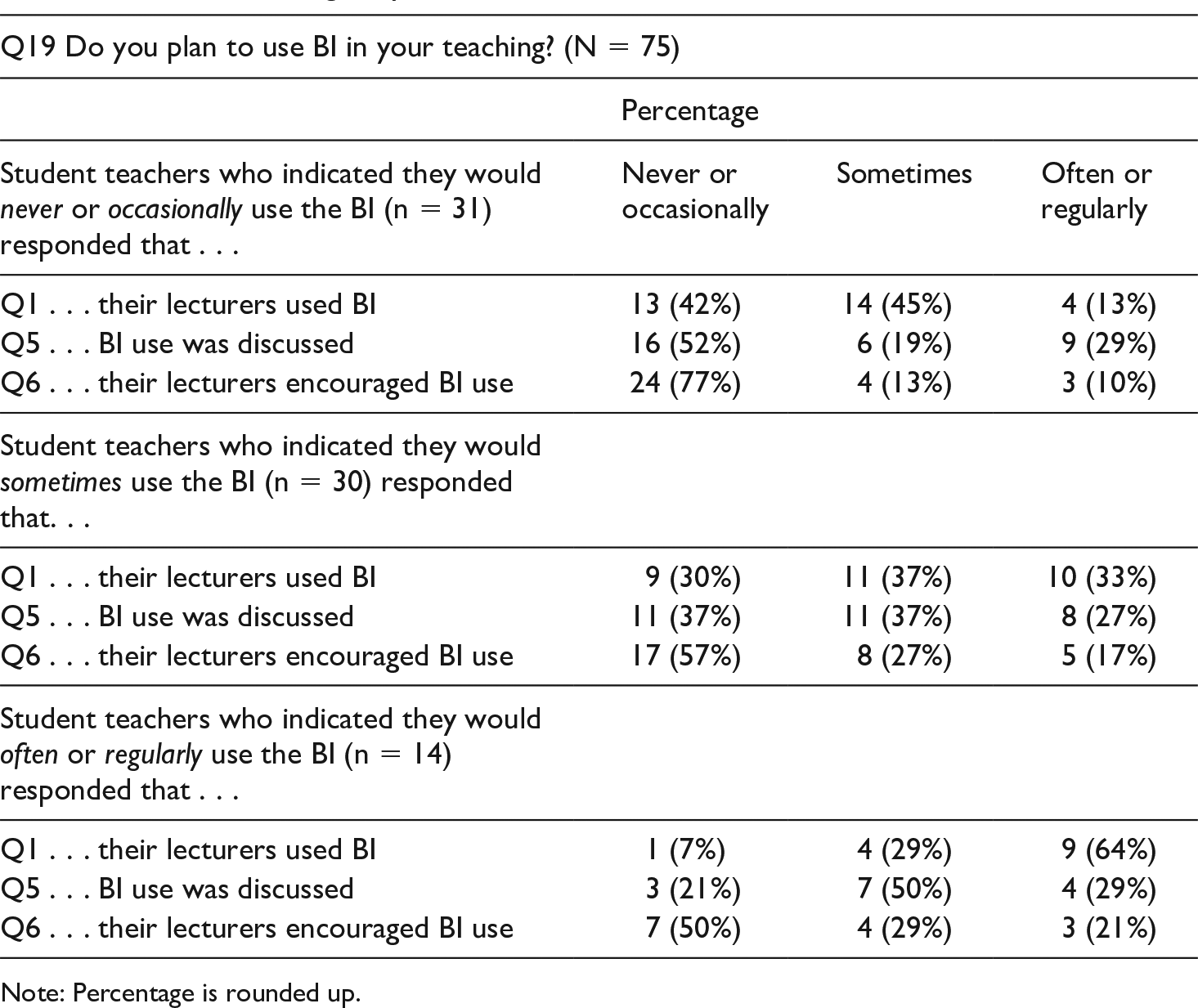
Note: Percentage is rounded up.
Selected findings from Table 2 are illustrated in Figure 3.

Percentage of Never/Occasionally Responses for the Three Uses of BI in the Programme, Q1 Lecturer Use, Q5 Discussion, and Q6 Lecture Encouragement, for Each Response Category (Never-Sometimes-Often) for the Student-Teacher Intention to Use BI (Q19).
To what degree are student-teacher responses affected by the BI-related behaviour they experienced in the programme? The bars in Figure 3 present the percentage of never/occasionally responses for the three BI use items (Q1 class use, Q5 discussion, and Q6 encouragement), for each response category (never-sometimes-often) for the student’s intention to use BI (Q19). The Avoiders are represented in the three-bar cluster on the left. These respondents indicated that 40% of their programme teachers avoided BI use. In contrast, the Embracers (the rightmost cluster) reported only 7% of their programme teachers never/occasionally used BI. Likewise, only half the Avoiders reported that BI use never came up as a topic of discussion, while the same figure for the Embracers was only 7%. Given the wording of Q5, it is possible the Embracers themselves were driving discussions of BI use. The Avoiders also experienced far less encouragement, with such input being absent or only occasionally 80% of the time, which compares to only 20% of the time for the Embracers. The middle-of-the-road students (responding sometimes to future BI use) had programme teachers that were more likely to use BI than the never/occasionally students but somewhat less likely than the often/regularly students.
Spearman’s Rho correlation was used to test the strength of association between intention to use BI in the future (Q19) and the three aspects of BI use in the programme (Q1) lecturer BI use, (Q5) BI discussion, and (Q6) lecturer encouragement, all ordinal measures. There was N = 75 for all comparisons. Future BI use (Q19) correlated with use of BI by teacher (Q1), rs = .36, and p = .002; and encouragement by the teacher to use BI (Q6), rs = .35, and p = .002. It did not significantly correlate with the discussion of BI use (Q5), rs = .12, and p = .29. The ambiguous wording of the item may have affected this result. Both effect sizes for the significant findings are considered small (Plonsky and Oswald, 2014). The results show that the behaviour of the lecturer has a small but palpable effect.
In summary, there was an observable effect of lecturer BI use and the probability of the student-teacher intention to use BI in their future teaching.
Should teacher preparation programmes provide explicit guidelines for BI use?
We have established that respondents differ in how they approach BI use. It is also evident that programme teachers influence student teachers. Nevertheless, the evidence for the latter only identifies incidental experiences that students have in the teacher training programme. What about more formal attempts by the teacher training programmes to address BI use and even provide prospective teachers with guidelines for its use? In the first author’s teacher training, there was no attempt to address the issue, and an online search of Indonesian ELT programmes did not yield any evidence that teacher training programmes in Indonesia address the L1 use in explicit terms. Some universities provide detailed syllabus information (e.g. Universitas Pendidikan Indonesia, 2018). However, none mention the role of the L1 in English teaching in their curriculum, or at best only provide general information about their English education study programmes and the list of required courses (e.g. Universitas Katolik Indonesia Atmajaya, 2017).
We directly asked student teachers whether such guidelines are needed and/or desired. Remarkably, nearly three-quarters of the respondents felt that teachers could decide for themselves the balance between BI and English use in the classroom (Q27). However, 40% also agreed that teachers need guidelines (Q28). Thus, although student teachers feel confident they can make decisions concerning BI use on their own, a large number also agreed that guidelines would be useful. The findings show that the student teachers demonstrated a very high degree of agency, that is, to act constructively and confidently, in future dealings with BI use (Duff, 2012).
The findings from a follow-up interview with nine of the participants are not being discussed at any length, due to space limitations. Briefly, the differences evident in the questionnaire were reflected in interviews, where views for and against BI use were expressed. The overall view emerging from the interviews mirrors that expressed in Hall and Cook (2013) namely, that the primacy of English in the classroom goes hand-in-hand with the use of the L1 where needed. In the words of one of the students, ‘We must admit that most of our students may not be able to fully speak English well. Therefore, the use of Indonesian in the classroom should not be prohibited. This is done solely to help students understand the lesson. However, English should remain as the dominant language’.
The robust support for the notion that the student teachers themselves are best placed to decide guidelines for BI use was also resolutely endorsed in the interviews and the need for guidelines was also expressed.
Summary of Outcomes
There are three main findings from the study:
1) Student teachers showed a range of views toward BI use. Avoiders sought to minimize BI use to the greatest extent possible, while the Embracers saw it as having a more positive function. In general, the use of BI was viewed as more of a necessity than the desired end. This was similar to earlier Indonesian studies (Haryanto et al., 2016; Manara, 2007; Zacharias, 2004). The findings were also similar to the teachers surveyed in Hall and Cook (2013)
2) Programme teachers influence student teachers’ attitudes. An important finding emerging from the study is the correlation between programme teacher behaviour vis-à-vis BI and the student-teacher likelihood of using it in their teaching in the future.
3) Student teachers are willing to decide for themselves how to deal with BI. In general, the student teachers felt that, despite having no explicit guidelines, they were confident that they could handle the potential problems that might arise when using BI in their future teaching. At the same time, many also felt that receiving such guidelines as part of the teacher training programme would be useful. This area needs immediate attention from researchers and curriculum developers.
Conclusion
Implications for Indonesian ELT
The results suggest that BI use should be part of the teacher training curriculum in Indonesia. BI was widely employed, and the student teachers displayed differing views as to whether and how it should be used in the classroom. However, to date, there has been little attention given in pre-service teacher training programmes to the specifics of English and BI use. Instead, the emphasis has been on educational theory and the teaching of generic skills, with little application to the specifics of the language being taught, particularly for early learners (Zein, 2014: 129). Thus, more attention is clearly needed to how language selection involving English and BI operates in the classroom interaction and interfaces with other aspects of instruction. Explicit guidelines for BI use as well as the theoretical justification for their implementation in specific teaching contexts would provide students and teachers alike with the tools to better address the language selection problem.
Programme teachers will, of course, play a central role in the development and implementation of these guidelines. It was evident here that these individuals serve as models for student teachers in regard to BI use. Thus, programme teachers need to reflect on how they present BI use both in explicit instruction and implicit behaviour.
Student teachers also need to be aware that the issue is not a matter of using either English or BI. The respondents here displayed confidence that they can navigate the issue in their future teaching. Allowing more scope within teacher training programmes for students and teachers to reflect on language selection would be welcome.
Future Directions
At the outset, we acknowledged Hall and Cook’s (2013) appeal to move beyond the overly simplified notion of the L1, to recognize that the language of instruction used to learn a new language is not necessarily the learner’s native language or even that of their teachers. This is undoubtedly the case in the Indonesian ELT classroom, where BI is a second language for many. Future work on the effect of learners’ multilingual background on ELT may be needed.
The need for guidelines has been discussed here at a general level, and more work is needed on how BI use affects specific language skills (spoken and written) as well as the way it interacts with learning goals and proficiency levels.
Finally, the study takes the more traditional, largely remedial approach to L1 use represented in Hall and Cook (2013). This view has been forcefully challenged in recent work on translanguaging (Hirsu and Zacharias, 2019; in Indonesia Rasman, 2018; Saputra, 2020). Here the L1 and L2 are used in collaboration, with the L2 playing a positive role throughout the learning process. It will be interesting to see how the discussion on the use of BI changes as translanguaging becomes more widespread in Indonesian English language education. This will clearly be work for the future.
Footnotes
Acknowledgements
The first author would like to thank the Australian Department of Foreign Affairs and Trade for their support through the Australia Awards Scholarships.
Funding
The author(s) received no financial support for the research, authorship, and/or publication of this article.
