



Abstract
Many scholars and teachers in EFL education should agree that compared with reading and writing, listening has received much less attention. This brief article discusses important gaps existing in EFL listening and overall proficiency development. It presents the case for a greater focus on sounds and actual listening in the classroom and spoken input (SI) beyond the classroom. To facilitate the discussion, two modalities of listening, namely learning to listen and listening to learn are introduced. It is hoped that by shedding light on these substantive issues, EFL stakeholders will work towards fine-tuning listening pedagogical practices and facilitating learners' reception of more SI beyond the classroom, both of which will highly likely improve learners' listening skills, enhance their overall English proficiency, and lead to more positive EFL learning experiences.
Introduction
The term “listening” is familiar to EFL researchers, teachers, and learners. Yet, the literature is replete with comments on how listening is often neglected by teachers and/or scholars (e.g., Lee, 2020; Vandergrift and Goh, 2012). Many stakeholders in EFL education would be inclined to agree with Buck (2018: xi) that listening was a “forgotten skill” in the 1980s and is still “the most neglected of the traditional four skills” to this present day.
Within this neglected area, there are a number of important aspects that require our immediate attention. Before delving into these issues, it is useful to conceptualize listening in the realm of language learning in two ways. From a competence-oriented perspective, it is one of the four fundamental macro language skills, along with reading, writing, and speaking. From an acquisition-oriented angle, it is one of the two channels (the other being reading) through which learners receive linguistic input for overall language proficiency development. Both facets are essentially “listening” per se. However, in many EFL contexts, the former sense usually manifests itself in the classroom when learners learn to listen (i.e., the development of listening skills) while the latter is connected more with learning outside the classroom when learners listen to learn (i.e., receiving spoken input (SI) which facilitates overall language development). Figure 1 illustrates the characteristics of these two types of listening. The two facets of listening overlap to some extent (e.g., in listening to learn, one is also learning to listen). However, the discussion of some major problems related to the teaching and learning of listening in this article will be facilitated by distinguishing between the two.
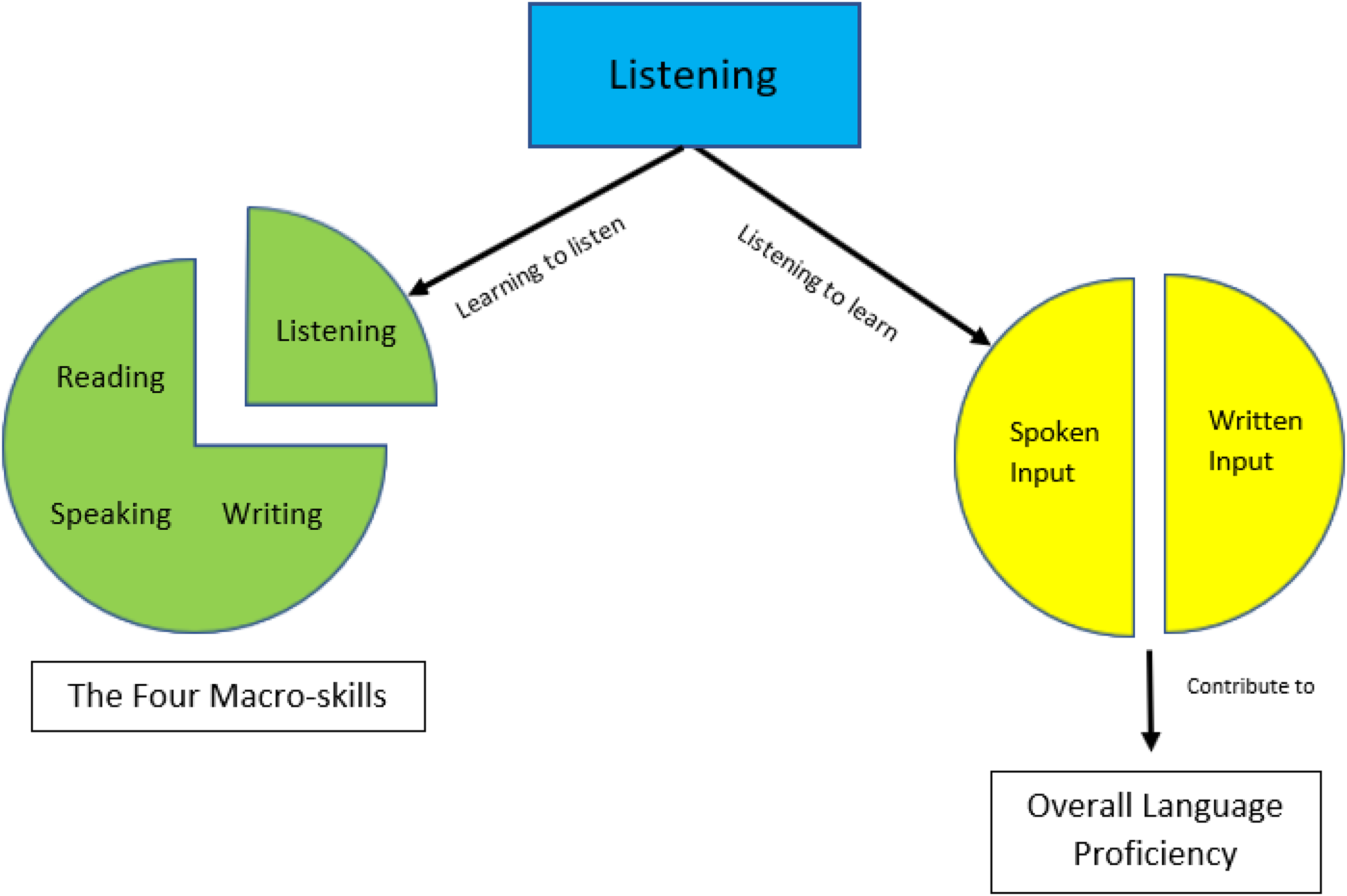
Two ways to conceptualize EFL listening.
In this brief Viewpoints article, I will discuss pressing gaps existing in the two above-mentioned modalities of listening, namely the lack of (a) focus on sounds and actual listening in the classroom; and (b) SI beyond the classroom, which correspond to the second section “Teachers and teaching in the classroom”, and third section “Learners and learning beyond the classroom”, respectively. By shedding light on these substantive issues, I hope that EFL stakeholders will work towards fine-tuning listening pedagogical practices and facilitating learners' reception of more SI beyond the classroom, both of which will highly likely improve learners' listening skills, enhance their overall English proficiency, and lead to more positive EFL learning experiences.
To supplement the discussion, I will also report illustrative anecdotes from a brief questionnaire survey which was distributed to in-service EFL teachers, lecturers, or researchers in China (n = 6), Hong Kong (n = 3), Japan (n = 3), Korea (n = 2) and Taiwan (n = 4) who had indicated possessing knowledge about current EFL education and common practices at the primary and/or secondary level in these geographical contexts. The reports from the small number of participants may seem to reflect low generalizability; however, note that only participants indicating having knowledge about EFL education and practices in their specific contexts (not just particular schools but general primary and/or secondary level EFL education in the city or country) were recruited. Also, as their accounts revealed (see below), similar patterns of what EFL teaching and learning in a specific setting are like were found (e.g., how listening is usually taught in EFL classes). The results were further supported by a few EFL educators and researchers (based in or having experience working in one of these five geographical areas) whom I approached to help verify the findings. For instance, despite the many provinces in China, “English taught in primary/secondary classrooms in normal schools is very similar across China” (email communication with an EFL researcher and educator in China). From my own experience having received years of EFL education, teaching EFL, and now researching EFL and being an EFL teacher educator in Hong Kong, many general aspects germane to EFL are (largely) similar for most local schools (i.e., those which most Hong Kong EFL students attend; for example, how listening is taught, the number of EFL lessons) and for most learners (e.g., the amount of spoken English input outside the classroom). Therefore, it is worthwhile scrutinizing the stakeholders' sharing. Findings that are pertinent to our discussion will be touched upon below.
Teachers and Teaching in the Classroom
The Comprehension Approach
When teaching this neglected skill, the close adherence to the comprehension approach (i.e., focusing primarily on comprehension as reflected in accompanying exercises while listening) in EFL listening instruction has been reiterated by different scholars (e.g., Field, 2019; Tsang, 2020; Wallace, 2012). This is indeed supported by most of the survey respondents. In spite of some differences, the comprehension-oriented approach to teaching primary-level and secondary-level listening seems highly common, as shown in Table 1. Whether or not there is schemata activation before listening (e.g., students expressing their thoughts on a certain topic, C1), pre-teaching vocabulary (e.g., C2), post-listening discussion (e.g., C2), listening strategies (e.g., prediction, H3), comprehension checks in the form of questions, exercises, and tests seem to be a common core feature of EFL listening instruction.
Survey respondents' descriptions of how listening is taught in the primary and secondary EFL classroom in the five contexts.
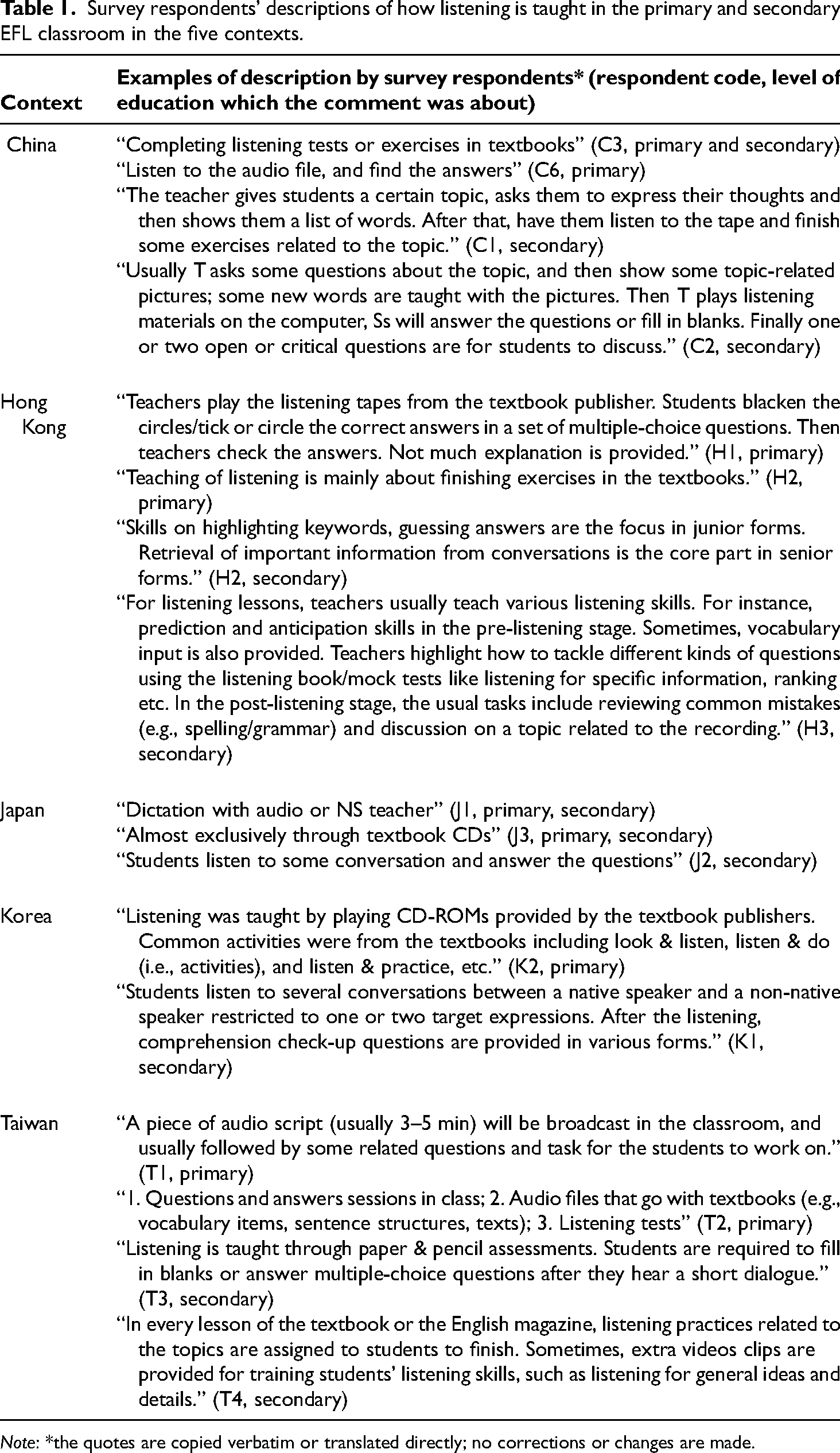
Note: *the quotes are copied verbatim or translated directly; no corrections or changes are made.
A major problem with this comprehension-oriented approach is that the focus tends to be narrowly on what correct and incorrect answers are; little to no attention is given to examining and addressing the difficulties that learners have (Field, 2019). In fact, from my experience, even when a student obtains the correct answer, it does not necessarily represent genuine comprehension; it could well be a result of, for instance, mere guesswork or sound test-taking strategies (e.g., eliminating the most likely incorrect choices in a multiple-choice question). Many EFL teachers would assume that getting correct answers is evidence enough for comprehension, and will do little to follow up on listening per se. Important listening skills such as being able to convert sounds to meaning are almost always left unaddressed whether students obtain the right or wrong answers in comprehension exercises.
Strategies are All Learners Need?
The comprehension approach usually involves the teaching of strategies (as suggested by a reviewer). Making reference to Milliner and Dimoski’s (2021) framework of three listening instruction approaches , listening strategies can be understood and described as cognitive top-down (i.e., “macro-features to make meaning… [such as] making predictions and inferences based on one's existing knowledge and prior experiences”) or metacognitive (i.e., the coordination of strategy use and facilitation of self-management such as monitoring one's comprehension). Many teachers seem to believe that these strategies are the most important in teaching listening and that they are a panacea when listening breaks down. Indeed, these strategies are useful and necessary at times, whether we are listening to our first language (L1), a second language (L2) or a foreign language (FL). Although research findings of the effectiveness of these strategies on listening are somewhat mixed (e.g., see the studies and reviews by Milliner and Dimoski, 2021 and Tanewong, 2019), the crux of the matter is that they alone should not be a plausible ultimate solution to listening breakdown. Strategies are often taught in the L2/FL context as compensatory techniques, that is “expedients used periodically when an individual's listening competence cannot match the demands of a listening task” (Field, 2019: 296). However, as Lee (2020) aptly states, “the primacy of the signal (i.e., the ability to accurately hear what is being said) stands as the first stages that must be cleared [in listening]”. Rather than solely focusing on employing different strategies to guess what is spoken, it makes more sense and is more effective to target at learning to actually decode sound signals. This is no mean feat, but given that (a) many incorrect answers in comprehension questions can be attributed to failures of word-level or clause-level rather than general understanding (Field, 2019) and (b) researchers who have focused on sounds and English phonology in teaching listening have shown promising results (e.g., Hamada, 2016; Tsang, 2020), greater emphasis on the process of listening is warranted. In other words, greater attention to the cognitive bottom-up approach (in Milliner and Dimoski's (2021) framework) is called for.
Process Over Products
Scholars (e.g., Field, 2019; Wallace, 2012) have drawn the distinction between the products of listening (e.g., focusing on correct or wrong answers in comprehension exercises; i.e., associated with the comprehension approach) and the processes of listening (i.e., how we actually listen and how sounds are converted into meanings). When zeroing in overwhelmingly on the product aspect and neglecting the processes of listening, learners are deprived of opportunities to develop their full repertoire of listening skills and the problems they encounter in listening may remain unaddressed. For example, due to the nature of connected speech in English, determining word boundaries often poses immense difficulties for learners and this problem is hardly ever tackled head-on in the classroom (Field, 2003; Lee, 2020). This leads to learners finding phrases that they actually know (if written) indecipherable in listening (e.g., not at all spoken as if these were a word; Tsang, 2020) and making errors in decoding (e.g., my name is as mayonnaise; Lee, 2020).
It is therefore worthwhile to introduce features of English phonology in EFL listening classes. After all, “the first step in making sense of what people say is recognizing patterns in recurring sequences of sounds and attaching meaning to them. This begins the process of segmenting the stream of speech into meaningful units…” (Saville-Troike, 2012: 170). Teachers can start at the phoneme level, drawing learners' attention to the fine auditory differences between similar phonemes (e.g., with the help of minimal pairs such as bed and bad and pool and pull). This can be easily done using the many free online dictionaries (e.g., playing “lend” and “land” without showing learners these words, and asking them which is which). After this, teachers can focus on higher-level phonological features such as linking, weak and strong forms, and rhythm. These topics are common components in a pronunciation syllabus, so it is possible to combine pronunciation instruction with listening instruction.
Actual Listening
Although learners' awareness and knowledge about the sound system of English are important, to become a fluent listener who can decode speech with ease, a large amount of practice is indispensable. In the process-oriented approach of teaching listening, there should be a substantial amount of actual listening to familiarize learners with how English is actually spoken (or Englishes are spoken). This is also a pressing concern because the amount of time that EFL learners listen to English is minimal in listening classes (e.g., Renandya, 2013) and outside class (see the next section). According to Renandya: In a typical 50-minute listening lesson, students listen to a two- or three-minute passage twice or three times – a total of about nine minutes of listening, which is less than 1/5 of classroom time. Students spend a bigger chunk of classroom time on tasks and activities that do not involve meaningful listening to the text. (Renandya, 2013: 16)
Amount of actual listening in listening lessons.
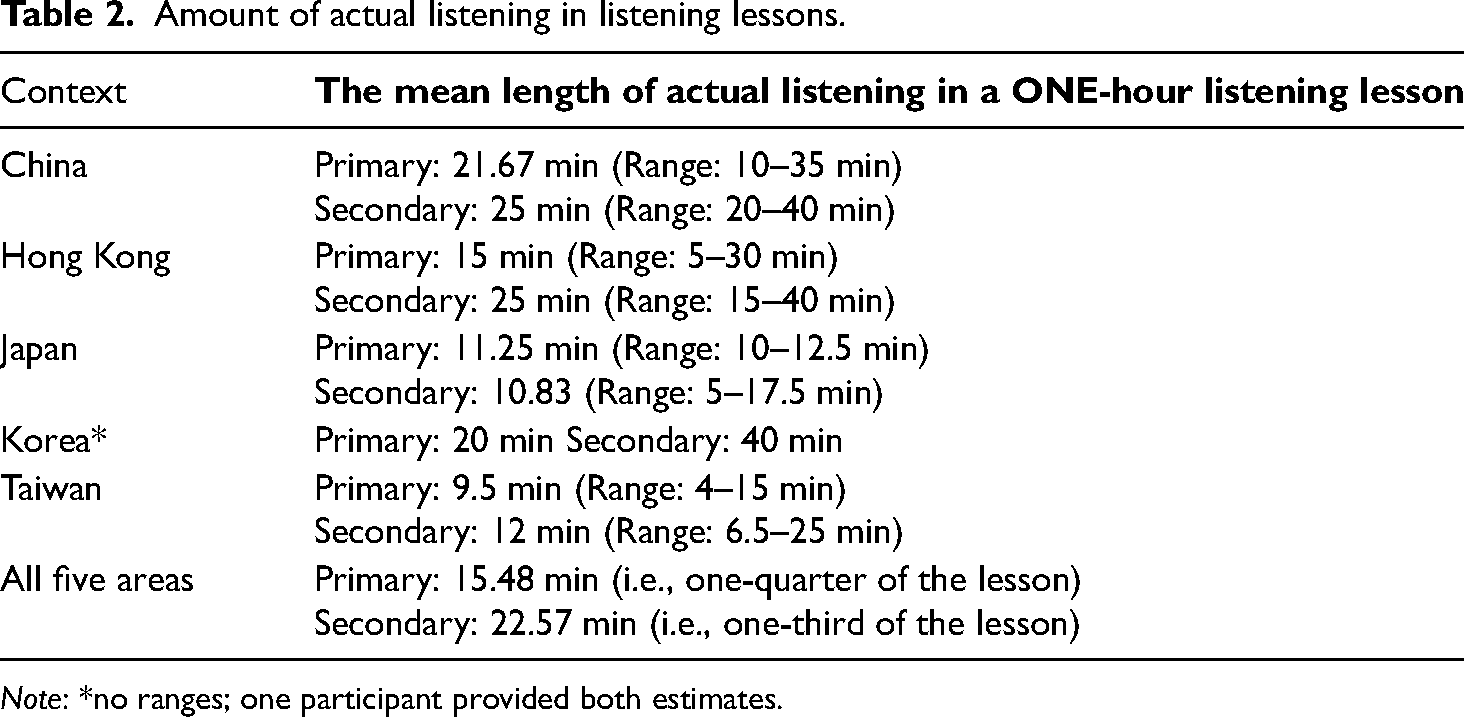
Note: *no ranges; one participant provided both estimates.
Summary
In summary, the two following points are in dire need of attention in EFL listening instruction:
Sounds: listening strategies are undoubtedly very useful tools but these cannot replace the primacy of sound-decoding in listening. There is also a need to shift from testing to teaching listening. Teachers should pay greater attention to the process of listening. To do this, English phonology can be capitalized on. Actual listening: more time needs to be allocated to listening in class as this will increase the opportunities for learners to practise processing sounds in listening. As will be elaborated in the next section, some important benefits reaped from practice cannot be gained from just enhanced awareness or greater knowledge.
These two points are directly germane to learning to listen, but can also be relevant to listening to learn (e.g., a heightened phonological awareness through careful listening may also benefit learners' spoken English). I will end this section with some food for thought. The following is contrived but it is very much the gist of many conversations I have had with EFL students in Hong Kong in the past decade. When asked what their overall experiences in their years of primary and secondary EFL education were like and what they learnt in reading, writing, listening and speaking lessons, learners were often able to recall genres they had read and wrote, and specific skills learnt in reading, writing, and speaking. However, when it came to listening, they could not remember much except that it was all about listening to audios, completing exercises, and checking the answers. There was little enjoyment to speak of and little was learnt aside from some common-sense strategies (e.g., guessing from the context, using background knowledge, and highlighting keywords on question papers). In the decade-long EFL education for many learners, EFL listening lessons seem to boil down to nothingness apart from mundane audio exercises with little value. This is indeed noteworthy.
Learners and Learning Beyond the Classroom
Input and Language Learning
Clichéd as it sounds, it is impossible for language learning to take place without any language input, which can be received through reading and listening. Although input alone does not necessarily guarantee successful mastery of a language, and aspects such as output (e.g., Swain, 1993), interaction (e.g., Long, 1996), and input becoming intake (e.g., Saville-Troike, 2012) are equally important for language learning, input is nonetheless the very first step in learning any language. From a general language acquisition perspective, learners' interlanguage undergoes restructuring as they process target language input, resulting in language development (Gass, 2003; Saito and Hanzawa, 2018). From a more layman's perspective, the input exposed to (e.g., a previously unknown word) can be taken in and kept in the mental storage (the vocabulary bank), leading to acquisition. The new word learnt may then be applied in the receptive (i.e., comprehending this newly learnt word in reading and listening) and productive modalities (i.e., using this new word in writing and speaking). Despite input being such a central element in language learning, SI (i.e., listening), as one of the only two kinds of language input, is very often neglected in EFL learning.
English Input and EFL Environments
As implied in the acronym EFL, English is typically foreign to many EFL learners. Apart from EFL lessons (and places such as train stations where some announcements may be in English), learners have very few opportunities to be exposed to spoken English on a daily basis, unless there is a need (e.g., conversing with foreigners using English) or it is a personal choice (e.g., watching videos in English on YouTube and/or listening to podcasts). However, these scenarios and hobbies are rare and exclusive to the minority who, for instance, have high motivation. The general lack of spoken English input is illustrated in the survey shown in Table 3. Although it is unclear how long each “time” (as in, e.g., “around three to four times”) is, no respondent indicated that primary and secondary EFL learners are likely to be exposed to English for more than 2 hours per week, which is very little in amount.
EFL learners' exposure to spoken English outside EFL lessons.
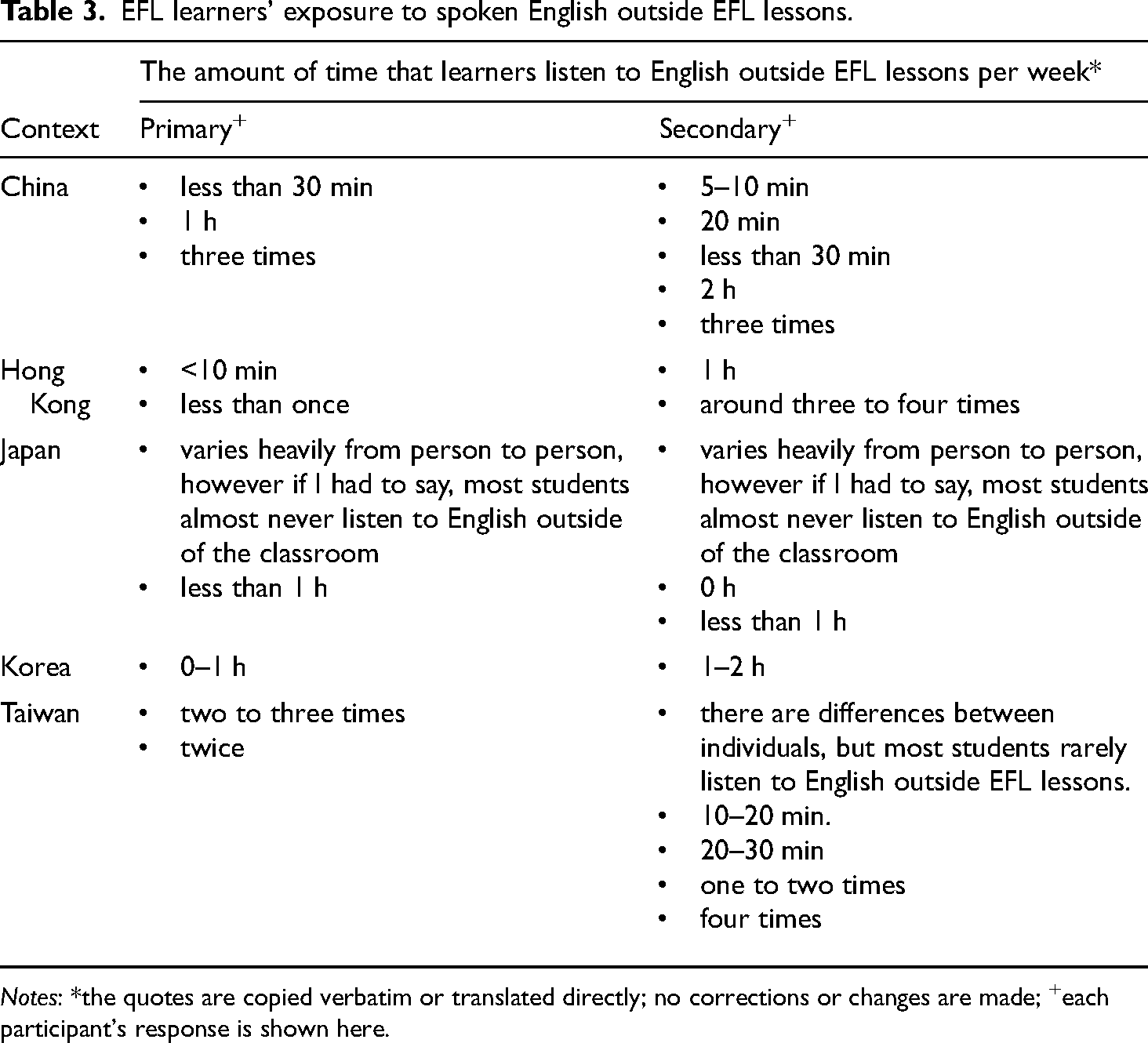
Notes: *the quotes are copied verbatim or translated directly; no corrections or changes are made; +each participant's response is shown here.
Interestingly, however, in the same English-deprived EFL environment, learners (e.g., those in Hong Kong) tend to receive more written English input naturally (although the overall amount is still unlikely to be high since it is an EFL environment after all, unless, as mentioned, it is an individual's choice). In this globalized multilingual world, it comes as no surprise that English can be found alongside L1s in food menus, signage, and labels on products, among others. Learners who study and revise English outside class tend to rely on notes, textbooks, exercises, electronic or in print, which require them to read rather than to listen. Most emphasis, effort, and time in EFL learning beyond the classroom are often given to and expended on written input (i.e., reading), whether this be initiated by learners themselves, parents, or educators (e.g., frequenting libraries and book stores for leisure reading; extensive reading schemes). Those who study other subjects in English also potentially receive a large amount of written English input when completing assignments and reading textbooks.
These give rise to two problems. First, EFL learners tend to be more comfortable with reading than with listening (though this does not apply to every learner). This is partly supported in studies showing that FL learners have higher reading self-efficacy and lower anxiety compared with listening (Mills et al., 2006). Although this has partly to do with the nature of reading and listening (e.g., listening is spontaneous, rapid, and non-permanent), learners generally receive very little amount of English listening practice, hence feeling less confident and more anxious about it. Second, by depriving themselves of the opportunities to listen to English, they have one fewer channel (out of a possibility of only two) to receive linguistic input for proficiency development. The strong tendency for them to rely on the reading channel likely leads to a decrease in the quantity (the overall amount of input) and quality (only the written modality) in their EFL learning journeys.
SI and Extensive Listening
Exposure to a large amount of SI partly chimes with the notion of extensive listening, which is defined as “all types of listening activities that allow learners to receive a lot of comprehensible and enjoyable listening input” (Renandya and Farrell, 2011: 56), or similarly, “doing a lot of easy, comprehensible, and enjoyable listening practice” (Chang and Millett, 2014: 31). Extensive listening is associated with many benefits. It enables learners to construct a cognitive map (i.e., “a network of linguistics information”) which is fundamental for the development of different language skills (Nation and Newton, 2009; Renandya, 2013: 19), echoing the construct of listening to learn. In relation to learning to listen, extensive listening provides opportunities for multiple (and at times repeated) exposure through which learners practise listening. This in turn facilitates their development of listening automaticity and fluency. Saville-Troike (2012) explains this: “[R]epetition can enhance noticing and contribute to automatization, by facilitating faster processing of input, and the ability to process longer segments in working memory”. Also, as scholars (e.g., Ellis, 2002; Field, 2019; Renandya, 2013) have stated, declarative knowledge is important but when it comes to actual performance or “expertise” (Field, 2019: 289), “hundreds of hours” (Renandya, 2013: 26) or even “tens of thousands of hours” (Ellis, 2002: 175) of practice is essential. There are no shortcuts to internalizing and automatizing language knowledge other than familiarizing oneself through practice. The need for such prolonged practice shows the irreplaceable value of a substantial amount of spoken (and written) input for language learners. In fact, “practice-induced developmental pattern of cognitive and motor skills [have] show[n] a remarkable regularity across tasks and situations” (Dörnyei, 2009: 152), so the common-sensical “practice makes perfect” mantra applies to multifarious situations including language learning. It is common to hear learners complain that English speech is too fast when in fact “the listener [is] listening too slowly” (Buck, 2018: xiv). Therefore, practice helps learners get used to what authentic English speech is genuinely like in terms of speed.
The notion of extensive listening also facilitates vocabulary learning such as fillers or stock phrases (Renandya, 2013). With more practice, learners' confidence in listening may well increase while their listening anxiety may decrease. By choosing an English input that they favour (e.g., watching a soccer match on television, a movie on Netflix, or catching up on news about one's idol on YouTube), it is likely that learners experience greater enjoyment in listening and perhaps even general EFL learning. Decoding problems (e.g., mishearing words or phrases, as mentioned above) due to poor mastery of the English phonological system may also decrease as learners become more used to features of connected speech through extensive exposure to spoken English (e.g., Tsang, 2020).
Summary
The importance of input in language learning is beyond dispute. As one of the only two channels to receive language input, spoken English deserves much more attention from learners, teachers and other stakeholders. Thanks to the advancement of technology and the high accessibility of the Internet in many places, spoken English is no longer a rarity in EFL settings. Radio and television programmes, downloadable podcasts, videos on platforms such as YouTube and Netflix, and numerous other resources have become more accessible than ever to EFL learners. They also come in relatively low cost or are mostly free. The promotion of extensive reading globally in L1/L2/FL education is a worthwhile educational enterprise and should certainly continue. If this can be coupled with extensive listening, it is in all likelihood that learners will be benefited in their EFL learning journeys to an even greater extent. Individual differences, learner autonomy, and learner agency are of high currency in education nowadays. The promotion of more SI sits very well with these paradigms. In EFL classes, two problems many teachers tend to face are how different learners have different interests and different problems in learning EFL. These can be more readily addressed with extensive listening outside class since learners can relish the flexibility of material selection. With proper guidance from teachers or parents, learners can be engrossed in materials that they enjoy and work on specific problems they have (e.g., for a learner who desires to work on their pronunciation, they may select specific YouTubers as role models to help them; see Tsang, 2019).
Conclusion (and What about Researchers?)
I have shared in this article how teaching listening in the classroom, learning listening beyond the classroom, learning to listen, and listening to learn command revisiting and attention. Although the discussion has focused on EFL settings, ESL stakeholders should also find this article relatable to them. For instance, based on the discussion above, ESL teachers can reflect on their pedagogical approaches to listening and decide if fine-tuning is needed. They will also have a heightened awareness of the likely dearth of spoken English input some of their non-English-L1 students receive before arriving in an ESL place. This in turn should prompt teachers to focus more on assisting learners to better capitalize on the English-rich ESL environments to maximize their reception of SI.
So much for teachers and learners, what about researchers and scholars? As many in L1/L2/FL education would agree, compared with reading, listening has received much less attention in research and academia. A clear piece of evidence is the number of journals, especially top-tier ones (e.g., those included in the Social Sciences Citation Index), which are dedicated to reading (and writing) such as Reading Research Quarterly, Reading and Writing, Scientific Studies of Reading, and The Reading Teacher, but not a single one in the Social Sciences Citation Index to date is dedicated to listening. In fact, looking for an outlet specifically for listening and speaking is very difficult and good papers in ESL/EFL listening can only appear in general L2/FL/ESL/EFL journals such as Language Learning, Language Teaching Research, RELC Journal, TESOL Quarterly, and The Modern Language Journal.
It is a good sign that recent decades have seen more research into L2/FL listening (Field, 2019). According to Field (2019), listening strategies have been studied most. Metacognition, which is partly related to strategies, has also gained much popularity recently (see Vandergrift and Goh, 2012). While there is value in researching these areas, they cannot solve the perennial problems touched upon in this article. As mentioned, strategies are usually treated as back-up plans in EFL listening instruction which assist learners when comprehension breaks down. Likewise, in a study by Wallace (2020), metacognitive awareness was found to have no direct but only an indirect effect on listening comprehension. Wallace also found that metacognitive awareness was less important than vocabulary knowledge, which was operationalized by listening vocabulary tests (i.e., sound recognition and audio vocabulary). These, together with what has been discussed, all point up the fact that the process-oriented approach to listening and the focus on sounds and phonology in teaching and learning listening are research-worthy and highly promising. There are still very few studies on these topics currently. Another concern is the general lack of research into language input in L2/FL learning, especially SI and extensive listening, which is still “a comparatively new idea [with] its theoretical framework […] underdeveloped” (Chang and Millet, 2014: 31).
There have been many “turns” in L2 acquisition and applied linguistics in recent decades. Those in the ESL/EFL field, while charging ahead with reading and writing, can take some time to turn around and look at the adjacent lanes of listening, considering what learning to listen and listening to learn can afford EFL learners in their learning journeys. By leveraging this neglected avenue and unleashing its true potential, it is likely that we can bring about synergetic benefits to our learners and the ESL/EFL education field at large.
Footnotes
Acknowledgements
I am very grateful to all the survey respondents, teachers, and scholars who assisted me in collecting and reviewing the data reported in this article. I am also indebted to an extremely helpful and supportive colleague of mine, Scott Aubrey, for his time and constructive comments on an earlier draft of the manuscript.
Declaration of Conflicting Interests
The author declared no potential conflicts of interest with respect to the research, authorship, and/or publication of this article.
Funding
The author received no financial support for the research, authorship and/or publication of this article.
