



Abstract
This report reviews studies on language teachers as materials developers in language education, particularly focusing on how language teachers act as materials users, materials analysts, and materials designers when engaging with language learning and teaching materials. We contend that the three dimensions of materials development – that is, materials use, materials analysis, and materials design – intersect with one another, and that language teachers play a critical role in all three. Therefore, this review concludes with a research agenda that centres on language teachers as materials developers to expand our understanding of their roles in materials development.
Introduction
Recent educational changes have highlighted the importance of language teachers in language learning and teaching (LLT) materials development, whereby, increasingly, language teachers are expected to adapt, supplement, and design LLT materials (Richards, 2015). Technological developments have enabled teachers to use multimodal resources, such as videos, augmented reality games, and pictures, as LLT materials to supplement traditional print textbooks (Guerrettaz and Johnston, 2013). Technological advances have also facilitated diverse publishing models in which teachers are encouraged to design and publish materials. In addition, curriculum reforms have promoted a contextualised pedagogical approach that requires language teachers to design their own materials in many contexts. Furthermore, language teachers are urged to develop localised materials by integrating local varieties of English, cultures, and values into LLT materials.
Despite the rising expectation that language teachers develop materials, previous research on language teacher education has largely focused on how teachers conceptualise and implement pedagogical ‘methods, approaches, … and techniques’ in practice (Ellis, 2012: vi). These studies generally position language teachers as materials users (Duyen et al., 2017; Lou et al., 2012), with very few studies recognising them as materials designers (de Laurentiis Brandão, 2018) or materials analysts (Biçer and Batdi, 2019).
Considering the recent surge of interest in materials development (Bouckaert, 2019; Guerrettaz and Johnston, 2013; Hu et al., 2021), we contend that language teachers should be regarded as key players in LLT materials development. This review aims to examine how research has advanced our understanding of this topic and deconstruct the nature of language teachers’ role as materials developers. To this end, we first describe how this review was conducted and then present a synthesised overview of the selected studies on language teachers as materials developers, noting their methodologies and findings. We also discuss the relationship between language teachers’ materials use, analysis, and design before identifying directions for future research.
The Review
For this review, we conducted systematic literature searches (Campbell et al., 2014) based on three dimensions of materials development in language teaching: ‘the materials themselves as product’, ‘the application of these materials in practice as use’, and ‘the creation or design of classroom materials’ (Bouckaert, 2019: 433). Appendix 1 shows the procedure used for the systematic literature searches. Initially, the search was for research articles in English without year limitations in Web of Science, Scopus, and ERIC. As the number of results based on titles, abstracts, and keywords was too overwhelming for in-depth analysis, the search was later limited to titles from 2011 onward. We also trialled other search terms, including ‘textbook’ and ‘coursebook’, to ensure that the most effective search words were employed. To safeguard the quality of the reviewed articles, we included only duplicated articles – that is, articles that are indexed in at least two of the databases mentioned. The first and second authors reviewed and grouped these articles using Endnote, and the first author recorded the detailed review procedure in a Microsoft Word document. If the two authors disagreed about an article's categorisation after a discussion, it was sent to the corresponding author for his opinion. Finally, a consensus was reached on the categorisations; each group of articles was checked at least five times. Ultimately, we identified 151 studies for review, including 36 studies on language teachers as materials developers (see Figure 1).
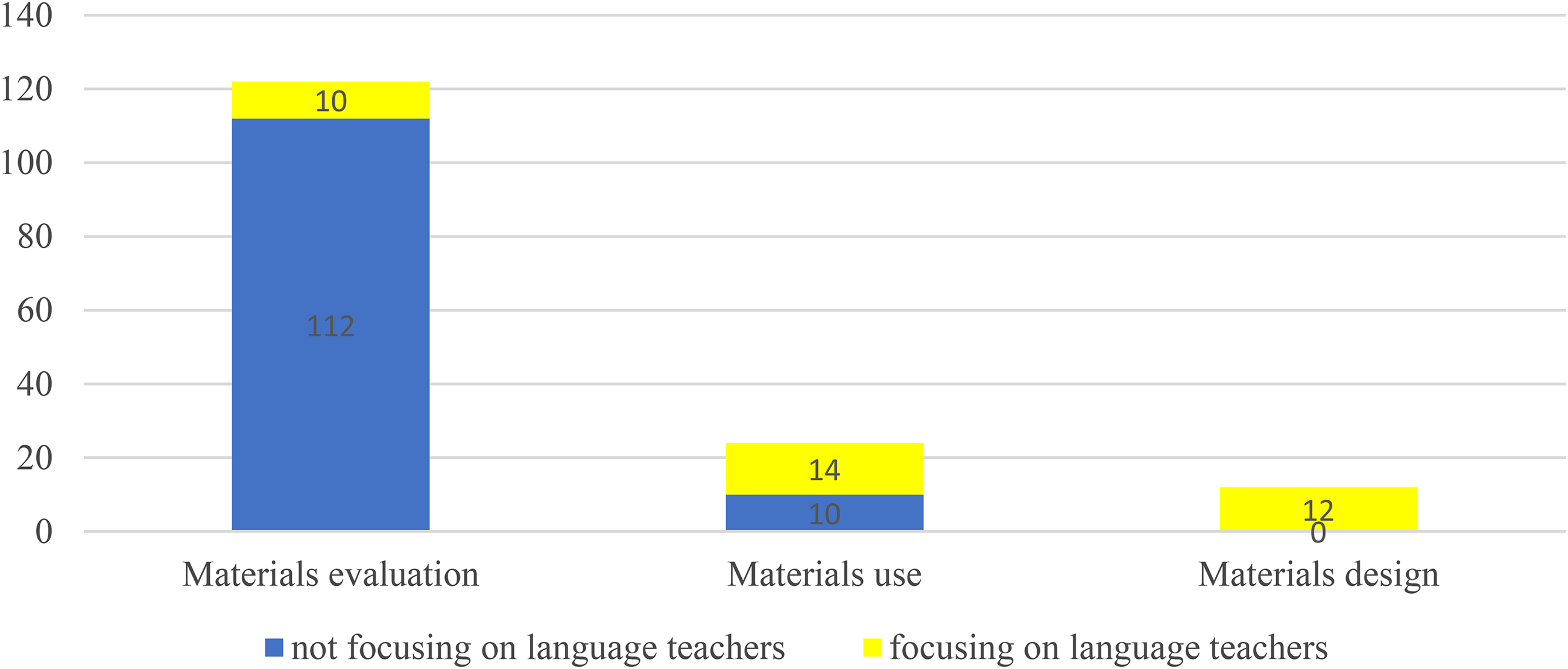
Studies on LLT materials.
Research on Language Teachers as Materials Developers
This section summarises studies on language teachers as materials developers, dividing them into three themes – namely, language teachers as materials users, as materials analysts, and as materials designers.
Language Teachers as Materials Users
Among the identified studies on language teachers as materials users, 12 studies describe how language teachers use LLT materials in classrooms (e.g. Li and Li, 2021; Li and Xu, 2020). These classroom-based studies collected data from lesson observations, interviews, and documents. They frequently found that to employ materials effectively and meaningfully, language teachers often assumed the role of materials evaluators or analysts, making real-time decisions to adapt existing materials in ways that accommodate diverse students’ needs within a dynamic classroom system. By analysing multiple data sources, such as observation data, interviews, and documents, Bolldén (2016) found that language teachers who adapted their teaching and materials use in online teaching needed to analyse virtual material arrangements so that they could understand how they functioned in their online classes. Taken together, these studies show that language teachers’ analysis and adaptation of materials are indispensable to their effective use of materials in classroom and online teaching.
Studies have also revealed factors underlying teachers’ practices surrounding materials use. Abdel Latif (2012) examined the factors influencing teachers’ materials use by collecting multiple data through surveys, observation, and interviews. The study revealed that with years of teaching non-communicative textbooks, these teachers’ oral fluency level was low, which resulted in their frequent switch from English to Arabic in teaching. Cuayahuitl and Carranza (2015) observed and interviewed language teachers about the contextual factors influencing their materials use. They found that teachers’ past pedagogical experiences influenced their perceptions of teaching, contributing to their varying practices related to materials use. Both studies confirm that teachers’ teaching experience affects how they use materials.
Studies have also investigated how language teachers engage with different LLT materials in teaching. Lou et al. (2012) employed action research to examine the effectiveness of teachers’ use of blogs as LLT materials in blended teaching. Their findings supported the value of blogs as teaching materials in language teaching, as they were tied to positive learning outcomes. Duyen et al. (2017) compared the effect of using the same textbook with two different teaching approaches (i.e. explicit teaching and traditional coursebook instruction) on Vietnamese university students’ learning of formulaic sequences. The results show that the experiment groups who received explicit teaching performed significantly better than the control group who took coursebook instruction. This finding implies that different teachers’ varied engagement with the materials influences pedagogical effectiveness.
Language Teachers as Materials Analysts
Ten of the reviewed studies focus on language teachers as materials analysts (e.g. Li and Cui, 2021). These studies ask language teachers to evaluate LLT materials using adapted checklists (Biçer and Batdi, 2019; Kirkgoz, 2011; Panezai and Channa, 2017). In Panezai and Channa (2017), language teachers were asked to complete a checklist covering four general aspects of the textbook, such as physical and utilitarian attributes. The language teachers in Biçer and Batdi (2019) and Kirkgoz (2011) were asked to comment on different dimensions of textbooks, such as ‘layout and design’, ‘language content’, and ‘subject content’, through a questionnaire and interview. While these checklists assisted language teachers in evaluating textbooks, notably, the data collected were about teachers’ recollections of the textbook and their use.
Relevant research has also used interviews to examine teachers’ views on how textbooks contribute to students’ linguistic development. For example, Huang et al. (2011) complemented their textbook analysis with language teachers’ views on how textbooks can support the dual goals of content and language learning. These studies confirm the significance of language teachers’ textbook analysis in ensuring the effective use of LLT materials in teaching.
Additional research has involved language teachers as materials analysts to investigate the representations of ideologies and values in LLT materials (Bori, 2021; Derakhshan, 2021). Derakhshan (2021) examined the construction of the cultural meaning of textbooks within an interactive context by asking language teachers to imagine that they were using the textbooks and verbalise their opinions on the images in the textbooks. Through interviews with teachers and observations of their classroom engagement with textbooks, Bori (2021) conducted an ethnographic study to explore the neoliberalism represented in a global English as a foreign language (EFL) textbook used in Serbia. These studies have identified imbalanced representations of ideologies and cultures in LLT materials and encourage language teachers to critically analyse and use such materials.
Language Teachers as Materials Designers
Twelve studies on language teachers as materials designers document how they experienced the procedures and stages of designing LLT materials. Through action research, Chang’s (2020) inquiry revealed three stages of designing a theory-based EFL textbook – namely, preparation, unit design, and whole book design. During each stage, language teachers planned, implemented, improved, and reflected on the materials. In their design-based research, Yuzen and Karamete (2016) identified five phases of designing materials for computer-assisted language teaching – that is, ‘analysis, design, development, implementation and evaluation’ (p.96). These studies all stress that language teachers’ analysis and use of materials are two essential steps in the materials design process.
Studies have revealed multiple challenges that language teachers encounter in designing materials. For example, in their design-based research, Moore and Lorenzo (2015) found that teachers designing Content Language Integrated Learning (CLIL) materials faced challenges, including balancing cognitive and linguistic demands. Through action research, Siekmann et al. (2017) revealed the tensions between cultural and academic content that language teachers experience when designing culturally and linguistically appropriate textbooks for Indigenous elementary students in southwest Alaska. Atkinson (2020) employed concurrent verbalisation to allow language teachers to speak their thoughts aloud while designing materials. This analysis revealed the challenges of producing ‘multiple, novel ideas in response to task specifications’ (p.491).
Research has also focused on language teachers’ professional development as materials designers. Sert and Li (2017) analysed pre-service English language teachers’ written reflections on their experiences of designing Computer Assisted Language Learning (CALL) materials in Turkey, categorising their knowledge development into three domains: disciplinary knowledge about CALL, instructional knowledge, and contextual knowledge. De Laurentiis Brandão (2018) used narrative inquiry to examine a pre-service language teacher's two-year experience of designing and using materials. The study captured how this teacher combated uncertainties and developed knowledge and skills in materials design. These findings suggest that involving language teachers in materials design can be an effective means for professional development.
Advancing a Research Agenda on Language Teachers as Materials Developers
In light of the findings on language teachers as materials developers, we propose a research agenda to advance our understanding of this topic. The proposed agenda highlights the role of language teachers in materials development, specifically in intertwining materials use, materials analysis, and materials design.
First and foremost, the results suggest that language teachers function as users, analysts, and designers of materials in the process of materials development. Proceeding from Bouckaert’s (2019) viewpoint that product, use, and design constitute a cyclical process of development, language teachers transform materials development into an infinitely developmental process by using, analysing, and designing LLT materials (see Figure 2). During this process, teachers make informed decisions on when to begin and complete the developmental process and decide which of the three dimensions should be the focus at each stage based on contextual and situational factors. It is important for researchers to approach the three dimensions of materials development as intertwined through the involvement of language teachers who play a central role in the process. Considering this role, we encourage language teachers to undertake more participatory research to document their lived experiences as materials developers. The analysis of relevant records can illuminate significant insights for teachers’ professional development as materials developers. This recommendation aligns with Richards (2006) suggestion of connecting research and materials development, which supports the development of quality materials and their effective use in classrooms.
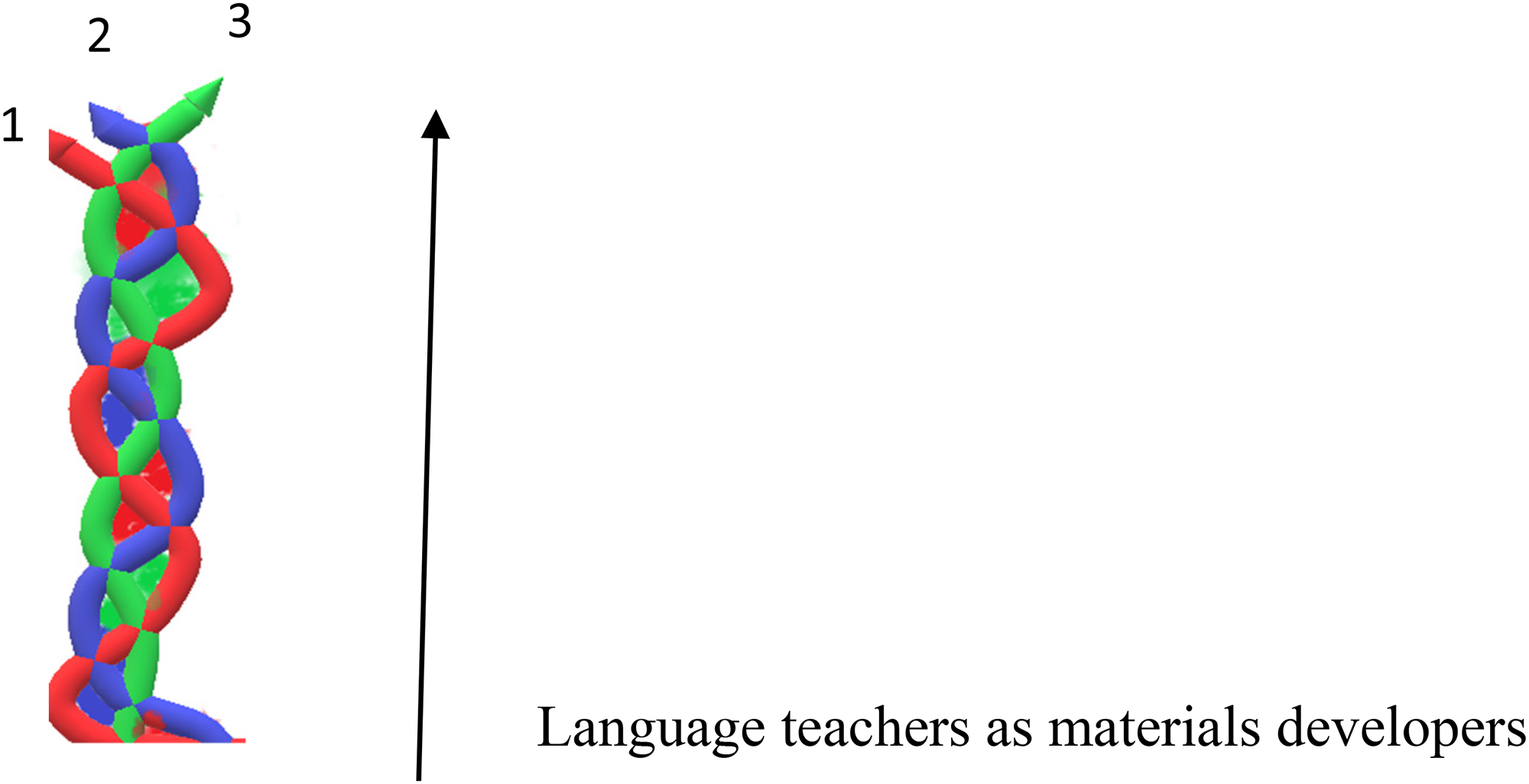
The infinitely developmental materials development process intertwined by language teachers.
Second, research is needed to understand teachers’ decision-making processes by examining the interactions between teachers and materials through classroom discourse analysis. Research should also explore the role that teaching experience plays in teachers’ materials use. Multimodal analyses can be conducted to investigate teachers’ use of multimodal learning resources, such as audio and visual materials.
Third, research should involve language teachers in materials evaluation studies to inform how these materials can be adapted and then used in class. Such studies may employ interviews and classroom observations to collect for analysis not only teachers’ accounts but also data about their actual use of materials in class. As most studies we reviewed were conducted in EFL contexts, more materials evaluation studies in other contexts that centre on teachers’ experiences are encouraged.
Fourth, research on language teachers as materials designers should consider their teaching philosophies by investigating their use and evaluation of materials. Understanding these teaching philosophies can illuminate how teachers design materials and how the design process changes them. As observations of the materials design process can be inconvenient, concurrent verbalisation and screen recording can be used to document teachers’ detailed thoughts and actions during the process.
Conclusion
This review outlines the existing research on language teachers as materials developers and what can be done to advance this area. It highlights that language teachers act as materials users, materials analysts, and materials designers when engaging with LLT materials. We suggest that more research, particularly participatory research, is needed to explore language teachers’ materials development and professional growth as they intertwine the use, analysis, and design of materials.
Footnotes
Declaration of Conflicting Interests
The author(s) declared no potential conflicts of interest with respect to the research, authorship, and/or publication of this article.
Funding
This work was supported by the University of New South Wales (University International Postgraduate Award, z5004574).
