



Abstract
Situated in the domain of Global Englishes research, this study explores a question of how far the issue of the English model for Japanese learners is complicated by the hierarchical coexistence of regular English courses taught by Anglophone English teachers and extracurricular online English lessons taught by non-Anglophone instructors. A questionnaire survey was administered to 100 Japanese English learners aged 18–34 who have taken such lessons. This study provides both hopeful and challenging suggestions for Global Englishes research and practice, that is, Japanese English learners’ favourable perceptions of Filipino teachers’ affordable and flexible lessons that, they believe, would not interfere with their subsequent or concurrent study of ‘real’ English taught by native Anglophone teachers. This study indicates future directions of research and practice regarding the legitimate positioning of in-class or online English classes taught by Association of Southeast Asian Nations and other non-native English-speaking teachers in East Asian English classrooms that remain bound by native English norms.
Keywords
Introduction
Current research on Global Englishes conceives contemporary English learners as being highly likely to engage in English communication with other non-Anglophones in non-Anglophone contexts where English functions as a global lingua franca (Jenkins, 2015; Kirkpatrick, 2014; Rose et al., 2021). This stance questions and challenges the globally pervasive native English norms that legitimize ‘native’ English teachers as the only and absolute model of English instruction and source of learning resources for learners of English as a second or foreign language (Braine, 2010; Llurda, 2015; Ruecker and Ives, 2015). The native English speaker norm, which remains dominant despite the global spread of English and dominance of non-native English speakers around the world, engenders discriminatory attitudes toward non-native English-speaking teachers (NNESTs) among English learners, their parents, and English teaching professionals (Bae, 2013; Braine, 2010; McKenzie and Gilmore, 2017; Sasayama, 2013; Watanabe et al., 2019). For example, recent studies conducted with Filipinos working as Assistant Language Teachers (ALTs) in Japan's secondary education system suggest that Japanese teachers and Anglophone ALTs question their colleagues’ legitimacy as English teachers because of their non-native accent and non-White skin colour (Balgoa, 2019; Sugimoto and Yamamoto, 2019).
Within this hierarchical world of English, can and will Japanese English learners come to perceive Filipino English teachers as legitimate English teachers? This study examines how far the issue of the English target model for learners is complicated by the hierarchical coexistence of regular English courses taught by Anglophone English teachers and extracurricular online English lessons taught by non-Anglophone instructors. It does so by analysing numerical and written data about Japanese English learners’ perceptions of Filipino English teachers from the perspective of native English norms entrenched in Japan's English teaching industry and formal education.
Research Background
This study's primary aim was guided by the extant literature, which suggests a conflicting coexistence of the pervasiveness of native English norms and the increasing popularity of online lessons taught by Filipino teachers. Japan's English teaching industry used to exclusively employ Western native English-speaking teachers (Ruecker and Ives, 2015; Seargeant, 2009). The new business model that hires Filipino and other non-Anglophone nationals as English instructors was first witnessed more than a decade ago. RareJob launched its service in November 2007 – it exclusively employed Filipino English teachers, and the company was listed on the Tokyo Stock Exchange on 27 June 2014. RareJob is now Japan's largest online English lesson provider. Its largest competitor, QQ English, entered the market in 2009 and opened its first branch in Cebu, the Philippines, catering to Japanese English learners. QQ English's business model was soon emulated by other competitors.
Recently, the ongoing COVID-19 pandemic has changed behaviours among Japan's English learners, creating an opportunity for companies offering online English lessons to expand. Overall, revenues in Japan's English language industry declined by 1.2% (or 876.2 billion yen) in fiscal year 2020 compared to the previous year. However, according to data provided by the Yano Research Institute Ltd on its website (https://www.yanoresearch.com/), the market value for e-learning English lessons increased from 12.5 billion yen to 16 billion yen.
That said, the increased popularity of online English lessons with Filipino teachers had been gaining momentum even before the COVID-19 pandemic. The success of this model is often ascribed to the remarkably low-priced lessons it offers (Sakai, 2018). On their website (https://www.rarejob.co.jp/en), RareJob reported that the most popular plan is a daily 25-min lesson plan, which costs 5.800 yen per month, with one lesson costing 187 yen (1.7 US dollars). By contrast, online English lessons with native English teachers are not available every day and are far more expensive. For example, ECC, Japan's premier English language school, provides eight lessons per month at the price of 31.680 yen or 3.960 yen (36 US dollars) for one 25-min lesson. This rate is 21 times higher than that for RareJob's lessons.
However, it is unlikely that those studying online with Filipino English teachers are confined to financially disadvantaged students who cannot afford the more expensive lessons with Anglophone teachers but need English skills for career mobility. In fact, Japan's business world is dominated by monolingual Japanese speakers, including its top-tier university graduates, many of whom are from upper-class households (The University of Tokyo, 2018). This group sees no urgent need to study abroad for degrees to transform themselves into bilingual global talents because they can reliably secure elite employment (Kobayashi, 2021). This minimizes the likelihood that socially disadvantaged students or workers need English skills and that the market for online English lessons depends on them. Instead, online English lessons are more likely targeted at domestically educated monolingual employees of companies that are expanding their business in the Association of Southeast Asian Nations (ASEAN) region and other overseas markets (NIKKEI Asia, 2020; Kobayashi, 2018, 2021). Presumably, these, predominantly male businesspersons, who must prepare themselves for work with overseas clients against their expectation, seek to avail themselves of online English lessons before or after work.
Besides the low tuition fees, Japanese English learners’ high level anxiety about speaking English in front of Anglophones is often considered a contributor to the popularity of English lessons with Filipino teachers. Indeed, Filipino English teachers’ accommodating personality is foregrounded in promotional advertising. RareJob advertises that two out of the four merits of studying English with Filipino instructors are: (a) their sense of empathy toward Japanese people studying English as a second language; and (b) their national traits of being friendly and kind combined with their culture of respecting others (https://www.rarejob.com/about/tutor/). On its official Japanese website, the Tokyo Office of the Philippine Department of Tourism also states that ‘fun lessons taught by Filipino teachers with a national character of being always cheerful and friendly have been attracting international students who want to learn English from around the world’ (https://philippinetravel.jp/category/study-abroad/).
Sakai (2018) found that the lack of association between Filipino English teachers and ‘Philippine English’ works in favour of those marketing English lessons taught by Filipino teachers. In his study, Sakai (2018) conducted an Amazon book keyword analysis, typing in ‘Philippine English’ and ‘Indian English’ in Japanese, and comparing the search results. The results showed the low frequency of the former vis-à-vis the high profile of the latter. Moreover, Watanabe et al. (2019) conducted a questionnaire and interview study with 112 Japanese university students and produced a related finding. Influenced by Japanese media information, the participants identified the Philippines elusively as an English-speaking country, with English as the official language, where locals speak an accented English that is at a higher level than those of Japanese, Korean, and Chinese English speakers.
This study acknowledges that ‘scholars rightly expose the homogenizing tendencies of Philippine English studies’ (Tupas, 2020: 237) and Filipino English teachers represent a small number of English-speaking college graduates who can work for foreign companies. Tupas described the small population of privileged elites working in the business processing outsourcing industry (e.g., call centres) from those who ‘typically come from relatively good universities or English-speaking families which have wide access to quality education’ and can thrive on ‘their ability to speak English in ways which are acceptable to industry standards’ (Tupas, 2019: 537). Their linguistic and socioeconomic privilege empowers them to access jobs as online English teachers working in Japan's English teaching industry.
However, once they are hired as non-Anglophone English teachers, this group of Filipino English teachers is relegated to cheap labour, earning significantly lower wages than Anglophone English speakers. Moreover, unlike Anglophone English speakers, English-speaking Filipinos are required to undergo rigorous pre-employment screening and post-employment staff management. Accentuating the high standards for instructor quality control, RareJob has ensured on its homepage that they hire only 1% of job applicants who, even after employment, are required to undergo constant monitoring, evaluation, and training (https://www.rarejob.com/about/tutor/). This resembles what occurs to call centre workers in the Philippines where merely 1% of privileged college graduates secure employment while 3–5% are conditionally allowed to move into the workforce after job training (e.g,. accent reduction) (Tupas, 2019: 537). A Japanese Assistant Director of the Tokyo Office of the Philippine Department of Tourism also reported that one of the advantages of studying English in the Philippines is the high-caliber teaching staff’ who ‘are employed after passing very competitive exams’ (Yokoyama, 2019: 5).
Nonetheless, these Filipino English teachers unlikely evoke an image of either privileged knowledge workers or marginalized cheap labour in the minds of Japanese English learners when they encounter the images of the smiling faces of Filipino teachers who seem happy to offer English lessons on any day, at any time, and at exceedingly low prices.
Guided by these previous studies, this study aims to identify the factors that have most contributed to Japanese English learners’ decision to study English online with Filipino teachers (e.g., low-income group, unfamiliarity with the term and the concept of Philippine English, lack of confidence in taking lessons from Anglophone teachers vis-à-vis the images of the supposedly friendly Filipino teachers). Its primary aim is to provide a better understanding of the growth of this niche market in a country known for its pronounced preference for so-called native English.
The Study
Participants
This study collected numerical and written survey data from 100 Japanese English learners aged 18–34 who have taken online English lessons taught by Filipino teachers. The participants were accessed through the database of a major research company in Japan. They voluntarily registered in the database of the company and can decide whether to participate in an online survey when informed of the survey link. They are free to withdraw from the survey at any time, without reason.
Before primary data collection, a preliminary survey was conducted with 500 registered survey respondents to estimate the probability with which Japanese nationals aged 18–34 have received online English lessons from Filipino teachers. Out of 414 respondents, 86 (17.2%) were found to have experienced this type of learning, suggesting the feasibility of conducting the main study with a smaller number of respondents (100) because of budget constraints. The participants in the preliminary study were excluded from the main study.
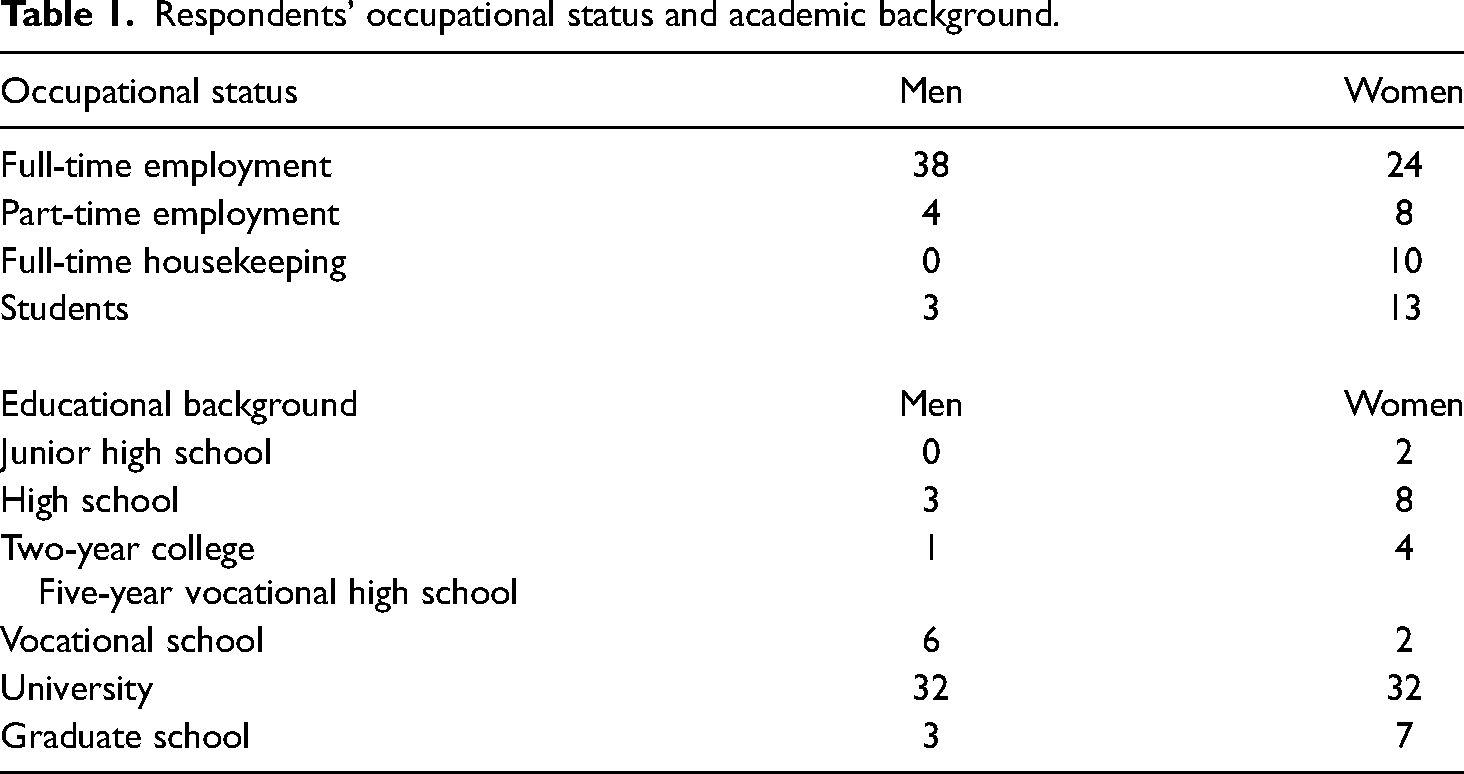
In all, 100 complete, valid responses were collected from 45 men and 55 women who are composed of those aged 18–29 (n = 57) and others aged 30–34 (n = 43) living in Japan. Most of them have taken online lessons for less than 1 year: 20 (for less than 1 month); 25 (for 1 month to less than 2 months); 26 (for 2 months to less than half of a year); 18 (for half a year to less than a year); 5 (for 1 year to less than 2 years); and 6 (for longer than 2 years). Tables 1 and 2 summarize the respondents’ occupational status, educational background, and English study experience with English teachers from abroad in formal education.
Respondents’ occupational status and academic background.
English study experience with teachers from abroad at schools in Japan.
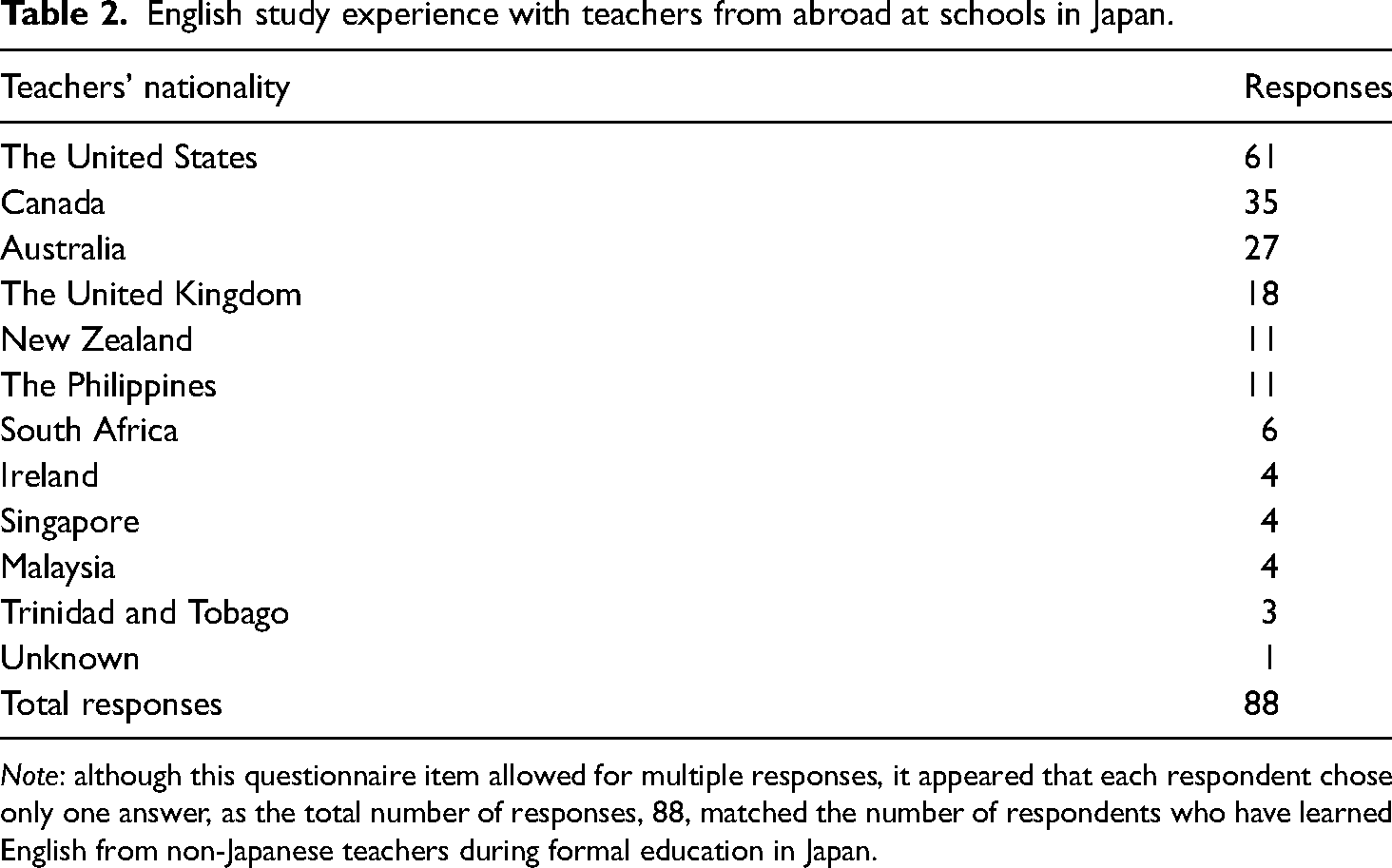
Note: although this questionnaire item allowed for multiple responses, it appeared that each respondent chose only one answer, as the total number of responses, 88, matched the number of respondents who have learned English from non-Japanese teachers during formal education in Japan.
Data Analysis
This study analyses the participants’ responses to closed-ended and open-ended questions. These questions were designed to collect the following information of the respondents: (a) demographic data; (b) reasons for studying English; (c) reasons for taking online lessons taught by Filipino teachers; (d) perceptions of Filipino teachers and the lessons they teach; (e) experience of taking lessons taught by teachers from Anglophone countries; and (f) experience of studying English abroad. These items were developed from a review of the literature. For example, items for the fifth and sixth questions were designed to confirm respondents’ financial capability to invest in English instruction, based on the shared belief that those attracted to low-cost tuition fees could not afford more expensive lessons taught by Anglophone teachers in Japan or abroad.
Additionally, the analysis of the data is predicated on the literature. The low frequency with which Japanese English learners encounter the term Philippine English’ may lead to a low profile to the idea of Philippine English’ in the minds of Japanese English learners, compared to ‘ Indian English,’ which may have facilitated their decision to take lessons from Filipino English teachers. The responses were also examined to establish any other group tendencies (e.g., men vs. women and employees vs. students) in light of the literature-derived knowledge that in the Japanese labour market predominantly male employees have more unexpected opportunities to study and use English at work than their female peers.
Findings
Reasons for Being Attracted to Low-Cost Tuition among Japanese Middle Class
The two factors of affordability and flexibility were chosen by many respondents as their primary reason for taking online lessons from Filipino teachers (multiple choices): affordability was mentioned by 60% men and 47.3% women; and flexibility was cited by 46.7% men and 49.1% women. However, only four respondents answered that they could not afford to take the high-priced lessons offered by Anglophone English teachers or that they did not have the confidence to do so. A total of 42 respondents had taken lessons taught by Anglophone teachers (40% men; 43.6% women). Additionally, 64 participants had studied abroad (multiple responses), mostly in Anglophone countries: (a) the United States (n = 34; 53.1%); (b) Canada (n = 20; 31.3%); (c) Australia (n = 18; 28.1%); (d) New Zealand (n = 12; 18.8%); and (e) the United Kingdom and the Philippines (respectively, n = 10; 15.6%). These findings suggest that online lessons taught by Filipino teachers may not cater to financially disadvantaged students or workers in Japan. Thus, the question that arises here is why middle-class English learners in Japan, who can afford to take the expensive lessons offered by Anglophone teachers, take online lessons from Filipino teachers.
Table 3 shows that many employees, who are the majority of this study's participants (93.3% men; 76.6% women), believe that they need or will need English for their work. Moreover, instead of having the cost of their tuitions charged to their employers, they study English at their own expense, before or after work (82.2% men; 70.9% women). The positioning of these Japanese workers increases the attractiveness of online lessons by Filipino teachers, which are extremely low-priced and can be booked any day at the last minute from early morning to late night.
Multiple reasons for male and female respondents to study English.
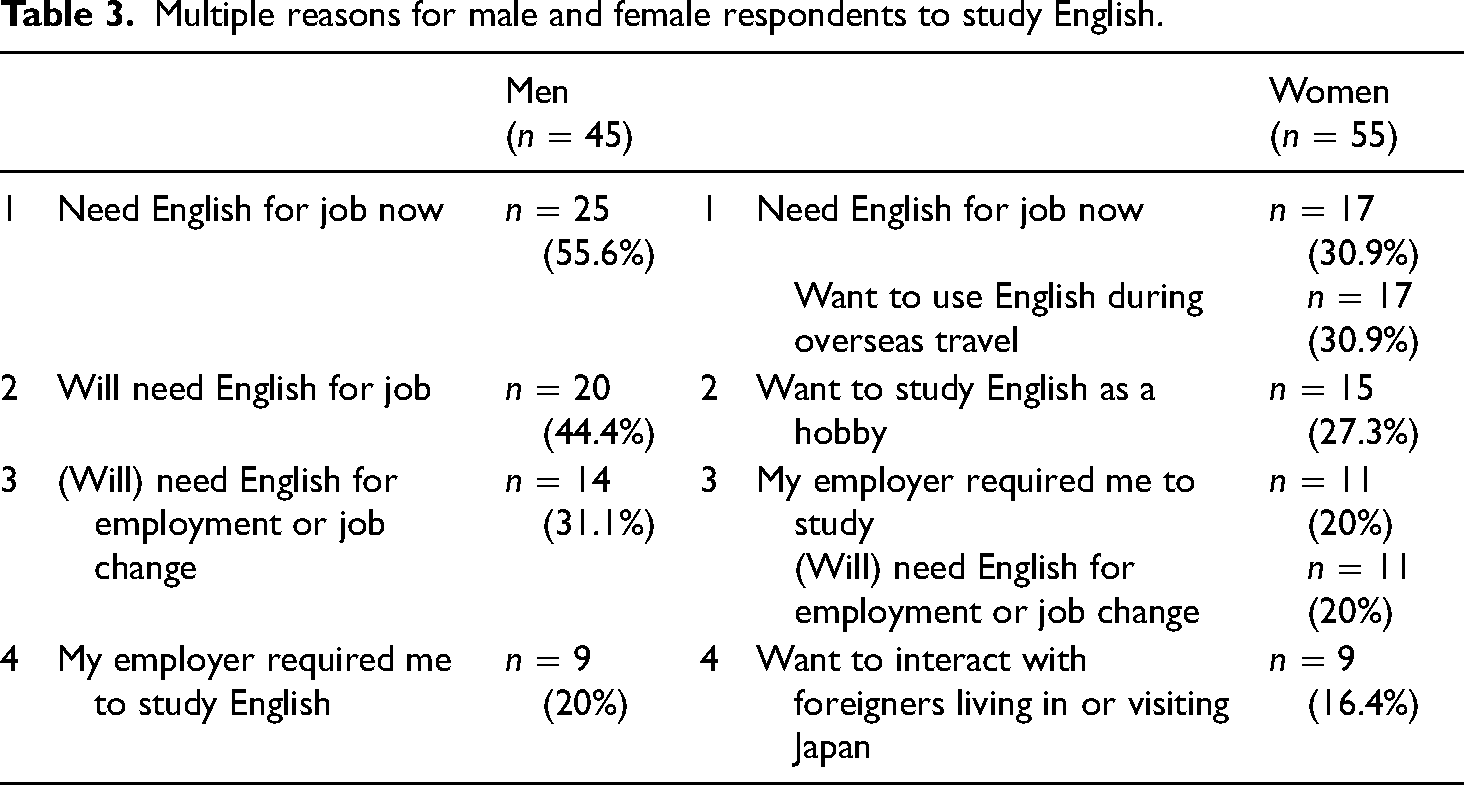
Meanwhile, Table 3 demonstrates that more women than men study English for non-professional purposes such as overseas travel, hobby, and intercultural communication with foreign visitors/residents in Japan, although the majority of both groups are working adults. Japanese working women's motivation to take online lessons taught by Filipino teachers would be worth further investigating in future studies.
Identity as Beginner-Level English Learners Who May Care Less About Accent
As aforementioned, many survey participants had taken lessons from Anglophone teachers at language schools in Japan and/or in the West, besides the regular English classes that are provided in formal education in Japan (Table 2). This native English learning experience, which abounds in Japan, illegitimizes Filipino English teachers as Japanese English learners’ target model for the language. Only nine respondents indicated a preference for Filipino teachers as a reason for taking lessons from them (‘I want to speak English the way that Filipino teachers do’). Even after having taken lessons from Filipino teachers, more than 70–80% of the survey participants did not come to identify Filipino English teachers as their target model. Thus, seeking to study English at their own expenses before or after a busy workday, many respondents capitalize on cheap, around-the-clock, and accessible online lessons taught by Filipino teachers without perceiving them as their target model.
On a more positive note, approximately 20–30% of the participants reported that they ‘were not concerned about Filipino teachers’ pronunciation or accent’ during their lessons (n = 20) and that now they ‘perceive Filipino teachers’ English as their goal’ (n = 29). Moreover, a slightly larger number of respondents indicated a positive way of perceiving Filipino teachers’ English: ‘English spoken by Filipino teachers can be understood anywhere in the world’ (n = 35). The same number of respondents also perceived that the language of Filipino English teachers is ‘close to American English.’
Without identifying Filipino teachers as their target model for the language, most Japanese English learners nonetheless chose to take online lessons from them and continued to do so not only because they need to study English while employed but also because of their identity as beginner-level English learners who should not be concerned about Filipino teachers’ accent. For example, a 33-year-old college-educated woman wrote: ‘I occasionally care about their namari [accent] because they are not native English speakers. But overall, I do not care, given my [low] level’ (a full-time worker who is studying English for an overseas trip, has never studied English abroad, and has been taking online lessons for over half of a year). A 33-year-old housewife commented that Filipino teachers speak English with a namari, but she and other Japanese English learners cannot tell this (another leisure-oriented English learner who is studying English in Japan as a hobby and in preparation for an overseas trip by taking lessons both from Anglophone and Filipino teachers). Indeed, when responding to a closed-ended question, this housewife answered that she has never cared about Filipino teachers’ pronunciation or accent. Meanwhile, none of the respondents used the term ‘Philippine English’ when remarking on their decision to take online lessons taught by Filipino teachers.
Non-Problematization of Differentiation Between NESTs and Filipino Teachers
As noted above, for Japanese English learners, the challenge of studying English while being employed and their identity as beginner-level English learners have resigned them to take online lessons taught by Filipino teachers, often for shorter periods or concurrently with the lessons taught by Anglophone teachers, whom they continue to idealize as their target model. Furthermore, written data show that Japanese English learners take Filipino teachers’ exceedingly low-priced lessons for granted because the teachers speak English with a non-native namari and live in a developing country, where commodity prices and the cost of labour are low:
I think that their English can be understood in [Anglophone] English-speaking countries without any problem. However, it is not as clear [kirei] as native English, and that is why their prices are low. It cannot be helped that Filipino English teachers’ lessons are very cheap because English teachers from Anglophone countries have more authentic knowledge of English. It cannot be helped because their English has a bit of namari. It is reasonable because their English has a Philippine namari. They can be hired as cheap labor because commodity prices are low in their country. It makes sense because employment costs vary across countries. It matches with my perception that things are cheap in Southeast Asia. They should be treated as equal to Anglophone teachers if their classes are equivalent to Anglophone teachers’ classes. The low prices of Filipino teachers’ English lessons cannot be helped because of the differences in skill between them and native English teachers. However, it should be a problem if there are other reasons why their lessons’ prices are low. Letting Filipino teachers teach English at a bargain price should be a problem if they suffer from it.
Meanwhile, the following three respondents, who appeared to be concerned about the possible negative aspects of the treatment of Filipino teachers as cheap labour, did not differ from many others, presupposing that Filipino teachers’ English classes are not equivalent to their Anglophone counterparts’ lessons and that they should be pleased to work for foreign companies:
Only seven respondents answered that they decided to begin or continue taking lessons provided by Filipino teachers because ‘it would be easy to work with the same Asian Filipino teachers,’ despite the emphasis placed on their friendliness and fun classes in promotional advertising.
Discussion
The current study results suggest that the increased popularity of online English lessons taught by Filipino teachers arises from Japanese English learners’ view that their engagement in this transitional and supplementary learning would not interfere with their subsequent or concurrent study of English taught by native Anglophone teachers. The flexibility and affordability of around-the-clock online lessons offered by Filipino teachers not only accommodates adult English learners’ work life but also reduces the impact of learners’ investment of time and money in high-priced and in-class lessons from Anglophone teachers. Many Japanese English learners take lessons from Filipino teachers without acknowledging them as their English target model, because they consider themselves to be beginner-level English learners who can or should compromise on questions of accent and pronunciation. Moreover, the lack of association in Japanese media and in English learners’ minds of the Philippines or Filipino English teachers with ‘Philippine English’ evokes ambiguity regarding Filipino English teachers, which facilitates Japanese English learners’ decision to take their lessons. Mostly, this decision stems from the hierarchical differentiation of (lessons taught by) Filipino teachers from (those taught by) Anglophone teachers, which manifests in their non-problematization of the extremely low-cost lessons provided by Filipino teachers. They are envisioned as happy workers living in a developing country who should be thankful for the wages they can earn from foreign companies, given that their English is not as clear [kirei] as native speakers’ English and that commodity prices are low in their country.
Although Filipino English teachers’ supposed character of friendliness and cheerfulness is often highlighted by the industry and related parties, only seven respondents chose this factor as a reason to study English online with Filipino teachers. As aforementioned, most learners classify Filipino teachers into a group providing cheap labour and living in a low-income economy who should be grateful to work for companies in an advanced country. In a similar vein, Watanabe et al. revealed that Japanese college students at a large private university (the first author's affiliation) considered Filipino English speakers to be the least affluent group of English speakers, in opposition to Chinese English speakers, which, the authors presuppose, may result from the salient visibility of affluent Chinese students on the campus in Tokyo (Watanabe et al., 2019: 14).
Japanese English learners’ discriminatory impression of the Philippines and Filipino English teachers unlikely provokes a sense of Asian solidarity with Filipino teachers. Indeed, previous studies have shown that Japanese English learners develop an identity as Asians and forge a friendship with other Asians only when positioned in the West and feeling marginalized for the first time (e.g., Kobayashi, 2010). In contrast, their majority status in Japan inspires them to approach ‘international’ Westerners in public and engage in one-shot, convenient English conversation, an attitude seldom displayed toward many seemingly non-international international students and visitors from neighboring Asian countries (Morita, 2012; Kobayashi, 2010).
These Japanese English learners’ sense of superiority over Filipino teachers is aligned with the English teaching industry's marketing strategy of selling a novel product; that is, lessons taught by non-Anglophone teachers to Japanese English learners, who are known for their distinct preference for native speakers’ English (e.g., McKenzie and Gilmore, 2017). Rather than fighting a losing battle against the brand-name product of native English lessons, this emerging industry has carved out a niche in Japan's lucrative English teaching market by promoting Filipino teachers’ online English lessons as a transitional, supplementary, and accessible way of learning, which would be optimal for Japanese English learners. In other words, this business model thrives by not eroding the existing native English norms but accommodating the needs of Japanese English learners with a low English proficiency, a busy schedule, and a preference for more expensive native English lessons.
The positioning of in-class or online classes taught by Filipino and other NNESTs warrants further discussion. This is because the presence of mainstream English teachers in Japan who question the legitimacy of Filipino and other NNESTs (Balgoa, 2019) is likely to not only impact non-Anglophone teachers’ sense of legitimacy but also dictate their students’ notion of target model. As an increasing number of Japanese university English courses incorporate online English lessons with Filipino or other non-Anglophone teachers as part of extracurricular English study activities, some Japanese English instructors are hoping to accomplish more than just improving students’ English skills, providing opportunities for them to use English as a lingua franca, and raising their awareness regarding the role of English in the real world (Takeshita, 2017). On the other hand, what remains to be addressed in the Global Englishes domain is the accumulation of theory-based classroom interventions that endorse NNESTs’ in-class or online lessons without introducing them as transitional and supplementary classes that cannot replace ‘real’ classes taught by Anglophone NESTs.
Meanwhile, the development of the perception among some Japanese English learners that Filipino teachers speak English with an acceptable and familiar Americanized accent is conducive to their voluntary continuation of online lessons from Filipino teachers. Japanese English learners’ developmental trajectory is a promising research theme, although it remains to be known as to whether this attitudinal change arises from Japanese English learners’ experience of taking online lessons from Filipino teachers itself or other factors such as Japanese businesspersons’ use of English as a lingua franca with domestically educated ASEAN workers when they were studying English online (Haisa and Watanabe, 2013).
On the other hand, the majority of respondents expressed concern about Filipino English teachers’ accent and remained bound by native English norms even after, or irrespective of their online English learning experience. This finding may be indicative of the possibility that Japanese working adults, who comprised a large share of the study participants, are reminded of the supremacy of American or British English when they encounter ASEAN and other Asian business colleagues who were educated in the Anglophone West and speak native-like English. For example, a large body of literature on the craze for English study in South Korea attests that elite employment necessitates a high command of American or British English earned from privileged English education at home or in the West (Choi, 2020; Lee, 2021; Shin and Lee, 2019). Given that Japanese companies are competing with South Korean businesses for a share in the ASEAN market, it is possible that domestically educated Japanese workers are witnessing the competitiveness of overseas-educated South Korean rivals because of their English fluency and intercultural communication skills. Thus, it would be worthwhile to pursue studying the relationship between Japanese working adults’ English use experience in the real world and their perceptions of Filipino English teachers as their target model before, during, and after their lessons.
Last but not the least, to seek a better understanding of NNESTs’ work experience and professional identity, future studies should incorporate as respondents Filipino or other NNESTs who teach English to neighbouring Asian students, either online or on-site. For instance, Filipino migrant English teachers in Bangkok (Ulla, 2019) are found to be grateful for their remuneration, even if it is lower than that of Anglophone NESTs. Moreover, they feel respected by local teachers and students despite their status as NNESTs and the supremacy of native English in Thailand. Similarly, Thai students’ respect for Filipino teachers is reported in Phan’s (2009) study conducted with East and Southeast Asian international students, including Filipinos, who are enrolled in a Master of Arts English Language Teaching programme at an international university in Thailand and as part of the programme requirements teach English at local Thai schools. By contrast, Japanese teachers and Anglophone ALTs are found to undermine the legitimacy of Filipino teachers (e.g., correcting their pronunciation or forcing them into silence) (Balgoa, 2019; Sugimoto and Yamamoto, 2019).
Because of such variances, it is worthwhile to conduct international comparative studies, such as, on Filipinos working as migrant English teachers either in Thailand or in Japan, to compare their work experiences (e.g., perceived discrimination/respect). Moreover, the discrimination experienced by Filipino ALTs teaching in Japanese English classes indicates the need to compare them with their peers working as online English teachers. Working from home and not exposed to the same risk of stigma from any Japanese or Anglophone colleagues, online English teachers in the Philippines might be better aware of their privileged status as members of a small population of English-speaking college graduates who can work for foreign companies (Tupas, 2019). Hence, the question of Filipino English teachers’ professional identity must be examined within and beyond the context of the Philippines and in relation to the ideas of privilege and marginalization.
Conclusion
This study provides hopeful and challenging suggestions for Global Englishes research and practice. On a positive note, the popularity of online lessons taught by Filipino teachers marks an unprecedented change in Japan's English teaching industry. The impact of these lessons upon Japanese English learners’ view of their target model remains to be investigated, with room left for a positive development. On the other hand, it might be naïve and uncritical to expect English learners to (come to) embrace Filipino English teachers as their target model when the industry and academic institutions are promoting Filipino teachers’ exceedingly low-priced online English lessons as being merely transitional and supplementary learning that could not replace the only legitimate real’ English classes taught by Anglophone NESTs.
The heightened popularity of online English learning during the COVID-19 pandemic could shift again, contingent on the post-pandemic era. The mindset and destinations of English study abroad travelers remain to be seen. Moreover, the current status of the Philippines as a labour-exporting country will change in the long run, thereby affecting the availability of English-speaking college graduates who wish to work as online or migrant English teachers. Determining these factors will warrant more, long-term studies on online or in-person English lessons provided by Filipino and other NNESTs in Japan or other Asian countries where locals continue to idealize native speakers’ English. Such studies should be crucial for the further development of Global Englishes research and practice which continue to face ‘a number of barriers to change’ such as ‘strong adherence to standard language ideology in TESOL [Teaching English to Speakers of Other Languages]’ and ‘hiring practices that favour native-speaking teachers’ (Rose et al., 2021: 160). This study hopes to serve as one additional attempt to unravel the complexity of some of those barriers even in a teaching context where the notion of Global Englishes appears to be embraced and practised.
Footnotes
Declaration of Conflicting Interests
The author declared no potential conflicts of interest with respect to the research, authorship, and/or publication of this article.
Funding
The authors disclosed receipt of the following financial support for the research, authorship, and/or publication of this article: This work was supported by the Japan Society for the Promotion of Science KAKENHI (Grant number: JP 19K00756).
