




Abstract
This study examined the role of positive and negative feedback on goal commitment and energy investment among English as a foreign language learners who experienced directed motivational currents (DMCs). To this purpose, a systematic methodology was used to identify language learners with a DMC experience (six students, four females, two males, mean of age = 19.5). Semi-structured interviews were conducted with the participants. The results of qualitative content analysis indicated that the three key features of DMCs were found in participants’ motivational experiences. In addition, the results showed that positive feedback affected goal commitment in DMCs by increasing goal persistence and sense of self-efficacy, while negative feedback enhanced motivation in DMCs by reducing the discrepancy between current state with the well-defined target state. The results also showed that feedback had some affective consequences that influenced goal pursuit in DMCs.
Introduction
Motivation has been broadly acknowledged as one of the main factors that affect the rate and success of second language (L2) learning (Aubrey and Philpott, 2021; Dörnyei and Ushioda, 2021; Teng et al., 2021). Motivation delivers the key energy to initiate learning the L2 and the dynamic force to endure the long learning process (Dörnyei, 1998). In recent years, studies on language learning motivation have shifted to socio-dynamic perception and more importance has been laid on the long-term aspect of motivation (Al-Hoorie, 2017; Henry et al., 2015). Dörnyei and his associates proposed the directed motivational currents (DMCs) construct to explain highly intense motivational experiences over long periods of time (Dörnyei et al., 2016; Muir and Dörnyei, 2013). Dörnyei et al. (2016: 2) defines the DMC as an “intense motivational drive-or surge-which is capable of stimulating and supporting long-term behavior (such as the learning of an L2).” L2 learners who experience a DMC feel captivated in a series of tasks following a well-defined target goal, dedicate noticeable amount of time and energy to achieve that goal, and in return feel pleased and fulfilled (Zarrinabadi and Khajeh, 2021; Zarrinabadi and Khodarahmi, 2021). A growing number of studies have progressively been investigating different features of the DMC, mostly with the aim of evaluating its validity to account for second language learning motivation (Zarrinabadi and Tavakoli, 2017; Zarrinabadi et al., 2019; Zarrinabadi and Khajeh, 2021; Zarrinabadi and Khodarahmi, 2021; García-Pinar, 2022; Henry et al., 2015; Ibrahim, 2016a, 2016b; Sak, 2021; Selcuk and Erten, 2017; Watkins, 2016). These studies have identified the DMC construct as a valid theoretical framework for understanding long-term intense motivational experiences (e.g., Zarrinabadi and Khajeh, 2021; Zarrinabadi and Khodarahmi, 2021; García-Pinar, 2022). One of the key characteristics of the DMCs is the existence of regular progress checks and feedback, which plays a significant role in the progress and moment of the DMC toward its target goal (e.g., Koné, 2022). Koné (2022) reported that existence of quality feedback enhanced feasibility and helped students to stay on the track until they achieved their goal. This shows that feedback plays an important role in goal achievement in DMCs (Dörnyei et al., 2016; Koné, 2022) and merits further exploration. Moreover, Jahedizadeh and Al-Hoorie (2021: 517), in a recent review study, concluded that “the evidence on the three characteristics proposed as necessary and/or distinguishing conditions of directed motivational currents (vision, salient facilitative structure, and positive affect) is inconclusive.” Therefore, one line of research in this regard would be to examine how teachers’ positive and negative feedback affect goal commitment and energy investment in the DMCs. Therefore, in the present study, we used a qualitative methodology to examine the role of positive and negative feedback on energy investment and goal commitment in the DMCs among Iranian learners of English as a foreign language (EFL). The outcomes of this study are important in that they expand our knowledge about the mechanisms of DMCs and increase the researchers and teachers’ awareness of the impacts of feedback on highly intense motivational experience among language learners, which can be useful for creating DMCs and intensive and collaborative classroom projects among L2 learners.
DMCs’ Construct
The DMCs are defined as “a prolonged process of engagement in a series of tasks which are rewarding primarily because they transport the individual towards a highly valued end” (Dörnyei et al., 2015: 98). The DMC is a newly developed motivational construct that describes the continued and intense motivational experience that a person may undergo when participating in a series of language learning tasks such as talking to an English native speaker, reading grammar books, taking English classes, and watching English movies (Ibrahim, 2016a; Muir, 2020). Moreover, Dörnyei et al. (2014) consider a DMC as the injection of motivation into the system that causes the individual to persevere in following a specific goal and to attempt that goal even when the opportunities for reaching it are slight. Individuals can direct their energy and efforts towards their important personal goal or vision (Muir, 2020), when they are involved in these extreme motivational surges (Dörnyei et al., 2016). To clarify the structure of DMC, it is essential to state that all DMC experiences are identified through three fundamental elements: goal/vision-orientedness; a salient facilitative structure; and positive emotionality (Dörnyei et al., 2014).
Based on Dörnyei et al. (2014, 2015, 2016), a DMC motivational experience is always directed by a well-defined target goal or vision. Some examples for this particular goal or vision are becoming a fluent English speaker, getting the band score of 8 in the International English Language Testing System (IELTS) examination, talking to native speakers, or completing a task assigned by a teacher. Of course, it should be noted that there are some differences between goal and vision. In contrast with goal, vision has a strong sense of imagery in which the individual has some tangible images about his/her goal achievement (Zarrinabadi and Khajeh, 2021; Zarrinabadi and Khodarahmi, 2021). The existence of a goal or vision, as suggested by Dörnyei et al. (2016), assists in focusing energy on the desired results, helps staying away from irrelevant routines, and ensures long-term engagement.
The second distinctive key characteristic of a DMC, which dynamically makes opportunities for feedback and progress checks and retains the motivational impetus, is a salient facilitative structure. There are three main features that give this unique structure to the DMC: (1) easily identifiable starting and ending points, meaning that individuals can simply detect the starting and ending of their motivational experience; (2) a series of repetitive behavioral routines which make a sort of motivational autopilot, that is, the individual involved in a DMC achieves every step without voluntary control (Dörnyei et al., 2014, 2016; Henry et al., 2015); and (3) consistent progress checks wherein the long-term goals are divided in to a number of smaller sub-goals. By offering positive feedbacks, these sub-goals can help in assessing improvement and sustaining energy.
Positive emotionality is the third characteristic of a DMC. Dörnyei et al. (2016) claim that individuals involved in a DMC demonstrate a deep sensation of positive emotions (enjoyment, excitement, delight, pleasure, and satisfaction) which is totally dissimilar to the short-lived feeling of contentment experienced via ordinary fun activities. This unmatched sensation of satisfaction and contentment contributes to the formation of a motivational surge that becomes self-propelling (Zarrinabadi and Khajeh, 2021; Zarrinabadi and Khodarahmi, 2021).
Empirical Research on DMCs
Since the advent of the DMCs construct, several researchers tried to examine the nature and validity of this construct (Zarrinabadi and Tavakoli, 2017; Zarrinabadi et al., 2019; Henry et al., 2015; Ibrahim, 2016a, 2016b; Muir and Gümüş 2020; Selcuk and Erten, 2017; Watkins, 2016). Henry et al. (2015), in the first systematic empirical study of DMCs, studied the motivational initiatives experienced by three learners of the Swedish language. They found that the main components of DMCs, namely goal/vision-orientedness, salient facilitative motivational structure, and positive emotionality were present in the participants’ motivated behaviors. Moreover, Zarrinabadi and Tavakoli (2017) investigated the existence of DMCs among English teacher trainees in Iran and reported that the key components of DMCs were witnessed in participants’ experiences. Furthermore, Ghanizadeh and Jahedizadeh (2017) demonstrated that there was a substantial difference between students with different proficiency levels. They found that upper-intermediate learners experienced more levels of motivational currents than their elementary counterparts. Also, Zarrinabadi et al. (2019) showed that factors such as failure to understand English movies, teachers’ comments, and talking with a tourist are considered as the starting stimuli for the presentation of DMCs. Besides which, they reported positive effects of experiencing DMCs on participants’ L2 willingness to communicate, autonomy, self-confidence, and self-concept. Additionally, Muir (2020) studied the existence of DMCs among participants from 71 nationalities using an online questionnaire. Her results revealed that almost 39% of the respondents stated having experience of intensive motivational states with major structures of DMCs. Moreover, Zarrinabadi and Khajeh (2021) and Zarrinabadi and Khodarahmi (2021) examined the existence of group level DMCs in Iran and reported that features including entitativity, collective efficacy, high responsibility, contagious motivation, unity and coherence, and attractiveness characterized group-DMCs in the L2 context. In addition, Peng and Phakiti (2022) discussed the DMCs framework by investigating how it can be translated into teaching experience. Based on their research findings, the DMCs framework has assisted in progressing a research line in terms of two features: context and perspectives on studying motivation. Furthermore, García-Pinar (2022) used interviews and post-intervention open questionnaires to investigate the existence of primary characteristics of DMCs among four undergraduates preparing their group in-class presentation as part of a technical English course. The results showed that DMCs could function at the group-level involving students entirely in tasks that were professionally, academically, personally, and meaningful to them. Besides which, Sak (2021) studied the role of personality traits in explaining variations in the DMC disposition among Turkish undergraduate students. Their findings showed that the students’ individual differences caused variation in DMC disposition among the students. Koné (2021) conducted a research study on DMCs in Mali and reported that experiencing a DMC had positive consequences for learners’ linguistic competence as well as real-life skills such as group work and presentation skills. In addition, Gümüş and Başöz (2021) who examined the propensity to experience a DMC in the Turkish EFL context, reported that a considerable portion of their sample experienced a DMC. They also found that major and gender did not affect the propensity to experience DMCs. Finally, Zarrinabbadi and Khodarahmi (2021) conducted a study to recognize the factors that stimulated activation of DMCs among Iranian EFL learners and found that DMCs undergone by participants were triggered by goal contagion and salient others, as well as critical life incidents, ego threat, and responsibility.
Present Study
One objective of the present study was to see how the key components of the DMC construct account for highly motivated Iranian EFL learners’ stories. Moreover, as Dörnyei et al. (2016) note, one of the salient characteristics of the DMCs is the presence of regular progress checks and feedback, which significantly influences the structure of a DMC and the individual's goal commitment and energy investment. While there is ample evidence about the significant role of feedback in DMCs (Dörnyei et al., 2016), it is not clear how different types of feedback play a role in energy investment and goal commitment, and which types are the most helpful for increasing learners’ commitment and effort investment. Knowing about the most influential types of feedback will certainly help the teacher to deliver appropriate feedback to the students when using the intensive group projects to trigger DMCs in L2 classrooms (see Dörnyei et al., 2016; Muir, 2020). As such, this study aimed to examine the role of positive and negative feedback, as two common types of feedback given to motivate individuals, on energy investment and goal commitment among those who experienced a DMC. In this study, positive feedback is the feedback that includes comments on “accomplishments, strengths, and correct responses” (Fishbach and Finkelstein, 2012: 203), while negative feedback involves comments given on “lack of accomplishments, weaknesses, and incorrect responses” and is related to the distance from the desired goal/state (Fishbach and Finkelstein, 2012: 203). For example, when the teacher informs a learner that he/she has correctly responded to 90% of the questions, the teacher is giving positive feedback; however, the teacher delivers negative feedback when he/she informs the learner that he/she has failed to answer to 10% of the items. It is believed that positive and negative feedback can have different motivational consequences. Past research has shown that these two types of feedback can influence persistence, change, and engagement (Fishbach and Finkelstein, 2012). In this study, we sought to understand how positive and negative feedback affected learners’ energy investment and goal commitment while experiencing a DMC. Specifically, this study aimed to answer the following research questions:
Methodology
Context
This study was conducted in one of the universities of Isfahan, a city in central Iran. The university in which the study was conducted is one of the largest universities in Iran. The university has graduate, undergraduate, and post-graduate courses in different subjects including humanities, sciences, and engineering. The language learning center at the university offers various courses on general English and English for specific purposes from elementary to advanced level. The language learning center also offered preparation courses for international language tests such as Test of English as a Foreign Language (TOEFL), IELTS, and Pearson Test of English.
Participants
The participants of this study were recruited via a three-phase procedure. This was done to identify only those individuals who experienced a DMC motivation since this type of motivation is different from other high and intense motivational experiences. In so doing, first, the second researcher attended 30 English classes in the university, explained the objectives of the study and asked if anyone has been highly and particularly motivated in the past two years. We decided to study learners’ DMCs in the past two years to allow for more DMCs’ cases. Moreover, we limited the time period to two years because we thought that learners’ retrospective information might not be reliable beyond two years.
Contact information was obtained from those who stated that they had been particularly motivated in the past two years. Sixty-seven students were invited for the interview. In the interviews, the second author interviewed the participants and asked them to describe their goal and experience, and the influence it had on their life plans and emotions. They were also required to draw the motivational experience on graphs. This was done to see if they experience any periods of high and intense motivation. In this stage, 61 students were deleted from the study because their experience did not fit into the core characteristics of DMCs (e.g., positive emotionality, goal-orientedness, and salient, facilitative structure). In the final stage, six students (four females, two males, mean of age = 19.5) were selected as the participants of the sample: five were BA students (majors: education, computer science, physics, and English literature); and one was an MA student, who studied English for academic purposes.
Instrumentation
The interview protocol developed by Zarrinabadi and Khajeh (2021) and Zarrinabadi and Khodarahmi (2021) for studying DMCs was used in the present study (see Appendix). The protocol has previously been used to study individual and group DMCs. The interview protocol included questions on the key aspects of DMCs as well as on how others’ comments and feedback influenced learners’ DMCs. In this interview, the second researcher asked some questions about the participants’ motivation, their target goal, their feelings, and possible triggers and daily activities. The interviewer (second researcher) particularly asked the participants about the comments they received from others and the effects they had. Moreover, they were required to explain how they checked their progress in achieving their goal. The interviews were audio-recorded and transcribed for further analysis. The interviews were conducted in Farsi and lasted 45 to 60 minutes. Prior to the interviews, the informed consent was obtained from the participants. The participants were also informed that their identity would be kept confidential and the results would be published anonymously (pseudonyms were used).
Data Analysis
The transcribed data were coded using qualitative content analysis (Miles and Huberman, 1994). The second researcher read the transcripts once to get familiar with the content of the interviews. Then, the second author read the transcripts again and used some annotation and codes for areas related to aspects of DMC including positive emotionality, goal-directedness, structure of DMCs, and feedback. The pieces were later cut and grouped together. The grouped pieces of data were again studied to ensure that they reflected aspects of DMCs’ assigned. In addition, the data for types of feedback were divided into further categories based on the nature of feedback and the role they had on learners’ motivation. In order to ensure the reliability of the findings and interpretations, several steps were taken. First, member checking was performed. The second researcher read the results to the participants and wanted them to comment on them. This was done to minimize bias and ensure that interpretations were grounded in the participants’ stories. Second, an external auditing was conducted by asking a researcher not involved in the research study to evaluate the process and product of the study. This colleague studied the qualitative report and suggested some changes in language, style, grammar, and adding details for further clarity and validity. Third, attempts were made to provide a rich and thick description of the phenomenon by giving a detailed account of the participants experiences.
Results and Discussion
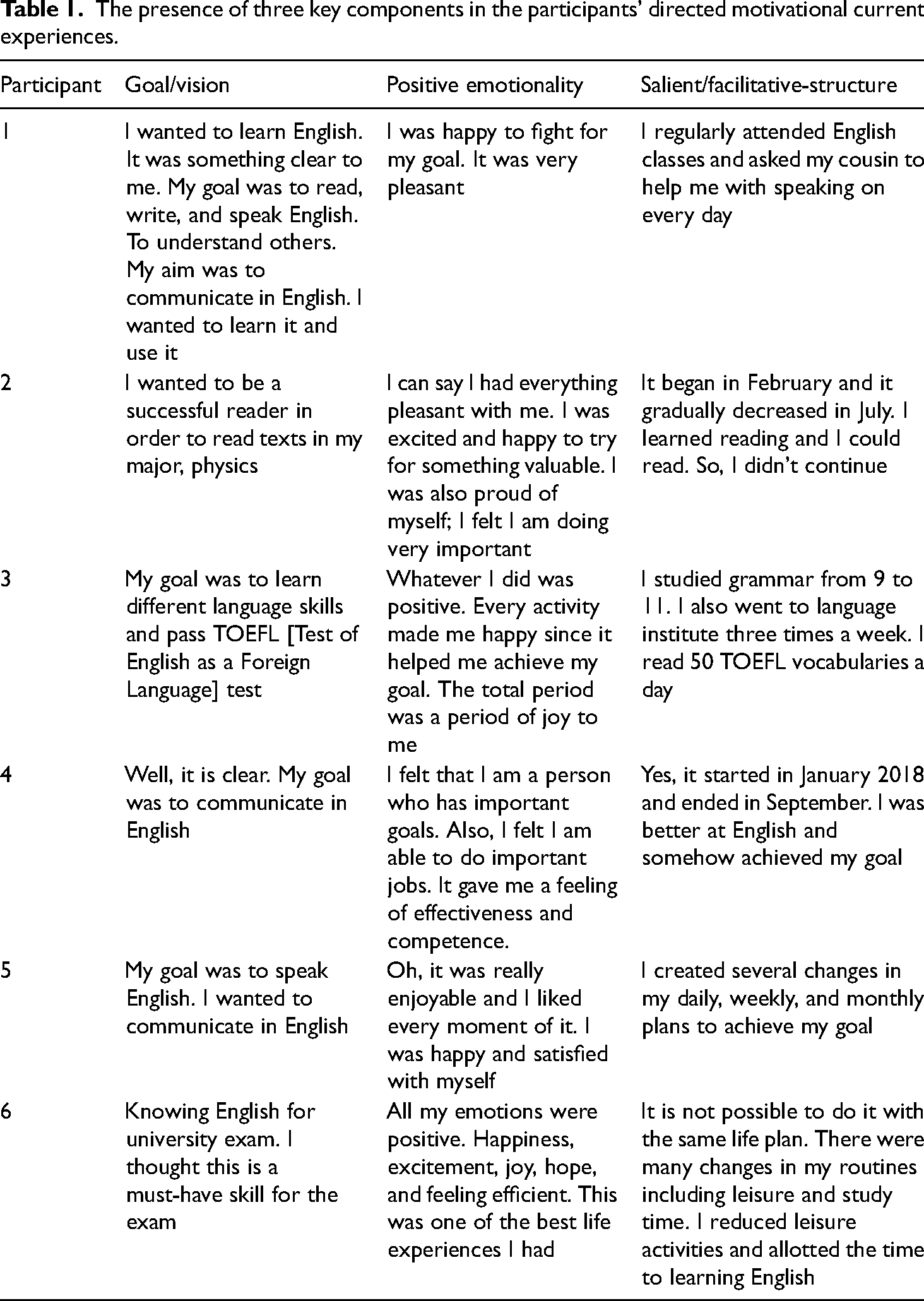
The results indicated that the three key components of DMCs were present in the participants’ motivational experience (see Table 1). Each of these components is described in the following subsections. Since the focus of the study was on the role of feedback on DMCs, the three key components are firstly described with attention to the role of feedback.
The presence of three key components in the participants’ directed motivational current experiences.
Goal-Orientedness
The qualitative data analysis revealed that the participants had a clear well-defined target goal. For all, the target goal was learning English, either learning four skills for general communication purposes (four participant) or particular skills (reading, two participants). This can be seen in the following examples: I wanted to learn English. It was something clear to me. My goal was to read, write, and speak English. To understand others. My aim was to communicate in English. I wanted to learn it and use it. (Participant 1)
Reading. I wanted to be a successful reader in order to read texts in my major, physics. (Participant 2)
As in Dörnyei et al. (2016), the participants’ DMCs had a clear well-defined target goal for which they made efforts. These goals were related to learning one or all language skills.
Positive Emotionality
The participants reported that they had several positive feelings when pursuing their goal. The results indicated that participants have an amalgam of feelings such as happiness, joy, excitement, self-efficiency and pride. This can be seen in the following excerpts of data. I was happy to fight for my goal. It was very pleasant. (Participant 1) I can say I had everything pleasant with me. I was excited and happy to try for something valuable. I was also proud of myself; I felt I am doing very important. (Participant 2) Whatever I did was positive. Every activity made me happy since it helped me achieve my goal. The total period is a period of joy to me. (Participant 3) I felt that I am a person who has important goals. Also, I felt I am able to do important jobs. It gave me a feeling of effectiveness and competence. (Participant 4)
The results confirm those of Dörnyei et al. (2016) who reported that experiencing a DMC is accompanied by positive emotional loading and experience of feelings that are pleasant.
Salient Facilitative Structure
The results also showed that the three features of establishing routines, regular checks, and recognizable start and endpoints were present in the participants’ motivational experiences. The participants, for example, mentioned that they changed their daily plans and included those related to learning English. As they commented: I regularly attended English classes and asked my cousin to help me with speaking on every day. (Participant 1) I studied grammar from 9 to 11. I also went to language institute three times a week. I read 50 TOEFL vocabularies a day. (Participant 3) I created several changes in my daily, weekly, and monthly plans to achieve my goal. (Participant 5)
Additionally, there were regular progress checks that propelled the motivational momentum. These progress checks were from sources such as examinations, others’ comments, or personal evaluations.
Finally, the participants clearly indicated the start and end points of their motivational experience. As they commented: It began in February and it gradually decreased in July. I learned reading and I could read. So, I didn't continue. (Participant 2) Yes, it started in January 2018 and ended in September. I was better at English and somehow achieved my goal. (Participant 4)
This was in line with the key tenets of the DMCs construct that there are clearly identifiable start and end points (Dörnyei et al., 2016). Overall, the data showed that the participants’ motivational experiences included the key features of DMCs.
Positive Feedback
The results indicated that positive feedback increased the participants’ motivation by promoting goal persistence. The positive feedback that the participants received was related to their accomplishments, outcome expectancies, achievement of their target goal, and goal commitment. As one of the participants commented on his teachers’ comments on his performance: His complements and comments made me believe that I can achieve the goal. Whenever he talked to me, I became more and more willing to try and to learn. (Participant 2)
Another participant echoed the same ideas and said: My sister was really effective. Whenever she talked to me, she was kind and positive. Her words made me try harder. (Participant 6)
Moreover, the results indicated that the feedback that the participants received has some affective consequences. The data showed that feedback created some affective consequences that led to some behavioral changes in response to feedback. For instance, the data analysis revealed that if a participant received positive feedback on getting a good grade in an English examination this gave him/her some good feelings that led to more goal commitment. As a participant commented: When they commented on my performance, I become more happy, positive, and hopeful about my attempts. This made me try harder and attempt more to achieve my goal. (Participant 1)
Another participant considered positive feedback as a major source of positive emotions in her motivational experience and said: I think the good feelings in that period were because of the comments I received from the others. I heard nice comments and I felt increasingly positive about what I was doing. These positive feelings made me try harder. (Participant 3)
In addition, the data analysis showed that positive feedback increases the participants’ sense of self-efficacy (Bandura, 1991, 1997). For example, one of the participants told us that comments from others on his strength and improvements gave him the feeling that he was competent and efficient in pursuing his goal. Thus, if he tried more, he would achieve the goal. As he commented: Comments from my family made me feel that I could do important and big works. (Participant 1)
Also, the data analysis showed that mastery experiences provided positive feedback that increased goal expectancy and goal commitments. These mastery experiences were mainly in the form of good performance in spoken or written tests. This can be seen in the following excerpt of data: I performed well in grammar and vocabulary test This showed that I was becoming better at English. I got better scores in speaking and reading test I saw that my attempts were successful so I kept trying I wanted to be a perfect speaker. (Participant 3)
Finally, it was found that positive feedback could enhance goal commitment when it emphasized that the goal was valuable and worthy of making attempts for. This can be seen in the following excerpt: My uncle encouraged me. He told me about the benefits of English. He said I had a great purpose. This was really good. I was happy to see that my goal is an important one. So, I tried more and more. The comments I received made me sure that I was in search of something important. Something classy and useful. They gave me energy and feeling of being important. (Participant 5)
All in all, as presented above, positive feedback increased learners’ goal-directed energy investment and commitments enhanced goal expectancy, fostered sense of self-efficiency and emphasized the value of the target goal. This is in line with research on goal-directed behavior that positive feedback can increase goal commitment whether by influencing goal expectancy and commitment or by creating positive effect (Fishbach and Finkelstein, 2012).
Negative Feedback
The analysis of qualitative data showed that negative feedback significantly influenced the participants’ motivation and goal-directed behavior. Negative feedback, in this study, mainly included information on the distance between current state and the goal. The participants noted that others’ comments on the distance between their current state and the desired state fueled their motivational energy. This can be seen in the following example: The teacher told me that I have progressed a lot but I am not fluent enough. I could feel the progress but I know I should try more. I thought I was close to what I wanted. I wanted to be accepted in university English test As I told you, I needed the certificate. My English teacher said that if I read the remaining two books, I would certainly pass the exam. Yes, only two books! I read with more energy. I was about to achieve my goal. I read them and passed! (Participant 6)
This can be explained by the discrepancy model of self-regulation (Carver and Scheier, 1998). Based on this model, when an individual strives toward the desired end state (here, well-defined target goal of a DMC), the motivational system estimates the size of discrepancy between the current state and desired one, and plans action so as to close the gap between the two states. It appears that the participants’ DMC system did the same using the negative feedback from others to calculate the discrepancy size and to increase investment to close it.
Additionally, the data analysis showed that sometimes, the motivation and energy came from one's calculation of the distance between the current state and well-defined goal. The analysis of interviews showed that participants used negative feedback in a Test-Operate–Test-Exit (TOTE, Miller et al., 1960) to keep their goal-directed motivation. In test phase, they first identified the gap between their present state and the goal, and decided on the amount of effort to reach the goal (e.g., “I thought I needed to attend English classes to improve my speaking”). Then, they enacted the effort required to achieve the goal (operate phase, e.g.,” I enrolled and attended English classes”). After some time, they again assessed their improvement and several TOTE phases cycled around recursively (e.g., “later, I regularly watched English movies, read grammar books, and took test”) till they finally felt that they have achieved their target goal (e.g., “I stopped trying hard since I had my goal, I could speak English”).
In sum, the data showed that negative feedback exerted a motivating impact for the participants through creating a process of making progress by reducing the discrepancy between the individuals’ present state and desired end state. Negative feedback increased energy investment. For example, some participants note that when they learned about their distance from their goal, they could calculate the distance from it which made them more motivated and energized because they knew that if they tried more, they could achieve their goal. As a participant mentioned: When you know how far you stand from your goal, you can guess how much effort and energy you should put to get it. When you see that you’re not far from it you try harder to get to it soon. (Participant 6)
General Discussion
The results of this study showed that the key characteristics of DMCs were found in the participants’ motivational experiences. This finding provides more empirical evidence for the validity of the DMC construct (Dörnyei et al., 2016) for explaining highly intense motivational experiences. Particularly, the results of this study confirm the significant role of feedback in the structure of DMCs. The results showed that both positive and negative feedback increased goal commitment by promoting self-efficacy and goal persistence, and by decreasing the difference between current and desired goal states. This is in line with the previous research on the role of positive and negative feedback in goal commitment and goal persistence (Fishbach et al., 2010; Fishbach and Finkelstein, 2012). As noted by Bandura (1997), positive feedback increases a sense of self-efficacy which in turn creates the idea that one is competent and one's efforts will pay off. Correspondingly, a person who receives feedback in a DMC would feel that he/she is competent enough to achieve the goal; therefore, more persistence and energy would be invested. Also, the results indicated that negative feedback promoted goal commitment by highlighting the distance from the desired goal. This is in line with a discrepancy model of self-regulation (Carver and Scheier, 1998; Miller et al., 1960). In other words, when negative feedback is given to the motivational structure of a DMC, it calculates the distance from the well-defined target goal and strives to decrease the distance between the current status and the well-defined target goal.
Feedback also has some affective consequences. Thus, when a learner who is experiencing a DMC receives feedback, he/she not only receives information on his/her accomplishments and quality of performance but also gets some information that fosters feelings and mood, which can translate into positive emotionality and propel the DMC toward its well-defined target goal. It can be understood from the findings of this study that feedback plays an integral role in the structure of DMCs by enhancing goal commitment and energy investment. Our findings also show that feedback is important for the positive emotionality in a DMC because receiving feedback was found to have positive affective consequences for the participants. Moreover, our findings delved more into the nature of the types of feedback that affect DMCs and showed that positive feedback through comments on “accomplishments, strengths, and correct responses” (Fishbach and Finkelstein, 2012: 203) and negative feedback in the form of comments on “lack of accomplishments, weaknesses, and incorrect responses” (Fishbach and Finkelstein, 2012) influenced learners’ DMCs. The present study adds to our knowledge about DMCs that feedback can increase goal commitment in DMCs if it is delivered to reduce the distance between current state and desired goal state.
Implications of the Study
This study has some implications for language teachers and researchers. It appears that positive feedback is more useful when the DMC has just started. Positive feedback provides information that the goal is a valuable one and presents information on individuals’ ability to achieve the goal, and therefore, enhances goal commitment. Moreover, negative feedback is more useful when the teacher aims to increase the students’ energy and investments. It is suggested that teachers who use intensive group projects try to use positive feedback in the beginning to enhance goal commitment. Later, they can use negative feedback to increase learners’ energy and effort. Moreover, this study shows that teachers should be aware of the effect that their comment and behavioral and affective feedback play on learners’ energy and perseverance in goal pursuit. Therefore, workshops should be held to inform teachers about the various effects of teachers’ comments, feedback and reactions to students’ performance to enhance learner motivation and goal pursuit.
Future research will show that positive and negative feedback influence emotions and affect in a DMC. For example, further research will inspect whether there is any link between feedback and positive emotionality in a DMC. Future research can also investigate whether positive and negative feedback influence establishing or abandoning daily routines as an important part of the structure of DMC.
Limitations of the Study
The results of this study are limited to the specific sample of the study. Further research with language learners from different contexts and sociolinguistic backgrounds are needed before making any generalizations about the findings. Moreover, the present study relied solely on interview as its main data collection tool; therefore, the results might be limited to the weaknesses of qualitative methodology.
Conclusion
This study employed a qualitative methodology to understand the ways in which feedback could influence energy investment and goal commitment among language learners who experienced a DMC. The results indicated that positive and negative feedback, whether from one's appraisals or others’ comments, significantly influenced energy and investments, and goal commitments. Positive feedback increased goal commitment by emphasizing the value of the goal and enhancing self-efficacy, while negative feedback monitored making progress and fostered gap-reducing actions. The results of this study show that positive and negative feedback play an important role in learners’ energy investment. Moreover, the findings show that each type of feedback affects goal pursuit in its own way whether by highlighting the value of the goal or by having the individual fill the remaining gap from the goal.
Footnotes
Ethical Statement
All procedures performed in this study involving human participants were in accordance with the ethical standards of the institutional and/or national research committee and with the 1964 Helsinki Declaration and its later amendments or comparable ethical standards.
Informed Consent
Informed consent was obtained from the participants before doing the study.
Data Availability
The datasets generated during and/or analyzed during the current study are available from the corresponding author on reasonable request.
Funding
The authors received no financial support for the research, authorship, and/or publication of this article

Appendix Semi-structured interview questions
Can you tell me about your motivational experience? How did you feel about it? How was your daily schedule? What was particularly interesting about your experience? What was your shared goal? Did you achieve it? Was there any change in your daily routines or study plan? Do you remember when it started? Do you remember what triggered your motivation? When did it start to lessen? What do you feel after that experience? Do you like to have such a motivational experience again? How do you think this experience influenced your feelings and beliefs about English learning? Do others’ (e.g., teachers) reactions influenced your motivation? What kinds of comments did you receive? How did they affect your motivation and energy? Does others’ feedback influenced your energy to pursue your goal? How?