



Abstract
This article begins a series of planned annual reviews of rehabilitation doctoral dissertation research. Twenty doctoral dissertations completed in 2011 from recognized doctoral programs in rehabilitation were identified and analyzed. Dissertations were indexed according to their research topic, methodology employed, model, and statistical analysis, and an annotated bibliography was developed. Institutional productivity and employment trends of doctoral graduates were added as baseline data points for future analysis. Results of the current analysis reflect that a majority of the studies consisted of quantitative descriptive research designs. Unlike prior analyses, advanced and basic statistics were utilized equitably. Dissertations focusing on attitudes toward persons with a disability were higher than any of the prior reporting periods. Predictive outcome studies and clinical population research also remain prevalent. Implications for the practice of rehabilitation counseling, education, and future research are discussed.
Doctoral education fosters the generation of new knowledge, the conservation of relevant precedent, and the transformation of knowledge through teaching (Golde, 2006). As the climax of the doctoral education process, doctoral dissertations reflect both the research interests and sophistication of prospective graduates. Previous doctoral dissertation research has been summarized in peer-reviewed literature to analyze research trends, enhance the accessibility of research, and identify topics for future study (Beck, Janikowski, & Stebnicki, 1994, 1996; Leahy, Habeck, & Fabiano, 1988, 1989; Leahy, Habeck, & Van Tol, 1992; Leahy, Van Tol, & Habeck, 1990; Lofaro, 1981a, 1981b, 1982, 1983a, 1983b; Tansey, Phillips, & Zanskas, 2012; Tansey, Zanskas, & Phillips, 2012). Review of 187 rehabilitation counseling dissertations for the years 2005 through 2010 revealed an increase in both predictive outcome and clinical population studies (Tansey, Phillips, et al., 2012; Tansey, Zanskas, et al., 2012). The current review of doctoral dissertation research completed in 2011 begins a series of planned annual reviews of doctoral dissertation research in rehabilitation counseling.
Although the process for these chronological reviews has varied throughout the years, the present study employs the method utilized by Tansey, Zanskas, et al. (2012). Doctoral dissertation research conducted by students from rehabilitation counseling programs listed in the 2010–2011 National Council on Rehabilitation Education (NCRE) Member Directory were analyzed by methodology, topic, type of research data, the type of statistical analyses, and the research design utilized by the dissertator to answer their respective research questions. This study represents a partial replication of Leahy et al. (1988, 1989, 1992, 1990) providing an annotated bibliography summarizing the content, reference citations, observations, and research trends. Institutional productivity and employment trends of doctoral graduates were also analyzed.
Method
The content review for this study was limited to rehabilitation programs listed in the 2011 NCRE directory. Dissertations were collected using a sequential method paralleling the approach used in previous reviews (Tansey, Phillips, et al., 2012; Tansey, Zanskas, et al., 2012). After identifying programs, an advanced search in the ProQuest Dissertation and Theses database was used to search for dissertators by program faculty in each of the parent universities. This process resulted in the collection of 38 dissertations from 14 universities. The researchers then contacted representatives of the doctoral programs to verify the accuracy of any listed dissertations that were in question. Additions and deletions were made based on this feedback. The final list represented a total of 20 dissertations.
The 20 dissertations were then distributed to one of the three authors for initial coding. The authors served as pairs of independent raters for each dissertation. Where discrepancies existed between independent raters, a third researcher, acting as an auditor, made final coding determinations. The content was categorized by methodology, type of data, type of analysis, and research design in addition to a categorization of the general content (see Tansey, Zanskas, et al., 2012, for a full description of these added categories).
Results
The current review focused on a single year of rehabilitation counseling–related dissertations, 2011, compared with the last two published reviews of dissertations from 2005–2007 (Tansey, Zanskas, et al., 2012) and 2008–2010 (Tansey, Phillips, et al., 2012). As a result, direct comparison to these prior reviews is limited to extracting the average number of dissertations published each year versus the cumulative total. This method was previously used to compare the study of published dissertations from 1992–1993 provided by Beck et al. (1996), covering a two-year period, with the subsequent review of published dissertations from 2005–2007 conducted by Tansey, Zanskas, et al. (2012). The mean number of dissertations published by students graduating from doctoral programs in rehabilitation counseling dropped by 32% relative to the average number published in the previous 3 years. As indicated in Figure 1, the number of published dissertations in 2011 was 39% lower than the high point established in 2005–2007.
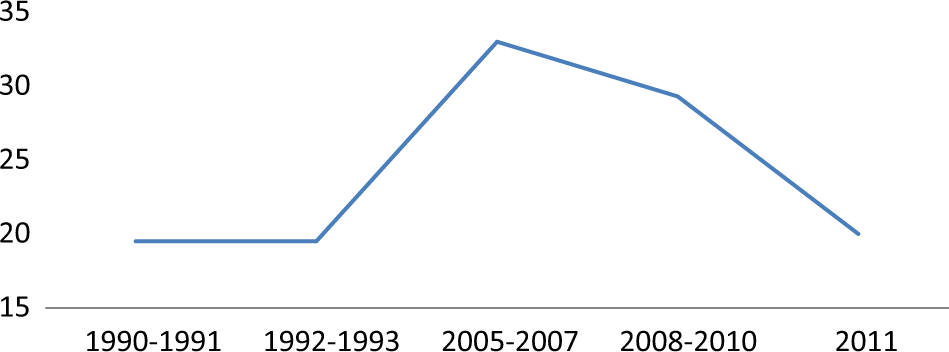
Average number of dissertations per year compared to last three documented studies.
In analyzing the type of methodology implemented in dissertations, it appears that a majority of dissertations used quantitative research designs (n = 15, 75%) although qualitative designs (n = 3, 15%) and mixed-method designs were also used (n = 2, 10%). Of the 15 quantitative dissertations, almost all were descriptive research studies (n = 14, 93.3%). It appears that a minority of dissertators used archival data sets (n = 2, 10.0%) in answering their research questions. In addition to the descriptive research, one dissertator implemented a quasi-experimental design (n = 1, 6.7%) and there were no dissertations published that implemented a true experimental design to investigate the research questions. In evaluating the statistical analyses implemented in the quantitative and mixed methods dissertations (n = 17), it appears that dissertators selected advanced statistical methods (n = 9, 52.9%) at approximately the same rate as basic statistics (n = 8, 47.1%). Consistent with the most recent study on doctoral dissertations in rehabilitation counseling (Tansey, Phillips, et al., 2012), a significant correlation between the use of an archival data set and advanced statistical methods was not observed, r(20) = −.140, p > .05.
Content Analysis
The content review of dissertations resulted in the identification of eight categories. Given that the focus of this project was limited to dissertations published within a single year, the inclusion of subcategories was not conducted due to the limited number of potential subcategories. The interrater reliability for the content review raters was found to be Kappa = .716 (p < .001). This taxonomy was similar to that produced by in the most recent reviews of published dissertations (Tansey, Phillips, et al., 2012; Tansey, Zanskas, et al., 2012). The number and percentage of dissertations in each category are summarized in Table 1. The distribution of dissertations among the major categories from 2011 were as follows: (a) attitudes and attitudinal change, 5 (25.0%); (b) predictive outcome studies, 4 (20.0%); (c) clinical population studies, 4 (20.0%); (d) professional issues, 2 (10.0%); (e) social and cultural aspects of disability, 2 (10.0%); (f) assessment, 1 (5.0%); (g) program and policy studies, 1 (5.0%); and (h) family studies, 1 (5.0%).
Historical Comparison of Dissertation Categories from 1990–1993 and 2005–2011.

Ten doctoral programs in rehabilitation counseling produced 20 dissertations in 2011. The number of dissertations from each program, in rank order, were as follows: (a) University of Iowa and the University of Arkansas, 4 each; (b) University of Wisconsin–Madison, 3; (c) Michigan State University and Southern Illinois University, 2 each; and (d) East Carolina University, Illinois Institute of Technology, Northern Colorado University, Utah State University, and Virginia Commonwealth University, 1 each. The first three universities on this list accounted for 11 of the 20 (55%) dissertations reviewed in this study.
The results of the categorization were compared to the most recent review of rehabilitation counseling dissertations conducted by Tansey, Phillips, et al. (2012). Table 1 provides a comparison between the content analysis provided in this review and reviews conducted on dissertations from 1990–1991, 1992–1993, 2005–2007, and 2008–2010. Dissertations focused on attitudes toward persons with disabilities were higher in 2011 than any of the previous reporting periods as it was the most prevalent area of research in the current review. It appears that the number of predictive outcome studies and research with specific clinical populations remain as prevalent areas of inquiry in dissertation research across all reviews. Furthermore, it appears that there was a significant drop in the number of dissertations using archival databases. Other content areas have remained relatively stable over time or experienced only minor declines or increases.
Retrieval of Dissertations
The success rate in the retrieval of dissertations was lower than that achieved in Tansey, Phillips, et al. (2012). The retrieval method implemented in this review resulted in 18 dissertations being identified as rehabilitation counseling dissertations that were later removed for a 47.4% initial false-positive rate. In comparison to Tansey, Phillips, et al. (2012), which reported a 15.3% false-positive rate, it does appear that the method selected by the researchers is inclined to systematically inflate the initial number of dissertations identified as rehabilitation counseling dissertations. Similar to Tansey, Philips, et al., the false-positives were primarily due to master’s thesis incorrectly being included in the initial sample as well as rehabilitation counseling faculty serving as dissertation chairs for doctoral candidates in related programs (i.e., special education, counselor education, counseling psychology).
Employment Settings of Doctoral Graduates in 2011
A new area of inquiry introduced in this review that was not included in previous reviews was a review of employment settings of doctoral graduates. A review of doctoral program websites, Internet search, and email contacts resulted in the researchers being able to identify that 11 of the 20 graduates in 2011 obtained employment in academic settings, 5 were employed in primarily clinical settings, 1 in administration and independent living, respectively, and 2 doctoral graduates current work settings were not identified. In 2010–2011 academic year (August 1, 2010–May 31, 2011), there were 26 tenure track, assistant professor position announcements and 11 nontenure track positions (i.e., clinical assistant professor, visiting professor, postdoctoral positions, and so on) sent over the National Council on Rehabilitation Education listserv for a total of 37 positions. With an effective yield of 55% entering academia, it appears that the number of doctoral graduates is well short of the published needs of rehabilitation counselor education programs.
Discussion
Analyzing dissertation research on an annual basis provides both advantages and limitations. Annual reviews provide an opportunity for improving research accessibility, suggesting areas for future inquiry, and establishing benchmarks for evaluating research trends and institutional productivity. Representing a “snapshot” in time, the results of an annual analysis require careful interpretation as prior analyses involved multiple years of research trends and productivity. Variations in any particular research trend or year were previously mitigated by the effect of averaging data points across multiple years. Despite these limitations, the current analysis reveals several findings that we believe can be used to stimulate a national dialogue about how we are preparing the future stewards of our discipline.
Unlike prior analyses, studies regarding the attitudes toward people with disabilities predominated dissertation research in 2011. Predictive outcome studies and clinical population studies also remained prevalent suggesting a continuing emphasis on evidence-based practice in rehabilitation counselor education (Chan, Rosenthal, & Pruett, 2008). Although other content areas remained relatively stable, the use of archival databases dropped relative to prior studies (Tansey, Phillips, et al., 2012; Tansey, Zanskas, et al., 2012). The essentially equitable use of advanced and basic statistics also represents a variation from the trend toward the use of advanced statistical methodologies reported in prior analyses. Overall, the majority of all dissertations completed in 2011 were descriptive reflecting Level 5 research (Pruett, Swett, Chan, Rosenthal, & Lee, 2008). The findings of this analysis may be used to assist faculty advisors and dissertators to consider the hierarchy of research evidence (Pruett et al., 2008) in order to develop questions that require research designs and the advanced statistics necessary to meet the need to identify evidence-based practices in rehabilitation counseling.
In addition to the changes in content and the forms of statistical analysis utilized by dissertators in 2011, dissertation productivity appears to have returned to levels reported in the 1992–1993 analysis (Beck et al., 1996). Slightly more than half of all the completed dissertations were produced at three universities: University of Iowa, University of Arkansas, and the University of Wisconsin. Anecdotally, in the researchers’ personal experience, the process of research is not always linear. However, rather than speculate on the rationale for these findings, these observations are offered as a baseline for future comparison and comment.
One new data point in the researcher’s analysis included the employment trends for graduates of doctoral rehabilitation counseling programs. Approximately half of all graduates in 2011 entered some form of academic employment. However, even if all the graduates of doctoral rehabilitation counseling programs had entered academia, it appears that the supply of doctoral graduates to fill available academic positions fell short of the demand. The 2011 shortage is likely not an anomaly. Shortages in doctoral rehabilitation graduates were predicted over two decades ago (Wright & Ebener, 1987) and again in 2004 (Ebener, 2004). Furthermore, both current and future leaders perceive these predicted shortages as an important professional issue for the discipline (Phillips et al., 2012; Shaw, Leahy, Chan, & Catalano, 2006).
Whether this shortfall continues in subsequent years warrants further investigation and represents a potential concern at both the doctoral and master’s degree level. If positions were left unfilled, programs would have less capacity to train master’s level rehabilitation counseling graduates. It is also possible, however, that these positions are sometimes being filled by graduates from programs outside rehabilitation. This latter case, despite the possibility of bringing unique perspective, may result in a reduced ability to teach foundational rehabilitation educational content (Ebener, Berven, & Wright, 1993) with possible implications for professional identity development and competence in masters and current doctoral students alike.
Footnotes
Declaration of Conflicting Interests
The author(s) declared no potential conflicts of interest with respect to the research, authorship, and/or publication of this article.
Funding
The author(s) received no financial support for the research, authorship, and/or publication of this article.