




Abstract
Sexuality is an important topic in rehabilitation counseling. Nonetheless, little is known about the state of training on sexuality for rehabilitation counseling students. This study surveyed rehabilitation counseling students on how much training they received on sexuality during their education. Less than half of the sample reported receiving graduate-level training on sexuality. Implications for research, training, and practice are discussed.
Keywords
Introduction
Sexuality is an essential part of the lives of people with disabilities, and rehabilitation counselors should be prepared to discuss sexuality with their clients with disabilities (Ames & Boyle, 1980; Burling, Tarvydas, & Maki, 1994). Sexuality is related to quality of life (McCabe, Cummins, & Deeks, 2000), acceptance of disability (Berkman, Weissman, Maxwell, & Frielich, 1978), and self-esteem (Taleporos & McCabe, 2002) for people with disabilities. It is also related to better social adjustment, higher morale, and better post-injury incomes (Berkman et al., 1978). In addition, Council on Rehabilitation Education (CORE) accreditation standards require that students be educated on both the impact of disability on a client’s sexuality and how to discuss sexuality with clients with disabilities (CORE, 2013). Despite this, little research has been conducted on the state of rehabilitation counselor training on sexuality. Rehabilitation counselors report comfort in discussing sex and disability, and have positive attitudes toward the topic (Kazukauskas & Lam, 2010). In addition, knowledge about sex and disability can predict rehabilitation counselor comfort with the topic (Kazukauskas & Lam, 2010). Similarly, rehabilitation counseling students who have more knowledge of sex and disability and are more comfortable with sex and disability are more willing to discuss the topic with their clients (Juergens, Smedema, & Berven, 2009). Finally, rehabilitation counseling students who have had more training on sex have higher levels of self-reported knowledge of sex (Pebdani, 2013). Still, we know very little about the state of sexuality training for rehabilitation counselors. The purpose of this article is to explore the current level of training on sexuality that rehabilitation counseling students receive during their education.
Method
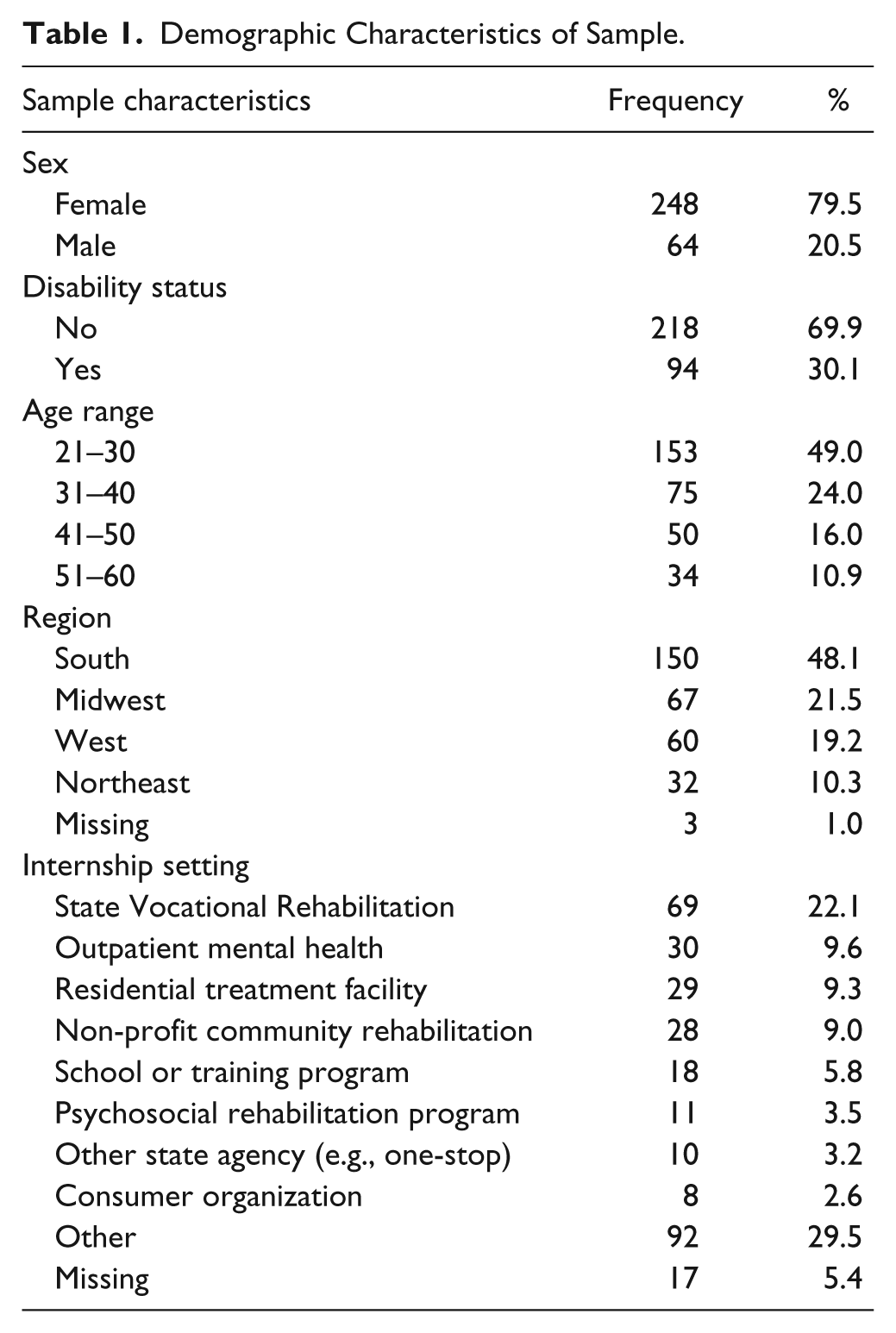
A total of 312 rehabilitation counseling graduate students enrolled in CORE-accredited programs completed a survey on sexuality in the spring of 2010. The survey had been sent by email to all CORE program directors who were asked to distribute it to their students. The sample size cannot be determined because it is not known how widely the survey was distributed by program directors; however, using CORE data on rehabilitation counseling students in 2010 (CORE, 2011), a tentative response rate of 5.9% could be calculated. Approximately half of the students were between 21 and 30 years old (n = 153, 49%), and 79.5% were female (n = 248). Nearly one third of the sample had a disability (n = 94, 30.1%), and almost half were located in the Southern region of the United States (n = 150, 48.1%). The most common internship site in the sample was in State Vocational Rehabilitation (n = 69, 22.1%), though the most common reported internship setting was “other” (n = 92, 29.5%). More detail on the sample is included in Table 1.
Demographic Characteristics of Sample.
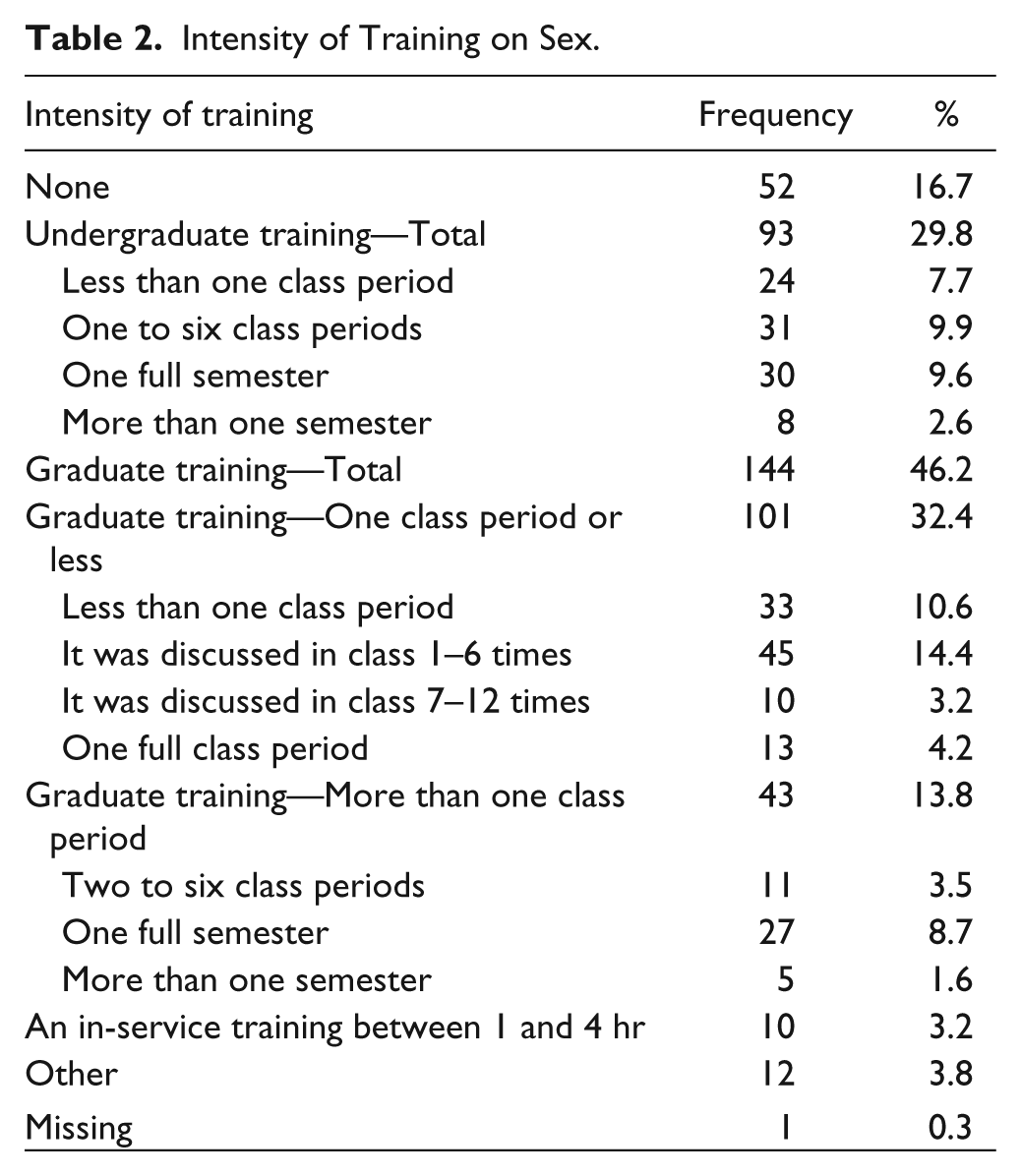
All procedures for this study were approved by the Institutional Review Board at the University of Maryland. A brief demographics survey that collected information about age, sex, disability status, region, and internship setting was developed and piloted on rehabilitation counseling students in a large middle-Atlantic university in the United States. This survey also included a single question on level of training on sexuality. Responses to this question are presented in Table 2. Response options were categorical; therefore, respondents were unable to provide more than one response per question. More information about this survey, as well as how participants were recruited, has been published elsewhere (Pebdani, 2013).
Intensity of Training on Sex.
Results
Descriptive data regarding training on sexuality indicated that 16.7% of the sample received no training on sexuality at all (n = 52). Next, 14.4% (n = 45) reported receiving between one and six class periods in graduate school, followed by 10.6% (n = 33) who reported less than one semester of training in graduate school. Less than half of the sample (n = 144, 46.2%) received training on sexuality during graduate school, and nearly one third of the sample received training on sexuality during their undergraduate education (n = 93, 29.8%). These results are presented in Table 2 (organized by level of training).
Discussion and Implications
Given the holistic nature of rehabilitation counseling and the CORE requirement that students receive training on sexuality during their graduate studies, it is striking that more than half the students reported that they did not receive graduate-level training in sexuality. This is especially important, as we know that other rehabilitation professionals often ignore the sexuality of people with disabilities (Charlifue, Gerhart, Menter, Whiteneck, & Manley, 1992; Leibowitz, 2005; Singh & Sharma, 2005). Rehabilitation counselors should possess the necessary skills to work with clients on topics related to sexuality (Ames & Boyle, 1980; Burling et al., 1994; CORE, 2013). As noted in the introduction, students who have had training in sexuality are more comfortable discussing sexuality with their clients and demonstrate more comfort with, and positive attitudes toward, sexuality. Therefore, the importance of teaching rehabilitation counseling students about sexuality cannot be understated.
Rehabilitation counselor educators may want to increase the intensity of training on sexuality in rehabilitation counselor education and integrate the topic throughout the curriculum. An increase in research on sexuality and disability and on sexuality training for rehabilitation counselors could also have positive results on training. Finally, revising the CORE standards to include sexuality in other areas (e.g., psychosocial or medical aspects of disability) may have a positive influence on the provision of training on sexuality and disability in rehabilitation counseling programs.
Limitations
This study has several limitations. First, there is a large potential for selection bias in this study. Requesting program directors to forward a recruitment email for a survey about sexuality may have led to selection bias in recruitment at the program director level. Further selection bias in recruitment may have occurred at the student level when they received the survey on sexuality and had the option to self-select out of taking the survey. In addition, without knowing how many program directors forwarded the recruitment email, a precise response rate cannot be calculated, though the estimated response rate is low, which limits generalizability. Although this survey does report on the amount of training in sexuality that students receive, it does not address the issue of quality of training. Some counselor educators may be more comfortable with the topic of sexuality and therefore may approach it differently than others. Finally, as the participants of this study were students completing their internships, it is possible that some of the students surveyed had not yet reached the point in their curriculum where sexuality is discussed. Regardless, if the results of this study are indicative of the training rehabilitation counseling students receive on sexuality, rehabilitation counselor educators must work to increase training on sexuality for the benefit of students and their future clients.
Footnotes
Declaration of Conflicting Interests
The author(s) declared no potential conflicts of interest with respect to the research, authorship, and/or publication of this article.
Funding
The author(s) disclosed receipt of the following financial support for the research, authorship, and/or publication of this article: Dr. Pebdani’s work on this article was funded by the U.S. Department of Education, National Institute on Disability and Rehabilitation Research, Postdoctoral Advanced Rehabilitation Research Training, Grant H133P080008.