



Abstract
The present study was designed to provide information about the content of the advisory opinions provided by the Ethics Committee of the Commission on Rehabilitation Counselor Certification. Specifically, a content analysis was performed on all of the advisory opinions rendered between March 1996 and November 2013. NVivo10 was utilized to systematically inspect the content of the opinions and describe emerging patterns. Results from the study revealed that most of the advisory opinions addressed ethical standards related to the counseling relationship, confidentiality, resolving ethical issues, and professional responsibility. Implications for future education outreach initiatives and research directions are discussed.
Ever changing labor market trends and business practices are reshaping how and where certified rehabilitation counselors (CRCs) work and the companies for whom they work (Fraser, Vandergoot, Thomas, & Wagner, 2004; Jenkins & Strauser, 1999; Lane, Shaw, Young, & Bourgeois, 2012). As CRCs venture into new work environments, new and complex ethical issues may negatively affect client welfare as well as the profession and practice of rehabilitation counseling. In response, the Commission on Rehabilitation Counselor Certification (CRCC) Code of Professional Ethics for Rehabilitation Counselors (hereafter referred to as the Code) was revised in 1987, 2002, and 2010 in anticipation of emerging ethical issues. “Rather than a static set of universal, impartial ethical rules, the Code is therefore a ‘living document’ that must be maintained and updated to define and better address perennial and emerging ethical issues” (Tarvydas, Cottone, & Saunders, 2010, p. 195).
As part of a commitment to ensure the relevancy of the Code to professional practice, the CRCC Ethics Committee provides advisory opinions as a source of consultation to assist CRCs, employers, and other stakeholders in interpreting the Code and in ethical decision making. The Ethics Committee comprises six members including a Committee chair, one Board member, and four non-Board members. The president elect of CRCC appoints the chair, when there is an upcoming vacancy, and the Board member when necessary, if the Board member is completing his or her second-year term on the Committee) to serve on the Ethics Committee. The remaining members are elected through an open Call for Applications process. Committee members must be CRCs in good standing. While CRCC is committed to maintaining diverse committee composition with regard to age, gender, ethnicity, and geographical location, an even greater emphasis is placed on encouraging a diverse composition with regard to work setting. Also considered, but not required, is prior experience with ethics such as having taught a course in ethics or participated on other committees or taskforces where ethics was a component of the issues discussed.
Ethical dilemmas arise when CRCs encounter conflict among ethical principles or between personal and professional values (Cottone & Tarvydas, 2007). Written to be broad enough to apply to general practice, yet specific enough to guide practitioners to deal with particular ethical concerns (Tarvydas et al., 2010), the process of ethical decision making becomes even more difficult if the Code and agency policies and procedures do not provide sufficient guidance to address the dilemma. In such instances, CRCs may use higher order critical reasoning, weighing potential costs against benefits. However, sometimes it is helpful that CRCs consult with trusted colleagues and professional organizations to obtain different perspectives to maintain best standards of ethical practice. Bowers and Pipes (2000) suggest that consultation may be sought as a source of guidance
to stimulate our thinking so that we can generate new ideas and options as well as to evaluate better the options that we have already generated;
to be able to receive specific feedback about the quality of our idea;
to receive directly from another new ideas and knowledge;
to help us become more self-aware of personal factors and conflicts that may influence our decision-making process;
to be able to say, to ourselves, that we have gone the extra mile to do the right thing when faced with a difficult choice;
to be supported and help us feel more confident if we made an initial decision; and
to reduce, or attempt to reduce, legal liability. (p. 66)
A review of the literature and several ethical decision-making models endorse consultation as an essential component of professional responsibility (Corey, Corey, & Callanan, 2011; Cottone, 2001; Cottone & Claus, 2000; Garcia, Cartwright, Winston, & Borzuchowska, 2003; Gottlieb, Handelsman, & Knapp, 2013; Kitchener, 1984; Luke, Goodrich, & Gilbride, 2013: Remley & Herlihy, 2013). In addition, proponents of risk-management models support consultation with peers, supervisors, and colleagues as a significant resource for primary prevention (Crowley & Gottlieb, 2012; Harris & Younggren, 2011).
Among the available studies on consultation in different settings, few address the content of the consultation or offer guidance on how consultation is used. Indeed, only one empirical study was found in the rehabilitation literature. Surveying CRCs’ perceptions of what sources of ethical consultation were most and least helpful to resolving ethical dilemmas, Tarvydas, Leahy, and Saunders (2004) found that the most useful sources of consultation were the codes of ethics and consultation with ethics committees. As a valuable tool for consultation, there has been only one study examining the content of the requests for advisory opinions. In that study, Shaw and Lane (2008) noted the high preponderance of requests for advisory opinions addressing professional disclosure and conflicts between ethical standards and legal directives. Given the importance of advisory opinions as a source of consultation, more research is needed to continually monitor and maintain the integrity and relevancy of the Code.
Advisory Opinions
Serving 2-year terms, the CRCC Ethics Committee comprises six members, including a chair who is appointed by the president elect of the CRCC Board. The remaining members are elected through an open Call for Applications process. Although CRCC is committed to maintaining diverse committee composition with regard to age, gender, ethnicity, and geographical location, an even greater emphasis is placed on encouraging a diverse composition with regard to work setting. Also considered, but not required, is prior experience with ethics such as having taught a course in ethics or participated on other committees or taskforces where ethics was a component of the issues discussed.
In line with the mission of the CRCC Ethics Committee, which is to educate and to prevent violations that are detrimental to the safety and welfare of clients, the CRCC Ethics Committee provides consultation in the form of advisory opinions to inform its members. Formal requests for an advisory opinion must be made in writing and submitted to CRCC headquarters. Once received, the request is reviewed by the Ethics Committee at the next quarterly meeting. After a careful analysis of the information provided, if the Ethics Committee determines that the Code does not provide clear guidance on its own, then an official advisory opinion is provided to clarify the ethical duties and responsibilities. The advisory opinions are rendered in response to limited, unverified information provided to the Ethics Committee and are therefore not to be construed as direct or legal advice. Rather than offering a solution to a specific problem, the intent of an advisory opinion is to provide more general clarification and/or guidance regarding how to interpret specific ethical standards. Furthermore, the Ethics Committee does not offer opinions regarding requests in which there appears to be a violation of the Code. In such cases, the Ethics Committee recommends the filing of a formal complaint to allow a full adjudication of the potential violation. Further information is available on the CRCC website (www.crccertification.com/pages/advisory_opinions/129.php).
Present Study
As the Code is a “living document” that must continually evolve in anticipation of emerging ethical issues (Tarvydas et al., 2010), an in-depth inquiry into the content of advisory opinions may provide insights into sections and standards within the Code that have required the most clarification over time (Koch, Niesz, & McCarthy, 2014). Whereas Shaw and Lane (2008) focused on requests as well as formal advisory opinions, the present study explored only the content of the actual advisory opinions rendered by the CRCC Ethics Committee, which are available on their website. As such, the guiding research question was “What sections, standards, and topical descriptors were most often addressed in the advisory opinions?” Considering that the current 2010 Code includes new and enhanced requirements, standards, and sections, a companion study to Shaw and Lane’s work is timely. Focused on the advisory opinion archive over the 17-year period from March 1996 to October 2013, the purpose of the present study was to explore the nature of all CRCC advisory opinions historically as well as more recently.
Method
Using an “inductive” approach to qualitative analysis, data analysis began with a coding template in mind with data organized according to an existing, though alterable structure (Hsieh & Shannon, 2005; Zimmer, 2006). Alterability was important as one aim of this study was to adapt, expand, and in general, improve on our understanding of the content of the advisory opinions with respect to emerging patterns. Pre-established by the CRCC Ethics Committee itself, data for this study were extracted from the CRCC advisory opinion archive that is categorized by section, standard, and topical descriptor. The topical descriptors specified the issue involved in the requests (e.g., disclosure, legal, confidentiality, forensic and indirect services, and informed consent). In addition to a manual analysis, the NVivo10 software program (QSR International Pty Ltd., 2012) was utilized to systematically inspect the data. A text search summary was then used to analyze word frequencies. In analyzing the data, the researchers identified the sections of the Code, specific standards, and topic descriptors most commonly referenced in the advisory opinions as the source classification and organized them into nodes. As a follow-up to the descriptive analysis, the researchers examined trends within the topic descriptors of the individual advisory opinions. Specifically, content analysis traced repeated trends in the structural categories of language and terminology. For instance, Figure 1 illustrates the coding scheme used to further analyze the larger structural category of Disclosure. Through this iterative process, recurring sub-codes were nested within the larger structural categories (Saldaña, 2013). Finally, to confirm the validity of structural categories and to heighten trustworthiness (Hsieh & Shannon, 2005), the researchers triangulated patterns across the referenced sections and standards of the Code for each advisory opinion.
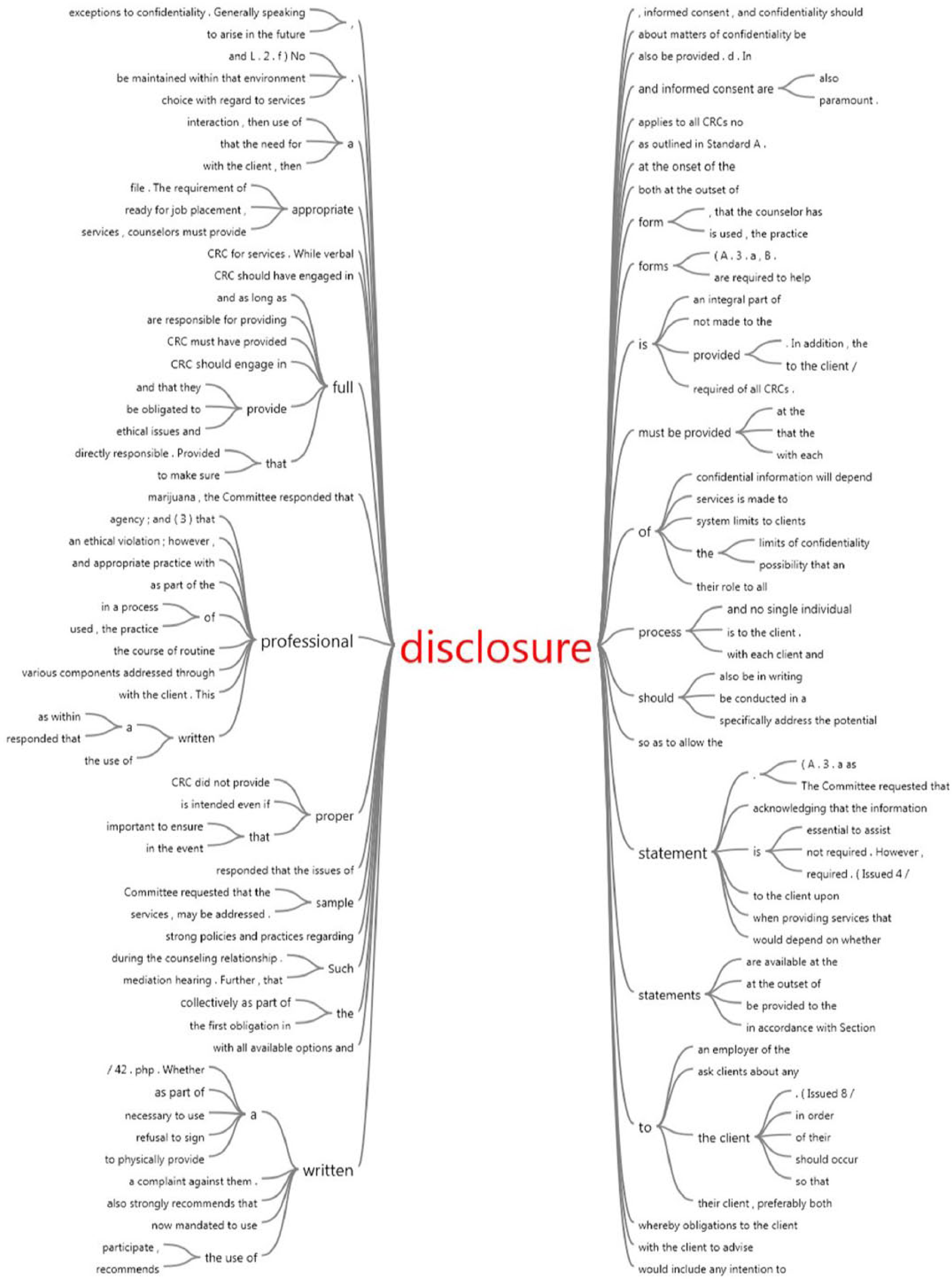
Text search query.
Most of the advisory opinions cited more than one standard and topical descriptor, so the overall number of sections, standards, and topical descriptors is higher than the actual number of advisory opinions. Furthermore, over time, the structure and standards of the Code have evolved; the present study used the current 2010 Code standards. As a companion article to the Shaw and Lane (2008) study, comparisons were made between trends over the 10-year period from 1996 to 2006 as well as trends since that study over the 7-year period of 2007 to 2013.
Results
Over the 17-year period from March 1996 through November 2013, a total of 127 advisory opinions were provided by the CRCC (2013) Ethics Committee. Of these, 91 (71.6%) were provided during the 10-year period between March 1996 and November 2006, whereas 26 (20.5%) were provided during the 7-year period between March 2007 and November 2013. Of these, the majority of opinions (n = 104, 81.9%) were in response to requests submitted by CRCs, whereas 23 (18.1%) responded to requests from other stakeholders (i.e., employers, practitioners providing direct services, attorneys, clients, and students). A close inspection of the content of the opinions may reveal insights into what types of ethical issues have required the most clarification.
Sections of the Code
Overall, the 127 advisory opinions referenced a total of 470 citations to specific sections of the Code (see Table 1). To begin, the most referenced section was Section A: The Counseling Relationship as cited in 135 of 470 (28.7%) opinions, followed by Section B: Confidentiality, Privileged Communication, and Privacy as cited in 89 of 470 (18.9%) opinions. Taken as a whole, these two sections accounted for slightly less than half (47.6%) of the citations to sections of the Code.
Sections of the Code.

Section L: Resolving Ethical Issues was the next most common with 58 of 470 citations (12.3%). In many ways, the high number of opinions addressing the resolution of ethical issues suggests that one tenth of the advisory opinions are in response to current ethical dilemmas, and the advisory opinion is intended to clarify the CRCs’ ethical duties and responsibilities. For instance, in many of the opinions, CRCs were reminded of the importance of consulting the laws and statutes in the jurisdiction in which they practiced to determine reporting requirements and action steps necessary to fulfill their professional and ethical responsibility. Relatedly, Section D: Professional Responsibility was another frequent section with 52 of 470 citations (11.1%), indicating that many of the advisory opinions clarified CRCs’ scope of practice as well as their ethical responsibilities and duties with respect to addressing ethical issues.
Finally, Section F: Forensic and Indirect Services was cited in 44 of the 470 (9.4%) opinions. In addition, the related Section G: Evaluation, Assessment, and Interpretation was cited another 17 (3.6%) times. As found by Shaw and Lane (2008), there continues to be a high number of advisory opinions related to forensic rehabilitation, one of the fast-growing areas of rehabilitation practice (Barros-Bailey, Carlisle, & Blackwell, 2010). The rest of the citations were spread out across the remaining sections of the Code.
Specific Standards
In addition to sections of the Code, the most frequently referenced standards were examined (see Table 2). Among the most common standards, there were 310 total citations. Of these, the most commonly cited standard was A.3.a. Professional Disclosure Statement with 79 of the 310 (25.5%) citations, accounting for approximately a quarter of the most frequent standards. When analyzed over time, professional disclosure was noted in 49.5% of the advisory opinions from March 1996 to November 2006 compared with 55.5% of the advisory opinions from March 2007 to November 2013, which is relatively consistent.
Most Frequent Standards.

After professional disclosure, L.2.c: Conflicts Between Ethics and Laws was the next most referenced standard as cited 37 (11.9%) times. Relative to the absolute number of advisory opinions, the percentage that addressed conflicts between ethics doubled from March 1996 to November 2006 compared with March 2007 to November 2013, from 23.1% to 50.0% of advisory opinions. Thus, there was a relative increase in consultation requests clarifying the impact of laws and legislation on the profession and practice of rehabilitation counseling.
The remaining most frequently cited standards were relatively spread out. Rather than examining each one separately, related standards were examined collectively. To begin, several of the standards related to the primary roles and responsibilities of CRCs with respect to their clients. Specifically, the following standards were frequently cited across all of the advisory opinions: A.1.a. Primary Responsibility (n = 23; 7.4%), A.3.b. Informed Consent (n = 17; 5.5%), F.1.a. Primary Obligation (n = 23; 7.4%), and F.1.d. Indirect Service Provision (n = 23; 7.4%). Sharing a common characteristic of defining the primary roles and responsibilities of CRCs across different employment settings, individually each of these standards was cited more frequently in recent years, in part, because the standard did not exist in previous versions of the Code. Taken as a whole, the four standards listed above were cited in 44.0% of the advisory opinions from March 1996 to November 2006 compared with 84.6% from March 2007 to November 2013, which is almost doubled.
In addition to clarifying that the CRCs’ primary responsibility is to their client, a second group of related standards involved Section B: Confidentiality, Privileged Communication, and Privacy. In terms of the most commonly cited standards, the following standards were mentioned across all of the referenced advisory opinions: B.1.b Respect for Privacy (n = 20; 6.5%), B.2.d. Minimal Disclosure (n = 15; 4.8%), and B.2.d Explanation of Limitations (n = 12; 3.9%). As a percentage of the absolute number of advisory opinions over time, the number of advisory opinions addressing these standards decreased. Indeed, when compared with November 2006 to March 2007, the absolute number of advisory opinions addressing one of these three standards decreased from 37.4% to 26.9% from March 2007 to November 2013, indicating a decrease in the number of advisory opinions addressing confidentiality. The decrease is surprising given the heightened questions around security, especially with respect to the safe transfer of confidential client information in the age of information technology.
Finally, there was also a decrease in the absolute number of advisory opinions that addressed employer policies. Among the most frequently cited standards, the following were common across all of the advisory opinions: E.1.c. Employer Policies (n = 20; 6.5%) and E.1.b. Questionable Conditions (n = 11; 3.5%). Similar to confidentiality, the percentage of these standards decreased from 22.0% to 15.4% from March 1996 to November 2006.
Topical Descriptors
Although analysis of the most frequently cited sections of the Code as well as specific standards is an important consideration for future Code revisions, the topical descriptors of the advisory opinions are perhaps more important for practitioners. Given the most frequently standards cited described above, topical descriptors ranked in a descending order are shown in Table 3. Topical descriptors addressing the area involved with disclosure of clients’ rights in the counseling relationship were the most frequently assigned in 56 (30.4%) of the advisory opinions. The next frequently assigned topical descriptors addressed legal (n = 40; 21.7%) and confidentiality (n = 38; 20.7%) issues. The topical descriptors addressing questions regarding dual roles and the provision of indirect services were denoted next (n = 26; 14.1%). Finally, topical descriptors related to informed consent between counselors and clients were found in 24 (13%) of the advisory opinions. Each of the most frequent topical descriptors is discussed in the following sections.
Most Frequent Topical Descriptors.

Disclosure
Standards related to disclosure have evolved considerably across the 1987, 2002, and 2010 Code revisions. For instance, today disclosure must be written and address specific information, including (a) an explanation of the knowledge, credentials, and expertise relevant to the services to be provided; (b) identification of role and role changes; (c) scope and limits of information and services among treatment team members, attorneys, employers, and other involved responsible parties; (d) consequences of deferring, refusing, and participating in services; (e) risks associated with social networking and other electronic means; and (f) legal issues affecting services. In addition, standards within the Code have evolved to explicitly note CRCs’ obligation to engage in full disclosure at the outset with reiteration or expansion throughout the counseling relationship. Finally, ethical practices in rehabilitation have evolved to the point where case documentation is encouraged, and in many instances, there is a need to document both verbal and written disclosures. Related to informed consent, disclosure has become a standardized procedure that is required in virtually all rehabilitation work settings.
The following example represents an opinion rendered involving professional disclosure:
The Committee considered a request for an advisory opinion regarding several questions related to informed consent and professional disclosure within the workers’ compensation setting where the carrier or accreditation standards mandate the use of certain documents in relation to informed consent and disclosure. The Committee responded first by clarifying that CRCs are now mandated to use written disclosure statements in accordance with Section A.3.a of the Code. Further, that this response will address a CRCs obligation with respect to the Code as opposed to any requirements established by an accrediting agency.
Importantly, this advisory opinion reaffirms that written disclosure is a requirement. Furthermore, the advisory opinion reinforces the obligation of written informed consent, even in situations in which an agency does not have that requirement.
Legal
Emerging from the state–federal vocational rehabilitation system, the profession of rehabilitation counseling has always been affected by federal legislation and laws. However, given the increasing complexities surrounding healthcare reform as well as the corresponding access to legal information, requests for consultation involving legal issues may continue to increase. An opinion appearing in the archive involving conflicts between ethics and laws is demonstrated in the following example:
The Committee considered a request for an advisory opinion with regard to whether CRCC’s Code of Professional Ethics for Rehabilitation Counselors precludes the provision of services to undocumented workers. The Committee responded that CRCC’s Code requires that individuals comply with legal requirements in the jurisdiction in which they practice and observe legal limitations of services they offer to clients. Should such legal requirements or limitations prohibit the provision of services to undocumented workers, the Code would require that a CRC does not engage in any such service provision.
In this advisory opinion, the Ethics Committee is noting that CRCs must comply with legal requirements in the jurisdiction in which they practice, including instances of undocumented workers, which is a larger political and social discussion in the United States (Correales, 2003; Thomas, 2010).
Confidentiality
As the cornerstone of the counseling relationship, confidentially remains a perennial concern. As demonstrated in the following example of an opinion appearing in the archive that involved confidentiality and respect for privacy, rehabilitation counselors do not share confidential information without consent from clients or without sound legal or ethical justification. Furthermore, CRCs must obtain written permission from clients to disclose records to legitimate third parties:
The Committee considered a request for an advisory opinion as to whether it was appropriate to furnish reports for clients other than those in the case in question. The Committee responded that the request appears to be a simple request from an attorney where the certified individual has no obligation to respond.
Forensic and indirect services
As a growing area of practice, advisory opinions addressing forensic and indirect services have become more and more common, a trend that is likely to continue into the future. An example below is an opinion rendered in the archive involving forensic and indirect services:
The Committee considered a request for an advisory opinion with regard to the obligation to a client in disclosing information, writing reports, and making recommendations without the client’s participation, knowledge, input or consideration when the client was initially interviewed and evaluated by the rehabilitation counselor. The Committee responded that the obligation is dependent upon the reason for the referral, which should have been disclosed to the client at the outset of services.
This advisory opinion reinforces an understanding that CRCs who engage in the provision of forensic and indirect services have an obligation to disclose the rights and responsibilities of both counselors and clients at the onset of services.
Informed consent
Related to disclosure, the concept of informed consent has evolved considerably over the course of the Code revisions. Becoming much more explicit in what informed consent truly means, including a differentiation between consent and assent for individuals who have legal guardians, the notion of informed consent is much larger than just providing information. In fact, it is the ability to help clients synthesize the overwhelming amount of information available on the Internet. With so much information available, it is relatively easy for rehabilitation professionals to provide a one-sided argument for a type of service or treatment. Thus, it is becoming more and more important to provide at least two good options for clients and then help them to navigate the virtually limitless amount of information available in today’s digital age.
A request for an advisory opinion with regard to several questions about electronic communications was found in the archive. The questions and the Committee’s response to one such request are detailed as follows:
How does CRCC review electronic sharing of case notes? What is the CRCs obligation to inform our clients of confidentiality limitations in this situation? Is it inappropriate to share some or all of typical case notes recorded in the vocational counseling process electronically? What does CRCC view as minimal disclosure?
Disclosure and informed consent are critical in every situation, but come to the forefront given this method of recording data. Furthermore, it is necessary that CRCs understand what is essential and vocationally relevant in a matter. The organization may need to provide additional training to staff members so that they understand these concepts.
This advisory opinion makes it clear that CRCs are held to the same level of expected behavior and competence regardless of the technology or its application, specifically in regard to disclosure and informed consent.
Discussion
Taken as a whole, an absolute number of 127 advisory opinions over the 17-year period indicates that the CRC membership as well as the CRCC Ethics Committee is actively involved in viewing the Code as a “living document” that requires narration and interpretation (Tarvydas et al., 2010). In addition to the analysis of trends in the sections, standards, and topical descriptors of the advisory opinions, it may be useful to consider broader themes, which may inform future Code revisions.
Complexity of Consultation Requests
The present study found that most of the advisory opinions referenced multiple sections of the Code, which highlights the fact that the consultation requests were complex, requiring clarification of multiple ethical duties and obligations. Relatedly, the high number of opinions addressing Section L: Resolving Ethical Issues suggests that one tenth of the advisory opinions are in response to current ethical dilemmas, and the advisory opinion is intended to clarify the CRCs ethical duties and responsibilities.
Counseling Relationship and Confidentiality
The most referenced sections were Section A: The Counseling Relationship and Section B: Confidentiality, Privileged Communication, and Privacy, accounting for almost half of the citations to particular sections of the Code. Mirroring the findings from the Shaw and Lane (2008) study, these results are not surprising especially when one considers that the development of a therapeutic relationship and trust is critical to effective rehabilitation practice (Lustig, Strauser, Rice, & Rucker, 2002). To be sure, the counseling relationship and confidentiality are two sections that will require careful consideration during future Code revisions in anticipation of ethical issues as CRCs venture into new practice settings.
Professional Disclosure
The high number of professional disclosure appears to be a perennial concern that needs to be carefully considered in future Code revisions as well as in continuing education. Although the basic tenets of privacy, minimal disclosure, and explanations of limits are clearly stated in the Code, there may be a need to reexamine these standards. Specifically, it is important to note that a simple request by an attorney does not justify the disclosure of confidentiality information. Rather, the advisory opinion reinforces an understanding of the Jaffee v. Redmond Supreme Court case privileging the confidentiality of the counselor–client relationship (Remley & Herlihy, 2013). Interestingly, in an analysis of the comprehensive review of the ethical complaints and violations received from fiscal years 2006 to 2013 by the CRCC, Hartley and Cartwright (2014) found only one violation related to confidentiality. Thus, it appears that rehabilitation counselors are aware and adhere to the ethical standards regulating disclosure of confidential information.
Forensic Rehabilitation
Consistent with the results of the Shaw and Lane (2008) study, there continues to be a high number of advisory opinions related to forensic rehabilitation, one of the fast-growing areas of rehabilitation practice (Barros-Bailey et al., 2010). Importantly, the 2010 revisions expanded the number and structure of the ethical standards related to forensic practices (Barros-Bailey et al.). Furthermore, in a climate of an increasingly finite amount of government funding, there may be increased pressures to produce unsubstantiated and biased evaluation reports affecting access to services (Hartley, 2012). Thus, there may be a need to educate and provide further guidance regarding the potential harm of providing exaggerated and/or unsubstantiated reports. In addition to the material consequences, the growth in online assessments, as well as the rapidly changing nature of the economy and employment, means that the practice of forensic and indirect services may become increasingly more complex and is thus likely to result in more advisory opinions.
Laws and Legislation
Speaking to the impact of changing laws and legislation on the profession and practice of rehabilitation counseling, the relative increase in the percentage of opinions suggests that perhaps legislation and laws may have a more substantial impact today than in the past. Moving forward, there may be an increase in requests clarifying ethical obligations related to healthcare reform and new legislation, such as the Affordable Health Care Act. Today, CRCs are more likely to be aware and thus hopefully more proactive in seeking consultation regarding changing legislation and federal laws. Given the influence and pervasiveness of managed-care health delivery systems, future revisions to the Code and continuing education should focus on the ethical issues involving cost-containment practices and client choice. Perhaps, attorneys should be invited to engage in a think tank with ethics experts to address legal directives within the context of the Code, particularly in the workers’ compensation and forensic practice areas.
Future Directions
In sum, the results of the present study suggest some trends with respect to the content of advisory opinions historically and more recently. As part of the purpose of the present study, these findings are particularly useful in considering directions for future Code revisions. Importantly, the identification of perennial issues, such as disclosure and confidentiality, must be reexamined with respect to anticipating changes in society, as well as the practice of rehabilitation counseling. As such, it is important to consider the potential implications for rehabilitation counseling professionals.
First and foremost, it is critical that all CRCs read through the advisory opinion archive from time to time as a complement to periodically reviewing the Code itself. Rather than a static set of universal, impartial ethical rules, the Code is a “living document” that requires narration and interpretation (Tarvydas et al., 2010, p. 195). Thus, the advisory opinion archive is an excellent resource for students and professionals in the field to become more comfortable with applying ethical standards to practice. Furthermore, as a source of consultation, the opinions are intended to be much broader than for an individual situation, but rather intended to illuminate and provide additional guidance to all CRCs. Thus, educational courses on ethics can use the archive to examine the ways in which ethical standards are situated within a particular employment context. Thus, the advisory opinion itself may be an excellent resource for future educational initiatives.
In addition to designing educational outreach, the CRCC Ethics Committee periodically reviews the advisory opinion archive as a way to note historic and more recent trends. Providing a lens to identify the topical descriptors and specific standards that have required the most clarification, the CRCC Ethics Committee can use the results of the present study to inform future Code revisions. In addition to noting the most common areas, such as disclosure and conflicts between ethics and the law, it is important to note the relative decrease in consultation requests addressing confidentiality and privileged communication, especially in today’s digital age. The absence of advisory opinions may mean that the Code provides enough guidance. At the same time, it may mean that the Code simply does not address emergent areas, such as social media, in which guidance would be particularly helpful. For example, digital technology is clearly an emerging ethical issue (Chapin & Byrne, 2013); however, the current Code does not address the use of social media. As social media continue to evolve, we are likely to see more explicit oversight regarding the use of social media in rehabilitation counseling. As a glimpse into the future, the Code of Ethics of the American Counseling Association (ACA; 2014) was recently revised and now contains specific standards addressing the use of social media in counseling. The standards established in the ACA revision focused primarily on the nature of the virtual presence of both the counselor and client, as well as protecting the privacy and confidentiality of the client. In addition, these new standards do require that counselors clearly explain to clients “the benefits, limitations, and boundaries of the use of social media” (ACA, 2014, p. 17) as part of the informed consent process. Similarly, in the near future, revisions to the CRCC Code may include specific ethical standards regulating the use of social media in rehabilitation counseling. In the future, there may be an increase in advisory opinions addressing Section J: Technology and Distance Counseling as it intersects with Section A: The Counseling Relationship and Section B: Confidentiality, Privileged Communication, and Privacy, which historically have been the most commonly addressed sections of Code across the advisory opinions.
Limitations
There were limitations to this study that may restrict the interpretation but do not negate the findings. First, the study analyzed the content of the advisory opinions provided by the CRCC Ethics Committee, which may or may not reflect the most common ethical dilemmas in the field. Furthermore, the present study was descriptive in nature and the interpretation of the trends was limited. In addition, as with all analyses involving textual content, the building of thematic categories involved an interpretative process, which does not allow for generalizability (Merriam, 1998). Finally, as an evolving document, the Code has changed over time, which makes it difficult to identify trends in the nature of violations over time.
Conclusion
The aim of the present study was to provide a content analysis of the advisory opinions provided by the CRCC Ethics Committee from 1996 to 2013. Overall, the study found that the CRCC Ethics Committee has been in regular dialogue with CRCC members with respect to ethics consultation that resulted in 127 advisory opinions over a 17-year period. Although the absolute number of advisory opinions is good news, further discussion in the field is needed to ensure that the Code remains relevant to practice. Thus, it is not enough to consider the content of the advisory opinions, but we must also use the knowledge of the past to anticipate future ethical problems within the profession and practice of rehabilitation counseling.
Footnotes
Acknowledgements
The authors wish to thank the Ethics Committee, Cindy Chapman, and Susan Stark of the Commission on Rehabilitation Counselor Certification for their support.
Declaration of Conflicting Interests
The author(s) declared no potential conflicts of interest with respect to the research, authorship, and/or publication of this article.
Funding
The author(s) received no financial support for the research, authorship, and/or publication of this article.