



Abstract
Accommodating students with disabilities may influence their academic performance. This study investigates the effects of accommodations on grade point average (GPA) by examining a sample of 1,248 students from the Office of Disability Services at the Pennsylvania State University. The results showed the significant influence that both test accommodation, specifically extension of time and modification of materials, and course accommodation, specifically assignment accommodation, had on overall GPA while controlling demographic variables and types of disability. The authors also discuss the significance, limitations, and implications of such results.
Introduction
More students with disabilities are pursuing college degrees than ever before (Eckes & Ochoa, 2005; Peña, 2014). Two- and 4-year programs demonstrate a continued increase in enrollment over time, and recent estimates of enrollment of students with disabilities range from 9.3% to 17% of the student body (National Center on Education Statistics, 2000; National Council on Disability, 2000). More recently, between 2007 and 2009, the percentage of high school graduates with disabilities who attended postsecondary institutions increased from 55% to 59% (U.S. Department of Education, Institute of Education Sciences, National Center for Special Education Research, 2010). Today, 1 in 10 postsecondary students reports having a disability (U.S. Department of Education, National Center for Education Statistics, 2009).
Compared with their counterparts, college students with disabilities are likely to have lower retention and persistence rates and are also more likely to take a greater amount of time in degree completion (Horn, Berktold, & Bobbit, 1999; Murray, Goldstein, Nourse, & Edgar, 2000; Wessel, Jones, Markle, & Westfall, 2009). College students with disabilities face a number of unique challenges and have specific transition needs in adjusting to higher education (Brinckerhoff, 1996; Sitlington, 2003).
A number of studies have developed and tested theoretical models for understanding retention and persistence in higher education (e.g., Bean & Metzner, 1985; Braxton & Hirschy, 2005; Braxton, Hirschy, & McClendon, 2004; Reason, 2009; Tinto, 1975, 1993). Such research projects, in fact, have been pursued actively for over 70 years. Although researchers have approached the vexing question of why students choose to leave college after enrollment from various perspectives, the most helpful approach so far arguably is Tinto’s (1975) interactionalist theory, which has been empirically tested by many subsequent studies that have further deepened our understanding of student departure.
According to Tinto’s model, as well as the many following frameworks, the characteristics of students before entering college, especially minority statuses (e.g., older, first-generation, lower socioeconomic class, and/or less academically prepared students), negatively affect persistence by increasing the likelihood of attrition (Engle & Tinto, 2008; Horn & Carroll, 1998; Ishitani, 2003, 2006; Lohfink & Paulsen, 2005; McCarron & Inkelas, 2006; Reason, 2009; Tinto, 2004; Warburton, Bugarin, & Nunez, 2001).
Having a disability can convey minority status that has been the subject of significant research. In postsecondary education participation, youths with disabilities are underrepresented in comparison with their counterparts. Snyder, Dillow, and Hoffman (2009), for instance, reported that in 2007, only one fourth of students with disability participated in some type of postsecondary education, a dramatically lower proportion when compared with the more than two thirds of their counterparts.
Rehabilitation researchers have shown that youths with disability are underrepresented not solely due to their disability itself but because of other traditional risk factors as well (Boutin, 2008; DaDeppo, 2009; Getzel, 2008; Wessel et al., 2009). In particular, students with disabilities are more likely to arrive at college without the requisite academic skills (Guy, Shin, Lee, & Thurlow, 2000; Newman, 2005; Snyder et al., 2009; Stodden, Whelley, Chang, & Harding, 2001). In addition, according to Mamiseishvili and Koch (2011), many students with disability take time off between high school graduation and college entrance, while a number of them come from first-generation families, which refer to families where both parents do not have bachelor’s degrees. Furthermore, relatively few students with disabilities reside on campus, instead choosing to live at home with their parents. Studies consistently show that delayed entry timing, first generation, and staying off campus relate to higher risks of retention and persistence (e.g., Engle & Tinto, 2008; Horn & Carroll, 1998; Ishitani, 2003, 2006; Lohfink & Paulsen, 2005; McCarron & Inkelas, 2006; Tinto, 2004; Warburton et al., 2001). Thus, these additional risk factors may challenge significantly students with disabilities.
In addition to students’ precollege characteristics, most of theoretical frameworks relied on reinforced factors related to college experience such as classroom experience, curricular experiences, or out-of-class experiences that can greatly influence on students’ retention and persistence. In particular, many studies about not only students with disabilities but also students without demonstrated that academic and social integration, that is, involvement with faculty or peers, affected decisions regarding retention and persistence (Astin, 1977, 1993; Boutin, 2008; Getzel, 2008; Kuh, Cruce, Shoup, Kinzie, & Gonyea, 2008; Mamiseishvili & Koch, 2011; Pascarella & Terenzini, 2005; Reason, 2009; Tinto, 1993; Wessel et al., 2009).
According to Metzner and Bean (1987), however, in the case of nontraditional college students, academic integration (e.g., grade point average [GPA] and number of credit earned) was more likely to predict persistence than social integration. More recently, Mamiseishvili and Koch (2011) conducted a logistic regression model approach to test the factors of first- to second-year persistence. When controlling for all other factors such as demographics, entry, and in-college characteristics, academic integration factors positively affected first- to second-year persistence rates of students with disabilities. These results imply that firsthand experiences for retention and persistence, such as academic involvement, can have important impacts.
Meanwhile, researchers have measured students’ academic integration patterns at various levels but use cumulative grade as the fundamental unit of analysis (Hagedorn, 2005). At the course and semester levels, cumulative grade directly influences not only students’ retention and persistence but also their overall college success. Many studies therefore include GPA because of its indication of academic success (Cejda, Kaylor, & Rewey, 1998). Cumulative grade can indicate the important factors affecting how much students value academic performance and learning.
Few studies, however, systematically consider students with disabilities’ cumulative grade throughout the postsecondary education experience. Cumulative grade detrimentally affects degree completion rates and may even influence retention and persistence. Therefore, this study focuses on cumulative GPA as a main outcome variable to measure academic performance.
Due to the low academic performance or success probability of students with disabilities, many programs and services have emerged to aid them in meeting their goals. Foremost among these programs is an official support service, called the Office of Disability Support Services (DSS), which serves students with disabilities on many campuses (Harding, Blaine, Whelley, & Chang, 2006). In the context of these vital programs and services, one of the most critical tools to facilitate learning for students with disabilities in higher education is the provision of accommodations. In fact, two laws protect the rights of students with disabilities to use accommodations: The first is Section 504 of the Rehabilitation Act (1973), and the second is the Americans With Disabilities Act (ADA; 1990). One of the purposes of laws is to ensure equal access to education and provide protection of civil rights for individuals with disabilities. Under these laws, institutions of higher education must provide any academic adjustments necessary to prevent discrimination on the basis of disability. Thurlow, Ysseldyke, and Silverstein (1995) defined accommodations as supporting the need for the learning environment in terms of instructional or testing situations (e.g., altering the textbook’s format, lecturing in sign language, or extending test time in a separate room). In the inclusive educational setting, which aims to educate all people (both individuals with disability and without) in the same fashion, accommodation importantly has promoted accessibility for students with disabilities (Olson & Goldstein, 1996; Sireci, Scarpati, & Li, 2005). As previously mentioned, Section 504 of the Rehabilitation Act (1973) and the ADA (1990) mandate that institutions of higher education provide appropriate accommodations for students with disabilities. Yet there is a distinct difference in the forms of accommodation in higher, elementary, and secondary education (Eckes & Ochoa, 2005; Madaus, Banerjee, & Hamblet, 2010). In particular, elementary and secondary school officials are responsible for identifying students in need of accommodations. In higher education, however, Section 504 and the ADA prohibit institutions from seeking student information based on disability status. By law then, college students with disability must disclose their disability status themselves before they can receive any accommodations. As such, researchers must consider the decision-making process for students with disabilities and make appropriate accommodations based on individual needs (Barnard-Brak, Davis, Tate, & Sulak, 2009; Kohler & Field, 2003). As students gain experience with the sorts of accommodation available to them in the postsecondary environment, they can work with institutions to find the most productive forms of individualized support, and this in turn greatly promotes academic success over time.
Even though legislation has mandated the provision of accommodation, several factors may still hinder the application of accommodations among students with disabilities. One such barrier is the lack of knowledge within the learning environment for both instructors and faculty concerning legal mandates (Hartman-Hall & Haaga, 2002; Hindes & Mather, 2007; Leyser, Vogel, Wyland, & Brulle, 1998). When researching Canadian college faculty and students, Hindes and Mather (2007) found that if an instructor held a negative attitude toward accommodations or impeded their implementation, then students with disability would hesitate or choose not to use accommodations because of the associated stigma (Denhart, 2008; Marshak, Van Wieren, Raeke Ferrell, Swiss, & Dugan, 2010; Parette, & Scherer, 2004).
The effect of professor attitude and perception may be more significant than that of peers. Hartman-Hall and Haaga (2002), for instance, studied the reaction of students with disabilities through hypothetical scenarios; their results were similar to the effects associated with negative professor reaction. Conversely, faculty with a positive stance regarding accommodations effected a greater willingness in students to seek assistance (Hartman-Hall & Haaga, 2002). In contrast, when researchers examined the same scenario in relation to peer attitude and perception of accommodation, they found no statistically significant influence. These consistent findings imply that faculty play a crucial role in the decision-making process of students with disabilities regarding accommodations (Hartman-Hall & Haaga, 2002; Hindes & Mather, 2007; Leyser et al., 1998).
Bolt, Decker, Lloyd, and Morlock (2011) argued that system-level challenges (e.g., complicated requirements for verifying disability and accommodation quality differences) can hinder students’ ability to use accommodations. Past research consistently notes the variability in requirements for verifying disability status across institutions (e.g., Barnard-Brak, Lechtenberger, & Lan, 2010; Madaus et al., 2010). Such variability also exists in the types and extent of accommodations (Harbour, 2008; Lindstrom, 2007; Madaus et al., 2010).
There have been few empirical studies that test the direct effect of accommodations on academic success in higher education for college students with disabilities. Mamiseishvili and Koch (2011) examined the national profile of college students with disabilities and the factors that influenced their first- to second-year persistence in U.S. higher education institutions by using the Beginning Postsecondary Students Longitudinal Study (BPS:04/06) data set. Their results showed a persistence rate of 76.4%. They also found that subtypes of accommodation (e.g., readers, classroom notetakers, course substitution, or waivers) significantly associated with students’ first- to second-year persistence. Furthermore, they reported that students who made accommodations in the first year were more likely to persist than those who did not.
Lombardi, Murray, and Gerdes (2012) analyzed college students with disabilities enrolled at an undergraduate program at a 4-year public university located in the Pacific Northwest and compared first-generation students with their counterparts. Their results showed that first-generation college students with disabilities were more likely to utilize accommodations. Interestingly enough, they found no statistical significance between GPA and the use of accommodations. While they directly tested the association between academic performance and accommodations, their study was limited by its engagement with subtypes of accommodation, specifically in how the study tested only status regarding whether college students with disability used accommodation or not.
Current Study
At present, little research exists that connects accommodations with academic success for postsecondary students with disabilities. Thus, this study has two main rationales. First, this research directly examined the relationship between several accommodations and GPA as an academic outcome of higher education. In particular, some studies suggest that the provision of accommodations in a college environment promotes the success of students with disabilities in higher education (e.g., Olson & Goldstein, 1996; Sireci et al., 2005). Second, this study attempted to test research questions through quantitative methods. Although Sireci et al. (2005) explored through a literature review whether specific accommodations are effective and found that only a few services are stably effective, they also reported that their study results had several limitations in terms of research methods.
Method
Sample and Procedure
At The Pennsylvania State University (PSU), the Office for Disability Services (ODS) serves all enrolled students with disabilities by offering reasonable accommodations and services. The website for the ODS notes that the office,
requests and maintains disability-related documents; certifies eligibility for services; determines and develops plans for reasonable accommodations such as academic adjustments, auxiliary aids, and/or services as mandated under Title II of the Americans with Disabilities Act, Amendments Act (ADAAA) of 2008 and Section 504 of the Rehabilitation Act of 1973.
The data set used for this study was provided by the ODS. Tables 1 and 2 show the frequency of accommodations that students requested.
Frequency of Test Accommodations Requests for Each Type of Disability (N = 1,055).
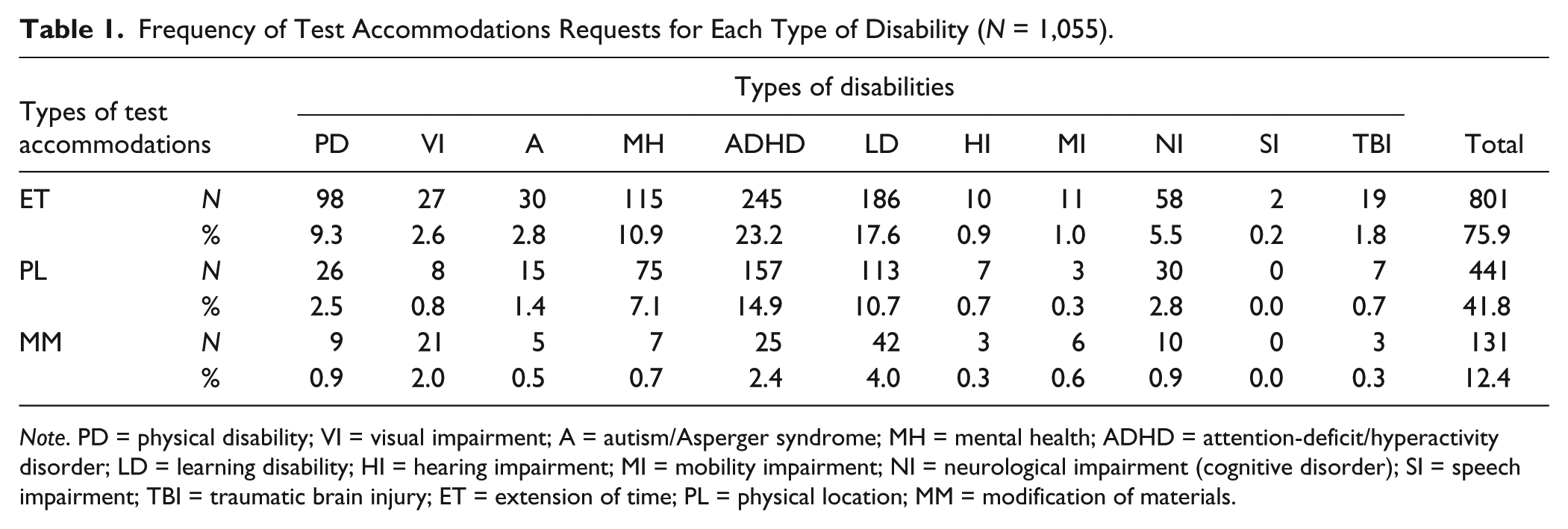
Note. PD = physical disability; VI = visual impairment; A = autism/Asperger syndrome; MH = mental health; ADHD = attention-deficit/hyperactivity disorder; LD = learning disability; HI = hearing impairment; MI = mobility impairment; NI = neurological impairment (cognitive disorder); SI = speech impairment; TBI = traumatic brain injury; ET = extension of time; PL = physical location; MM = modification of materials.
Frequency of Course Accommodations Requests for Each Type of Disability (N = 1,055).
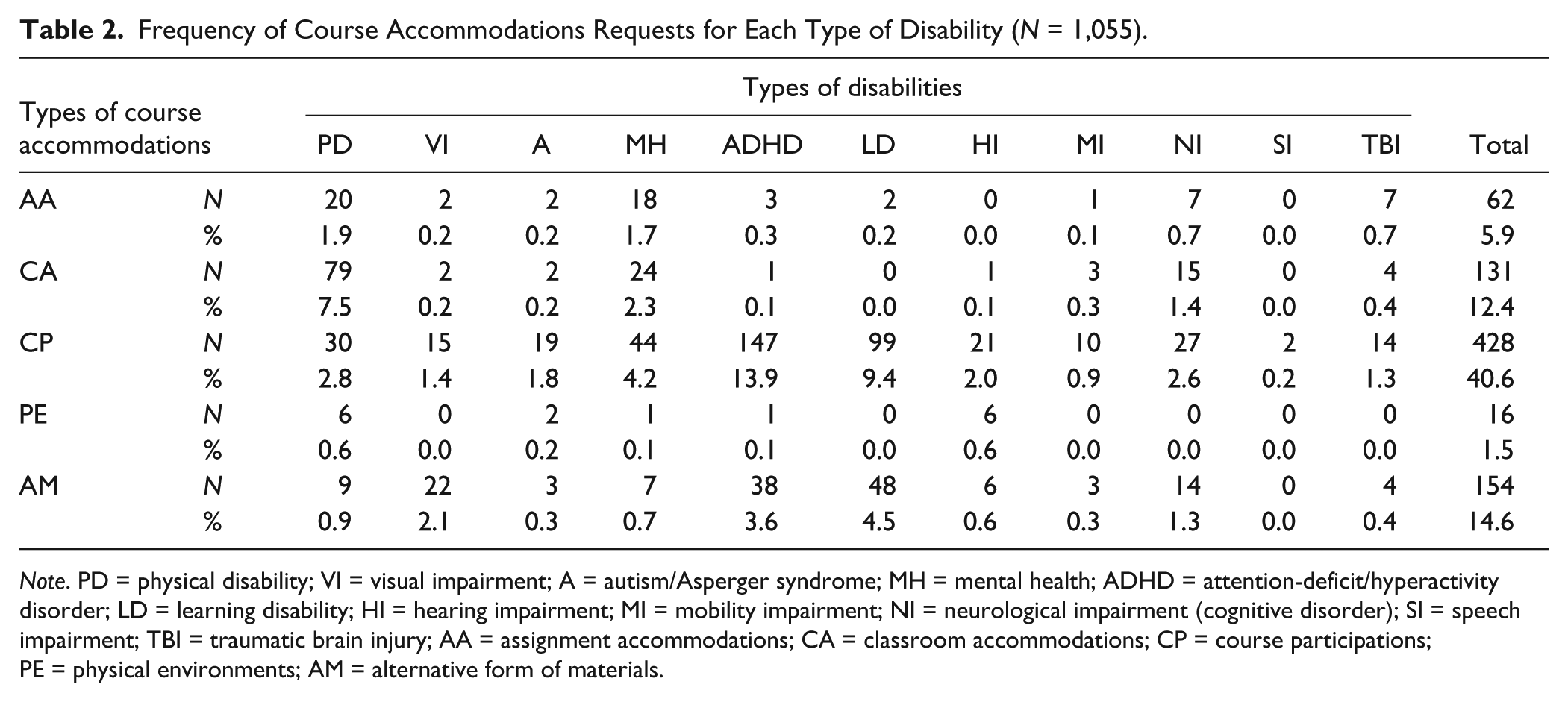
Note. PD = physical disability; VI = visual impairment; A = autism/Asperger syndrome; MH = mental health; ADHD = attention-deficit/hyperactivity disorder; LD = learning disability; HI = hearing impairment; MI = mobility impairment; NI = neurological impairment (cognitive disorder); SI = speech impairment; TBI = traumatic brain injury; AA = assignment accommodations; CA = classroom accommodations; CP = course participations; PE = physical environments; AM = alternative form of materials.
These data provide a complete administrative record from the ODS at PSU, meaning that the data had little missing. Originally, the provided data included 1,252 subjects. In this sample, 34 (2.7%) subjects reported having a visual impairment (VI), 231 (18.5%) subjects reported having a learning disability (LD), 36 (2.9%) subjects reported having a hearing impairment (HI), 21 (1.7%) subjects reported having a mobility impairment (MI), 77 (6.2%) subjects reported having a neurological impairment/cognitive disorder, 7 (0.6%) subjects reported having a speech impairment (SI), 22 (1.8%) subjects reported having a traumatic brain injury (TBI), 141 (11.3%) subjects reported having a physical disability (PD), 41 (3.3%) subjects reported having autism/Asperger syndrome (A), 154 (12.3%) subjects reported having a mental health-related disability (MH), 291 (23.3%) subjects reported having an attention-deficit/hyperactivity disorder (ADHD), and finally 152 (12.2%) subjects reported having two different types of disability conditions and 21 (1.7%) subjects reported having three different types of disability conditions.
We deleted four subjects because these subjects did not report any disability types. Accommodations variables were categorized based on the ODS’s practical considerations. In the ODS, there are two kinds of accommodation types, including test accommodation and course accommodation. Test accommodations are categorized into three subtypes: the extension of time or schedule (ET; for example, double time to take exams/quizzes), the physical location (PL; for example, testing in a distraction-reduced environment), and the modification of materials (MM; for example, assistive technology to read exams/quizzes). Course accommodations are categorized into five subtypes: the assignment accommodation (AA; for example, consideration for an extension to complete an out-of-class assignment), the classroom accommodation (CA; for example, consideration with regard to absences), the course participation accommodation (CP; for example, notetaking assistance or Nittany Notes), the physical environments (PE; for example, reserved front row seating), and the alternative form of materials (AM; for example, textbooks/written material in an alternative format). To categorize each accommodation type, we cross-checked with the ODS director and disability specialists several times.
Data Analysis
The hierarchical approach is used when entering variables such as disability conditions and subtypes of accommodations in a series of blocks or groups. As each new group is added, the researcher is able to determine if the group contributes to predictions produced by the previous blocks. In an instance when a researcher has a priori ideas concerning how the relevant predictors combine to predict the dependent variable, this approach is very useful. In this example, the demographic and disability condition variables are entered first; the test accommodation variables and course accommodation variables are then entered to analyze whether they make an additional contribution. The purpose of this method is to control for or even eliminate any impact of demographic and disability condition variables on the prediction.
Results
The Effect of Test Accommodation on GPA
To investigate whether test accommodations predict cumulative GPA, after controlling for demographic and disability conditions, a hierarchical linear regression was computed. The results of this analysis are presented in Table 3.
The Hierarchical Regression Model Results in Prediction of GPA From Demographic and Disability Conditions and Test Accommodations.

Note. GPA = grade point average; VI = visual impairment; LD = learning disability; HI = hearing impairment; MI = mobility impairment; NI = neurological impairment (cognitive disorder); SI = speech impairment; TBI = traumatic brain injury; PD = physical disability; A = autism/Asperger syndrome; MH = mental health; ADHD = attention-deficit/hyperactivity disorder; ET = extension of time; PE = physical environments; MM = modification of materials.
p < .05. **p < .01. ***p < .001.
As is indicated by the R2, only 1.7% of the variance in cumulative GPA could be predicted by knowing the student’s demographic and disability conditions. The addition of the other test accommodation variables significantly improved the prediction, R2 change = .014, F(3, 1223) = 5.897, p = .001. The entire group of variables significantly predicted cumulative GPA, F(17, 1223) = 3.158, p < .000, adjusted R2 = .029. This is a small effect according to Cohen (1988).
The beta weights and significance values indicate which variable(s) contributes most to predicting accumulative GPA when receiving the extension of time, receiving physical location accommodations, and receiving the modification of exam materials are entered together as predictors. With this combination of predictors, receiving the extension of time has the highest beta (β = .114, p = .003), receiving the modification of exam environments has beta (β = −.087, p = .004), and physical location accommodations are not significant (β = .011, p = .741) in predicting cumulative GPA.
The Effect of Course Accommodations on GPA
To investigate whether course accommodations predict cumulative GPA, after controlling for demographic and disability conditions, a hierarchical linear regression was computed. The results of this analysis are presented in Table 4.
The Hierarchical Regression Model Results in Prediction of GPA From Demographic and Disability Conditions and Course Accommodations.
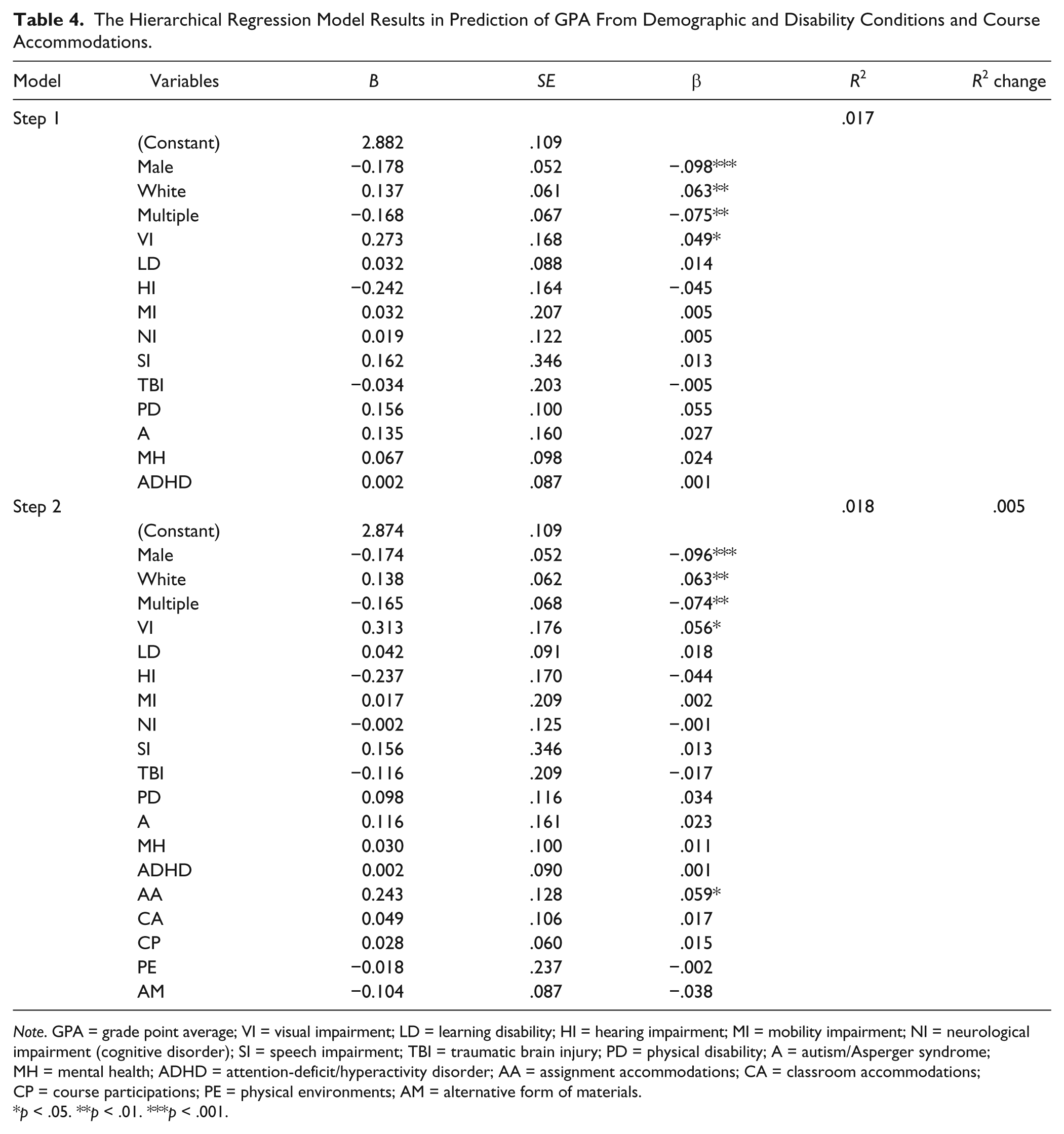
Note. GPA = grade point average; VI = visual impairment; LD = learning disability; HI = hearing impairment; MI = mobility impairment; NI = neurological impairment (cognitive disorder); SI = speech impairment; TBI = traumatic brain injury; PD = physical disability; A = autism/Asperger syndrome; MH = mental health; ADHD = attention-deficit/hyperactivity disorder; AA = assignment accommodations; CA = classroom accommodations; CP = course participations; PE = physical environments; AM = alternative form of materials.
p < .05. **p < .01. ***p < .001.
When the other course accommodation variables were added in Step 2, they did not significantly improve the prediction, R2 change = .005, F(5, 1221) = 1.278, p = .271. However, the entire group of variables still significantly predicted cumulative GPA, F(19, 1221) = 2.210, p = .002, adjusted R2 = .018. This is a small effect according to Cohen (1988).
The beta weights and significance values indicate which variable(s) contributes most to predicting cumulative GPA when receiving assignment accommodations, classroom accommodations, course participation accommodations, changes in physical environment, and alternative forms of materials are entered together as predictors. With this combination of predictors, receiving assignment accommodations has the only significant beta (β = .059, p = .05).
Discussion
The purpose of this study was to identify the influence of accommodations on GPA and find out which accommodations can be predictors for the academic performance of students with disabilities when controlling for demographic variables and disability conditions. The results indicate that test accommodations indicate the difference of GPA, with the extension of time and the modification of exam materials having especially strong influences on GPA. These variables have also been supported as stable predictors of the performance of students with disabilities by Sireci et al. (2005). This finding implies that time extensions and material transformations can improve the possibility of academic success and that these accommodations directly influence test scores. However, even though the beta weight of assignment accommodations was statistically significant when added to the course accommodation, the lesser effect of course accommodations compared with test accommodations means that course accommodations may have less direct impact on a student’s grade.
Although the coefficient of the predictors was statistically significant, the amount of explanation provided by the regression model including accommodations remained low. The results showed that total amount of explained variance for academic performance through each accommodation was quite a small portion. It implies that there may be the possible existence of other variables that could impact GPA. As mentioned above, several variables can affect retention and persistence besides disability-related factors (i.e., type of disability, severity, and accommodations). Some prior researchers have focused on the importance of traditional factors related to college entrance or persistence. Dowrick, Anderson, Heyer, and Acosta (2006), for example, showed that peer and family support were more likely to be related to the success of youth with disabilities than disability-specific factors (e.g., accommodations, or services) in postsecondary education. Mamiseishvili and Koch (2011) also have identified the importance of in-college characteristics, such as full-time attendance, on-campus living, degree aspirations, first-year GPA, and net price of attendance, for predicting persistence rather than the use of accommodations and disability conditions alone. Finally, Fleming and Fairweather (2012) noted the relative importance of traditional factors compared with disability-related variables on predicting college entrance. This consistent evidence shows that the traditional predictors of college attendance or success can also influence the persistence or academic achievement of students with disabilities. Therefore, cumulative GPA, which is a dependent variable in this study and represents academic accomplishment or college persistence, is also influenced by factors such as social support, in-college characteristics, and traditional risk factors including minority, low socioeconomic status (SES), first-generation status, and so forth.
Limitations and Future Study
There are several limitations of this study. First, it is difficult to generalize the findings because the participants were a self-disclosed population of students who use ODS services at PSU. In other words, this study did not include students who did not request any accommodations from the ODS even if they have a disability. In addition, because the atmosphere or situation of a learning environment can differ by type of institution, the campus environment at PSU can be differentiated from other institutions in the United States. Therefore, it is hard to say that this finding at PSU informs generally about students with disabilities in higher education. More diverse participants, including both users and nonusers of services provided from multiple institutions and a nationwide sample, are needed to test and generalize these findings in future research.
Second, although statistically total amount of explained variance for GPA by each accommodation was quite a small portion, accommodations certainly play a crucial role in academic performance. This small change implies the possibility of other variables which predict GPA more powerfully or the presence of mediators between accommodations and grade. Several previous researches have already examined associations between performance or success in higher education and other elements of social background, psychosocial variables, or traditional predictors of attending institutions of higher education, such as whether students with disabilities are first-generation postsecondary students or not (e.g., Lombardi et al., 2012), perceived self-efficacy (Caprara et al., 2008), social support such as mentoring programs (Burgstahler & Crawford, 2007), in-college characteristics (Mamiseishvili & Koch, 2011), minority statuses, SES, high school grades (Fleming & Fairweather, 2012), and so on. Therefore, additional social-background variables, psychosocial variables, or traditional predictors of college entrance can be added to test their association with the academic performance of students with disabilities.
The effectiveness of accommodations for students with disabilities can differ by each disability condition (e.g., visual impairment, learning disability, or mental health-related disability) in that groups of individuals with disabilities are heterogeneous groups. In other words, the influence of accommodations on GPA varies with the nature of the student’s disability. Each type and condition of accommodation (e.g., the frequency of accommodation requests, the acceptance possibility of such requests, or the relative relationship level with test performance) may effect a totally different impact on academic success. Thus, future studies can evaluate the differential effect of accommodations for students with various disability conditions and consider each specific type and condition of each accommodation.
Finally, we only considered GPA as an outcome variable. Even though GPA is an important or critical factor for graduation and experiences of even higher education, there are still remaining accommodations associated with other valuable outcome variables (e.g., individual course unit completion, persistence, retention, higher education satisfaction, or career influence of postsecondary education). Therefore, nonsignificant accommodations of this study should not be neglected and should be identified for association with possible dependent variables in future research.
In conclusion, although some limitations exist, findings in this study are significant evidence for the value of DSS on campus. The atmosphere of higher education is quite different from that of secondary education in terms of providing accommodations as mentioned above. Thus, DSS specialists, faculty, and administrators in university must encourage these students to adjust to such a new environment and to persist until their ultimate completion of a degree.
Implications
In this study, we highlighted the importance of accommodations for the academic success of students with disabilities. Our results imply that accommodations play a crucial role in maintaining students’ academic success at institutions of higher education. However, every student with a disability does not receive accommodations automatically as doing so is not a prerequisite service but a voluntary choice determined through a decision-making process. Preliteratures, as mentioned above, showed how negative attitudes among faculties regarding accommodations can impede a student’s decision to ask for services. Our results therefore provide strong evidence to help persuade students to request accommodations and for faculties and staffs to support such assistance.
Our results can aid DSS counselors and related professionals when helping students make effective and proactive use of accommodations. These counselors and professionals should encourage students with disabilities to contact their professors to study with their peers in groups. At the individual level, students with disabilities should have the same opportunities as other students to form a connection with each other and with faculty members. As result of these proactive activities, college students with disabilities can learn how to advocate for accommodations and develop other social skills. Palmer and Roessler (2000) have studied the effects of conflict resolution and a self-advocacy intervention on the complex social skills necessary for students with disabilities when asking for accommodations from faculty members. The researchers concluded that when counselors intervened in the decision-making process and required students to make appointments with instructors to communicate their need of accommodation, the students advocated more effectively their intentions and desires. Ultimately, counselors and professionals can play a critical role in the decision-making process.
Also, these results can help convince faculties and staffs to provide several types of accommodation. In higher education, instructors generally only know the basic components of the laws regarding accommodation, while most curriculums for training K-12 teachers usually require at least one course in a disability-related field. Several studies (e.g., Bourke, Strehorn, & Silver, 2000; Murray & Wren, 2003) have found that disability-focused training can improve faculty skills, knowledge, and positive attitudes and perceptions concerning accommodations. Murray and Wren (2003), for instance, noted that instructor knowledge regarding learning disabilities, which faculty members gained through disability-focused training, positively related to their willingness to provide students a chance to disclose their disability and to offer proper accommodations. Furthermore, Murray, Wren, and Keys (2008) pointed out that there is still a need for additional training and opportunities even when university instructors have that crucial positive attitude. Many researchers argue that additional training for enhancing positive attitude, knowledge, or skills, should focus on directly how to teach students with disabilities using and offering appropriate accommodations (Cook et al., 2006; Debrand & Salzberg, 2004; Sowers & Smith, 2004; U.S. Department of Education, 2008).
Recently, a number of researchers (e.g., McGuire, Scott, & Shaw, 2003; Rohland et al., 2003; Wilson & Getzel, 2001) have worked to expand the idea that disability-related training should be required for other university members and professionals of such as administrators and staffs. These efforts should focus on altering the overall university culture and climate by creating a more supportive environment for students with disabilities. Because most university administrators and staff members frequently interact with students with disabilities in a variety of contexts, it is important to recognize the central role these professionals play in assisting these students (e.g., completing applications or paperwork, responding to student queries, advising coursework, or providing other services such as libraries, housing, student organizations, and financial aid).
First of all, students with disabilities should be well aware of DSS and their ability to access accommodations before entering into higher education (Wessel et al., 2009). Second, to support students with disabilities in achieving their educational goals, disability specialists in DSS, faculty in class, and administrators across the campus environment should recognize the factors that promote or impede the use of accommodations and also should understand the significant role that accommodations have on academic success. Third, because the number of students with disabilities in higher education continues to grow, the design and implementation of additional training for faculty and staff members to encourage a positive attitude regarding accommodations should become a systemwide priority. Finally, supporting the success of students with disabilities should not be only a responsibility of DSS but also considered a shared responsibility of every person across campus.
Footnotes
Declaration of Conflicting Interests
The author(s) declared no potential conflicts of interest with respect to the research, authorship, and/or publication of this article.
Funding
The author(s) received no financial support for the research, authorship, and/or publication of this article.