



Abstract
Social effectiveness is central to workplace success. Yet, surprisingly little is known about the factors that influence effectiveness in managing the social requirements of the workplace. This study provides a preliminary analysis of a model of workplace social effectiveness for adults with disabilities. A total of 330 adults with disabilities participated in an online, cross-sectional research study. Researchers used several measures to assess the extent to which latent variables representing communal and positive approaches to social situations influenced workplace social effectiveness and whether that relationship was mediated by the ability to connect with others. Results from a structural equation model analysis suggest that both a communal and positive social approach predict workplace social effectiveness. The ability to connect with others partially mediated relationships between both communal and positive approaches and workplace social effectiveness. Although the cross-sectional and self-report nature of this study limits the conclusions that can be drawn, the findings lay a groundwork for further model testing and clinical interventions in rehabilitation counseling services. The results offer an alternative socioemotional approach for identifying and intervening on workplace social effectiveness that can be applied to adults with disabilities.
I’ve learned that people will forget what you said, people will forget what you did, but people will never forget how you made them feel.
One of the most central, constant, and marginalizing discrepancies between people with and without disabilities is the opportunity to work. Unemployment rates are nearly two and a half times higher for people with disabilities than for people without disabilities (U.S. Bureau of Labor Statistics, 2017), a dismal discrepancy that has become the norm (Stapleton & Burkhauser, 2003). Among the reasons for this discrepancy, many center on social aspects of the workplace. Literature and legislation acknowledge that people with disabilities seeking to gain or keep employment experience numerous social hazards as the result of both real deficits (Gilbride & Stensrud, 2008; Guinjoan, de Achával, Villarreal, Abusamra, & Nemeroff, 2015) and socially discounted differences (Americans With Disabilities Act, 1990; Gouvier, Systma-Jordan, & Mayville, 2003; Kleck, 1968). Whether real or perceived, social deficits account for a substantial amount of job loss for people with disabilities (Elksnin & Elksnin, 2001; Greenspan & Shoultz, 1981). However, within the tomes of social deficit and discrimination literature, little attention has been given to understanding how workplace social effectiveness is achieved in a labor market that continues to marginalize people with disabilities. A 30-year review of rehabilitation counseling and rehabilitation psychology literature indicated that workplace social effectiveness research, although prevalent, offered very little in the way of overarching frameworks or shared understanding of factors influencing workplace social effectiveness (Phillips, Deiches, Morrison, & Kaseroff, 2015).
Effectively navigating social aspects of the workplace is widely accepted in literature and clinical settings as being crucial to gaining and keeping employment (Carter, Austin, & Trainor, 2012; Finch, Hamilton, Baldwin, & Zehner, 2013; Phillips, Kaseroff, Fleming, & Huck, 2014; Tsang & Li, 2010). We proceed with a brief description of workplace social effectiveness and review related research.
Workplace Social Effectiveness
Workplace social effectiveness is a broad, higher-order construct that addresses an ability to meet the social expectations of the workplace and includes many related, yet distinct facets of social ability and relations (Ferris, Perrewé, & Douglas, 2002). The numerous undifferentiated and inconsistently defined constructs used to convey aspects of workplace social effectiveness have impeded the development or shared use of a strength-based model of workplace social effectiveness in rehabilitation counseling (Phillips et al., 2015). The most common approach for approximating workplace social effectiveness has been to create a list of dimensions believed to influence workplace social effectiveness (e.g., Chadsey-Rusch, 1992; Foy, Massey, Duer, Ross, & Wooten, 1979). These efforts provide helpful insights, but do not sufficiently increase understanding of how their listed dimensions relate to one another and to workplace outcomes in their influence on workplace social effectiveness.
Less commonly, researchers have created models of workplace social effectiveness. These efforts, while important in their contributions, have tended to focus on an egocentric pursuit of workplace goals for describing workplace social effectiveness (Cheung & Tsang, 2005; Ferris et al., 2002; Schneider, Ackerman, & Kanfer, 1996; Schneider & Johnson, 2005; Tsang & Pearson, 1996). For instance, Schneider et al. (1996) stated that social effectiveness involves “behavior that is instrumental in helping people achieve personal goals that are social in nature” (p. 471). Ferris and colleagues perceived the workplace as a political arena in which those who navigate the political landscape more effectively are more likely to achieve desired goals (Ferris et al., 2002; Ferris et al., 2005). Thus, social effectiveness in these models is primarily judged on the ability to shape and control interpersonal relations (Ferris, Perrewé, Anthony, & Gilmore, 2000; Solga, Betz, Düsenberg, & Ostermann, 2015), thereby reducing social effectiveness to the pursuit of individual needs and social success to the achievement of those needs. Goleman (2006) cautioned against focusing too narrowly on “the pragmatics of influence and control,” while ignoring the “virtues of a warm heart” (p. 101).
We proceed with a model of workplace social effectiveness that is framed around the needs of others in the organization as an alternative pathway to success in the workplace. This other-oriented model is not aimed at refuting the more self-interested explanations for workplace social effectiveness, but rather at adding a contrasting and possibly complementary theory-based model.
Current Model of Workplace Social Effectiveness
Phillips et al. (2015) concluded that there is a strong need in rehabilitation counseling for theoretically based model development that helps to define and explain social effectiveness while accounting for the relationship between its dimensions. For this study, we propose an alternative model of workplace social effectiveness built on a foundation of relational self-theory (Andersen & Chen, 2002; Andersen, Chen, & Carter, 2000; Aron, Aron, Tudor, & Nelson, 1991; Bakan, 1966; Blustein, 2008, 2011; Guisinger & Blatt, 1994) and social capital theory (Gui & Sugden, 2005; Robison & Ritchie, 2010). So much more than a paycheck, the inherently relational nature of work and its central role in society make it a natural setting for people to meet their own needs and those of others (Blustein, 2011; Flum, 2001; Sluss & Ashforth, 2007). One can recognize the relational nature of the workplace simply by walking through one and listening to the discussions regarding a first date, a shared interest, the illness of a loved one, or pictures of a new child. Such shared moments among workers serve as a reminder that as much as the workplace can feel like a competitive political arena, it can also be a communal and therapeutic setting. Thus, social expectations in the workplace revolve around not only task-oriented social needs of the organization but also relationship-oriented needs of individuals (Locke, 1976).
The socioemotional needs met through workplace relationships are frequently described in the research to include the need for belonging (Blustein, 2011; Broeck, Vansteenkiste, Witte, Soenens, & Lens, 2010), acceptance (Buckley, Winkel, & Leary, 2004; Leary, Cottrell, & Phillips, 2001), validation (Flum, 2001; Robison & Ritchie, 2010), competence (Broeck et al., 2010), and meaning (Frankl, 1959/1984). Research on socioemotional needs suggests that these needs may be summarized as the need for competence and communion. These two fundamental needs have consistently been shown to shape judgments and understanding of self and others (Abele & Wojciszke, 2014; Bakan, 1966; (Baumeister & Leary, 1995; Deci & Ryan, 2000; Fiske, Cuddy, Glick, & Xu, 2002; Judd, James-Hawkins, Yzerbyt, & Kashima, 2005; Paulhus & Trapnell, 2008; Ryan & Deci, 2000; Wiggins, 1991). The relational context of the workplace suggests that judgments of social effectiveness in the workplace may depend as much or more on how an interaction makes others feel and think about themselves as it does on what it helps someone to accomplish or do (Kelly & Barsade, 2001). As a result, perceptions of workplace social effectiveness are likely to be influenced by the degree to which an actor (someone employed or seeking employment) is capable of accurately addressing the socioemotional needs of others within the organization. In relationship economics, this interaction is referred to as an exchange of socioemotional goods (Gui & Sugden, 2005; Robison & Ritchie, 2010).
In the present model of workplace social effectiveness, we contend that a positive social approach characterized by a positive mindset, happiness, and psychological capital (PsyCap) and a communal approach that is characterized by empathy, sincerity, humility, and reciprocity provide a foundation for interpersonal exchanges most likely to address fundamental socioemotional needs. We hypothesize that latent variables representing a communal and positive means for approaching social situations will be positively related with workplace social effectiveness. We further hypothesize that the ability to connect with others will mediate this relationship. With a brief theoretical justification in place, we proceed with a logical and empirical justification for each of the research hypotheses depicted in Figure 1.
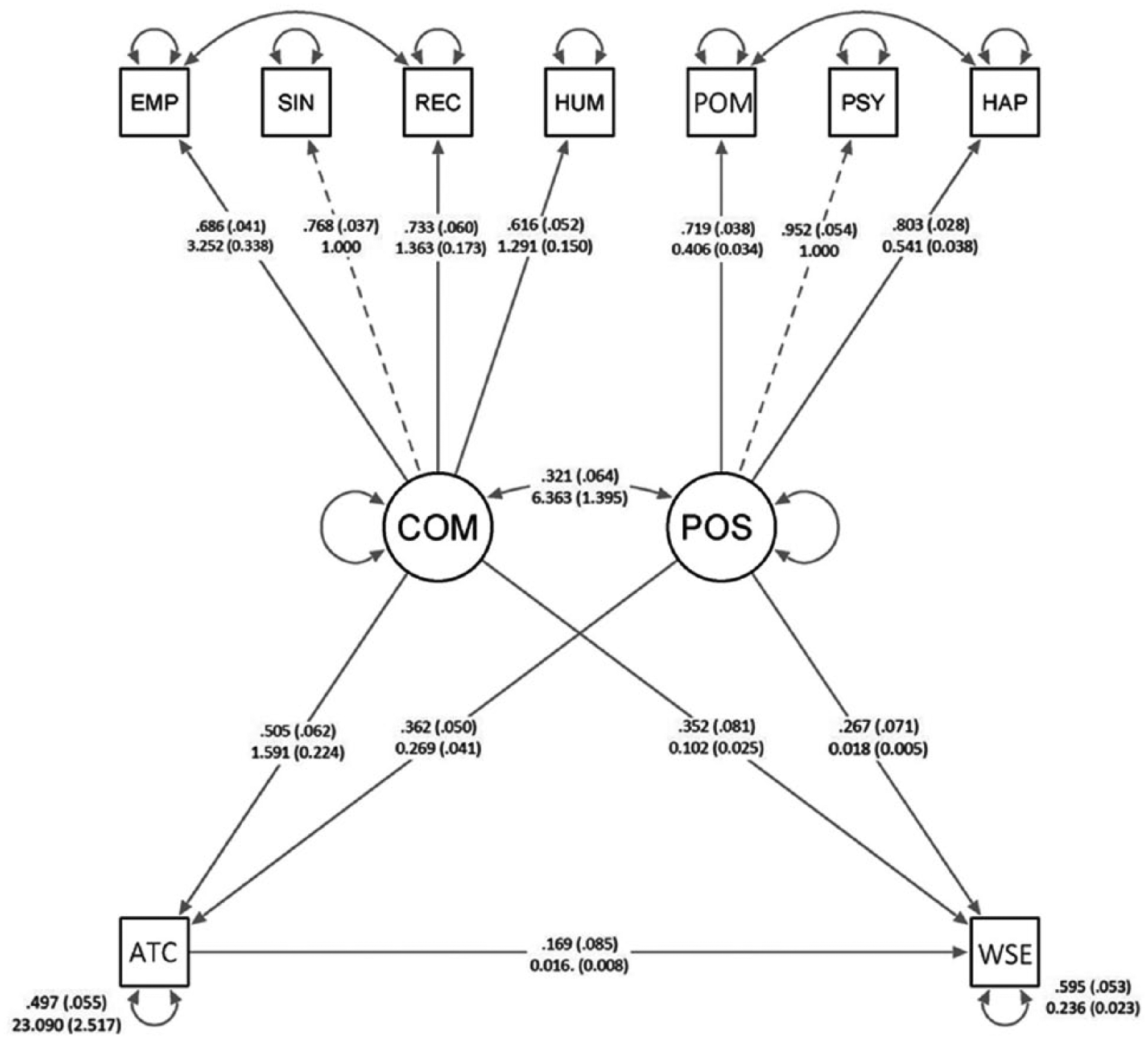
Structural model of workplace social effectiveness (N = 330).
Research Hypotheses
Positive Approach → Ability to Connect With Others
The latent variable referred to as a positive social approach includes the constructs of positive mindset, happiness, and PsyCap. PsyCap is a higher-order construct consisting of self-efficacy, hope, optimism, and resilience. Positivity has been linked to the ability to connect with others. For example, people with a positive approach are judged as more physically attractive (Diener, Wolsic, & Fujita, 1995), as more likely to be helpful (Perry, Perry, & Weiss, 1986), and as more enjoyable to be around (Berry & Hansen, 1996). Observers consistently find the happiest or most positive individuals most likable, even when experiencing negative moods themselves (Lyubomirsky, King, & Diener, 2005). Happy and satisfied people are perceived as more friendly, warm, and assertive (Schimmack, Oishi, & Furr, 2004); less selfish (Rimland, 1982); more moral (King & Napa, 1998); and more likeable (Harker & Keltner, 2001) than unhappy or less happy people. Based on this evidence, we posit the following hypothesis:
Positive Approach → Workplace Social Effectiveness
A positive approach highly correlates with success on the job and positive interpersonal relationships (Lyubomirsky et al., 2005; Scheier & Carver, 1991). In a meta-analysis, Lyubomirsky and colleagues (2005) found that studies corroborate a link between happiness and positive affect and desirable work outcomes. A longitudinal study on positive approach and workplace outcomes found that positivity had a strong effect on supervisor rating of employees, a strong effect on supervisor support, and a moderate effect on coworker support (Staw, Sutton, & Pelled, 1994). PsyCap, which is made up of self-efficacy, hope, optimism, and resilience, has a significant positive correlation with work performance and favorable social evaluations in the workplace (Luthans, Avolio, Avey, & Norman, 2007). Positive affect is also predictive of favorable evaluations regarding group effectiveness and competency in interpersonal relationships (Staw & Barsade, 1993). Livi, Alessandri, Caprara, and Pierro (2013) found a strong correlation between an individual’s positivity and work performance, particularly when other workers’ positivity was low. Thus,
Communal Social Approach → Ability to Connect With Others
A communal approach, captured in this study by the combination of sincerity, empathy, reciprocity, and humility, comprises qualities that are believed to engender social connection. Sincerity has been positively related to organizational attractiveness for individuals high in conscientiousness (Schreurs, Druart, Proost, & De Witte, 2009), and aspects of empathy have been shown to predict trust and liking from others (Hogan & Hogan, 2002). Furthermore, humility is related to social relationship quality (Peters, Rowatt, & Johnson, 2011) and promotes the formation of social bonds (D. E. Davis et al., 2013). Singer et al. (2006) found that individuals acting fairly through mutually beneficial actions are perceived as more likeable and attractive than those who make selfish decisions. Based on this evidence, it is reasonable to theorize that individuals who tend to use a communal approach would be more adept at connecting with others within a workplace. Based on this collective evidence,
Communal Approach → Workplace Social Effectiveness
Multiple studies provide support for the relationship between a communal social approach and workplace social effectiveness. For example, research has shown that people who reciprocate encourage others to reciprocate in turn, thereby contributing to building a better workplace environment (Jou & Fukada, 2002). Research has also shown reciprocity, along with other aspects of social support, to be negatively associated with stressors in the workplace (Viswesvaran, Sanchez, & Fisher, 1999). Empathetic actions can result in improved organizational affect and an increase in other employees’ willingness to engage in organizational citizenship behaviors, which contributes to the task performance of the group (Nummenmaa, Hirvonen, Parkkola, & Hietanen, 2008; Organ, 1997). Z. X. Chen, Shi, and Dong (2008) found that empathy and likeability were two factors that influence relationship quality (trust and satisfaction) in employees, which in turn affected outcomes. Owens, Johnson, and Mitchell (2013) found that humility predicts performance above and beyond general mental ability, self-efficacy, and conscientiousness. In addition, humility has predicted academic performance (Rowatt et al., 2006) as well as effective personal and organizational performance (Vera & Rodriguez-Lopez, 2004). Therefore, based on the literature,
Ability to Connect With Others → Workplace Social Effectiveness
Finally, research provides a theoretical connection between ability to connect with others and workplace social effectiveness. For example, when examining the evaluation of workplace deviance among in-group and out-group members, Bown and Abrams (2003) found that employees who were considered likeable received more positive evaluations, were judged to have more positive personal traits, and were rated as being more personally attractive than individuals who were not likeable, regardless of group membership or level of deviance. Likeability also moderates the negative effect of workplace deviance on evaluations of work-related attributes when evaluating based on personality attributes (Bown & Abrams, 2003). Likability contributes positively to the workplace and is valued by group members (Bown & Abrams, 2003; Ferris et al., 2007). Thus,
Method
Participants and Procedures
The sample consisted of 330 employed U.S. adults with disabilities, none of whom were self-employed. The mean age of participants was 37.9 years (SD = 11.9, range = 18–84), with 35.2% male, 63.0% female, and 1.8% other. A total of 85.5% identified as Caucasian, 6.1% as African American, 3.3% as Latinx/Hispanic, 2.7% as Asian or Pacific Islander, and 2.4% as Other. Highest level of education for the sample was 8.2% with a high school degree or General Education Diploma (GED), 25.5% with some postsecondary schooling without a degree, 16.1% with an associate’s degree, 32.7% with a bachelor’s degree, and 17.6% with a graduate degree. Finally, primary disability, in order of prevalence, included 133 participants with depression or anxiety (40.3%), 82 with a medical disability such as epilepsy or diabetes (24.8%), 44 with a physical disability (13.3%), 24 with a psychiatric disability other than depression or anxiety (7.3%), 10 with alcohol or other substance abuse disorder (5.5%), and 10 with attention-deficit/hyperactivity disorder (3.0%). The remaining 19 participants reported a variety of other primary disabilities. Although these represent the primary disability, the majority (n = 176) reported experiencing two or more disabilities.
Human subjects approval for this project was granted from the University of Wisconsin–Madison Institutional Review Board. Participants were recruited using a combination of the crowdsourcing data collection tools Amazon Mechanical Turk (MTurk) and TurkPrime. MTurk is used by thousands of researchers to obtain sample participants while TurkPrime provides a more user-friendly interface and additional options for data collection (see Sheehan, 2017; Litman, Robinson, & Abberbock, 2017, for a description of these tools.). Participants were administered an online survey via Qualtrics; those who completed the survey received a $4.00 incentive payment.
Measures
Positive approach
This latent variable was measured by a combination of the following constructs: PsyCap, positivity, and happiness. PsyCap was measured using a brief PsyCap measure created from a previous combination of existing instruments. This brief measure was created by taking the three highest loading items for each of the following scales: the New General Self-Efficacy Scale (G. Chen, Gully, & Eden, 2001) to measure general self-efficacy, the State Hope Scale (Snyder et al., 1996) to measure state hope, the Life-Orientation Test–Revised (Scheier, Carver, & Bridges, 1994) to measure optimism, and the Brief Resilience Scale (Smith et al., 2008) to measure resilience. The resulting scale consists of 12 items (e.g., “I will be able to successfully overcome many challenges.”) that are rated on a 5-point Likert-type rating scales (1 = strongly disagree to 5 = strongly agree). Higher scores indicate greater levels of PsyCap. The Cronbach’s alpha coefficient for the present study was computed to be .94. Positivity was measured using the Positive Mindset Index, which is a measure of positive mindset (Barry, Folkard, & Ayliffe, 2014). The scale consists of six items (e.g., happy and confident) presented on a bipolar 5-point Likert-type scale, with anchors varying slightly to match each item (e.g., 1 = very unhappy to 5 = very happy, and 1 = very out of control to 5 = very in control). Higher scores indicate greater overall positive outlook. According to the authors, internal consistency reliability estimates (Cronbach’s alpha) exceed .92. The Cronbach’s alpha coefficient for the present study was computed to be .86. Happiness was measured using the Subjective Happiness Scale developed by Lyubomirsky and Lepper (1999) as a global, subjective measure of happiness. It is a unidimensional scale comprising four items (e.g., “Some people are generally very happy. They enjoy life regardless of what is going on, getting the most out of everything. To what extent does this characterization describe you?”). Each item is rated on a seven-point Likert-type scale ranging from 1 to 7, the anchors varying slightly to match each item. Higher scores indicate greater levels of happiness. Internal consistency across 14 adult samples ranged from .79 to .94 (M = .86). The Cronbach’s alpha coefficient for the present study was computed to be .92.
Communal approach
This latent variable was measured by the following factors: empathy, sincerity, reciprocity, and humility. Empathy was measured using the Empathic Concern and Perspective Taking subscales of the Interpersonal Reactivity Index, which was developed by M. H. Davis (1980) as a measure of the tendency to experience feelings of warmth, compassion, and concern for others. The instrument was treated as a unidimensional scale comprising 14 items (e.g., “I often have tender, concerned feelings for people less fortunate than me” and “I sometimes try to understand my friends better by imagining how things look from their perspective”) that are rated on a 5-point Likert-type rating scale (1 = does not describe me well to 5 = describes me very well). Higher scores indicate greater levels of empathic concern. According to M. H. Davis (1980), internal consistency reliability estimates (Cronbach’s alpha) exceed .70. The Cronbach’s alpha coefficient for the present study was computed to be .88. Sincerity was measured using the Apparent Sincerity subscales of the Political Skill Inventory, which was developed by Ferris and colleagues (2005) as a measure of perceived sincerity and genuineness. This subscale consists of three items (e.g., “I try to show a genuine interest in other people.”) that are rated on a 7-point Likert-type rating scale (1 = strongly disagree to 7 = strongly agree). According to the authors, internal consistency reliability estimates (Cronbach’s alpha) ranged from .58 to .66. The Cronbach’s alpha coefficient for the present study was considerably higher at .83. The measure of reciprocity was created for this study. The unidimensional scale consists of five items (e.g., “I am the type of person who returns a favor.”) that are rated on a 7-point Likert-type rating scale (1 = strongly disagree to 7 = strongly agree). Higher scores indicate a tendency to reciprocate. The Cronbach’s alpha coefficient for the present study was computed to be .82. The measure of Humility was also created for this study, as a measure of self-reported humility. This unidimensional scale consists of six items (e.g., “I am glad that people around me have strengths in areas I don’t.”) that are rated on a 7-point Likert-type rating scale (1 = strongly disagree to 7 = strongly agree). Higher scores indicate greater levels of humility. The Cronbach’s alpha coefficient for the present study was computed to be .79.
Ability to connect with others
The ability to connect with others was measured by a scale created for this project as a measure of how well participants felt they could experience and create a social connection with others. The unidimensional scale consists of seven items (e.g., “I work well with just about anyone.”) that are rated on a 7-point Likert-type rating scale (1 = strongly disagree to 7 = strongly agree). Higher scores indicate a greater ability to connect socially with others. The Cronbach’s alpha coefficient for the present study was computed to be .89, and the test–retest reliability after 2 months was computed to be .72.
Workplace social effectiveness
Workplace social effectiveness was measured using a scale created for this project that weighted social effectiveness by the social demands of the workplace. The scale consists of 24 items (e.g., “Starting conversations with co-workers”) that are rated on two parallel 5-point Likert-type rating scales, one measuring the importance to the organization and the other measuring performance in the organization. Both use the same scale (0 = low to 4 = high). Scores were calculated by first dividing each item in the importance scores by the total importance score, thus yielding a relative social-importance score that sums to exactly 1. Social importance scores were then multiplied by social-performance scores for each item. The sum of these scores produced a workplace social effectiveness total score. Higher scores indicate greater levels of workplace social effectiveness. For construct validation purposes, external correlates of the Workplace Social Effectiveness Scale were explored using Pearson product–moment correlation analysis.
Results
Prior to addressing the research questions, preliminary analysis included screening for univariate and multivariate outliers as well as for normality of the data. A total of 10 univariate outliers (data greater than 3.29 standard deviations from the mean) were identified across all measures. An additional five multivariate outliers were detected using Mahalanobis values. Each of the univariate and multivariate outliers was thoroughly reviewed, including a consideration of whether outliers represented a specific disability type. Finding nothing to suggest the outliers were the result of an error or differences represented by disability type, all analysis was run both with and without the flagged outliers. There were no significant differences between the models, and so it was determined to keep all data in the analysis rather than delete extreme, but seemingly legitimate participant data. Normality was tested using a combination of probability plots and the Kolmogorov–Smirnov test of univariate normality. Both the visual and empirical assessment suggested that the assumption of normality had been violated for all variables in the model (ps < .01). Model estimation was performed using the maximum likelihood (MLMV) estimator, which is robust to any potential nonnormality (L. K. Muthén & Muthén, 2010). There were no missing data in the measured scales. Descriptive statistics (range, mean, and standard deviations) of the nine measured variables in the proposed model as well as their intercorrelations are provided in Table 1.
Correlation Matrix With Range, Mean, and Standard Deviations of Measured Variables (N = 330).
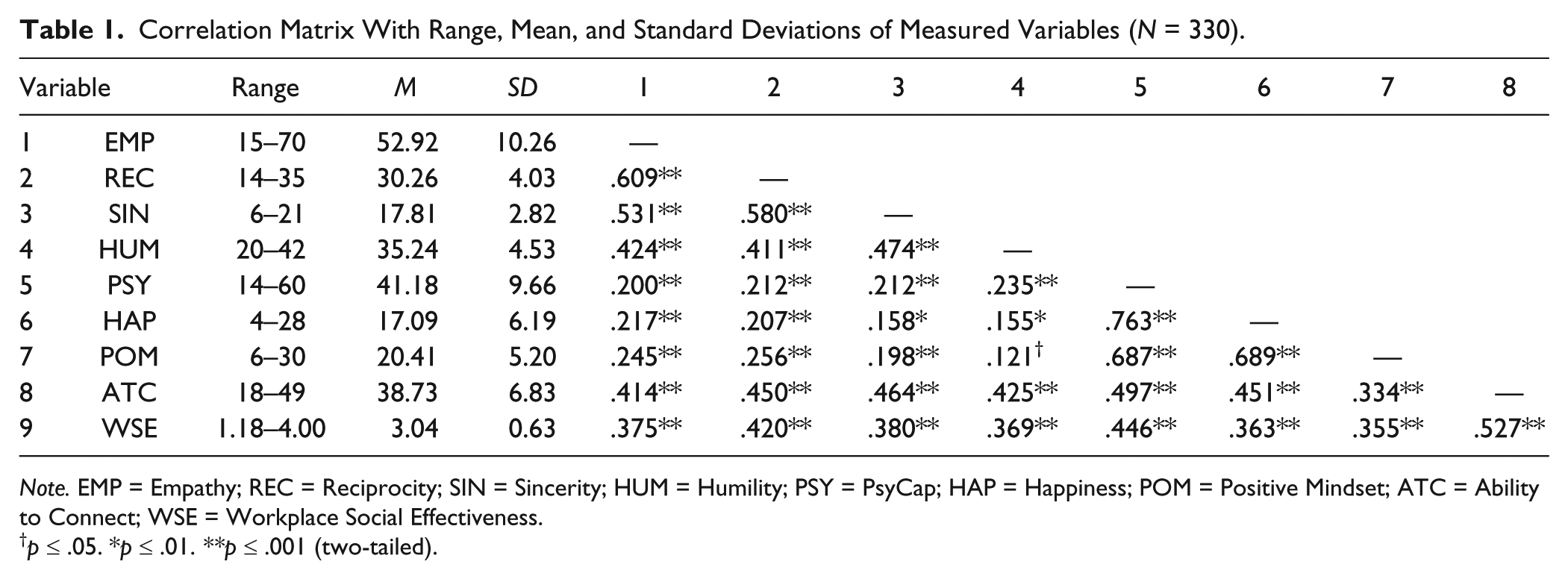
Note. EMP = Empathy; REC = Reciprocity; SIN = Sincerity; HUM = Humility; PSY = PsyCap; HAP = Happiness; POM = Positive Mindset; ATC = Ability to Connect; WSE = Workplace Social Effectiveness.
p ≤ .05. *p ≤ .01. **p ≤ .001 (two-tailed).
Hypotheses were tested using structural equation modeling (SEM) techniques, with measurement and structural model testing conducted through Mplus (Mplus v.7.11; B. Muthén & Muthén, 2012). A two-step modeling approach was used by first analyzing the measurement model and then the structural model. A two-step process offers the advantage of ensuring that latent constructs are properly determined before examining structural relationships in the model (Anderson & Gerbing, 1988; Kline, 2016). Goodness of fit was assessed using the chi-square (χ2) statistic as a model test statistic and the following approximate fit indexes: the comparative fit index (CFI), root mean square error of approximation (RMSEA), and the standardized root mean square residual (SRMR). A good fitting model is indicated by a nonsignificant χ2 test >.05, a CFI ≥.95, an RMSEA ≤.08, and an SRMR ≤.05 (Hooper, Coughlan, & Mullen, 2008; Hu & Bentler, 1999; Kline, 2016).
Confirmatory factor analysis was used to test the measurement model. As indicated in Table 2 (Model 1), the measurement model demonstrated good fit, χ2(13, N = 330) = 20.85, p < .076; CFI = .99, RMSEA = 0.04, SRMR = 0.02. With fit of the measurement model confirmed, the structural model was then tested. Results suggested a reasonably good fit of the hypothesized structural model, χ2(23, N = 330) = 38.65, p < .022; CFI = .97, RMSEA = 0.05, SRMR = 0.03, with only the χ2 test failing to meet goodness-of-fit thresholds. Modification indices (MI) were then reviewed to determine whether, based on theory and research, any changes could be made to high residual correlations between the scales within each latent variable to strengthen the model (Kline, 2016). The MIs suggested a close relationship between both the positive mindset index and happiness scales and between the empathy and reciprocity scales. Both suggested relationships exist within latent variables where construct similarity might be expected to drive residual correlations, and so both changes were made to the model. After freeing these residual correlations, the model exhibited a good fit across all indicators, χ2(21, N = 330) = 28.65, p < .123; CFI = .99, RMSEA = 0.03, SRMR = 0.03.
Fit Indexes for Covariance Structure Analyses (N = 330).
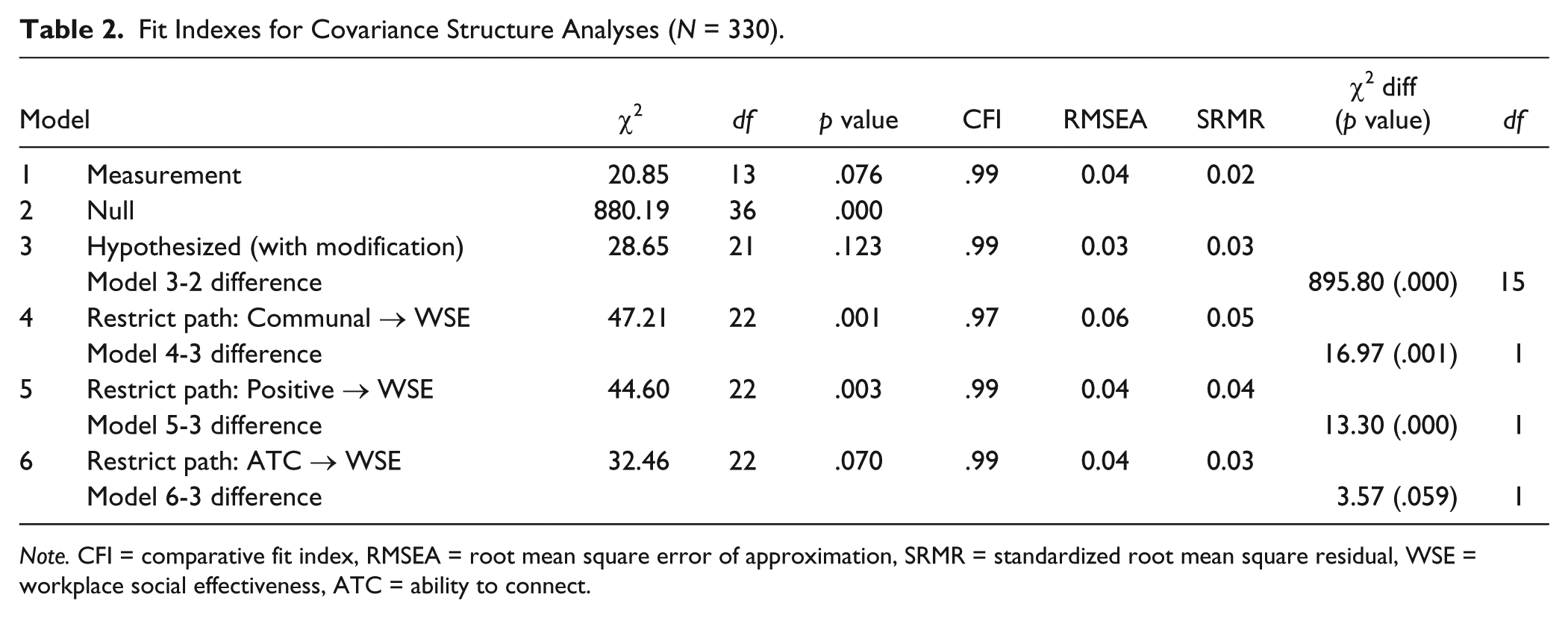
Note. CFI = comparative fit index, RMSEA = root mean square error of approximation, SRMR = standardized root mean square residual, WSE = workplace social effectiveness, ATC = ability to connect.
Given the exploratory nature of this research, the modified model was compared with two plausible alternative nested models. Changes in fit between hypothesized and alternative models were tested using χ2 difference tests. Determination of which model to retain is made based on whether changes from the hypothesized model result in a significant χ2 difference test and whether fit indexes show substantial change. If alternative models result in little change to fit indexes and do not produce a significant χ2, then the more parsimonious model is typically retained (Houghton & Jinkerson, 2007). Results are shown in Table 2, with the hypothesized model (with modifications) represented in Model 3. In the first alternative (Model 4 in Table 2), the path between communal approach and workplace social effectiveness was restricted to determine whether this path is crucial to the model. As seen in Table 2, restricting this path resulted in a significantly worse model fit. The second alternative (Model 5 in Table 2) restricted the path between positive approach and workplace social effectiveness, producing a result similar to Model 4. A third alternative (Model 5 in Table 2) restricted the path between ability to connect and workplace social effectiveness. This restriction resulted in a slightly higher χ2 and a lower p value that bordered significance. In light of this evidence and existing literature, the originally hypothesized model was retained.
The unstandardized and standardized solution for the originally hypothesized model is shown in Figure 1. As shown, the hypothesized relationship between the two social dispositions (communal and positive) and both affability and workplace social performance were significant (p < .001). Thus, Hypotheses 1 through 4 were strongly supported. Hypothesis 5, that the ability to connect with others would be positively correlated with workplace social effectiveness, was also supported (p = .046). Several indirect effects were observed in addition to the direct effects hypothesized in the model. Analysis of indirect effects was accomplished using the delta method in Mplus 7. The ability to connect with others partially mediated the relationship between positive disposition and workplace social effectiveness (p = .039) and between communal disposition and workplace social effectiveness (p = .050).
Discussion and Implications
People with disabilities experience great inequities in employment. Given the relational nature of work, gaining a better understanding of the social dimensions of the workplace might be key to addressing these disparities. This study adds to the sparse literature on the factors that predict workplace social effectiveness for people with disabilities. The alternative model of workplace social effectiveness created and tested in this study places unique emphasis on the social approach used to meet socioemotional needs of others in the workplace, consistent with tenets of relational and social capital theories. Results provide support for all hypothesized relationships in the proposed model. Furthermore, the ability to connect with others was shown to partially mediate the relationships between both a positive and communal social approach and workplace social effectiveness. Overall, results suggest that one’s socioemotional approach to interaction has a significant influence on workplace social effectiveness and that one’s ability to connect with others serves as a partial mediator to that relationship. This new model of workplace social effectiveness offers new insights to guide further research and practice aimed at helping people with disabilities gain and keep employment. The model’s use of simple and widely understood constructs may help clarify the otherwise messy workplace social effectiveness literature. A number of potentials and additional questions arise from the supported model.
Research Implications
It is important to view this model as the exploratory work that it is. As such, even with supported hypotheses, more questions than answers are generated from the current model. Next steps include (a) measurement based on external raters; (b) consideration of other individual, dyadic, and environmental constructs believed to influence perceptions of workplace social effectiveness; (c) consideration of how the existing model complements and adds to more egocentric models of workplace social effectiveness; (d) use of longitudinal or randomized controlled studies to approximate causal relationships between constructs; and (e) testing of the assumption that social approach influences connecting with others and, ultimately, workplace social effectiveness through its facilitation of socioemotional needs. We briefly approach each topic.
First, no model of workplace social effectiveness is truly validated without measurement from others, preferably those who make determinations of workplace social effectiveness. Next steps in researching this model must investigate how hypothesized factors contribute to measurements of employers, supervisors, or colleagues in their perceptions of workplace social effectiveness. As previously noted, this model does not represent a comprehensive attempt to capture workplace social effectiveness. Additional research is needed to consider other facets of workplace social effectiveness that help explain distinctly different aspects of workplace social effectiveness not included in the present model. As assumed by Tsang and Pearson (1996), it is possible that perceptions will vary based on some level of occupational classification or a number of other hypothesized factors (McPherson, Smith-Lovin, & Cook, 2001; Sally, 2000). To gain clinical utility, meaningful and predictable differences across external evaluators need to be identified, as outsider ratings have often been shown to differ from each other and from self-ratings (Dirks, Treat, & Weersing, 2010; Gresham, Elliot, Cook, Vance, & Kettler, 2010). Such moderators might exist in the environment (e.g., differing jobs or occupational categories), the dyad (e.g., similarities or differences in demographics, values, or experiences), or the individual (e.g., general mental ability, personality, pain levels). Regarding differences in the labor market, the most effective level of measurement will most likely be determined through a compromise between specificity and generalizability such that each case need not be treated as completely novel even while critical differences in social dynamics of the labor market are accounted for (see McFall, 1982, for a discussion of the unit of measurement).
Existing models and constructs (e.g., problem-solving ability) may serve to complement the current model. Future research focused on differentiating the predictive value of each model for different employment and participation outcomes will be helpful for prediction and practice. Ferris and colleagues’ (2002) model of political skill is by far the most established model of workplace social effectiveness and the only one that continues to be used in the research. More research is also needed to clarify the direction of causal relationships. Although we provided literature to support the direction of each hypothesis in this study, it is conceivable that alternative causal relationships exist. Ferris, Kane, Summers, and Munyon (2011), for example, argued that the strategic aspects of political skill would lead to factors included in this study such as humility and aspects of positivity, while we view humility and positivity as predictors of workplace social effectiveness. Also, as a test to the theoretical explanation of the model, future research is needed to test the assumption that social approach influences the ability to connect with others and workplace social effectiveness by addressing the socioemotional needs of others. To test this assumption, it will be necessary to measure social approach and its influence on perceptions of socioemotional needs fulfillment. This might be most readily accomplished, at least initially, through controlled experiments that systematically use different socioemotional approaches.
Clinical Implications
Qualitative research suggests that rehabilitation counselors regularly seek to identify, address, and capitalize on social aspects of work without a framework or theory to guide their practice (Phillips et al., 2014). The provision of a simple and straightforward model built on familiar constructs may serve to support rehabilitation professionals in their efforts to support people with disabilities toward employment success. We proceed by discussing a few clinical implications while noting the preliminary nature of this model and the accompanying need for more research.
In rehabilitation counseling, there are many methods and interventions for identifying and addressing social deficits, but relatively little emphasis on the use of social strengths. This imbalance of deficit research may suggest that workplace social effectiveness for people with disabilities ranges from extreme deficit on one end to adequate at times on the other. This perception, intended or not, belies a philosophy of rehabilitation counseling that emphasizes strengths of the client with disabilities while also limiting understanding of how high levels of workplace social effectiveness benefit people with disabilities and their organizations in the labor market (Chou, Chan, Phillips, & Chan, 2013; Livneh & Martz, 2016). Our intentionally positive model of workplace social effectiveness for adults with disabilities offers counselors a framework for identifying and utilizing client strengths.
The present model offers an alternative to more self-interested frameworks and may provide a more complete explanation of how success is achieved in the relational workplace. The model also minimizes strategic and manipulative approaches to instead emphasize authentic ways of approaching interactions and relationships. One potential from this model stems from the reduced emphasis on social skills that require high levels of general mental ability. We expect that people with severe intellectual disabilities are able to display high levels of workplace social effectiveness through their capacity to meet the socioemotional needs of others in the organization. Rehabilitation counselors may serve as a bridge for clients high in workplace social effectiveness through their knowledge of the needs these clients may be able to address in a workplace. The loneliness and workplace incivility that are negatively related with well-being and overall health provide a persuasive argument for placing a premium on maintaining a workforce that is likely to meet the socioemotional needs of others in the workplace (Butterworth, Leach, McManus, & Stansfeld, 2012; Pearson & Porath, 2005; Schilpzand, De Pater, & Erez, 2016).
The focus of this study has been on identifying aspects of workplace social effectiveness. Future research must consider the efficacy of emphasizing strengths compared with addressing deficits as an employment intervention. That said, rehabilitation counselors would do well to consider these different approaches to workplace social effectiveness on a case-by-case basis. In situations where disability makes correction of social deficits unlikely or too costly, an emphasis on strengths may prove equally, if not more effective for employment outcomes.
Limitations
Although results provide strong support for the proposed model of workplace social effectiveness and self-determination, two primary limitations must be taken into account when interpreting findings. First, the measures were all self-report scales, which brings a number of limitations for this area of research (Zingoni, 2015). This approach was meaningful for exploratory analysis of the relationship between constructs; however, it would be preferable in future tests of this model to include multiple sources of evaluation, and particularly from those that would be most fit to make workplace evaluations (i.e., employers, human resource providers, supervisors, or colleagues). This will help to not only limit shared method variance but also provide important evidence for the practical application of the model. In addition, the methodology of SEM has distinct advantages over many other methods used to test causal relationships; however, because of the cross-sectional design, it is not possible to make any conclusive decisions about the directionality between causal variables. That said, theoretical and logical arguments have been used to justify the proposed directionality of the variables. Longitudinal studies are needed to gain a clearer understanding of the causal relationships between the measured variables. Finally, the use of crowdsourcing data collection tools, although widely used and accepted in social research, may limit generalizability to the general disability population in a manner that is unique to the more commonly used disability association members or student samples.
Conclusion
Social effectiveness is often key to success in the workplace. Although rehabilitation counseling literature is unified regarding the importance of social effectiveness, researchers have not yet developed a shared model of workplace social effectiveness for research or professional practice. Workplace social effectiveness is a complex higher-order construct that, without the guidance of theory or model, will likely be experienced as unwieldy in application (Phillips et al., 2014). Our model of workplace social effectiveness provides a parsimonious framework using familiar constructs. It also serves as a sharp contrast to existing models that assume high levels of general mental ability, which may allow for greater application with clients who experience cognitive deficits. Perhaps most important, creation and use of a strength-based model of workplace social effectiveness provides a foundation for research and practice that is in harmony with the philosophy of rehabilitation counseling. Greater recognition of the socioemotional needs experienced in the workplace and of the capacities for people with disabilities to meet those needs may create new opportunities in a labor market and society that values an individual’s ability to foster human connections.
Footnotes
Acknowledgements
The authors thank Professor Daniel Bolt and Professor William T. Hoyt for their consultation and guidance regarding the analysis for this project.
Declaration of Conflicting Interests
The author(s) declared no potential conflicts of interest with respect to the research, authorship, and/or publication of this article.
Funding
The author(s) disclosed receipt of the following financial support for the research, authorship, and/or publication of this article: The contents of this article were developed with support from the Rehabilitation Research and Training Center on Employment of People With Physical Disabilities at Virginia Commonwealth University, with funding provided by the National Institute on Disability, Independent Living, and Rehabilitation Research (NIDILRR Grant 90RT503502). NIDILRR is a Center within the Administration for Community Living (ACL), Department of Health and Human Services (HHS). The opinions expressed herein do not necessarily represent the policy of NIDILRR, and funding does not serve as endorsement by the U.S. Department of Health and Human Services.