




Abstract
Vietnam is in the emerging stage in supporting and protecting people with disabilities (PWDs) in terms of employment rights and opportunities. The main purpose of this study was to explore how Vietnamese perceive their coworkers with disabilities in general workplace settings. In addition, the secondary objective of this study was to explore how Vietnamese perceive community acceptance and inclusive education of PWDs in different environmental contexts. Results indicated participants had generally positive affective reactions toward their coworkers with disabilities in the workplace. However, findings also indicated that Vietnamese people possessed hierarchical attitudes toward people with different types of disabilities in terms of community acceptance and educational rights.
Keywords
Vietnam is located on the Indochina Peninsula in Southeast Asia with nearly 91.71 million people (General Statistics Office of Vietnam, 2016). According to the Vietnamese National Coordinating Council on Disability (2010), about 6.7 million people aged 5 years or older have some kind of disability, accounting for about 7.8% of the total population. The main causes of disabilities in Vietnam include war diseases, genetically transmitted conditions, workforce and traffic accidents, and environmental pollution.
A report by the United Nations (2016) indicates that modes of defining disability and collecting data could lead to a lack of reliable information on employment rates of people with disabilities (PWDs) in the Asia-Pacific region. For instance, the report indicated that the Vietnam disability prevalence is about 7.8%, but there is no information on employment-to-population ratio and employment of PWDs by sections.
Disability Rights
The Law on People with Disabilities is considered the most comprehensive regulation wherein the concepts of disabilities, social protections from the government, and responsibilities of families of PWDs were outlined and defined (Hayden, Tran, Nguyen, Tran, & Chang, 2015). This law requires families of Vietnamese PWDs must support their relatives with disabilities. Specifically, Article 8 of the Law states that the responsibilities of families of PWDs are as follows: “Family shall educate and create conditions for family members to raise awareness about disability issues; apply measures to prevent and minimize congenital disability [and other disabilities] caused by injury or disease and other dangers of disability” (Ministry of Justice, The Socialist Republic of Vietnam, 2017, General Provisions, para. 8).
Vocational Training Law of 2006 also grants tax provision to organizations that provide job training programs for Vietnamese PWDs. The Vietnamese Assistance for the Handicapped (VNAH; 2017), founded in 1991, is considered as one of the organizations supporting PWDs. The VNAH implemented related disability projects supported by the U.S. Agency for International Development (USAID) that focused on developing and promoting vocational rehabilitation services and employment placements from 2006 to 2014.
Hayden et al. (2015) reported that the gap between development and implementation of disability-related laws and regulations in Vietnam is obvious due to limited funding and a lack of data-driven accountability in service systems. As a result, the most efforts made by the Vietnamese government for serving PWDs may still be in the legal development stage instead of implementing already mandated laws and regulations.
Governmental Support Programs
In addition, governmental programs provide instrumental support to PWDs. Since 1989, the USAID has helped to support Vietnamese PWDs through its disability program funded by the Patrick Leahy War Victims Fund and the Displaced Children and Orphans Fund. The USAID (2016) also supported the government of Vietnam and collaborated with nonprofit organizations and local and international employers in establishing educational systems and matching local labor market opportunities with skills of PWDs (Hayden et al., 2015).
Hayden and colleagues (2015) stated, USAID programs provided crucial financial and technical assistance to support the government of Vietnam in drafting and enacting the legal framework on disabilities in Vietnam [that] resulted in the passage of 24 legal documents, including the Law on People with Disabilities. (p. 21)
With funding support from the USAID, the Blue Ribbon Employer Council (BREC; 2016) was established in 2007 through the effort of VNAH and the Vietnam Chamber of Commerce and Industry to improve labor force participation of PWDs.
Community Inclusion
Vietnamese with disabilities experience severe limitations in education, community participation, and employment opportunities.
Education
A report by the UNICEF (2015) reveals several significant challenges regarding readiness for inclusive education of children with disabilities in Vietnam. For example, data about children with disabilities are collected by different governmental sectors (such as education and social welfare), and it is not often categorized. Also, since very limited training of teachers in inclusive education, prevailing stigma and discrimination toward students with disabilities are obvious.
Similarly, a previous report by the United Nations Educational, Scientific and Cultural Organization (UNESCO; 2009) notes that inclusive education in Vietnam is primarily available to students with physical, mobility, or slight learning disabilities. No sufficient information about education of children with severe disabilities and specific schools with inclusive education services is available. Thus, it is estimated that very limited Vietnamese children with disabilities go to schools based on the information from Vietnam Ministry of Labour – Invalids and Social Affairs and Ministry of Education and Training (Tran, 2014).
Impact of Caregiver Burden on Inclusion
Children with disabilities are commonly perceived by their family caregivers as burdens to society negatively impacting their quality of life (Shin & Nguyen, 2016). Some parents of children with moderate and severe disabilities may choose not to participate in social activities or even withdraw their children from schools to avoid confronting prevailing stigma about disability (Motchan, 2012; Thuy & Berry, 2013). Riewpaiboon, Hoang, and Nguyen (2014) asserted that the amount of time and the expenses incurred by Vietnamese families of PWDs should be a focus of social protection improvement. Whether Vietnamese families of PWDs are able to afford the extra costs of living for their relatives with disabilities is a significant concern as well (Hoang et al., 2015).
Employment
For some Vietnamese PWDs who received proper education, finding a job or starting an own business is also difficult due to social stigma and limited personal capital (Palmer, Groce, Mont, Nguyen, & Mitra, 2015). The application procedures of determination of eligibility for disability monthly income support conducted by local commune/ward committee are complex and the amount of financial support is not always enough (Palmer et al., 2015). All in all, a lack of special education teacher training and poor learning facility limit educational opportunities of Vietnamese with disabilities, along with insufficient social service support and employee training (Lich, Ngoc, & Tung, 2014; Palmer et al., 2015; Rosenthal, 2009).
Affective Reactions
According to Copeland, Chan, Bezyak, and Fraser (2010), affective reactions represent “emotional reactions [that are] related to working with people with disabilities and contributes to the overall measurement of [employees’] attitudes toward individuals with disabilities” (p. 427). Although employers may provide opportunities for PWDs, negative attitudes toward PWDs held by workers without disabilities might lead to problems with work accommodations (Colella, 2001), social networks (Shafer, Rice, Metzler, & Haring, 1989), and work stability (Hsu, Ososkie, & Huang, 2009).
Although efforts of supporting PWDs in employment rights and opportunities have been made, extremely limited research has been conducted on employed PWDs in Vietnam, especially in terms of acceptance and job accommodation, which are influential determinants of job retention, career enhancement, and promotions of PWDs (Colella, Paetzold, & Belliveau, 2004; Hsu et al., 2009; Lengnick-Hall & Gaunt, 2007). Therefore, exploring affective reactions uncovers perceptions of accommodations and equal treatment of coworkers with disabilities (Copeland et al., 2010; Popovich, Scherbaum, Scherbaum, & Polinko, 2003).
Effects of Demographic Variables on Affective Reactions Toward Persons With Disabilities
Some prominent demographic variables associate with affective reactions toward PWDs including age, gender, contact experience, and educational attainment.
Age
A study indicated that older people have more positive attitudes toward PWDs due to additional knowledge about related issues and increased contact with PWDs (Mamboleo, Diallo, Ocharo, Oire, & Kampfe, 2015). However, no significant relationship was identified between age and attitudes toward PWDs among health care specialists (Al-Abdulwahab & Al-Gain, 2003) and college students (Perry, Ivy, Conner, & Shelar, 2008).
Gender
Gender may or may not associate with perspectives on PWDs. For example, men tended to have less favorable attitudes than women toward PWDs in terms of their employment (Jones, Ouellette-Kuntz, Vilela, & Brown, 2008). Others found that gender was not associated with people’s perceptions toward coworkers with disabilities (Hsu et al., 2015) or related to employers’ attitudes toward their workers with disabilities (Paez & Arendt, 2014).
Contact Experience
The variable of contact experience appears to have a positive impact on attitudes toward PWDs. Hsu and colleagues (2015) found that length of work contact contributed to more favorable attitudes toward workers with disabilities held by counterparts without disabilities, and similar findings were reported by other researchers as well (Huang et al., 2014; Yazbeck, McVilly, & Parmenter, 2004).
Educational Attainment
Researchers indicated that people with higher educational backgrounds tend to be more open-minded and knowledgeable about disability and related matters such as community inclusion and employment opportunities, leading them to have more favorable attitudes toward PWDs (Henry, Duvdevany, Keys, & Balcazar, 2004; Scior, Kan, McLoughlin, & Sheridan, 2010).
Purpose
Despite the fact that the government of Vietnam and some national and international nonprofit organizations have begun supporting PWDs, perceptions of PWDs held by Vietnamese people remain largely unknown. Therefore, three primary research questions guided this study:
Method
Participants
Three criteria for eligibility of research participants were developed. First, participants must not identify as having a disability. Second, participants must be native Vietnamese, and finally, participants must work or have interacted with coworkers with disabilities in the workplace. For recruitment purposes, the researchers contacted the BREC members. One hundred seventy-four workers without disabilities participated in the study, and data collection took place in 17 companies located in Ho Chi Minh City, Da Nang City, and nearby areas. Seventeen participants who had more than three incomplete responses in their surveys were removed. The final sample used for data analysis included 157 participants, which met the required sample size of 103 participants, according to G*Power estimates.
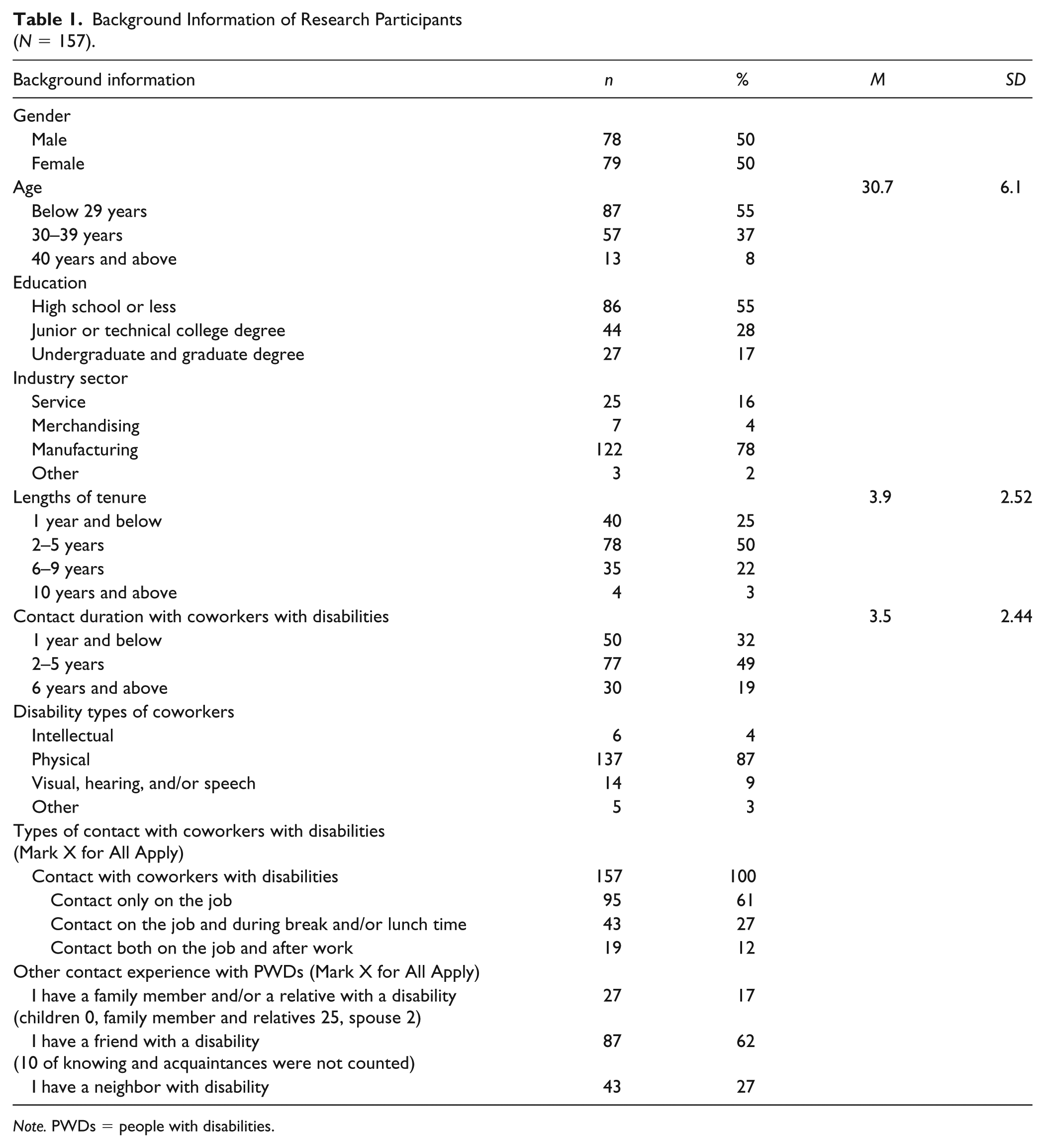
Of the 157 participants, 78 (49.7%) were male and 79 (50.3%) were female. The ages of participants ranged from 19 to 49 years with a mean age of 30.7 years. This paralleled Vietnam’s demographics provided by International Monetary Fund (2017), which indicated “Vietnam has a young population [with a median age of 26 and] the largest age cohorts between 20 and 34” (p. 9). Detailed information is presented in Table 1.
Background Information of Research Participants (N = 157).
Note. PWDs = people with disabilities.
Measures
Two survey instruments were used: the Affective Reactions Subscale of the Disability Questionnaire (AR) and the Survey of Public Attitudes toward Disability Issues (SPAD).
AR
Created by Popovich and colleagues in 2003, the Disability Questionnaire has three subscales that can be used to examine people’s perspectives on the issues of (a) what constitutes a disability, (b) reflections toward working with PWDs, and (c) opinions toward workplace accommodations. Among the three subscales, the AR subscale (see Appendix A) with 17 items was used to specifically examine employees’ attitudes toward coworkers with disabilities.
All items of AR subscale were scored with 1 = very strongly disagree to 6 = very strongly agree without providing a neutral midpoint, which pushed participants to respond in the either agree or disagree direction (Garland, 1991). Negative statements were reverse coded for scoring. The final score of AR subscale ranged from 17 to 102 with a midpoint of 59.5 between positive and negative reflections. Higher scores are indicative of more favorable affective reactions toward coworkers with disabilities held by participants. The composite score for the overall AR subscale was computed by tallying all items. Scores of three attitudinal constructs that reside in AR subscale were calculated by finding the sum of scores for each subscale. The mean, median, and standard deviation of each item were also determined.
Popovich et al. (2003) used the AR subscale in two preliminary studies with psychology students, which yielded acceptable Cronbach’s alpha values of .69 and .74. Copeland (2007) used the AR subscale to study employers’ attitudes toward their coworkers with disabilities and produced an internal consistency reliability of .81. An exploratory factor analysis of the scale was also conducted to find that 17 items loaded in three dimensions with coefficient values of .83, .63, and .61, respectively (Copeland et al., 2010). These three dimensions were (a) negative cognitive and affective reactions (NAR), (b) positive attitudes toward accommodations (PAA), and (c) positive attitudes toward equal treatment of workers with disabilities (PAET).
Hsu and colleagues (2015) also utilized the AR subscale to explore Taiwanese affective reactions toward coworkers with disabilities and found an internal consistency reliability of .85. In this study, the results produced a Cronbach’s alpha value of .80 for the full AR subscale. An internal consistency reliability analysis of three dimensions of AR subscale produced acceptable Cronbach’s alpha values of .71 for the NAR, .65 for the PAA, and .76 for the PAET.
SPAD
The SPAD (see Appendix B) was adopted from a study conducted by Ireland National Disability Authority in 2011. This survey was initially developed in 2001 by the National Disability Authority and Social Market Research (Ireland National Disability Authority, 2011). The 2011 survey was built based on previous surveys conducted by the National Disability Authority in 2001 and 2006. The major differences between the 2011 version and previous surveys were that it added questions to address the issues of social isolation and public service websites.
The Ireland National Disability Authority (2011) survey contained nine sections with 17 major questions that examined public’s attitudes toward PWDs. There were dual questioning (subgroup) analyses for certain questions within each section. To use this survey in the present study, seven sections were omitted, except for sections of education and friends and family. The original term of disability is used to refer people with physical disabilities, intellectual disabilities, visual impairments, hearing loss, and various types of chronic illnesses. In this study, the definitions of disability were changed based on Vietnam’s Law on People with Disabilities (Ministry of Justice, The Socialist Republic of Vietnam, 2017).
Some questions remaining in these two sections were revised to reflect the objectives of the present study. Questions 1 through 4 that resided in Section 1 were utilized to explore participants’ perceptions toward educational rights of people with different types of disabilities. Questions 5 through 7 explored comfort levels of present and/or potential neighbors with various disabilities and whether PWDs are capable of living independently in the community. Original questions that are related to attitudes toward temporary neighbors (travelers and migrant workers), minority ethnic groups, and lesbian, gay, bisexual, and transgender (LGBT) populations were removed. In the present study, the results produced a Cronbach’s alpha value of .69 for the full scale.
Procedure
The researchers contacted the BREC members through assistance from the USAID and VNAH. The BREC members consisted of national and international employers who were considered strong supporters of hiring PWDs. Upon agreement, the contact persons at the BREC companies assisted in recruitment of participants for the study. Because some BREC members were reluctant to recruit participants, snowball sampling was also utilized to recruit participants from non-BREC members through support from contact persons of BREC companies.
The participants were permitted to complete the surveys and related documents at times and locations of their choice. All documents were retrieved by researchers 3 to 4 weeks after distribution. The two survey instruments were translated from English to Vietnamese through the committee approach technique (Brislin, Lonner, & Thorndike, 1973). This technique requires two to three people to translate the surveys from English to Vietnamese and compare and examine results to ensure translations are accurate and appropriate in the Vietnamese culture.
Statistical Analysis
Microsoft Excel 2016 and Statistical Package for the Social Science (SPSS) 19.0 for Windows were used to organize and analyze the data. For Question 1, the item mean, median, and standard deviation of AR subscale were computed individually. The composite mean score and Cronbach’s alpha values of AR subscale were calculated and reported as well.
To answer the second question, the demographic information of participants was reviewed. To address small sample size and the younger age of participants, selected demographic variables categorized as follows. Age was categorized into three types: 29 and below, 30 to 39, and 40 years and above. Educational attainment was categorized into three levels: undergraduate and graduate, junior and/or technical college, and high school or less. Length of tenure was categorized into four levels: 1 year and below, 2 to 5 years, 6 to 9 years, and 10 years and above. Contact duration with coworkers with disabilities was categorized into three types: below 1 year, 2 to 5 years, and 6 years and above.
Contact types with coworkers with disabilities were categorized as follows: only on the job, on the job and during break and/or lunch, and both on the job and after work. Due to insufficient sample size, the variable other contact experiences with PWDs was regrouped from six options (children, family members and relatives, spouse, friends, neighbors, and others such as knowing and acquaintances) into three groups (i.e., having a family member and/or a relative with a disability, a friend with a disability, and a neighbor with a disability).
Pearson correlations were first used to explore whether each of the seven demographic features related to participants’ perceptions on the AR subscale. Stepwise forward regression was later used to reexamine which demographic factors associated with affective reactions of participants toward coworkers with disabilities and to investigate the results found from Pearson correlations. A one-way analysis of variance (ANOVA) was conducted to independently identify which categories of demographic characteristics yielded significant differences among affective reactions. Finally, the post hoc analysis was used to reexamine results found from ANOVA.
The third question investigated perceptions held by participants toward people with different types of disabilities in terms of their educational rights and community inclusion. Descriptive data analysis techniques were used to respond to this question, and tables and figures present the results in Appendix B.
Results
Affective Reactions
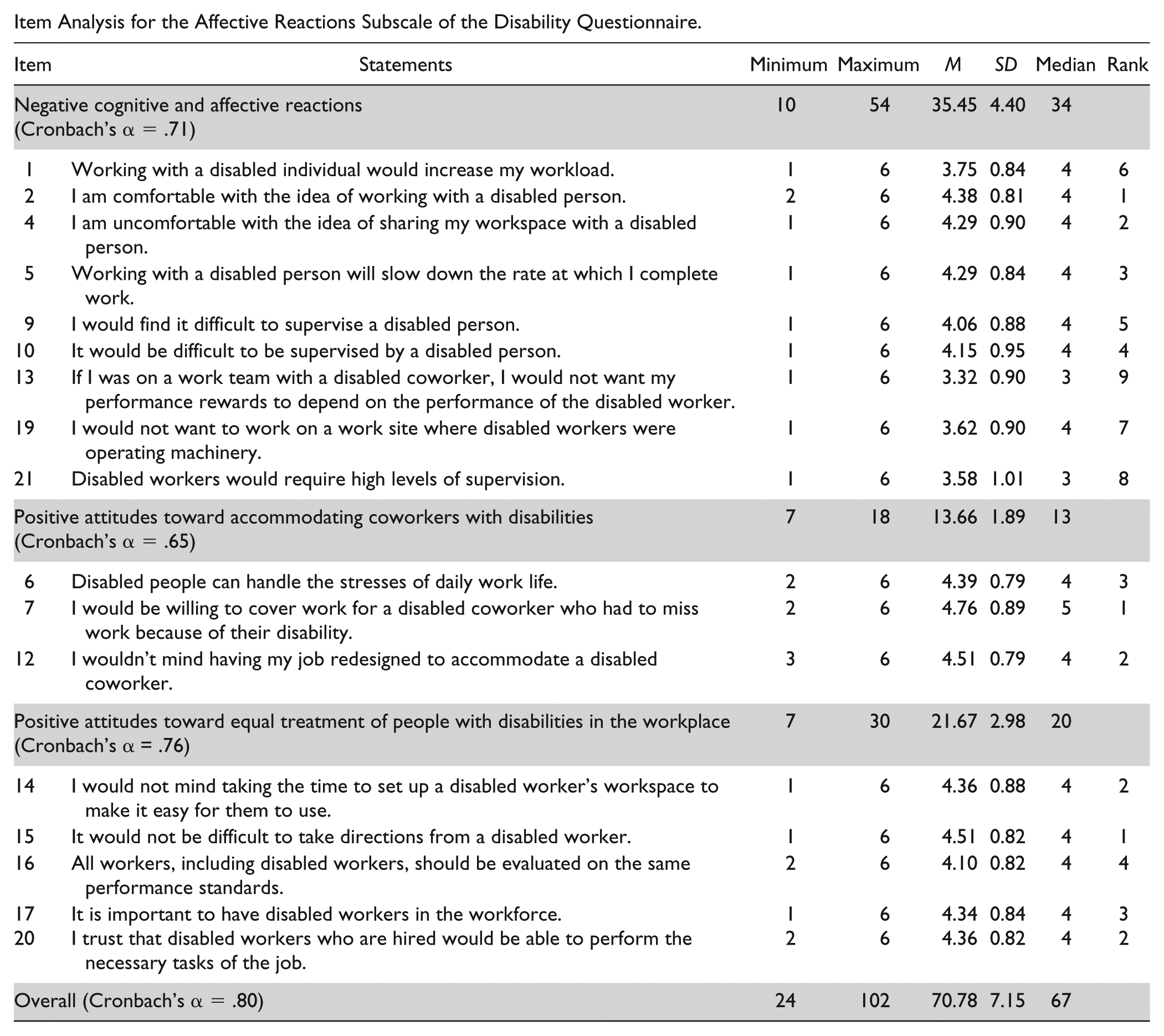
The results (see Appendix A) showed an overall item mean of 4.16 for the AR subscale and factor means for each of the following: NAR (3.94), PAA (4.55), and PAET (4.33). In the present study, the composite mean score for the AR subscale was 70.78 with a standard deviation of 7.15. Results indicated participants had positive affective reactions toward their coworkers with disabilities.
Among the 17 items, the most favorable affective reactions were expressed in the following items: Participants were comfortable with the idea of working with PWDs (Item 2—NAR), and they were willing to cover work for coworkers with disabilities when there was a need (Item 7—PAA). Participants did not mind having their jobs redesigned to accommodate coworkers with disabilities (Item 12—PAA), and they believed coworkers with disabilities could handle stresses of daily work life (Item 6—PAA). Also, participants believed that it was not difficult to take directions from coworkers with disabilities (Item 15—PAET).
Although positive attitudes were discovered, some concerns were expressed by participants. For example, participants mentioned they preferred to be rewarded based on their own performance (Item 13—NAR), they believed their coworkers with disabilities would require high levels of supervision (Item 21—NAR), they indicated coworkers with disabilities should not operate machinery (Item 19—NAR), and their workload would increase when working with their coworkers with disabilities (Item 1—NAR).
Demographic Factors and Affective Reactions
After utilizing Pearson correlations, there were correlations between the three AR subscale dimensions (NAR-PAA = .404 [p < .01], NAR-PAET = .344 [p < .01], PAA-PAET = .309 [p < .01]). In addition, the findings indicated only other contact experiences with PWDs (r = .299, *p < .05) and lengths of tenure (r = −.173, *p < .05) were significantly associated with participants’ affective reactions toward their coworkers with disabilities (see Table 2).
Correlations of AR and Demographic Factors.
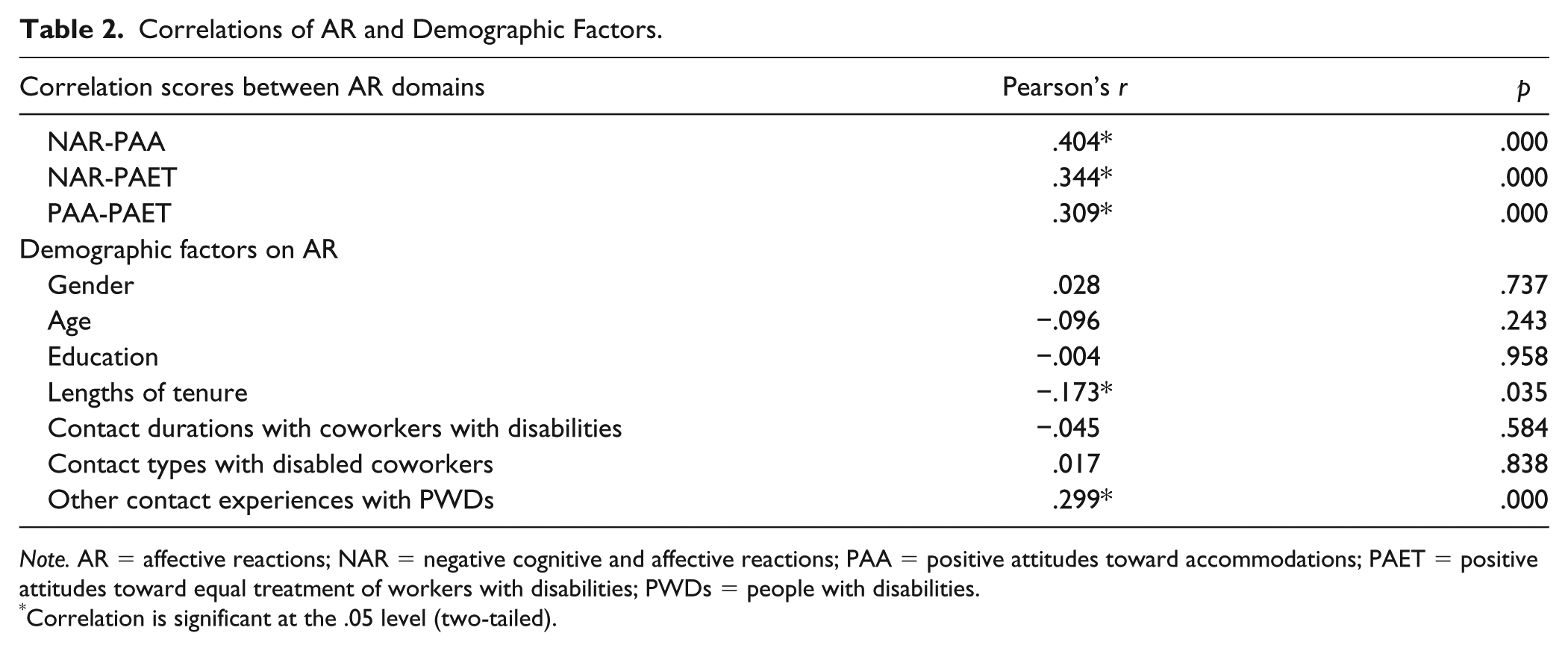
Note. AR = affective reactions; NAR = negative cognitive and affective reactions; PAA = positive attitudes toward accommodations; PAET = positive attitudes toward equal treatment of workers with disabilities; PWDs = people with disabilities.
Correlation is significant at the .05 level (two-tailed).
To confirm the findings of Pearson correlations, stepwise forward regression was applied. Five independent variables were removed including gender, age, education, contact duration, and contact types. The results showed that other contact experiences with PWDs, t(155) = 3.748, p < .05, was first entered and stayed in the model followed by lengths of tenure, t(154) = −1.844, p < .05 (see Table 3). The results of stepwise forward regression (R2 = .132) indicated more than 13% variability of a dependent variable (affective reactions) could be explained by other contact experiences and lengths of tenure, F(2, 154) = 5.40, p < .01.
Summary of Regression Analyses of Demographic Features on Affective Reactions.
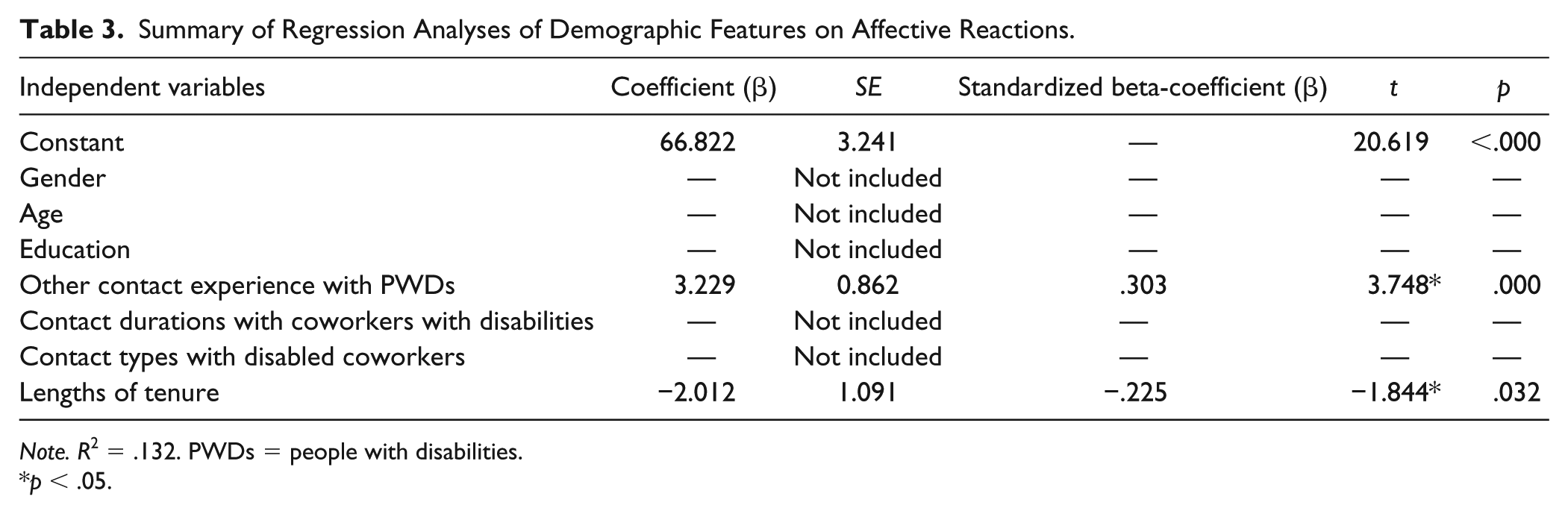
Note. R2 = .132. PWDs = people with disabilities.
p < .05.
To reexamine the results reported above, a one-way ANOVA was implemented. Results again indicated that other contact experience with PWDs, F(2,154) = 6.51, p = .002, and lengths of tenure, F(3,153) = 10.37, p = .005, had significant differences with respect to AR subscale. As there are several features resided in of each of these two factors, the post hoc analysis was used to study the associations of other contact experience and lengths of tenure on the participants’ affective reactions toward working with coworkers with disabilities. The results of the post hoc analysis using Scheffé test indicated that participants who had contact experiences with family members and/or relatives with a disability (M = 66.26, SD = 8.35) had the strongest favorable affective reactions toward coworkers with disabilities. In addition, participants who had the shortest length of tenure—below 1 year (M = 71.55, SD = 7.62)—had the most positive affective reactions toward coworkers with disabilities.
Perceptions of Education and Community Inclusion
Results indicated that people with intellectual disabilities and mental illness were rated strongly unfavorable by participants in terms of their educational opportunities and community inclusion (see Questions 1, 2, and 5 of Appendix B). The results of Question 1 indicated children with physical/mobility disabilities (M = 4.11, SD = 0.68) were acceptable in the same schools, followed by children with vision, hearing, and/or speech disabilities (M = 3.41, SD = 0.97). However, participants strongly disagreed that children with mental illness (M = 2.39, SD = 0.72) and intellectual disabilities (M = 2.83, SD = 0.83) should attend the same schools.
Question 3 of the SPAD addressed the reasons for objecting to children with disabilities being included in the same schools. The top reasons included safety concerns for both children with and without disabilities (33.5% and 23.6%, respectively), special needs consideration (26.9%), and mobility difficulties (20.9%). Although the majority of participants objected to people with mental illness (70.7%) being included in general education, the results from Item 4 indicated that participants believed children with disabilities receive equal opportunities in terms of education (M = 4.36, SD = 0.95).
Questions 5 and 6 were used to explore comfort levels of people without disabilities if accepting the fact that those with various disabilities are living in the general community. Again, people with mental illness (M = 2.65, SD = 0.88) and intellectual disabilities (M = 3.04, SD = 0.88) were ranked as the most unacceptable neighbors. Disruptive or dangerous behaviors were considered the primary reasons for objection. Finally, the results of analysis designed to respond to Question 7 clearly indicated that participants believed only people with physical/mobility (M = 4.12, SD = 0.73), and vision, hearing, and/or speech disabilities (M = 4.06, SD = 0.87) were able to fully participate in life.
Discussion
Affective Reactions
The overall results were encouraging because participants held positive affective reactions toward coworkers with disabilities, especially in terms of issues of work accommodations (Item 7), job redesign (Item 12), and work competence (Item 20). Participants also felt comfortable working with coworkers with disabilities (Item 2) and believed they had similar skills to handle daily work life as their counterparts without disabilities (Item 6).
Rehabilitation counselors and relevant professionals agree that providing reasonable accommodation and job redesign is important for enabling PWDs to perform well in the workplace (Brodwin, Parker, & DeLaGarza, 2003; Gilbride & Hagner, 2005). In the present study, all survey items related to accommodation and job redesign (Items 6, 7, and 12) were ranked high by participants, which could be considered potential indicators of successful inclusion of PWDs in the workplace.
Some specific concerns were also identified. For example, participants indicated coworkers with disabilities should not be operating machinery (Item 19), and they did not want to be rewarded based on performances of their coworkers with disabilities (Item 13). Although work competence of coworkers with disabilities was recognized by participants as mentioned previously, they slightly agreed that working with coworkers with disabilities would increase their workload, and high levels of supervision might be needed (Items 1 and 21).
Previous research indicates that functional limitations of PWDs are varied, and their work environments should be taken into account when examining work participation and performance (Ellenkamp, Brouwers, Embregts, Joosen, & Weeghel, 2016; World Health Organization, 2010), and the current study supports these findings. Among 157 participants, 122 participants worked in the manufacturing industry where they might be required to use machines and tools. Those concerns from employees without disabilities might simply reflect safety issues that their coworkers with disabilities should be supervised or reminded frequently due to particular functional limitations.
Demographic Factors and Affective Reactions
Only two factors had significant relationships with affective reactions toward working with PWDs. These findings were consistent with previous studies where no certain demographic factors are associated with one’s perceptions toward disability (Hsu et al., 2015; Perry et al., 2008). In the present study, negative regression weight for tenure indicated affective reactions of coworkers who have less work experience had the most favorable affective reactions than those with more work experience (see Table 3). Social desirability tendency could be one of the reasons that caused participants to respond in a socially preferred direction (Krosnick, Judd, & Wittenbrink, 2005; Michaels & Corrigan, 2013). It is also possible they had more empathy for coworkers with disabilities because they were new and still learning the workplace culture and norms. On the contrary, participants with longer length of tenure might be more comfortable sharing their thoughts on the same issues.
Regarding impacts of other contact experiences on affective reactions toward coworkers with disabilities, having a family member/relative with a disability was the only factor found to be significant. Participants who had a family member/relative with a disability might be more capable of feeling empathy for coworkers with disabilities. It is also highly possible they might be more knowledgeable about employability of PWDs due to their personal experiences.
Perceptions of Education and Community Inclusion
The hierarchy of attitudes toward people with different types of disabilities was supported (Werner, 2015; Westbrook, Legge, & Pennay, 1993). Participants strongly perceived that only people with physical, vision, hearing, and/or speech disabilities be included in the mainstream educational settings (see Questions 1 and 2 of Appendix B). The lack of educational and relevant professionals for supporting particular needs of PWDs in terms of safety and mobility in educational settings were major concerns (see Question 3 of Appendix B). Previous research indicates that inclusive education is mainly available to students with physical, mobility, and slightly learning disabilities (UNESCO, 2009), and the current study supports these findings.
Providing appropriate services to include people with different disabilities in mainstream education is a challenging task in this developing country. For example, Rydstrom (2010) mentioned that children with various intellectual and mental health disabilities, such as Down syndrome, attention deficit hyperactivity, and attention deficit disorder, are commonly classified into one homogeneous entity, learning difficulties, in Vietnam. Students with these learning difficulties were provided inadequate supports in special schools or integrated schools with a limited amount of teaching aids and lack of well-trained teachers. Furthermore, Vietnam has no public schools or related programs that are specifically designed to support children with autism except for private institutions (Lich et al., 2014). All of these challenges prevent children with intellectual and mental health disabilities from being included in mainstream education, not to mention the lack of vocational rehabilitation and career preparation programs.
Finally, several concerns regarding inclusion of PWDs in the neighborhood were highlighted in Appendix B related to disruptive or dangerous behavior, and the findings were not surprising as disability-related laws and regulations have not been fully implemented. For all of the above reasons, Vietnamese people might have limited opportunities to be exposed to persons with different types of disabilities in diverse settings. This may ultimately lead them to have elevated concerns regarding the stability and disruptive behaviors of PWDs.
Implications for Practice
The majority of coworkers that participants interacted with were identified with physical disabilities, demonstrating people with other types of disabilities were not fully recognized. To promote employment opportunities for people with intellectual disabilities and mental illness, employment options in sheltered workshops and/or supported employment should be promoted by local nonprofit organizations.
The findings indicated that participants believed coworkers with disabilities should not operate machinery and working with workers with disabilities would increase their workload. Therefore, a mentoring system should be established that would allow a senior employee with or without a disability to be matched with employees with a disability to provide proper supports and trainings in a timely manner (Hanley-Maxwell, Owens-Johnson, & Fabian, 2003).
Participants clearly indicated people with intellectual disabilities and mental illness should not be included in mainstream education and/or in the community. Although resources for supporting this disadvantaged population are scarce in Vietnam, low cost and easy to implement techniques could be utilized to improve disability awareness of the public about these groups of people. For example, college curricula could include more information about intellectual disabilities and mental illness, especially in academic departments of sociology, social work, and nursing (USAID, 2015). Also, students who are required to complete a practicum to fulfill their graduation requirements from relevant academic departments should be encouraged to conduct internships in particular nonprofit organizations, specifically designed for serving populations of individuals with intellectual disabilities and/or mental illness.
Limitations and Future Research
The results of the present study must be considered in light of several limitations, which could provide suggestions for further research. Initially, the ages of participants ranged from 19 to 49 years with a mean age of 30.7 years (see Table 1), which limits the generalizability of opinions for order participants. In addition, 137 of 157 participants indicated having coworkers with physical disabilities. The affective reactions of participants could have been different if coworkers had disabilities other than physical disabilities. Future studies could be designed to examine the perceptions of Vietnamese toward coworkers and/or other people with different types of disabilities in terms of employment, education, and social service support systems.
The fact that 122 participants worked in the manufacturing industry at the time the study was conducted limits the generalizability of the findings. Future researchers could conduct relevant studies to find out how Vietnamese perceived coworkers with various disabilities in different workplace settings. Also, face-to-face interviews should be taken into consideration when conducting related studies, as they would provide more detailed information about the issues of employability and social inclusion of PWDs in Vietnam.
Potential bias of snowball sampling should be taken into consideration (Sheu, Wei, Chen, Yu, & Tang, 2009). Biases of snowball sampling that could influence the interpretation of results may include engaging participants as research assistants, collecting repetitious information due to possibility of recruiting related referral chains, and lack of generalizability (Biernacki & Waldorf, 1981; Faugier & Sargeant, 1997).
Finally, the results of the study illustrated participants had less positive attitudes toward people with intellectual disabilities and mental illness in terms of educational rights and community inclusion. Future studies should be conducted to explore how public and private educational institutions could be specifically designed or improved for this disadvantaged population in Vietnam. Difficulties and challenges faced by families with individuals with intellectual and mental health disabilities should be explored as well. Findings could be used to remind authorities about the limited nature of appropriate services and education for people with particular disabilities.
Footnotes
Appendix A
Item Analysis for the Affective Reactions Subscale of the Disability Questionnaire.
| Item | Statements | Minimum | Maximum | M | SD | Median | Rank |
|---|---|---|---|---|---|---|---|
| Negative cognitive and affective reactions (Cronbach’s α = .71) |
10 | 54 | 35.45 | 4.40 | 34 | ||
| 1 | Working with a disabled individual would increase my workload. | 1 | 6 | 3.75 | 0.84 | 4 | 6 |
| 2 | I am comfortable with the idea of working with a disabled person. | 2 | 6 | 4.38 | 0.81 | 4 | 1 |
| 4 | I am uncomfortable with the idea of sharing my workspace with a disabled person. | 1 | 6 | 4.29 | 0.90 | 4 | 2 |
| 5 | Working with a disabled person will slow down the rate at which I complete work. | 1 | 6 | 4.29 | 0.84 | 4 | 3 |
| 9 | I would find it difficult to supervise a disabled person. | 1 | 6 | 4.06 | 0.88 | 4 | 5 |
| 10 | It would be difficult to be supervised by a disabled person. | 1 | 6 | 4.15 | 0.95 | 4 | 4 |
| 13 | If I was on a work team with a disabled coworker, I would not want my performance rewards to depend on the performance of the disabled worker. | 1 | 6 | 3.32 | 0.90 | 3 | 9 |
| 19 | I would not want to work on a work site where disabled workers were operating machinery. | 1 | 6 | 3.62 | 0.90 | 4 | 7 |
| 21 | Disabled workers would require high levels of supervision. | 1 | 6 | 3.58 | 1.01 | 3 | 8 |
| Positive attitudes toward accommodating coworkers with disabilities (Cronbach’s α = .65) | 7 | 18 | 13.66 | 1.89 | 13 | ||
| 6 | Disabled people can handle the stresses of daily work life. | 2 | 6 | 4.39 | 0.79 | 4 | 3 |
| 7 | I would be willing to cover work for a disabled coworker who had to miss work because of their disability. | 2 | 6 | 4.76 | 0.89 | 5 | 1 |
| 12 | I wouldn’t mind having my job redesigned to accommodate a disabled coworker. | 3 | 6 | 4.51 | 0.79 | 4 | 2 |
| Positive attitudes toward equal treatment of people with disabilities in the workplace |
7 | 30 | 21.67 | 2.98 | 20 | ||
| 14 | I would not mind taking the time to set up a disabled worker’s workspace to make it easy for them to use. | 1 | 6 | 4.36 | 0.88 | 4 | 2 |
| 15 | It would not be difficult to take directions from a disabled worker. | 1 | 6 | 4.51 | 0.82 | 4 | 1 |
| 16 | All workers, including disabled workers, should be evaluated on the same performance standards. | 2 | 6 | 4.10 | 0.82 | 4 | 4 |
| 17 | It is important to have disabled workers in the workforce. | 1 | 6 | 4.34 | 0.84 | 4 | 3 |
| 20 | I trust that disabled workers who are hired would be able to perform the necessary tasks of the job. | 2 | 6 | 4.36 | 0.82 | 4 | 2 |
| Overall (Cronbach’s α = .80) | 24 | 102 | 70.78 | 7.15 | 67 | ||
Appendix B
Declaration of Conflicting Interests
The authors declared no potential conflicts of interest with respect to the research, authorship, and/or publication of this article.
Funding
The authors received no financial support for the research, authorship, and/or publication of this article.
