




Abstract
Having prior contact with people with mental illness in the workplace can lead to an improvement in employers’ attitudes toward this group. However, there is currently a lack of instruments to measure attitudes toward the employability of people with mental illness. The overall aim of this study was to develop a Spanish scale of attitudes toward the employability of people with mental illness (CEPEM) and obtain preliminary data regarding its psychometric properties. Ninety-four items from three content domains were selected (attitudes, employability, and impact) and revised in an inter-rater agreement procedure in order to produce an initial scale. The scale was tested by employers and workers from the field of mental health. A reduced set of items was selected according to variability and homogeneity indexes. Additional analyses were conducted to explore the validity of the scale. Internal consistency was estimated for the full 33-item scale. Scale scores partially captured attitudinal differences between employers and workers. Finally, linear multiple regression analysis showed that the scale score, in combination with educational level, can help to predict employers’ intentions to hire people with mental illness. Limitations and future research directions are also addressed.
In Spain, the rate of employment of people with disabilities (25.7%) is much lower than those without disabilities (58.2%), while the employment rate of people with mental illness is even lower (15.8%). This figure may be indicative of current policy in Spain, whereby this group is in receipt of more public benefits than others. For example, 63% of people with mental illness receive some type of disability pension. As a result, there are low rates of participation in the labor market among people with mental illness (only 28.5% is either currently employed or is unemployed but actively seeking employment), and consequently, compared with people with other disabilities, there is a lower employment rate in the competitive labor market, as reported by the National Statistical Institute (Instituto Nacional de Estadística [INE], 2016). This situation is not unique to Spain as there is evidence that people with mental illness do not participate in the competitive labor market in many of the most economically developed countries, as shown by the Organisation for Economic Co-operation and Development (OECD, 2012) and the World Health Organization (WHO, 2000).
Employment Benefits for People With Disabilities in Spain
The Spanish Social Security Institute has established a series of measures to prevent people with a disability from being economically unprotected when they are unable to work in the form of a contributory or non-contributory pension. When the disability reduces or prevents an individual’s ability to work, they receive a contributory pension. This can be “partial” if the disability partly influences an individual’s ability to work in their usual occupation or “total” if the disability fully prevents an individual from working in their usual occupation at all. It is “absolute” when the disability prevents an individual from all forms of work and classed as “high disability” when an individual requires the assistance of another person for the basic activities of daily living. A non-contributory pension is awarded when the disability affects the physical, mental, or sensory capacities of an individual. This type of pension is not specifically related to work activity (Malo et al., 2011).
Individuals can continue to receive a pension and work according to the following stipulations: the “partial” pension is compatible with any job, and the “total” pension is also compatible with any job, except for the individual’s usual occupation. The “absolute” pension and the “high disability” pension allow for any activity (lucrative or not) that is compatible with a person’s condition and that does not represent a change in the work capacity and generate a review of the pension assessment. In these cases (absolute and high disability pensions), the possibility of a suspension of the pension could have a demotivating effect. In the case of non-contributory pensions, individuals can carry out any work activity but the sum of the two incomes cannot exceed a specific amount. Therefore, in this case, the possibility of withholding the pension can also have a demotivating effect toward the acceptance of low-paid or part-time jobs (Blanco-Martín, 2002). These types of benefits are essential for people to have access to a sufficient level of quality of life, but they can also have the opposite effect of discouraging return to work, consequently limiting an employer’s contact with people with mental illnesses as employees, which potentially plays a part in their attitudes toward this group.
Inclusion of People With Mental Illness in Employment
Currently, Spanish laws provide economic assistance to companies that hire people with a disability greater than 33%, and these grants are higher if employees have a disability greater than 66%. However, legislative actions in Spain to promote the employment of people with disabilities provide no mechanisms to ensure access to employment according to the specific type of disability, such as mental illness, and the policy of awarding economic benefits to companies hiring people with higher levels of disability has not proved to be an effective mechanism in fostering greater inclusion (Luis Gil y Gil, 2012; Menéndez-Calvo, 2012). In this context, social organizations working to promote labor inclusion have historically invested more resources aimed at delivering initial training and encouraging recruitment in protected contexts rather than inclusive employment (Bellostas et al., 2016; Corrigan & McCracken, 2005; Rodríguez et al., 2012).
The limited efforts at providing services aimed at the inclusion of people with mental illness in competitive employment settings mean that this group often struggles to find employment. Consequently, as there is a lower rate of people with mental illness in or seeking employment, it is likely to be more difficult for companies to find a candidate from this group. However, attitudes of employers toward disabilities are also likely to play an influential role in their choice of who to recruit (INE, 2016). Therefore, studying attitudes more closely is important when examining the part that prejudices associated with mental illness play in work discrimination and the unemployment rate among people with mental illness in Spain.
In recent years, the mental health system has moved away from a pathology-based approach to a recovery model where the aim is to manage the condition in such a way that enables people to fulfill life goals, placing an emphasis on personal preferences, abilities, possibilities, and self-efficacy, thus making it possible for them to lead a productive life (Piat & Polvere, 2014; Ryan et al., 2012). In this regard, access to employment is essential, since it allows the person to receive relevant compensation on both a material and symbolic level (feeling useful in society). Furthermore, it can lead to significant changes in the person’s own definition of self-esteem, while facilitating empowerment (Blank et al., 2015; Kirsh et al., 2009). However, inclusion in an ordinary work setting is typically associated with a risk of stress and relapse, which may be accentuated by the overprotective attitudes of official mental health workers (Saavedra et al., 2016; Wang et al., 2018). Therefore, in addition to exploring the attitudes of employers, it is also important to explore the attitudes of mental health workers toward the employability of people with mental illness in order to examine the extent to which the attitudes of those who claim to have assisted in introducing a more inclusive society for people with mental illness do, in fact, conform with this paradigm of inclusion.
Review of Current Research and Rationale for Developing a New Instrument
Research on employers’ attitudes toward the employability of people with mental illness has evolved from an initial, broad approach focused on discrimination determined by type of disability to a more detailed approach that attempts to fully consider the functional characteristics of mental illness and the ways in which these impact on an individual’s ability to work (Biggs et al., 2010; Bricout & Bentley, 2000; Marwaha et al., 2009; Unger, 2002). Mental illness has been shown to be one of the most discriminated-against conditions in the recruitment process, whereby variables such as the complexity of the work to be carried out and the extent of contact with the public that is required are considered by employers before hiring an individual with mental illness. Within the workplace, staff have been found to associate people with mental illness with negative characteristics, such as low motivation, increased likelihood of becoming ill (and consequently higher rates of absence), unpredictability and dangerous behavior, reduced communication skills, and difficulties in following instructions or controlling their emotions (Bezborodovs & Thornicroft, 2013; Gouvier et al., 2003).
Work itself is also considered to be a source of stress and often thought to be harmful for people with mental illness, so that hiring individuals from this group can be considered an act of charity since it does not fit well with the idea of productivity in the business world (Krupa et al., 2009). A culmination of these factors has meant that people with mental illness are more likely to find employment in the low-skilled labor market, with lower incomes and greater reliance on public financial benefits (Corrigan et al., 2012; Kosyluk et al., 2014; Stuart, 2006). Therefore, the process of stigmatizing people with mental illness, which has led to discrimination and exclusion from the competitive labor world, can be considered a major topic of concern.
After reviewing the literature about attitudes toward the employability of people with mental illness more closely, we found that among employers, there is an association between previous positive contact with people with mental illness in a workplace environment and better attitudes toward them (Diksa & Rogers, 1996; Ju et al., 2013; Kosyluk et al., 2014; Ozawa & Yaeda, 2007). However, it is necessary to explore the reasons why this occurs in more depth. Perhaps contact in a workplace environment generates a change in ideas regarding disability in general, or more specifically, about the productivity of people with mental illness. Therefore, we decided to develop a new scale considering two domains of attitudes: (a) attitudes toward people with mental illness and (b) attitudes toward the employability of people with mental illness.
In search of relationships between attitudes and other variables, some authors have found that a company’s economic performance, its number of employees, and the academic level of employers show no significant relationship with employers’ attitudes toward people with mental illness (Crisp et al., 2000; Hand & Tryssenaar, 2006). In contrast, other authors have shown that in certain work settings, the emphasis is placed on the employee having the appropriate skills to do the job, while in others, relationships with fellow employees and the social image of the company take precedence over the employee’s capabilities (Jin et al., 2009; Pettersen & Fugletveit, 2015; Tsang et al., 2007, 2012). This shows that environmental variables also play a part in determining the attitudes of employers toward the employability of people with mental illness. Therefore, we decided to explore a third content domain in our attitude scale: (iii) attitudes toward the social and economic impact associated with hiring people with mental illness, where we consider the importance of some environmental variables in attitudinal change.
In the light of the above, the overarching aim of this study was to develop an Employability of People with Mental Illness Questionnaire (CEPEM), including a scale to assess attitudes toward the employability of this group, focusing specifically on those attitudes of employers and also workers involved in their recovery process. According to our literature review, previous research in this field has been discrete, and furthermore, there is an absence of instruments published at an international level that have been subjected to a sufficient validation process in order to be adapted to the Spanish context (Diksa & Rogers, 1996; Hand & Tryssenaar, 2006; Ozawa & Yaeda, 2007). Moreover, there is a lack of evidence to show that instruments used in previously published studies have considered the three content domains used in this study: attitudes toward people with mental illness, their employability, and socio-economic impact on the company.
Purpose
We conducted a preliminary content analysis of an initial version of the attitude scale, based on the assessments of expert judges to support the content validity of the items included in each section of the instrument and on qualitative analysis of the items. The results were then used to draft a preliminary version of the scale, which was applied to a real sample. Calculations of internal consistency and homogeneity between items were used to create a shortened version of the scale. We first explored whether the final version of the CEPEM scale would be able to detect differences between different groups in term of their attitudes and also whether it would be able to detect if employers’ attitudes are related to a company’s economic performance or whether they vary according to type of contact with people with mental illness. Potential predictive power of the scale was explored, analyzing the relationship between employers’ attitudes and their behavioral intention to employ people with mental illness in their companies.
Method
Instrument Development
The scale of attitudes in the CEPEM questionnaire was developed according to our findings from the literature review about attitudes toward the employability of people with mental illness. This first phase involved producing 94 items initially distributed into the three content domains: attitudes toward people with mental illness, employability, and social impact on the company. Subsequently, an inter-rater agreement content validation process was carried out by five experts (of which 60% were female) in the field of mental health and job placement. These included two professional experts in the field of work inclusion for people with mental illness, one professor with extensive academic experience in the development of scales, and two professionals working in the community inclusion of people with mental illness. All experts had more than 15 years’ experience in their field. and four had a doctorate and one a master’s degree. After consenting to participate, they received another e-mail with instructions on how to carry out the validation process.
Participants were asked to rate an initial set of 94 items using a scale from 1 to 10, where 1 corresponded to “The item measures the dimension very poorly” and 10 corresponded to “The item measures the dimension very well.” In order to select the most relevant items, the content validity index (CVI) for each item was calculated, like the proportion of content experts giving item a relevance rating. In the second phase, the same set of five participants assigned the pre-selected items to the three content domains. Finally, the S-CVI/Ave was calculated for each content domain and for the entire attitude scale.
The item scale was then evaluated qualitatively through a focus group conducted with six psychology graduates to verify the relevance of the instrument at a qualitative level. After reading the items, participants were asked to write their opinion about what each item might be measuring and what the scale in general could be used to measure. We selected participants without specific experience in this field to confirm the appropriateness of the language used in the scale and to evaluate the usability of the scale. Finally, the instrument was tested with a sample of five businesspeople, five civil servants, and five private workers in the field of mental health.
For the first content domain, attitudes toward people with mental illness, the literature in this field was reviewed and content spheres related to stigma, discrimination (social exclusion), participation, rights in general, and right to work were selected. For the employability content domain, we first considered adapting a previously developed scale applied in Canada from a similar study (Hand & Tryssenaar, 2006). However, after a first translation by two proficient English speakers and a subsequent meeting to discuss language adaptation, the use of this instrument was discarded because it was concerned with the opposition between sheltered workshops and competitive employment. The authors decided instead to produce original items derived from the literature review that were specifically related to the employability of people with mental illness. Moreover, the literature review also highlighted the importance of considering environmental variables, such as the relationship with co-workers or the link between the social image of companies and the hiring of people with disabilities (Jin et al., 2009; Pettersen & Fugletveit, 2015; Tsang et al., 2007, 2012). For this reason, a third content domain with items related to the social impact for companies hiring people with mental illness was produced and included in the scale.
In the inter-rater agreement content validation process, all items with CVI > .6 were selected (63 items). Finally, 50 items for which a Fleiss’s Kappa (FK) showed almost perfect agreement (>.80) were selected. The results of the CVI and the FK are calculated for the scale in its entirety (CVI = .77; FK = .70) and in each of the three content domains (attitudes, CVI = .71, FK = .66; employability, CVI = .84, FK = .72; impact, CVI = .75, FK = .75). The focus group participants stated that the items were specifically related to attitudes toward people with mental illness or their employability and impact in companies, and all participants were in agreement that the complete scale could be used to measure attitudes toward the employability of people with mental illness. Taking into account the positive results from testing with businesspeople, civil servants, and private workers, we proceeded to the pilot test without making any substantial changes to the instrument.
The CEPEM Questionnaire
The CEPEM Questionnaire is divided into a socio-demographic section, the scale of attitudes toward the employability of people with mental illness (the CEPEM attitude scale), and a behavioral intention scale. The socio-demographic section collects data from the respondent about age, gender, level of education, contact with people with mental illness, level of knowledge about mental illness, and existing laws in regard to work inclusion. Furthermore, this section also collects data about the companies. For example, the sector of work, the number of employees, the annual profit of the company, and their history of hiring people with mental illness. For the mental health worker questionnaire, in this section, we also collected data about the type of service provided (e.g., work rehabilitation, housing support, etc.) and their opinion on whether people with mental illness could lose disability benefits if they work.
The scale of attitudes toward the employability of people with mental illness is made up of items distributed into the three content domains: attitudes toward people with mental illness; attitudes toward their employability; and socio-economic impact on the company (Appendix). The response format is a Likert-type scale with values scoring along the range of 1 Totally Disagree, 4 Neither Agree nor Disagree, and 7 Totally Agree. The total attitude score represents the collapse of the three content domains into a single global measure. Higher total scores correspond with better attitudes.
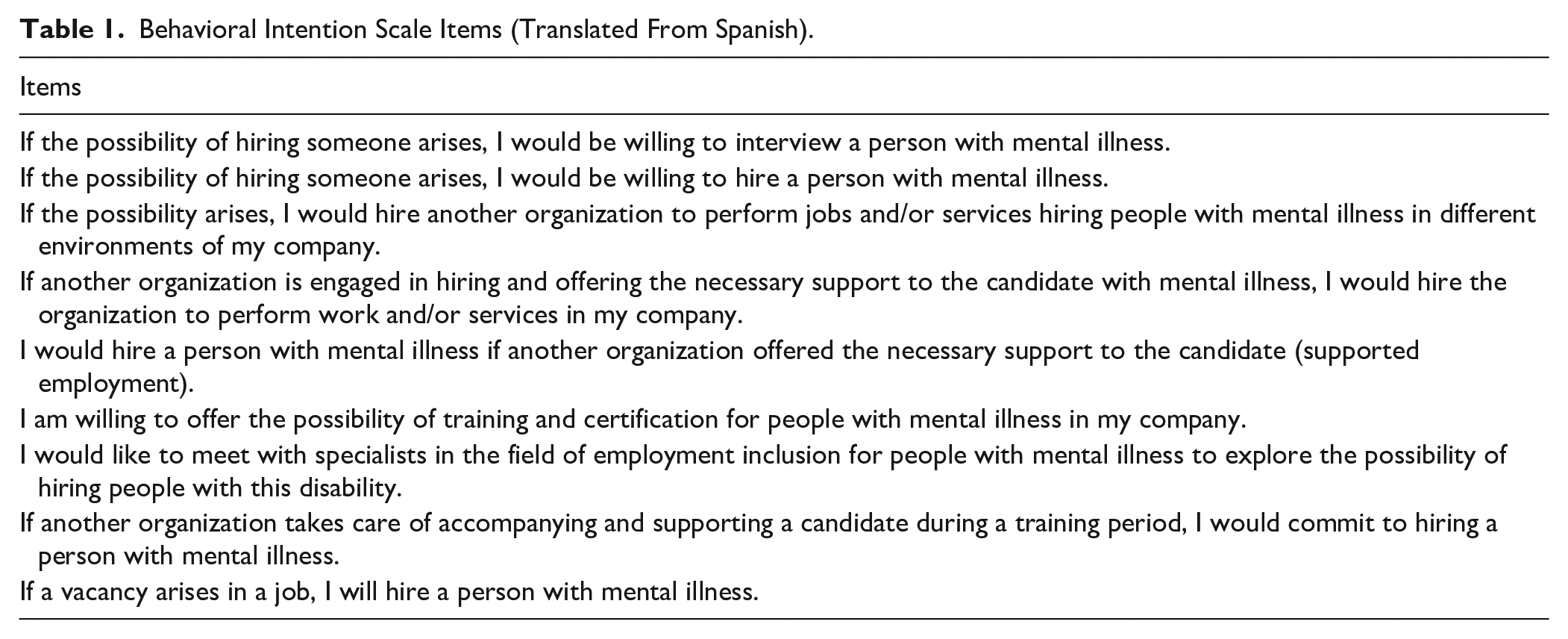
The behavioral intention scale is composed of nine items where participants could rate their opinion about the possibility of employing people with mental illness in their companies. The main purpose of this was to synthesize employers’ opinions regarding the different possibilities of hiring people with mental illness in their companies in the future. Items about intention to hire were produced separately by two professional experts in the field of employment inclusion for people with mental illness. In a subsequent meeting, they discussed instrument adjustment with a researcher. Items concerning potential employment contact between employers and people with mental illness were selected (i.e., being willing to interview or willing to hire) (Table 1). We obtained a variable to relate it to the attitude scale, also considering the possibility that we might not find sufficient companies with previous experiences of employing people with mental illness.
Behavioral Intention Scale Items (Translated From Spanish).
Participants
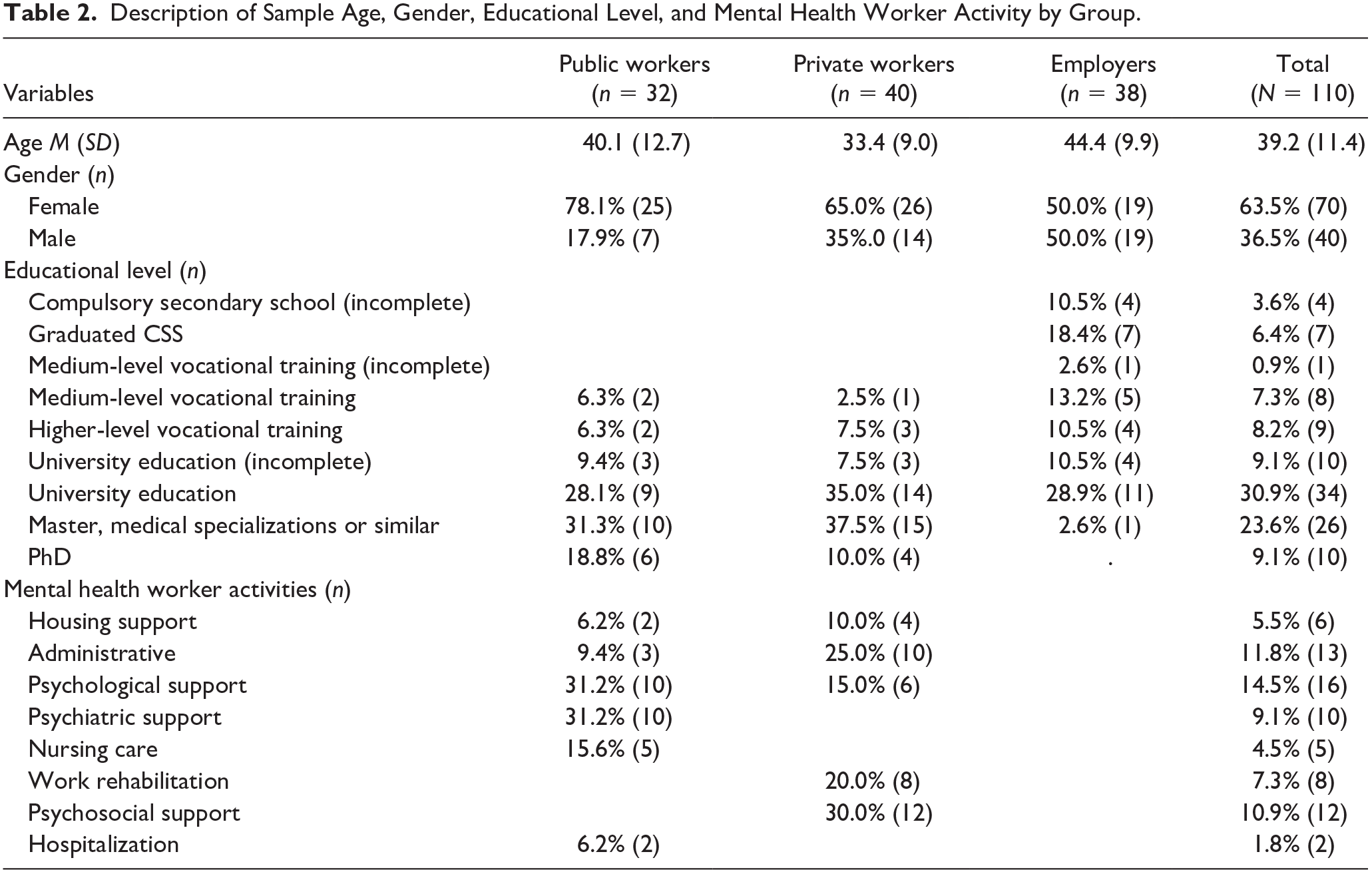
One hundred ten people answered the questionnaire. Twenty-nine percent of the sample (n = 32) were official staff members (psychiatrists, psychologists, and nurses) of the Department of Psychiatry and Mental Health (DPMH) of Zamora, 36.4% (n = 40) worked in the private sector (two non-profit organizations) supporting people with mental illness in different recovery process activities, and 34.5% (n = 38) were employers (hiring managers) of the aforementioned province (Table 2). The businesspeople participating in the study mainly belonged to the service (44.7%) and commercial (34.2%) sectors, with a lower representation of companies in the industrial (10.5%) and agriculture and construction sectors (both accounted for 5.3%). The mean age was 44, and gender distribution was equal across the sample.
Description of Sample Age, Gender, Educational Level, and Mental Health Worker Activity by Group.
Sampling procedures
Company selection was based on data from the Chamber of Commerce in Zamora. First, 126 companies were selected according to the highest invoiced amounts and workers number registered in 2012. Hiring managers were then contacted by telephone (68.25%) or in person. All those who accepted to participate in the study received the questionnaire link via e-mail (44.74%) or the printed version. A small group (n = 22) was selected based on their location in areas frequently visited by people with mental illness. We chose these because of the availability of specific services aimed at pharmacological and housing support or work rehabilitation in the area. Workers were selected through the DPMH of the Provincial Hospital of Zamora and two organizations that are actively involved in supporting the social integration of people with mental illness. All workers (n = 224) were contacted via e-mail. The official staff members of the DPMH were contacted by the psychiatric and nurse coordinators. The private sector workers were contacted directly by one of the researchers. In both cases, participants were also offered the printed version of the questionnaire. In the recruitment process, employers and workers were invited to participate in the study but were not informed beforehand about the specific theme research. The language used in the instructions of the questionnaire was reviewed by two external researchers in order to ensure assuring simplicity and neutrality. Data collection began on April 10, 2016, and two reminder communications were sent to each sample. In this study, those responses received up until May 12, 2016, have been included. The study is part of the CEPEM-ActiToWork research project, the protocol of which was approved by the Clinical Research Ethics Committee of the Health Area of Zamora.
Data Analysis
First, we conducted data analysis to obtain information about the psychometric properties of the items and to make a selection of the best items for building the final version of the attitude scale. Subsequently, we tested to see if the final CEPEM scale was sensitive enough to detect different attitudes for different groups of the sample. Two participant groups were workers in the mental health field, so we expected different results between these groups and the employer group. We also looked at whether CEPEM attitude scores can be predicted by economic or social factors. For example, whether employers’ attitudes are related to the company’s economic performance or whether they vary according to type of contact with people with mental illness. Finally, predictive validity of the attitude scale was analyzed exploring the relationship between employers’ attitudes and their intention to hire people with mental illness.
Results
Participants and Initial Scale Assessment
The response rate was 40% for the official staff members, while it was lower for the other two groups (employers 30.1%, non-profit workers 27.7%). The online response rate was 55.4% for the entire sample. We received more online responses from private workers (60%) and mental health official staff members (59.4%), than from hiring managers of companies (47.4%). After testing the attitude scale for the first time, all the items (13) with a standard deviation lower than 1.2 and a homogeneity index (item-total correlation) lower than the discrimination index calculated to evaluate the relevance of each item (.188) were excluded and not considered for the final version of the scale (Clark & Watson, 1995). An internal consistency analysis indicated an acceptable reliability of the full 33-item attitude scale for the entire sample (Cronbach’s α = .92) as well as for the groups of employers (Cronbach’s α = .92) and workers (Cronbach’s α = .90). The internal consistency analysis also indicated an acceptable reliability of the items in the three content domains (attitudes, Cronbach’s α = .71; employability, Cronbach’s α = .87; socio-economic impact, Cronbach’s α = .84).
First CEPEM Scale Results
The first aim of the pilot test of the CEPEM was to review the sensitivity of the CEPEM scale to attitudinal differences among distinct groups. An analysis of variance revealed differences in the attitudes scores as a function of the group: F(2,107) = 17.37, mean squared error (MSE) = .48, p < .001, η2p = 0.25, 95% confidence interval [CI] = [0.13, 0.34]. According to the Bonferroni post hoc tests, the mean of the attitude total score was significantly lower (p < .001) in the group of employers (M = 4.93; standard error of mean [SEM] = .14) than in the group of public (M = 5.55; SEM = .10) or private workers (M = .5.84; SEM = .10). This pattern was also found when testing differences as a function of group in the attitudes and impact content domains but not for employability, which only showed differences between employers (M = 4.85; SEM = .15) and private workers (M = 5.59; SEM = .12).
A second objective of the pilot application was to test the link between the attitude total score with other questionnaire variables, focusing on links that have been tested in previous research for employers. First, regarding the influence of variables on the attitudes of the employers, Welch’s t-test showed that there is no relationship between previous experience with disabled employees and a company’s policies of allocating positions for this group with better attitudes (with previous experience and policy of allocation, M = 4.89, standard deviation [SD] = 1.10; without previous experience and without policy of allocation, M = 4.93, SD = 0.78), t(7.5) = −0.08, p = .94, d = −.03, 95% CI = [–0.89, 0.82], r = .01. Second, no evidence could be found in regards to having prior contact with people with mental illness and significantly different attitudes among employers (some type of relationship, M = 4.82, SD = 0.79; no relationship, M = 5.41, SD = 0.88), t(8.4) = 1.6, p = .1, d = .68, 95% CI = [–0.18, 1.54], r = .26. Third, the analysis of the scale scores relating to economic performance did not reach significance. Therefore, a better economic situation does not appear to determine a more positive attitude toward the employability of people with mental illness (better economic performance, M = 5.02, SD = 0.84; worse economic performance, M = 4.88, SD = 0.85), t(19) = .46, p = .7, d = .17, 95% CI = [–0.57, 0.9], r = .08.
Finally, we decided to study the relationship between attitude total scores and geographic proximity of employers to mental health services. Here, we found that attitudes of employers from companies located in areas characterized by the presence of mental health services present significantly lower scores (M = 4.36; SD = 0.60) from those that are not in proximity to such services (M = 5.16; SD = 0.81), t(25) = −3.4, p < .01, d = −1.2, 95% CI = [−1.98, −0.42], r = .49.
Criterion Predictive Validity
The predictive validity of the CEPEM scale was analyzed to explore the relationship between employers’ attitudes toward the employability of people with mental illness and the behavioral intention to hire people with mental illness. A new variable was calculated, intention to hire, averaging the scores of the 9 items of the behavioral intention scale, as all items reflected different possible work inclusion behaviors that an employer could carry out in regard to hiring individuals with mental illness (Table 1). An internal consistency analysis indicated an acceptable reliability of the full 9-item intention to hire scale (Cronbach’s α = .92). Although the number of employers in the sample is small (n = 38), it is slightly higher than the minimum number of participants considered large enough by some authors (Van Voorhis & Morgan, 2007) per variable in a regression analysis and, for that reason, we decided to conduct several linear regression analyses using intention to hire as a dependent variable and several other variables, including CEPEM attitude scores, as predictors. Post hoc power analyses were conducted with G*Power 3.1 (Faul et al., 2007, 2009) to test the power to obtain a deviation of R2 from zero similar to that obtained in our study (a large effect size) with the employers sample size. Power analysis showed an adequate power (>.99). Also, post hoc power analyses were conducted for testing the power of the increase of R2 when entering CEPEM total score. Again, power was adequate (>.97) for the employer sample size.
First, a simple linear regression analysis was used to test if the CEPEM attitude scores significantly predicted employer’s intention to hire a worker with mental illness. The results of the regression indicated that CEPEM total score explained 30.1% of the variance, F(1,36) = 15.5, p < .001, R2 =.28. We found that CEPEM total mean scores significantly predicted the behavioral intention of hiring (β = .89, p < .001). Second, to explore the predictive value of CEPEM attitude scores in more depth, hierarchical multiple regression analyses were conducted. In consecutive steps, demographical variables (Step 1), previous contact with mental illness variables (Step 2), and CEPEM total attitude score (Step 3) were used as predictors. As can be seen in Table 3, CEPEM total score, entered in step 3, was a significant predictor of intention to hire, with a significant increment in explained variance of .30, F(1,29) = 19.74, p < .001, when considered in the model. Finally, a third hierarchical regression analysis was conducted entering the three CEPEM content domain global scores in the last three steps in the order of their assumed theoretical importance as predictors of intention to hire (attitudes, employability, and impact). As shown in Table 4, the successive entering of the three content domains subscales in the model produced a significant change in the total explained variance by the model for attitudes subscale (ΔR2 = .30, global adjusted R2 = .58), while there are not significant changes when employability and impact were entered in the model.
Results of Hierarchical Multiple Regression Analyses for Employers’ Intention to Hire.
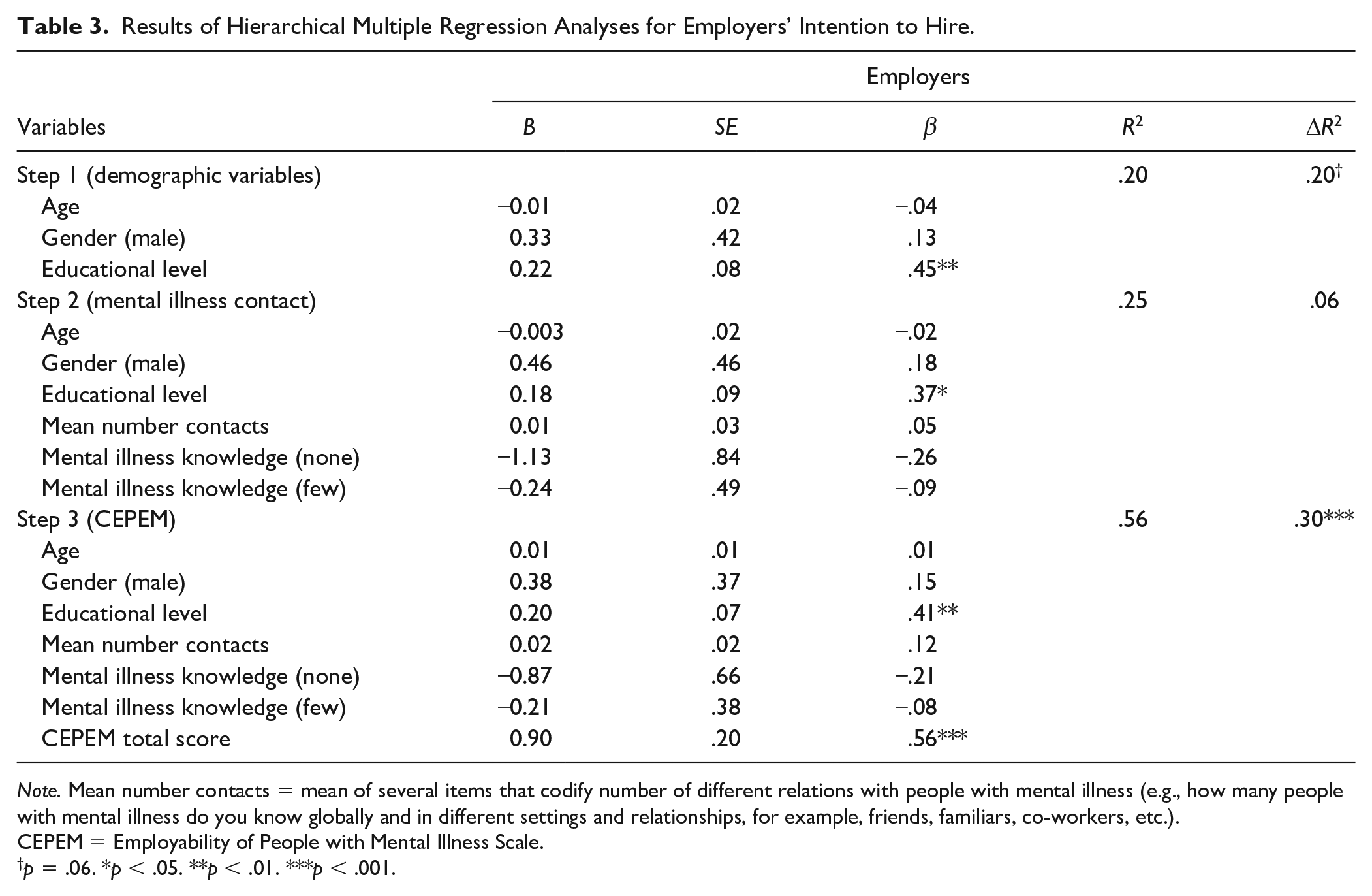
Note. Mean number contacts = mean of several items that codify number of different relations with people with mental illness (e.g., how many people with mental illness do you know globally and in different settings and relationships, for example, friends, familiars, co-workers, etc.). CEPEM = Employability of People with Mental Illness Scale.
p = .06. *p < .05. **p < .01. ***p < .001.
Results of Hierarchical Multiple Regression Analyses for Intention to Hire With CEPEM Content Domains Scores Entering in Last Three Steps.

Note. CEPEM = Employability of People with Mental Illness Scale.
p = .06. *p < .05. **p < .01. ***p < .001.
Discussion
As noted in other recent work (Lettieri & Díez, 2017), there is a need to develop different strategies to promote inclusive employment for individuals with mental illness, considering that they are one of the most discriminated groups in recruitment processes and in the workplace (Bezborodovs & Thornicroft, 2013; Biggs et al., 2010; Bricout & Bentley, 2000; Lettieri & Díez, 2017). As a result, they experience some of the worst employment rates in Spain and in other countries (INE, 2016; OECD, 2012). We, therefore, decided to focus our attention on the attitudes toward the employability of people with mental illness. In particular, it is important to understand the views of employers and mental health workers in greater depth, as these are actors who play an essential role in promoting inclusive employment by hiring people with mental illness or by providing inclusive services, such as supported employment. Through the development of the CEPEM questionnaire presented in this article, we have focused specifically on how different types of contact with people with mental illness influence the opinions of employers and mental health workers, covering content domains that are important for understanding more about the inclusion processes of people with mental illness in employment. Results from this study showed that the CEPEM attitude scale has an acceptable internal consistency and demonstrates predictive validity, as it is able to distinguish attitudes between employers and workers and also to predict, specifically by attitudes content domain, employers’ intention to hire people with mental illness. These initial results are positive. However, we need to confirm these findings with further research on this theme and explore in more depth. It could be useful to focus more on participants who are employers with experience in hiring and working with people with mental illness. This could contribute toward a better understanding about the subscales structure and its usefulness in predicting intention to hire. Moreover, we have to investigate whether the scale can distinguish attitudes of people with mental illness. Self-stigma and the low expectations for employment are important barriers to individual decisions related to seeking and maintaining employment (Corrigan et al., 2012; Prior et al., 2013).
As suggested from our results, the attitude total score was significantly lower in the group of employers than in the public or private workers groups. This pattern was also found when testing differences as a function of groups in the content domains, except for the employability content domain, which only showed a significant difference between employers and private workers. These limited first results suggest that a different global vision between employers and mental health workers regarding the employment of people with mental illness may exist, and that specifically, mental health public workers will have more negative attitude scores with items related to the employability content domain (specifically regarding capability at work).
As described in recent reviews, previous positive experiences with employees with disabilities may determine an improvement in employers’ attitudes (Ju et al., 2013; Unger, 2002). Our results reflect those of an earlier study (Hand & Tryssenaar, 2006), which suggest that there is not a consistent, significant relationship between previous experiences in the workplace and better employers’ attitudes. However, we found that the specific context of prior contact (not only in workplace but also outside of the workplace) with people with mental illness may also be relevant when considering employers’ attitudes toward this group of people. In particular, our results suggest that company location could be an influential factor in employers’ attitudes. For example, companies located in areas with services for people with mental illness have significantly worse attitudes than those located in areas without these services. The issue of diversity as a social phenomenon characteristic of urban settings involves the emergence of everyday interactions among inhabitants sharing the same areas, and it is important to consider these interactions in any cultural study exploring opinions from the mainstream toward minority groups (de Certeau et al., 1990). It would seem, therefore, that in our study, everyday interactions with people with mental illness may have led to more negative opinions about this group among employers. However, this topic requires further research. The other possibility could be that the location of mental health services contributes to worsening attitudes because people may be in disagreement about the distribution of economic resources to mental health services (Sharac et al., 2010).
Regarding mental health officials, the literature available from Spanish research suggests that their attitudes toward people with mental illness are more positive than those of the rest of the population, even family members of people with mental illness (Campo et al., 2010; Yllá et al., 2007). Our research compares this group with employees in private organizations that work alongside people in the recovery process. Our data show that the attitudes displayed by both the groups (public and private mental health workers) are similar and more positive than those of employers. However, more positive attitudes on the part of mental health workers do not always lead to fully inclusive employment practices and services. This confirms the need for further research on the reasons for this, in particular, to explore whether there is a link with economic issues, or perhaps poor training, in the areas where employment services are set up. We know that supported employment programs exist and that rapid placement often leads to lower income and lower quality jobs (Baldwin, 2016). Nonetheless, we have evidence that supported employment (specifically the Individual Placement and Support model) is the best available option in the labor market (Drake et al., 2012; Kinoshita et al., 2013; Luciano et al., 2014; Marshall et al., 2014). Perhaps supported employment programs are not the only option in a slow workforce market. These programs involve searching for rapid placement, but where there is a slow turnover of the workforce, it could be more difficult to obtain work opportunities. However, the Spanish mental health system should also add services oriented toward this more inclusive employment modality.
Limitations
This article presents the results of the first application of the CEPEM questionnaire and should be taken with care and considered as an initial report supporting the future direction of this research project. The major limitation of this study is the sample size, the consequence of which is a limited variability in the sample about employers’ previous contact with people with mental illness and experience in hiring individuals from this group. We developed a behavioral intention scale, but “intention to hire” is not a bonafide criterion for actual hiring practices. Therefore, in the future, we need to compare these results with real data about the number of employees hired in order to support our findings. The sample size also limited the possibility of conducting a factor analysis taking into account the three content domains level of the CEPEM attitude scale. In order to improve the psychometric properties analysis considering the three content domains of the scale, and to relate this to an exploratory and confirmatory factor analysis model, again we need to extend the sample size. At this preliminary stage of our research, we consider the total attitude score as a sum of these three content domains, using each one to explore the predictive validity of the content domains on employers’ intention to hire. In the future, the exploratory factor analysis (EFA) and the confirmatory factor analysis (CFA) will allow a better understanding about the relationship between these three content domains and the suitability of using these in one global score. It is necessary to further explore the psychometric properties of the instrument.
Another limitation of the study is the lack of contributions from people with mental illness in the content validation process as well as the lack of the application of an attitude scale with people with mental illness. The low response rate by participants in several groups (ranging from 27.7% to 40%) is another important weakness of this study. Moreover, some of the data collected have not been intensively researched and have not been presented in this work. For example, we did not test and evaluate every modality of each of the contact variables. The individuation of relevant variables of contact with people with mental illness and its relation with the three content domains of our scale is one of the central aims of our project in the medium term.
It should also be noted that for the correct interpretation of our results, it is important to take into account the probable interference of the social desirability mechanism, the impact of which may have affected the responses of the whole sample. The sampling procedure that was used for data collection with the official mental health staff members may have also been a limitation. Most likely, receiving an invitation to participate in a study by managers in the psychiatry department could have altered the response rates. It is also possible that employers who agreed to participate were those who were more likely to have more positive attitudes toward employment for people with mental illness. However, the observed variability of the CEPEM scores in the employer group could be evidence that this bias did not occur.
Future Research Directions
Considering the findings of the study presented in this article, it appears that instruments like the CEPEM questionnaire can prove useful in acquiring key knowledge in the underexplored area of attitudes toward people with mental illness. Obtaining more information about the prior contact of employers with this group and their attitudes could offer vital support to every professional involved in the inclusion of people with mental illness in employment.
The general hypothesis is that employers’ attitudes improve after having positive contact with people with mental illness in the workplace. However, there is currently no extensive evidence to verify this and more information is required. In order to do so, we first need to improve the psychometric analysis of our attitude scale, which currently lacks enough psychometric data to support its usefulness as a research tool.
Second, we need to collect more data about individuals’ prior contact with people with mental illness inside and outside of the workplace and the relationship between this contact and attitudes. The aim of our research was to explore whether prior contact really does improve attitudes toward the employability of people with mental illness and to explore what type of contact influences these attitudes. However, the findings presented here are limited, and more information about this link is important to assess inclusive services and to explore how they can be improved.
The results presented in our study show how employers’ attitudes are one of the most crucial factors in the intention to recruit people with mental illness, leading to the conclusion that it is of the utmost importance to work alongside employers to inform them about this illness and to encourage positive employment practices.
Footnotes
Appendix
Items of Attitude Scale—Final Version According to Their Type of Content Domain (Translated).

| Content domains | Items |
|---|---|
| Employability | 1. The treatments that people with mental illness receive make it difficult for them to work. |
| 2. Many people with mental illness find it difficult to follow work instructions properly. | |
| 3. People with mental illness often have problems of absenteeism and punctuality in their jobs. | |
| 4. Regardless of how much training is offered, it will not be enough to prepare a person with mental illness for a job. | |
| 5. People with mental illness can be trained for any job. | |
| 6. People with mental illness can show adequate skills for the job. | |
| 7. People with mental illness can only work on routine and/or simple tasks. | |
| 8. Many people with mental illness are too slow to work efficiently. | |
| 9. People with mental illness experience too much frustration at work. | |
| 10. The productivity of people with mental illness can be as good as that of people without disabilities. | |
| 11. A person with mental illness who needs medication cannot be a productive and functional worker. | |
| 12. If a person with mental illness does not work for years, it will be more difficult to return to work and be efficient and productive. | |
| 13. Working means receiving orders, and people with mental illness do not usually respect authority. | |
| 14. The responsibility and stress involved in any job is a factor that worsens the health condition of people with mental illness. | |
| 15. Work environments provide too many distractions that impede the professional activity of people with mental illness. | |
| 16. People with mental illness do not want to work. | |
| Attitudes | 1. People with this disability are often dependent on drugs and alcohol. |
| 2. People with this type of disability are victims of rejection by most people. | |
| 3. Obtaining employment allows people with mental illness to lead relatively normal lives. | |
| 4. People who have a mental illness should not be allowed to vote. | |
| 5. People with mental illness should be able to choose where they want to live as any other citizen. | |
| 6. People with this disability can live a life in the community like any other person. | |
| 7. It should be promoted that people with this disability fall in love and have children to be happier. | |
| 8. Companies should offer people with mental illness the possibility to work and feel fulfilled. | |
| 9. Jobs for people with mental illness removes jobs for people without disabilities. | |
| Impact | 1. Sharing the workplace with people with mental illness promotes positive attitudes among co-workers without disabilities. |
| 2. More economic benefits should be offered for companies that hire people with mental illness. | |
| 3. It is not convenient to hire a person with mental illness because it does not ensure work continuity because of their unstable health. | |
| 4. Hiring a person with mental illness improves the company’s image of social commitment. | |
| 5. Training a person with mental illness for a job in a company would take a greater amount of time and money than someone without mental illness. | |
| 6. The productivity of co-workers without a disability is reduced when they work with people with mental illness. | |
| 7. If I were obliged to hire a person with a disability, I would avoid choosing people with mental illness. | |
| 8. If I had two candidates for a job, both with the same abilities but one with a disability, I would not choose the person with the disability even if they offered me financial incentives to hire them. |
Declaration of Conflicting Interests
The author(s) declared no potential conflicts of interest with respect to the research, authorship, and/or publication of this article.
Funding
The author(s) received no financial support for the research, authorship, and/or publication of this article.
