



Abstract
The experience of transitioning into adulthood is a critical phase in life. The navigation of government benefits adds further complexity that can affect employment outcomes for youth with disabilities. Some individuals hesitate to work out of fear to losing access to monetary, disability, and related health care benefits. However, using available work incentives while pursuing employment and career paths can provide opportunities to work and address poverty without forgoing needed services. The Wisconsin Promoting Readiness of Minors in Supplemental Security Income (PROMISE) research grant aimed to positively change youth readiness to work through the use of Motivational Interviewing, work incentive benefits counseling, financial capability building, shifting expectations, and help in navigating transition resources. To measure the impact on readiness to work, 126 transition-age youth receiving supplemental security income (SSI), 188 of their family members, and 411 Division of Vocational Rehabilitation (DVR) counselors working with the youth and families completed a modified Stages of Change Scale survey. Results indicated that youths’ work readiness and positive feelings about work significantly increased from baseline to follow-up, along with an increase in employment rates. The implications of these findings highlight the utility of incorporating the stages of change theory into the design and implementation of services and supports to increase work readiness for youth with disabilities in transition.
Employment rates for youth with disabilities continues to be concerningly low compared to their counterparts without disabilities (Luecking & Wittenburg, 2009; McDonough & Revell, 2010). According to the Bureau of Labor Statistics, 18.6% of transition-age youth with disabilities are working, compared to 64.8% of transition-age youth without disabilities (U.S. Department of Labor, Bureau of Labor Statistics, 2018). Many youths with disabilities experience poverty and receive financial support from the Social Security Administration (SSA) through supplemental security income (SSI) or social security disability insurance (SSDI) benefits. Fear of losing these benefits can negatively impact work motivation and work readiness for youth, since youth and families depend on stable health insurance and often need the additional monetary benefits to pay for basic necessities (Fraker et al., 2014; Tansey et al., 2017). Navigating the impact of earned income on SSA benefits can be complex. This, along with the misguided belief that individuals with disabilities cannot work, contributes to the comparatively high unemployment and underemployment rates for people with disabilities (Lui et al., 2010; Tremblay et al., 2004, 2006). More recently, research has demonstrated that through the use of an array of SSA work incentives, youth with disabilities can increase their income and still maintain access to services and supports including health care, thus positively impacting overall quality of life (Molfenter et al., 2017). Therefore, research on better understanding work motivation and work readiness among transition-age youth receiving SSI is important to help improve employment outcomes and progress toward achieving greater financial self-sufficiency.
To identify systemic cost-savings opportunities, SSA conducted a review of effective transition services for youth with disabilities that were shown to increase work motivation, improve employment outcomes, and support youth on a pathway to economic independence. The experimental Youth Transition Demonstration (YTD) integrated the identified services and was subsequently conducted across six project sites, studying youth ages 14 to 25 who were either receiving SSA benefits or those predicted likely to receive them in the future (Fraker et al., 2014). Results of the 3-year evaluation demonstrated significant positive impact on earnings, total income, and paid employment for youth in the treatment group which underscores the importance of programs and services designed to help motivate transition-age youth with disabilities seek work experiences. Acquiring job skills and engaging with the community can improve the likelihood of success when pursuing employment and financial independence (Fraker et al., 2014).
Stages of Change Theory
The stages of change (SOC) theory has been a successful means to increasing motivation and behavioral change across professional disciplines (Levesque et al., 1999; Prochaska & DiClemente, 1983). Aligned with self-determination and self-efficacy theory, SOC seeks to increase an individual’s motivation to change their behavior. People advance through the defined stages until achieving the desired outcome. The process is rarely linear, and individuals often revisit earlier stages before successfully achieving the desired behavioral change (Levesque et al., 1999; Passmore, 2007; Prochaska & DiClemente, 1983). The SOC is composed of five unique stages: precontemplation, contemplation, preparation, action, and maintenance, with progression through the stages representing positive change (Hashemzadeh et al., 2019; Passmore, 2007). While a sixth stage—highlighting termination—was added to the model, it has rarely occurred and therefore was not considered in this study. The SOC theory has been validated through numerous empirical studies and can be adapted for use in many different fields including vocational rehabilitation (VR) (Gervey, 2010; Iwanaga et al., 2020).
Iwanaga et al. (2019) examined the relationship between working alliance and SOC for employment by studying autonomous motivation, outcome expectancy, and VR engagement with participants experiencing chronic illness or disability who were receiving services from VR. Working alliance refers to the relationship and established trust between the VR client and counselor. The study revealed that good working alliance significantly improved autonomous motivation, outcome expectancy, and VR engagement. Consistent with prior research, these factors were found to increase success in progressing through the SOC and enhance the likelihood of obtaining and retaining paid employment (Iwanaga et al., 2019). These findings demonstrate that increasing an individual’s motivation and outcome expectancy can facilitate successful progression through subsequent stages and in turn, contribute to improved outcomes and paid integrated employment.
Counseling individuals through the SOC is important for increasing motivation to change and ultimately achieving the desired behavior change and outcomes (Norcross et al., 2010). It is anticipated that an individual’s progress through the stages will predict their future behavior, in this case, increased motivation to seek out employment opportunities (Levesque et al., 1999). Professionals who assist people with behavior change are recommended to focus on movement through the precontemplation, contemplation, and preparation stages into action and maintenance. Supporting progression into the action and maintenance phases ultimately leads to the desired behavioral change and improved outcomes. Similarly, the provision of additional support and services to those trying to make positive life changes such as obtaining competitive integrated employment and decreasing dependence on public benefits, is key.
Motivation Interviewing
Motivational interviewing (MI) has been studied as a method to assist individuals progress through the SOC and may help increase attainment of the desired behavior change (Britt et al., 2018). Combining SOC and MI has been demonstrated to improve success across differing focus areas including employment assistance for individuals returning to work after an injury, individuals with a disability, and people with serious mental illness (Britt et al., 2018; Hampson et al., 2015). A recent randomized control study examined this concept to determine whether MI helps increase motivation for individuals who are unemployed or underemployed (Britt et al., 2018). All participants were assessed using an SOC measure at enrollment and those in the treatment group received two 3-hour MI interventional workshops. Those remaining in the contemplation stage following the workshops received additional individualized MI support. Results revealed that those in the treatment group who received MI in addition to the standard program demonstrated increased motivation for employment, were more engaged in seeking employment, experienced improved employment outcomes, and retained their intended results (Britt et al., 2018).
Current Study
The current study used a modified SOC Scale to measure work readiness and feelings about work of youth receiving SSI benefits before and after receipt of Wisconsin Promoting Readiness of Minors in Supplemental Security Income (PROMISE) services. Wisconsin PROMISE included services aimed to increase work motivation and readiness including MI, work incentive benefits counseling, financial capability building, counseling on career development and work possibilities for youth with disabilities, and support navigating transition resources. The modified SOC scale included questions about job interests, job searches, positive and negative impacts of employment on family life, and following up on job leads. The scale was designed to evaluate both positive and negative factors that influence work motivation for transition-age youth with disabilities (Hartman et al., 2019). In addition to youth participants, the scale was also administered to a member of the youth’s family, and the youth’s PROMISE counselor through the Wisconsin Division of Vocational Rehabilitation (DVR). The study examined responses to the scale and measured progress through the SOC toward increased work readiness and positive feelings about employment.
Method
Services Affecting SOC
Wisconsin PROMISE was one of six federal research demonstration grant awards built on the findings of the YTD projects. Funded by the U.S. Department of Education, in partnership with the Departments of Health and Human Services and Labor and the SSA, PROMISE grants aimed to increase the education, employment, and financial self-sufficiency outcomes of youth receiving SSI and their families (Anderson & Golden, 2019). In addition to interagency collaboration, targeted family case management, and employment services and supports, Wisconsin PROMISE services aimed to increase motivation to achieve post high school outcomes. With this aim, Wisconsin PROMISE incorporated MI into case management services (Britt et al., 2018). Case managers explored youth and family ambivalence toward work, then reinforced and supported identified motivations through individualized services and supports, meeting youth and families where they were at, and empowering youth and families through counseling and guidance. In addition to MI, Wisconsin PROMISE provided work incentive benefits counseling, financial capability training, and self- and family-advocacy training with the aim of improving youth and family beliefs regarding employment of the youth with disabilities and assisting with navigation of transition services and supports. Each of these services was intended to increase youth motivation and readiness to work.
Study Participants
Participants receiving Wisconsin PROMISE services were asked to complete the SOC scale following enrollment in Wisconsin PROMISE and again later in the project allowing time for engagement in the Wisconsin PROMISE services aimed to increase motivation to work. A total of 2,024 participants ages 14 to 16 years who were receiving SSI benefits enrolled, and 1,018 were randomly assigned to the PROMISE treatment group between April 2014 and April 2016. Seven treatment youth withdrew from the study, bringing the total number of youths in the treatment group to 1,011. Of the remaining PROMISE treatment group participants, 126 youth, 188 of their family members, and 411 of their DVR counselors completed the SOC scale survey at both baseline and follow-up.
Measurements
All youth and their parents signed a consent form and filled out an intake form prior to enrollment in the program. The intake form requested contact information along with basic demographic questions about the youth such as race/ethnicity, gender, household information, number of people living in the household, living arrangements, primary language spoken at home, annual household income, household public assistance, school attendance, education, individualized education plan (IEP) status, prior employment, expectations about the future, disability type, and health status. It also posed questions to family members, and responses were required for at least one parent/guardian although responses from up to seven additional family members were accepted. The questions included contact information, relationship to youth, race/ethnicity, gender, highest level of education, employment status, and expectations about the youth participant’s future.
SOC scale baseline survey
The SOC scale questions were designed to measure the youth’s feelings about work and to gauge their work readiness. The family survey questions were designed to measure the family member’s feelings about work and their own work readiness. The DVR survey questions were designed to measure the counselor’s perception of the youth’s feeling about work and work readiness. There were nine questions pertaining to the SOC using a 6-point Likert-type scale ranging from 1 (Disagree a lot) to 5 (Agree a lot), along with an Option 6 (“I already have a job I like”). See Table 1 for the complete list of youth and family questions, along with the scale. The DVR counselor survey asked the same questions; however, they were worded slightly differently. For example, instead of “I think about what kind of job I would like,” the DVR counselor surveys asked, “The consumer thinks about what kind of job he or she would like?”
Stages of Change Questions for Youth and Family.

Reversed coded for data analyses.
All treatment youth were asked by their PROMISE DVR counselor to take a baseline survey, preferably before any services began. Recruitment and enrollment in the project ended April 2016, and participants had until December 31, 2016, to complete the baseline survey. At least one family member was also asked to take the baseline survey. Family members and DVR Counselors were respectively asked to complete the SOC scale, as the answers pertained to the enrolled youth. To increase response rates, PROMISE researchers emailed, called, and texted reminders. Following data cleaning, deletion of duplicates, and removal of surveys with less than one half of the questions completed, a total of 424 youth, 497 family members, and 807 DVR counselor follow-up surveys were included in the baseline survey. Cronbach’s alphas were as follows: youth baseline survey = .834, family baseline survey = .817, and DVR baseline survey = .854, all indicating good reliability.
SOC scale follow-up survey
PROMISE services ended September 30, 2018. All treatment youth were asked by their DVR counselor or assigned family advocate to complete a follow-up survey near the end of the service provision period. At least one family member was also asked to take the follow-up survey, as was the youth’s PROMISE DVR counselor. To encourage a higher response rate, PROMISE researchers emailed, called, and texted reminders to those who had not yet taken the survey. During their last meeting with the youth, counselors and family advocates also encouraged youth and families to take the survey. Reminders for survey completion were actively sent over a 7-month period between June of 2018 and January 31, 2019. The follow-up SOC scale involved the same questions as the baseline survey. Following data cleaning, deletion of duplicates, and removal of surveys with less than one half of the questions completed, a total of 213 youth, 254 family members, and 498 DVR counselor surveys were included in the follow-up data. Cronbach’s alphas for the follow-up surveys were as follows: youth = .860, family = .878, and DVR = .901, which all fell within the good or excellent reliability range.
Data Analysis
Only youth, family members, and counselors who took both the baseline and follow-up surveys were included in the analysis. Participants consisted of 126 transition-age youth receiving SSI, 188 family members of those youth, and 411 PROMISE DVR counselors for the youth. When focusing analysis on this subset, Cronbach’s alphas for the youth baseline and follow-up surveys were .799 and .866, respectively. Cronbach’s alphas for the modified SOC Scale surveys were .822 for the youth baseline and .892 for the youth follow-up. The same subset was used for the family surveys, for which Cronbach’s alphas for baseline and follow-up surveys were .904 and .816, respectively. Cronbach’s alpha for the modified SOC Scale was .823, and for the family follow-up, it was .828. Again, using the same subset for the counselor surveys, the Cronbach’s alpha for baseline survey was .858 and the DVR follow-up survey was .906. Cronbach’s alpha for the modified SOC Scale questions was .758; for follow-up it was .933. The reliability of the subsets of participants and questions for all the surveys ranged from excellent to acceptable, most falling in the good to excellent reliability range.
Descriptive statistics on the survey data were calculated using the Statistical Package for Social Sciences (SPSS), version 26, along with paired samples t tests and related samples Wilcoxon signed-rank tests. In addition, youth were divided into three different groups, depending on their mean score difference between the baseline survey and follow-up survey: decrease, small increase, and large increase. Employment rates of youth in these three groups were compared and assessed using a chi-square test.
Three of the nine questions in the SOC model were reverse coded. For example, “I believe looking for work will hurt my benefits and I cannot do that” (see Table 1 for the list of questions). In analyzing the data, each response was assigned an ordinal scale number from 1 (disagrees a lot) to 6 (already working). Statements indicating a fear to work were reverse coded before analysis was conducted, with lower scores indicating lower readiness to work and higher scores indicating an increased readiness to work. A paired samples t test was conducted on the youth, family, and DVR survey responses, given that participants completed the same survey at separate times: at baseline and then at follow-up. As questions used a Likert-type ordinal scale to measure the SOC, the related samples Wilcoxon signed-rank test was also conducted on all three surveys to test whether changes in scores were higher than predicted by chance.
Results
Demographics
Of 126 youth who took both the baseline and follow-up surveys, 60.3% reported as male and 39.7% as female. Ethnic/racial demographics of participants were as follows: 53.2% identified as white, 34.1% as black, 7.1% as Hispanic, and 5.6% reported other/unknown, non-Hispanic, not reported, or American Indian/AK/HI/Pacific Islander. The ages of youth at the end of PROMISE services ranged from 16 to 20 years. The majority were 18 (30.2%) or 19 (20.6%) years old. At enrollment, most youth reported a primary disability of cognitive impairment (49.2%) or psychosocial impairment (30.2%), followed by communicative impairment (4%), and other physical impairments (4.8%). The majority reported no secondary disability (41.3%), followed by cognitive impairment (20.6%) and psychosocial impairment (18.3%).
At the time of enrollment, 39.7% of youth participants’ families had an annual household income of $10,000 to $24,999; 26.2% of families had an annual household income of less than $10,000; and 24.6% of families had annual household income over or equal to $25,000. Youth mainly lived in families with a single parent/guardian (61.9%). Two-parent/guardian families made up 32.5% of the sample. Population demographics denote that 50.8% of participants lived in a city with a population over 50,000; 27.8% lived in a town with a population of fewer than 10,000 people; and 20.6% of participants lived in a city with a population between 10,000 and 50,000. All 2,024 youth participants were receiving SSI benefits at the time of enrollment into PROMISE, and most youth and families (94.4%) self-reported that they were receiving at least one type of public support in addition to SSI benefits.
Paired Samples T Test
The baseline mean for youth was 3.5 (“not sure”), while the follow-up survey indicated an overall mean of 4.0 (“agree a little”). The mean difference is statistically significant, t(113) = 3.6, p < .01. The family and DVR surveys revealed similar results. Family members’ mean scores increased from 3.7 (“not sure”) at baseline to a mean of 4.2 (“agree a little”) at follow-up. The mean difference is statistically significant, t(149) = 3.9, p < .01. The DVR survey mean increased from 3.2 (“not sure”) on the baseline to 4.1 (“agree a little”) at follow-up. The mean difference was statistically significant, t(403) = 12.9, p < .01.
Related Samples Wilcoxon Signed-Rank Test
The youth, family, and DVR surveys were all statically significant, p < .01, indicating most youth, family members, and DVR counselors reported a positive change in youth and family member readiness to work, moving from contemplation to action, actively working, and/or finding a job. Figure 1 highlights the reported youth increases in readiness to work, and Figure 2 highlights family members’ increased readiness to work. Figure 3 highlights PROMISE DVR counselors’ reported perception of increases in youth readiness to work.

Results from related samples Wilcoxon signed-rank test—youth.

Results from related samples Wilcoxon signed-rank test—family.
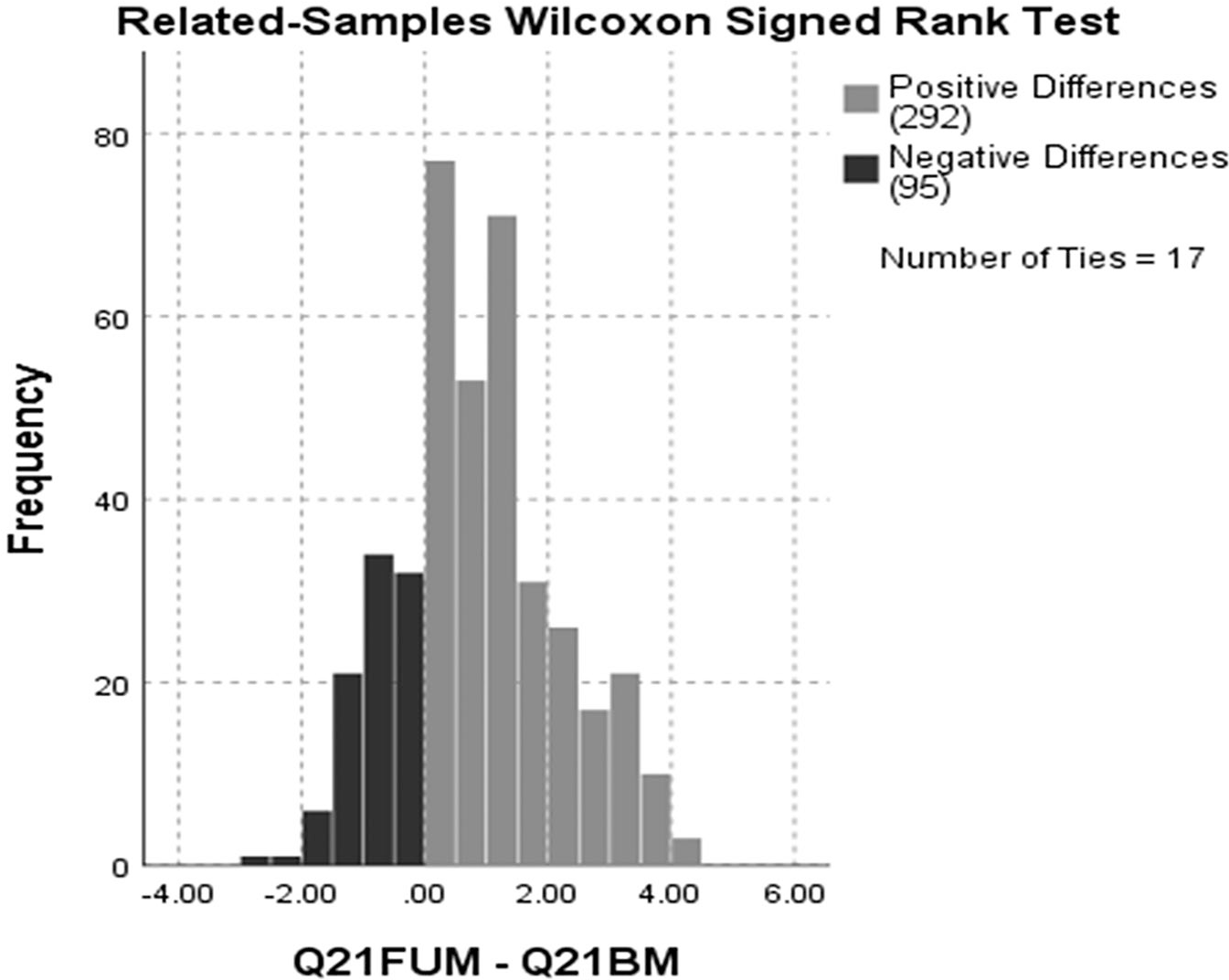
Results from related samples Wilcoxon signed-rank test—DVR.
Chi-Square Test
Youth employment rates were calculated by average unemployment insurance (UI) wage data using dates after PROMISE services ended in September 2018. Youth were divided into three categories based on their mean score difference on the SOC scale from baseline to follow-up. Youth with a decrease in score had an employment rate of 50%, youth with a small increase in score had an employment rate of 71%, and youth with a large increase in score had an employment rate of 94%. A chi-square test of independence performed on the data using the three categories of score change and employment after PROMISE was statistically significant, χ2(2, N = 109) = 13.65, p < .001.
Discussion
The results from this study reveal that youth, family, and counselor responses on the SOC scale significantly improved from the time of the baseline survey to the time of the follow-up survey. The SOC scale questions were designed to measure the youths’ feelings about work both before and after the program to examine if their attitudes had changed. The youths’ feelings about work and their work readiness significantly increased throughout the PROMISE program. The results from the counselor survey are consistent with the youth survey which reinforces the finding that youth’s feelings about work and work readiness improved significantly. These results are consistent with increased employment rates of PROMISE youth (Hartman et al., 2019). At enrollment, 2% were working, but these employment rates increased to 67% by the end of services. As readiness for work increased, so did employment rates. This was further tested using employment rates after PROMISE services ended, employment rates significantly increased for youth who had a large increase of scores on the SOC measures from baseline to follow-up compared to youth with a small increase or decrease in scores. Youth who had the largest increase in score were more likely to be working after services ended. Similarly, youth family members, typically a parent or guardian, also reported a significant increase in work readiness and improved perspective about their own work.
The PROMISE program implemented a series of interventions to help progress participants through the SOC to increase work readiness, increase work motivation, and achieve integrated paid employment. Through techniques such as MI and goal-building, to pre-employment services and trial-work experiences, the PROMISE interventions sought to build self-determination and self-efficacy to influence functional outcomes and employment goals. Self-determination interventions have been introduced as effective tools for encouraging people with disabilities to be active participants in all aspects of their treatment and rehabilitation program (Corrigan et al., 2012). A study conducted by Shogren and colleagues (2015) provided evidence that a student’s level of self-determination at the end of high school significantly predicts higher employment, career goals, and community access outcomes.
To guide participants through the SOC, PROMISE implemented interventions to help youth progress through the precontemplation, contemplation, and preparations stages into the action and maintenance stages. PROMISE DVR counselors were trained in MI techniques to implement during their client interactions. MI has been demonstrated to positively influence student’s self-efficacy, self-determination, employment outcome expectations, and employment outcomes (Britt et al., 2018). MI is especially useful in the early SOC, as it is integral for individuals to develop the skills, awareness, and motivation necessary to work toward eliminating ambivalence toward change.
Research has also shown that increasing an individual’s expectations can lead to better employment outcomes (Wagner et al., 2005). To help increase the expectations of both parents and youth participants and to support empowerment, PROMISE offered trainings specific to employment, work incentives benefits counseling, and financial capability. Work incentive benefits counseling helped youth and families navigate benefits while working using work incentives such as Student-Earned Income Exclusion and reduced fears regarding work impact on benefits (Schlegelmilch et al., 2019). “Make Your Money Talk,” a four-session personal finance program covering economic and financial education, was offered to help increase ownership and control over benefits and financial assets, which increased youth and family self-advocacy and self-determination, both of which are predictors of employment and postschool education (Test et al., 2009). Self-advocacy modules were also offered to teach participants the skills and knowledge needed to actively participate in their own treatment.
PROMISE VR counselors and family advocates used MI techniques and empowerment strategies to help move youth and families from ambivalence about work to readiness for employment. One of the empowerment strategies involved strength-based approaches focusing on the youth or family’s identified knowledge, skills, and interests and subsequently identifying job matches that aligned. Another strategy involved listening to youth and family goals, allowing the youth and family to lead their own plans and paths, and helping guide them through the process rather than telling them in what to do and how best to complete tasks. Counselors and family advocates also helped youth and families set smaller attainable goals and then continued to build on these successes. All strategies used were intended to foster development of the youth and family’s independence so that following the completion of PROMISE services, participants had the tools to gain and retain employment on their own.
Given the strong correlation between readiness to work and employment outcomes, VR counselors can improve guidance and counseling by better understanding readiness to work at the beginning of the VR process. Guidance and counseling will vary, depending which stage of change the individual presents at. If consumers are in precontemplation, VR counselors may first need to address fears or concerns. If consumers are contemplating employment, the VR counselor will benefit from discovering the individual’s motivation to work, using MI techniques, and capitalizing on these internal motivations to move the individual toward action. If the consumer comes to VR ready to work, counselors may be able to skip pre-employment services and start with job search and placement immediately. An SOC measure for youth transitioning into adulthood can help VR staff better identify which stage the individual is presenting at to align services, supports, and strategies that help improve work motivation, readiness, and employment outcomes. Including specific interventions such as MI, self-advocacy training, work-incentive benefits counseling, financial capability building, and job shadowing can assist youth in accomplishing smaller successes and increasing work motivation, ultimately leading to better employment outcomes.
Study Limitations
It is unknown regarding the exact extent to which the results are generalizable beyond youth receiving SSI. Youth and families who enrolled in PROMISE were considered more likely to engage in services and employment, as they self-selected into the program, so the generalizability of this study may be somewhat limited. In addition, not all youth who enrolled in PROMISE completed both the voluntary baseline and follow-up surveys, so it is possible that those who completed the baseline and follow-up surveys were more likely to be engaged in services and employment while in the program. The survey itself was a self-report, which creates a possibility of response bias, although the impact of that is diminished by the fact their assigned counselors rated the youth very similarly to the way the youth rated themselves on both the baseline and follow-up surveys.
Conclusion
This article helps to illustrate the importance of increasing motivation and self-determination for transition-age youth as a means to guide them through the SOC toward meaningful employment opportunities and financial self-sufficiency. The impact of using the SOC framework to help increase work motivation and work readiness can help to inform policy and practices for VR agencies and other programs aimed at supporting transition-age youth receiving SSI benefits in obtaining employment. It is recommended that future research in this area focus on how work motivation influences long-term employment outcomes and financial independence for transition-age youth and their families.
Footnotes
Acknowledgements
The views expressed herein do not necessarily represent the positions or policies of the Department of Education, the Wisconsin Department of Workforce Development, or their federal or state partners. No official endorsement by the U.S. Department of Education or the Wisconsin Department of Workforce Development of any product, commodity, service, or enterprise mentioned in this publication is intended or should be inferred.
Declaration of Conflicting Interests
The author(s) declared no potential conflicts of interest with respect to the research, authorship, and/or publication of this article.
Funding
The author(s) disclosed receipt of the following financial support for the research, authorship, and/or publication of this article: The contents of this paper were developed under a cooperative agreement with the U.S. Department of Education, Office of Special Education Programs, associated with PROMISE Award #H418P140002. Selete Avoke served as the project officer.