




Abstract
The purpose of the study is to investigate the barriers to and facilitators of job tenure among persons with disabilities (PWD), using the theory of work adjustment, which explains that the correspondence between person and environment predicts job satisfaction and consequently job tenure. This study utilized the ninth Panel Survey of Employment for the Disabled (PSED) data set compiled from 1,755 employees with disabilities in South Korea in 2016. The results show that education-level match and aptitude match are associated with job satisfaction, whereas the effect of job–skill match on job satisfaction was not significant. Job discrimination experience and accessible work facilities were significantly related to job satisfaction, which is a significant predictor of job tenure.
Persons with disabilities (PWD) experience greater unemployment than persons without disabilities (PWOD). In the United States, only 19.1% of PWD but 65.9% of PWOD were employed in 2018 (U.S. Bureau of Labor Statistics, 2019). In South Korea, 36.5% of PWD and 61.3% of PWOD were employed, in 2017 (Korea Employment Agency for the Disabled [KEAD], 2018). Furthermore, 59.4% of employed PWD in South Korea had temporary positions. The rate of temporary employment among PWD is almost double that of temporary employment among employed PWOD, which was 32.9%. Vocational rehabilitation services help PWD to obtain gainful employment and maintain independent lives (Poppen et al., 2017). Many studies have explored how PWD can successfully enter the workforce, but there is a lack of literature investigating how to best assist PWD to maintain their employment (Denny-Brown et al., 2015). Keeping employment is as important as obtaining employment (Rogers et al., 2006) and additional studies are needed to understand barriers to and facilitators of job retention and tenure for PWD.
Finding a job that matches one’s skill, education, or aptitude has been one of the keys to satisfying employment for employees. However, more job mismatch has been shown among PWD than PWOD, causing low job satisfaction for PWD (Chiocchio & Frigon, 2006; Fornes et al., 2008; Jones et al., 2014). Employees with disabilities often experience job mismatch due to the interaction of functional limitations and environmental and social barriers (Jones et al., 2014). Jones et al. found a significant gap in job satisfaction between PWD and PWOD, especially more when the disability limits the work functions of PWD. Although not all employees with disabilities need accommodations for accessibility to perform their job tasks successfully, accessible work environments can support more PWD in maintaining employment (Loprest, 2007).
Disability-related discrimination also decreases job satisfaction for employees with disabilities. Even with legislative supports such as Americans with Disabilities Act Amendments of 2008 (ADA AA), discrimination in the workplace remains prevalent, as evidenced by the large wage gap between PWD and PWOD globally (Jones et al., 2014). PWD earn less than PWOD, regardless of job and demographic characteristics such as job responsibilities and level of education (Kruse et al., 2018; Schur et al., 2009). This wage gap is not necessarily caused by the functional limitation of PWD; rather, it may stem from discriminatory practices such as employers who assign PWD less essential work responsibilities (Kruse et al., 2018). Regardless of cause, wage discrimination contributes to PWD’s dissatisfaction with work, as fair compensation is one of the key drivers of employee satisfaction. Attitudinal and social discrimination in their workplaces also contribute to PWD’s dissatisfaction with work and may discourage PWD from remaining in their jobs (Phillips et al., 2016). Schur et al. (2009) reported that (a) PWD generally report low job satisfaction, and (b) the job satisfaction gap between PWD and PWOD is greater when employees perceive a lack of fairness in the workplace, leading to lower job satisfaction and a higher likelihood of turnover among PWD.
Employment of PWD in South Korea
The definition of PWD in South Korea is “a person whose daily life or social activity is substantially hampered by physical or mental disability over a long period of time” (Act on Welfare of Persons with Disabilities, 2019, Article 2). The basic components of the definition are similar to the definition from the ADA AA of 2008. The South Korean government passed the Employment Promotion Act for People with Disabilities in 1990, which was succeeded by the Employment Promotion and Vocational Rehabilitation Act for People with Disabilities in 2004. Nearly 80% of persons with severe disabilities do not participate in economic activity in South Korea (KEAD, 2018). Of the employees with disabilities who are paid in South Korea, many are in part-time (31.9%) or low-skilled positions (38.6%), rates that are twice of those of employees without disabilities (KEAD, 2018). The average wage of PWD is 73.5% of that of PWOD (KEAD, 2018). Of the unemployed PWD in South Korea, 17.0% reported discrimination and stigma because of their disability and 28.8% reported direct and indirect workplace discrimination as a reason for the termination of their most recent employment (Y. H. Jeon & Choi, 2015). Less than one fourth (23.9%) indicated that they were provided with accessibility tools to complete the job tasks and only 22.5% worked at accessible facilities. Although the KEAD; Ministry for Health, Welfare, and Family Affairs; and Ministry of Employment and Labor have provided supports for workplace accessibility and developed policies against discrimination, PWD in South Korea experience substantial unmet employment needs (Oh et al., 2005).
Theory of Work Adjustment
The theory of work adjustment explains the vocational choices of an individual as an interactive process between a person and the environment (Dawis, 1996; Lofquist & Davis, 1991). It explains the relationship of a person to the environment, with the goal of predicting job retention (Dahling & Librizzi, 2015). Employees bring work personality, consisting of work skills, educational experiences, and work aptitude, to their workplaces, and they exchange their labor for financial compensation as well as a favorable working environment. Each employee has different workplace priorities, including compensation, preferable work environments, or professional development opportunities, among others, and continuously seeks to improve or maintain the correspondence between person and environment through an adjustment process (Dawis & Lofquist, 1984). In this model, job satisfaction indicates the extent of the correspondence between person and environment perceived by a given individual; this correspondence leads to greater job retention (Dawis, 1996; Lofquist & Davis, 1991). Satisfactoriness of the organization, on the contrary, indicates whether the employee meets the expectations from the organization, such as performance or a positive teamwork attitude. Cable and DeRue (2002) introduced two different types of person–environment correspondence: needs–supplies fit and abilities–demands fit. Needs–supplies fit refers to the match between the needs and values of the employee and the resources provided by the environment (job satisfaction) and abilities–demands fit refers to the match between an employee’s knowledge and skills and the demands of the job (satisfactoriness of the organization.
The theory of work adjustment has been applied to diverse populations (Dawis, 2005; Swanson & Schneider, 2013). Whereas many career development theories have limited implications for individuals with backgrounds different from those of the mainstream population, which is largely composed of White, male, middle-class, able-bodied, and heterosexual individuals (Blustein, 2013), the theory of work adjustment takes individuals’ contextual and cultural characteristics into account when examining the work adjustment process by considering the individuals’ diverse needs in the needs–supplies fit of the model. Recent studies using the theory of work adjustment have provided empirical support for the theory’s application among culturally diverse populations, including individuals with lower socioeconomic status (Lyons et al., 2014), African American individuals (Lyons & O’Brien, 2006), and persons with nonheterosexual orientations (Velez & Moradi, 2012). These studies included specific needs of minorities to their original model of person–environment match and examined its influence on job satisfaction and, consequently, on job tenure. When there is a lack of empirical studies directly addressing the work experiences of PWD (Snyder et al., 2010), the theory of work adjustment provides a useful framework for understanding the job satisfaction and job tenure of PWD who experience multiple forms of mismatch in the labor market and whose specific needs are not fully met in the labor market (Jones et al., 2014). Previous studies using the theory of work adjustment framework generally showed that job match and job satisfaction increase the length of job tenure among PWD (e.g., Chiocchio & Frigon, 2006; Fornes et al., 2008). However, these studies did not consider the disability-specific needs of PWD that may influence their needs–supplies fit, such as workplace discrimination and accessible work facilities.
There can be many different needs that PWD may seek from their employment, and two most urgent needs among them will be discussed in this study, namely, discriminative work environment and workplace accessibility. Employees with disabilities across different countries commonly face barriers related to work environment and accessibility that negatively affect job satisfaction and may increase turnover intentions (Madera et al., 2012; Redman & Snape, 2006; Schur et al., 2009). There are many reasons why discrimination against disability affects job satisfaction for PWD. Workplace discrimination against disability occurs in the form of marginalized work assignments, less compensation, and mistreatment, which are components in deciding one’s job satisfaction (Arvey et al., 1989). Social barriers, such as negative attitudes and beliefs about the disabilities of coworkers, keep PWD from performing their best (Stone & Colella, 1996). PWD are often assigned rather insignificant tasks and consequently receive fewer rewards than their coworkers, based on the bias that PWD experience lower productivity and higher rates of absenteeism than PWOD (Jammaers et al., 2016; Snyder et al., 2010). Supervisors hold lower expectation for PWD, based on stereotypes for their current and future job performance, leading to fewer promotional opportunities (Colella & Bruyere, 2011; Colella & Varma, 2001). PWD may also receive excessive positive feedback due to lower expectations, which they might view as ungenuine or patronizing (Colella & Bruyere, 2011). PWD are given fewer challenging job assignments or jobs with less autonomy than PWOD (Colella & Bruyere, 2011). Studies from the United Kingdom found that more PWD have jobs lower than their skill levels than do PWOD (Jones & Sloane, 2010). Stigma attached to disabilities such as mental disabilities inhibits employees with disability from full integration into the work environment (Cavanagh et al., 2017; Jammaers et al., 2016; Snyder et al., 2010). Biases toward PWD’s functional abilities contribute to greater gaps in job satisfaction and wages of PWD compared with PWOD.
Accessible facilities help to create a work environment in which the employees’ disability does not inhibit them from performing at their highest productivity levels. Accessible facilities encompass both features that promote physical accessibility, such as sidewalks or enlarged entrances for individuals using wheelchairs, and features that promote job completion, such as accessibility software. Assistive technology, such as specially designed keyboards and vehicles, is also considered part of accessible facilities. The costs for most accommodations are minimal and are generally not perceived as a main barrier to employment for PWD (Colella & Bruyere, 2011). Schur and colleagues (2014) found that employers do not worry about the costs of accommodations and, when they are supportive, accommodations can facilitate positive attitudes toward employees who requested them, showing that the corporate culture of granting accommodation requests may facilitate a work environment that is supportive for PWD. Accessible facilities at workplaces have been discussed as facilitators of employment of PWD, but there is a scarcity of studies focusing on their role in helping PWD sustain their employment (Nevala et al., 2015). According to Moore et al. (2011), having an accessible work environment leads to job satisfaction for PWD directly and also reduces discrimination in the workplaces for better job performance, which again contributes to job satisfaction.
This study applies the theory of work adjustment to understand facilitators of and barriers to job satisfaction and job tenure of PWD. Whereas the theory of work adjustment considers both sides of employment—employers and employees—in understanding job tenure, this study focuses on the employee’s job satisfaction to provide understanding to rehabilitation counselors who are assisting PWD to have satisfying employment. Job match is usually evaluated for satisfactoriness of employers for employees’ work performance in the theory of work adjustment; however, this study examines job match as evaluated by employees because working in an under-skilled or under-educated job mismatch is a salient issue for PWD, and these issues likely impact their job satisfaction (Jones et al., 2014; Jones & Sloane, 2010). Diverse forms of vocational rehabilitation services are provided to PWD, to facilitate job matches. The study will expand the literature on the job-keeping behavior of PWD, which provides more empirical evidence of the needs for vocational rehabilitation services and advocacy for PWD to sustain their employment.
Purpose of Study
The purpose of the study is to examine the facilitators of and barriers to job tenure among PWD, using the theory of work adjustment from the employee’s perspective to predict the outcome variables, job satisfaction, and, consequently, job tenure. Job match variables, including skill, education, and aptitude, will be used to predict the outcome variable, as well as disability-specific variables, including job discrimination and accessible work facilities as reviewed so far. The following research questions were developed based on the theory of work adjustment and the empirical studies discussed above in the disability study literature.
For RQ1, it was hypothesized that job match variables would be positively related to job satisfaction and, consequently, job tenure. For RQ2, it was hypothesized that job discrimination experience would be negatively related to job satisfaction and consequently job tenure, and that accessible work facilities will be positively related to job satisfaction and consequently job tenure.
Method
Sample
This study utilized the ninth Panel Survey of Employment for the Disabled (PSED) data set compiled by the Employment Development Institute (EDI) in South Korea. The EDI has conducted panel surveys every year since 2008 to track the economic activity status and labor market participation of PWD in South Korea. As there is a registration system for PWD in South Korea for social welfare purposes the target population was randomly recruited from among those ages 15 to 64 years who resided in South Korea as of May 15, 2016, and who have one or more disabilities, stratified with geographical residing area, disability type, severity of disability, and age, from the registered disability directory of the Ministry of Health and Welfare as of December 31, 2015. The ninth PSED was compiled in 2016 from the responses of 4,577 participants.
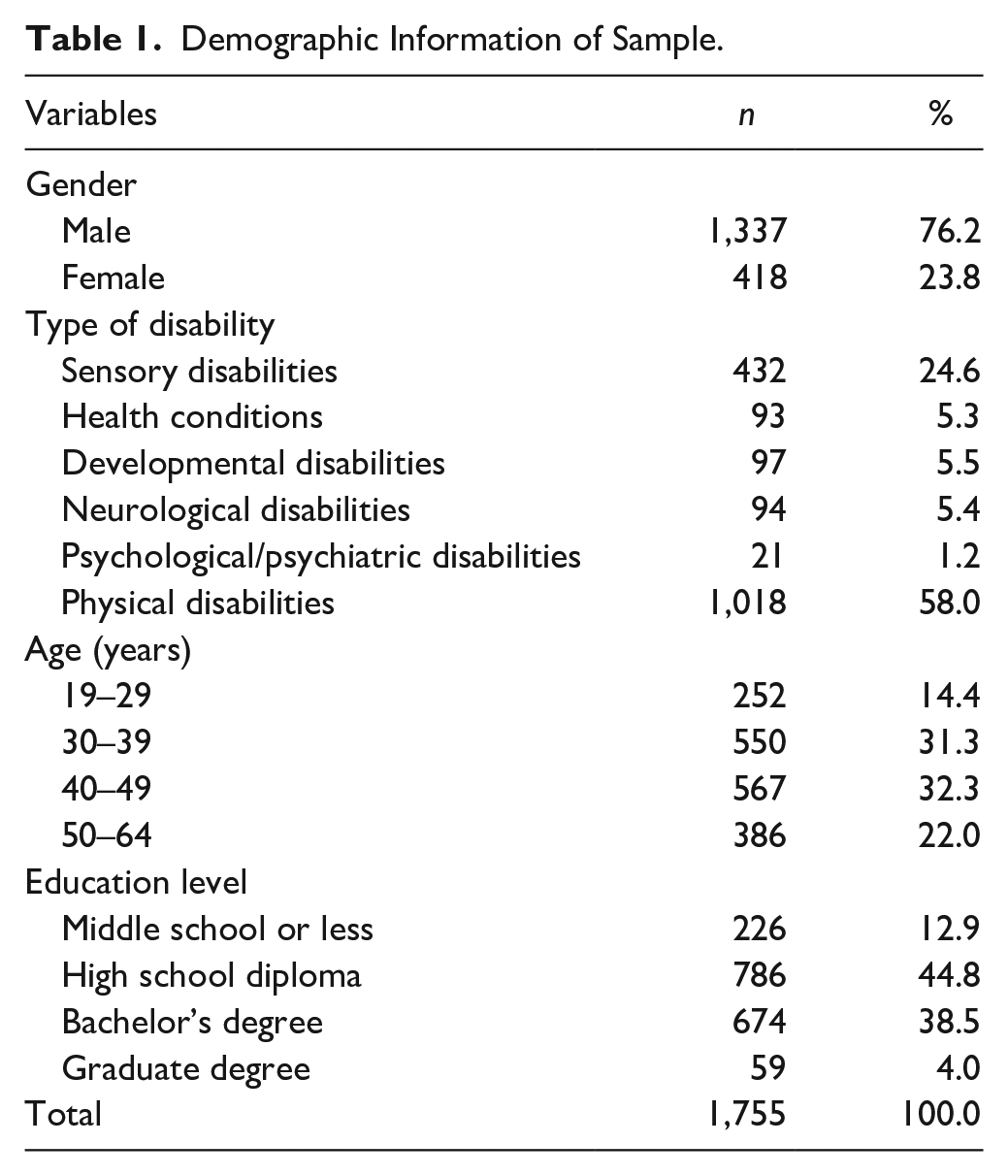
The ninth PSED data set was collected using five different questionnaires according to economic activity status (i.e., wage workers, self-employed, noneconomically productive population, nonpaid family employees, and the unemployed); in this analysis, we used the data for wage workers (1,763 participants). We excluded respondents below the age of 19 years from the analysis because full-time employment of Koreans below the age of 18 years is very rare. Working itself is rare for that population; most Koreans below the age of 18 years who work have short-term, part-time jobs, which is around 1% of the entire Korean population ages 15 to 19 years who work part-time (J. Y. Kim et al., 2017). This decision left us with 1,755 employees. The demographics of the respondents are presented in Table 1. Sensory disabilities include visual, hearing, and language-related disabilities; health conditions include digestive disorders, respiratory disorders, and so on; developmental disabilities include intellectual disabilities and autism spectrum disorder; and neurological disabilities include brain lesion and epilepsy. Psychological/psychiatric disabilities and physical disabilities are as they were from the survey.
Demographic Information of Sample.
Measures
Endogenous variable
The dependent variable, job tenure (M = 67.16 months; SD = 77.70), was measured as a continuous variable, using the month the individual reported beginning work at his or her current job: “Please fill when you start your current job (year and month)” in the PSED questionnaire.
Exogenous variables
Job match
Employees’ perceptions of the match to their job skill, education level, and aptitude were used to measure job match perception from employees. In the PSED questionnaire, job–skill match was measured with the item, “What do you think [about] the level of your current job compared to your skill level?” Education-level match was also measured with one item: “What do you think [about] the level of your current job (work) compared to your education level?” Job–skill match and education-level match were measured using a 5-point Likert-type scale, where 1 = very low level, 2 = somewhat low level, 3 = matched, 4 = somewhat high level, and 5 = very high level. Thereafter, the researchers recoded these items from PSED for this study to indicate the level of match as follows: The original responses 1 (very low level) and 5 (very high level), indicating the lowest level of match, were recoded as 1 (not matched at all) for the analysis in this study. Similarly, the original responses 2 (somewhat low level) and 4 (somewhat high level), indicating a mediocre level of match, were recoded as 2 (somewhat not matched). In addition, the original response 3 (matched) was recoded as 3 (well matched). In the recoded scale, higher scores mean that respondents’ levels of job and levels of skill (or levels of education) match better. Finally, aptitude match was also measured with one item: “Does your job match your aptitude?” Aptitude match was measured using a 4-point Likert-type scale ranging from 1 (not at all) to 4 (very matched).
Job discrimination experience
Discrimination experience was measured using a dichotomous variable. The item’s stem was “Have you ever experienced unreasonable discrimination in your job (workplace) in terms of recruitment, work, evaluation, wages, welfare, and benefits? Please tell us your experience of discrimination based on the following reasons.” The item was “I have been discriminated against because of my disability.” The item was coded as dummy variable, with “yes” coded as “1” and “no” coded as “0.”
Accessible work facilities
Accessibility refers to a “barrier-free and adapted (environment) to fulfill the needs of all people equally” (United Nations, 2004). This study measured the accessibility of working environments as the extent to which PWD’s workplaces included facilities for the PWD’s convenience. We used the item stem, “What disability facilities are installed at your workplace? Please tell us whether or not the facility is installed regardless of whether you used or not,” for five different items. The five items were as follows: (a) walkway (sidewalk) separate from road, (b) parking area for PWD, (c) installation of ramp or elimination of floor height difference, (d) level floors between spaces, and (e) toilets for PWD. Each item was coded as a dummy variable (where “installed” was coded as 1 and “uninstalled” was coded as 0) and the sum of the five items was used as the accessible facilities variable. The options do not comprehensively include accessibility needs of all types of disability but for the purposes of this study were used as a proxy of how much the workplace considers accessibility for employees with disabilities.
Job satisfaction
Eight items regarding job satisfaction were selected based on the Job Satisfaction Survey (Spector, 1985) from the PSED questionnaire. The item stem was “How satisfied are you with your job? Please tell me by item.” The eight items were as follows: (a) wage or income, (b) stability of employment, (c) contents of work, (d) working environment, (e) working hours, (f) personal development potential, (g) communication and human relations, and (h) welfare and benefits. Job satisfaction was measured using a 5-point Likert-type scale ranging from 1 (strongly unsatisfied) to 5 (strongly satisfied). The validity (factor loadings—Item 1 = .61, Item 2 = .69, Item 3 = .78, Item 4 = .77, Item 5 = .69, Item 6 = .76, Item 7 = .67, and Item 8 = .72)—and reliability (Cronbach’s α = .89) of job satisfaction met the recommended criteria (factor loading >.50; Cronbach’s α > .70). Satisfactoriness, which also contributes to job tenure, was not included in this study as the data were only collected for employees. There were also no items asking about job performance from the employee’s perspective in the data.
Control variables
Age (M = 41.50 years, SD = 77.70) was measured as a continuous variable and used as a control variable. Gender was used as a dummy variable: male was coded as 1, and female was coded as 0. Education was made up of two dummy variables: high school (high school graduation was coded as 1 and anything else was coded as 0) and undergraduate (university graduation or higher was coded as 1 and anything else was coded as 0).
Analysis
This study conducted structural equation modeling analysis to answer the two research questions in one model (see Figure 1). Only one variable—job satisfaction—was a latent variable in this study. Item parceling was adopted for job satisfaction to make our research model more parsimonious and to yield a lower sampling error (MacCallum et al., 1999). Thus, the eight items for job satisfaction were randomly combined into four parcels of two indicators each, according to the guidelines for parceling from Little et al. (2002). The data analysis was performed using IBM Amos 21.0.

Schematic representation of the hypothesized model.
Results
Descriptive Statistics and Correlation Analysis
The means, standard deviations, and correlations between study variables are presented in Table 2. In terms of person–environment match factors, all correlations were statistically significant at p < .01, with values ranging from .23 to .86. Regarding disability factors, the correlation between accessible facilities and discrimination experience was not significant. In terms of control variables, all correlations except for the correlation between gender and age and the correlation between gender and high school were statistically significant at p < .01, with values ranging from –.74 to .08.
Descriptive Analysis and Correlations.
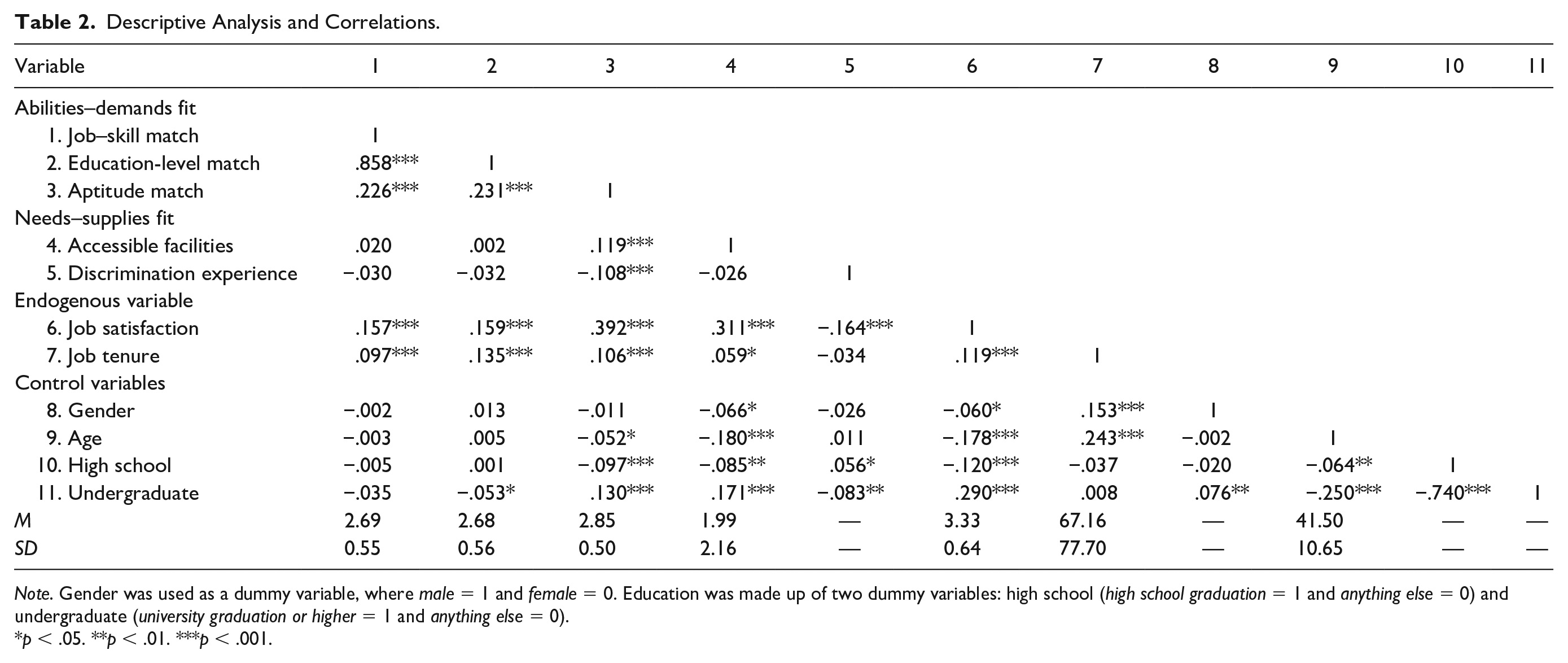
Note. Gender was used as a dummy variable, where male = 1 and female = 0. Education was made up of two dummy variables: high school (high school graduation = 1 and anything else = 0) and undergraduate (university graduation or higher = 1 and anything else = 0).
p < .05. **p < .01. ***p < .001.
Structural Equation Modeling Analysis
Prior to testing the hypothesized model, we analyzed the fitness of the model. This study used the comparative fit index (CFI ≥ .95), Tucker–Lewis index (TLI ≥ .95), root mean square error of approximation (RMSEA <.06), and standardized root mean square residual (SRMR <.08) to perform this analysis, as suggested by Hu and Bentler (1999). The results indicate that the data adequately fit the model (χ2 = 128.27, df = 37, p < .001, TLI = .97, CFI = .98, RMSEA = .04, SRMR = .02).
Table 3 and Figure 1 show the results of our structural equation modeling analysis. In terms of job match variables (RQ1), the effect of job–skill match on job satisfaction was not significant. The effect of education-level match on job satisfaction was positively significant (β = .08, p < .05). The effect of aptitude match on job satisfaction was also positively significant (β = .32, p < .001). Regarding disability-specific needs variables (RQ2), the effect of discrimination experience on job satisfaction was negatively significant (β = –.13, p < .001). The effect of accessible facilities on job satisfaction was positively significant (β = .24, p < .001). Finally, the effect of job satisfaction on job tenure was positively significant (β = .22, p < .001).
Results of Structural Equation Modeling Analysis.

p < .05. **p < .01. ***p < .001.
In addition, the indirect effect of job satisfaction was also tested. Table 4 shows the results of mediating effects and bootstrapping. The indirect effect of job satisfaction between job–skill match and job tenure was not significant at the alpha level .05 with the bias-corrected bootstrap of 1,000 resamples. The indirect effects of job satisfaction between education-level match and job tenure (γ = .02, p < .05) and between aptitude match and job tenure (γ = .07, p < .001) were positively significant. The indirect effect of job satisfaction between discrimination experience and job tenure was negatively significant (γ = –.03, p < .001). Finally, the indirect effect of job satisfaction between accessible facilities and job tenure was positively significant (γ = .05, p < .001).
Results of Indirect Effects and Bootstrapping.
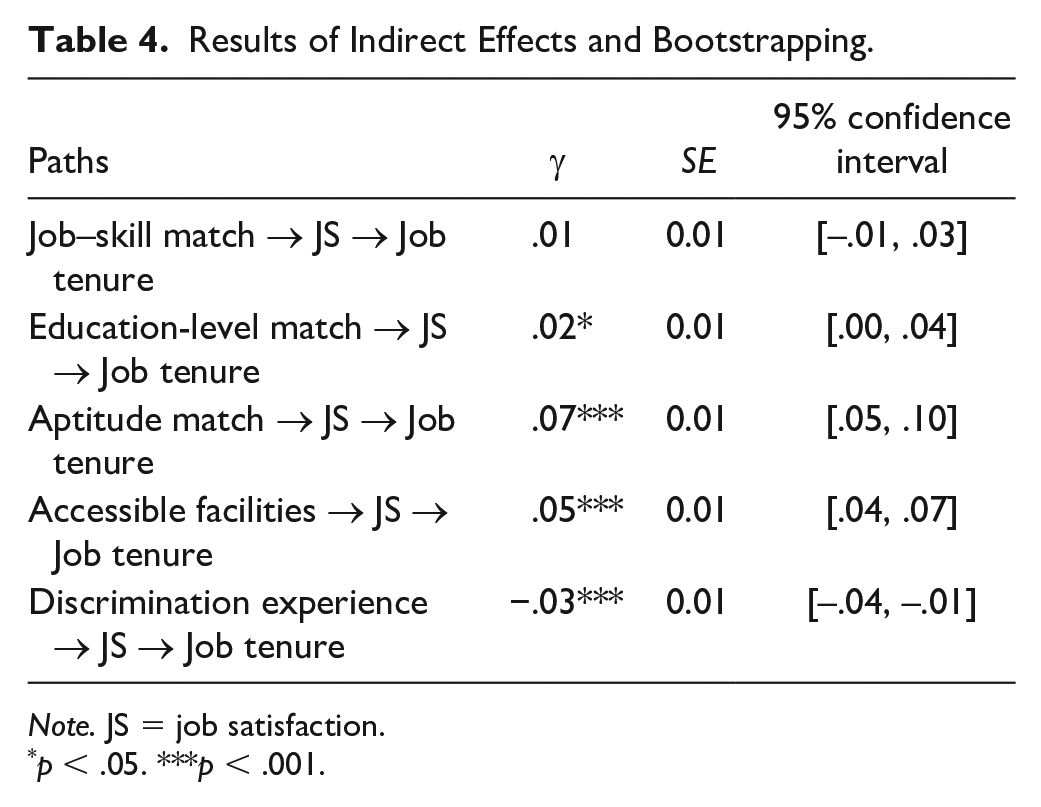
Note. JS = job satisfaction.
p < .05. ***p < .001.
Discussion
This study examined the facilitators of and barriers to job satisfaction and consequently job tenure of PWD using the theory of work adjustment. Specifically, we hypothesized that job match variables (job skill, education level, and aptitude match: RQ1) and disability-specific needs (accessible work facilities and job discrimination: RQ2) would explain job satisfaction and, consequently, job tenure of PWD. Our results supported the mediating effects of both variables and job tenure, except for the job–skill match. The findings corroborate those of other studies using the theory of work adjustment that has shown the impact of the person–environment match in the general population (Dahling & Librizzi, 2015) and in diverse populations, with cultural and contextual variables explaining their special needs (Lyons et al., 2014; Lyons & O’Brien, 2006; Velez & Moradi, 2012).
Regarding RQ1, job–skill match was not significantly related to job satisfaction or to job tenure of PWD when considered alongside the other variables. Saks and Ashforth (1997) measured the person–environment match using one instrument; therefore, the evidence for different fit indices in the literature is scarce. Job–skill match is still important and may play a critical role in entering the workforce (Allen & Van der Velden, 2001), but it was not significant in terms of job satisfaction and tenure in this study. The difference between skill match and aptitude match is whether the ability to perform a job is earned or comes naturally. In this study, only job aptitude match was significantly associated with job satisfaction and tenure, suggesting that in terms of job match, natural suitability for a job may be more important than earned skills. This supports the benefit of actively using interest or aptitude instruments to help ensure the long-term employment of PWD. Job education-level matches showed a significant relationship to job satisfaction and job tenure. Education-level fit reflects job status or compensation-level match. Usually, persons with higher levels of education expect higher wages and better work environments (Kong et al., 2015), and the findings of our study show that education-level match is also critical to PWD. Recent studies have reported lower levels of hope in employment among PWD with higher levels of education due to the PWD’s anticipated lack of fulfillment of their expectations in the labor market (Waynor et al., 2012). It needs to be considered in employment support programs for PWD that the level of hope can be marginalized among PWD with a high education.
Regarding RQ2, the presence of accessible work facilities generally was found to be a facilitator of job satisfaction and job tenure although the respondents to the questionnaire were only asked about facilities related to wheelchair access, rather than the respondents’ specific needs. The questions may have reflected an overall disability-friendly work environment or the existence of other accessible facilities. Job discrimination, on the contrary, was found to be a barrier to employees’ retention of their jobs, which is in line with the findings of previous studies (e.g., Kennedy & Olney, 2001; Villotti et al., 2018). These two disability-specific variables were found to be significant in explaining PWD’s retention of their jobs with other key match variables.
Overall, the studied model demonstrates that the theory of work adjustment can help explain the job satisfaction of diverse populations, including PWD. This study also shows that population-specific needs variables should be considered in the study model. With the exception of job–skill matches, traditional job match variables contributed to predicting job satisfaction for employees. This suggests that job–skill matches may not be as important as other variables for promoting employee satisfaction.
Implications for Future Research
The findings of this study contribute to scholars’ understanding of the variables that impact the job retention of employees with disability and suggest the importance of considering disability-specific needs of the PWD population. The study supports the applicability of the theory of work adjustment to PWD, which is shown here to be a good model fit. More specifically, it shows that the theory of work adjustment can augment current career theories’ limited implications for minorities by considering disability-specific needs in their corresponding study models. Although job match has been traditionally considered in job placement of PWD widely, specific needs of PWD tend to be ignored when they seek employment as they already face restricted opportunities in the labor market due to a lack of environmental support and institutional barriers because of their disability (Laditka & Laditka, 2016). However, the job retention of PWD can be explained using the theory of work adjustment, suggesting that job satisfaction is, of course, critical for PWD’s job retention.
Practical Implications
The findings suggest that disability-related factors are as important as the factors suggested by job matches. Career interventions for PWD can include more aspects of population-specific needs, focusing on the individuals’ disability-related special needs. This finding has implications for employment interventions for PWD. Aptitude should be actively integrated into the career support of PWD for better job retention; this support should include ongoing counseling services after workforce entry so that PWD can find the best fits for their particular aptitudes. The work environment should also be designed to fit PWD’s disability needs best; this means creating physically accessible work facilities, providing needed accommodations for various disability types, and promoting a nondiscriminative work environment. These supports can be designed through a collaboration between vocational rehabilitation counselors and human resource development (HRD) personnel as one of HRD personnel’s goals is the job retention and psychological well-being of their companies’ employees (Luthans, 2012).
Bierema (2010) analyzed more than 600 research papers related to diversity in the field of HRD and found that the discussions of disability in the HRD field were limited or insufficient when compared with other factors, such as gender and race. For HRD practitioners, this study suggests that it is necessary to develop mentoring, training, and educational programs, as well as career development opportunities that consider person–environment fit to increase job satisfaction and job tenure of the employees with a disability (McDowall-Long, 2004). Collaboration between vocational rehabilitation counselors assisting PWD and HRD personnel would be beneficial in finding the best person–environment match (Procknow & Rocco, 2016). Diversity training also can be orchestrated by a collaboration between vocational rehabilitation counselors and HRD personnel to address social and environmental barriers. Diversity training in the workplace helps increase acceptance and tolerance and reduces prejudice and stereotypes for employees with disabilities (see Boyle, 1997). Diversity training in an organization can help to change the perceptions of PWD and can be a starting point for the installation and expansion of accessible facilities, along with the elimination of discrimination, in the workplace.
Limitations
This study utilized data from South Korea, where the legislation regarding employment of PWD is, of course, different from that of the United States. PWD in South Korea may face more challenges than PWD in the United States in terms of accessible work facilities, as these facilities have been comparatively recently introduced in South Korea (Y. Kim et al., 2014). The workforce participation rate of PWD in South Korea is lower than in the United States (Social Security Information Service, 2016). The definition of disability is also narrower and focused on visible disabilities, with a low diagnosis rate of psychological conditions (H. J. Jeon et al., 2014). There may be fewer legal safety nets for PWD facing potential layoffs due to a lack of a similar law as that of the United States. Therefore, job tenure, as measured in this study, may reflect more layoffs than occurs in the United States. In addition, different social welfare systems should be considered as they affect individuals’ work-related behavior (Burkhauser & Turner, 1978). Interpreting and applying the findings of this study would require acknowledging these differences. The data for this study were collected at the national level, providing a good representation of the population of employees with disabilities in South Korea, with a smaller sampling bias expected. However, the replication of this study is needed using a sample of PWD in the United States.
Second, physically accessible facilities were only measured in this study in terms of (a) walkway (sidewalk) separate from the road, (b) parking area for PWD, (c) installation of ramp or removal of floor height difference, (d) door without height (level difference), and (e) toilets for PWD. Persons with different types of disabilities required different accessible facilities, and the provided options were neither comprehensive nor targeted to the disability types of respondents. The item does, however, provide a good index of whether the respondents’ work environments offered accessible facilities for disability in general. A broader and more targeted range of accessibility facilities can be included in future studies, as well as broader concepts of work accommodations such as a flexible work schedule and job modification.
Third, many factors were measured by one item, including job match variables and discrimination against individuals with disabilities. Job match can be asked with the instrument developed for the theory of work adjustment (Rounds et al., 1987) in future studies. Multiple aspects of employment (recruitment, work, evaluation, wages, welfare, and benefits) were included in a single question; they need to be asked separately. As there are many instruments that measure workplace discrimination against PWD, future studies can adopt one of them to measure the discrimination experience of PWD more comprehensively. There was also a high correlation between job–skill match and education-level match, which may imply that education-level match suppressed the effect of job–skill match. However, we did not combine the two because they are different variables. It might show a different outcome when the two variables are measured as constructs from multiple items. In addition, all items were self-reported, which can embed bias.
Fourth, the employer’s contribution to the theory of work adjustment was not included in the studied model due to the use of secondary data. The employer responses were not linked to the survey; therefore, satisfactoriness from employers were not included in the model. The findings only suggest the match from the perception of employees, which can be subjective and sometimes favorable to employees. Employees’ job satisfaction is not the only factor that affects job tenure, and employers’ job satisfactoriness was ignored in this study due to the limitations of the data used. The results might be different if the employer’s input is included. Future studies can be conducted by linking the employer’s responses for satisfactoriness.
Finally, the study uses cross-sectional data; therefore, the result may be biased due to the responders who had shorter job tenure at the point of the survey. Among participants, 14.4% were younger than 30 years of age, and many of them did not have a long tenure regardless of their status in job match variables or disability-specific factors. Many other factors influence job tenure, such as industries where the turnover rate is higher in general. For example, accommodation, food services, or retail have higher turnover rates than manufacturing or education sectors.
Conclusion
Job satisfaction and tenure are as important as initial job placement to increase employment rates for PWD. This study analyzed PSED data from South Korea and suggests that disability-related aspects of employment are strongly associated with job satisfaction, whereas job–skill match was not significantly associated with job satisfaction when controlling for job–skill match, education-level match, and aptitude match. The study supports the idea that rehabilitation counselors should consider population-specific needs variables, the variables specific to the context and culture of PWD, to increase job satisfaction and job tenure.
Footnotes
Declaration of Conflicting Interests
The author(s) declared no potential conflicts of interest with respect to the research, authorship, and/or publication of this article.
Funding
This work was supported by the research fund of Hanyang University (HY-2020). The findings and interpretation of the data expressed in the article do not necessarily represent the views of Hanyang University but are the sole responsibility of the authors.
