




Abstract
Workplace mistreatment is common for workers with and without disabilities. Overt forms of mistreatment in the workplace (e.g., abuse, bullying, harassment) have been well studied; however, less is known about more subtle forms of workplace mistreatment for employees with disabilities. The purpose of this study was to examine how workers with disabilities are treated on the job, the types of mistreatment present in the workplace, the consequences involved (if any), the courses of action taken (if any), and workers’ satisfaction with the outcomes of actions taken. We used a grounded theory approach to learn from 26 employees with disabilities about their experiences with workplace treatment. Primary themes that emerged from the data were (a) the emotional toll of being mistreated on the job; (b) attempting to “grin and bear it,” as one participant described it, to avoid mistreatment; (c) a desire to feel a sense of belongingness at the workplace; and (d) the intersection of disability characteristics, individual characteristics, and work environment characteristics that influences how people with disabilities are treated on the job. Implications are presented for understanding the role that rehabilitation counselors play in helping workers and employers to respond to mistreatment of employees with disabilities.
Workplace mistreatment is defined as intimidating, mean-spirited, manipulative abuse that is repetitive and targeted at employees perceived as less powerful (Lutgen-Sandvik, 2003). This treatment is unwelcome, unsolicited, and ubiquitous (i.e., 90% of employees have reported experiencing mistreatment in the workplace; Olson-Buchanan & Boswell, 2008). It causes emotional harm and, if directed at employees with disabilities, could exacerbate their symptoms, increase their functional limitations, undermine their job satisfaction, and contribute to the onset of co-occurring disabling conditions (Koch & Rumrill, 2017). Three different types of workplace mistreatment that have been investigated by rehabilitation and organizational psychology researchers are discrimination under Title I of the Americans with Disabilities Act (ADA), workplace incivility, and microaggressions. Conversely, researchers have investigated what it means for people with disabilities to be treated fairly and with dignity at their worksites. In particular, growing attention has focused on characteristics of disability-inclusive workplaces.
Disability Discrimination
Overt discrimination against workers with disabilities is a form of workplace mistreatment that has been extensively investigated by rehabilitation researchers (e.g., Bruyère et al., 2010; McMahon & McMahon, 2016; Snyder et al., 2010). It is interesting to note that most workplace discrimination allegations filed by workers with disabilities are related to job retention rather than job acquisition. In fact, McMahon and McMahon (2016) discovered that 76% of all allegations fall in the areas of discharge/constructive discharge, failure to reasonably accommodate, terms and conditions of employment, disability harassment/intimidation, and hiring. Except for hiring, all of these allegations constitute workplace mistreatment. Also, of note is McMahon and McMahon’s (2016) finding that merit resolutions which favor charging parties (i.e., people with disabilities) only occur in 23.4% of all closures.
Workplace Incivility
A more subtle, yet insidious form of on-the-job mistreatment is workplace incivility, which is defined as “low intensity deviant behavior with ambiguous intent to harm the target [that is in] violation of workplace norms for mutual respect” (Andersson & Pearson, 1999, p. 457). Examples of workplace incivility include rude/discourteous behaviors, use of condescending tones, interrupting others when they are talking, ignoring or failing to speak to a co-worker, yelling or swearing at others, and making jokes at the target’s expense (Cortina & Magley, 2009). Kabat-Farr and Cortina (2012) noted that employees of color and women report experiencing more incivility in the workplace than White males. Disturbingly, researchers have also discovered that workplace incivility can have even more deleterious effects on targets relative to other more overt forms of discrimination and harassment. These effects include psychological distress, job stress, cognitive distraction, reduced job satisfaction, reduced creativity, negative health consequences, and departure from employment (Cortina et al., 2001; Rosen et al., 2016). Although no research to our knowledge has examined workplace incivility experienced by people with disabilities, it is anticipated that because so many workers have had these experiences, especially those from marginalized populations, workers with disabilities are highly likely to experience workplace incivility as well.
Microaggressions
Like workplace incivility, microaggressions based on disability and other characteristics (e.g., race, gender, sexual orientation, age) are also problematic and ubiquitous forms of workplace mistreatment. Sue et al. (2007) defined racial microaggressions as “brief and commonplace daily verbal, behavioral, or environmental indignities, whether intentional or unintentional, that communicate hostile, derogatory, or negative racial slights and insults toward people of color” (p. 271). Microaggressions are also commonplace for individuals with disabilities (Gonzales et al., 2015; Keller & Galgay, 2010; Olkin et al., 2019), especially those with stigmatizing conditions such as mental illness and hidden disabilities (Koch & Rumrill, 2017). For example, Gonzales et al. (2015) conducted focus groups on microaggressions experienced by adults and college students with psychiatric disabilities. The major themes that evolved from their focus groups included invalidation, assumptions of inferiority, fear of mental illness, shaming of mental illness, and second-class citizenship. In another study, Olkin et al. (2019) investigated the experiences of microaggressions against women with obvious and hidden disabilities. Women in their investigation reported experiencing disability-related microaggressions such as downplaying the effects of their disabling conditions on their lives, ignoring everything about them except their disability, denying their rights to equality, treating them like children, treating them as if they are helpless, desexualizing them, discounting that they have a disability based on the fact that they look healthy or young, and delaying of diagnoses. Although these investigations were focused on microaggressions, in general, and not workplace microaggressions specifically, individuals who experienced microaggressions reported that they occurred in all areas of their lives. Over time, the accumulation of recurring microaggressions can lead to mental health problems (e.g., anxiety, depression, and trauma) as well as isolation, treatment nonadherence, and social withdrawal for those with psychiatric disabilities (Gonzales et al., 2015; Olkin et al., 2019).
Workplace Inclusion
Even though workplace mistreatment is a common experience, employers are increasingly focused on creating inclusive workplace climates in which employees view the organization’s policies and practices to be fair (McKay et al., 2007) and promoting inclusive behavior of all employees, regardless of age, gender, race/ethnicity, disability, or social group (Nishii, 2013). Inclusive workplace climates are viewed as actively promoting full participation from all organizational members (Roberson et al., 2017) and encouraging employees to express their authentic identities (Ramarajan, 2009). These climates are also viewed by employees as transparent and open to their shared expertise and opinions in both formal and informal work contexts (Mor Barak, 2016) without fear of retribution, unwanted attention, or negative consequences (Kulkarni & Valk, 2010). In these types of climates, workplace mistreatment is not tolerated. Inclusive work environments build trust and remove barriers that would inhibit social interaction with dissimilar others (Zhu et al., 2019).
In a systematic review of employer practices that indicate a commitment to hiring and retaining workers with disabilities, Lindsay et al. (2018) found that employees with disabilities benefit from inclusive practices by experiencing an improved quality of life, greater income, enhanced self-esteem, an expanded social network, and a sense of community. Arguably, employers, benefit even more with increased profits, reductions in turnover, employee loyalty, improved company image, a more diverse customer base, increased customer loyalty and satisfaction, more creativity and innovation, increased productivity, and greater disability awareness among all employees.
Purpose of the Research
Given the predominance of workplace mistreatment in contemporary society, as well as the trend toward establishing more inclusive work environments by employers, the purpose of this article is to summarize the findings from an investigation of how workers with disabilities perceive the way they are treated on the job. Data used in this study were derived from interviews used in other investigations conducted with the same 26 employees who participated in this study. We used a grounded theory approach to investigate four research questions:
How are employees with disabilities treated on the job?
What types of mistreatment, if any, do employees with disabilities experience on the job?
What are the consequences of being mistreated on the job?
For those who report mistreatment, what, if any, courses of action do employers take and how satisfied are employees with disabilities with the outcomes of these actions?
Method
We chose a grounded theory approach to study on-the-job treatment of employees with disabilities because this approach is methodologically aligned with our research purpose. In grounded theory, as in our investigation, researchers do not begin with a theory to test; rather, they begin with an area of interest, gather relevant data from research participants, and develop a final product in the form of a theory or set of propositions grounded in the “lived experiences” of research participants (Niesz et al., 2020).
Researcher Reflexivity
In contemporary qualitative research, many investigators reject the notion that complete objectivity is possible and instead reflect upon how their assumptions, a priori theories, and biases can shape what data they collect and how they analyze and interpret these data (Niesz et al., 2020). Following in the footsteps of these researchers, we do the same here and report to readers our own assumptions, a priori theories, and biases as well as how we attempted to manage these.
Our research team consisted of two investigators in rehabilitation counseling, one investigator in communication sciences and disorders, and four investigators in organizational behavior and human resources. Among the research team, two of us have disabilities and have experienced varied positive and negative workplace treatment during our careers. In addition, one member of the research team is the spouse of a person with a disability.
The first author has “lived experience” with the phenomenon being studied. She also has learned about workplace treatment from former clients when she practiced as a vocational rehabilitation (VR) counselor and from individuals with disabilities in qualitative research studies she has conducted. Based on these experiences, she entered the study anticipating that our findings would lean predominantly toward insidious mistreatment rather than positive treatment or overt discrimination.
The second author conducted her dissertation research using a grounded theory approach to study the experiences of adults with cochlear implants in auditory rehabilitation. Her clinical and research experience have led her to believe that there would be a mixture of both positive and negative experiences in the participants’ narratives. She entered the study with expectations of some negative narratives and some positive narratives from participants, but she was not sure which way the pendulum might swing in terms of the number of accounts of each.
The third author is a former secondary education teacher, and at the time of the study was a doctoral student in organizational behavior, conducting her dissertation research on social interaction patterns of people with disabilities in the workplace. She began working with the rest of the research team while we were in the process of coding the interviews and was involved in completing the coding, analysis, and interpretation. She expected that there would be some participants who had negative experiences in the workplace just as she would with any sample because not everyone has positive work experiences. The fourth author was also a doctoral student in organizational behavior and has research interests in business management and marketing. This was the first study he has conducted with people with disabilities. Thus, he entered it with few expectations regarding what we would discover.
The other members of the interdisciplinary team included a rehabilitation researcher who has extensively studied workplace discrimination, especially as experienced by individuals with autoimmune disorders. His presumptions included the belief that mistreatment of people with disabilities in the workplace persists, and it is becoming more subtle. More explicitly, he entered the study believing that (a) the most egregious and blatant acts of harassment and intimidation are not as common as they used to be; (b) people with invisible or less obvious conditions are more highly stigmatized and, therefore, subjected to worse treatment in the workplace than are people whose disabilities are obvious; and (c) employers are not especially motivated to improve workplace culture to make people with disabilities feel included and welcome. The final two authors conduct research on different forms of mistreatment (e.g., abusive supervision, incivility) in the workplace, in general, rather than specifically as it relates to employees with disabilities. They both suspected that responses would be nuanced and complex, often not involving legal complaints. They anticipated that, instead, participants would use an array of coping strategies that depended on the context of the mistreatment. Along with the fifth author, these research team members served as critical peers and met with the first four authors two to three times a semester to discuss emerging codes, patterns, and themes; critique findings; and provide advice on how to proceed with the study. They also applied their own professional lenses to the interpretation of our data and implications of the findings for employees with disabilities, employers, and rehabilitation counselors.
The four researchers involved in conducting the interviews and coding and analyzing data were very rigorous in their process to (a) position themselves as learners rather than experts and follow the lead of participants rather than directing them what to talk about and (b) only code what was said and not what might have been implied. We also pointed out to each other when our analyses and interpretations appeared to reflect our own personal preconceptions and biases rather than the responses of participants. In addition, three of the four research team members were involved in each coding and data analysis meeting. Two of the researchers would code and analyze each transcript, and the third researcher would assist us in addressing discrepancies in our coding and analyses. We would then discuss our discrepancies, with input from the third person, until all three of us reached consensus.
Sampling
We used a convenience sampling approach to recruit research participants (Patton, 2001). In an attempt to recruit a heterogeneous group of participants who had a range of disabilities, diverse demographic characteristics, and were employed in a variety of occupations, we used multiple techniques for recruitment. We began by reaching out to our personal contacts; used snowball sampling, a qualitative technique that engages research participants in assisting us to recruit additional participants; and hand delivered or emailed an Institutional Review Board (IRB)-certified recruitment flyer to various organization that indicated our intent to study the work experiences of person with chronic health conditions and disabilities. These organizations included our campus Center for Educational Access, a satellite office of the state–federal VR program, the university’s speech and hearing clinic, an outpatient physical therapy office, a rheumatologist’s office, a non-profit rehabilitation agency that provides employment-related services to people with disabilities, and a community-independent living center. To be included in the study, participants were required to have a self-reported disability or chronic illness and to be currently employed, either part-time or full-time.
Participants
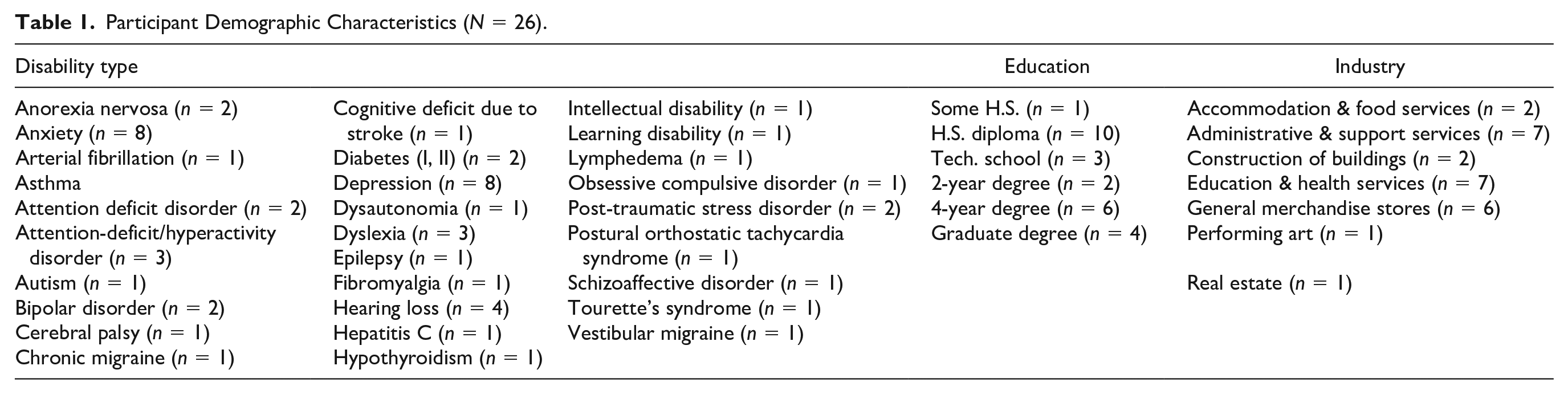
Table 1 lists participants’ disabling conditions, educational background, and industries in which they were employed. Readers are referred to Glade et al. (2020) for the specific occupations of the research participants. More than half of the 26 participants reported multiple disabilities (i.e., two or more). Half of the participants had psychiatric disabilities, and all but one had invisible disabilities. However, some of these invisible disabilities became apparent when individuals were symptomatic (e.g., panic attacks, seizures) on the job. Of the participants, 19 were female. Participants ranged in age from 18 to 24 (n = 10), 25 to 30 (n = 1), 31 to 40 (n = 5), 41 to 50 (n = 5), 51 to 60 (n = 1), and 61 and older (n = 4). The sample included 19 Caucasians, 6 African Americans, and 1 participant who reported being multiracial (Latinx, Native American, and Alaskan Native). The duration of reported employment among participants ranged from 2 months to 51 years (M = 7, SD = 11.76). Participants reported holding hourly (n = 1), full-time (n = 7), part-time (n = 13), and self-employed positions (n = 5). Of the participants, eight participants were employed in entry-level jobs (i.e., positions that generally require no degree and no supervisory responsibilities). Seven were employed in mid-level employment jobs (i.e., positions may require associate degree/technical training or higher and intermediate skills with some supervisory responsibilities). Ten were employed in professional-level jobs (i.e., highly skilled positions), and one was in employed in upper-level management as a business owner. For participants who listed more than one job, the position categorized at the highest level was used to determine employment level.
Participant Demographic Characteristics (N = 26).
Data Collection Procedures
We used data sources that included a demographic questionnaire, individual interviews with participants, researcher memos, and meeting minutes. Before beginning the data collection process, we obtained approval from our university’s IRB to conduct our study. After signing a consent form and prior to the interviews, participants filled out a demographic questionnaire. The first author conducted 5 of the interviews, the second author conducted 10, and the fourth author conducted 12. We determined that data saturation was achieved after interviewing 26 participants because we believed we had a sufficient number of participants as specified in the grounded theory methodological literature, no new codes or themes emerged from the interviews, and we had a solid representation of responses that supported each of our themes.
As a research team, we developed a semi-structured interview protocol to collect data. The overarching interview question for this study was “We are interested in learning about how employees with disabilities are treated on the job. Please describe how you are treated at your job.” The interview protocol included two additional questions specific to this investigation: (a) “Do you think there is anything about your condition that influences the way people treat you on the job” and (b) “Is there anything else you would like to share about your experiences?” We also used probes and follow-up questions to gain a deeper understanding of the participants’ perspectives.
With consent from participants, we audio-recorded each interview. All audio recordings were transcribed verbatim by a professional transcriptionist or graduate assistant. The interviews lasted from 45 min to 1.5 hr, with the average interview lasting 1 hr. To conceal the identities of participants, we used pseudonyms to label each interview. Upon completion of the interviews, participants were each paid $40.00. Consistent with the IRB protocol, we kept all files securely stored.
Data Analysis Procedures
We followed Pandit’s (1996) recommendations for analyzing the data using the grounded theory strategies of open, axial, and selective coding. Readers are referred to Glade et al. (2020) for an in-depth description of specific steps we took in each phase of the data analysis process. Two investigators who independently coded interview data met with a third research team member once a week until all data were analyzed. The third researcher helped resolve discrepancies in coding.
We relied heavily on the constant comparative method to analyze our data. Throughout the open, axial, and selective coding processes, we wrote memos summarizing in the margins of the transcripts or on separate pieces of paper what appeared to be the most salient responses emerging from the participants’ stories as well as categories, patterns, and potential themes that were emerging across participants. We took care to repeatedly return to previous transcripts throughout our analyses to check for consistency and identify discrepancies in our emergent findings. We also wrote memos about our collective thoughts during our coding meetings and made lists of quotes, both in our independent transcript analyses and as a team, that were exemplars of the themes that evolved in our analyses. We kept an audit trail of our memos and posted them in a Google Docs file that was only accessible to the research team. We also took minutes during or immediately following each coding and data analysis meeting as well as during each meeting of the entire research team. These too were posted in a Google Docs file.
Trustworthiness
As recommended by Morrow (2005), we used strategies associated with grounded theory research to enhance the trustworthiness of our findings. First, we conducted member checks by emailing transcribed interviews to each participant and requesting additions or changes as they saw necessary. None of the participants responded with any recommended changes or additions. In our identification of codes and themes, we frequently returned to our transcripts to look for discrepant data and to determine whether these were, indeed, representative of the participants’ experiences. Once we wrote up the “Research Findings” section of this article, we emailed it to 12 participants who indicated a desire in their interviews to review our findings and invited them to comment on, add to, or challenge our findings. We received only one response indicating that our findings appeared to be accurate. As previously mentioned, we also kept an audit trail consisting of a written detailed record of what occurred during each meeting among the researchers doing the coding and data analyses and among the entire research team. Finally, because our author team represented different disciplines and perspectives, we were able to triangulate our data across researchers.
Research Findings
The most prominent theme in participants’ accounts of their experiences was the emotional toll that workplace mistreatment took on them. However, before discussing the emotional toll of workplace mistreatment, we begin by contextualizing our preliminary theme in our discussion of the types of mistreatment participants experienced. After presenting findings on the emotional toll of workplace mistreatment, we examine another key finding—participants often chose to “grin and bear it” (as articulated by one individual) rather than do anything in response to mistreatment. Another theme was the strong desire of participants to feel a sense of belongingness in the workplace and to be treated like other, non-disabled employees. We conclude our findings with a discussion of how these themes intersected.
Types of Mistreatment
Some forms of reported mistreatment were overt whereas others were subtle and insidious. Overt mistreatment included failure to provide reasonable accommodations, disability harassment, failure to equitably reward and advance employees with disabilities, and failure to keep information disclosed about one’s disability confidential.
Overt mistreatment
Participants indicated that their requests for job accommodations were often responded to negatively. For example, one participant had requested periodic breaks when her anxiety became overwhelming on the job. She was told in an interview at one of her jobs that this accommodation would be provided, but then when she took the job, her accommodation request was denied. At another employment site, when she requested a brief unscheduled break as an accommodation, stating, “I need to sit down for a minute,” the response was, “You need to wait another hour for a break.” As a result of failure to provide this simple accommodation, the participant reported that her symptoms were “getting worse and worse over the hour, and then ten minutes isn’t enough.” In response to an accommodation request, one participant was told, “not my problem” and “deal with it.”
A couple of participants also discussed experiences of blatant harassment. One described on-going harassment because he often talked to himself when he worked: They do tend to make fun of me because I think out loud so they think I’m talking to myself and they make fun of me for that. They (two managers) had their kids stay and watch (me until) I’ll start talking to myself. Anyone that sees me . . . then whoever they can tell about it and get to come and watch it.
Another participant was called names such as “stupid or retarded.” One customer said to this participant, “guess I’ll starve tonight because you are not smart enough to do your job.” Finally, a participant who reported being constantly bossed around by his peers reached the point of no longer being able to tolerate this treatment and said to a co-worker, “why don’t you just shut up?” In response, the co-worker “stared at me like he was mad at me. He pushed me with his stomach, and he knocked me in the back of the head. He slapped me in the back of the head.”
One participant went into detail about her on-going requests for a transfer to another position that was more compatible with her abilities and functional limitations and did not cause the exacerbation of her condition that her current position did: “[They] said I was one of the best, a hard worker. I do more in four hours than others do in eight.” This participant even trained new employees for the position she wanted and was called in to work in that position when someone else called in sick. Still, she never received the transfer she requested. Failure to advance or transfer participants to other positions with their employers led to thoughts such as “I always wondered why I didn’t and they never asked me to do things like everybody else . . . they didn’t pick me to go and I did good.” Finally, this theme is represented in the statement that “some people get voted employee of the month, but never people like me.”
One participant described the violation of privacy about disability information disclosed for the purpose of receiving accommodations: What was supposed to be very private information that should not have been shared in the workplace definitely became public, [and] instead of allowing me to do my job and do it efficiently, they would constantly talk negatively about my [disabilities].
In another example, this participant described contacting a therapist (a reasonable accommodation she requested and was provided) while a co-worker eavesdropped on her conversation with the therapist. This experience created anxiety that this co-worker would gossip with other co-workers about what he heard.
Subtle mistreatment
Participants also provided examples of subtle mistreatment that came from co-workers and supervisors. Even though participants may have been satisfied with the way they were treated by supervisors, this treatment did not always ensure that they would not be mistreated by co-workers. One individual described sensing that co-workers felt animosity and jealousy that this participant received reasonable accommodations and was viewed as being shown favoritism by the supervisor. The participant who was hit on the head by a co-worker also illustrates the finding that co-workers do not always treat employees with disabilities in the same manner as supervisors. When this participant reported the mistreatment to his supervisor, the supervisor responded, “well next time you have a problem with somebody come to me immediately.” The supervisor also informed this participant that he was going to have a talk with the abusive co-worker about his actions.
Some participants described the experience of being excluded by co-workers as a source of mistreatment: A group of coworkers hung out . . . I got kind of left alone . . . I was never someone they spoke to on break . . . I never felt part of the group . . . I felt very much on the outside . . . I never got invited out.
This mistreatment can exacerbate symptoms of participants’ disabling conditions, and they may isolate themselves from co-workers who exclude them: “I did that to myself . . . I stayed on the outside . . . [reluctant] to share personal [disability information] or what’s going on in my life.” Being excluded at work is also exemplified in the statement, “they don’t require me to come to huddle [beginning of shift meeting of all associates].” Finally, this theme is reflected in a participant’s statement: When I’m not doing well, I seem obviously strange and so people get kind of freaked out about that, and then after that it’s kinda like a, uh, a silent tension workin’ around me you know, and they’re there, they’re worried, and people kinda subconsciously isolate me in a work environment after that happens a lot of times.
Additional subtle forms of mistreatment included the experience of a participant with a hearing loss whose supervisor never looked at her when she was speaking. Likewise, a co-worker constantly covered her mouth when she talked. As another example, a participant described how a supervisor constantly hovered over her, closely scrutinizing her work. Another participant was reprimanded by a supervisor for not keeping clean a medical garment that was needed to perform required job tasks. The supervisor went on to say that the lack of cleanliness of the garment could be offensive to customers. In reality, it was the participants’ job tasks that caused the device to get dirty, not personal negligence to keep it clean. Summing up these experiences, it was pointed out that “having a disability is enough of an obstacle in and of itself, but to insinuate that it is an excuse not to do the job the way they feel it should be done isn’t fair.”
The Emotional Toll of Workplace Mistreatment
Participants were very articulate about the emotional toll that continuing to experience workplace mistreatment took on them. As one participant explained, it “shakes my self-confidence in my abilities . . . maybe I really am screwed up.” A participant also indicated, “I look forward to getting out of the house and being able to work, but at the same time, I get discouraged when I am here.” Another characterized the experience of continuing to tolerate workplace mistreatment as “it’s like fight or flight . . . we just kind of hunker down and we battle ourselves inside of our heads to pull through it, and people expect us to stay there and continue to battle it.” Being avoided and excluded by others in the work environment was described as “incredibly lonely.” As a participant observed, “when it’s peers, there’s more of them so it’s more likely something will arise eventually, and it’s just a slow build, and then once it feels like it’s a mountain, then it’s just too much for me.” The overall experience of being alienated may best be illustrated in the statement, “where it hurts most is getting them to give you a chance.”
Several participants indicated that they perceived the fact that their disabilities were hidden as contributing to the negative treatment they experienced: “People with visible disabilities are treated better than people with invisible disabilities.” This perspective is also reflected in the statement: If you have a disability that’s very noticeable . . . they’re going to put you out front and center, but if you have a disability that people can’t see on the outside, but they know you have it, they’re gonna put you in the back.
Participants, for the most part, did not blame themselves or internalize the stigma, discrimination, and mistreatment they experienced on the job. Rather, they placed the blame on the general lack of understanding about disability in society and the perpetuation of negative stereotypes. Several spoke specifically about the stigma of mental illness as a reason for mistreatment. For example, a participant described how the media perpetuates negative stereotypes: The way that mental health is presented in the media is a very narrow segment . . . so that what most laymen will define mental health as that one type from that one movie that stuck in their head, and they think that’s what the epitome of crazy is when it’s a whole rainbow.
Another stated, “employers and peers have an idea [stereotype] once they hear you have a mental disorder.” One participant surmised that “people have very uneducated concepts of especially [mental illness], and then they just know a couple, a handful of terms, and they still don’t know how to handle it.” Also representative of this phenomenon is the comment, “it’s just mostly an issue of people actually understanding what the issue is and how to approach it. People just feeling like you’re a pain in the butt to deal with have no clue whatsoever.” Finally, as an explanation for mistreatment on the job, a participant observed that employers “kind of push the limit to see what they can get away with without having to actually meet the requirements [of the ADA].”
Even though participants did not blame themselves for the mistreatment they endured and pointed to stigma as the source of mistreatment, they did describe how stigma and inaccurate perceptions of their disabling conditions undermined their self-worth and increased self-doubt, resulting in consequences such as “not believing you have a place in society.” Another person stated, “I was totally, totally demeaned.” These subtle forms of mistreatment, even if they occurred on only one or two occasions, also had a lasting impact on some participants’ well-being. As described by one participant, “Those are the situations that I don’t think that I will ever forget. . . . I think that when I’m retired, I think that I will still think back on a couple of years that were really hard.” Another articulated a similar sentiment: I [am] happy that someone stood up for me, but sad—it still bothers me to this day that someone told me that I am not smart enough to do my job and whenever I am having trouble . . . with doing a task, it comes back to haunt me.
A third participant described this long-lasting impact in her comment about two experiences of mistreatment: “They still cause me a lot of grief, and I have ill feelings” and “Those two situations still stand out and really haunt me.”
Grin and Bear It
In response to workplace mistreatment, many chose to, as one participant said, “grin and bear it” and “[try] to fly under the radar.” In most cases, participants did not report the mistreatment or stand up to the instigator(s). Participants provided various reasons for tolerating the mistreatment rather than taking action to end it. One participant stated, “I fear backlash.” Another believed that reporting mistreatment would be perceived as trying to get out of doing her job. One participant reported the financial need to keep his job and not wanting to do anything that could possibly jeopardize his employment. In addition, an employee did not feel she would be believed if she reported mistreatment because her disability was invisible. One individual did not stand up to or report a co-worker who was making comments indicating she was not doing her job, even though her supervisor was satisfied with her job performance, because: I was really upset about it, but I didn’t confront the co-worker because I, you know have a thing about confrontation, and I just didn’t want to get that started at work cause I feel like it would just make the situation more tense . . . so it’s just festering.
One employee indicated “not wanting to ruffle any feathers.” However, she also reported that this failure to address the problem “end[ed] up being to my detriment.” Part of the problem she experienced with the employee who mistreated her was that the employee misinterpreted her behaviors as incompetence rather than the lack of her ability to do the job because she had never requested needed accommodations. She ultimately transferred to another position and was upfront about her disability and accommodation needs. In response to a co-worker who was abrasive and pushy, another participant reported, “I had to walk out of the room and go to the bathroom and get my composure.” As a final example, an employee who felt left out and ignored by co-workers attributed it to his psychiatric disability, which sometimes led to changes in his behaviors at work that may have caused discomfort for others. Even so, the participant felt excluded and lonely as a result of being ignored and avoided by co-workers.
Even those who took actions (e.g., reporting instances of mistreatment) believed that these actions did nothing to resolve the problem. One participant filed a grievance against a co-worker and indicated that her supervisor was not pleased that she took this course of action. Another participant described the response she received when she brought up to supervisors her feelings of unfairness related to being overlooked for pay raises and not being allowed to transfer to a position that was less likely to exacerbate the symptoms of her chronic illness: “Every time you bring it up or you try to have a meeting about it, you’re upset. They’re like ‘Oh you’re seeing it wrong’ or ‘you’re thinking wrong. Don’t think like that.’” A third participant, the individual who was left out of “huddles,” finally said to the supervisor on one day when a “huddle” was scheduled, “okay I’m coming in” and was told “you don’t have to go. You go ahead and just do your work.” Indeed, one participant called the HR hotline number to complain about mistreatment by a supervisor and spent 3 hr being put on hold and transferred from one person to the next. Her characterization of the experience illustrates the perceived futility of reporting workplace mistreatment: “I was put on hold for 45 minutes with one person . . . and it seemed like that’s what they are doing—they were trying to make it longer so they did not have to take the complaint.” The experience of reporting mistreatment only exacerbated her feelings of being mistreated. Another participant indicated that after reporting mistreatment, “they started treating me with kid gloves. They started treating me a little more delicately, like I’m some kind of special needs person. If I catch them treating me differently, I call them on it.” These impressions of no resolution or that reporting mistreatment only made situations worse are perhaps best summed up in one participant’s statement that employers had “no time to deal with people who were not cookie cutter to their expectations”
Desire for a Sense of Belongingness
In participants’ descriptions of the on-the-job treatment they desired, the theme of a sense of belongingness emerged. Belongingness meant being treated like other co-workers and not as “special” or different because they have a disability; being valued for the contributions they make to the organization; having the same opportunities as co-workers to make lateral moves or receive promotions; feeling like they are a member of the work family; being included on team-based work projects, meetings, and after-work outings; and not being ignored, bullied, chastised, called names, or harassed because of their disabilities. Having a strong sense of belongingness is illustrated in the experiences of a participant who reported only positive treatment at his workplace: “I’m treated like everyone else. No one pays heed to my disability. I’m expected to work and perform the same as everyone else.” This theme is reinforced in his statement: I feel like I’ve been treated more than fairly with my [disability]. I’ve never had any issues or adverse repercussions or anything. I don’t feel like I’ve ever been held back. I’ve been promoted. I don’t feel like I have ever been treated as special or that it’s given me a leg up. Anything I’ve done has been based off of merit I’ll say and not in any way related positively or negatively to my disability.
The theme of feeling valued for the work they do is articulated in the comment by a participant about his employer, “he knew my capabilities, and he wouldn’t set me up to fail.” Feeling like one is a member of a work family is reflected in a participant’s statement that “there’s more of a family-friendly atmosphere. I can go to my boss’ boss . . . and ask for a cornbread recipe as much as a medical leave . . . both would be accepted generously.”
Another characteristic of belongingness was feeling like one was cared about by both employers and co-workers. In addition, workplace treatment was viewed as positive when employers and employees demonstrated awareness and understanding about disabilities, and supervisors were easily accessible and communicated to participants that they were valued. Also, in descriptions of workplace treatment that conveyed a sense of belongingness, accommodations were readily provided. Several participants worked for agencies or programs that provided services to people with disabilities, and the disability awareness of their employers was viewed by some as an explanation for positive treatment. Reported responses of workers with disabilities to positive workplace treatment and feeling as if they belong included a positive self-image as an employee, a strong worker identity, pride in the work they do, a desire to present themselves first as a valued employee, and plans to remain at the same employment site rather than change jobs. Interestingly, several participants indicated that the positive treatment they experienced was unique or atypical (e.g., “I’ve been treated just about the best that I could have ever been treated for a person with my kind of disability,” “It’s another luck of the draw if they have enough empathy to be able to understand what it is like”).
Intersection of Disability Characteristics, Individual Characteristics, and Work Environment Characteristics
How participants are treated on the job is influenced by multiple intersecting factors including, but not limited to, disability characteristics (i.e., visibility, psychiatric, physical, stigmatization, invalidation); how the employee is treated on the job by employers, co-workers, and customers; the devastating emotional impact of mistreatment; responses to mistreatment; employer responses to reports of mistreatment and accommodation requests; other characteristics of the worker with a disability (i.e., disability identity, awareness of stigma associated with disability, pride in one’s abilities); and the fit of the total individual with the job, as influenced by all of these additional intersecting factors.
Two participants who distinguished themselves, first and foremost, as valued employees reported only positive treatment on the job. They were also more likely to describe their workplace climates as inclusive and employers as proactive in providing needed reasonable accommodations. For example, one participant acquired her chronic illness after she had already begun working for her employer. Because she had demonstrated that she was a hard-working, capable employee who often went above and beyond in performing job tasks, she was readily accommodated by her employer with flexible work hours and part-time employment. This example illustrates the intersection of worker characteristics, disability onset post-hire, a workplace climate in which this participant was perceived to be a valued employee, and the employer’s willingness to provide needed accommodations. Conversely, hidden and stigmatized disabilities that are episodic and unpredictable may predispose individuals to workplace mistreatment. This phenomenon is illustrated by a participant who compared her treatment to the treatment of a co-worker with an obvious disability, “they tended to be nicer to her.”
Workplace mistreatment can exacerbate symptoms of chronic illnesses and disabilities, causing increased impairment in performing job functions. One participant illustrated how characteristics of her disability intersected with the emotional toll of workplace mistreatment in her experience of having anxiety that was so severe, she could not even email her supervisor to let her know she was too sick to come into work. Another participant with a psychiatric disability described how when she was too sick (due to an exacerbation of her disability-related symptoms) to go to work, upon her return to the job the following day, her co-workers would comment that she did not look sick and ask her why she wasn’t coughing. For some participants, the outcome of this treatment was termination of employment or voluntarily resignation from their jobs. For others, however, characteristics such as self-efficacy, a strong worker identity, pride in the work they do, and a desire to present themselves first as a valued employee seemed to counter negative perceptions and actions from others in their workplace. These characteristics are illuminated in the comment, “I want to be able to achieve wherever I go and whatever I do because of me and my abilities not because of a disability or perceived disability. I’ve earned what I’ve gotten.” However, these personal characteristics did not always protect individuals against workplace mistreatment, as some participants who possessed these characteristics still reported experiencing workplace mistreatment.
As additional evidence of the intersection of multiple factors influencing the treatment of employees with disabilities, we found that the lack of a good person-job fit contributed to some participant’s perceptions of workplace mistreatment. At times, providing requested accommodations could pose an undue hardship for employers. Several participants needed specific accommodations (e.g., flexible work schedules, periodic breaks), but they worked in positions (e.g., retail sales clerk, cashier) in which these accommodations were not feasible. In responding to these accommodation requests, rather than explaining why the accommodations could not be provided and exploring potential alternatives with the employees, supervisors were often disrespectful and mean-spirited.
Discussion
The predominant themes that emerged from this investigation were (a) workplace mistreatment, whether overt or insidious, took an immense emotional toll on participants; (b) most participants grinned and bore the mistreatment, rather than directly confronting the perpetrator(s) or making complaints to HR or supervisors; and (c) participants desired a sense of belongingness and wanted to be treated like other employees. Finally, research findings indicate that the intersectionality of various individual, disability, and workplace factors that influenced on-the-job treatment is important to consider.
The Emotional Toll of Workplace Mistreatment
The findings from our study lend additional support to the literature on workplace discrimination, microaggressions, and incivility. Our study also adds to the literature base a better understanding of the profound emotional toll of workplace mistreatment, as articulated by those with lived experiences of this mistreatment. The narratives of participants, describing the deeply damaging impact of workplace mistreatment on their emotional well-being and sense of self has considerable implications for rehabilitation counseling. For example, even a single instance of mistreatment is very disturbing and has the potential to cause long-lasting distress and self-doubt for some participants. This finding is not surprising, given a large body of psychology research which suggests that negative events in our lives often have a stronger psychological impact on us than positive events of the same type (Baumeister et al., 2001).
We also discovered that some of the mistreatment experienced by participants seemed to be conveyed with the intent to harm. Examples of this type of mistreatment include calling individuals derogatory names; laughing at their behavior as they perform job tasks; and telling participants to endure negative symptoms of their conditions, rather than allowing them to attend to these symptoms. This finding supports the characterizations of workplace incivility and microaggressions as sometimes including an intent to harm and begs the question of whether the incivility and microaggressions experienced by those with disabilities is more malicious than what is experienced by those without disabilities. To this point, participants poignantly described the lonely and isolated feelings that accompanied insensitive, mean-spirited, and even violent reactions to their disabilities.
Most scholars associate the development of a strong disability identity (i.e., positive sense of self and feelings of solidarity with the disability community; Dunn & Burcaw, 2013) with a positive self-concept (Santuzzi & Waltz, 2016). Indeed, there is evidence that healthy disability identities contribute to well-being, self-acceptance, and realistic appraisals of self-capabilities and limitations (Nario-Redmond et al., 2013). Furthermore, Dunn and Burcaw (2013) proposed that a positive disability identity helps individuals successfully navigate social stresses and daily hassles. However, depending on the nature of their disabilities, in combination with characteristics of the job and other factors such as the attitudes of other employees in the work setting toward disability, these personal attributes did not serve as protective factors against mistreatment and its ill psychological effects for all participants. Similarly, workplace mistreatment had the potential to undermine positive self-concepts.
Likewise, participants in our study were all very knowledgeable about their disabling conditions. They were also well aware of the societal stigma associated with their conditions, but in most cases, did not seem to internalize societal stigma. The treatment associated with stigma clearly exerted a powerful emotional toll on many, but they attributed the anguish they experienced to others, not to their own personal flaws. Perhaps, this finding is related to being well-educated about their disabling conditions as well as the efforts of disability advocacy groups to eradicate disability stigma. Although these advocacy efforts do not seem to have had an impact on many of the employers and co-workers of participants in our investigation, they may certainly have reduced internalized stigma for participants.
Interestingly, the reports of mistreatment related to stigma by employees with psychiatric disabilities share both similarities and differences with the research conducted by Shaw et al. (2012) indicating that disability harassment claims filed with the Equal Employment Opportunity Commission (EEOC) revealed that those with behavioral disorders are more vulnerable to this form of discrimination than individuals with other disabilities. However, these researchers concluded that disability harassment is especially heinous because individuals with behavioral disorders may lack awareness that harassment is taking place. Participants in our study were very aware of being mistreated due to the stigma of mental illness.
Responses to Workplace Mistreatment: Grin and Bear It
The overt and subtle mistreatment reported by participants resulted in many believing there was little they could do in response. This is consistent with Cortina and Magley’s (2009) research, which indicates that most targets either do not respond to workplace mistreatment or use avoidance strategies, with most incidents of workplace incivility going unreported. As these researchers observed, dealing with on-going mistreatment can emotionally wear people down to the point that their capacity to manage these situations is severely restricted. As also observed by Cortina and Magley (2009), employees may not perceive the mistreatment as serious enough to report and could fear retaliation for being a “whistle blower.” In particular, responses to mistreatment by participants in our study were similar to one of the coping responses found by Cortina and Magley (2009) in their investigation of how employees emotionally appraise and cope with uncivil behavior at work. More explicitly, “grinning and bearing it” and attempting to “fly under the radar” are very similar to the strategy of detachment that was described by Cortina and Magley (2009).
Dissatisfaction with the outcomes of reporting mistreatment to HR or supervisors was also reported in a study by Snyder et al. (2010) who found that, in comparison with employees without disabilities, employees with disabilities reported relatively lower levels of procedural justice. This finding reinforces Cortina and Magely’s (2009) discovery that individuals who sought support in their organizations to address experienced incivility found this approach to be far more frustrating, offensive, disturbing, and time-wasting (i.e., responses to reports often took weeks to months) than just attempting to minimize, ignore, or avoid the instigator(s) of incivility. Indeed, it appears that workplace policies and procedures are not designed to facilitate quick resolution of workplace mistreatment. Instead, they place a tremendous burden on individuals, adding to the distress they are already experiencing on the job rather than providing them with any sense of resolution (Koch & Rumrill, 2017).
To this point, whether they are developed by HR or the EEOC, the very policies and procedures designed to protect employees are actually cumbersome, time consuming, anxiety provoking, insulting, and involve lengthy investigations. Indeed, the EEOC has a backlog of complaints, further lengthening the time it takes to interview individuals who allege discrimination and to conduct investigations (United States Equal Employment Opportunity Commission, 2018). Although the EEOC has been committed to reducing this backlog, the COVID-19 pandemic has increased the backlog. Likewise, the cards are stacked against individuals with disabilities who choose to file discrimination complaints under Title I of the ADA because in most cases, the EEOC favors the employer, not the charging party (McMahon & McMahon, 2016). As such, it is not surprising that many participants chose to endure on-the-job mistreatment, given that laws and workplace policies designed to protect them from workplace mistreatment may, in fact, do the opposite and increase their sense of being mistreated.
Unfortunately, bearing the burden and keeping a low profile in response to mistreatment did not seem to ease participants’ feelings of isolation, anxiety, despair, and exclusion. Some participants indirectly responded to the mistreatment by quitting their jobs. Other participants were attending college while working, and one participant indicated that he hoped that attending college, while continuing to work and endure mistreatment out of financial necessity, would prepare him for a higher-skilled occupation that would protect him against workplace mistreatment in the future.
Desire for Belongingness
The finding that participants in our study wanted to feel a sense of belongingness and to be treated like other employees is compatible with the findings from Kulkarni and Valk’s (2010) qualitative study, which indicated that individuals with disabilities and HR managers alike preferred that people with disabilities be treated as “regular” employees. Although this was a key finding in our study, many participants indicated that they did not receive this kind of treatment. In addition, descriptions that participants provided of positive treatment are exemplars of psychological safety, particularly feelings of interpersonal trust and mutual respect (Kirk-Brown & Van Dijk, 2016). Yet, again, many participants did not express feeling psychologically safe at their jobs (as was illustrated by the participant who was being eavesdropped on while talking on the phone to her therapist).
Participants who reported positive disability-related experiences in the workplace frequently attributed those to being treated like everyone else and feeling as if they belonged. The desire participants expressed for belongingness parallels characteristics of inclusive workplaces. In particular, our findings reflect the characteristics of inclusiveness described in the introduction to this article (e.g., fairness; active promotion of full participation of all employees; expectations of inclusive behaviors by all employees toward all other employees, regardless of disability; encouragement of employees to express their authentic identities; openness to their shared expertise and opinions in both formal and informal work contexts without fear of retribution, unwanted attention, or negative consequences; removal of barriers that would inhibit social interaction with dissimilar others).
Intersectionality
The intersection among disability characteristics, individual attributes, employer and employee characteristics, job fit, mistreatment or desired treatment, the profoundly painful responses to mistreatment, and the desire for a sense of belongingness in the workplace that emerged as the grounded theory in this investigation is not dissimilar to other ecological models (e.g., Bishop, 2005; Livneh, 2001; Szymanski & Hershenson, 2005) that underscore the complexity of multiple factors and processes that influence the psychosocial adaptation and career development of individuals with disabilities. Specifically, in our study, we learned from participants about how workplace mistreatment influences career maintenance and advancement as well as psychosocial well-being. How participants are treated by others seemed to be as influential, or arguably more influential than their actual disabling conditions, in terms of its impact on their sense of well-being, suggesting that this factor be given greater prominence in ecological models of psychosocial adaptation and career development.
Rehabilitation Counseling Implications
In considering rehabilitation counseling implications, first we must underscore the importance of acknowledging the devastating emotional toll of workplace mistreatment for those with disabilities. Then it is imperative that the rehabilitation counselor engage clients in developing manageable and sequential steps to respond to unfair, hostile, or harassing actions that have been leveled against them (McMahon & McMahon, 2016). Mental health counseling and referrals to support groups may be indicated if individuals are experiencing symptoms such as depression, anxiety, or post-traumatic stress resulting from mistreatment.
Although rehabilitation counselors may aspire to place individuals in inclusive work environments where they are treated with civility and afforded the same rights and responsibilities as other employees, locating these types of work environments may be difficult. Due to the pervasiveness of workplace mistreatment, an important service to clients is to honestly discuss workplace culture and how to effectively identify and respond to mistreatment, rather than acting as if change through external interventions can be ensured. Weighing the risks and benefits of leaving abusive jobs is also critical for people with disabilities, especially during these uncertain times when unemployment rates are skyrocketing.
In August 2019, the employment rate of people with disabilities was 32% in comparison with 74.6% of people without disabilities. In August 2020, the employment rate for people with disabilities went down to 28.8% in comparison with 69.7% for people without disabilities (United States Bureau of Labor Statistics, 2020). This downward trend is anticipated to continue as long as we are in the midst of the COVID-19 pandemic. This phenomenon creates a Catch-22 for employees with disabilities, who now must decide whether to endure mistreatment or leave abusive work environments and potentially experience long periods of unemployment. Indeed, continuing to work in hostile environments can have serious consequences for people with disabilities; however, departure from one’s position due to workplace mistreatment can, in some cases, lead to even greater problems. These include being unable to find suitable employment, the anxiety and other negative psychosocial consequences that accompany unemployment, financial stressors, food insecurity, homelessness, and the loss of much needed medical benefits if these were provided by the employer. In cases when nothing that is done stops the mistreatment, assisting mistreated employees to retrain for other positions, identifying positions with other employers, and locating financial assistance from government programs while looking for another job may be in their best interest.
Rehabilitation counselors can support employees who choose to stay in abusive work environments by helping them to identify, process, and resolve workplace mistreatment. Moreover, developing and maintaining positive workplace relationships is an important way that employees with disabilities can build resources that can protect them against the deleterious effects of mistreatment. For example, participants can be advised to identify a work ally who has more power than the instigator(s) of workplace mistreatment to constructively confront (alongside the employee with the disability) the instigator(s) and request that the mistreatment stops. This ally can serve as a model to other employees who, as bystanders, may then be willing to say something to the aggressor(s), as opposed to idly watching the mistreatment take place. Support groups can also be invaluable to mistreated employees in assisting them to process their feelings about being mistreated with others who have the same or similar disabilities and explore with them possible ways to respond to mistreatment (Koch & Rumrill, 2017).
The theme of fair treatment and equity, or more accurately the lack thereof, that recurred in participants’ reflections, has important implications vis-a-vis reasonable accommodations in the workplace. Reasonable accommodations, such as those required under Title I of the ADA, are one of the most important Federal mandates to level the proverbial playing field for workers with disabilities (Job Accommodation Network, 2020; Roessler et al., 2018). Given that participants in this study often reported that their accommodation requests were summarily denied by employers, rehabilitation counselors must serve as technical experts and supportive resources to help workers with disabilities ensure that their rights to accommodations are being honored (Job Accommodation Network, 2020).
At the same time, if employers continue to refuse to provide reasonable accommodations, as rehabilitation counselors, we must actively support clients as they file grievances with HR or the EEOC, while also serving as advocates for changes in policies and procedures to make the process of filing complaints less taxing and more user-friendly. Recognizing and responding to the emotional toll of filing grievances is also paramount. In some cases, adding on this pressure may be too much for individuals who are already overly taxed by attempting to manage their disabling conditions along with the stress of working in hostile environments. In these cases, it may be necessary to engage disability law advocates in guiding and supporting individuals through the process. However, if they decide not to make formal grievances, their decision must be honored. At the same time, rehabilitation counselors and employees can explore ways to prepare themselves to resign from jobs in which they are mistreated (e.g., job development and placement, retraining, postsecondary education). In addition, aspiring to achieve safe, respectful, inclusive workplaces is important. Indeed, rehabilitation counselors may be called upon to consult with employers to build workplace climates that are conducive to the ideals of inclusion, equitable treatment, and civility that are hallmarks of safe and productive work environments (Koch & Rumrill, 2017; Strauser, 2014).
Limitations and Future Research Directions
Several limitations of our study should be noted. First, all participants were recruited from the same metropolitan area of the United States. Thus, our study should be replicated in other parts of the United States to determine whether the findings that emerge are consistent with our findings. Second, disability status was based on self-reports (i.e., we did not require any medical documentation that participants had a disability). In addition, participants in our study were primarily women who had psychiatric and other hidden disabilities or individuals whose disabilities only became apparent when their symptoms were exacerbated or became visible on the job. Thus, future research should attempt to replicate our study with more male participants and individuals with obvious disabilities to determine whether their treatment on the job is similar to or different from the treatment of participants in our investigation. This limitation could be a derivation of our non-randomized recruitment procedures.
In addition, more in-depth investigations are warranted to better understand why so many workers with disabilities choose to endure workplace mistreatment rather than take actions to end it. Gaining this understanding could assist rehabilitation counselors in developing targeted multidimensional interventions that empower workers with disabilities to take a stand against workplace mistreatment. Researchers could also investigate the intersection of multiple disability, individual, and workplace variables that predict how individuals with disabilities are treated on the job. Then, experimental or quasi-experimental research studies could be designed, implemented, and evaluated to determine their effectiveness in improving the on-the-job treatment of workers with disabilities.
As a final limitation, prior to our interviews, we could have emailed research participants the interview questions and asked them to reflect on these before our meetings. Doing so may have resulted in different or more in-depth responses from some of the participants. Focus groups could also be conducted to obtain data that are inaccessible in individual interviews. Thus, we encourage future scholars to adopt these practices when studying mistreatment of employees with disabilities.
Conclusion
Although most employees will experience workplace mistreatment at some point during their career, our research leveraging “thick data” from employees with disabilities provides deeper insight—and much needed context—into how workplace mistreatment is experienced specifically by these individuals. In particular, our research provides a nuanced view of how emotionally devastating workplace mistreatment can be. It also highlights the complicated process of navigating workplace mistreatment when also having a disability and points to the inadequacy of institutionalized solutions (e.g., legal remedies) as tools for addressing mistreatment. Perhaps, most importantly, our findings revealed several primary themes, in addition to the emotional toll of workplace mistreatment, that characterize experiences of employment for persons with disabilities. We hope that the identification of these themes will prompt additional research in this area and inform rehabilitation counselors’ understanding of the intra- and interpersonal work experiences of persons with disabilities.
Footnotes
Declaration of Conflicting Interests
The author(s) declared no potential conflicts of interest with respect to the research, authorship, and/or publication of this article.
Funding
This research was supported in part by a grant through the Office of Diversity and Inclusion at the Sam M. Walton College of Business at the University of Arkansas.